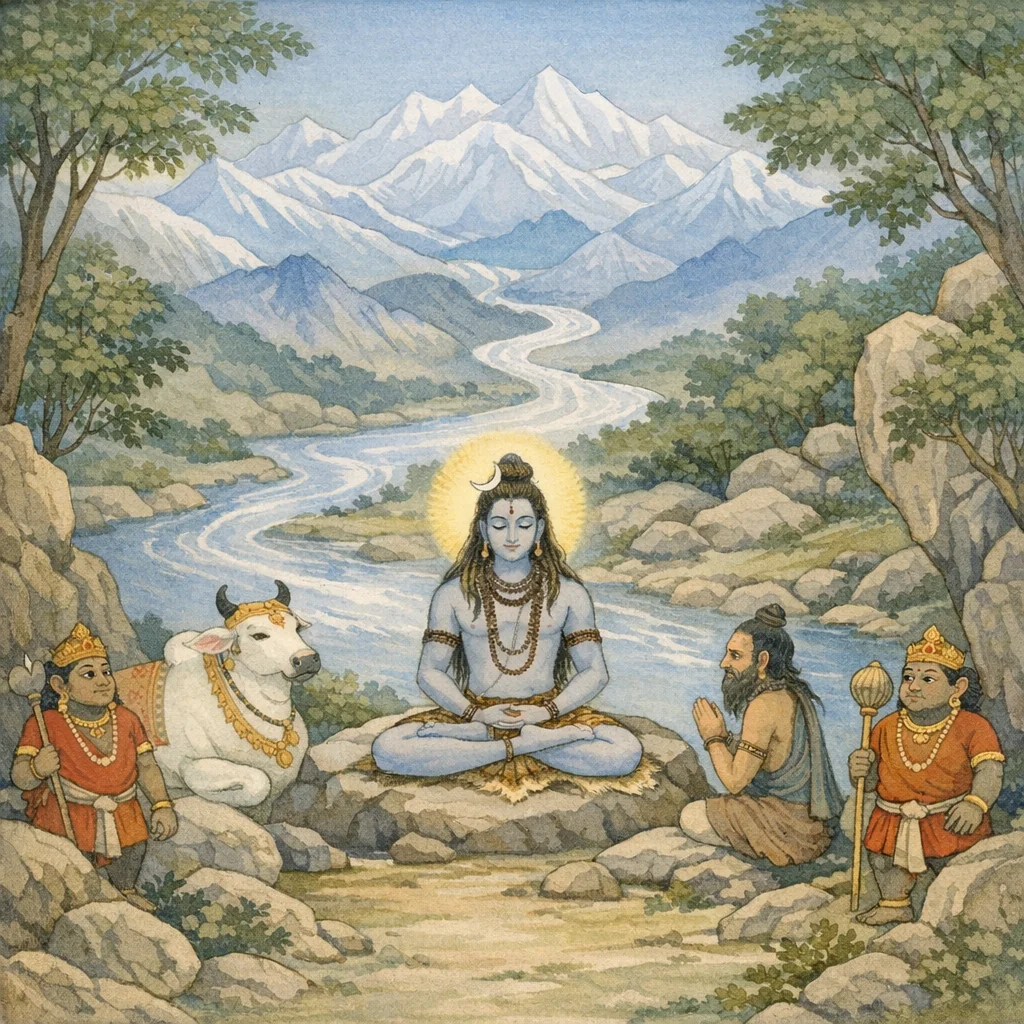
शिवस्य तपोऽनुष्ठानम् — Śiva’s Austerity and Meditation at Himavat (Gaṅgā-Region)
Adhyāya 11 begins with Brahmā describing how Himālaya’s daughter—Śakti revered by the worlds—matures early and reaches eight years of age in her father’s home. Śiva, still pained by separation from Satī, hears of this birth and rejoices inwardly, showing that the divine plan for reunion is stirring again. Śambhu adopts a worldly mode (laukikī gati) to steady the mind and undertake tapas, and with a few serene gaṇas (including Nandin and Bhṛṅgin) he goes to the Himavat region linked to Gaṅgā’s descent, famed as supremely purifying and sin-destroying. There Śiva begins austerities and enters one-pointed contemplation of the Self; the gaṇas follow his meditative discipline, while others silently stand as door-guardians, highlighting ritual order and yogic restraint. The doctrinal heart portrays consciousness/ātman as knowledge-born, eternal, luminous, disease-free, all-pervading, blissful, non-dual, and without support—framing Śiva’s tapas as the enactment of advaita-Śaiva metaphysics. The excerpt ends with Himavat, hearing of Śiva’s arrival, approaching Śaṅkara’s herb-laden slope, preparing for the next dialogue and the movement toward Pārvatī’s destiny.
Shlokas
Verse 1
ब्रह्मोवाच । वर्द्धमाना गिरेः पुत्री सा शक्ति लोकपूजिता । अष्टवर्षा यदा जाता हिमालयगृहे सती
Brahmā said: As the mountain-king’s daughter grew, she became that Divine Śakti, revered by all the worlds. When she reached eight years of age, the virtuous one dwelt in the house of Himālaya.
Verse 2
तज्जन्म गिरिशो ज्ञात्वा सतीविरहकातरः । कृत्वा तामद्भुतामन्तर्मुमोदातीव नारद
O Nārada, when Girīśa (Lord Śiva) learned of her birth, though still anguished by separation from Satī, he formed within himself a wondrous resolve and rejoiced exceedingly.
Verse 3
तस्मिन्नेवान्तरे शम्भुर्लौकिकीं गतिमाश्रितः । समाधातुं मनस्सम्यक्तपः कर्त्तुं समैच्छत
Just then, Śambhu assumed an outward, worldly mode of conduct, wishing to steady his mind in true concentration (samādhi) and to undertake austerity (tapas) in the proper way.
Verse 4
कांश्चिद्गणवराञ्छान्तान्नंद्यादीनवगृह्य च । गङ्गावतारमगमद्धिमवत्प्रस्थमुत्तमम्
Taking with him some of the foremost, tranquil Gaṇas—beginning with Nandī—he went to the most excellent region on Himavān’s slopes, to bring about the descent of the Gaṅgā.
Verse 5
यत्र गंगा निपतिता पुरा ब्रह्मपुरात्स्रुता । सर्वाघौघविनाशाय पावनी परमा मुने
“O sage, in that very place the Gaṅgā once descended—flowing forth from Brahmā’s celestial abode—supremely purifying, for the destruction of the entire flood of sins.”
Verse 6
हरे ध्यानपरे तिस्मिन्प्रमथा ध्यानतत्पराः । अभवन्केचिदपरे नन्दिभृंग्यादयो गणाः
When Lord Hara was absorbed in meditation, the Pramathas too became intent on meditation. Among them, others—such as Nandin and Bhṛṅgī and the rest of the Gaṇas—also entered that same contemplative absorption.
Verse 7
चेतो ज्ञानभवं नित्यं ज्योतीरूपं निरामयम् । जगन्मयं चिदानन्दं द्वैतहीनं निराश्रयम्
He is the eternal source of awareness and knowledge, of the very form of light, free from all affliction. He pervades the universe; He is Consciousness and Bliss—without duality and depending on nothing else.
Verse 9
सेवां चक्रुस्तदा केचिद्गणाः शम्भोः परात्मनः । नैवाकूजंस्तु मौना हि द्वरपाः केचनाभवन्
Then some of the gaṇas began to render service to Śambhu—the Supreme Self. Others, acting as gatekeepers, remained silent and did not utter any sound.
Verse 10
एतस्मिन्नन्तरे तत्र जगाम हिमभूधरः । शङ्करस्यौषधिप्रस्थं श्रुत्वागमनमादरात्
Just then, Himabhūdhara (Himālaya, the lord of mountains) went there at once; having heard with reverence of Śaṅkara’s arrival at the herb-bearing plateau, he hastened to meet Him.
Verse 11
इति श्रीशिवमहापुराणे द्वितीयायां रुद्रसंहितायान्तृतीये पार्वतीखण्डे शिवशैलसमागमवर्णनं नामैकादशोऽध्यायः
Thus, in the Śrī Śiva Mahāpurāṇa—within the Second Saṃhitā, the Rudrasaṃhitā, in its Third section, the Pārvatī-khaṇḍa—ends the Eleventh Chapter entitled “The Description of the Meeting at Śiva Mountain.”
Verse 12
हिमालय उवाच । देवदेव महादेव कपर्दिच्छंकर प्रभो । त्वयैव लोकनाथेन पालितं भुवनत्रयम्
Himālaya said: O God of gods, O Mahādeva, O Kapardin, O Śaṅkara, O Lord—by You alone, the Lord of the worlds, the three realms are protected and sustained.
Verse 13
नमस्ते देवदेवेश योगिरूपधराय च । निर्गुणाय नमस्तुभ्यं सगुणाय विहारिणे
Salutations to You, O Lord of lords, who assume the form of the supreme Yogi. Salutations to You as Nirguṇa—beyond all qualities—and also to You as Saguṇa, who freely sports and moves within the manifest world.
Verse 14
कैलासवासिने शम्भो सर्वलोकाटनाय च । नमस्ते परमेशाय लीलाकाराय शूलिने
Salutations to You, O Śambhu, Dweller on Kailāsa, who freely moves through all the worlds. Homage to You, the Supreme Lord, who assumes forms in divine play and who bears the trident.
Verse 15
परिपूर्णगुणाधानविकाररहितायते । नमोऽनीहाय वीहाय धीराय परमात्मने
Salutations to the Supreme Self—perfectly bearing all auspicious qualities, yet untouched by any change; desireless and free from worldly striving; the steadfast, serene Lord dwelling within all beings.
Verse 16
अबहिर्भोगकाराय जनवत्सलते नमः । त्रिगुणाधीश मायेश ब्रह्मणे परमात्मने
Salutations to You, who bestow enjoyment without outward entanglement, and who are lovingly compassionate to all beings as to Your own children. O Lord of the three guṇas, Master of Māyā—salutations to You, the Supreme Brahman, the Highest Self.
Verse 17
विष्णुब्रह्मादिसेव्याय विष्णुब्रह्मस्वरूपिणे । विष्णुब्रह्मकदात्रे ते भक्तप्रिय नमोऽस्तु ते
Salutations to You—worshipped even by Viṣṇu, Brahmā, and the other gods; to You who assume the very forms of Viṣṇu and Brahmā; to You who bestow upon Viṣṇu and Brahmā their offices and powers. O Beloved of devotees, may my homage be to You.
Verse 18
तपोरत तपस्थानसुतपः फलदायिने । तपःप्रियाय शान्ताय नमस्ते ब्रह्मरूपिणे
Salutations to You—ever absorbed in tapas, the giver of the fruits of sacred penance performed in holy places; the lover of tapas, the Peaceful Lord, whose very form is Brahman, the Supreme Reality.
Verse 19
व्यवहारकरायैव लोकाचारकराय ते । सगुणाय परेशाय नमोस्तु परमात्मने
Salutations to You, the Supreme Self—You who establish worldly dealings and uphold the proper conduct of society; who, for the sake of devotees, are Saguna (with attributes), and yet remain the transcendent Lord above all.
Verse 20
लीला तव महेशानावेद्या साधुसुखप्रदा । भक्ताधीनस्वरूपोऽसि भक्तवश्यो हि कर्मकृत्
O Maheśāna, Your divine play is beyond full comprehension, yet it bestows joy upon the righteous. You assume a form as though governed by Your devotees—indeed, You are ‘won over’ by bhakti, and for their sake You take up action and accomplish deeds.
Verse 21
मम भाग्योदयादत्र त्वमागत इह प्रभो । सनाथ कृतवान्मां त्वं वर्णितो दानवत्सलः
O Lord, by the rising of my good fortune You have come here. You have made me no longer helpless, for You are renowned as compassionate—even toward those who seek refuge, including the daityas.
Verse 22
अद्य मे सफलं जन्म सफलं जीवनं मम । अद्य मे सफलं सर्वं यदत्र त्वं समागतः
Today my birth is fulfilled; my very life has become fruitful. Today everything of mine is accomplished, because You have arrived here.
Verse 23
ज्ञात्वा मां दासमव्यग्रमाज्ञान्देहि महेश्वर । त्वत्सेवां च महाप्रीत्या कुर्यामहमनन्यधीः
Knowing me to be Your undistracted servant, O Maheśvara, please grant me Your command, so that with great love I may serve You with exclusive, one-pointed devotion.
Verse 24
ब्रह्मोवाच । इत्याकर्ण्य वचस्तस्य गिरीशस्य महेश्वरः । किंचिदुन्मील्य नेत्रे च ददर्श सगणं गिरिम्
Brahmā said: Having thus heard the words of Girīśa (the Lord of the Mountain), Maheśvara slightly opened His eyes and beheld the mountain, together with His attendant hosts.
Verse 25
सगणं तन्तथा दृष्ट्वा गिरिराजं वृषध्वजः । उवाच ध्यानयोगस्थः स्मयन्निव जगत्पतिः
Seeing the King of Mountains arrived along with his attendants, the Bull-bannered Lord (Śiva)—abiding in the yoga of meditation—spoke, as though smiling, the Lord and Master of the worlds.
Verse 26
महेश्वर उवाच । तव पृष्ठे तपस्तप्तुं रहस्यमहमागतः । यथा न कोपि निकटं समायातु तथा कुरु
Maheśvara said: “I have come here in secrecy to perform austerity behind you. Arrange it so that no one at all comes near.”
Verse 27
त्वं महात्मा तपोधामा मुनीनां च सदाश्रयः । देवानां राक्षसानां च परेषां च महात्मनाम्
You are Mahātma, the very abode of tapas (spiritual power), and the ever-present refuge of sages—indeed, of the devas, the rākṣasas, and all other noble, great-minded beings as well.
Verse 28
सदा वासो द्विजादीनां गंगापूतश्च नित्यदा । परोपकारी सर्वेषां गिरीणामधिपः प्रभुः
He is ever the abode of the twice-born and other seekers, eternally sanctified by the Gaṅgā. Benefiting all beings, he is the sovereign Lord among mountains.
Verse 29
अहं तपश्चराम्यत्र गंगावतरणे स्थले । आश्रितस्तव सुप्रीतो गिरिराज यतात्मवान्
“Here, at this sacred place of Gaṅgā’s descent, I practise tapas (austerity). Taking refuge in you, O Girirāja, I remain deeply pleased and self-restrained.”
Verse 30
निर्विघ्नं मे तपश्चात्र हेतुना येन शैलप । सर्वथा हि गिरिश्रेष्ठ सुयत्नं कुरु साम्प्रतम्
O lord of the mountain, by whatever means my tapas here may proceed without obstacles—O best of mountains, make every effort for that right now.
Verse 31
ममेदमेव परमं सेवनं पर्वतोत्तम । स्वगृहं गच्छ सत्प्रीत्या तत्संपादय यत्नतः
O best of mountains, this alone is My highest service: go to your own abode with a noble and loving intent, and accomplish that task with diligent effort.
Verse 32
ब्रह्मोवाच । इत्युक्त्वा जगतां नाथस्तूष्णीमास स सूतिकृत् । गिरिराजस्तदा शम्भुं प्रणयादिदमब्रवीत्
Brahmā said: Having spoken thus, that Lord of the worlds—the one who had brought forth the progeny—became silent. Then Girirāja (Himālaya), with affectionate reverence, addressed Śambhu as follows.
Verse 33
हिमालय उवाच । पूजितोऽसि जगन्नाथ मया त्वम्परमेश्वर । स्वागतेनाद्य विषये स्थितं त्वाम्प्रार्थयामि किम्
Himālaya said: “O Lord of the universe, O Supreme Lord, you have been worshipped by me. Now that you have graciously arrived and are present here today, what boon should I ask of You?”
Verse 34
महता तपसा त्वं हि देवैर्यत्नपराश्रितैः । न प्राप्यसे महेशान स त्वं स्वयमुपस्थितः
O Maheśāna, even by great austerities performed by the gods—though they strive with every effort—you are not attained. Yet that very Lord, out of His own freedom and grace, has now appeared before you of Himself.
Verse 35
मत्तोप्यन्यतमो नास्ति न मत्तोऽन्योऽस्ति पुण्यवान् । भवानिति च मत्पृष्ठे तपसे समुपस्थितः
“There is none more exalted than I, and none more meritorious than I. Yet you—addressing me as ‘O Lord (Bhavān)’—have come before me and have presented yourself for austerity.”
Verse 36
देवेन्द्रादधिकम्मन्ये स्वात्मानम्परमेश्वर । सगणेन त्वयागत्य कृतोऽनुग्रहभागहम्
O Parameśvara, I deem myself greater even than Indra; for You have come here with Your gaṇas, and thus I have been made a recipient of Your grace.
Verse 37
निर्विघ्नं कुरु देवेश स्वतन्त्रः परमन्तपः । करिष्येऽहन्तथा सेवां दासोऽहन्ते सदा प्रभो
O Lord of the gods, please make this undertaking free from obstacles. You are fully independent, O supreme subduer of suffering. Thus will I render service as ordained; for I am ever Your servant, O Master.
Verse 38
ब्रह्मोवाच । इत्युक्त्वा गिरिराजोऽसौ स्वं वेश्म द्रुतमागतः । वृत्तांत्तं तं समाचख्यौ प्रियायै च समादरात्
Brahmā said: Having spoken thus, that lord of mountains (Himālaya) swiftly returned to his own abode, and with due respect he related that entire account to his beloved consort.
Verse 39
नीयमानान्परीवारान्स्वगणानपि नारद । समाहूयाखिलाञ्छैलपतिः प्रोवाच तत्त्वतः
O Nārada, seeing his attendants and all his own followers being led away, the Lord of the Mountain (Himālaya) summoned them all together and then spoke to them in accordance with the truth of the matter.
Verse 40
हिमालय उवाच । अद्य प्रभृति नो यातु कोपि गंगावतारणम् । मच्छासनेन मत्प्रस्थं सत्यमेतद्ब्रवीम्यहम्
Himālaya said: “From this very day, let no one go forth to bring down the sacred Gaṅgā. By my command and authority, let this stand as my firm decree. Truly, I speak this as truth.”
Verse 41
गमिष्यति जनः कश्चित्तत्र चेत्तं महाखलम् । दण्डयिष्ये विशेषेण सत्यमेतन्मयोदितम्
“If anyone goes there and proves to be that great wicked one, I shall punish him with special severity. Truly, this is what I have declared.”
Verse 42
इति तान्स नियम्याशु स्वगणान्निखिलान्मुने । सुयत्नं कृतवाञ्छैलस्तं शृणु त्वं वदामि ते
Thus, O sage, having swiftly restrained all his own attendants, the Mountain (Himālaya) then exerted himself with great care. Listen to what he did—I shall tell you.
Frequently Asked Questions
Śiva, grieving Satī, learns of Himālaya’s daughter’s birth and proceeds with select gaṇas to Himavat’s Gaṅgā-associated region to begin tapas and deep meditation, initiating the narrative setup for the Śiva–Pārvatī convergence.
It encodes an advaya (non-dual) ontology: consciousness/ātman is portrayed as eternal, luminous, all-pervading, blissful, and supportless—framing Śiva’s tapas as realization and stabilization of ultimate reality rather than mere ascetic hardship.
Śiva appears as Śambhu/Śaṅkara/Haṛa in a tapas-dhyāna mode; the gaṇas manifest complementary roles as meditators, attendants, and silent gatekeepers, modeling service (sevā) and restraint (mauna) around the divine yogin.