संन्यासमण्डलविधिवर्णनम् (Sannyāsa Maṇḍala Vidhi—Procedure for the Renunciate Mandala)
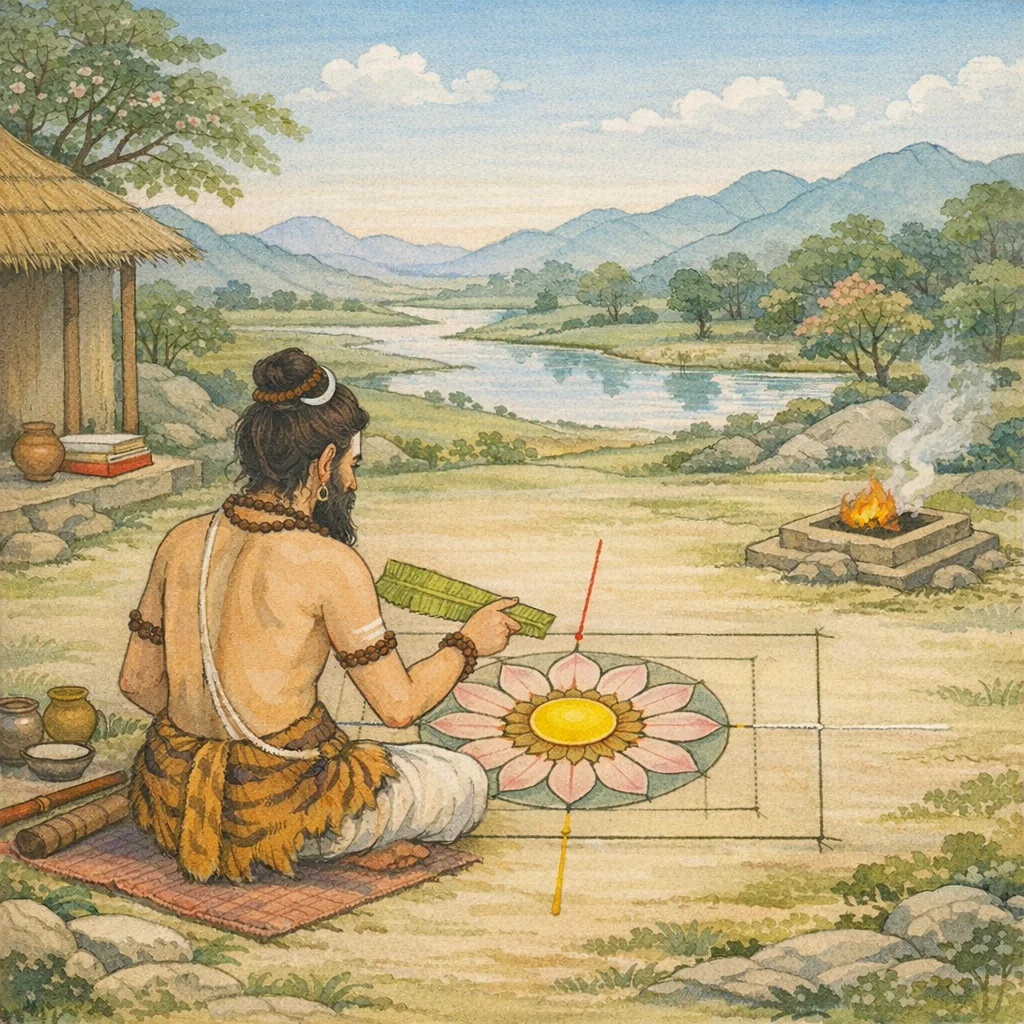
This adhyāya presents Īśvara’s technical liturgical instructions for constructing the sannyāsa-maṇḍala, a consecrated diagram used in renunciatory initiation and mantra-yoga. It begins with selecting and testing the site by sensory qualities (smell, color, taste, etc.), then leveling and plastering the ground until it is smooth like a mirror. A precise square is laid out with the standard measure of two aratnis, using a tālapatra (palm leaf) to guide proportional divisions, including a 13-part segmentation. Facing west, the practitioner places durable colored threads in the four directions, fixing 169 threads as a ritual-architectural requirement. The maṇḍala is arranged in compartments (koṣṭhas): a central karṇikā (pericarp), an outer set of eight (koṣṭhāṣṭaka), and an eight-petaled form (dalāṣṭaka). Prescribed colors follow—white petals, a yellow karṇikā, and a red circular boundary—then graded red and black at the petal-joints. Finally, a yantra that “illumines the meaning of praṇava” is inscribed in the karṇikā, with pīṭha placed below and Śrīkaṇṭha above, revealing a vertical theology embedded within the sacred diagram.
Shlokas
Verse 1
ईश्वर उवाच । परीक्ष्य विधिवद्भूमिं गंधवर्णरसादिभिः । मनोभिलषिते तत्र वितानवितताम्बरे
The Lord (Īśvara) said: “After duly examining the ground according to rule—by its fragrance, color, taste, and other signs—one should choose a place pleasing to the mind; there, beneath a canopy spread out above, the rite should be undertaken.”
Verse 2
सुप्रलिप्ते महीपृष्ठे दर्पणोदरसन्निभे । अरत्नियुग्ममानेन चतुरस्रं प्रकल्पयेत्
On the ground, well-smeared and made smooth—shining like the inner face of a mirror—one should lay out a square, each side measuring two aratnis (two forearms).
Verse 3
तालपत्रं समादाय तत्समायामविस्तरम् । तस्मिन्भागान्प्रकुर्वीत त्रयोदशसमां कलाम्
Taking a palm leaf and keeping its measure even, without widening it, one should mark divisions upon it, establishing a measure made of thirteen equal parts.
Verse 4
तत्पत्रं तत्र निक्षिप्य पश्चिमाभिमुखः स्थितः । तत्पूर्वभागे सुदृढं सूत्रमादाय रंजितम्
Placing that leaf there, he stood facing west. Then, at its eastern side, he took a firm thread—already dyed and consecrated—and held it ready for the rite.
Verse 5
इति श्रीशिवमहापुराणे षष्ठ्यां कैलाससंहितायां संन्यासमण्डलविधिवर्णनं नाम पंचमोऽध्यायः
Thus, in the Śrī Śiva Mahāpurāṇa, in the Sixth Book, the Kailāsa‑saṃhitā, ends the fifth chapter, entitled “Description of the procedure for the renunciant’s ritual maṇḍala.”
Verse 6
कोष्ठानि स्युस्ततस्तस्य मध्यकोष्ठं तु कर्णिका । कोष्ठाष्टकं बहिस्तस्य दलाष्टकमिहोच्यते
Then it has its compartments; the central compartment is the karṇikā, the lotus‑heart. Outside it are eight compartments—here they are declared to be the eight petals.
Verse 7
दलानि श्वेतवर्णानि दलाष्टकमिहोच्यते । दलानि श्वेतवर्णात्रि समग्राणि प्रकल्पयेत् । पीतरूपां कर्णिकां च कृत्वा रक्तं च वृत्तकम्
Here one should depict an eight‑petalled lotus with petals of white colour. All the petals are to be made uniformly white; then, having made the karṇikā (the central core) yellow, one should also draw a red circular ring.
Verse 8
वनभिद्दलदक्षं तु समारभ्य सुरेश्वरि । रक्तकृष्णाः क्रमेणैव दलसन्धीन्विचित्रयेत्
O Goddess, beginning with the petal on the southern side, one should in proper order adorn the junctions between the petals with red and black colours.
Verse 9
कर्णिकायां लिखेद्यंत्रं प्रणवार्थप्रकाशकम् । अधः पीठं समालिख्य श्रीकण्ठं च तदूर्ध्वतः
In the central pericarp, one should inscribe the yantra that illumines the meaning of the Praṇava (Oṁ). Below it, carefully draw the pedestal (pīṭha), and above that depict Śrīkaṇṭha—Lord Śiva, the auspicious-throated One.
Verse 10
तदुपर्य्यमरेशं च महाकालं च मध्यतः । तन्मस्तकस्थं दण्डं च तत ईश्वरमालिखेत्
Above that, one should depict Amareśa, the Lord of the immortals, and in the middle place Mahākāla. Upon His head one should draw the staff (daṇḍa); and then portray Īśvara (Śiva) accordingly.
Verse 11
श्यामेन पीठं पीतेन श्रीकण्ठं च विचित्रयेत् । अमरेशं महाकालं रक्तं कृष्णं च तौ क्रमात्
One should depict the pedestal (pīṭha) in dark blue, and paint Śrīkaṇṭha in yellow. Then, in due order, Amareśa is to be shown in red, and Mahākāla in black.
Verse 12
कुर्यात्सुधूम्रं दण्डं च धवलं चेश्वरं बुधः । एवं यंत्रं समालिख्य रक्तं सद्येन वेष्टयेत्
A wise practitioner should fashion the staff (daṇḍa) in a fine smoke-grey hue and depict the Lord Īśvara (Śiva) as white. Having thus carefully drawn this sacred yantra, he should immediately wrap it with a red cloth.
Verse 13
तदुत्थेनैव नादेन विद्यादीशानमीश्वरि । तद्वासपंक्तीर्गृह्णीयादाग्नेयादिक्रमेण वै
O Goddess, by that very sound (nāda) that arises, one should recognize Īśāna, the Lord; and then, in due order beginning with the Agneya (southeast) direction, collect the rows of His abodes/placements accordingly.
Verse 14
कोष्ठानि कोणभागेषु चत्वार्येतानि सुन्दरि । शुक्लेनापूर्य्य वर्णादि चतुष्कं रक्तधातुभिः
O beautiful one, in the corner-sections there are these four compartments. Fill them with a white substance, and prepare the fourfold set beginning with the colours, using red mineral pigments.
Verse 15
आपूर्य्य तानि चत्वारि द्वाराणि परिकल्पयेत् । ततस्तत्पार्श्वयोर्द्वंद्वं पीतेनैव प्रपूरयेत्
Having filled it completely, one should fashion those four gateways. Then, on both sides of each, one should fully fill the paired spaces with yellow colouring, as prescribed.
Verse 16
आग्नेयकोष्ठमध्ये तु पीताभे चतुरस्रके । अष्टपत्रं लिखेत्पद्मं रक्ताभं पीतकर्णिकम्
In the Agneya (fire, southeastern) compartment, within a yellow-hued square, one should draw an eight-petalled lotus—reddish in colour, with a yellow karṇikā (pericarp) at its centre.
Verse 17
हकारं विलिखेन्मध्ये विन्दुयुक्तं समाहितः । पद्मस्य नैरृते कोष्ठे चतुरस्रन्तदा लिखेत्
With a steady, collected mind, one should inscribe the syllable “ha” in the center, joined with the bindu. Then, in the south‑western compartment of the lotus‑diagram, one should draw a square at that time.
Verse 18
पद्ममष्टदलं रक्तं पीतकिंजल्ककर्णिकम् । शवर्गस्य तृतीयन्तु षष्ठस्वरसमन्वितम्
“(Visualize) a red lotus with eight petals, having a yellow pericarp and central core; and (upon it place/meditate on) the third letter of the Śa‑varga, joined with the sixth vowel.”
Verse 19
चतुर्दशस्वरोपेतं बिन्दुनादविभूषितम् । एतद्बीजवरं भद्रे पद्ममध्ये समालिखेत्
Endowed with the fourteen vowels and adorned with bindu and nāda, this excellent seed‑mantra—O auspicious one—should be inscribed within the center of the lotus (diagram).
Verse 20
पद्मस्येशानकोष्ठे तु तथा पद्मं समालिखेत् । कवर्गस्य तृतीयं तु पंचमस्वरसंयुतम्
In the Īśāna compartment of the lotus, one should likewise draw the lotus-mark. There one should place the third letter of the “ka” group, joined with the fifth vowel, thus seating the mantra-syllable in its proper abode.
Verse 21
विलिखेन्मध्यतस्तस्य बिन्दुकण्ठे स्वलंकृतम् । तद्बाह्यपंक्तित्रितये पूर्वादिपरितः क्रमात्
One should inscribe it at the very center, adorning the “throat with the bindu” (the marked central point). Then, upon the three outer rows, one should arrange them all around in sequence, beginning from the east and proceeding in order.
Verse 22
कोष्ठानि पंच गृह्रीयाद्गिरिराजसुते शिवे । मध्ये तु कर्णिकां कुर्यात्पीतां रक्तं च वृत्तकम्
O Śivā, daughter of the king of mountains, one should form five compartments (petals/sections). And in the middle one should make the karnikā, the central seat, a circular form marked in yellow and red.
Verse 23
दलानि रक्तवर्णानि कल्पयेत्कल्पवित्तमः । दलबाह्ये तु कृष्णेन रंध्राणि परिपूरयेत्
The adept, skilled in sacred visualization, should arrange the petals as red in color; and on the outer side of the petals, he should fill in the openings with black, completing the form in proper order.
Verse 24
आग्नेयादीनि चत्वारि शुक्लेनैव प्रपूरयेत् । पूर्वे षड्बिन्दुसहितं षट्कोणं कृष्णमालिखेत्
One should fill the four directions beginning with the southeast with white. In the eastern part, one should draw in black a hexagon together with six bindus (six dots).
Verse 25
रक्तवर्णं दक्षिणतस्त्रिकोणं चोत्तरे ततः । श्वेताभमर्द्धचन्द्रं च पीतवर्णं च पश्चिमे
To the south, contemplate the red-colored form; then, to the north, place a triangle. Meditate also on the white-hued half-moon, and to the west set the yellow-colored form—thus arranging the sacred marks in their proper directions.
Verse 26
चतुरस्रं क्रमात्तेषु लिखेद्बीजचतुष्टयम् । पूर्वे बिन्दुं समालिख्य शुभ्रं कृष्णं तु दक्षिणे
Then, within those divisions, in due order, draw a square and inscribe the set of four seed-syllables (bīja). In the eastern quarter draw the bindu (dot); and in the southern quarter place the white and the black marks.
Verse 27
उकारमुत्तरे रक्तं मकारं पश्चिमे ततः । अकारं पीतमेवं तु कृत्वा वर्णचतुष्टयम्
Place the syllable “u” in the northern quarter as red; then place the syllable “ma” in the western quarter; and place the syllable “a” as yellow. Thus one should arrange the set of four sacred syllables.
Verse 28
सर्वोर्द्ध्वपंक्त्यधः पंक्तौ समारभ्य च सुन्दरि । पीतं श्वेतं च रक्तं च कृष्णं चेति चतुष्टयम्
O beautiful one, beginning from the row beneath the uppermost row, there is a set of four: yellow, white, red, and black.
Verse 29
तदधो धवलं श्यामं पीतं रक्तं चतुष्टयम् । अधस्त्रिकोणके रक्तं शुक्लं पीतं वरानने
Below that are four hues—white, dark-blue/black, yellow, and red. And in the lower triangular section, O fair-faced one, the colors are red, white, and yellow.
Verse 30
एवन्दक्षिणमारभ्य कुर्यात्सोमान्तमीश्वरि । तद्बाह्यपंक्तौ पूर्वादिमध्यमान्तं विचित्रयेत्
“Thus, O Goddess, beginning from the southern side one should arrange it up to the end marked by Soma (the Moon). In its outer row, one should design it in an ordered sequence—starting from the eastern part, through the middle, and up to the end—making the arrangement beautifully distinct.”
Verse 31
पीतं रक्तं च कृष्णं च श्यामं श्वेतं च पीतकम् । आग्रेय्यादि समारभ्य रक्तं श्यामं सितं प्रिये
“(Use) yellow, red, black, dark-blue, white, and pale-yellow. Beginning from the Agneya (south‑east) and the other directions, (arrange/apply) red, dark-blue, and white, O beloved.”
Verse 32
रक्तं कृष्णं च रक्तं च षट्कमेव प्रकीर्तितम् । दक्षिणाद्यं महेशानि पूर्वावधि समीरितम्
“Red, black, and again red—thus the sixfold order has been declared. O Maheśānī, it is described as beginning from the southern direction and extending up to the eastern limit.”
Verse 33
नैरृताद्यन्तु विज्ञेयमाग्नेयावधि चेश्वरि । वारुणं तु समारभ्य दक्षिणावधि चेरितम
O Goddess, know that the boundary begins from the south‑west (Nairṛta) and extends up to the south‑east (Āgneya). And beginning from the western quarter (Vāruṇa), it is described as extending to the southern limit.
Verse 34
वायव्याद्यं महादेवि नैरृतावधि चेरितम् । सोमार्थं परमेशानि वारुणावधि चेरितम्
O Mahādevī, beginning from the north‑west (Vāyavya) and proceeding up to the south‑west (Nairṛta), it should be performed as taught. O Parameśānī, for the purpose of Soma, it should be performed up to the west (Vāruṇa).
Verse 35
ईशानाद्यं तु विज्ञेयं वायव्यावधि चाम्बिके । इत्युक्तो मण्डलविधिर्मया तुभ्यं च पार्वति
O Ambikā, know that the arrangement begins from the Īśāna direction and extends up to the Vāyavya quarter. Thus, O Pārvatī, I have explained to you the proper method of constructing the sacred maṇḍala.
Verse 36
एवं मण्डलमालिख्य नियतात्मा यतिस्स्वतः । सौरपूजां प्रकुर्वीत स हि तद्वस्तुतत्परः
Having thus drawn the sacred maṇḍala, the ascetic—self-restrained and inwardly disciplined—should perform the worship of Sūrya; for he becomes intent upon that very Reality (tattva) which the rite signifies.
Frequently Asked Questions
Rather than a mythic episode, the chapter presents a theological-ritual argument: correct sacred geometry and consecrated materials can embody mantra-meaning—especially the praṇava—so that the maṇḍala becomes a functional interface between practitioner and Shiva-tattva.
The lotus-like structure (central karṇikā with eight petals) encodes a cosmological and psychophysical map: the center signifies the unifying mantra-source (praṇava), while petals/compartments represent ordered manifestation. Color prescriptions operate as semiotic constraints—white (purity/clarity), yellow (central potency/authority), red (activation/limit), and red-black junctions (differentiation and protective boundary logic).
Śiva is highlighted as Īśvara (the instructing Lord) and as Śrīkaṇṭha positioned in the yantra schema, indicating a specific iconic-theological placement within the maṇḍala; Gaurī is not foregrounded in the sampled verses of this adhyāya.