Sūtasya Punargamanaṃ Kāśyāṃ—Bhasma-Rudrākṣa-Tripuṇḍra-Vidhiśca (Sūta’s Return to Kāśī and the Observances of Bhasma, Rudrākṣa, and Tripuṇḍra)
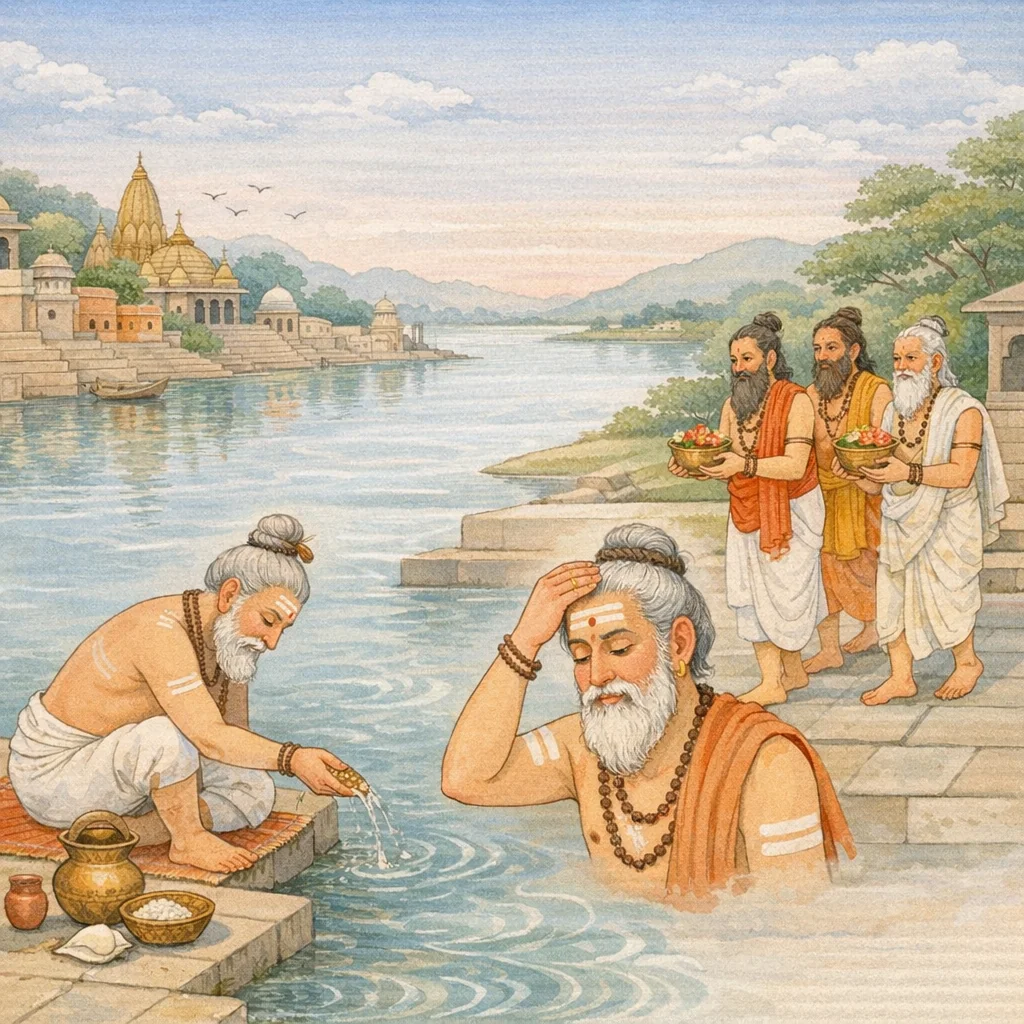
Vyāsa describes how the sages, after Sūta’s departure, are amazed, feel bereft of the remembered teaching, and yearn for the muni whose presence dissolves existential sorrow. After a year, Sūta—portrayed as a jñānī and a Śiva-bhakta who illumines Purāṇic meaning—returns to Kāśī and is received with due hospitality (the munis rise, offer a seat and arghya). Sūta then follows the discipline of purity: he bathes in the supremely purifying Jāhnavī (Gaṅgā), performs tarpana to ṛṣis, devas, and pitṛs with sesame and grains, returns to the bank, and dons clean garments. He performs ācamana, takes up bhasma with the Sadyojāta and related mantras and applies it in the prescribed order, wears a rudrākṣa mālā, and completes his nitya-kriyā. Finally, he marks his limbs with tripuṇḍra and worships Viśveśvara (Śiva), Umākānta, their son, and Gaṇeśa/gaṇādhipa, bowing again and again in sustained devotion. The chapter thus serves as a narrative vignette encoding correct Śaiva bodily signs and the theological orientation of worship in Kāśī.
Shlokas
Verse 1
व्यास उवाच । गतेऽथ सूते मुनयस्सुविस्मिता विचिन्त्य चान्योन्यमिदन्तु विस्मृतम् । यद्वामदेवस्य मतन्मुनीश्वर प्रत्यूचितन्तत्खलु नष्टमद्य नः
Vyāsa said: After Sūta had departed, the sages—greatly astonished—reflected among themselves: “But this has slipped from our minds: the teaching that accords with Vāmadeva’s doctrine, O lord among sages—indeed, that reply seems lost to us today.”
Verse 2
कदानुभूयान्मुनिवर्यदर्शनम्भावाब्धिदुःखौघहरम्परं हि तत् । महेश्वराराधनपुण्यतोऽधुना मुनीश्वरस्सत्वरमाविरस्तु नः
When shall we truly behold the vision of that best of sages—whose very sight is supreme, for it removes the torrents of sorrow in the ocean of worldly becoming? By the merit born of worshipping Mahādeva, may that lord among sages now quickly appear before us.
Verse 3
इति चिन्तासमाविष्टा मुनयो मुनिपुंगवम् । व्यासं संपूज्य हृत्पद्मे तस्थुस्तद्दशर्नोत्सुकाः
Thus absorbed in contemplation, the sages—having duly honored Vyāsa, the bull among seers—remained with lotus-hearts, eager to behold him and receive his darśana and instruction.
Verse 4
सम्वत्सरान्ते स पुनः काशीम्प्राप महामुनिः । शिवभक्तिरतो ज्ञानी पुराणार्थप्रकाशकः
At the end of a year, that great sage again reached Kāśī—steadfast in devotion to Lord Śiva, a knower of truth, and one who illumines the inner meaning of the Purāṇas.
Verse 5
तन्दृष्ट्वा सूतमायान्तम्मुनयो हृष्टचेतसः । अभ्युत्थानासनार्घ्यादिपूजया समपूजयन्
Seeing Sūta approaching, the sages—joyful at heart—honored him fully with the traditional acts of reverence: rising to receive him, offering a seat, presenting arghya (honor-water), and other forms of worship.
Verse 6
सोपि तान्मुनिशार्दूलानभिनन्द्य स्मितोदरम् । प्रीत्या स्नात्वा जाह्नवीये जले परमपावने
He too, with a gentle smile, greeted those tiger-like sages with reverence; then, out of heartfelt devotion, he bathed in the supremely purifying waters of the Jāhnavī (Gaṅgā).
Verse 7
ऋषीन्संतर्प्य च सुरान्पितॄंश्च तिलतण्डुलैः । तीरमागत्य सम्प्रोक्ष्य वाससी परिधाय च
Having duly satisfied the sages, the gods, and the ancestors with offerings of sesame and rice-grains, he then came to the riverbank, performed the ritual sprinkling for purification, and put on his garments.
Verse 8
द्विराचम्य समादाय भस्म सद्यादिमंत्रतः । उद्धूलनादिक्रमतो विधार्य्याऽथ मुनीश्वरः
Having sipped water twice for purification, the lordly sage took up the sacred ash (bhasma) and, with the Sadyojāta and related mantras, applied it in the prescribed order—beginning with rubbing it over the body and then the other enjoined steps.
Verse 9
रुद्राक्षमालाभरणः कृतनित्यक्रियस्सुधी । यथोक्तांगेषु विधिना त्रिपुण्ड्रं रचति स्म ह
Wearing a rosary of Rudrākṣa beads, the wise devotee—having duly completed the daily rites—then, according to the prescribed rule, applied the Tripuṇḍra, the three sacred ash lines, upon the limbs as enjoined.
Verse 10
विश्वेश्वरमुमाकान्तं ससुतं सगणाधिपम् । पूजयामास सद्भक्त्या ह्यस्तौ न्नत्वा मुहुर्मुहुः
With true devotion, he worshipped Viśveśvara—Śiva, the beloved of Umā—together with their son and the Lord of the Gaṇas; and, bowing again and again, he repeatedly offered hymns of praise.
Verse 11
कालभैरवनाथं च संपूज्याथ विधानतः । प्रदक्षिणीकृत्य पुनस्त्रेधा नत्वा च पंचधा
Then, having duly worshipped Kālabhairava Nātha according to the prescribed rite, one should circumambulate (pradakṣiṇā) and again bow—three times, and also in the fivefold prostration.
Verse 12
पुनः प्रदक्षिणी कृत्य प्रणम्य भुवि दण्डवत् । तुष्टाव परया स्तुत्या संस्मरंस्तत्पदाम्बुजम्
Again, having performed circumambulation and then bowed upon the earth like a staff, he praised the Lord with a supreme hymn—while inwardly remembering His lotus-feet.
Verse 13
श्रीमत्पंचाक्षरीम्विद्यामष्टोत्तरसहस्रकम् । संजप्य पुरतः स्थित्वा क्षमापय्य महेश्वरम्
Having duly repeated the sacred five-syllabled mantra—“Oṁ Namaḥ Śivāya”—a thousand and eight times, one should stand before Mahādeva and, in humility, seek forgiveness from Maheśvara.
Verse 14
चण्डेशं सम्प्रपूज्याऽथ मुक्तिमण्डपमध्यतः । निर्द्दिष्टमासनं भेजे मुनिभिर्वेदपारगैः
Then, having duly worshipped Caṇḍeśa, he took his seat in the midst of the Hall of Liberation (Mukti-maṇḍapa), upon the seat that had been indicated by the sages who were well-versed in the Vedas.
Verse 15
एवं स्थितेषु सर्वेषु नमस्कृत्य समंत्रकम् । अथ प्राह मुनीन्द्राणां भाववृद्धिकरम्वच
When all were thus assembled and settled, he offered reverent obeisance together with the appropriate mantra; then he spoke to the foremost of sages words that increased and deepened their devotional disposition (bhāva).
Verse 16
सूत कृतः । धन्या यूयं महाप्राज्ञा मुनयश्शंसितव्रताः । भवदर्थमिह प्राप्तोऽहन्तद्वृत्तमिदं शृणु
Sūta said: “Blessed indeed are you—greatly wise sages, acclaimed for your sacred vows. For your sake I have come here; now listen to this account as it happened.”
Verse 17
यदाहमुपदिश्याथ भवतः प्रणवार्थकम् । गतस्तीर्थाटनार्थाय तद्वृत्तान्तम्ब्रवीमि वः
After I had instructed you in the meaning of the Praṇava (Oṁ), I departed to pilgrimage among the sacred tīrthas. Now I shall relate to you what occurred thereafter.
Verse 18
इतो निर्गत्य सम्प्राप्य तीरं दक्षपयोनिधेः । स्नात्वा सम्पूज्य विधिवद्देवीं कन्यामयीं शिवाम् । पुनरागत्य विप्रेन्द्रास्सुवर्णमुखरीतटम्
Departing from here and reaching the shore of Dakṣa’s ocean, one should bathe and, according to proper rite, worship the Goddess Śivā who abides there in the form of a maiden. Then, O best of brāhmaṇas, returning again, one should come to the bank of the Suvarṇamukharī.
Verse 19
श्रीकालहस्तिशैलाख्यनगरे परमाद्भुते । सुवर्णमुखरीतोये स्नात्वा देवानृषीनपि
In the supremely wondrous city called Śrī Kālahasti upon the sacred hill, having bathed in the waters of the Suvarṇamukharī, he performed tarpaṇa, offering ritual satisfaction to the gods and to the sages as well.
Verse 20
सन्तर्प्य विधिवद्भक्त्या समुदं गिरिशं स्मरन् । समर्च्य कालहस्तीशं चन्द्रकांतसमप्रभम्
Having duly offered the prescribed tarpaṇa with devotion, and remembering Girīśa (Lord Śiva) with a tranquil mind, one should worship Kālahastīśa, radiant with a splendor equal to moonstone.
Verse 21
पश्चिमाभिमुखम्पंचशिरसम्परमाद्भुतम् । सकृद्दर्शनमात्रेण सर्वाघक्षयकारणम्
Facing west, that supremely wondrous five-faced form (of Śiva) is such that even a single act of beholding it becomes a cause for the destruction of all sins.
Verse 22
सर्वसिद्धिप्रदम्भुक्तिमुक्तिदन्त्रिगुणेश्वरम् । ततश्च परया भक्त्या तस्य दक्षिणगां शिवाम्
He (the Lord) bestows all siddhis, grants both worldly enjoyment and liberation, and is Sovereign over the three guṇas. Thereafter, with supreme devotion, one should worship the auspicious Śivā who stands at His right.
Verse 23
ज्ञानप्रसूनकलिकां समर्च्य हि जगत्प्रसूम् । श्रीमत्पंचाक्षरीं विद्यामष्टोत्तरसहस्रकम्
Having duly worshipped the bud of the flower of spiritual knowledge—the Pañcākṣarī Vidyā, the auspicious Mother who brings forth the whole universe—one should recite it one hundred and eight thousand times.
Verse 24
जप्त्वा प्रदक्षिणीकृत्य स्तुत्वा नत्वा मुहुर्मुहुः
Having repeated the sacred mantra, having performed circumambulation, having offered praises, and having bowed down again and again.
Verse 25
ततः प्रदक्षिणीकृत्य गिरिम्प्रत्यहमादरात् । आमोदतीव मनसि प्रत्यहन्नियमास्थितः
Then, having reverently circumambulated the mountain each day, he remained steadfast in his daily disciplines, and his mind rejoiced as though filled with divine delight.
Verse 26
अनयञ्चतुरो मासानेवन्तत्र मुनीश्वराः । ज्ञानप्रसूनकलिका महादेव्याः प्रसादतः
In this manner, the lordly sages spent four months there. By the gracious favor of Mahādevī, the tender bud of their knowledge blossomed like a flower.
Verse 27
एकदा तु समास्तीर्य चैलाजिनकुशोत्तरम् । आसनम्परमन्तस्मिन्स्थित्वा रुद्धेन्द्रियो मुनि
Once, having spread an excellent seat, topped with cloth, deerskin, and kuśa grass, the sage sat firmly upon it, restraining his senses in perfect inner control.
Verse 28
समाधिमास्थाय सदा परमानंदचिद्धनः । परिपूर्णश्शिवोस्मीति निर्व्यग्रहृदयोऽभवम्
Abiding always in samādhi, rich in the wealth of consciousness and supreme bliss, I became inwardly untroubled, realizing, “I am Shiva—whole and complete.”
Verse 29
एतस्मिन्नेव समये सद्गुरुः करुणानिधिः । नीलजीमूतसङ्काशो विद्युत्पिङ्गजटाधरः
At that very moment, the true Guru—an ocean of compassion—appeared, resembling a dark-blue rain cloud, bearing matted locks tawny like lightning.
Verse 30
प्रांशुः कमण्डलूद्दण्डकृष्णाजिनधरस्स्वयम् । भस्मावदातसर्वाङ्गस्सर्वलक्षणलक्षितः
He Himself was tall and radiant, bearing a water-pot (kamaṇḍalu), a staff, and a black antelope-skin. His entire body was made pure and bright with sacred ash (bhasma), and He was marked by all the auspicious signs—revealing the visible, saguna form of the Supreme Lord who bestows liberation upon devotees.
Verse 31
त्रिपुण्ड्रविलसद्भालो रुद्राक्षालङ्कृताकृतिः । पद्मपत्रारुणायामविस्तीर्णनयनद्वयः
His forehead shone with the three sacred ash-lines (tripuṇḍra); his form was adorned with rudrākṣa beads; and his two eyes—reddish like lotus petals—were long and widely expansive.
Verse 32
प्रादुर्भूय हृदम्भोजे तदानीमेव सत्वरम् । विमोहितस्तदैवासमेतदद्भुतमास्तिकाः
O faithful devotees, at that very moment, swiftly manifesting within the lotus of my heart, this wondrous presence left me at once bewildered, overwhelmed by its marvel.
Verse 33
तत उन्मील्य नयने विलापं कृतवानहम् । आसीन्ममाश्रुपातश्च गिरिनिर्झरसन्निभः
Then I opened my eyes and began to lament; and my tears poured forth like a mountain waterfall.
Verse 34
एतस्मिन्नेव समये श्रुता वागशरीरिणी । व्योम्नो महाद्भुता विप्रास्तामेव शृणुतादरात्
Just at that moment an unembodied voice was heard from the sky, most wondrous indeed. O brāhmaṇas, listen to that very utterance with reverent attention.
Verse 35
सूतपुत्र महाभाग गच्छ वाराणसीम्पुरीम् । तत्रासन्मुनयः पूर्वमुपदिष्टास्त्वयाऽधुना
O noble son of Sūta, go to the city of Vārāṇasī. There the sages who were formerly instructed by you are now residing.
Verse 36
त्वदुपागमकल्याणं कांक्षंते विवशा भृशम् । तिष्ठन्ति ते निराहारा इत्युक्त्वा विरराम सा
“They long intensely—almost helplessly—for the blessedness of your arrival. They remain standing without taking food.” Having spoken thus, she fell silent.
Verse 37
तत उत्थाय तरसा देवन्देवीञ्च भक्तितः । प्रदक्षिणीकृत्य पुनः प्रणम्य भुवि दण्डवत्
Then, rising swiftly, he bowed in devotion to the Goddess and the God. Having circumambulated them in pradakṣiṇa, he again prostrated on the earth like a staff, in complete surrender.
Verse 38
द्विषड्वारं गुरोराज्ञां विज्ञाय शिवयोरथ । क्षेत्रान्निर्गत्य तरसा चत्वारिंशद्दिनान्तरे
Then, having understood the Guru’s command, they quickly departed from that sacred kṣetra; and within forty days they reached their destination, in the matter pertaining to Śiva and His divine purpose.
Verse 39
आगतोऽस्मि मुनिश्रेष्ठा अनुगृह्णन्तु मामिह । मया किमद्य वक्तव्यं भवन्तस्तद्ब्रुवन्तु मे
“O best of sages, I have come. Please bestow your grace upon me here. What should I speak today? You yourselves tell me what I ought to say.”
Verse 40
इति सूतवचश्श्रुत्वा ऋषयो हृष्टमानसाः । अवोचन्मुनिशार्दूलं व्यासन्नत्वा मुहुर्मुहुः
Hearing thus the words of Sūta, the sages became joyful at heart. Again and again they addressed that tiger among sages, drawing near to him with reverence.
Frequently Asked Questions
A narrative return: after Sūta’s absence, the sages yearn for renewed instruction; Sūta reappears in Kāśī after a year, and the chapter theologically frames his presence as sorrow-removing and knowledge-illuminating, validating the teacher-disciple economy within Purāṇic transmission.
Bhasma, rudrākṣa, and tripuṇḍra operate as embodied metaphysics: bhasma signifies impermanence and purification; rudrākṣa indexes Rudra-centered protection and disciplined remembrance; tripuṇḍra encodes Śaiva identity and a yogic inscription of Śiva-tattva onto the body, aligning external mark with internal orientation.
Śiva is invoked as Viśveśvara and Umākānta—cosmic lord and spouse of Umā—worshipped together with their son and Gaṇādhipa (Gaṇeśa), emphasizing a Kāśī-centered devotional configuration that includes Śiva’s familial and gaṇa-related iconography.