Sukta 3
Sukta 8.3
Indra
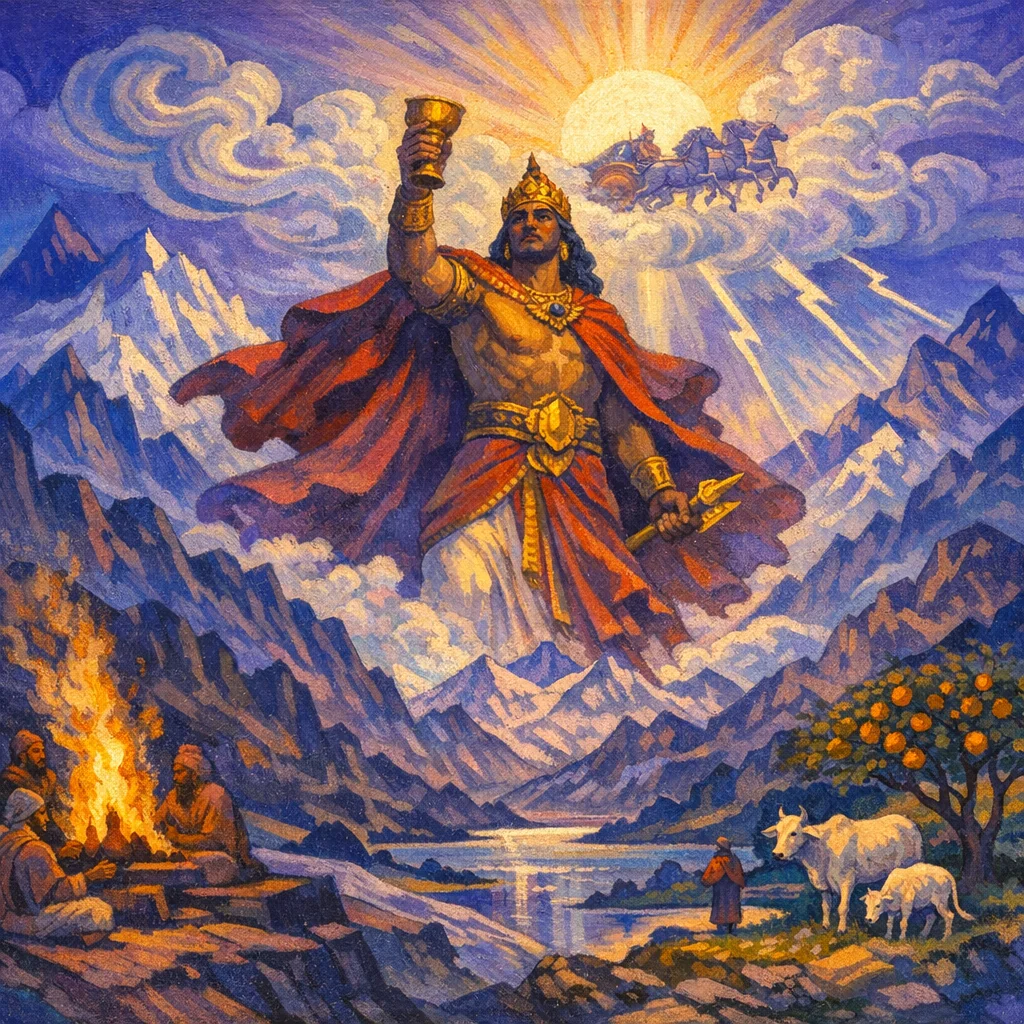
This hymn is a Soma-invitation and praise of Indra, urging him to drink the pressed sap, enter the shared exhilaration (sadhamāda), and protect the singers with his inspired power (dhī). It celebrates Indra’s unmatched might (indriya) that leads toward the Light, and closes with a more esoteric reflection invoking Rohita/Pākasthāmā as a bounteous, strength-giving principle allied to Indra’s force.
Mantras
Mantra 1
पिबा सुतस्य रसिनो मत्स्वा न इन्द्र गोमतः । आपिर्नो बोधि सधमाद्यो वृधेऽस्माँ अवन्तु ते धियः ॥
Drink of the pressed Soma’s sap and become glad within us, O Indra of the luminous Rays. Awaken for us as our near helper, the companion in the common ecstasy for our increase; may thy inspired thoughts protect and foster us.
Mantra 2
भूयाम ते सुमतौ वाजिनो वयं मा नः स्तरभिमातये । अस्माञ्चित्राभिरवतादभिष्टिभिरा नः सुम्नेषु यामय ॥
May we be more and more in thy good-will, we who seek the plenitudes of force; do not leave us to the assault of the hostile thinker. With thy many-colored helps protect us, and lead us into thy felicities.
Mantra 3
इमा उ त्वा पुरूवसो गिरो वर्धन्तु या मम । पावकवर्णाः शुचयो विपश्चितोऽभि स्तोमैरनूषत ॥
These my utterances, O wide-shining one, increase thee; pure and of cleansing hue, the seers of discerning vision have chanted to thee with hymns.
Mantra 4
अयं सहस्रमृषिभिः सहस्कृतः समुद्र इव पप्रथे । सत्यः सो अस्य महिमा गृणे शवो यज्ञेषु विप्रराज्ये ॥
This power, made might by a thousand seers, has spread wide like an ocean. True is his greatness; I proclaim his force in the sacrifices, in the sovereignty of the inspired.
Mantra 5
इन्द्रमिद्देवतातय इन्द्रं प्रयत्यध्वरे । इन्द्रं समीके वनिनो हवामह इन्द्रं धनस्य सातये ॥
Indra alone we call for the coming of the godhead, Indra in the advancing sacrifice; Indra at the close encounter we invoke, we seekers—Indra for the winning of the riches of being.
Mantra 6
इन्द्रो मह्ना रोदसी पप्रथच्छव इन्द्रः सूर्यमरोचयत् । इन्द्रे ह विश्वा भुवनानि येमिर इन्द्रे सुवानास इन्दवः ॥
Indra by his greatness has widened the two worlds by his force; Indra has made the Sun to shine forth. In Indra indeed all worlds find their right holding; in Indra the pressed Soma-streams flow out.
Mantra 7
अभि त्वा पूर्वपीतय इन्द्र स्तोमेभिरायवः । समीचीनास ऋभवः समस्वरन्रुद्रा गृणन्त पूर्व्यम् ॥
Toward thee for the first drinking, O Indra, the seekers come with hymns. In right accord the Rbhus have raised one sound; the Rudras chant thy ancient might.
Mantra 8
अस्येदिन्द्रो वावृधे वृष्ण्यं शवो मदे सुतस्य विष्णवि । अद्या तमस्य महिमानमायवोऽनु ष्टुवन्ति पूर्वथा ॥
By this indeed Indra has grown in his manly force, in the ecstasy of the pressed Soma, O all-pervading One. Today the seekers chant after his greatness as in the ancient way.
Mantra 9
तत्त्वा यामि सुवीर्यं तद्ब्रह्म पूर्वचित्तये । येना यतिभ्यो भृगवे धने हिते येन प्रस्कण्वमाविथ ॥
That heroic power of thine I seek; that is the Word for the awakening of the ancient consciousness—by which thou didst aid the striving ones, the Bhṛgu, when the treasure was set, by which thou didst protect Praskaṇva.
Mantra 10
येना समुद्रमसृजो महीरपस्तदिन्द्र वृष्णि ते शवः । सद्यः सो अस्य महिमा न संनशे यं क्षोणीरनुचक्रदे ॥
By which thou didst send forth the ocean, the great waters—this, O Indra, is thy bull-like force. Immediately his greatness does not diminish, whom the earth-realms follow in their circling course.
Mantra 11
शग्धी न इन्द्र यत्त्वा रयिं यामि सुवीर्यम् । शग्धि वाजाय प्रथमं सिषासते शग्धि स्तोमाय पूर्व्य ॥
O Indra, be able for us: for I approach you for the plenitude (rayi) that is heroic power of the soul (su-vīrya). Be able for the first winning of the Vāja—force and fullness—for those who strive; be able also for our ancient hymn of affirmation.
Mantra 12
शग्धी नो अस्य यद्ध पौरमाविथ धिय इन्द्र सिषासतः । शग्धि यथा रुशमं श्यावकं कृपमिन्द्र प्रावः स्वर्णरम् ॥
Be able for us in this, since indeed you didst aid the ancestral (paura) inspirations, O Indra, when they were striving to win. Be able now as you once powerfully helped Ruśama, Śyāvaka, and Kṛpa—O Indra who leadest toward the light (svar-nara).
Mantra 13
कन्नव्यो अतसीनां तुरो गृणीत मर्त्यः । नही न्वस्य महिमानमिन्द्रियं स्वर्गृणन्त आनशुः ॥
What new mortal among these weavers of the word will swiftly sing? For truly none have attained his greatness, his Indra-power, even though they chant toward the Light.
Mantra 14
कदु स्तुवन्त ऋतयन्त देवत ऋषिः को विप्र ओहते । कदा हवं मघवन्निन्द्र सुन्वतः कदु स्तुवत आ गमः ॥
When will the praising ones, moving in the rhythm of Ṛta, set the godhead in motion? Which seer, which illumined one, can draw you near? When, O bountiful Indra, to the Soma-presser’s call will you come—when to the one who praises will you arrive?
Mantra 15
उदु त्ये मधुमत्तमा गिरः स्तोमास ईरते । सत्राजितो धनसा अक्षितोतयो वाजयन्तो रथा इव ॥
Up rise those utterances most filled with honey-delight; the hymns surge forth. Ever-victorious, winning the treasure, with unfailing helps they drive the Vāja like chariots pressing on.
Mantra 16
कण्वा इव भृगवः सूर्या इव विश्वमिद्धीतमानशुः । इन्द्रं स्तोमेभिर्महयन्त आयवः प्रियमेधासो अस्वरन् ॥
Like the Kaṇvas, like the Bhṛgus, like the Suns, they attained the whole by their concentrated vision. Magnifying Indra with hymns, the Āyus, rich in the dear intelligence, cried out in inspired sound.
Mantra 17
युक्ष्वा हि वृत्रहन्तम हरी इन्द्र परावतः । अर्वाचीनो मघवन्त्सोमपीतय उग्र ऋष्वेभिरा गहि ॥
Yoke, for indeed, your two tawny powers, O Indra most slayer of the Obstructor, and come from the far realm. Turn hither, O bountiful one, for the drinking of Soma; strong and uplifted with the seers’ ardor, come.
Mantra 18
इमे हि ते कारवो वावशुर्धिया विप्रासो मेधसातये । स त्वं नो मघवन्निन्द्र गिर्वणो वेनो न शृणुधी हवम् ॥
These your singers have cried aloud with inspired thought, O Indra, the illumined ones for the winning of intelligence. So you, for us, O bountiful Indra, lover of hymns, hear the call as a yearning lover hears.
Mantra 19
निरिन्द्र बृहतीभ्यो वृत्रं धनुभ्यो अस्फुरः । निरर्बुदस्य मृगयस्य मायिनो निः पर्वतस्य गा आजः ॥
O Indra, you shattered the Obstruction away from the great (powers), from their bows; you drove out the deceiver Arbuda, the hunter; you forced out from the mountain the cows—rays of light and knowledge.
Mantra 20
निरग्नयो रुरुचुर्निरु सूर्यो निः सोम इन्द्रियो रसः । निरन्तरिक्षादधमो महामहिं कृषे तदिन्द्र पौंस्यम् ॥
Forth shone the fires; forth rose the Sun; forth flowed the Soma, the sap of Indra-power. You dragged out from the mid-world the great Serpent from below—this, O Indra, is your manhood-force, your victorious potency.
Mantra 21
यं मे दुरिन्द्रो मरुतः पाकस्थामा कौरयाणः । विश्वेषां त्मना शोभिष्ठमुपेव दिवि धावमानम् ॥
He whom for me Indra and the Maruts, the ripener of the immature, set in motion—most radiant in his own self among all—rushing as if near to the heaven: him I hold as the swift power of ascent in the inner firmament.
Mantra 22
रोहितं मे पाकस्थामा सुधुरं कक्ष्यप्राम् । अदाद्रायो विबोधनम् ॥
Pākasthāmā has given me the Rohita—well-yoked, filling the encircling spaces—an awakener of the plenitude (rāyas) within, stirring the soul to its riches of being.
Mantra 23
यस्मा अन्ये दश प्रति धुरं वहन्ति वह्नयः । अस्तं वयो न तुग्र्यम् ॥
To whom the other ten bear the yoke in response—the carriers of the flame-force—like birds to their home at dusk: thus all powers return to that leading principle, the settled resting-place of the journey.
Mantra 24
आत्मा पितुस्तनूर्वास ओजोदा अभ्यञ्जनम् । तुरीयमिद्रोहितस्य पाकस्थामानं भोजं दातारमब्रवम् ॥
The Self is the father; the body is the dwelling and the vesture; the giver of strength is the anointing within. As a fourth power indeed of Rohita I proclaimed Pākasthāmā—bounteous, the giver—who completes the mature enjoyment of the soul.
Frequently Asked Questions
It invites Indra to drink the pressed Soma, praises his unmatched power, and asks him to protect the singers and grant growth, strength, and prosperity.
In Vedic ritual, Soma is the offering that ‘gladdens’ Indra and draws his presence; the hymn uses this to request help, victory, and inspired protection (dhī).
The hymn is generally placed in the Kāṇva tradition of seers; individual verse attributions vary in manuscripts, but the family style and placement point to the Kaṇvas.