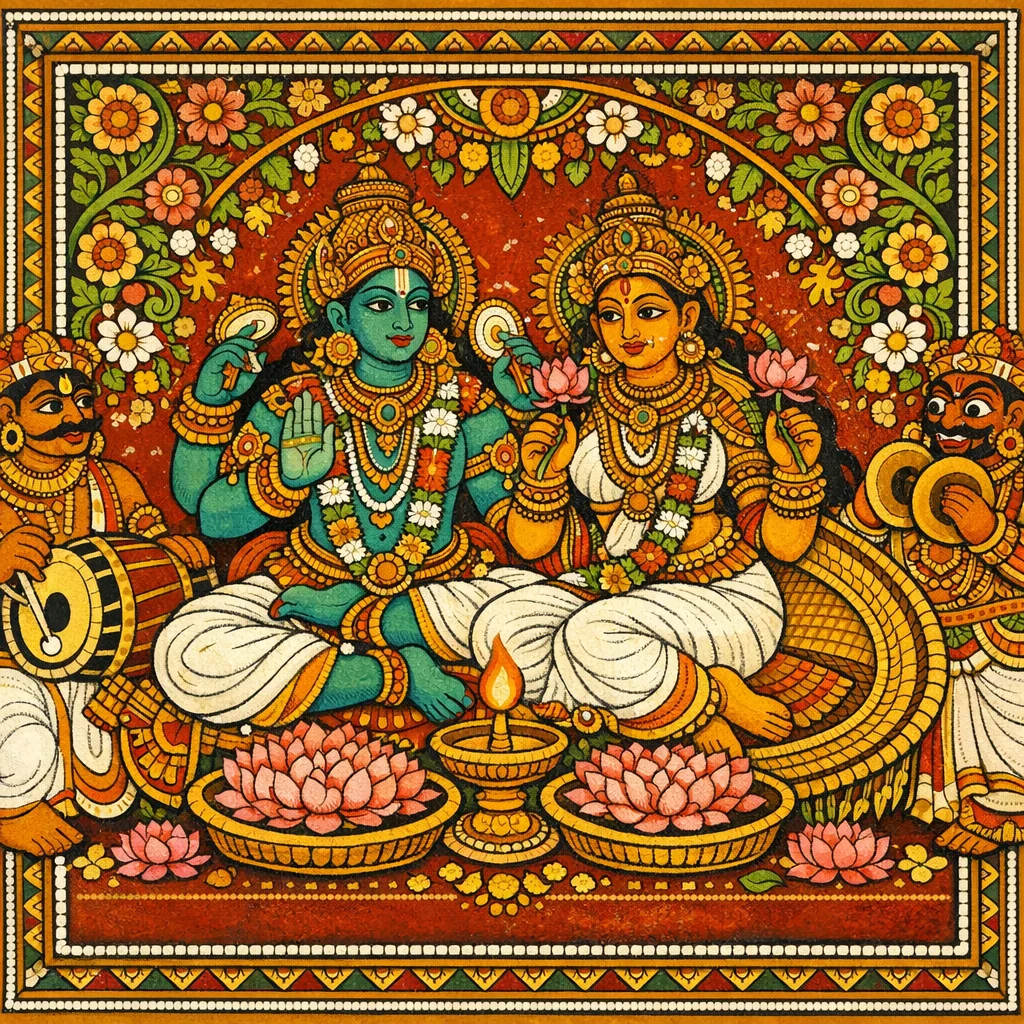
Adhyaya 81: The Observance of Viśoka-Dvādaśī: A Lakṣmī–Viṣṇu Vow for Sorrow-Removal and Prosperity
विशोकद्वादशीव्रतविधानम्
Speaker: Vaivasvata Manu, Lord Matsya (Viṣṇu)
Manu asks Matsya which fast or vrata can save a person from intense grief born of separation from desired objects, while also granting prosperity and easing fear of saṃsāra. Matsya replies that the practice is exalted and rare, yet will be taught for Manu’s devotion: the Viśoka-Dvādaśī Vrata, to be begun in Āśvayuja. The account then becomes a vrata-vidhi: Daśamī preparations; Ekādaśī fasting and worship of Keśava–Śrī with a vow to eat the next day; dawn purification and offering of specified flowers; limb-by-limb nyāsa of divine names; making a measured sthaṇḍila and maṇḍala; installing and praising Lakṣmī in a śūrpa, keeping night vigil with music; early-morning worship of the divine couple; modest, truthful eating; listening to Purāṇa recitation; monthly repetition; and final gifts—bed, jaggery-cow (guḍa-dhenū), and a śūrpa with Lakṣmī—along with mantras seeking lasting beauty, health, devotion, and freedom from sorrow.
Key Concepts
Shlokas in Adhyaya 81
Verse 1
*मनुरुवाच किम् अभीष्टवियोगशोकसंघादलम् उद्धर्तुमुपोषणं व्रतं वा विभवोद्भवकारि भूतले ऽस्मिन् भवभीतेरपि सूदनं च पुंसः //
Manu said: Which observance—fasting (upoṣaṇa) or a vowed religious discipline (vrata)—can lift a man out of the crushing mass of grief caused by separation from what he desires, and which, on this earth, becomes a source of prosperity and also a destroyer of his fear of worldly existence (saṃsāra)?
Verse 2
*मत्स्य उवाच परिपृष्टमिदं जगत्प्रियं ते विबुधानामपि दुर्लभं महत्त्वात् तव भक्तिमतस्तथापि वक्ष्ये व्रतमिन्द्रासुरमानवेषु गुह्यम् //
Matsya said: “You have asked about this, O beloved of the worlds—something that, because of its greatness, is difficult to obtain even for the gods. Yet, since you are devoted, I shall explain that sacred vow (vrata), a secret even among Indra, the Asuras, and human beings.”
Verse 3
पुण्यमाश्वयुजे मासि विशोकद्वादशीव्रतम् दशम्यां लघुभुग्विद्वान् आरभेन्नियमेन तु //
In the auspicious month of Āśvayuja, the learned person should begin the sacred Viśoka-Dvādaśī vow. On the tenth day (Daśamī), eating lightly, he should undertake it with disciplined observances.
Verse 4
उदङ्मुखः प्राङ्मुखो वा दन्तधावनपूर्वकम् एकादश्यां निराहारः समभ्यर्च्य तु केशवम् श्रियं वाभ्यर्च्य विधिवद् भोक्ष्यामि त्वपरे ऽहनि //
Facing north or east, and having first cleansed the teeth, on Ekādaśī one should remain without food; then, duly worshiping Keśava—and also worshiping Śrī (Lakṣmī) according to rule—one should vow, “I shall eat on the following day.”
Verse 5
एवं नियमकृत्सुप्त्वा प्रातरुत्थाय मानवः स्नानं सर्वौषधैः कुर्यात् पञ्चगव्यजलेन तु शुक्लमाल्याम्बरधरः पूजयेच्छ्रीशमुत्पलैः //
Thus, having slept after observing the prescribed restraints, a person should rise at dawn and bathe using all purificatory herbs, and also with water mixed with the five products of the cow. Wearing white garments and a white garland, he should worship Śrīśa (Lord Viṣṇu) with blue lotuses.
Verse 6
विशोकाय नमः पादौ जङ्घे च वरदाय वै श्रीशाय जानुनी तद्वद् ऊरू च जलशायिने //
Salutation to Viṣṇu as ‘Viśoka’ for the feet; to ‘Varada’ for the shanks; to ‘Śrīśa’ for the knees; and likewise to ‘Jalaśāyin’ for the thighs.
Verse 7
कन्दर्पाय नमो गुह्यं माधवाय नमः कटिम् दामोदरायेत्युदरं पार्श्वे च विपुलाय वै //
One should place (the mantra) “Obeisance to Kandarpāya” upon the secret part; “Obeisance to Mādhava” upon the waist; “(Obeisance) to Dāmodara” upon the belly; and upon the sides, indeed, “(Obeisance) to Vipula.”
Verse 8
नाभिं च पद्मनाभाय हृदयं मन्मथाय वै श्रीधराय विभोर्वक्षः करौ मधुजिते नमः //
Salutations to the navel of the Lotus-naveled Lord Padmanābha; to the heart of Manmatha, the enchanter; to the chest of the all-pervading Śrīdhara, bearer of Śrī; and salutations to the hands of Madhujit, slayer of Madhu.
Verse 9
चक्रिणे वामबाहुं च दक्षिणं गदिने नमः वैकुण्ठाय नमः कण्ठम् आस्यं यज्ञमुखाय वै //
Salutations to the Bearer of the discus—placing reverence upon the left arm; and salutations to the Bearer of the mace—placing reverence upon the right arm. Salutations to Vaikuṇṭha—placing reverence upon the throat; and indeed salutations to Yajña-mukha—placing reverence upon the mouth/face.
Verse 10
नासामशोकनिधये वासुदेवाय चाक्षिणी ललाटं वामनायेति हरये च पुनर्भ्रुवौ //
One should assign (by nyāsa) the name Aśokanidhī to the nose, Vāsudeva to the eyes, Vāmana to the forehead, and again Hari to the eyebrows.
Verse 11
अलकान्माधवायेति किरीटं विश्वरूपिणे नमः सर्वात्मने तद्वच् छिर इत्यभिपूजयेत् //
Reciting, “Obeisance to Mādhava, Lord of the Alakās; obeisance to the Universal-Formed One; obeisance to the All-Self,” one should duly worship the crown; and in the same manner one should worship the head of the deity as well.
Verse 12
एवं सम्पूज्य गोविन्दं फलमाल्यानुलेपनैः ततस्तु मण्डलं कृत्वा स्थण्डिलं कारयेन्मुदा //
Thus, having duly worshipped Govinda with fruits, garlands, and unguents, one should then—joyfully—draw the ritual maṇḍala and have the sthaṇḍila, the consecrated altar-ground, prepared.
Verse 13
चतुरस्रं समन्ताच्च रत्निमात्रमुदक्प्लवम् श्लक्ष्णं हृद्यं च परितो वप्रत्रयसमावृतम् //
Let it be square on all sides, with a water-slope for drainage of one ratni; smooth and pleasing to the eye, and enclosed all around by three ramparts (earthen embankments).
Verse 14
अङ्गुलेनोच्छ्रिता वप्रास् तद्विस्तारस्तु द्व्यङ्गुलः स्थण्डिलस्योपरिष्टाच्च भित्तिरष्टाङ्गुला भवेत् //
The embankments (vaprāḥ) should be raised by one aṅgula (finger-breadth), and their breadth should be two aṅgulas. Above the sthaṇḍila (prepared ritual platform), the wall (bhitti) should be eight aṅgulas high.
Verse 15
नदीवालुकया शूर्पे लक्ष्म्याः प्रतिकृतिं न्यसेत् स्थण्डिले शूर्पमारोप्य लक्ष्मीमित्यर्चयेद्बुधः //
Using river-sand, one should form and place an image (or representation) of Lakṣmī in a winnowing basket (śūrpa). Setting the basket upon the prepared ritual ground (sthaṇḍila), the wise person should worship her with the invocation, “Lakṣmī.”
Verse 16
नमो देव्यै नमः शान्त्यै नमो लक्ष्म्यै नमः श्रियै नमः पुष्ट्यै नमस्तुष्ट्यै वृष्ट्यै हृष्ट्यै नमो नमः //
Salutations to the Goddess; salutations to Peace. Salutations to Lakṣmī; salutations to Śrī (splendour and prosperity). Salutations to Puṣṭi (nourishment); salutations to Tuṣṭi (contentment). Salutations to Vṛṣṭi (rain); salutations to Hṛṣṭi (joy). Again and again, salutations!
Verse 17
विशोका दुःखनाशाय विशोका वरदास्तु मे विशोका चास्तु सम्पत्त्यै विशोका सर्वसिद्धये //
May Viśokā destroy my sorrow; may Viśokā be my giver of boons. May Viśokā grant prosperity, and may Viśokā bestow complete success in all attainments.
Verse 18
ततः शुक्लाम्बरैः शूर्पं वेष्ट्य सम्पूजयेत्फलैः वस्त्रैर्नानाविधैस्तद्वत् सुवर्णकमलेन च //
Then, having wrapped the śūrpa (winnowing-fan) in white cloth, one should worship it well with fruits; likewise, one should honor it with various kinds of garments, and also with a golden lotus.
Verse 19
रजनीषु च सर्वासु पिबेद्दर्भोदकं बुधः ततस्तु गीतनृत्यादि कारयेत्सकलां निशाम् //
On every night, the wise person should drink water sanctified with darbha grass; thereafter, he should have singing, dancing, and the like performed throughout the entire night.
Verse 20
यामत्रये व्यतीते तु सुप्त्वाप्युत्थाय मानवः अभिगम्य च विप्राणां मिथुनानि तदार्चयेत् //
When three yāmas have passed, even if he has been asleep, a man should rise and, approaching the Brāhmaṇas, then worship the paired forms (male and female) among them.
Verse 21
शक्तितस् त्रीणि चैकं वा वस्त्रमाल्यानुलेपनैः शयनस्थानि पूज्यानि नमो ऽस्तु जलशायिने //
According to one’s capacity, with three offerings or even with a single one—such as cloth, garlands, and unguents—the deity’s resting-places (beds/couches) should be worshipped. Salutations to the One who lies upon the waters.
Verse 22
ततस्तु गीतवाद्येन रात्रौ जागरणे कृते प्रभाते च ततः स्नानं कृत्वा दाम्पत्यमर्चयेत् //
Then, having kept the night vigil with singing and instrumental music, and at dawn thereafter having bathed, one should worship the divine couple.
Verse 23
भोजनं च यथाशक्त्या वित्तशाठ्यविवर्जितः भुक्त्वा श्रुत्वा पुराणानि तद्दिनं चातिवाहयेत् //
Let him take his meal according to his means, free from deceit regarding wealth; and, having eaten, let him listen to the Purāṇas and thus pass the day in that manner.
Verse 24
अनेन विधिना सर्वं मासि मासि समाचरेत् व्रतान्ते शयनं दद्याद् गुडधेनुसमन्वितम् सोपधानकविश्रामं सास्तरावरणं शुभम् //
Following this prescribed method, one should observe the rite month after month. At the conclusion of the vow, one should donate a bed, accompanied by a ‘jaggery-cow’ (a cow gifted along with jaggery), complete with a pillow and a resting-couch, and furnished with auspicious bedding and coverings.
Verse 25
यथा न लक्ष्मीर्देवेश त्वां परित्यज्य गच्छति तथा सुरूपतारोग्यम् अशोकश्चास्तु मे सदा //
O Lord of the gods, just as Lakṣmī never abandons you and departs, so may beauty of form, good health, and freedom from sorrow ever abide with me.
Verse 26
यथा देवेन रहिता न लक्ष्मीर्जायते क्वचित् तथा विशोकता मे ऽस्तु भक्तिरग्र्या च केशवे //
Just as Lakṣmī is never born anywhere without the Lord, so may sorrowlessness be mine—and may my devotion to Keśava be supreme.
Verse 27
मन्त्रेणानेन शयनं गुडधेनुसमन्वितम् शूर्पं च लक्ष्म्या सहितं दातव्यं भूतिमिच्छता //
With this very mantra, one who seeks prosperity should donate a bed—together with a ‘jaggery-cow’ offering—and also a winnowing basket (śūrpa) accompanied by Lakṣmī as an auspicious emblem.
Verse 28
उत्पलं करवीरं च बाणमम्लानकुङ्कुमम् केतकी सिन्दुवारं च मल्लिका गन्धपाटला कदम्बं कुब्जकं जातिः शस्तान्येतानि सर्वदा //
The blue lotus, karavīra (oleander), the bāṇa-flower, unfading kuṅkuma (saffron), ketakī, sinduvāra, mallikā (jasmine), the fragrant pāṭalā, kadamba, kubjaka, and jāti—these flowers are always esteemed as commendable offerings for worship.
Frequently Asked Questions
The chapter teaches that grief and saṃsāra-fear can be addressed through a structured devotional discipline: the Viśoka-Dvādaśī Vrata. Matsya instructs Manu in a complete method—Daśamī preparation, Ekādaśī fasting, Lakṣmī–Viṣṇu worship, nyāsa, night vigil, Dvādaśī worship and measured conduct, monthly repetition, and concluding charity—aimed at viśoka (sorrowlessness), prosperity, and steadfast devotion to Keśava.
This adhyāya is primarily Vrata-Dharma (religious observance) and ritual theology of Lakṣmī–Viṣṇu. It also includes a Vastu-like ritual-geometry component via sthaṇḍila and maṇḍala specifications (square layout, ramparts, measured heights/widths). Genealogy and creation narratives are not the focus in this chapter.
Begin in Āśvayuja: eat lightly on Daśamī; fast on Ekādaśī after cleansing; worship Keśava and Śrī and vow to eat next day; at dawn bathe with herbs and pañcagavya, wear white, offer blue lotuses; perform nyāsa with Viṣṇu’s names on limbs; draw maṇḍala and prepare a measured sthaṇḍila; install Lakṣmī as a sand-image in a śūrpa and recite praises; keep night vigil with music, drink darbha-water; at dawn worship the divine couple; eat honestly within means and listen to Purāṇas; repeat monthly; conclude with dāna (bed + guḍa-dhenu + śūrpa with Lakṣmī).
The sthaṇḍila is described as square on all sides, with a water-slope (udak-plava) of one ratni, smooth and pleasing, enclosed by three ramparts (vapratraya). The ramparts are raised by one aṅgula and are two aṅgulas wide; above the sthaṇḍila, the wall (bhitti) is eight aṅgulas high.
The text praises offerings such as blue lotus (utpala), oleander (karavīra), bāṇa-flower, unfading saffron, ketakī, sinduvāra, jasmine (mallikā), fragrant pāṭalā, kadamba, kubjaka, and jāti as commendable for worship.