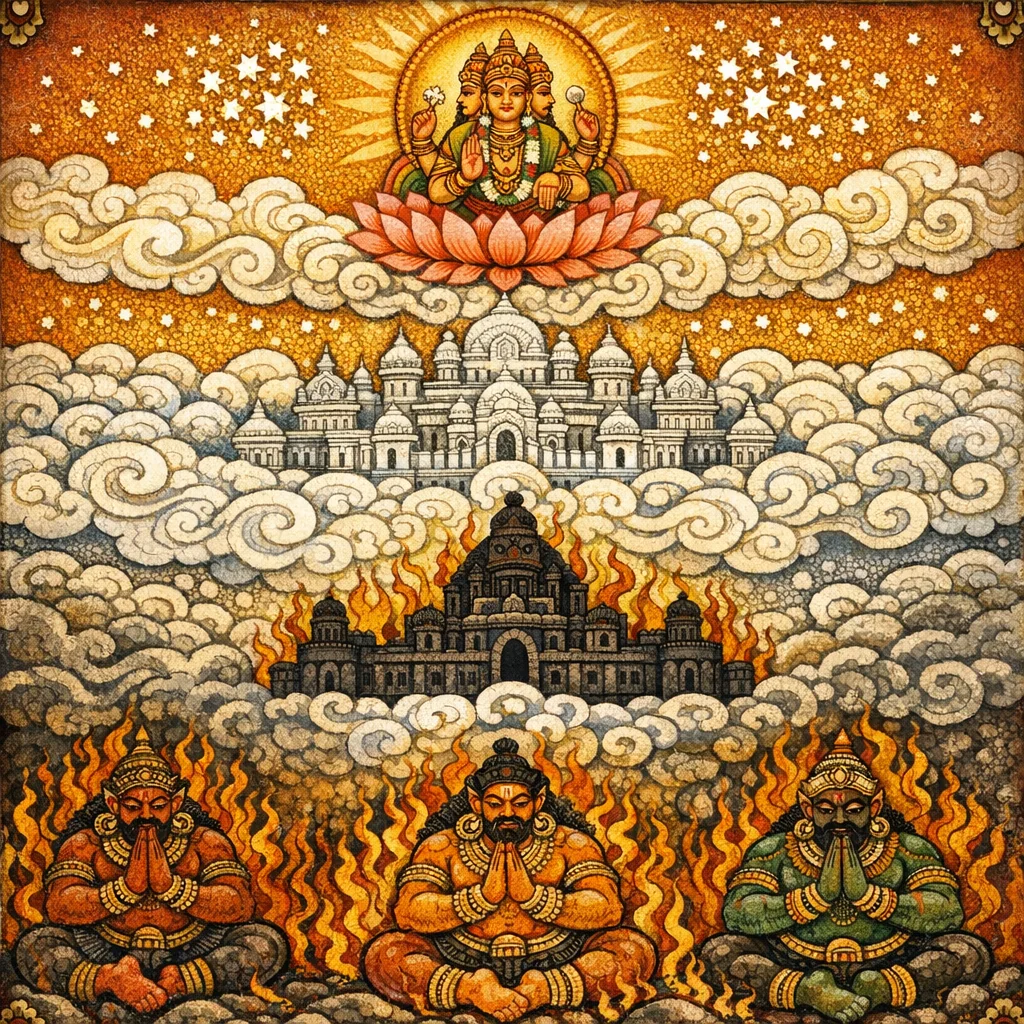
Adhyaya 129: The Burning of Tripura: Maya’s Triple Fortresses and the Boon that Leads to Shiva as Purāri
त्रिपुरदाहवर्णनम्
Speaker: Rishis, Suta
The Ṛṣis repeatedly and reverently ask how Maheśvara gained the epithet Purāri and how Tripura was burned by a single arrow. Sūta begins: the asura Maya, progenitor of māyā-arts, together with mighty Daityas—especially Vidyunmālī and Tāraka—performs dreadful austerities that torment the three worlds. Brahmā appears, pleased, and offers boons; Maya seeks an unassailable fortress. Brahmā warns that absolute immortality is not granted to the wicked, yet permits immediate construction. The chapter then describes Tripura’s plan: three vast cities, each 100 yojanas in length and breadth, arranged to meet in heaven under Pushya-yoga—an iron city on earth, a silver city aloft, and a golden city above, separated by 100-yojana intervals, furnished with towers, engines, and colossal gates. It closes by stressing Tripura’s māyā-protections and that only the Three-Eyed Śiva can destroy it, preparing for the later burning.
Key Concepts
Shlokas in Adhyaya 129
Verse 1
*ऋषय ऊचुः कथं जगाम भगवान् पुरारित्वं महेश्वरः ददाह च कथं देवस् तन्नो विस्तरतो वद //
The sages said: “How did the Blessed Lord Maheśvara come to assume the state of being ‘Purāri’ (the enemy of the cities)? And how did that God burn them? Tell us that in detail.”
Verse 2
पृच्छामस्त्वां वयं सर्वे बहुमानात्पुनः पुनः त्रिपुरं तद्यथा दुर्गं मयमायाविनिर्मितम् देवेनैकेषुणा दग्धं तथा नो वद मानद //
We all ask you again and again, out of deep reverence: tell us, O bestower of honor, how that fortress called Tripura—fashioned by the magical art of Maya—was burned by the Deva with a single arrow.
Verse 3
*सूत उवाच शृणुध्वं त्रिपुरं देवो यथा दारितवान् भवः मयो नाम महामायो मायानां जनको ऽसुरः //
Sūta said: Hear how the god Bhava (Śiva) shattered Tripura. There was an asura named Maya, a great master of illusion, the very progenitor of magical arts (māyās).
Verse 4
निर्जितः स तु संग्रामे तताप परमं तपः तपस्यन्तं तु तं विप्रा दैत्यावन्यावनुग्रहात् //
Defeated in battle, he then undertook the highest austerities (tapas). While he was absorbed in that ascetic discipline, the brahmin sages, through the favor (anu-graha) of the Daitya-lord, extended to him support and grace.
Verse 5
तस्यैव कृत्यमुद्दिश्य तेपतुः परमं तपः विद्युन्माली च बलवांस् तारकाख्यश्च वीर्यवान् //
With that very aim in view, they undertook the highest austerities (tapas)—Vidyunmālī, mighty in strength, and the valiant one named Tāraka, endowed with great prowess.
Verse 6
मयतेजःसमाक्रान्तौ तेपतुर्मयपार्श्वगौ लोका इव यथा मूर्तास् त्रयस् त्रय इवाग्नयः //
Overwhelmed by my tejas, my radiance of power, the two came and fell down at my sides—like the three embodied worlds, as it were, before the three sacred fires.
Verse 7
लोकत्रयं तापयन्तस् ते तेपुर्दानवास्तपः हेमन्ते जलशय्यासु ग्रीष्मे पञ्चतपे तथा //
Scorching the three worlds, those Dānava demons performed austerities—lying upon beds of water in the winter, and likewise enduring the five-fire penance (pañcatapa) in the summer.
Verse 8
वर्षासु च तथाकाशे क्षपयन्तस्तनूः प्रियाः सेवानाः फलमूलानि पुष्पाणि च जलानि च //
In the rainy season—and likewise beneath the open sky—those devoted to disciplined observance, dear to the virtuous, should mortify the body, subsisting in service on fruits and roots, on flowers, and on water.
Verse 9
अन्यदाचरिताहाराः पङ्केनाचितवल्कलाः मग्नाः शैवालपङ्केषु विमलाविमलेषु च //
They subsisted on whatever food they could obtain; their bark-garments were smeared and caked with mud. Sunk in slime and algae-choked mire, they remained—whether in places deemed pure or impure.
Verse 10
निर्मांसाश्च ततो जाताः कृशा धमनिसंतताः तेषां तपःप्रभावेन प्रभावविधुतं यथा //
Then there arose beings as though without flesh—gaunt, with veins and sinews standing out; and by the potency of their austerity (tapas), their worldly impress and influence were, as it were, shaken off and swept away.
Verse 11
निष्प्रभं तु जगत्सर्वं मन्दमेवाभिभाषितम् दह्यमानेषु लोकेषु तैस्त्रिभिर्दानवाग्निभिः //
But the entire universe became lusterless, and speech itself grew faint and sluggish, as the worlds were being consumed by those three demonic fires.
Verse 12
तेषामग्रे जगद्बन्धुः प्रादुर्भूतः पितामहः ततः साहसकर्तारः प्राहुस्ते सहसागतम् //
Before them, Pitāmaha—the grandsire, the kinsman of the world—manifested. Therefore, the makers of the Sahasra (the “thousandfold” group) declared that they had come forth all at once, suddenly (sahasā).
Verse 13
स्वकं पितामहं दैत्यास् तं वै तुष्टुवुरेव च अथ तान्दानवान्ब्रह्मा तपसा तपनप्रभान् //
Then the Daityas praised their own Pitāmaha, Brahmā indeed; and thereafter Brahmā—radiant like the burning sun through the power of austerity—beheld and attended to those Dānavas.
Verse 14
उवाच हर्षपूर्णाक्षो हर्षपूर्णमुखस्तदा वरदो ऽहं हि वो वत्सास् तपस्तोषित आगतः //
Then, with eyes brimming with joy and a face radiant with delight, he said: “Dear children, I have come to you as a giver of boons, pleased by your austerities (tapas).”
Verse 15
व्रियताम् ईप्सितं यच्च साभिलाषं तदुच्यताम् इत्येवमुच्यमानास्तु प्रतिपन्नं पितामहम् //
“Choose and declare whatever is desired—whatever is wished for.” Thus addressed, they approached Pitāmaha (Brahmā) and submitted their request.
Verse 16
विश्वकर्मा मयः प्राह प्रहर्षोत्फुल्ललोचनः देव दैत्याः पुरा देवैः संग्रामे तारकामये //
Maya said to Viśvakarmā, his eyes widened with joy: “Formerly, O god, the Dānavas (Daityas) fought against the Devas in the battle known as Tārakāmaya.”
Verse 17
निर्जितास्ताडिताश्चैव हताश्चाप्यायुधैरपि देवैर्वैरानुबन्धाच्च धावन्तो भयवेपिताः //
Conquered, struck down, and even slain by the gods’ weapons, and further pursued because of enmity, they ran off trembling with fear.
Verse 18
शरणं नैव जानीमः शर्म वा शरणार्थिनः सो ऽहं तपःप्रभावेन तव भक्त्या तथैव च //
We who seek refuge know no shelter—nor even peace—other than you. It is I who, by the potency of austerity (tapas) and likewise by devotion to you (bhakti), have come, taking you as my sole refuge.
Verse 19
इच्छामि कर्तुं तद्दुर्गं यद्देवैरपि दुस्तरम् तस्मिंश्च त्रिपुरे दुर्गे मत्कृते कृतिनां वर //
I wish to build that fort which is difficult to breach even for the gods; and within that threefold fortress, Tripura, constructed by me—O best among the accomplished—I shall establish it as is fitting.
Verse 20
भूम्यानां जलजानां च शापानां मुनितेजसाम् देवप्रहरणानां च देवानां च प्रजापतेः //
“(He speaks of the powers) of beings of the earth and those born in the waters; of curses arising from the fiery spiritual might of sages; of the divine missiles; and of the gods—and of Prajāpati, the Lord of progeny, as well.”
Verse 21
अलङ्घनीयं भवतु त्रिपुरं यदि ते प्रियम् विश्वकर्मा इतीवोक्तः स तदा विश्वकर्मणा //
“If it pleases you, let Tripura be made unassailable.” Thus addressed as ‘O Viśvakarmā,’ he then set about the work through Viśvakarmā, the divine architect.
Verse 22
उवाच प्रहसन्वाक्यं मयं दैत्यगणाधिपम् सर्वामरत्वं नैवास्ति असद्वृत्तस्य दानव //
Smiling, he spoke these words to Maya, lord of the host of Daityas: “O Dānava, for one of wicked conduct there is certainly no complete immortality.”
Verse 23
तस्माद्दुर्गविधानं हि क्षणादपि विधीयताम् पितामहवचः श्रुत्वा तदैवं दानवो मयः //
“Therefore, let the construction and arrangement of the fortifications be undertaken at once, without delay even for a moment.” Having heard the words of Pitāmaha (Brahmā), the Dānava Maya acted immediately in that very manner.
Verse 24
प्राञ्जलिः पुनरप्याह ब्रह्माणं पद्मसम्भवम् यस्तदेकेषुणा दुर्गं सकृन्मुक्तेन निर्दहेत् //
With folded hands, he again addressed Brahmā, the Lotus-born: “Who is that person who could burn down a fort by a single arrow, released just once?”
Verse 25
समं स संयुगे हन्याद् अवध्यं शेषतो भवेत् एवमस्त्विति चाप्युक्त्वा मयं देवः पितामहः //
In battle, he should strike down only an equal opponent; as for the rest, they should be regarded as not to be slain. Having said, “So be it,” the divine Grandsire (Brahmā) then spoke thus.
Verse 26
स्वप्ने लब्धो यथार्थो वै तत्रैवादर्शनं ययौ गते पितामहे दैत्या गता मयरविप्रभाः //
What had been obtained in a dream proved to be true; and right there, it vanished from sight. When Pitāmaha (Brahmā) had departed, the Daityas—radiant like Maya—also went away.
Verse 27
वरदानाद्विरेजुस्ते तपसा च महाबलाः स मयस्तु महाबुद्धिर् दानवो वृषसत्तमः //
Through the granting of boons and through austerity, those mighty ones shone forth in power; and among them was Maya—the great-minded Dānava—foremost among the excellent.
Verse 28
दुर्गं व्यवसितः कर्तुम् इति चाचिन्तयत्तदा कथं नाम भवेद्दुर्गं तन्मया त्रिपुरं कृतम् //
Having resolved to build a fort, he then reflected: “How, indeed, should a fort be made?”—and accordingly I fashioned the (model of) Tripura as a fortification.
Verse 29
वत्स्यते तत्पुरं दिव्यं मत्तो नान्यैर्न संशयः यथाचैकेषुणा तेन तत्पुरं न हि हन्यते //
That divine city shall be safeguarded by me—by none other, without doubt. Just as he cannot destroy it with a single arrow, so indeed that city cannot be slain.
Verse 30
देवैस्तथा विधातव्यं मया मतिविचारणम् विस्तारो योजनशतम् एकैकस्य पुरस्य तु //
So too, in accordance with the gods’ ordinance, I have determined this plan after due consideration: the extent of each city, indeed, is to be one hundred yojanas.
Verse 31
कार्यस्तेषां च विष्कम्भश् चैकैकशतयोजनम् पुष्ययोगेण निर्माणं पुराणं च भविष्यति //
Their construction should be undertaken so that each has a breadth (diameter/width) of one hundred yojanas; and when built under Puṣya-yoga, the work becomes purāṇa—time-honoured and authoritative—ensuring lasting renown and continuity.
Verse 32
पुष्ययोगेण च दिवि समेष्यन्ति परस्परम् पुष्ययोगेण युक्तानि यस्तान्यासादयिष्यति //
By the auspicious Puṣya-yoga, they will meet one another in heaven; and whoever brings about and completes those acts when they are conjoined with Puṣya-yoga will attain that heavenly result.
Verse 33
पुराण्येकप्रहारेण शतानि निहनिष्यति आयसं तु क्षितितले राजतं तु नभस्तले //
With a single blow, the ancient implement/weapon can strike down hundreds. Iron, however, is to be placed in the earth, while silver is to be placed in an elevated, skyward position.
Verse 34
राजतस्योपरिष्टात्तु सौवर्णं भविता पुरम् एवं त्रिभिः पुरैर्युक्तं त्रिपुरं तद्भविष्यति शतयोजनविष्कम्भैर् अन्तरैस्तद्दुरासदम् //
Above the silver city there shall arise a golden city. Thus, endowed with three cities, it will be called “Tripura,” the Triple City. With intervening gaps of a hundred yojanas, it will be exceedingly hard to assail.
Verse 35
अट्टालकैर् यन्त्रशतघ्निभिश्च सचक्रशूलोपलकम्पनैश्च द्वारैर्महामन्दरमेरुकल्पैः प्राकारशृङ्गैः सुविराजमानम् //
It shone in splendor with lofty watchtowers and countless engines of war; with devices that hurled wheels, spears, and stones; with gateways vast as Mandara and Meru; and with ramparts crowned by prominent battlements and towering peaks.
Verse 36
सतारकाख्येन मयेन गुप्तं स्वस्थं च गुप्तं तडिन्मालिनापि को नाम हन्तुं त्रिपुरं समर्थो मुक्त्वा त्रिनेत्रं भगवन्तमेकम् //
Tripura—guarded by the Māyā called Satāraka, secure and well-protected, and even shielded by Taḍinmālin, the lightning-garlanded power—who could destroy it, save the one blessed Lord, the Three-Eyed (Śiva) alone?
Frequently Asked Questions
The chapter teaches that extraordinary power gained through tapas and boons remains morally conditioned: Brahmā grants capability and protection, yet denies “complete immortality” to those of wicked conduct. It also frames Tripura’s seeming invincibility as māyā-based and ultimately subordinate to Śiva, who alone can end it—explaining the theological basis for Śiva as Purāri.
Primarily Shaiva narrative theology and dharmic ethics of boon-granting (limitations on immortality), with strong Vastu/architecture motifs: a triple-fortress plan, material stratification (iron–silver–gold), massive measurements (100 yojanas), defensive mechanisms (watchtowers, yantras, missile devices), and auspicious timing via Pushya-yoga. Genealogy is not central here beyond identifying Maya and the Daitya figures.