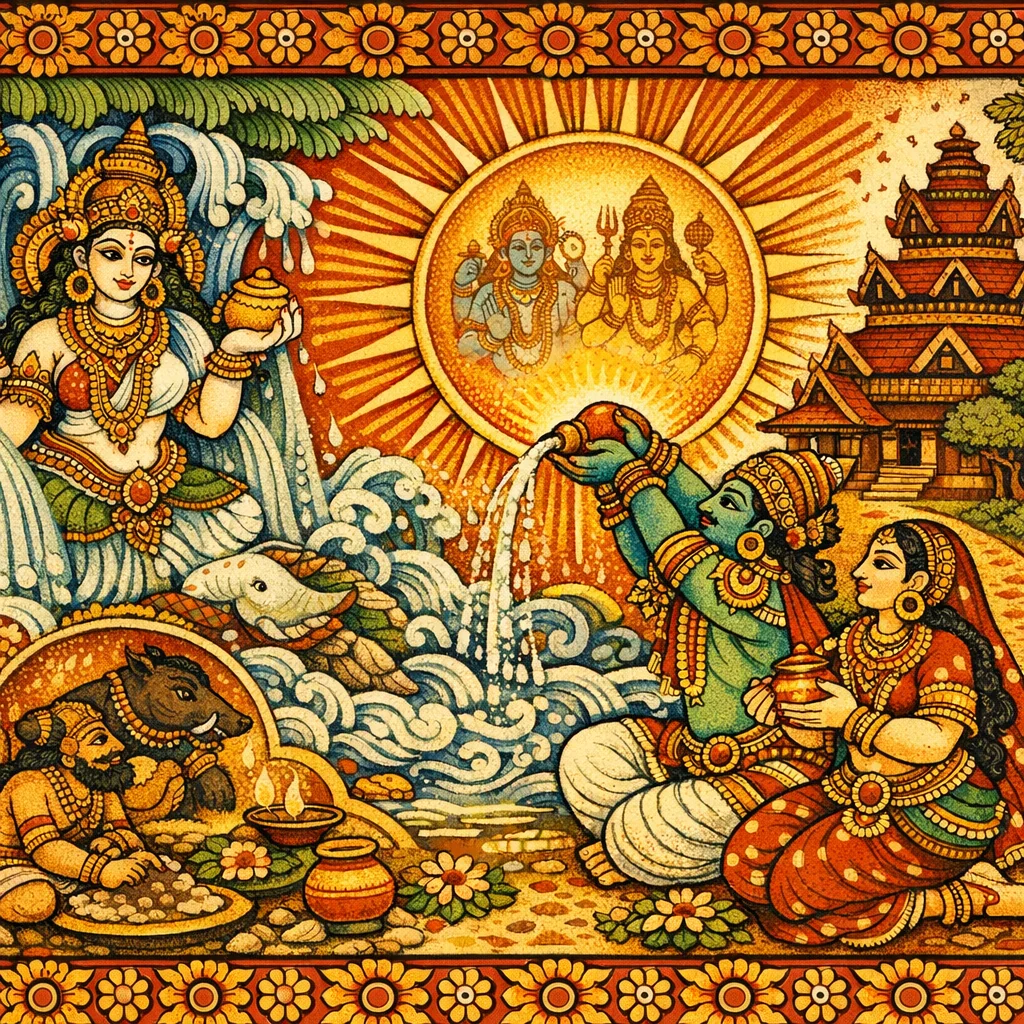
Adhyaya 102: Ritual Bathing, Tarpaṇa for Devas–Ṛṣis–Pitṛs, and Sun Arghya Procedure
स्नान-तर्पण-सूर्यार्घ्यविधिः
Speaker: Nandikeśvara (teacher/speaker), Vāyu (cited authority on tīrthas)
In dialogue form, Nandikeśvara teaches the proper daily sequence of purification: begin with snāna to gain śauca and bhāva-śuddhi; consecrate the bathing tīrtha with the mūla-mantra “namo nārāyaṇāya”; prepare a square ritual space and invoke Gaṅgā by her names so she becomes present. The bather repeats the mantra seven times and pours water on the head in prescribed counts, then performs mṛttikā-snāna with Earth/Varāha-themed mantras for pāpa-kṣaya. After ācamana and donning clean white clothing, he performs tarpaṇa in graded order, observing sacred-thread orientations for offerings to devas and to pitṛs, invoking specific ṛṣi lineages and pitṛ classes, and adding a universal satisfaction mantra for known and unknown relations. Finally, he draws a lotus, offers Sūrya arghya with a sequence of salutations identifying the Sun with Viṣṇu and Śiva, circumambulates thrice, touches brāhmaṇa/cow/gold, and proceeds to Viṣṇu’s abode (temple).
Key Concepts
Shlokas in Adhyaya 102
Verse 1
*नन्दिकेश्वर उवाच नैर्मल्यं भावशुद्धिश्च विना स्नानं न विद्यते तस्मान्मनोविशुद्ध्यर्थं स्नानमादौ विधीयते //
Nandikeśvara said: Without bathing, neither cleanliness nor purity of disposition is attained. Therefore, for the purification of the mind, bathing is prescribed first, as the initial rite.
Verse 2
अनुद्धृतैरुद्धृतैर्वा जलैः स्नानं समाचरेत् तीर्थं च कल्पयेद्विद्वान् मूलमन्त्रेण मन्त्रवित् नमो नारायणायेति मूलमन्त्र उदाहृतः //
One should duly perform the ritual bath with water either undrawn (as found in nature) or drawn (collected). A learned person, skilled in mantras, should also ritually constitute a sacred bathing-spot (tīrtha) by means of the root-mantra (mūla-mantra). The root-mantra is declared to be: “namo nārāyaṇāya” (“Obeisance to Nārāyaṇa”).
Verse 3
दर्भपाणिस्तु विधिना आचान्तः प्रयतः शुचिः चतुर्हस्तसमायुक्तं चतुरस्रं समन्ततः प्रकल्प्यावाहयेद् गङ्गाम् एभिर्मन्त्रैर्विचक्षणः //
Holding kuśa-grass in his hand, and having duly performed ācamana, disciplined and pure, the adept should prepare on all sides a square measuring four hastas, and then, with these mantras, skillfully invoke the presence of the River-Goddess Gaṅgā.
Verse 4
विष्णोः पादप्रसूतासि वैष्णवी विष्णुदेवता पाहि नस् त्वेनसस् तस्माद् आजन्ममरणान्तिकात् //
O Vaiṣṇavī—born from the feet of Viṣṇu, the very divinity of Viṣṇu—protect us from that sin, from birth until the very brink of death.
Verse 5
तिस्रः कोट्यो ऽर्धकोटी च तीर्थानां वायुरब्रवीत् दिवि भुव्यन्तरिक्षे च तानि ते सन्ति जाह्नवि //
Vāyu declared that the sacred fords (tīrthas) number three crores and half a crore; and those tīrthas, O Jāhnavī, are found in heaven, on earth, and in the mid-region (the atmosphere).
Verse 6
नन्दिनीत्येव ते नाम देवेषु नलिनीति च दक्षा पृथ्वी च विहगा विश्वकायामृता शिवा //
Among the gods, your names are indeed “Nandinī” and also “Nalinī”; you are “Dakṣā”, “Pṛthvī”, “Vihagā”, “Viśvakāyā”, “Amṛtā”, and “Śivā”.
Verse 7
विद्याधरी सुप्रशान्ता तथा विश्वप्रसादिनी क्षेमा च जाह्नवी चैव शान्ता शान्तिप्रदायिनी //
She is “Vidyādharī”, the bearer of sacred knowledge, perfectly serene, and the one who bestows grace upon the whole world; she is “Kṣemā”, and also “Jāhnavī” (the Gaṅgā), “Śāntā” the Peaceful One, and “Śānti-pradāyinī” the Giver of peace.
Verse 8
एतानि पुण्यनामानि स्नानकाले प्रकीर्तयेत् भवेत्संनिहिता तत्र गङ्गा त्रिपथगामिनी //
At the time of bathing, one should recite these holy names; then the Gaṅgā—she who flows along the three paths—becomes present there.
Verse 9
सप्तवाराभिजप्तेन करसम्पुटयोजितः मूर्ध्नि कुर्याज्जलं भूयस् त्रिचतुष्पञ्चसप्तकम् स्नानं कुर्यान्मृदा तद्वद् आमन्त्र्य तु विधानतः //
Having recited (the mantra) seven times, and cupping the hands together, one should pour water again and again upon the crown of the head—three, four, five, or seven times. In the same manner one should bathe with purifying earth (clay), duly invoking it according to the prescribed rule.
Verse 10
अश्वक्रान्ते रथक्रान्ते विष्णुक्रान्ते वसुंधरे मृत्तिके हर मे पापं यन्मया दुष्कृतं कृतम् //
O Earth—trodden by horses, trodden by chariots, and sanctified by Viṣṇu’s stride—O sacred clay, remove my sin, whatever evil deed has been done by me.
Verse 11
उद्धृतासि वराहेण कृष्णेन शतबाहुना मृत्तिके ब्रह्मदत्तासि काश्यपेनाभिमन्त्रिता आरुह्य मम गात्राणि सर्वं पापं प्रचोदय //
O sacred clay (Earth), you were lifted up by Kṛṣṇa in the form of Varāha, the Boar of a hundred arms; you are a gift of Brahmā, consecrated by Kaśyapa’s mantras. Ascend upon my limbs and drive out from me every sin.
Verse 12
मृत्तिके देहि नः पुष्टिं त्वयि सर्वं प्रतिष्ठितम् नमस्ते सर्वलोकानां प्रभवारणि सुव्रते //
O sacred clay (Earth), grant us nourishment and strength; in you all things are firmly established. Salutations to you—the origin and very foundation of all worlds, O virtuous one.
Verse 13
एवं स्नात्वा ततः पश्चाद् आचम्य च विधानतः उत्थाय वाससी शुक्ले शुद्धे तु परिधाय वै ततस्तु तर्पणं कुर्यात् त्रैलोक्याप्यायनाय वै //
Thus, having bathed, and thereafter performing ācamana according to the prescribed rule, one should rise and put on clean, pure white garments. Then one should perform tarpaṇa (the rite of libations), for the nourishment and satisfaction of the three worlds.
Verse 14
देवा यक्षास्तथा नागा गन्धर्वाप्सरसो ऽसुराः क्रूराः सर्पाः सुपर्णाश्च तरवो जम्बुकाः खगाः //
The gods, the Yakṣas, and likewise the Nāgas; the Gandharvas and Apsarases, and the Asuras; fierce serpents, Suparṇas (great birds), trees, jackals, and birds—(all these classes are spoken of).
Verse 15
वाय्वाधारा जलाधारास् तथैवाकाशगामिनः निराधाराश्च ये जीवा ये तु धर्मरतास्तथा //
Some beings are sustained by air, some are sustained by water, and others move through the sky; and there are also beings that are without any support—so too are those living beings who are devoted to dharma.
Verse 16
तेषामाप्यायनायैतद् दीयते सलिलं मया कृतोपवीती देवेभ्यो निवीती च भवेत्ततः //
For their refreshment and satisfaction, I offer this water. When making offerings to the gods, one should wear the sacred thread (yajñopavīta) in the proper upavīta manner; thereafter, for the ancestral offering to the Pitṛs, one should wear it in the nivīta manner.
Verse 17
मनुष्यांस्तर्पयेद्भक्त्या ब्रह्मपुत्रानृषींस्तथा सनकश्च सनन्दश्च तृतीयश्च सनातनः //
With devotion, one should offer tarpaṇa (libations of satisfaction) to human beings, and likewise to the sage-sons of Brahmā—Sanaka, Sanandana, the third, Sanatkumāra, and Sanātana.
Verse 18
कपिलश्चासुरिश्चैव वोढुः पञ्चशिखस्तथा सर्वे ते तृप्तिमायान्तु मद्दत्तेनाम्बुना सदा //
May Kapila, Asuri, Vodhu, and Pañcaśikha—may all of them ever attain satisfaction through the water offered by me.
Verse 19
मरीचिमत्र्यङ्गिरसं पुलस्त्यं पुलहं क्रतुम् प्रचेतसं वसिष्ठं च भृगुं नारदमेव च देवब्रह्मऋषीन् सर्वांस् तर्पयेद् अक्षतौदकैः //
With water mixed with unbroken rice-grains (akṣata), one should perform tarpaṇa to Marīci, Atri, Aṅgiras, Pulastya, Pulaha, Kratu, Pracetas, Vasiṣṭha, Bhṛgu, and Nārada—indeed, to all the divine Brahma-ṛṣis.
Verse 20
अपसव्यं ततः कृत्वा सव्यं जान्वाच्य भूतले अग्निष्वात्तास्तथा सौम्या हविष्मन्तस्तथोष्मपाः //
Then, having arranged the rite in the apasavya manner, he should place his left knee upon the ground and invoke the Pitṛs—namely the Agniṣvāttas, the Saumyās, the Haviṣmants, and the Oṣmapās.
Verse 21
सुकालिनो बर्हिषदस् तथान्ये वाज्यपाः पुनः संतर्प्याः पितरो भक्त्या सतिलोदकचन्दनैः //
The Pitṛs known as the Sukālina, the Barhiṣad, and the others—again, the Vājyapā—are to be duly satisfied with devotion by offerings of water mixed with sesame and by sandalwood paste.
Verse 22
यमाय धर्मराजाय मृत्यवे चान्तकाय च वैवस्वताय कालाय सर्वभृतक्षयाय च //
Salutation to Yama—the King of Dharma; to Mṛtyu (Death) and Antaka (the Ender); to Vaivasvata; to Kāla (Time); and to him who brings the dissolution of all living beings.
Verse 23
औदुम्बराय दध्नाय नीलाय परमेष्ठिने वृकोदराय चित्राय चित्रगुप्ताय वै नमः दर्भपाणिस्तु विधिना पितॄन्संतर्पयेद्बुधः //
Salutations indeed to Audumbara, Dadhnā, Nīla, Parameṣṭhin, Vṛkodara, Citra, and Citragupta. Holding darbha grass in his hand, the wise man should, according to the prescribed rite, satisfy the Pitṛs by tarpaṇa (libations).
Verse 24
पित्रादीन्नामगोत्रेण तथा मातामहानपि संतर्प्य विधिना भक्त्या इमं मन्त्रमुदीरयेत् //
Having duly offered tarpaṇa with devotion—addressing the fathers and other ancestors by their names and lineage (gotra), and likewise the maternal grandfathers—one should then recite this mantra according to the prescribed rite.
Verse 25
ये ऽबान्धवा बान्धवा वा ये ऽन्यजन्मनि बान्धवाः ते तृप्तिमखिलां यान्तु यश् चास्मत्तो ऽभिवाञ्छति //
May those who are not our relatives, and those who are our relatives, and those who were our relatives in another birth—may all of them attain complete satisfaction; and likewise, whoever seeks a share from us, may they too be fully gratified.
Verse 26
ततश्चाचम्य विधिवद् आलिखेत्पद्ममग्रतः अक्षताभिः सपुष्पाभिः सजलारुणचन्दनम् अर्घ्यं दद्यात्प्रयत्नेन सूर्यनामानि कीर्तयेत् //
Then, having performed ācamanā (ritual sipping of water) according to rule, one should draw a lotus in front. With akṣata (unbroken grains) and flowers, and with red sandalwood mixed with water, one should carefully offer arghya (a reverential water-offering) while reciting the names of Sūrya, the Sun.
Verse 27
नमस्ते विष्णुरूपाय नमो विष्णुमुखाय वै सहस्ररश्मये नित्यं नमस्ते सर्वतेजसे //
Salutations to You whose very form is Viṣṇu; salutations indeed to You whose face is Viṣṇu. Ever do I bow to You, the Thousand-rayed One—salutations to You who are the radiance of all.
Verse 28
नमस्ते शिव सर्वेश नमस्ते सर्ववत्सल जगत्स्वामिन्नमस्ते ऽस्तु दिव्यचन्दनभूषित //
Salutations to You, O Śiva, Lord of all. Salutations to You, the one who is affectionate to all. O Master of the universe—salutations to You, adorned with divine sandalwood.
Verse 29
पद्मासन नमस्ते ऽस्तु कुण्डलाङ्गदभूषित नमस्ते सर्वलोकेश जगत्सर्वं विबोधसे //
Salutations to You, O Lotus-seated One; salutations to You, adorned with earrings and armlets. Salutations to You, Lord of all worlds—you awaken and illumine this entire universe.
Verse 30
सुकृतं दुष्कृतं चैव सर्वं पश्यसि सर्वग सत्यदेव नमस्ते ऽस्तु प्रसीद मम भास्कर //
You behold all—both merit and demerit—O all-pervading One. O God of truth, salutations to You; be gracious to me, O Bhāskara (the Sun).
Verse 31
दिवाकर नमस्ते ऽस्तु प्रभाकर नमो ऽस्तु ते एवं सूर्यं नमस्कृत्य त्रिः कृत्वाथ प्रदक्षिणम् द्विजं गां काञ्चनं स्पृष्ट्वा ततो विष्णुगृहं व्रजेत् //
O Sun, maker of day—salutations to you. O Illuminator—homage to you. Thus, having bowed to Sūrya and performed circumambulation three times, after touching a brāhmaṇa, a cow, and gold, one should then proceed to the house (temple) of Viṣṇu.
Frequently Asked Questions
The chapter teaches that snāna is the first and necessary purifier for both external cleanliness and inner disposition (bhāva-śuddhi). It then lays out a complete daily rite: consecrate a bathing tīrtha with “namo nārāyaṇāya,” invoke Gaṅgā through her holy names so she becomes present, perform water and mṛttikā purification, follow with ācamana and clean dress, offer tarpaṇa in correct order and thread-orientations, and conclude with Sūryārghya before proceeding to Viṣṇu’s temple.
This adhyāya is primarily Dharma (nitya-karma and śauca). It includes ritual-technical details (tīrtha construction by mantra, counts of water-pouring, thread orientations) and genealogical/lineage awareness indirectly through tarpaṇa—naming ṛṣis (Sanaka group; Marīci, Atri, etc.) and Pitṛ classes, plus instruction to address ancestors by nāma and gotra.
The mūla-mantra explicitly given is “namo nārāyaṇāya.” A mantra-knowing learned person uses it to ritually constitute (kalpayet) the tīrtha for bathing.
After ācamana and preparing a square space of four hastas, the practitioner recites Gaṅgā’s epithets (e.g., Nandinī, Nalinī, Dakṣā, Pṛthvī, Viśvakāyā, Amṛtā, Śivā, Jāhnavī, Tripathagā). The text states that by reciting these holy names at bathing time, Gaṅgā becomes present there.
Tarpaṇa is performed after bathing and dressing in clean white clothes, for the ‘nourishment of the three worlds.’ Offerings are extended broadly (various beings) and specifically to humans, Brahmā’s mind-born sages (Sanaka, Sanandana, Sanatkumāra, Sanātana), Kapila and related teachers, the Brahma-ṛṣis (Marīci, Atri, Aṅgiras, etc.), and then the Pitṛ classes (Agniṣvāttas, Saumyās, Haviṣmants, Oṣmapās, Sukālina, Barhiṣad, Vājyapā), using appropriate materials like akṣata-water, tilodaka, and sandalpaste.
After offering arghya to Sūrya with his names and salutations (including identifications with Viṣṇu and Śiva), one performs three pradakṣiṇās, then touches a brāhmaṇa, a cow, and gold, and finally goes to Viṣṇu’s house/temple (Viṣṇu-gṛha).