Adhyaya 142: Measures of Time: Caturyuga Computation, Manvantara Length, and Tretā-Yuga Dharma
कालप्रमाण-चतुर्युग-मन्वन्तरनिर्णयः
Speaker: Ṛṣis (Sages), Sūta
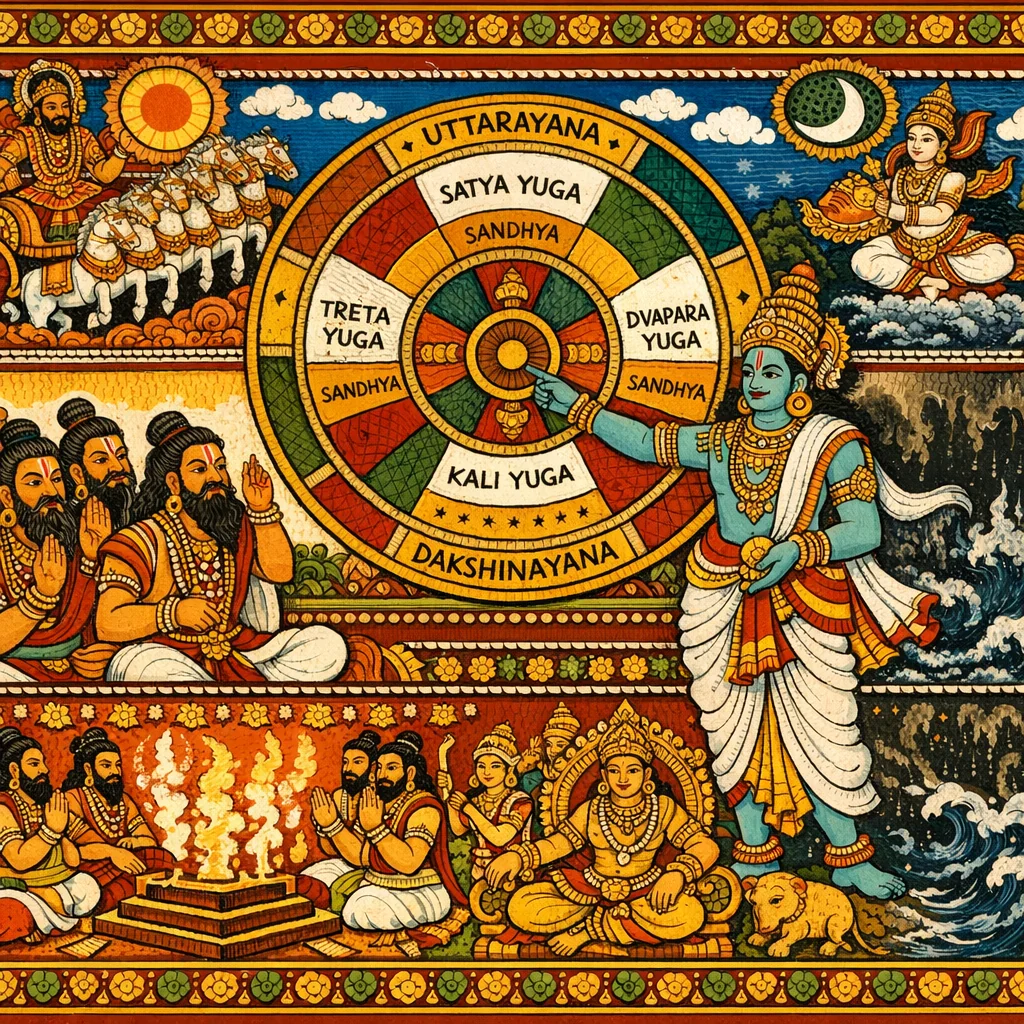
The Ṛṣis ask Sūta to recount, in proper order and exact number, the caturyugas occurring in the early Svāyambhuva Manvantara. Sūta first standardizes time-measurement from nimeṣa-based micro-units up to day and night, then correlates human time with Pitṛ time (a month as their day–night) and deva time (a human year as their day–night; uttarāyaṇa/dakṣiṇāyaṇa as day/night). On this basis he defines Kṛta, Tretā, Dvāpara, and Kali with their sandhyā and sandhyāṃśa junctions, states the 12,000 divine-year total of a caturyuga, and gives the corresponding spans in human years. He then scales upward: 71 caturyugas (with the additional interval) make a Manvantara; the inter-Manu intervals are noted; fourteen Manvantaras form a Kalpa, after which the great dissolution is taught. The chapter closes by turning from chronology to yuga-dharma: in Tretā, Manu and the Saptarṣis set forth Śrauta and Smārta dharma, establish varṇa–āśrama, assign yajñas by varṇa, and describe cakravartin kings—their sapta-ratna, marks, powers, and social harmony under daṇḍanīti.
Key Concepts
Shlokas in Adhyaya 142
Verse 1
*ऋषय ऊचुः चतुर्युगाणि यानि स्युः पूर्वे स्वायम्भुवे ऽन्तरे एषां निसर्गसंख्यां च श्रोतुमिच्छाम विस्तरात् //
The sages said: “We wish to hear in detail the number and sequence, by the natural reckoning, of the caturyugas that occur in the earlier Svāyambhuva Manvantara.”
Verse 2
*सूत उवाच पृथिवीद्युप्रसङ्गेन मया तु प्रागुदाहृतम् एतच्चतुर्युगं त्वेवं तद्वक्ष्यामि निबोधत तत्प्रमाणं प्रसंख्याय विस्तराच्चैव कृत्स्नशः //
Sūta said: “Earlier, in connection with the earth and the heavenly worlds, I had already spoken of it. Now I shall explain to you this caturyuga. Listen attentively as I set forth its measure—fully, in due detail, and by proper enumeration.”
Verse 3
लौकिकेन प्रमाणेन निष्पाद्याब्दं तु मानुषम् तेनापीह प्रसंख्याय वक्ष्यामि तु चतुर्युगम् निमेषतुल्यकालानि मात्रालब्धेक्षराणि च //
First, using the common worldly standard of measure, I shall establish the human year; then, reckoning from that, I will explain the caturyuga cycle—together with the time-units equal to a nimeṣa and the syllables obtained by counting mātrās.
Verse 4
काष्ठा निमेषा दश पञ्च चैव त्रिंशच्च काष्ठां गणयेत्कलां तु त्रिंशत्कलाश्चैव भवेन्मुहूर्तस् तैस्त्रिंशता रात्र्यहनी समेते //
Fifteen nimeṣas make one kāṣṭhā; thirty kāṣṭhās are counted as one kalā. Thirty kalās make one muhūrta; and by thirty muhūrtas, the night and the day are completed.
Verse 5
अहोरात्रे विभजते सूर्यो मानुषलौकिके रात्रिः स्वप्नाय भूतानां चेष्टायै कर्मणामहः //
In the human world, the Sun apportions time into day and night: night is for the sleep of beings, and day is for activity and the performance of duties.
Verse 6
पित्र्ये रात्र्यहनी मासः प्रविभागस् तयोः पुनः कृष्णपक्षस् त्वहस्तेषां शुक्लः स्वप्नाय शर्वरी //
In the realm of the Pitṛs (ancestors), a month is made up of their day and night; and its division is as follows: the dark fortnight (kṛṣṇa-pakṣa) is their daytime, while the bright fortnight (śukla-pakṣa) is their night, appointed for sleep.
Verse 7
त्रिंशद्ये मानुषा मासाः पित्र्यो मासः स उच्यते शतानि त्रीणि मासानां षष्ट्या चाभ्यधिकानि तु पित्र्यः संवत्सरो ह्येष मानुषेण विभाव्यते //
Thirty human months are said to make one month of the Pitṛs. And three hundred and sixty human months—by human reckoning—are indeed regarded as one year of the Pitṛs.
Verse 8
मानुषेणैव मानेन वर्षाणां यच्छतं भवेत् पितॄणां तानि वर्षाणि संख्यातानि तु त्रीणि वै दश च द्व्यधिका मासाः पितृसंख्येह कीर्तिता //
By the human measure, whatever amounts to one hundred years becomes, in the reckoning of the Pitṛs, their years; and in this Pitṛ-calculation it is declared to be three years with ten months added—thus is the ancestral count stated here.
Verse 9
लौकिकेन प्रमाणेन अब्दो यो मानुषः स्मृतः एतद्दिव्यमहोरात्रम् इत्येषा वैदिकी श्रुतिः //
By the common worldly measure, what is remembered as a human “year”—that itself is the day-and-night of the gods; thus declares the Vedic Śruti.
Verse 10
दिव्ये रात्र्यहनी वर्षं प्रविभागस्तयोः पुनः अहस्तु यदुदक्चैव रात्रिर्या दक्षिणायनम् एते रात्र्यहनी दिव्ये प्रसंख्याते तयोः पुनः //
A human year constitutes the divine day-and-night; and their division is explained again: the day is the uttarāyaṇa (northward course), and the night is the dakṣiṇāyaṇa (southward course). Thus are that divine day and night reckoned accordingly.
Verse 11
त्रिंशद्यानि तु वर्षाणि दिव्यो मासस्तु स स्मृतः मानुषाणां शतं यच्च दिव्या मासास्त्रयस्तु वै तथैव सह संख्यातो दिव्य एष विधिः स्मृतः //
Thirty human years are remembered as constituting one divine month. Likewise, one hundred human years amount to three divine months. In this way, this traditional method of reckoning “divine time” is preserved.
Verse 12
त्रीणि वर्षशतान्येवं षष्टिर्वर्षास्तथैव च दिव्यः संवत्सरो ह्येष मानुषेण प्रकीर्तितः //
Thus, three hundred years, and likewise sixty years more—when reckoned in human years—are declared to constitute one divine year.
Verse 13
त्रीणि वर्षसहस्राणि मानुषेण प्रमाणतः त्रिंशदन्यानि वर्षाणि स्मृतः सप्तर्षिवत्सरः //
By human reckoning, three thousand years—together with another thirty years—are remembered as one ‘Saptarishi year’, the year measured by the cycle of the Seven Sages.
Verse 14
नव यानि सहस्राणि वर्षाणां मानुषाणि च वर्षाणि नवतिश्चैव ध्रुवसंवत्सरः स्मृतः //
Nine thousand human years—together with a further ninety years—are traditionally known as the Dhruva-year (dhruva-saṃvatsara).
Verse 15
षट्त्रिंशत्तु सहस्राणि वर्षाणां मानुषाणि च षष्टिश्चैव सहस्राणि संख्यातानि तु संख्यया दिव्यं वर्षसहस्रं तु प्राहुः संख्याविदो जनाः //
Thirty-six thousand human years—and additionally sixty thousand more—are reckoned by calculation; those skilled in enumeration declare that this amounts to one thousand divine years.
Verse 16
इत्येतदृषिभिर्गीतं दिव्यया संख्यया द्विजाः दिव्येनैव प्रमाणेन युगसंख्या प्रकल्पिता //
Thus, O twice-born ones (dvijas), this has been sung by the sages in a divine system of numbers; by that very divine standard of measure, the computation of the yugas has been set forth.
Verse 17
चत्वारि भारते वर्षे युगानि ऋषयो ऽब्रुवन् कृतं त्रेता द्वापरं च कलिश्चैवं चतुर्युगम् //
In Bharata-varṣa, the seers declared that there are four ages—Kṛta (Satya), Tretā, Dvāpara, and Kali—thus constituting the fourfold cycle called caturyuga.
Verse 18
पूर्वं कृतयुगं नाम ततस्त्रेताभिधीयते द्वापरं च कलिश्चैव युगानि परिकल्पयेत् //
First comes the age called Kṛta (Satya); after that it is known as Tretā; then come Dvāpara and Kali—thus one should conceive the yugas as a fourfold cycle.
Verse 19
चत्वार्याहुः सहस्राणि वर्षाणां तत्कृतं युगम् तस्य ताव् अच्छती संध्या संध्यांशश्च तथाविधः //
They say that the Kṛta Yuga consists of four thousand years; and that its twilight junction (sandhyā) is of the same measure, and its twilight portion (sandhyāṃśa) is likewise of that very kind.
Verse 20
इतरेषु ससंध्येषु ससंध्यांशेषु च त्रिषु एकपादे निवर्तन्ते सहस्राणि शतानि च //
In the other three yugas as well, together with their sandhyā junctions and sandhyāṃśa portions, the amounts reckoned in thousands and hundreds are reduced to a single quarter (ekapāda) alone.
Verse 21
त्रेता त्रीणि सहस्राणि युगसंख्याविदो विदुः तस्यापि त्रिशती संध्या संध्यांशः संध्यया समः //
Those who know the reckoning of the yugas declare that the Tretā-yuga consists of three thousand (divine years). Its twilight period (sandhyā) is three hundred, and its succeeding twilight portion (sandhyāṃśa) is equal to the sandhyā.
Verse 22
द्वे सहस्रे द्वापरं तु संध्यांशौ तु चतुःशतम् सहस्रमेकं वर्षाणां कलिरेव प्रकीर्तितः द्वे शते च तथान्ये च संध्यासंध्यांशयोः स्मृते //
The Dvāpara Yuga is said to be two thousand (divine) years, with its twilight portions (sandhyā and sandhyāṃśa) totaling four hundred. Kali Yuga is proclaimed to be one thousand years, and for it the twilight and the twilight’s fraction are remembered as two hundred and another two hundred.
Verse 23
एषा द्वादशसाहस्री युगसंख्या तु संज्ञिता कृतं त्रेता द्वापरं च कलिश्चेति चतुष्टयम् //
This is known as the yuga-count of twelve thousand (years): the fourfold set consisting of Kṛta, Tretā, Dvāpara, and Kali.
Verse 24
तत्र संवत्सराः सृष्टा मानुषास्तान्निबोधत नियुतानि दश द्वे च पञ्च चैवात्र संख्यया अष्टाविंशत्सहस्राणि कृतं युगमथोच्यते //
Now understand the human years laid down here: by this reckoning—ten niyutas, and also two and five—twenty‑eight thousand (years) are declared to be the Kṛta Yuga.
Verse 25
प्रयुतं तु तथा पूर्णं द्वे चान्ये नियुते पुनः षण्णवतिसहस्राणि संख्यातानि च संख्यया त्रेतायुगस्य संख्यैषा मानुषेण तु संज्ञिता //
A prayuta (ten thousand) is taken as complete; and again, two niyutas (two hundred thousand) together with ninety‑six thousand are reckoned by calculation. This is declared to be the human-number (mānuṣa-saṃjñā) for the measure of the Tretā-yuga.
Verse 26
अष्टौ शतसहस्राणि वर्षाणां मानुषाणि तु चतुःषष्टिसहस्राणि वर्षाणां द्वापरं युगम् //
The Dvāpara Yuga consists of 800,000 human years, with an additional 64,000 years.
Verse 27
चत्वारि नियुतानि स्युर् वर्षाणि तु कलिर्युगम् द्वात्रिंशच्च तथान्यानि सहस्राणि तु संख्यया एतत्कलियुगं प्रोक्तं मानुषेण प्रमाणतः //
Kali-yuga consists of four niyutas of years, and additionally 32,000 years by count. Thus this Kali-yuga is stated according to the human measure of time.
Verse 28
एषा चतुर्युगावस्था मानुषेण प्रकीर्तिता चतुर्युगस्य संख्याता संध्या संध्यांशकैः सह //
Thus the condition (full measure) of the four-yuga cycle has been set forth by Manu in human terms; the total reckoning of a caturyuga is to be understood together with its twilight (sandhyā) and twilight-portions (sandhyāṃśa).
Verse 29
एषा चतुर्युगाख्या तु साधिका त्वेकसप्ततिः कृतत्रेतादियुक्ता सा मनोरन्तरमुच्यते //
This unit called a “cycle of four yugas”—seventy-one of them (with an additional portion), comprising Kṛta, Tretā, and the rest—is declared to be the interval of a Manu (a Manvantara).
Verse 30
मन्वन्तरस्य संख्या तु मानुषेण निबोधत एकत्रिंशत्तथा कोट्यः संख्याताः संख्यया द्विजैः //
Now understand the measure of a Manvantara in human terms: the twice-born (dvija) have reckoned it, by established computation, as thirty-one crores of years.
Verse 31
तथा शतसहस्राणि दश चान्यानि भागशः सहस्राणि तु द्वात्रिंशच् छतान्यष्टाधिकानि च //
Likewise, in due proportion, there are ten additional hundred-thousands; and further there are thirty-two thousands, and also two hundreds increased by eight.
Verse 32
अशीतिश्चैव वर्षाणि मासाश्चैवाधिकास्तु षट् मन्वन्तरस्य संख्यैषा मानुषेण प्रकीर्तिता //
Eighty years indeed, with six additional months besides—this is declared to be the measure of a Manvantara when stated in human reckoning.
Verse 33
दिव्येन च प्रमाणेन प्रवक्ष्याम्यन्तरं मनोः सहस्राणां शतान्याहुः स च वै परिसंख्यया //
And now, by the divine measure of time, I shall explain the interval of a Manu. It is declared to be hundreds of thousands, and that too by precise calculation.
Verse 34
चत्वारिंशत्सहस्राणि मनोरन्तरमुच्यते मन्वन्तरस्य कालस्तु युगैः सह प्रकीर्तितः //
The interlude between Manus (manorantara) is said to be forty thousand (years). Thus is proclaimed the duration of a Manvantara together with its Yugas.
Verse 35
एषा चतुर्युगाख्या तु साधिका ह्येकसप्ततिः क्रमेण परिवृत्ता सा मनोरन्तरमुच्यते //
This unit called the cycle of four Yugas (caturyuga), when completed in due order seventy-one times (with the requisite additional interval), is termed a Manvantara—the period of a Manu.
Verse 36
एतच्चतुर्दशगुणं कल्पमाहुस्तु तद्विदः ततस्तु प्रलयः कृत्स्नः स तु संप्रलयो महान् //
Those who know the doctrine declare this to be a Kalpa fourteenfold in measure; thereafter occurs the total dissolution—indeed, that is the great and complete dissolution (Mahā-saṃpralaya).
Verse 37
कल्पप्रमाणो द्विगुणो यथा भवति संख्यया चतुर्युगाख्या व्याख्याता कृतं त्रेतायुगं च वै //
By numerical computation, the measure of a Kalpa becomes double; and the fourfold age-cycle (Caturyuga) has been explained—namely the Kṛta (Satya) Yuga and also the Tretā Yuga.
Verse 38
त्रेतासृष्टं प्रवक्ष्यामि द्वापरं कलिमेव च युगपत्समवेतौ द्वौ द्विधा वक्तुं न शक्यते //
I shall describe what pertains to the Tretā age, and also the Dvāpara and the Kali. Yet two ages that have come together at the same time cannot be explained separately as though divided into two.
Verse 39
क्रमागतं मयाप्येतत् तुभ्यं नोक्तं युगद्वयम् ऋषिवंशप्रसङ्गेन व्याकुलत्वात्तथा क्रमात् //
Although this topic arose in proper sequence, I did not tell you of the two yugas, because—preoccupied with the episode concerning the lineage of the ṛṣis—I proceeded in that order and was distracted by that digression.
Verse 40
नोक्तं त्रेतायुगे शेषं तद्वक्ष्यामि निबोधत अथ त्रेतायुगस्यादौ मनुः सप्तर्षयश्च ये श्रौतस्मार्तं ब्रुवन्धर्मं ब्रह्मणा तु प्रचोदिताः //
What remains unsaid about the Tretā Yuga I shall now declare; listen attentively. At the beginning of the Tretā Yuga, Manu and the Seven Ṛṣis, urged on by Brahmā, proclaimed the dharma according to the Śrauta and Smārta traditions.
Verse 41
दाराग्निहोत्रसम्बन्धम् ऋग्यजुःसामसंहिताः इत्यादिबहुलं श्रौतं धर्मं सप्तर्षयो ऽब्रुवन् //
The Seven Sages declared the Śrauta form of dharma—abundant in injunctions—connected with the wife and the Agnihotra, and grounded in the Saṁhitās of the Ṛg, Yajus, and Sāman (and the rest of the Vedic corpus).
Verse 42
परम्परागतं धर्मं स्मार्तं त्वाचारलक्षणम् वर्णाश्रमाचारयुतं मनुः स्वायम्भुवो ऽब्रवीत् //
The ancient dharma transmitted through lineage—the Smārta dharma, marked by right conduct—together with the practices of the varṇas and āśramas, was taught by Svāyambhuva Manu.
Verse 43
सत्येन ब्रह्मचर्येण श्रुतेन तपसा तथा तेषां सुतप्ततपसाम् आर्षेणानुक्रमेण ह //
By truthfulness, by the discipline of brahmacarya, by sacred learning (śruti), and likewise by austerity—thus, for those sages who have performed intense penance, their succession is preserved according to the ṛṣi-lineage and its proper order.
Verse 44
सप्तर्षीणां मनोश्चैव आदौ त्रेतायुगे ततः अबुद्धिपूर्वकं तेन सकृत्पूर्वकमेव च //
In the beginning—and later in the Tretā Yuga as well—this account/practice concerning the Seven Sages and Manu was undertaken by him, first without full understanding, and then once again with deliberate intent.
Verse 45
अभिवृत्तास्तु ते मन्त्रा दर्शनैस्तारकादिभिः आदिकल्पे तु देवानां प्रादुर्भूतास्तु ते स्वयम् //
Those mantras were indeed brought to full expression through the philosophical systems—beginning with the Tāraka and others; and in the primordial aeon they manifested of themselves for the benefit of the gods.
Verse 46
प्रमाणेष्वथ सिद्धानाम् अन्येषां च प्रवर्तते मन्त्रयोगो व्यतीतेषु कल्पेष्वथ सहस्रशः ते मन्त्रा वै पुनस्तेषां प्रतिमायामुपस्थिताः //
Thus, in the authoritative canons of measure and iconographic rule, the accomplished masters—and others as well—set forth the discipline of mantra-yoga, the application of mantras. Though thousands of kalpas have passed, those very mantras again become present for them within the consecrated image (pratimā).
Verse 47
ऋचो यजूंषि सामानि मन्त्राश्चाथर्वणास्तु ये सप्तर्षिभिश्च ये प्रोक्ताः स्मार्तं तु मनुरब्रवीत् //
The Ṛk-verses, the Yajus-formulas, the Sāman-chants, and the Atharvan-mantras—together with the teachings declared by the Seven Sages—these Manu proclaimed as the authoritative tradition of Smārta dharma.
Verse 48
त्रेतादौ संहता वेदाः केवलं धर्मसेतवः संरोधादायुषश्चैव व्यस्यन्ते द्वापरे च ते ऋषयस्तपसा वेदान् अहोरात्रमधीयते //
In the beginning of the Tretā age, the Vedas remain compact and undivided, serving solely as bridges that uphold dharma. But owing to constraint and the shortening of lifespan, they are arranged into divisions in the Dvāpara age. Then the seers, through ascetic discipline (tapas), study the Vedas day and night.
Verse 49
अनादिनिधना दिव्याः पूर्वं प्रोक्ताः स्वयम्भुवा स्वधर्मसंवृताः साङ्गा यथाधर्मं युगे युगे विक्रियन्ते स्वधर्मं तु वेदवादाद्यथायुगम् //
These divine ordinances—without beginning or end—were formerly proclaimed by Svayambhū (Brahmā). Endowed with their own proper dharma and complete with the auxiliary disciplines (sāṅga), they undergo modification from age to age in accordance with dharma; thus one’s proper duty is to be determined from Vedic teaching, as suited to each yuga.
Verse 50
आरम्भयज्ञः क्षत्रस्य हविर्यज्ञा विशः स्मृताः परिचारयज्ञाः शूद्राश्च जपयज्ञाश्च ब्राह्मणाः //
For the Kṣatriya, the sacrifice called Ārambha-yajña is prescribed; for the Vaiśya, the Havis-yajñas are declared. For the Śūdra, sacrifices consisting in service (paricaryā) are enjoined; and for the Brāhmaṇa, sacrifices consisting in japa (sacred recitation) are prescribed.
Verse 51
ततः समुदिता वर्णास् त्रेतायां धर्मशालिनः क्रियावन्तः प्रजावन्तः समृद्धाः सुखिनश्च वै //
Then, in the Tretā-yuga, the social orders (varṇas) became fully established—upholding dharma, devoted to prescribed rites and duties, blessed with progeny, prosperous, and indeed happy.
Verse 52
ब्राह्मणैश्च विधीयन्ते क्षत्रियाः क्षत्रियैर्विशः वैश्याञ्छूद्रा अनुवर्तन्ते परस्परमनुग्रहात् //
Brahmins guide and regulate the Kshatriyas; the Kshatriyas in turn regulate the common people (Vaishyas). The Shudras follow and serve the Vaishyas—thus, through mutual support and goodwill, the social order is sustained.
Verse 53
शुभाः प्रकृतयस्तेषां धर्मा वर्णाश्रमाश्रयाः संकल्पितेन मनसा वाचा वा हस्तकर्मणा त्रेतायुगे ह्यविकले कर्मारम्भः प्रसिध्यति //
Their dispositions are auspicious, and their duties rest upon the disciplines of varṇa and āśrama. In the Tretā-yuga, when it is still uncorrupted, the undertaking of action becomes effective—whether through an intention formed in the mind, through speech, or through deeds performed by the hand.
Verse 54
आयूरूपं बलं मेधा आरोग्यं धर्मशीलता सर्वसाधारणं ह्येतद् आसीत्त्रेतायुगे तु वै //
Long life, beauty of form, strength, intelligence, good health, and a disposition grounded in dharma—these were, indeed, qualities commonly shared by all in the Tretā Yuga.
Verse 55
वर्णाश्रमव्यवस्थानम् एषां ब्रह्मा तथाकरोत् संहिताश्च तथा मन्त्रा आरोग्यं धर्मशीलता //
For them, Brahmā likewise established the proper organization of varṇas and āśramas; and he also set forth the saṃhitās and the mantras—granting health and a disposition grounded in dharma.
Verse 56
संहिताश्च तथा मन्त्रा ऋषिभिर् ब्रह्मणः सुतैः यज्ञः प्रवर्तितश्चैव तदा ह्येव तु दैवतैः //
The Saṃhitās and the mantras were likewise set forth by the seers, the sons of Brahmā; and at that very time the gods themselves caused the sacrificial rite (yajña) to be established in practice.
Verse 57
यामैः शुक्लैर्जयैश्चैव सर्वसाधनसंभृतैः विश्वसृड्भिस् तथा सार्धं देवेन्द्रेण महौजसा स्वायम्भुवे ऽन्तरे देवैस् ते यज्ञाः प्राक्प्रवर्तिताः //
In the Svāyambhuva Manvantara, those sacrifices were first set in motion by the gods—together with the Yāmas, the Śuklas, and the Jayas, fully furnished with every requisite means—along with the Viśvasṛj deities and the mighty Indra.
Verse 58
सत्यं जपस्तपो दानं पूर्वधर्मो य उच्यते यदा धर्मस्य ह्रसते शाखाधर्मस्य वर्धते //
Truthfulness, sacred recitation (japa), austerity (tapas), and charity (dāna)—these are declared to be the ancient, foundational Dharma. When that Dharma declines, the branch-like, sectarian forms of Dharma increase.
Verse 59
जायन्ते च तदा शूरा आयुष्मन्तो महाबलाः न्यस्तदण्डा महायोगा यज्वानो ब्रह्मवादिनः //
And then are born heroic men—long-lived and exceedingly strong—who have laid aside violence, are great practitioners of yoga, devoted sacrificers, and proclaimers of Brahman, the Vedic truth.
Verse 60
पद्मपत्त्रायताक्षाश्च पृथुवक्त्राः सुसंहताः सिंहोरस्का महासत्त्वा मत्तमातंगगामिनः //
They have eyes long like lotus-petals, broad faces, and well-knit, compact frames; lion-chested and great-souled, they move with the gait of an intoxicated elephant.
Verse 61
महाधनुर्धराश्चैव त्रेतायां चक्रवर्तिनः सर्वलक्षणपूर्णास्ते न्यग्रोधपरिमण्डलाः //
In the Tretā-yuga, they were mighty bearers of great bows and cakravartins (universal monarchs); endowed with all auspicious marks, they were broad and well-proportioned—like the wide-spreading circle of the nyagrodha (banyan).
Verse 62
न्यग्रोधौ तु स्मृतौ बाहू व्यामो न्यग्रोध उच्यते व्यामेन सूच्छ्रयो यस्य अत ऊर्ध्वं तु देहिनः समुच्छ्रयः परीणाहो न्यग्रोधपरिमण्डलः //
The two arms are remembered as the measure called “nyagrodha”, and the full outstretched arm-span is called “vyāma”. For one whose bodily height (from the feet upward) equals that vyāma, the total stature and circumference are termed “nyagrodha-parimaṇḍala”, the banyan-like symmetry of perfect proportion.
Verse 63
चक्रं रथो मणिर्भार्या निधिरश्वो गजस्तथा प्रोक्तानि सप्त रत्नानि पूर्वं स्वायम्भुवे ऽन्तरे //
The cakra (sovereign wheel), the chariot, the jewel, the queen, the treasure, the horse, and likewise the elephant—these were proclaimed as the seven “jewels” (sapta-ratna) in the earlier age, in the Manvantara of Svāyambhuva Manu.
Verse 64
विष्णोरंशेन जायन्ते पृथिव्यां चक्रवर्तिनः मन्वन्तरेषु सर्वेषु ह्य् अतीतानागतेषु वै //
Cakravartins (universal monarchs) are born upon the earth through a portion of Viṣṇu’s power—indeed, in every Manvantara, whether in those that have passed or those yet to come.
Verse 65
भूतभव्यानि यानीह वर्तमानानि यानि च त्रेतायुगानि तेष्वत्र जायन्ते चक्रवर्तिनः //
In ages that are past and in those yet to come, as well as in those present here—within those Tretā-yugas, cakravartins (universal monarchs) are born.
Verse 66
भद्राणीमानि तेषां च विभाव्यन्ते महीक्षिताम् अत्यद्भुतानि चत्वारि बलं धर्मं सुखं धनम् //
For those kings, these auspicious excellences are discerned: four truly wondrous endowments—strength, dharma (righteousness), happiness, and wealth.
Verse 67
अन्योन्यस्याविरोधेन प्राप्यन्ते नृपतेः समम् अर्थो धर्मश्च कामश्च यशो विजय एव च //
When they do not conflict with one another, a king attains all of these together: prosperity (artha), dharma (righteousness), legitimate enjoyment (kāma), fame (yaśas), and victory indeed.
Verse 68
ऐश्वर्येणाणिमाद्येन प्रभुशक्तिबलान्विताः श्रुतेन तपसा चैव ऋषींस्ते ऽभिभवन्ति हि //
Endowed with sovereign power—such as aṇimā and the other extraordinary attainments—strengthened by mastery and might, and supported by sacred learning (śruti) and austerity (tapas), they indeed surpass even the sages (ṛṣis).
Verse 69
बलेनाभिभवन्त्येते तेन दानवमानवान् लक्षणैश्चैव जायन्ते शरीरस्थैरमानुषैः //
By their sheer force, these beings overpower even Dānavas and humans; and they are recognized by non-human bodily marks that manifest as fixed signs upon the body.
Verse 70
केशाः स्थिता ललाटेन जिह्वा च परिमार्जनी श्यामप्रभाश्चतुर्दंष्ट्राः सुवंशाश्चोर्ध्वरेतसः //
Their hair is set upon the forehead; the tongue is fashioned as a cleanser. They shine with a dark luster, have four fangs, are of noble lineage, and are depicted as practicing continence, with the vital seed directed upward (ūrdhva-retas).
Verse 71
आजानुबाहवश्चैव तालहस्तौ वृषाकृती परिणाहप्रमाणाभ्यां सिंहस्कन्धाश्च मेधिनः //
They should have arms reaching down to the knees, palms measured in tāla-units, and a bull-like, well-knit and powerful build; with proportionate breadth and girth, lion-like shoulders, and a solid, well-set physique.
Verse 72
पादयोश्चक्रमत्स्यौ तु शङ्खपद्मे च हस्तयोः पञ्चाशीतिसहस्राणि जीवन्ति ह्यजरामयाः //
On His feet are the marks of the Discus (Cakra) and the Fish, and in His hands are the Conch (Śaṅkha) and the Lotus (Padma). Those beings live for eighty-five thousand years, indeed free from old age and disease.
Verse 73
असङ्गा गतयस्तेषां चतस्रश्चक्रवर्तिनाम् अन्तरिक्षे समुद्रेषु पाताले पर्वतेषु च //
Unhindered are their movements—fourfold are the courses of those universal monarchs: through the mid-air, across the oceans, into Pātāla (the netherworld), and upon the mountains.
Verse 74
इज्या दानं तपः सत्यं त्रेताधर्मास्तु वै स्मृताः तदा प्रवर्तते धर्मो वर्णाश्रमविभागशः मर्यादास्थापनार्थं च दण्डनीतिः प्रवर्तते //
Worship in sacrificial duty (ijyā), charity (dāna), austerity (tapas), and truthfulness (satya) are remembered as the dharmas of the Tretā age. Then dharma proceeds according to the divisions of varṇa and āśrama; and, for the establishment of proper boundaries and order, the science of punishment and governance (daṇḍanīti) also comes into operation.
Verse 75
हृष्टपुष्टा जनाः सर्वे अरोगाः पूर्णमानसाः एको वेदश्चतुष्पादस् त्रेतायां तु विधिः स्मृतः त्रीणि वर्षसहस्राणि जीवन्ते तत्र ताः प्रजाः //
In the Tretā Yuga, all people are cheerful and well-nourished, free from disease and of fulfilled minds. The Veda is one, yet it stands on four feet (fully established); such is the ordained order remembered for the Tretā. The beings there live for three thousand years.
Verse 76
पुत्रपौत्रसमाकीर्णा म्रियन्ते च क्रमेण ताः एष त्रेतायुगे भावस् त्रेतासंख्यां निबोधत //
Surrounded by sons and grandsons, they pass away in due succession. Such is the condition in the Tretā Yuga—now understand the reckoning (numbers) for the Tretā.
Verse 77
त्रेतायुगस्वभावेन संध्यापादेन वर्तते संध्यापादः स्वभावाच्च यो ऽंशः पादेन तिष्ठति //
By the inherent character of the Tretā Yuga, the age proceeds with a “twilight-quarter” (saṃdhyā-pāda). And that twilight-quarter, by its very nature, is the portion that stands as one quarter of the whole.
Frequently Asked Questions
It teaches the Purāṇic science of time (kāla): how to measure and convert time from nimeṣa up to divine years, how the four yugas are computed with sandhyā and sandhyāṃśa, how 71 caturyugas (with an added interval) define a Manvantara, and how this chronology connects to dharma-history—especially the promulgation of Śrauta–Smārta dharma and varṇa–āśrama order in Tretā-yuga.
This chapter is primarily Creation/Cosmology via time-reckoning (yugas, Manvantara, Kalpa, pralaya) and Dharma/Rājadharma via Tretā-yuga norms: Śrauta and Smārta traditions, varṇa–āśrama duties, yajña-types by varṇa, daṇḍanīti, and the ideal cakravartin king with sapta-ratna. Vāstu is not the focus in this adhyāya.
It states that a human year equals one day-and-night of the gods, divided as uttarāyaṇa (day) and dakṣiṇāyaṇa (night). For the Pitṛs, a month functions as their day-and-night, where the dark fortnight is their day and the bright fortnight is their night; it then gives conversions from human months/years into Pitṛ reckoning.
It presents the four yugas—Kṛta, Tretā, Dvāpara, Kali—with junction periods called sandhyā (dawn) and sandhyāṃśa (dusk/remaining junction portion). The total yuga-count is given as 12,000 (divine years) for the full caturyuga, and then translated into human-year magnitudes, emphasizing that the junctions are included in the full measure.
A Manvantara is defined as 71 cycles of the four yugas (caturyugas), together with an additional interval (manorantara). The chapter then scales this up to the Kalpa framework (fourteen Manvantaras) and relates it to dissolution at the end of the cycle.
Tretā-yuga is depicted as the age where Śrauta and Smārta dharma are formally proclaimed by Manu and the Saptarṣis, varṇa–āśrama order becomes stable, yajñas are assigned by varṇa (ārambha/havis/paricaryā/japa), and daṇḍanīti operates to establish social boundaries and order; people are described as healthy, long-lived, and prosperous.
Read Matsya Purana in the Vedapath app
Scan the QR code to open this directly in the app, with audio, word-by-word meanings, and more.