Adhyaya 7
Droṇasya raudra-prayogaḥ (Droṇa’s intensified assault and the Pāṇḍava response)
Upa-parva: Droṇa-vadha (Contextual Arc: Droṇa’s battlefield onslaught and containment attempts)
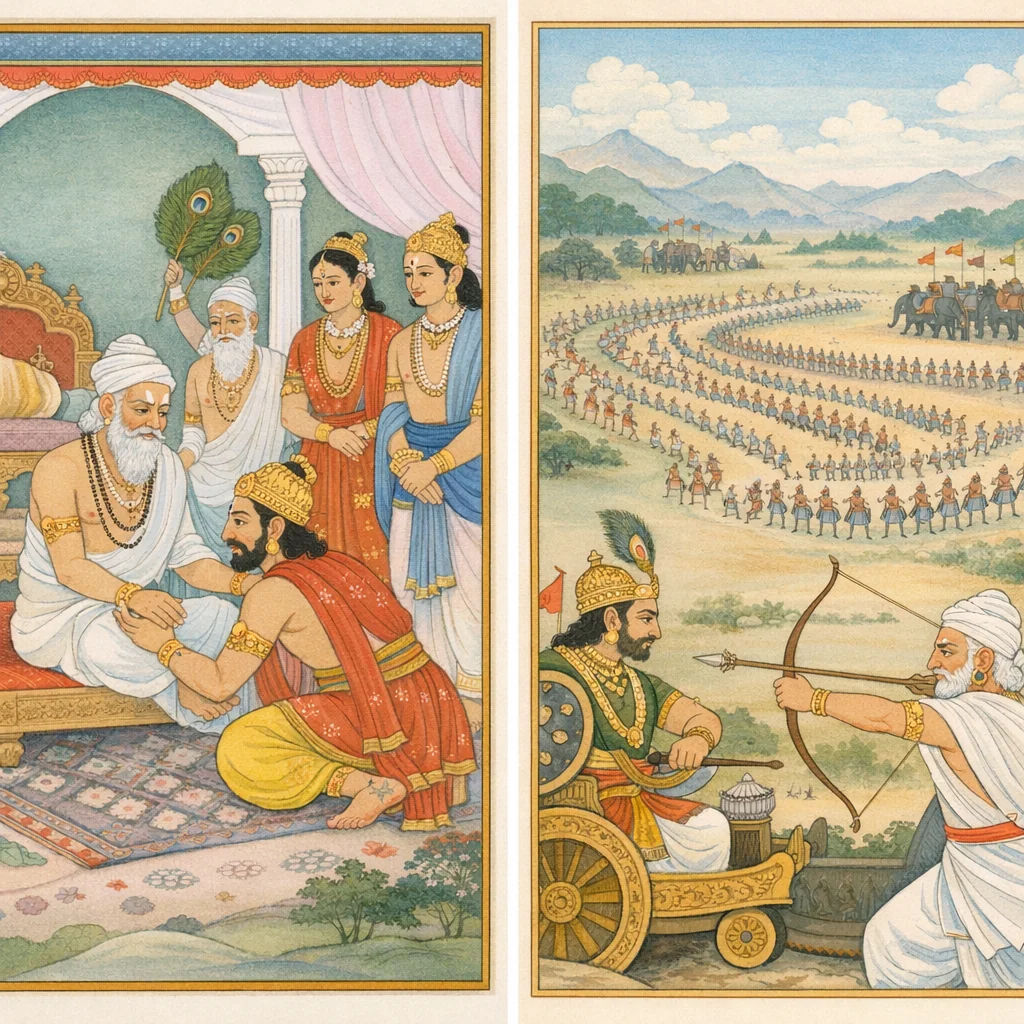
Saṃjaya reports that the Pāṇḍavas, unsettled by Droṇa’s effective strikes against chariots, horses, elephants, and warriors, initially fail to contain him. Yudhiṣṭhira then instructs Dhṛṣṭadyumna and Arjuna to restrain Droṇa from all sides, prompting a broad convergence of allied leaders (including Bhīma, Abhimanyu, Ghaṭotkaca, the twins, the Matsyas, the sons of Drupada, the Draupadeyas, Sātyaki, and others). Droṇa, angered, increases operational ferocity: he moves rapidly across unit-types, projects dense missile volleys, and generates overwhelming battlefield sound—chariot rumble, bowstring snap, and collective cries—producing fear-driven dispersal and re-aggregation among troops. The narration emphasizes the visible and auditory theatre of war (standards, dust-cloud imagery, thunder-like noise) alongside tactical outcomes (heavy casualties, disrupted formations). The chapter closes with a victory-cry from the Pāṇḍavas after the fall of the ācārya in battle, framed as a seismic, morale-shifting event observed even by non-human witnesses within the epic’s cosmological register.
Chapter Arc: भीष्म के पतन के बाद कौरव-सभा में शोक और भय के बीच एक ही प्रश्न गूंजता है—अब सेनापति कौन? उसी क्षण द्रोणाचार्य का नाम उठता है, और युद्ध का भाग्य एक नए हाथ में सौंपा जाने लगता है। → दुर्योधनमुख नरेश द्रोण का सेनापति-पद पर अभिषेक करते हैं (जैसे देवताओं ने स्कन्द का किया था)। द्रोण अपनी प्रतिज्ञा और नीति स्पष्ट करते हैं—पाण्डवों को युद्ध में जकड़कर विजय की दिशा में ले जाना; पर साथ ही वे धृष्टद्युम्न को न मारने का वचन देते हैं, क्योंकि उसे वे अपने ही वध के लिए नियत मानते हैं। दोनों सेनाएँ व्यूहों में उतरती हैं; पाण्डव-सेना का क्रौंचव्यूह युधिष्ठिर द्वारा रचा हुआ दिखता है, और द्रोण उसे भेदने/विक्षुब्ध करने को अग्रसर होते हैं। → रणभूमि में द्रोण का प्रचण्ड पराक्रम फूट पड़ता है—वे धृष्टद्युम्न पर इन्द्रवत् बाण-वर्षा करते हैं, पाण्डवों और उनके सहायक राजाओं को सिंह की भाँति बार-बार तितर-बितर करते हैं, और अपनी सेना को स्थिर कर निर्णायक दबाव बनाते हैं। → कौरव पक्ष में नया उत्साह और मनोबल स्थापित होता है—कर्ण के उभार/उपस्थिति से भीष्म-वध का शोक हल्का पड़ता है और राजाओं में ‘विशोक’ भाव आता है। पाण्डव पक्ष पर द्रोण की रणनीति और शर-वृष्टि का भार बढ़ता है, युद्ध का स्वरूप भीष्म-युग से द्रोण-युग में बदल जाता है। → द्रोण की प्रतिज्ञा (धृष्टद्युम्न को न मारना) और फिर भी उसी पर केन्द्रित आक्रमण—यह विरोधाभास अगले संघर्षों में किस प्रकार निर्णायक मोड़ बनेगा, और कौन-सा उपाय द्रोण को रोकेगा?
Shlokas
Verse 1
अपन का छा | अकाल सप्तमो<्ध्याय: द्रोणाचार्यका सेनापतिके पदपर अभिषेक, कौरव-पाण्डव- सेनाओंका युद्ध और द्रोणका पराक्रम द्रोण उदाच वेदं षडड़ृ वेदाहमर्थविद्यां च मानवीम् । त्रैय्यम्बकमथेष्वस्त्रं शस्त्राणि विविधानि च,द्रोणाचार्यने कहा--राजन्! मैं छहों अंगोंसहित वेद, मनुजीका कहा हुआ अर्थशास्त्र, भगवान् शंकरकी दी हुई बाण-विद्या और अनेक प्रकारके अस्त्र-शस्त्र भी जानता हूँ
Droṇa said: “O King, I know the Veda together with its six auxiliaries, and also the science of polity and governance taught by Manu. I also know the missile-weapon lore granted by Tryambaka (Śiva), and many kinds of weapons and arms.”
Verse 2
ये चाप्युक्ता मयि गुणा भवद्धिर्जयकाड्क्षिभि: । चिकीर्षुस्तानहं सर्वान् योधयिष्यामि पाण्डवान्,विजयकी अभिलाषा रखनेवाले तुमलोगोंने मुझमें जो-जो गुण बताये हैं, उन सबको प्राप्त करनेकी इच्छासे मैं पाण्डवोंके साथ युद्ध करूँगा
Droṇa said: “The qualities you, who long for victory, have attributed to me—I desire to realize them all. Therefore I shall engage the Pāṇḍavas in battle, driven by the wish to win.”
Verse 3
पार्षत॑ तु रणे राजन् न हनिष्ये कथंचन । स हि सृष्टी वधार्थाय ममैव पुरुषर्षभ:,राजन! मैं ट्रुपदकुमार धृष्टद्युम्नको युद्धस्थलमें किसी प्रकार भी नहीं मारूँगा; क्योंकि वह पुरुषप्रवर धृष्टद्युम्न मेरे ही वधके लिये उत्पन्न हुआ है
Sanjaya said: “O King, I will not slay the son of Pṛṣata (Dhṛṣṭadyumna) on the battlefield—by no means. For that bull among men was brought forth precisely for my own death.”
Verse 4
योधयिष्यामि सैन्यानि नाशयन् सर्वसोमकान् । नच मां पाण्डवा युद्धे योधयिष्यन्ति हर्षिता:,मैं समस्त सोमकोंका संहार करते हुए पाण्डव-सेनाओंके साथ युद्ध करूँगा; परंतु पाण्डवलोग युद्धमें प्रसन्नतापूर्वक मेरा सामना नहीं करेंगे
Sanjaya said: “I shall engage the armies in battle, utterly destroying all the Somakas. Yet the Pāṇḍavas will not confront me in war with gladness.”
Verse 5
संजय उवाच स एवमभ्यनुज्ञातश्षक्रे सेनापतिं ततः । द्रोणं तव सुतो राजन् विधिदृष्टेन कर्मणा,संजय कहते हैं--राजन्! इस प्रकार आचार्य द्रोणकी अनुमति मिल जानेपर आपके पुत्र दुर्योधनने उन्हें शास्त्रीय विधिके अनुसार सेनापतिके पदपर अभिषिक्त किया
Sanjaya said: “O King, once he had thus obtained the consent of the mighty one, your son then, in accordance with the rites prescribed by the śāstras, installed Droṇa as commander of the army.”
Verse 6
अथाभिषिषिचुद्रोंणं दुर्योधनमुखा नृपा: । सैनापत्ये यथा स्कन्दं पुरा शक्रमुखा: सुरा:,तदनन्तर जैसे पूर्वकालमें इन्द्र आदि देवताओंने स्कन्दको सेनापतिके पदपर अभिषिक्त किया था, उसी प्रकार दुर्योधन आदि राजाओंने भी द्रोणाचार्यका अभिषेक किया
Sanjaya said: “Then the kings led by Duryodhana consecrated Droṇa to the office of commander of the army—just as, in former times, the gods led by Śakra (Indra) had consecrated Skanda as their general.”
Verse 7
ततो वादित्रघोषेण शड्खानां च महास्वनै: । प्रादुरासीत् कृते द्रोणे हर्ष: सेनापतौ तदा,उस समय वाद्योंके घोष तथा शंखोंकी गम्भीर ध्वनिके साथ द्रोणाचार्यके सेनापति बना लिये जानेपर सब लोगोंके हृदयमें महान् हर्ष प्रकट हुआ इति श्रीमहाभारते द्रोणपर्वणि द्रोणाभिषेकपर्वणि द्रोणपराक्रमे सप्तमो5ध्याय: ।। ७ || इस प्रकार श्रीमह्गाभारत द्रोणपर्वके अन्तर्गत द्रोणाभिषेकपर्वमें द्रोगपराक्रमविषयक सातवाँ अध्याय पूरा हुआ
Sanjaya said: “Then, amid the clamour of musical instruments and the deep, mighty blare of conches, when Droṇa was appointed commander of the army, a great surge of joy arose in the hearts of the warriors.”
Verse 8
ततः पुण्याहघोषेण स्वस्तिवादस्वनेन च । संस्तवैर्गीतशब्दैश्व सूतमागधवन्दिनाम्,पुण्याहवाचन, स्वस्तिवाचन, सूत, मागध और वन्दीजनोंके स्तोत्र, गीत तथा श्रेष्ठ ब्राह्मणोंक जय-जयकारके शब्दसे एवं नाचनेवाली स्त्रियोंके नृत्यसे द्रोणाचार्यका विधिवत् सत्कार करके कौरवोंने यह मान लिया कि अब पाण्डव पराजित हो गये
Sañjaya said: Then, amid the auspicious cries of “puṇyāha” and the resonant blessings of “svasti,” with hymns and songs sung by the sūtas, māgadhas, and court-bards, with formal proclamations of auspiciousness, with the loud “Victory! Victory!” of eminent brāhmaṇas, and with the dances of performing women, the Kauravas duly honored Droṇācārya. In their hearts they concluded that the Pāṇḍavas were now as good as defeated.
Verse 9
जयशब्दे्द्धिजाग्रयाणां सुभगानर्तितिस्तथा | सत्कृत्य विधिना द्रोणं मेनिरे पाण्डवाञ्जितान्,पुण्याहवाचन, स्वस्तिवाचन, सूत, मागध और वन्दीजनोंके स्तोत्र, गीत तथा श्रेष्ठ ब्राह्मणोंक जय-जयकारके शब्दसे एवं नाचनेवाली स्त्रियोंके नृत्यसे द्रोणाचार्यका विधिवत् सत्कार करके कौरवोंने यह मान लिया कि अब पाण्डव पराजित हो गये
Sañjaya said: Amid the cries of victory raised by eminent brāhmaṇas, along with auspicious dancing, the Kauravas performed a formal, rule-bound honoring of Droṇa. Having thus celebrated him with due rites, they concluded that the Pāṇḍavas had now been defeated.
Verse 10
सैनापत्यं तु सम्प्राप्प भारद्वाजो महारथ: । युयुत्सु्व्यूह् सैन्यानि प्रायात् तव सुतैः सह,राजन! महारथी द्रोणाचार्य सेनापतिका पद पाकर अपनी सेनाकी व्यूह-रचना करके आपके पुत्रोंको साथ ले युद्धके लिये उत्सुक हो आगे बढ़े
Sañjaya said: Having obtained the command of the army, the great chariot-warrior Droṇa, son of Bhāradvāja, eager to fight, arranged the troops in battle-formation and advanced to battle together with your sons, O King.
Verse 11
सिन्धुराज जयद्रथ, कलिंगनरेश और आपके पुत्र विकर्ण--ये तीनों उनके दक्षिण पार्वका आश्रय ले कवच बाँधकर खड़े हुए
Sañjaya said: King Jayadratha of Sindhu, the king of Kaliṅga, and your son Vikarṇa—these three, taking position on his right flank, stood firm after fastening their armor.
Verse 12
प्रपक्ष: शकुनिस्तेषां प्रवरैर्हपसादिभि: । ययौ गान्धारकै: सार्थ विमलप्रासयोधिभि:,गान्धार देशके प्रधान-प्रधान घुड़सवारोंके साथ, जो चमकीले प्रासोंद्वारा युद्ध करनेवाले थे, गान्धारराज शकुनि उन दक्षिण पार्श्वके योद्धाओंका प्रपक्ष (सहायक) बनकर चला
Sañjaya said: Shakuni, acting as their supporting wing, advanced together with the Gandhāra warriors—foremost among them, including the Hapsa and others—fighters who wielded bright, gleaming spears. Thus the Gandhāra king took his place to strengthen that flank in the ordered violence of war.
Verse 13
सैन्धवश्नलृ कलिड्रश्न विकर्णश्र॒ तवात्मज: । दक्षिण पाश्वमास्थाय समतिष्ठन्त दंशिता:,कृपश्च कृतवर्मा च चित्रसेनो विविंशति: । दुःशासनमुखा यत्ता: सव्यं पक्षमपालयन् कृपाचार्य, कृतवर्मा, चित्रसेन, विविंशति और दुःशासन आदि वीर योद्धा बड़ी सावधानीके साथ द्रोणाचार्यके वाम पार्श्वकी रक्षा करने लगे
Sañjaya said: Jayadratha, Śalya, the king of Kaliṅga, and Vikarṇa—along with your son—took their stand on the right flank, fully armed and resolute. On the left flank, Kṛpa, Kṛtavarmā, Citraseṇa, Viviṃśati, and the warriors led by Duḥśāsana kept vigilant guard. Thus Drona’s formation was protected on both sides by determined defenders.
Verse 14
तेषां प्रपक्षा: काम्बोजा: सुदक्षिणपुर:सरा: । ययुरश्वैर्महावेगै: शकाश्न यवनै: सह,उनके सहायक या प्रपक्ष थे सुदक्षिण आदि काम्बोजदेशीय सैनिक। ये सब लोग शकों और यवनोंके साथ महान् वेगशाली घोड़ोंपर सवार हो युद्धके लिये आगे बढ़े
Sañjaya said: Supporting them were the Kāmboja warriors, led by Sudakṣiṇa. Mounted on swift, high-speed horses, they advanced for battle together with the Śakas and the Yavanas—an allied surge of cavalry moving to reinforce their side in the war.
Verse 15
मद्रास्त्रिगर्ता: साम्बष्ठा: प्रतीच्योदीच्यमालवा: । शिबय: शूरसेनाश्व शूद्राश्न मलदै: सह
Sañjaya said: The Madras, the Trigartas, the Sāmbaṣṭhas, the western and northern Mālavas, the Śibis, the Śūrasenas, the Śūdras, and the Maladas as well—these peoples were all present, gathered as part of the vast war-host.
Verse 16
सौवीरा: कितवाः प्राच्या दाक्षिणात्याश्ष सर्वश: । तवात्मजं पुरस्कृत्य सूतपुत्रस्थ पृष्ठत:
Sañjaya said: “The Sauvīras, the gamblers, the men of the eastern lands, and all the southerners—placing your son at the front and keeping the Sūta’s son behind him—advanced in a body.”
Verse 17
हर्षयन्तः स्वसैन्यानि ययुस्तव सुतैः सह । मद्र, त्रिगर्त, अम्बष्ठ, प्रतीच्य, उदीच्य, मालव, शिबि, शूरसेन, शूद्र, मलद, सौवीर, कितव, प्राच्य तथा दाक्षिणात्य वीर--ये सब-के-सब आपके पुत्र दुर्योधनको आगे करके सूतपुत्र कर्णके पृष्ठभागमें रहकर अपनी सेनाओंको हर्ष प्रदान करते हुए आपके पुत्रोंके साथ चले ।। प्रवर: सर्वयोधानां बलेषु बलमादधत्
Sañjaya said: Cheering their own divisions, the warriors—Madras, Trigartas, Ambaṣṭhas, the westerners and northerners, Mālavas, Śibis, Śūrasenas, Śūdras, Maladas, Sauvīras, Kitavas, the easterners, and also the southern heroes—all advanced together with your sons. Placing Duryodhana at the front, they moved in the rear of Karṇa, the charioteer’s son, heartening their troops as they went. And the foremost among all fighters infused strength into the forces.
Verse 18
तस्य दीप्तो महाकाय: स्वान्यनीकानि हर्षयन्
Sañjaya said: Blazing with martial splendor, that mighty-bodied warrior cheered on his own battle-formations—kindling their courage and resolve amid the press of war.
Verse 19
न भीष्मव्यसनं कश्रिद् दृष्टया कर्णममन्यत
Sañjaya said: Seeing Karṇa, no one regarded Bhīṣma’s calamity as decisive—his fall did not seem to them the end of the Kaurava cause, for Karṇa’s presence revived their confidence in the war.
Verse 20
हृष्टाश्ष बहवो योधास्तत्राजल्पन्त वेगत:
Sañjaya said: There, many warriors, elated at heart, began speaking rapidly and excitedly—an outburst of spirited talk arising from the heat and momentum of battle.
Verse 21
कर्णो हि समरे शक्तो जेतुं देवान् सवासवान्
Sañjaya said: In battle, Karṇa is indeed capable of conquering even the gods—Indra along with them. The line underscores Karṇa’s formidable martial power as a factor in the moral and strategic calculus of war, where prowess can appear to rival even divine order.
Verse 22
भीष्मेण तु रणे पार्था: पालिता बाहुशालिना
Sañjaya said: In the thick of battle, the sons of Pṛthā were protected by Bhīṣma, the mighty-armed warrior. The line underscores how the course of war can hinge on the guardianship of a single eminent fighter, raising the ethical tension between loyalty to one’s side and the duty to restrain destruction.
Verse 23
एवं ब्रुवन्तस्तेडन्योन्यं हृष्टरूपा विशाम्पते,प्रजानाथ! इस प्रकार प्रसन्न होकर परस्पर बात करते तथा राधानन्दन कर्णकी प्रशंसा और आदर करते हुए आपके सैनिक युद्धके लिये चले। उस समय द्रोणाचार्यने हमारी सेनाके द्वारा शकटव्यूहका निर्माण किया था
Sanjaya said: “Speaking thus among themselves, with faces bright with delight, O lord of the people, your warriors set out for battle—gladly conversing with one another and offering praise and honor to Karna, the son of Radha. At that time, Dronacharya had the Śakaṭa (cart-shaped) battle-formation arranged by our army.”
Verse 24
राधेयं पूजयन्तश्न प्रशंसन्तश्न निर्ययु: । अस्माकं शकटबव्यूहो द्रोणेन विहितो&$भवत्,प्रजानाथ! इस प्रकार प्रसन्न होकर परस्पर बात करते तथा राधानन्दन कर्णकी प्रशंसा और आदर करते हुए आपके सैनिक युद्धके लिये चले। उस समय द्रोणाचार्यने हमारी सेनाके द्वारा शकटव्यूहका निर्माण किया था
Sanjaya said: Honouring Rādheya (Karna) and praising him among themselves, our warriors set out for battle. At that time, O lord of men, Droṇa had arranged our army in the Śakaṭa (cart-shaped) battle-formation. The verse shows how public esteem and encouragement of a champion can steady an army’s morale, even as strategy and command—Droṇa’s formation—determine the shape of violence on the field.
Verse 25
परेषां क्रौज्च एवासीदू व्यूहो राजन् महात्मनाम् । प्रीयमाणेन विहितो धर्मराजेन भारत
Sanjaya said: O King, the great-souled warriors on the opposing side were arranged in the Krauñca (Crane) battle-formation. It was set in place by Dharmaraja (Yudhishthira), who, intent on what he deemed right and beneficial, ordered the array for the coming clash.
Verse 26
राजन! हमारे महामनस्वी शत्रुओंकी सेनाका क्रौंचव्यूह दिखायी देता था। भारत! धर्मराज युधिष्ठिरने स्वयं ही प्रसन्नतापूर्वक उस व्यूहकी रचना की थी ।। व्यूहप्रमुखतस्तेषां तस्थतु: पुरुषर्षभौ । वानरध्वजमुच्छित्य विष्वक्सेनधनंजयौ,पाण्डवोंके उस व्यूहके अग्रभागमें अपनी वानरध्वजाको बहुत ऊँचेतक फहराते हुए पुरुषोत्तम भगवान् श्रीकृष्ण और अर्जुन खड़े हुए थे
Sanjaya said: “O King, the Krauñca (crane-shaped) battle-formation of our high-souled enemies’ army could be seen. O descendant of Bharata, Dharmaraja Yudhishthira himself had gladly arranged that formation. At the very front of the Pandavas’ array stood two best of men—Krishna, the all-directing commander, and Dhananjaya (Arjuna)—raising aloft the banner marked with the monkey.”
Verse 27
ककुदं सर्वसैन्यानां धाम सर्वधनुष्मताम् । आदित्यपथग: केतु: पार्थस्यामिततेजस:
Sanjaya said: He was the very crest and pride of all the armies, the radiant refuge of all who bore bows. Like a banner moving along the sun’s path, that warrior of immeasurable splendor—Arjuna—stood forth as a blazing sign for his side, inspiring his own and striking awe into the foe.
Verse 28
यथा प्रज्वलित: सूर्यो युगान्ते वै वसुंधराम्
Sañjaya said: “Just as the sun, blazing at the end of an age, scorches the earth…”
Verse 29
योधानामर्जुन: श्रेष्ठो गाण्डीवं धनुषां वरम्
Sañjaya said: Among warriors, Arjuna is the foremost; and among bows, Gāṇḍīva is the finest.
Verse 30
वासुदेवश्व भूतानां चक्राणां च सुदर्शनम् । समस्त योद्धाओंमें अर्जुन श्रेष्ठ है, धनुषोंमें गाण्डीव श्रेष्ठ है, सम्पूर्ण चेतन सत्ताओंमें सच्चिदानन्दघन वसुदेवनन्दन भगवान् श्रीकृष्ण श्रेष्ठ हैं और चक्रोंमें सुदर्शन श्रेष्ठ है ।। २९३ || चत्वार्येतानि तेजांसि बहन् श्वेतहयो रथ:,शत घोड़ोंसे सुशोभित वह रथ इन चार तेजोंको धारण करता हुआ शत्रुओंके सामने उठे हुए कालचक्रके समान खड़ा हुआ। इस प्रकार वे दोनों महात्मा श्रीकृष्ण और अर्जुन अपनी सेनाके अग्रभागमें सुशोभित हो रहे थे
Sañjaya said: Among all beings, Vāsudeva (Krishna) is supreme; among discus-weapons, the Sudarshana is supreme. Among all warriors Arjuna is the foremost; among bows the Gandiva is the foremost. Bearing these four blazing excellences, the chariot drawn by white horses—adorned with a hundred steeds—stood before the enemy like the upraised Wheel of Time. Thus the great-souled Krishna and Arjuna shone at the very front of their army.
Verse 31
परेषामग्रतस्तस्थौ कालचक्रमिवोद्यतम् | एवं तौ सुमहात्मानौ बलसेनाग्रगावुभौ,शत घोड़ोंसे सुशोभित वह रथ इन चार तेजोंको धारण करता हुआ शत्रुओंके सामने उठे हुए कालचक्रके समान खड़ा हुआ। इस प्रकार वे दोनों महात्मा श्रीकृष्ण और अर्जुन अपनी सेनाके अग्रभागमें सुशोभित हो रहे थे
Sañjaya said: In the very forefront of the enemy host, that chariot stood poised like the upraised Wheel of Time (Death) itself. Thus those two great-souled heroes—Kṛṣṇa and Arjuna—shone at the head of their army, embodying resolve and righteous purpose amid the onrush of war.
Verse 32
तावकानां मुखे कर्ण: परेषां च धनंजय: । ततो जयाभिसंरब्धौ परस्परवधैषिणौ
Sañjaya said: Karṇa stood at the forefront of your forces, and Dhanañjaya (Arjuna) at the forefront of the opposing host. Then, fired by the desire for victory, the two—each seeking the other’s death—closed in against one another.
Verse 33
ततः प्रयाते सहसा भारद्वाजे महारथे
Sañjaya said: Then, as Bhāradvāja—the great chariot-warrior—suddenly set out, the course of events on the battlefield shifted with swift urgency, signaling a decisive movement amid the moral strain of war.
Verse 34
आर्तनादेन घोरेण वसुधा समकम्पत । तदनन्तर सहसा महारथी द्रोणाचार्य आगे बढ़े। फिर तो भयंकर आर्तनादके साथ सारी पृथ्वी काँप उठी ।। ततस्तुमुलमाकाशमावृणोत् सदिवाकरम्,इसके बाद प्रचण्ड वायुके वेगसे बड़े जोरकी धूल उठी, जो रेशमी वस्त्रोंके समुदाय-सी प्रतीत होती थी। उस तीव्र एवं भयंकर धूलने सूर्यसहित समूचे आकाशको ढक लिया। आकाशमें मेघोंकी घटा नहीं थी, तो भी वहाँसे मांस, रक्त तथा हड्डियोंकी वर्षा होने लगी
Sañjaya said: With a dreadful cry of anguish, the earth shook. Immediately thereafter, Droṇācārya—the great chariot-warrior—surged to the fore. Then, in the tumult, a thick pall rose and covered the sky, veiling even the sun. Though there were no storm-clouds, the battlefield’s horror seemed to overturn the natural order itself, as if flesh, blood, and bones were raining down—an ominous sign of war’s adharma and the suffering it unleashes.
Verse 35
वातोद्धूतं रजस्तीव्रं कौशेयनिकरोपमम् । ववर्ष द्यौरनभ्रापि मांसास्थिरुधिराण्युत,इसके बाद प्रचण्ड वायुके वेगसे बड़े जोरकी धूल उठी, जो रेशमी वस्त्रोंके समुदाय-सी प्रतीत होती थी। उस तीव्र एवं भयंकर धूलने सूर्यसहित समूचे आकाशको ढक लिया। आकाशमें मेघोंकी घटा नहीं थी, तो भी वहाँसे मांस, रक्त तथा हड्डियोंकी वर्षा होने लगी
Sañjaya said: Though the sky was without clouds, it poured down a fierce dust, driven up by violent winds, appearing like a mass of silk. And even in that cloudless heaven there fell a ghastly rain of flesh, bones, and blood—ominous portents that darkened the battlefield and signaled the war’s descent into utter horror.
Verse 36
गृध्रा: श्येना बका: कड्का वायसाश्न सहस्रश: । उपर्युपरि सेनां ते तदा पर्यपतन् नूप
Sañjaya said: “Vultures, hawks, cranes, herons, and crows—by the thousands—were then circling again and again above your army, O king.” The ominous flight of carrion-birds signals the moral darkness and impending slaughter that accompany a war driven by pride and adharma.
Verse 37
नरेश्वर! उस समय गीध, बाज, बगले, कंक और हजारों कौवे आपकी सेनाके ऊपर- ऊपर उड़ने लगे ।। गोमायवदश्च प्राक्रोशन् भयदान् दारुणान् रवान् | अकार्षुरपसव्यं च बहुश: पृतनां तव
Sañjaya said: “O king, at that time vultures, hawks, herons, kites, and thousands of crows began circling again and again above your army. Jackals, too, cried out with harsh, fear-bringing calls, and repeatedly moved inauspiciously to the left around your host—omens that darkened the moral atmosphere of the battle and foretold calamity for those driven by adharma and destructive intent.”
Verse 38
अपतद् दीप्यमाना च सनिर्घाता सकम्पना
Sañjaya said: It fell—blazing with fiery brilliance—accompanied by a thunderous crash and a trembling of the earth. In the midst of war, such ominous portents intensify fear and confusion, reminding all that violence unleashes forces beyond human control and that adharma-laden conflict invites dreadful signs.
Verse 39
परिवेषो महांश्वापि सविद्युत्स्तनयित्नुमान्
Sañjaya said: “A vast halo appeared as well—accompanied by lightning and thunder.” In the war-narrative, this functions as an ominous celestial sign, suggesting that nature itself mirrors the moral gravity and impending calamity of the conflict.
Verse 40
एते चान्ये च बहव: प्रादुरासन् सुदारुणा:
Sañjaya said: “These, and many others besides, appeared—terrible and ominous in their aspect.”
Verse 41
ततः प्रववृते युद्ध परस्परवधैषिणाम्
Sañjaya said: Then the battle truly commenced, as the opposing warriors—each intent on the other’s destruction—closed in with mutual resolve to kill. The scene marks the grim ethical collapse of restraint, where rivalry hardens into a shared will for slaughter.
Verse 42
ते त्वन्योन्यं सुसंरब्धा: पाण्डवा: कौरवै: सह
Sañjaya said: The Pāṇḍavas, locked in fierce mutual hostility, engaged together with the Kauravas—each side inflamed with resolve, as the battle’s moral strain and duty-bound violence tightened its grip.
Verse 43
अभ्यघ्नन् निशितै: शस्त्रैर्जयगृद्धा: प्रहारिण: । क्रोधमें भरे हुए पाण्डव तथा कौरव विजयकी अभिलाषा लेकर एक-दूसरेको तीखे अस्त्र-शस्त्रोंद्वारा मारने लगे। वे सभी योद्धा प्रहार करनेमें कुशल थे || ४२ ई ।। स पाण्डवानां महतीं महेष्वासो महाद्युति:
Sañjaya said: Driven by a hunger for victory, the Pāṇḍavas and the Kauravas—fighters skilled in striking—fell upon one another with keen weapons. Filled with wrath and intent on triumph, they began to slay each other with sharp missiles and arms, as the battle’s violence intensified.
Verse 44
वेगेनाभ्यद्रवत् सेनां किरज्छरशतै: शितै: । महाधनुर्धर महातेजस्वी द्रोणाचार्यने पाण्डवोंकी विशाल सेनापर सैकड़ों पैने बाणोंकी वर्षा करते हुए बड़े वेगसे आक्रमण किया ।। ४३ $ ।। द्रोणमभ्युद्यतं दृष्टवा पाण्डवा: सह सृञ्जयै:
Sañjaya said: With great speed he rushed upon the army, scattering volleys of sharp arrows by the hundreds. The mighty archer, radiant with power—Droṇa—advanced fiercely against the vast host of the Pāṇḍavas, pouring down a rain of shafts. Seeing Droṇa thus rising to attack, the Pāṇḍavas, together with the Sṛñjayas, prepared to meet him.
Verse 45
प्रत्यगृह्लंस्तदा राजज्छरवर्ष: पृथक् पृथक् । राजन! उस समय द्रोणाचार्यको युद्धके लिये उद्यत देख सूंजयोंसहित पाण्डवोंने पृथक्-पृथक् बाणोंकी वर्षा करते हुए उनका सामना किया ।। ४४ $ || विक्षोभ्यमाणा द्रोणेन भिद्यमाना महाचमू:
Sañjaya said: O King, at that time, seeing Droṇācārya poised for battle, the Pāṇḍavas—each in his own way—met him by showering volleys of arrows. Yet that vast host, shaken by Droṇa and being broken apart, began to reel under his assault.
Verse 46
बहूनीह विकुर्वाणो दिव्यान्यस्त्राणि संयुगे
Sañjaya said: “Here, in the midst of battle, he was repeatedly displaying and deploying many celestial weapons.”
Verse 47
अपीडयत् क्षणेनैव द्रोण: पाण्डवसृज्जयान् | द्रोणने युद्धमें बहुत-से दिव्यास्त्रोंका प्रयोग करके क्षणभरमें पाण्डवों तथा सूंजयोंको पीड़ित कर दिया ।। ते वध्यमाना द्रोणेन वासवेनेव दानवा:
Sañjaya said: In a mere moment, Droṇa overwhelmed and afflicted the Pāṇḍavas and the Sṛñjayas. As they were being struck down by Droṇa, they appeared like Dānavas being slain by Vāsava (Indra).
Verse 48
ततो दिव्यास्त्रविच्छूरो याज्ञसेनिर्महारथ:
Sañjaya said: Then Yājñasenī, the great chariot-warrior, blazing with the discharge of celestial weapons, advanced into the battle—his prowess speaking at once of war’s dreadful momentum and of the grave responsibility borne by those who wield extraordinary power.
Verse 49
अभिनच्छरवर्षेण द्रोणानीकमनेकधा । तब दिव्यास्त्रोंके ज्ञाता यज्ञसेनकुमार शूरवीर महारथी धृष्टद्युम्नने अपने बाणोंकी वर्षासे द्रोणाचार्यकी सेनाको बारंबार घायल किया || ४८ $ ।। द्रोणस्य शरवर्षाणि शरवर्षेण पार्षत:
Sañjaya said: The son of Pṛṣata, Dhṛṣṭadyumna, met Droṇa’s showers of arrows with his own counter‑shower, matching missile with missile. The scene reveals the grim reciprocity of battle—skill answering skill, resolve answering resolve—while kṣātra-dharma drives both sides into relentless, wounding exchange.
Verse 50
संयम्य तु ततो द्रोण: समवस्थाप्य चाहवे
Sañjaya said: Then Droṇa, having restrained and steadied his forces, duly arrayed them again for battle—reasserting discipline and order amid the turmoil of war.
Verse 51
स्वमनीकं महेष्वास: पार्षतं समुपाद्रवत् । तब महाथनुर्धर द्रोणाचार्यने अपनी सेनाको काबूमें करके उसे युद्धस्थलमें स्थिरभावसे खड़ा कर दिया और ट्रुपदकुमारपर धावा किया || ५० $ ।। स बाणवर्ष सुमहदसृजत् पार्षतं प्रति
Sañjaya said: The mighty archer Droṇa, having brought his own division under control and set it firmly in battle order, charged straight at Pārṣata (Dhṛṣṭadyumna), the son of Drupada. Then he unleashed a tremendous shower of arrows against him. The scene underscores the grim ethic of kṣatriya warfare: disciplined command of troops and single-minded engagement with a principal foe, even when personal enmity and destiny press upon the combatants.
Verse 52
ते कम्प्यमाना द्रोणेन बाणै: पाण्डवसृञ्जया:
Sañjaya said: Shaken and made to tremble by Droṇa’s arrows, the Pāṇḍavas and the Sṛñjayas found themselves hard-pressed on the battlefield—an image of how a single master of arms can unsettle even a righteous alliance when war’s force overwhelms resolve.
Verse 53
तथा पर्यचरद् द्रोण: पाण्डवानां बले बली | अलातचक्रवद् राज॑स्तदद्भुतमिवाभवत्,राजन! बलवान द्रोणाचार्य पाण्डवोंकी सेनामें अलातचक्रकी भाँति चारों ओर चक्कर लगाने लगे। यह एक 5 बात हुई
Sañjaya said: Thus the mighty Droṇa moved about within the Pāṇḍavas’ army, O King, circling on every side like a whirling firebrand; it appeared truly wondrous.
Verse 54
खचरनगरकल्पं | शास्त्रदृष्टया चलदनिलपताकं ह्वादनं वल्गिताश्वम् | स्फटिकविमलतकेतु त्रासनं शात्रवाणां रथवरमधिरूढ: संजहारारिसेनाम्,शास्त्रोक्त विधिसे निर्मित हुआ आचार्य द्रोणका वह श्रेष्ठ रथ आकाशचारी गन्धर्वनगरके समान जान पड़ता था। वायुके वेगसे उसकी पताका फहरा रही थी। वह रथीके मनको आह्वाद प्रदान करनेवाला था। उसके घोड़े उछल-उछलकर चल रहे थे। उसका ध्वज-दण्ड स्फटिक मणिके समान स्वच्छ एवं उज्ज्वल था। वह शत्रुओंको भयभीत करनेवाला था। उस श्रेष्ठ रथपर आरूढ़ होकर द्रोणाचार्य शत्रुसेनाका संहार कर रहे थे
Sañjaya said: Mounted upon that excellent chariot—fashioned according to the prescriptions of the martial treatises, resembling a city of the sky, its banner streaming in the moving wind, delighting the warrior’s heart, its horses bounding as they ran, its standard-staff clear and radiant like crystal, and striking terror into the enemy—Ācārya Droṇa proceeded to cut down the opposing host.
Verse 173
ययीौ वैकर्तन: कर्ण: प्रमुखे सर्वधन्विनाम् । समस्त योद्धाओंमें श्रेष्ठ विकर्तनपुत्र कर्ण सारी सेनाओंमें नूतन शक्ति और उत्साहका संचार करता हुआ सम्पूर्ण धनुर्धरोंके आगे-आगे चला
Sañjaya said: Vaikartana Karṇa advanced at the very front of all the bowmen, moving ahead as the foremost archer—his presence invigorating the host with renewed strength and ardor.
Verse 186
हस्तिकक्ष्यो महाकेतुर्ब भौ सूर्यसमद्युति: । उसका अत्यन्त कान्तिमान् विशाल ध्वज बहुत ऊँचा था। उसमें हाथीको बाँधनेवाली साँकलका चिह्न सुशोभित था। वह ध्वज अपने सैनिकोंका हर्ष बढ़ाता हुआ सूर्यके समान देदीप्यमान हो रहा था
Sañjaya said: The great-bannered standard, marked with the emblem of an elephant’s tethering-chain, shone forth with a radiance like the sun. Lofty and splendid, it heightened the ardour and confidence of the troops.
Verse 206
न हि कर्ण रणे दृष्टवा युधि स्थास्यन्ति पाण्डवा: । हर्षमें भरे हुए बहुत-से योद्धा वहाँ वेगपूर्वक बोल उठे--“इस रणक्षेत्रमें कर्णको उपस्थित देख पाण्डवलोग ठहर नही सकेंगे
Sañjaya said: “Indeed, upon seeing Karṇa present in battle, the Pāṇḍavas will not be able to hold their ground in the fight.” The cry rose from many warriors in high spirits, reflecting their swelling confidence and martial pride.
Verse 216
किमु पाण्डुसुतान् युद्धे हीनवीर्यपराक्रमान् । “क्योंकि कर्ण समरांगणमें इन्द्रके सहित देवताओंको भी जीतनेमें समर्थ है। फिर, जो बल और पराक्रममें कर्णकी अपेक्षा निम्न श्रेणीके हैं, उन पाण्डवोंको युद्धमें पराजित करना उसके लिये कौन बड़ी बात है
Sañjaya said: “What great feat would it be for him to defeat in battle the sons of Pāṇḍu, whose strength and martial prowess are inferior?”
Verse 226
तांस्तु कर्ण: शरैस्ती3्ैर्नाशयिष्यति संयुगे । “अपनी भुजाओंसे सुशोभित होनेवाले भीष्मने तो युद्धमें कुन्तीकुमारोंकी रक्षा की है; परंतु कर्ण अपने तीखे बाणोंद्वारा उनका विनाश कर डालेगा”
Sañjaya said: “But Karṇa, with his sharp arrows, will destroy them in the thick of battle.”
Verse 276
दीपयामास तत् सैन्यं पाण्डवस्य महात्मन: । अमित तेजस्वी अर्जुनका वह ध्वज सूर्यके मार्गतक फैला हुआ था। वह सम्पूर्ण सेनाओंके लिये श्रेष्ठ आश्रय तथा समस्त धनुर्धरोंके तेजका पुंज था। वह ध्वज पाण्डुनन्दन महात्मा युधिष्ठिरकी सेनाको अपनी दिव्य प्रभासे उद्भधासित कर रहा था
Sañjaya said: “The mighty host of the Pāṇḍavas was lit up. Arjuna’s banner, blazing with immeasurable radiance and spread out along the sun’s path, stood as the finest refuge for all the armies and as a concentrated mass of the splendour of all bowmen. With its divine brilliance that standard made the army of the great Pāṇḍu’s son Yudhiṣṭhira shine forth.”
Verse 283
दीप्यन् दृश्येत हि तथा केतु: सर्वत्र धीमत: । जैसे प्रलयकालमें प्रज्वलित सूर्य सारी वसुधाको देदीप्यमान करते दिखायी देते हैं, उसी प्रकार बुद्धिमान् अर्जुनका वह विशाल ध्वज सर्वत्र प्रकाशमान दिखायी देता था
Sañjaya said: “So indeed, the wise one’s banner could be seen blazing everywhere. Just as, at the time of cosmic dissolution, the sun—kindled into a fierce radiance—appears to set the whole earth aflame with light, so too did that mighty standard of the discerning Arjuna appear, shining visibly in every direction.”
Verse 323
अवेक्षेतां तदान्योन्यं समरे कर्णपाण्डवौ | राजन्! आपकी सेनाके प्रमुख भागमें कर्ण और शत्रुओंकी सेनाके अग्रभागमें अर्जुन खड़े थे। वे दोनों उस समय विजयके लिये रोषावेशमें भरकर एक-दूसरेका वध करनेकी इच्छासे रणक्षेत्रमें परस्पर दृष्टिपात करने लगे
Sañjaya said: “Then, in the midst of battle, Karṇa and the Pāṇḍava (Arjuna) fixed their gaze upon one another. O King, Karṇa stood at the forefront of the Kaurava host’s main body, and Arjuna at the head of the enemy ranks. Inflamed with wrath for victory and desiring each other’s death, they looked upon one another on the field of war.”
Verse 373
चिखादिषन्तो मांसानि पिपासन्तश्न शोणितम् । गीदड़ जोर-जोरसे दारुण एवं भयदायक बोली बोलने लगे और मांस खाने तथा रक्त पीनेकी इच्छासे बारंबार आपकी सेनाको दाहिने करके घूमने लगे
Sañjaya said: “Howling harshly and terrifyingly, the jackals—craving flesh and thirsting for blood—kept circling your army again and again, keeping it to their right.”
Verse 383
उल्का ज्वलन्ती संग्रामे पुच्छेनावृत्य सर्वश: । उस समय एक प्रज्वलित एवं देदीप्यमान उल्का युद्धस्थलमें अपने पुच्छभागद्वारा सबको घेरकर भारी गर्जना और कम्पनके साथ पृथ्वीपर गिरी
Sañjaya said: “In the midst of the battle, a blazing meteor, its fiery tail spreading all around as though enveloping everything, fell upon the earth with a dreadful roar and a trembling of the ground.”
Verse 393
भास्करस्याभवद् राजन् प्रयाते वाहिनीपतौ । राजन! सेनापति द्रोणके युद्धके लिये प्रस्थान करते ही सूर्यके चारों ओर बहुत बड़ा घेरा पड़ गया और बिजली चमकनेके साथ ही मेघ-गर्जना सुनायी देने लगी
Sañjaya said: “O King, as the commander of the host set out for battle, a vast halo formed around the sun; lightning flashed, and the rumbling of clouds was heard.”
Verse 403
उत्पाता युधि वीराणां जीवितक्षयकारिण: । ये तथा और भी बहुत-से भयंकर उत्पात प्रकट हुए, जो युद्धमें वीरोंकी जीवन-लीलाके विनाशकी सूचना देनेवाले थे
Sañjaya said: “In the midst of battle, ominous portents appeared—signs that bring about the wasting away of warriors’ lives. Many other dreadful omens also manifested, foretelling the destruction of the heroes’ life-breath in the war.”
Verse 413
कुरुपाण्डवसैन्यानां शब्देनापूरयज्जगत् । तदनन्तर एक-दूसरेके वधकी इच्छावाले कौरवों तथा पाण्डवोंकी सेनाओंमें भयंकर युद्ध होने लगा और उनके कोलाहलसे सारा जगत् व्याप्त हो गया
Sañjaya said: “The roar of the Kuru and Pāṇḍava armies filled the world. Thereafter, with each side intent on the other’s destruction, a dreadful battle erupted between the Kaurava and Pāṇḍava forces, and their tumult seemed to pervade the whole earth.”
Verse 453
व्यशीर्यत सपाञज्चाला वातेनेव बलाहका: । जैसे वायु बादलोंको उड़ाकर छिज्न-भिन्न कर देती है, उसी प्रकार द्रोणाचार्यके द्वारा क्षत-विक्षत हुई पांचालोंसहित पाण्डवोंकी विशाल सेना तितर-बितर हो गयी
Sañjaya said: Like clouds torn apart and scattered by the wind, the vast army of the Pāṇḍavas—together with the Pāñcālas—was shattered and dispersed, mangled by Droṇācārya’s assault.
Verse 473
पड्चाला: समकम्पन्त धृष्टद्युम्नपुरोगमा: । जैसे इन्द्र दानवोंको पीड़ा देते हैं, उसी प्रकार द्रोणाचार्यसे पीड़ित हो धृष्टद्युम्म आदि पांचाल योद्धा भयसे काँपने लगे
Sañjaya said: The Pāñcāla warriors, led by Dhṛṣṭadyumna, began to tremble. Tormented by Droṇācārya—just as Indra afflicts the Dānavas—they were shaken with fear.
Verse 493
संनिवार्य ततः सर्वान् कुरूनप्यवधीद् बली । बलवान ट्रुपदपुत्रने अपने बाणोंकी वर्षसे द्रोणाचार्यकी बाणवृष्टिको रोककर समस्त कौरव सैनिकोंको मारना आरम्भ किया
Sañjaya said: Then the mighty warrior checked them all and began to slay even the Kurus. Powerful Drupada’s son, by a shower of his own arrows, stemmed Droṇācārya’s rain of missiles and commenced the destruction of the entire Kaurava host.
Verse 513
मघवान् समभिक्रुद्ध: सहसा दानवानिव । जैसे क्रोधमें भरे हुए इन्द्र सहसा दानवोंपर बाणोंकी बौछार करते हैं, उसी प्रकार द्रोणाचार्यने धृष्टद्युम्मपर बाणोंकी बड़ी भारी वर्षा आरम्भ कर दी
Sañjaya said: “Like Maghavān (Indra), suddenly inflamed with wrath, showering arrows upon the Dānavas, so did Droṇācārya begin a tremendous downpour of arrows against Dhṛṣṭadyumna.”
Verse 526
पुन: पुनरभज्यन्त सिंहेनेवेतरे मृगा: । जैसे सिंह दूसरे मृगोंको भगा देता है, उसी प्रकार द्रोणाचार्यके बाणोंसे विकम्पित हुए पाण्डव तथा सूंजय बारंबार युद्धका मैदान छोड़कर भागने लगे
Sañjaya said: Again and again they were scattered—like other beasts before a lion. In the same way, the Pāṇḍavas and their allies, shaken by Droṇācārya’s arrows, repeatedly abandoned the battlefield and fled.
Verse 1963
विशोकाश्वाभवन् सर्वे राजान: कुरुभि: सह । कर्णको देखकर किसीको भी भीष्मजीके मारे जानेका दुःख नहीं रह गया। कौरवोंसहित सब राजा शोकरहित हो गये
Sañjaya said: All the kings, together with the Kurus, became free from grief. Seeing Karṇa, no one any longer sorrowed over Bhīṣma’s being struck down; with the Kauravas, all the rulers were bereft of lamentation.
Frequently Asked Questions
How a coalition can restrain a single high-impact commander: the Pāṇḍavas must shift from reactive dispersal to coordinated encirclement and pressure, while managing morale under sustained missile saturation.
Effective action under crisis requires organized coordination and clear command intent; individual prowess is shown as insufficient unless integrated into a coherent collective response.
No explicit phalaśruti appears in these verses; the closure functions as narrative meta-framing through cosmic-scale reactions and victory cries, signaling the event’s epic-level significance rather than prescribing ritual merit.