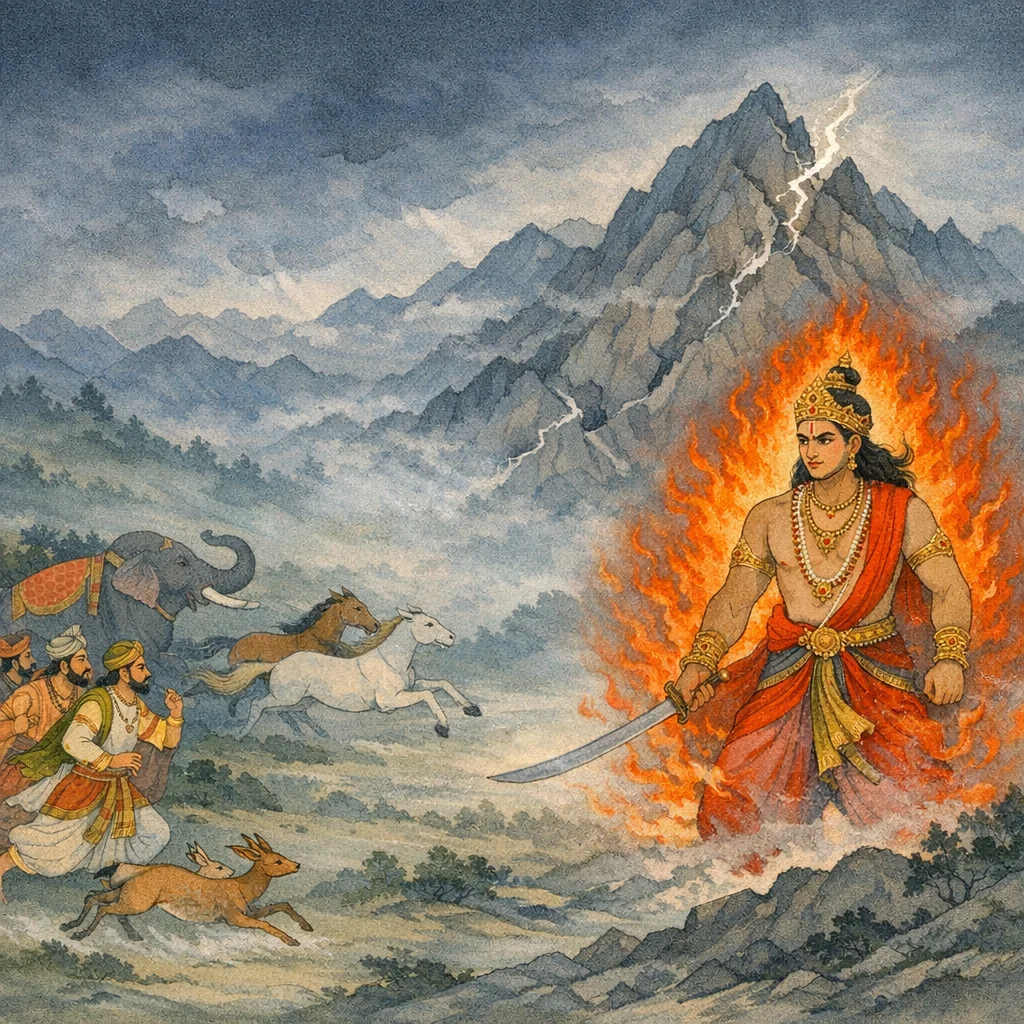
Adhyaya 198
Chapter Arc: कौरव-सेना के सिंहनाद और रण-कोलाहल के बीच युधिष्ठिर अर्जुन से पूछते हैं—यह कैसा अपूर्व गर्जन है, किस हेतु यह भय समस्त दिशाओं में फैल रहा है? → संजय वर्णन करते हैं कि नारायणास्त्र के प्रकट होते ही प्रकृति विक्षुब्ध हो उठती है—जल-बूँदों के साथ प्रचण्ड वायु, बिना बादलों के मेघ-गर्जना, पर्वत-शिखरों का टूटना, मृगों का अपसव्य चलना; राजाओं और सैनिकों में आतंक फैलता है। द्रोण-वध के बाद कौरव-पक्ष को सहारा देने हेतु मानो इन्द्र-गर्जना-सा शब्द उठता है और धृतराष्ट्र-पक्ष की पंक्तियाँ डगमगाने लगती हैं। → अश्वत्थामा के घोर क्रोध से प्रेरित द्रोण-पुत्रास्त्र/नारायणास्त्र का भयावह रूप चरम पर पहुँचता है—सेना-समुद्र में कोलाहल बार-बार बढ़ता है, योद्धा स्तब्ध-त्रस्त होते हैं, और रणभूमि पर यह प्रश्न जलता है कि कौन महारथी भागते कौरवों को रोककर पुनः युद्ध में लौटा रहा है। → अस्त्र-भय के दबाव में अनेक योद्धा शस्त्र त्यागकर प्राण-ममता से रहित-से, अचेत-से हो जाते हैं; युद्ध-व्यवस्था क्षण भर के लिए टूटती है, और दोनों पक्षों में जीवित रहने की सहज वृत्ति तथा धर्म-संकट साथ-साथ उभरते हैं। → द्रोण-वध के पश्चात कौरवों की ओर से उठे इस दैवी-से प्रतिशोध का अंत क्या होगा—और कौन-सा उपाय इस अस्त्र-आतंक को थामेगा?
Shlokas
Verse 1
अत-#-छका+ षण्णवर्त्याधेकशततमो< ध्याय: कौरव-सेनाका सिंहनाद सुनकर युधिष्ठिरका अर्जुनसे कारण पूछना और द्वारा अश्रृत्थामाके क्रोध एवं मा आज परिणामका वर्णन संजय उवाच प्रादुर्भूते ततस्तस्मिन्नस्त्रे नारायणे प्रभो । प्रावात् सपृषतो वायुरन भ्रे स््तनयित्नुमान्,इस प्रकार श्रीमहाभारत द्रोणपर्वके अन्तर्गत नारायणास्त्रमोक्षपर्वमें अरजुनवाक्यविषयक एक सौ छानबेवाँ अध्याय प्रा हुआ ॥/ १९६ ॥। (दाक्षिणात्य अधिक पाठका १ श्लोक मिलाकर कुल ५४ “लोक हैं।) ऑपन-मा बछ। अति ऋण सप्तनवर्त्याधिकशततमो< ध्याय: भीमसेनके वीरोचित उद्गार और धृष्टद्युम्नके द्वारा अपने कृत्यका समर्थन संजय उवाच अर्जुनस्य वच: श्रुत्वा नोचुस्तत्र महारथा: । अप्रियं वा प्रियं वापि महाराज धनंजयम्
Sañjaya said: “Hearing Arjuna’s words, the great chariot-warriors there did not answer Dhanañjaya (Arjuna), O King—whether with something unwelcome or with something welcome.”
Verse 2
संजय कहते हैं--प्रभो! तदनन्तर उस नारायणास्त्रके प्रकट होनेपर जलकी बूँदोंके साथ प्रचण्ड वायु चलने लगी। बिना बादलोंके ही आकाशमें मेघोंकी गर्जना होने लगी ।। चचाल पृथिवी चापि चुक्षुभे च महोदधि: । प्रतिस्त्रोतः प्रवृत्ताश्न गन्तुं तत्र समुद्रगा:,पृथ्वी काँप उठी, समुद्रमें ज्वार आ गया और समुद्रमें मिलनेवाली बड़ी-बड़ी नदियाँ अपने प्रवाहकी प्रतिकूल दिशामें बहने लगीं
Sañjaya said: “O Lord, as that Nārāyaṇāstra manifested, a fierce wind began to blow, driving along with it showers of water-drops. Though no clouds had gathered, thunder seemed to roar in the sky. The earth trembled; the great ocean heaved in turmoil; and the mighty rivers that run to the sea turned back, flowing against their natural current.”
Verse 3
शिखराणि व्यशीर्यन्त गिरीणां तत्र भारत | अपसव्यं मृगाश्चैव पाण्डुसेनां प्रचक्रिरे
Sañjaya said: “O Bhārata, there the very mountain-peaks seemed to crumble and fall away. And beasts, moving inauspiciously to the left, began to circle the army of the Pāṇḍavas—portents that cast an ominous shadow over the unfolding violence of war.”
Verse 4
भारत! पर्वतोंके शिखर टूट-टूटकर गिरने लगे। हरिणोंके झुंड पाण्डव-सेनाको अपने दायें करके चले गये ।। तमसा चावकीर्यन्त सूर्यश्ष कलुषो5भवत् | सम्पतन्ति च भूतानि क्रव्यादानि प्रहृष्टवत्,सम्पूर्ण दिशाओंमें अन्धकार छा गया, सूर्य मलिन हो गये और मांसभोजी जीव-जन्तु प्रसन्न-से होकर दौड़ लगाने लगे
Sañjaya said: “O Bhārata, darkness spread everywhere; the sun itself appeared dim and sullied. Carnivorous creatures and flesh-eaters, as if delighted, rushed about.” The scene is presented as an ominous moral and cosmic disturbance accompanying the violence of war—nature reflecting the adharma and impending destruction on the battlefield.
Verse 5
देवदानवगन्धर्वास्त्रिस्तास्त्वासन् विशाम्पते । कथंकथाभवत् तीव्रा दृष्टवा तद् व्याकुलं महत्,प्रजानाथ! वह महान् उत्पात देखकर देवता, दानव और गन्धर्व भी त्रस्त हो उठे तथा सब लोगोंमें यह तीव्र गतिसे चर्चा होने लगी कि “अब क्या करना चाहिये'
Sañjaya said: “O lord of the people, O ruler of men! When that great and terrifying upheaval was seen, even the gods, Dānavas, and Gandharvas were shaken with fear. Among all people, urgent talk spread rapidly—‘What should be done now?’”
Verse 6
व्यथिता: सर्वराजानस्त्रस्ताश्चासन् विशाम्पते । तद् दृष्टवा घोररूपं वै द्रौणेरस्त्रं भयावहम्,महाराज! अश्वत्थामाके उस घोर एवं भयंकर अस्त्रको देखकर समस्त भूपाल व्यथित एवं भयभीत हो गये
Sañjaya said: “O lord of the people, when they beheld the dreadful form of Droṇa’s son Aśvatthāman’s fearsome weapon, all the kings were shaken and fell into terror, sensing the ruinous power it carried upon the battlefield.”
Verse 7
घतरयाट्र उवाच निवर्तितिषु सैन्येषु द्रोणपुत्रेण संयुगे । भृशं शोकाभिततप्तेन पितुर्वधममृष्यता
Dhṛtarāṣṭra said: “When the armies were being driven back in the battle by Droṇa’s son, he—burning with intense grief—could not endure the slaying of his father.”
Verse 8
कुरूनापततो दृष्ट्वा धृष्टद्युम्नस्य रक्षणे । को मन्त्र: पाण्डवेष्वासीत् तनन््ममाचक्ष्व संजय
Dhṛtarāṣṭra said: “Seeing the Kuru warriors fall while protecting Dhṛṣṭadyumna, what strategy or guiding counsel did the Pāṇḍavas have? Tell me that, Sañjaya.”
Verse 9
धृतराष्ट्रने पूछा--संजय! अपने पिताके वधको सहन न कर सकनेवाला अत्यन्त शोकसंतप्त द्रोणपुत्र अश्वत्थामाके साथ जब सारी सेनाएँ युद्धसस््थलमें लौट आयीं, तब कौरवोंको आते देख पाण्डवदलमें धृष्टद्युम्नकी रक्षाके लिये क्या विचार हुआ, वह मुझे बताओ ।। संजय उवाच प्रागेव विद्रुतान् दृष्टवा धार्तराष्ट्रान युधिष्ठिर: । पुनश्च तुमुलं शब्दं श्रुत्वार्जुनमथाब्रवीत्,संजयने कहा--राजन्! राजा युधिष्ठिरने पहले तो आपके सैनिकोंको भागते देखा था। फिर उन्होंने वह भयंकर शब्द सुनकर अर्जुनसे कहा
Sanjaya said: O King, Yudhishthira had already seen your sons’ forces in flight. Then, hearing again that dreadful, tumultuous roar from the battlefield, he turned to Arjuna and spoke—seeking clarity and the right course amid the chaos of war.
Verse 10
युधिछिर उवाच आचार्य निहते द्रोणे धृष्टद्युम्नेन संयुगे । निहते वज्रहस्तेन यथा वृत्रे महासुरे
Yudhiṣṭhira said: “When the preceptor Droṇa was slain in battle by Dhṛṣṭadyumna—just as the great asura Vṛtra was slain by the wielder of the thunderbolt—then …”
Verse 11
नाशंसन्तो जयं युद्धे दीनात्मानो धनंजय । आत्मत्राणे मतिं कृत्वा प्राद्रवन् कुरवो रणात्
Yudhiṣṭhira said: “Having lost all hope of victory in the battle, the Kauravas—broken in spirit—fixed their minds only on saving their own lives and fled from the battlefield.”
Verse 12
युधिष्ठिर बोले--धनंजय! पूर्वकालमें जैसे वज्रधारी इन्द्रने महान् असुर वृत्रासुरको मार डाला था, उसी प्रकार युद्धस्थलमें धृष्टद्युम्नद्वारा आचार्य द्रोणके मारे जानेपर युद्धमें अपनी विजयसे निराश हो दीनचित्त कौरव आत्मरक्षाका विचार करके रणभूमिसे भागे जा रहे थे ।। केचिद् भ्रान्तै रथैस्तूर्ण निहतै: पार्ष्णियन्तृभि: । विपताकध्वजच्छन्रै: पार्थिवा: शीर्णकूबरै:,जिनके पार्श्चरक्षक और सारथि मारे गये थे, ध्वजा, पताका और छत्र नष्ट हो गये थे, कूबर टूटकर बिखर गये थे, बैठनेके स्थान चौपट हो चुके थे तथा धुरे, जूए और पहिये भी टूट-फूट गये थे, वैसे रथ भी व्याकुल घोड़ोंसे आकृष्ट हो वहाँ चक्कर लगा रहे थे और उनके द्वारा कुछ विशेष घायल हुए नरेश चारों ओर खिंचे चले जा रहे थे
Yudhiṣṭhira said: “Dhanañjaya (Arjuna)! Just as, in ancient times, Indra the wielder of the thunderbolt slew the great asura Vṛtra, so too—when, on the battlefield, Droṇa the preceptor was killed by Dhṛṣṭadyumna—the Kauravas, their hope of victory shattered, became despondent. Thinking only of self-preservation, they began to flee the field. Some kings were dragged about by chariots that had gone out of control—whose rear-guards and drivers had been slain, whose banners, pennants, and parasols were destroyed, and whose chariot-poles were broken—so that the vehicles, pulled by frantic horses, whirled about in confusion.”
Verse 13
भग्ननीडैराकुलाश्रैः प्रारुग्णाश्न॒ विशेषत: । भग्नाक्षयुगचक्रैश्व व्याकृष्पन्त समन्तत:,जिनके पार्श्चरक्षक और सारथि मारे गये थे, ध्वजा, पताका और छत्र नष्ट हो गये थे, कूबर टूटकर बिखर गये थे, बैठनेके स्थान चौपट हो चुके थे तथा धुरे, जूए और पहिये भी टूट-फूट गये थे, वैसे रथ भी व्याकुल घोड़ोंसे आकृष्ट हो वहाँ चक्कर लगा रहे थे और उनके द्वारा कुछ विशेष घायल हुए नरेश चारों ओर खिंचे चले जा रहे थे
Yudhiṣṭhira said: “All around, chariots with their fittings shattered—seats and frames broken, axles, yokes, and wheels smashed—were being dragged about in confusion by frantic horses. With their guards and charioteers slain and their standards, banners, and parasols destroyed, some kings, grievously wounded in particular, were pulled helplessly in every direction.”
Verse 14
भीता: पादैर्हयान् केचित् त्वरयन्तः स्वयं रथान् । रथान् विशीर्णनुत्सृज्य पद्धि: केचिच्च विद्रुता:,कुछ लोग भयभीत हो घोड़ोंको पैरोंसे मार-मारकर स्वयं ही जल्दी-जल्दी रथ हाँक रहे थे और कुछ लोग टूटे हुए रथोंको छोड़कर पैदल ही भागने लगे थे
Yudhiṣṭhira said: “Some, seized by fear, struck their horses with their feet and hurried their chariots on by themselves; others, abandoning their shattered chariots, fled on foot.”
Verse 15
हयपृष्ठगताश्षान्ये कृष्यन्ते<र्थच्युतासना: । गजस्कन्धेषु संस्यूता नाराचैश्वनलितासना:
Yudhiṣṭhira said: “Some warriors, seated upon the backs of horses, are being dragged along after falling from their chariots. Others, mounted on the shoulders of elephants, have their seats set ablaze by nārāca arrows.”
Verse 16
विशस्त्रकवचाश्षान्ये वाहनेभ्य: क्षितिं गता:
“Others too—stripped of weapons and armor—fell from their mounts and came down upon the earth.”
Verse 17
क्रोशन्तस्तात पुत्रेति पलायन्ते परे भयात्
Yudhiṣṭhira said: “Crying out, ‘Father!’ and ‘Son!’, the others flee in terror.”
Verse 18
पुत्रान् पितृन् सखीन् भ्रातृन् समारोप्य दृढक्षतान्
Yudhiṣṭhira said: “Having mounted upon the funeral pyre sons, fathers, friends, and brothers—those bearing grievous wounds—…”
Verse 19
अवस्थां तादशीं प्राप्य हते द्रोणे द्रुतं बलम्
Yudhiṣṭhira said: “Having reached such a condition—when Droṇa has been slain—the army has swiftly fallen into disorder, losing its steadiness.”
Verse 20
हयानां ह्वेषतां शब्द: कुज्जराणां च बृंहताम्
Yudhiṣṭhira said: “The sound of neighing horses and the loud trumpeting of elephants is rising.”
Verse 21
एते शब्दा भृशं तीव्रा: प्रवृत्ता: कुरुसागरे
Yudhiṣṭhira said: “These sounds—exceedingly harsh and intense—have arisen and are spreading through the Kuru-ocean, the vast host of the Kurus,” betraying his anxious awareness of the moral and human cost signaled by the uproar of battle.
Verse 22
य एष तुमुल: शब्द: श्रूयते लोमहर्षण:
Yudhiṣṭhira said: “What is this tumultuous sound that is being heard—so dreadful that it makes the hair stand on end?”
Verse 23
मन्ये वज़ञधरस्यैष निनादो भैरवस्वन:
Yudhiṣṭhira said: “I believe this is the dreadful, thunderous roar of Vajradhara (Indra).” In the war’s confusion, he took the terrifying sound as a divine sign—seeking meaning and moral order in an overwhelming event on the battlefield.
Verse 24
द्रोणे हते कौरवार्थ व्यक्तमभ्येति वासव: । मैं समझता हूँ, यह भयंकर शब्द वज्रधारी इन्द्रकी गर्जना है। द्रोणाचार्यके मारे जानेपर कौरवोंकी सहायताके लिये साक्षात् इन्द्र आ रहे हैं, यह स्पष्ट जान पड़ता है ।। प्रहष्टरोमकूपा श्व संविग्ना रथपुड़वा:
Yudhiṣṭhira said: “Now that Droṇa has been slain, it is evident that Vāsava (Indra) is approaching for the sake of the Kauravas. I take this dreadful sound to be the thunderous roar of Indra, the wielder of the vajra. It clearly seems that, with Droṇācārya killed, Indra himself is coming to aid the Kaurava side.” Even the dogs’ hair stood on end, and the foremost chariot-horses grew agitated.
Verse 25
क एष कौरवान् दीर्णानवस्थाप्य महारथ:
Yudhiṣṭhira said: “Who is this great chariot-warrior who, having checked the shattered Kaurava forces, has made them stand firm again?”
Verse 26
अजुन उवाच उद्यम्यात्मानमुग्राय कर्मणे वीर्यमास्थिता:
Arjuna said: “Rousing their own spirits, they have taken their stand in valor for a fierce deed.”
Verse 27
धमन्ति कौरवा: शड्खान् यस्य वीर्य समाश्रिता: । यत्र ते संशयो राजन् न््यस्तशस्त्रे गुरी हते
Arjuna said: “The Kauravas blow their conches, taking refuge in the prowess of one man. Yet, O King, where is their confidence now—when their revered teacher has been slain while having laid down his weapons?”
Verse 28
धार्तराष्ट्रानवस्थाप्य क एष नदतीति हि । ह्वीमन्तं तं महाबाहुं मत्तद्विरदगामिनम्
Arjuna said: “Having halted the sons of Dhṛtarāṣṭra, who is this that roars so? Indeed, that mighty-armed warrior—full of challenge—advances with the gait of an intoxicated elephant.”
Verse 29
(इन्द्रविष्णुसमं वीर्ये कोपेडन्तकमिव स्थितम् | बृहस्पतिसमं बुद्ध्या नीतिमन्तं महारथम् ।।) आख ेयास्याम्युग्रकर्माणं कुरूणामभयंकरम् । अर्जुनने कहा--राजन्! जिसके विषयमें आपको यह संदेह होता है कि शस्त्रोंका परित्याग कर देनेवाले गुरुदेव द्रोणाचार्यके मारे जानेपर यह कौन वीर कौरव-सैनिकोंको दृढ़तापूर्वक स्थापित करके सिंहनाद कर रहा है तथा जिसके बल और पराक्रमका आश्रय लेकर पराक्रमी कौरव अपनेको भयंकर कर्म करनेके लिये उद्यत करके शंखध्वनि कर रहे हैं; जो महाबाहु मतवाले हाथीके समान मस्तानी चालसे चलनेवाला और लज्जाशील है, जो बलमें इन्द्र और विष्णुके समान, क्रोधमें यमराजके सदृश तथा बुद्धिमें बृहस्पतिके तुल्य है, जो नीतिमान, महारथी, उग्र कर्म करनेमें समर्थ तथा कौरवोंको अभयदान देनेवाला है, उस वीरका परिचय देता हूँ, सुनिये || २६--२८ $ ।। यस्मिज्जाते ददौ द्रोणो गवां दशशतं धनम्
Arjuna said: “O King, I shall identify for you that formidable warrior who inspires fearlessness in the Kurus—whose might equals Indra and Viṣṇu, whose wrath stands like Death itself, whose intellect rivals Bṛhaspati; who is a master of policy and a great chariot-fighter, capable of fierce deeds. Listen as I name him.”
Verse 30
जातमात्रेण वीरेण येनोच्चै:श्रवसा यथा,अश्वत्थामेति सोअ्द्यैष शूरो नदति पाण्डव | पाण्डुनन्दन! जिस वीरने जन्म लेते ही उच्चै:श्रवा अश्वके समान हिनहिनाकर पृथ्वी तथा तीनों लोकोंको कम्पित कर दिया था और उस शब्दको सुनकर किसी अदृश्य प्राणीने उस समय उसका नाम “अश्व॒त्थामा” रख दिया था, यह वही शूरवीर अश्व॒त्थामा सिंहनाद कर रहा है
Arjuna said: “O son of Pāṇḍu, this very hero—who, at the moment of his birth, neighed like the celestial horse Uccaiḥśravas and shook the earth and the three worlds—was then given the name ‘Aśvatthāmā’ by an unseen being upon hearing that sound. That same Aśvatthāmā is now roaring his battle-cry.”
Verse 31
ह्वषता कम्पिता भूमिलोंकाश्व सकलास्त्रय: । तच्छुत्वान्तहिंतं भूतं॑ नाम तस्याकरोत् तदा
Arjuna said: “In that moment, through the surge of exultation, the earth trembled and all the three worlds were shaken. Hearing that, the mysterious being that had remained unseen then proclaimed its name.”
Verse 32
यो हानाथ इवाक्रम्य पार्षतेन हतस्तथा
Arjuna said: “He who, as though helpless and without a protector, was overpowered and then slain in that manner by the son of Pṛṣat—this is what has happened.”
Verse 33
कर्मणा सुनृशंसेन तस्य नाथो व्यवस्थित: । द्रपदकुमार धृष्टद्युम्नने जिनपर आक्रमण करके अत्यन्त क्रूरतापूर्ण कर्मके द्वारा जिन्हें अनाथके समान मार डाला था, उन्हींका यह रक्षक या सहायक उठ खड़ा हुआ है || ३२६ || गुरु मे यत्र पाउचाल्य: केशपक्षे परामृशत्
Arjuna said: “By a deed of extreme cruelty he was left as though without a protector; yet now, for that very man, a guardian has risen and stands ready. It was Drupada’s son Dhrishtadyumna who, attacking with hostile force and committing a ruthlessly cruel act, struck him down as if he were helpless and unowned—yet now someone has come forward as his defender. And it was there that the Panchala prince seized my teacher by the hair.”
Verse 34
उपचीर्णों गुरुमिथ्या भवता राज्यकारणात्
Arjuna said: “For the sake of kingship, you have falsely accused and wronged your own teacher—an act that violates the reverence owed to one’s guru and stains the pursuit of power with deceit.”
Verse 35
चिरं स्थास्यति चाकीर्तिस्त्रिलोक्ये सचराचरे
And this infamy will endure for a long time, spreading through the three worlds—among all beings, moving and unmoving.
Verse 36
सर्वधर्मोपपन्नो5यं स मे शिष्यश्षल पाण्डव:
Arjuna said: “This Pāṇḍava is endowed with every form of dharma; he is my disciple, O Śalya.”
Verse 37
स सत्यकज्चुकं नाम प्रविष्टेन ततोडनृतम्
Arjuna said: “Having entered under the guise of a ‘coat of truth’ (a show of honesty), what followed was in fact untruth.”
Verse 38
ततः शस्त्र समुत्सृज्य निर्ममो गतचेतन:
Then, casting aside his weapons, Arjuna—his sense of possession extinguished and his mind as if numbed—stood overwhelmed, as though a warrior’s resolve had collapsed beneath the moral shock of battle.
Verse 39
स तु शोकसमाविष्टो विमुख: पुत्रवत्सल:
But he, overwhelmed by grief and turning away in anguish, was deeply tender and attached to his son—his paternal affection eclipsing his composure amid the harsh demands of war.
Verse 40
न्यस्तशस्त्रमधर्मेण घातयित्वा गुरुं भवान्
Having slain the teacher by unrighteous means when he had laid down his weapons, you would be acting against dharma.
Verse 41
रक्षत्विदानीं सामात्यो यदि शक्तो$सि पार्षतम् । ग्रस्तमाचार्य पुत्रेण क्रुद्धेन हतबन्धुना,जिसके पिता मारे गये हैं, वह आचार्यपुत्र अश्वत्थामा आज कुपित होकर धृष्टद्युम्नको कालका ग्रास बनाना चाहता है। अस्त्र त्यागकर निहत्थे हुए गुरुदेवको अधर्मपूर्वक मरवाकर अब आप मन्त्रियोंसहित उसके सामने जाइये और यदि शक्ति हो तो धृष्टद्युम्नकी रक्षा कीजिये
Arjuna said: “Now then, go with your ministers and protect the son of Pṛṣata (Dhṛṣṭadyumna), if you have the power. He is being seized by the Teacher’s son—Aśvatthāmā—who, enraged because his kinsmen have been slain, seeks to make Dhṛṣṭadyumna a prey to Death. After having caused our unarmed preceptor to be killed by unrighteous means, you should now stand before him and, if you can, save Dhṛṣṭadyumna.”
Verse 42
सर्वे वयं परित्रातुं न शक्ष्यामोड्द्य पार्षतम् | सौहार्द सर्वभूतेषु यः करोत्यतिमानुष: । सोड्द्य केशग्रहं श्रुत्वा पितुर्थक्ष्यति नो रणे,आज हम सब लोग मिलकर भी धृष्टद्युम्नको नहीं बचा सकेंगे। जो अभश्वत्थामा अतिमानव (अलौकिक पुरुष) है और समस्त प्राणियोंके प्रति मैत्रीका भाव रखता है, वही आज अपने पिताके केश पकड़े जानेकी बात सुनकर समरांगणमें हम सब लोगोंको जलाकर भस्म कर देगा
Arjuna said: “Even if all of us unite, we will not be able to save Dhṛṣṭadyumna today. Aśvatthāmā—an extraordinary, almost superhuman warrior—who is otherwise known for goodwill toward all beings, will, upon hearing that his father’s hair was seized, rage in battle and destroy us.”
Verse 43
विक्रोशमाने हि मयि भृशमाचार्यगृद्धिनि । अपाकीर्य स्वयं धर्म शिष्येण निहतो गुरु:,मैं आचार्यके प्राणोंकी रक्षा चाहता हुआ बारंबार पुकारता ही रह गया, परंतु स्वयं शिष्य होकर भी धृष्टद्युम्नने धर्मको लात मारकर अपने गुरुकी हत्या कर डाली
Even as I cried out loudly—intent on protecting the Teacher’s life—Dṛṣṭadyumna, though himself a disciple, cast dharma aside and slew his guru. It was a moral rupture: the sanctity of the teacher–student bond was violated amid the frenzy of war.
Verse 44
यदा गत॑ वयो भूय: शिष्टमल्पतरं च नः । तस्येदानीं विकारो5यमधर्मोडयं कृतो महान्,अब हमलोगोंकी आयुका अधिकांश भाग बीत चुका है और बहुत थोड़ा ही शेष रह गया है। इसीसे इस समय हमारा मस्तिष्क खराब हो गया और हमलोगोंने यह महान् पाप कर डाला है
Now that most of our lifetime has already passed and only a little remains, our judgment has become distorted. Because of that failing, we have committed this great act of adharma—a grave sin—at this time.
Verse 45
पितेव नित्यं सौहार्दात् पितेव हि च धर्मत: । सो5ल््पकालस्य राज्यस्य कारणादू घातितो गुरु:,जो सदा पिताकी भाँति हमलोगोंपर स्नेह रखते और हमारा हित चाहते थे, धर्मदृष्टिसे भी जो हमारे पिताके ही तुल्य थे, उन्हीं गुरुदेवको हमने इस क्षणभंगुर राज्यके लिये मरवा दिया
That guru loved us always like a father, and by dharma too he was as a father to us. Yet for the sake of this fleeting kingdom, we have brought about the Teacher’s death.
Verse 46
धृतराष्ट्रेण भीष्माय द्रोणाय च विशाम्पते । विसृष्टा पृथिवी सर्वा सह पुत्रैश्न तत्परै:,प्रजानाथ! धृतराष्ट्रने भीष्म और द्रोणको उनकी सेवामें रहनेवाले अपने पुत्रोंके साथ ही इस सारी पृथ्वीका राज्य सौंप दिया था
O lord of the people, Dhṛtarāṣṭra entrusted the sovereignty of this entire earth to Bhīṣma and to Droṇa, together with his sons who were devoted to serving them.
Verse 47
सम्प्राप्य तादृशीं वृत्ति सत्कृतः सततं परै: । अवृणीत सदा पुत्रान् मामेवाभ्यधिकं गुरु:,हमारे शत्रु सदा आचार्यका सत्कार किया करते थे। उनके द्वारा वैसी उत्तम जीविका- वृत्ति पाकर भी आचार्य सदा मुझे ही अपने पुत्रसे बढ़कर मानते रहे हैं
Arjuna said: “Though our enemy—the preceptor—continually received honor from others and through that obtained an excellent livelihood, the teacher still always chose me, regarding me as even dearer and more worthy than his own sons.”
Verse 48
अवेक्षमाणत्त्वां मां च न्यस्तास्त्रश्नाहवे हतः । न त्वेनं युध्यमानं वै हन्यादपि शतक्रतु:,उन्होंने आपको और मुझको देखकर युद्धमें हथियार डाल दिया और मारे गये। यदि वे युद्ध करते होते तो साक्षात् इन्द्र भी उन्हें मार नहीं सकते थे
Arjuna said: “Seeing you and me, he laid down his weapons and was slain in the battle. Had he been fighting on, even Śatakratu (Indra) could not have killed him.”
Verse 49
तस्याचार्यस्य वृद्धस्य द्रोहो नित्योपकारिण: । कृत्वे हानार्यरस्माभी राज्यार्थे लुब्धबुद्धिभि:
Arjuna said: “We have committed treachery against that aged teacher—one who has always been our benefactor—driven by greedy minds for the sake of kingship. Such conduct is ignoble, and it stains our cause with moral fault even amid war.”
Verse 50
हमारी बुद्धि लोभसे ग्रस्त है, हम नीचोंने राज्यके लिये सदा उपकार करनेवाले बूढ़े आचार्यके साथ द्रोह किया है ।। अहो बत महत् पापं कृतं कर्म सुदारुणम् | यद् राज्यसुखलोभेन द्रोणो5यं साधु घातित:,ओह! हमने यह अत्यन्त भयंकर महान् पापकर्म कर डाला है, जो कि राज्य-सुखके लोभमें पड़कर इन आचार्य द्रोणकी पूर्णतः हत्या करा दी
Arjuna said: “Alas! We have committed a great sin—an act most dreadful. For, driven by greed for the pleasures of kingship, this noble Droṇa has been brought to his death.”
Verse 51
पुत्रान् भ्रातृन् पितृन् दाराज्जीवितं चैव वासवि: | त्यजेत् सर्व मम प्रेम्णा जानात्येवं हि मे गुरु:,मेरे गुरुदेव ऐसा समझते थे कि अर्जुन मेरे प्रेमवश आवश्यकता हो तो अपने पिता, पुत्र, भाई, स्त्री तथा प्राण--सबका त्याग कर सकता है
Arjuna said: “My teacher believed this about me: that out of affection for me, Vāsavi (Indra) would even renounce everything—sons, brothers, fathers, wives, and even life itself.”
Verse 52
स मया राज्यकामेन हन्यमानो हापेक्षित: । तस्मादर्वाक््शिरा राजन प्राप्तोडस्मि नरकं प्रभो,किंतु मैंने राज्यके लोभमें पड़कर उनके मारे जानेकी उपेक्षा कर दी। राजन! प्रभो! इस पापके कारण अब मैं नीचे सिर करके नरकमें डाला जाऊँगा
Blinded by my desire for sovereignty, I looked on with indifference while he was being slain. Therefore, O King, O Lord, because of this sin I am destined to fall into hell, headlong—my face turned downward—bearing the weight of my neglect.
Verse 53
ब्राह्मणं वृद्धमाचार्य न्यस्तशस्त्रं महामुनिम् । घातयित्वाद्य राज्यार्थे मृतं श्रेयो न जीवितम्,एक तो वे ब्राह्मण, दूसरे वृद्ध और तीसरे अपने आचार्य थे। इसके सिवा उन्होंने हथियार नीचे डाल दिया था और महान मुनिवृत्तिका आश्रय लेकर बैठे हुए थे। इस अवस्थामें राज्यके लिये उनकी हत्या कराकर मैं जीनेकी अपेक्षा मर जाना ही अच्छा समझता हूँ
Arjuna said: “He is a brāhmaṇa, an aged man, and moreover our own teacher—having laid down his weapons, a great sage. If, for the sake of a kingdom, I were to have him slain today, then death would be better for me than life.”
Verse 156
शरार्तैविंद्रुतैनगि्ता: केचिद् दिशो दश । कितने ही योद्धा घोड़ोंकी पीठपर बैठे, परंतु उनका आधा आसन खिसक गया और उसी अवस्थामें घोड़ोंक साथ खिंचे चले गये। कुछ लोग नाराचोंकी मार खाकर अपने आसनसे भ्रष्ट हो हाथियोंके कंधोंसे चिपक गये थे और उसी अवस्थामें बाणोंसे पीड़ित हो भागते हुए हाथी उन्हें दसों दिशाओंमें लिये जाते थे
Yudhiṣṭhira said: Some warriors, struck and tormented by arrows, were dragged helplessly in all ten directions. Many remained seated on horseback, yet their seat had slipped halfway, and in that precarious state they were pulled along with their horses. Others, hit by the force of nārāca arrows, lost their proper posture and clung to the shoulders of elephants; and as those wounded elephants fled in panic, they carried the men—still pierced and suffering—scattering them across every quarter.
Verse 163
संछिन्ना नेमिभिश्रैव मृदिताश्न हयद्विपैः । कुछ लोगोंके अस्त्र-शस्त्र और कवच कट गये और वे अपने वाहनोंसे पृथ्वीपर गिर पड़े। उस दशामें रथके पहियोंकी नेमिसे दबकर उनके शरीरके टुकड़े-टुकड़े हो गये और कितने ही घोड़ों तथा हाथियोंसे कुचल गये
Yudhiṣṭhira said: “Many were cut down by the very rims of chariot-wheels, and many were crushed beneath horses and elephants. Their weapons and armour were shattered; hurled from their mounts and vehicles onto the earth, they were pressed and broken into pieces—an image of war’s pitiless momentum, where strength and pride alike are reduced to ruin.”
Verse 173
नाभिजानन्ति चान्योन्यं कश्मलाभिहतौजस: । दूसरे बहुत-से योद्धा “हा तात! हा पुत्र!” की रट लगाते हुए भयभीत होकर भाग रहे थे। मोहसे बल और उत्साह नष्ट हो जानेके कारण वे ऐसे अचेत हो रहे थे कि एक-दूसरेको पहचान भी नहीं पाते थे
Yudhiṣṭhira said: Their strength and ardor being shattered by bewilderment, they no longer recognized one another. In the panic of battle, many fled crying, “Alas, father! Alas, son!”—a scene that exposes how delusion can eclipse discernment and fracture even the most basic bonds of human recognition.
Verse 186
जलेन क्लेदयन्त्यन्ये विमुच्य कवचान्यपि । कितने ही सैनिक अधिक चोट खाये हुए अपने पुत्र, पिता, मित्र और भाइयोंको रथपर चढ़ाकर तथा उनके कवच खोलकर उनके घावोंको जलसे भिगो रहे थे
Yudhiṣṭhira said: “Some, after removing the armour as well, were moistening the wounds with water.” In the midst of battle’s cruelty, wounded sons, fathers, friends, and brothers were lifted onto chariots, their protective gear undone, and their injuries tended with water—an image of human compassion persisting even within the machinery of war.
Verse 193
पुनरावर्तितं केन यदि जानासि शंस मे | आचार्य द्रोणके मारे जानेपर वैसी दुरवस्थामें पड़कर जो सेना भाग गयी थी, उसे फिर किसने लौटाया है? यदि तुम जानते हो तो मुझे बताओ
Yudhiṣṭhira said: “By whom has our army been turned back and brought again into order? If you know, tell me. After the slaying of the teacher Droṇa, the host—thrown into a grievous and helpless condition—had fled in confusion. Who has now rallied it and made it return?”
Verse 195
इस प्रकार श्रीमहाभारत द्रोणपर्वके अन्तर्गत नारायणास्त्रगोक्षपर्वमें अश्वत्थामाका क्रोधविषयक एक सौ पंचानबेवाँ अध्याय पूरा हुआ
Sanjaya said: Thus ends the one hundred and ninety-fifth chapter, concerning Ashvatthama’s wrath, within the Narayanastra-and-cow-protection episode of the Drona Parva of the sacred Mahabharata. This closing note marks a transition in the war narrative, highlighting how anger and the escalation of divine weapons intensify the ethical strain of battle and foreshadow further consequences.
Verse 196
इति श्रीमहा भारते द्रोणपर्वणि नारायणास्त्रमोक्षपर्वणि अर्जुनवाक्ये षण्णवत्यधिकशततमो< ध्याय:
Thus, in the sacred Mahābhārata, within the Droṇa Parva, in the section concerning the discharge of the Nārāyaṇa weapon, concludes the one-hundred-and-ninety-sixth chapter—marked here as the words of Arjuna. This is a colophon-style closing that situates the episode within the larger war narrative, emphasizing the gravity of divine weaponry and the ethical weight borne by warriors who must restrain or respond to such forces in accordance with dharma.
Verse 203
रथनेमिस्वनैश्लात्र विमिश्र: श्रूयते महान् | रथके पहियोंकी घर्घराहटसे मिला हुआ हिनहिनाते हुए घोड़ों और गर्जते हुए गजराजोंका महान् शब्द सुनायी पड़ता है
Yudhiṣṭhira said: “A mighty tumult is heard—mingled with the rumbling of chariot-wheels—together with the neighing of horses and the roaring of great elephants.”
Verse 213
मुहुर्महुरुदीर्यन्ते कम्पयन्त्यपि मामकान् । कौरव-सेनारूपी समुद्रमें यह कोलाहल अत्यन्त तीव्र वेगसे होने लगा है और बारंबार बढ़ता जा रहा है, जो मेरे सैनिकोंको कम्पित किये देता है
Yudhiṣṭhira said: “Again and again this uproar rises, and it even makes my own troops tremble. In this ocean-like host of the Kaurava army, the tumult has begun to surge with exceedingly fierce force, repeatedly swelling, and it shakes the hearts of my soldiers.”
Verse 226
सेन्द्रानप्येष लोकांस्त्रीन् ग्रसेदिति मतिर्मम । यह जो महाभयंकर रोमांचकारी शब्द सुनायी देता है, यह इन्द्रसहित तीनों लोकोंको ग्रस लेगा, ऐसा मुझे जान पड़ता है
Yudhiṣṭhira said: “It seems to me that this dreadful, hair-raising sound will swallow up even the three worlds together with Indra. Such is the fearsome portent I perceive—one that threatens the very order of the cosmos.”
Verse 246
धनंजय गुरु श्रुत्वा तत्र नादं सुभीषणम् | धनंजय! यह अत्यन्त भीषण और भारी सिंहनाद सुनकर हमारे श्रेष्ठ रथी भी उद्विग्न हो उठे हैं और इनके रोंगटे खड़े हो गये हैं
Yudhiṣṭhira said: “O Dhanañjaya, having heard there that dreadsome roar—like a heavy lion’s thunder—our finest chariot-warriors have been shaken; their bodies bristle with alarm. Such a sound is not merely noise: it signals a grave turn in the battle and tests the steadiness of the righteous.”
Verse 293
ब्राह्मणेभ्यो महाहेंभ्य: सो<श्व॒त्थामैष गर्जति । जिसके जन्म लेनेपर आचार्य द्रोणने परम सुयोग्य ब्राह्मणोंको एक सहसख्र गौएँ दान की थीं, वही अश्वत्थामा यह गर्जना कर रहा है
Arjuna said: “To the great and venerable Brahmins—this is Aśvatthāmā roaring. At his birth, the teacher Droṇa gifted a thousand cows to supremely worthy Brahmins; and yet it is that very Aśvatthāmā who now bellows in pride.”
Verse 316
अश्वत्थामेति सोअ्द्यैष शूरो नदति पाण्डव | पाण्डुनन्दन! जिस वीरने जन्म लेते ही उच्चै:श्रवा अश्वके समान हिनहिनाकर पृथ्वी तथा तीनों लोकोंको कम्पित कर दिया था और उस शब्दको सुनकर किसी अदृश्य प्राणीने उस समय उसका नाम “अश्व॒त्थामा” रख दिया था, यह वही शूरवीर अश्व॒त्थामा सिंहनाद कर रहा है
Arjuna said: “O Pandava! Today that hero is roaring—Ashvatthama. O son of Pandu, he is the very warrior who, at the moment of his birth, neighed like the celestial horse Uccaiḥśravā, shaking the earth and the three worlds; and hearing that sound, some unseen being then bestowed on him the name ‘Ashvatthama.’ That same formidable hero now utters a lion-like roar.”
Verse 336
तन्न जातु क्षमेद् द्रौणिजानन् पौरुषमात्मन: । पांचालराजकुमारने जो मेरे गुरुदेवका केश पकड़कर खींचा था, उसे अपने पुरुषार्थको जाननेवाला अभश्वत्थामा कभी क्षमा नहीं कर सकता
Arjuna said: “Knowing his own manly prowess, Aśvatthāmā, the son of Droṇa, will never forgive that act—when the prince of Pāñcāla seized my revered teacher by the hair and dragged him.”
Verse 346
धर्मज्ञेन सता नाम सो<धर्म: सुमहान् कृत: । आपने धर्मज्ञ होते हुए भी राज्यके लोभसे झूठ बोलकर जो अपने गुरुको धोखा दिया, वह महान् पाप किया है
Arjuna said: “A grievous unrighteous act has indeed been committed by one who is reputed to be virtuous and a knower of dharma. Though knowing what is right, driven by greed for sovereignty, he spoke falsehood and deceived his own teacher—this is a great sin.”
Verse 356
रामे वालिवधाद् यद्वदेव॑ द्रोणे निपातिते । अत: छिपकर वालीका वध करनेके कारण जैसे श्रीरामचन्द्रजीको अपयश मिला, उसी प्रकार झूठ बोलकर द्रोणाचार्यको मरवा देनेके कारण चराचर प्राणियोंसहित तीनों लोकोंमें आपकी अकीर्ति चिरस्थायिनी हो जायगी
Arjuna said: “Just as Rāma incurred blame because of the slaying of Vāli, so too, if Droṇa is brought down by deceit, then for causing the death of that ‘Vālika’ (Droṇa) through falsehood, your ill-fame will endure for a long time across the three worlds, together with all moving and unmoving beings.”
Verse 366
नायं वदति मिथ्येति प्रत्ययं कृतवांस्त्वयि । आचार्यने यह समझकर आपपर विश्वास किया था कि पाण्डुनन्दन युधिष्ठिर सब धर्मोके ज्ञाता और मेरे शिष्य हैं। ये कभी झूठ नहीं बोलते हैं
“I was convinced about you that ‘this one does not speak falsehood.’ The Teacher, understanding you in that way, had placed his trust in you—thinking that Yudhiṣṭhira, the son of Pāṇḍu, is a knower of all dharma and also my disciple, and that he would never utter a lie.”
Verse 373
आचार्य उक्तो भवता हत: कुज्जर इत्युत । परंतु आपने सत्यका चोला पहनकर आचार्यसे झूठे ही कह दिया कि “अश्व॒त्थामा मारा गया।” उसी नामका हाथी मारा गया था, इसलिये आपने उसकी आड़ लेकर झूठ कहा
Arjuna said: “You told the Teacher, ‘The elephant has been slain,’ and yet, wearing the guise of truth, you effectively lied to him by declaring, ‘Aśvatthāmā has been killed.’ It was only an elephant bearing that name that had died; using that ambiguity as a cover, you spoke falsehood.”
Verse 393
शाश्च॒तं धर्ममुत्सज्य गुरु: शस्त्रेण घातित: । पुत्रवत्सल गुरुदेव बेटेके शोकमें मग्न होकर युद्धसे विमुख हो गये थे। उस अवस्थामें आपने सनातनधर्मकी अवहेलना करके उन्हें शस्त्रसे मरवा डाला
Arjuna said: “Casting aside the eternal law of righteousness, you had the Guru struck down by weapons. Though he was a revered teacher, tenderly attached to his son and overwhelmed by grief—having turned away from battle in that condition—you disregarded the timeless demands of dharma and caused him to be slain.”
Verse 2536
निवर्तयति युद्धार्थ मृथे देवेश्वरो यथा । देवराज इन्द्रके समान यह कौन महारथी भागे हुए कौरवोंको खड़ा करके उन्हें पुनः युद्धके लिये रणभूमिमें लौटा रहा है?
Yudhiṣṭhira said: “As the Lord of the gods turns back the tide of battle, who is that great chariot-warrior—equal to Indra, king of the gods—who is rallying the fleeing Kauravas, making them stand firm, and driving them back onto the battlefield to fight again?”
Verse 3836
आसीतू सुविद्धलो राजन् यथा दृष्टस्त्वया विभु: । फिर वे हथियार डालकर अपने प्राणोंकी ममतासे रहित हो अचेत हो गये। राजन! उस समय शक्तिशाली होनेपर भी वे कितने व्याकुल हो गये थे, यह आपने प्रत्यक्ष देखा था
Arjuna said: “O King, you yourself witnessed how that mighty one appeared—pierced through and overwhelmed. Casting aside his weapons, he fell into a senseless state, free from clinging to life; and though powerful, he was seen to be shaken with anguish.”