Adhyaya 130
Rātri-yuddhe Droṇasya prahāraḥ — Bhīmasenasya dhārtarāṣṭra-śūrānām nigrahaḥ (Night Battle: Droṇa’s Assault and Bhīma’s Suppression of Dhārtarāṣṭra Warriors)
Upa-parva: Rātri-yuddha (Night-Combat) Episode under Droṇa’s Command
Dhṛtarāṣṭra questions Sañjaya about the Kuru response when a formidable adversary entered the fray after earlier pivotal deaths, asking who advanced, who followed, and how decisions were formed amid night conditions. Sañjaya describes a harsh night engagement: the Pāṇḍavas and allies surge toward Droṇa, who repels them with rapid arrows, sending multiple fighters to death. A duel sequence follows where Śibi attacks Droṇa, briefly disrupts his chariot team, and is then decisively neutralized by Droṇa. The focus then shifts to Bhīma’s engagements: a Kalinga prince attacks Bhīma; Bhīma counters with close-range force, causing severe disarray. Karṇa and associated warriors attempt to check Bhīma with heavy missiles; Bhīma continues by disabling chariots and subduing Dhārtarāṣṭra princes (notably Durmada and Duṣkarṇa), producing panic and flight among surrounding rulers. The chapter closes with allied commendation of Bhīma and a grim depiction of the night battlefield’s terror and disorder.
Chapter Arc: रथसेना को चीरकर आगे बढ़े भीमसेन को रोकने के लिए आचार्य द्रोण हँसते-हँसते बाण-वर्षा आरम्भ करते हैं—मानो गुरु का कौशल स्वयं रणभूमि पर गरज उठा हो। → द्रोण के धनुष से छूटे शर-समूहों को ‘पीते हुए-से’ भीम वेग से आगे बढ़ते हैं, पर दुर्योधन के प्रेरित अनेक महाधनुर्धर नरेश चारों ओर से घेर लेते हैं। द्रोण के तीक्ष्ण बाणों से सैकड़ों-हजारों वीर कटने लगते हैं; भीम का आवेग और कौरव-पक्ष की संगठित रोक—दोनों एक साथ चढ़ते हैं। → रण में द्रोण की बाण-वृष्टि के बीच भीम का उन्मत्त गर्जन और उसके प्रत्युत्तर में धर्मराज युधिष्ठिर का मन-ही-मन धैर्यपूर्ण, मुस्कराता हुआ संकल्प—युद्ध की बाहरी हिंसा के भीतर नेतृत्व की आंतरिक स्थिरता का टकराव चरम पर पहुँचता है। साथ ही अर्जुन के जीवित होने और उसके पूर्व-पराक्रम (कालकेयों के संहार) का स्मरण सैनिकों के मन में निर्णायक आशा/भय जगाता है। → अध्याय का स्वर निर्णायक निष्कर्ष से अधिक ‘रण-स्थिति का लेखा’ बनता है: द्रोण की रोक, भीम की धृष्टता, और पाण्डव-पक्ष में अर्जुन के जीवित होने से उपजी आश्वस्ति—इन तीनों के बीच युद्ध का संतुलन क्षणिक रूप से थमता नहीं, बल्कि और कसता है। जयद्रथ-वध की प्रतिज्ञा की छाया भी कथा को अगले चरण की ओर धकेलती है। → क्या अर्जुन के हाथों जयद्रथ का वध देखकर दुर्योधन का मन टूटेगा और वह संधि की ओर झुकेगा—या प्रतिशोध में युद्ध और उग्र होगा?
Shlokas
Verse 1
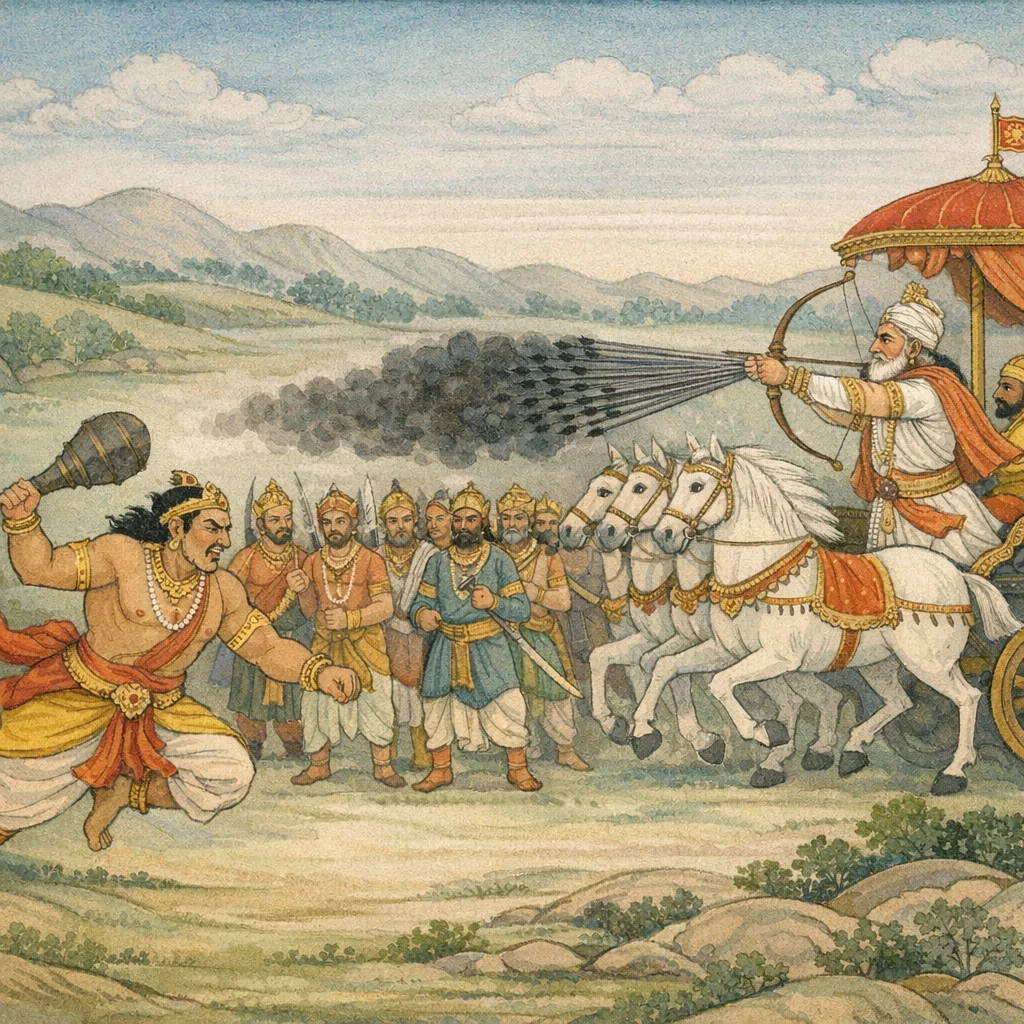
संजय कहते हैं--महाराज! रथसेनाको पार करके आये हुए पाण्डुनन्दन भीमसेनको युद्धमें रोकनेकी इच्छासे आचार्य द्रोणने हँसते-हँसते उनपर बाणोंकी वर्षा आरम्भ कर दी
Sañjaya said: “O King, Bhīmasena—the son of Pandu—having forced his way across the chariot-host, was advancing. Wishing to check him in battle, the preceptor Drona, smiling as he did so, began to shower him with a rain of arrows.”
Verse 2
पिबन्निव शरौघांस्तान् द्रोणचापपरिच्युतान् । सो<भ्यद्रवत सोदर्यान् मोहयन् बलमायया,द्रोणाचार्यके धनुषसे छूटे हुए उन बाणोंको पीते हुए-से भीमसेन अपने बलकी मायासे समस्त कौरव बन्धुओंको मोहित करते हुए उनपर टूट पड़े
Sañjaya said: As though drinking in that dense shower of arrows released from Droṇa’s bow, Bhīmasena charged upon his own kinsmen. By the sheer force of his martial prowess—almost like a bewildering illusion—he confounded the Kaurava host and fell upon them.
Verse 3
त॑ मृथे वेगमास्थाय नृपा: परमधन्विन: । चोदितास्तव पुत्रैश्न सर्वत: पर्यवारयन्,उस समय आपके पुत्रोंद्वारा प्रेरित हुए बहुत-से महाधनुर्धर नरेशोंने महान् वेगका आश्रय ले युद्धस्थलमें भीमसेनको सब ओरसे घेर लिया
Sañjaya said: Then, in the thick of battle, many kings—supreme archers—spurred on by your sons, gathered their full momentum and surrounded Bhīmasena on every side.
Verse 4
स तैस्तु संवृतो भीम: प्रहसन्निव भारत । उद्यच्छन् स गदां तेभ्य: सुघोरां सिंहवन्नदन् | अवासृजच्च वेगेन शत्रुपक्षविनाशिनीम्,भरतनन्दन! उनसे घिरे हुए भीमने हँसते हुए-से अपनी अत्यन्त भयंकर गदा ऊपर उठायी और सिंहनाद करते हुए उन्होंने शत्रुपक्षका विनाश करनेवाली उस गदाको बड़े वेगसे उन राजाओंपर दे मारा
Sañjaya said: Surrounded by them, Bhīma—almost as if laughing—raised his exceedingly dreadful mace. Roaring like a lion, he hurled that enemy-host-destroying weapon with great force at those kings.
Verse 5
इन्द्राशनिरिवेन्द्रेण प्रविद्धा संहतात्मना । प्रामथ्नात् सा महाराज सैनिकांस्तव संयुगे,महाराज! सुस्थिरचित्तवाले इन्द्र जिस प्रकार अपने वज्रका प्रयोग करते हैं, उसी तरह भीमसेनद्वारा चलायी हुई उस गदाने युद्धसस््थलमें आपके सैनिकोंका कचूमर निकाल दिया
O Maharaja, that mace, hurled by Bhīmasena with a steadfast, united will, crushed your soldiers in the battle, even as Indra casts his thunderbolt (vajra).
Verse 6
घोषेण महता राजन् पूरयन्तीव मेदिनीम् | ज्वलन्ती तेजसा भीमा त्रासयामास ते सुतान्,राजन! तेजसे प्रज्वलित होनेवाली उस भयंकर गदाने अपने महान् घोषसे इस पृथ्वीको परिपूर्ण करके आपके पुत्रोंको भयभीत कर दिया
Sañjaya said: O King, that dreadful mace—blazing with its own radiance—seemed to fill the very earth with its mighty roar, and it struck your sons with fear.
Verse 7
तां पतन्तीं महावेगां दृष्टवा तेजो$भिसंवृताम् । प्राद्रवंस्तावका: सर्वे नदन््तो भैरवान् रवान्,उस महावेगशालिनी तेजस्विनी गदाको गिरती देख आपके समस्त सैनिक घोर स्वरमें आर्तनाद करते हुए वहाँसे भाग गये
Sañjaya said: Seeing it rushing down with tremendous speed, enveloped in blazing radiance, all your troops broke and fled, crying out in dreadful, terrifying shouts.
Verse 8
तं च शब्दमसहां वै तस्या: संलक्ष्य मारिष । प्रापतन्मनुजास्तत्र रथेभ्यो रथिनस्तदा,माननीय नरेश! उस गदाके असहा शब्दको सुनकर उस समय कितने ही रथी मानव अपने रथोंसे नीचे गिर पड़े
Sañjaya said: “O revered King, hearing and recognizing that unbearable sound of hers, many warriors there—chariot-fighters among men—at that moment fell down from their chariots.”
Verse 9
ते हन्यमाना भीमेन गदाहस्तेन तावका: । प्राद्रवन्त रणे भीता व्याप्रप्राता मृगा इव,रणभूमिमें गदाधारी भीमके द्वारा मारे जानेवाले आपके सैनिक व्याप्रोंके सूँघे हुए मृगोंके समान भयभीत होकर भाग निकले
Sañjaya said: “Struck down by Bhīma, who wielded his mace, your soldiers—terrified on the battlefield—broke and fled, like deer panicked when a tiger is upon them.”
Verse 10
स तान् विद्राव्य कौन्तेय: संख्येअमित्रान् दुरासदान् | सुपर्ण इव वेगेन पक्षिराडत्यगाच्चमूम्,कुन्तीकुमार भीमसेन युद्धस्थलमें उन दुर्जय शत्रुओंको भगाकर पक्षिराज गरुडके समान वेगसे उस सेनाको लाँघ गये
Sañjaya said: “Having routed those hard-to-overcome enemies in the thick of battle, Bhīmasena, the son of Kuntī, surged forward with the speed of Suparṇa (Garuḍa) and leapt past the opposing host.”
Verse 11
तथा तु विप्रकुर्वाणं रथयूथपयूथपम् । भारद्वाजो महाराज भीमसेनं समभ्ययात्,महाराज! रथयूथपतियोंके भी यूथपति भीमसेनको इस प्रकार सेनाका संहार करते देख द्रोणाचार्य उनका सामना करनेके लिये आगे बढ़े
Sañjaya said: “O King, seeing Bhīmasena—himself a leader among the leaders of chariot-squadrons—thus wreaking havoc and slaughtering the army, Droṇa, the son of Bharadvāja, advanced to confront him.”
Verse 12
भीम॑ तु समरे द्रोणो वारयित्वा शरोरमिभि: | अकरोत् सहसा नादं पाण्डूनां भयमादधत्,उस समरांगणमें अपने बाणरूपी तरंगोंसे भीमसेनको रोककर आचार्य द्रोणने पाण्डवोंके मनमें भय उत्पन्न करते हुए सहसा सिंहनाद किया
Sañjaya said: “In the thick of battle, Droṇa checked Bhīma with waves of arrows; then, to strike fear into the hearts of the Pāṇḍavas, the preceptor suddenly let out a lion-like roar.”
Verse 13
तद युद्धमासीत् सुमहद् घोरं देवासुरोपमम् | द्रोणस्प च महाराज भीमस्य च महात्मन:,महाराज! द्रोणाचार्य तथा महामनस्वी भीमसेनका वह महान युद्ध देवासुर-संग्रामके समान भयंकर था
Sañjaya said: That battle was exceedingly vast and terrifying, like the legendary clashes between gods and demons. O King, the encounter between Droṇa and the great-souled Bhīmasena rose to a scale that seemed beyond human measure—an image of war’s overwhelming force and the grave moral weight carried by those who fight it.
Verse 14
यदा तु विशिखैस्ती&णैद्रोणचापविनि:सृतै: । वध्यन्ते समरे वीरा: शतशो5थ सहस्रश:
Sañjaya said: But when the heroes in the battle are struck down—by hundreds and then by thousands—by the arrows that have flown forth from Droṇa’s bow, the field becomes a testimony to the terrible power of mastery in war, and to the grave moral cost that such mastery exacts when turned to slaughter.
Verse 15
ततो रथादवप्लुत्य वेगमास्थाय पाण्डव: । निमील्य नयने राजन् पदातिद्रोणमभ्ययात्
Sañjaya said: Then the Pāṇḍava leapt down from his chariot and, gathering speed, O King, with his eyes closed, advanced on foot toward Droṇa—an act shaped by the grim ethics of battle, where resolve and necessity drive a warrior to confront even a revered teacher.
Verse 16
अंसे शिरो भीमसेन: करौ कृत्वोरसि स्थिरौ | वेगमास्थाय बलवान् मनो5निलगरुत्मताम्
Sañjaya said: Bhīmasena, fixing his head upon the shoulder and setting both hands firmly upon the opponent’s chest, gathered his full force and surged forward—his speed likened to that of the mind, the wind, and Garuḍa. The verse highlights the ferocity and resolve of close combat in war, where strength and momentum are harnessed with unwavering intent.
Verse 17
राजन्! जब इस प्रकार द्रोणाचार्यके धनुषसे छूटे हुए पैने बाणोंद्वारा समरांगणमें सैकड़ों और हजारों वीर मारे जाने लगे, तब बलवान् पाण्डुनन्दन भीम वेगपूर्वक रथसे कूद पड़े तथा दोनों नेत्र मूँदकर सिरको कंधेपर सिकोड़कर दोनों हाथोंको छातीपर सुस्थिर करके मन, वायु तथा गरुडके समान वेगका आश्रय ले पैदल ही द्रोणाचार्यकी ओर दौड़े ।। यथा हि गोवृषो वर्ष प्रतिगृह्ञाति लीलया । तथा भीमो नरव्याप्र: शरवर्ष समग्रहीत्,जैसे साँड़ लीलापूर्वक वर्षाका वेग अपने शरीरपर ग्रहण करता है, उसी प्रकार पुरुषसिंह भीमसेनने आचार्यकी उस बाण-वर्षाको अपने शरीरपर ग्रहण किया
Sanjaya said: O King, when, in this manner, hundreds and thousands of warriors were being struck down on the battlefield by the sharp arrows released from Drona’s bow, the mighty Bhima, son of Pandu, leapt down swiftly from his chariot. Closing his eyes, drawing his head in toward his shoulder, and steadying both arms upon his chest, he took refuge in a speed like that of the mind, the wind, and Garuda, and ran on foot straight toward Drona. Just as a powerful bull playfully receives the force of a rainstorm upon its body, so did Bhima—the tiger among men—take upon himself the teacher’s shower of arrows.
Verse 18
स वध्यमान: समरे रथं द्रोणस्य मारिष । ईषायां पाणिना गृह प्रचिक्षेप महाबल:,आर्य! समरांगणमें बाणोंसे आहत होते हुए महाबली भीमने द्रोणाचार्यके रथके ईषादण्डको हाथसे पकड़कर समूचे रथको दूर फेंक दिया
Sañjaya said: Though struck by arrows in the thick of battle, mighty Bhīma—O venerable one—seized the pole (īṣā) of Droṇa’s chariot with his hand and hurled the entire chariot far away.
Verse 19
द्रोणस्तु सत्वरो राजन क्षिप्तो भीमेन संयुगे । रथमन्यं समारुहा व्यूहद्वारं ययौ पुन:,राजन! उस युद्धस्थलमें भीमसेनद्वारा फेंके गये आचार्य द्रोण तुरंत ही दूसरे रथपर आरूढ़ हो पुनः व्यूहके द्वारपर जा पहुँचे
Sañjaya said: O King, when Bhīma hurled Droṇa down in the thick of battle, the preceptor—swift to recover—mounted another chariot at once and again made for the entrance of the battle-formation (vyūha).
Verse 20
तमायान्तं तथा दृष्टवा भग्नोत्साहं गुरुं तदा । गत्वा वेगात् पुनर्भीमो धुरं गुह्रू रथस्य तु,उस समय गुरु द्रोणका उत्साह भंग हो गया था। उन्हें उस अवस्थामें आते देख भीमने पुनः वेगपूर्वक आगे बढ़कर उनके रथकी धुरी पकड़ ली और अत्यन्त रोषमें भरकर उन अतिरथी वीर द्रोणको भी पुनः रथके साथ ही फेंक दिया। इस प्रकार भीमसेनने खेल-सा करते हुए आठ रथ फेंके
Sañjaya said: Seeing the preceptor Droṇa approaching then, his resolve broken, Bhīma once again surged forward with speed, seized the axle-bar (dhura) of his chariot, and—burning with wrath—hurled that great chariot-warrior Droṇa along with his chariot. Thus Bhīmasena, as if in sport, kept flinging chariots aside, eight in all.
Verse 21
तमप्यतिरथं भीमश्रिक्षेप भूशरोषित: । एवमष्टो रथा: क्षिप्ता भीमसेनेन लीलया,उस समय गुरु द्रोणका उत्साह भंग हो गया था। उन्हें उस अवस्थामें आते देख भीमने पुनः वेगपूर्वक आगे बढ़कर उनके रथकी धुरी पकड़ ली और अत्यन्त रोषमें भरकर उन अतिरथी वीर द्रोणको भी पुनः रथके साथ ही फेंक दिया। इस प्रकार भीमसेनने खेल-सा करते हुए आठ रथ फेंके
Sañjaya said: Enraged to the very depths, Bhīma hurled even that great chariot-warrior. Thus, as though it were mere sport, Bhīmasena flung away eight chariots.
Verse 22
व्यदृश्यत निमेषेण पुन: स्वरथमास्थित: । दृश्यते तावकैर्योधैर्विस्मयोत्फुल्ललोचनै:,परंतु द्रोणाचार्य पुन: पलक मारते-मारते अपने रथपर बैठे दिखायी देते थे। उस समय आपके योद्धा विस्मयसे आँखें फाड़-फाड़कर यह दृश्य देख रहे थे
Sañjaya said: In the very blink of an eye he was seen again seated upon his own chariot. Your warriors beheld the sight with eyes widened in astonishment.
Verse 23
तस्मिन् क्षणे तस्य यन्ता तूर्णमश्वानचोदयत् | भीमसेनस्य कौरव्य तदद्भुतमिवाभवत्,कुरुनन्दन! इसी समय भीमसेनका सारथि तुरंत ही घोड़ोंको हाँककर वहाँ ले आया। वह एक अद्भुत-सी बात थी
Sañjaya said: “At that very moment, his charioteer swiftly urged on the horses. O descendant of Kuru, in Bhīmasena’s case it seemed almost wondrous—how instantly the chariot was brought into action amid the press of battle.”
Verse 24
ततः स्वरथमास्थाय भीमसेनो महाबल: । अभ्यद्रवत वेगेन तव पुत्रस्य वाहिनीम्,तत्पश्चात् महाबली भीमसेन पुनः अपने रथपर आरूढ़ हो आपके पुत्रकी सेनापर वेगपूर्वक टूट पड़े
Sañjaya said: Then Bhīmasena, mighty in strength, mounted his own chariot and, with swift force, charged straight into the army of your son.
Verse 25
स मृदनन् क्षत्रियानाजौ वातो वृक्षानिवोद्धत: । आगच्छद् दारयन् सेनां सिन्धुवेगो नगानिव,जैसे उठी हुई आँधी वृक्षोंको उखाड़ फेंकती है और सिंधुका वेग पर्वतोंको विदीर्ण कर देता है, उसी प्रकार युद्धस्थलमें क्षत्रियोंको रौंदते और कौरव-सेनाको विदीर्ण करते हुए भीमसेन आगे बढ़ गये
Sañjaya said: Crushing the kṣatriya warriors on the battlefield, he advanced—like a storm that uproots trees—rending the Kaurava host as the surging force of the Sindhu cleaves mountains.
Verse 26
भोजानीकं समासाद्य हार्दिक्येनाभिरक्षितम् । प्रमथ्य तरसा वीरस्तदप्यतिबलो5भ्ययात्,फिर अत्यन्त बलशाली वीर भीमसेन कृतवर्माद्वारा सुरक्षित भोजवंशियोंकी सेनाके पास जा पहुँचे और उसे वेगपूर्वक मथकर आगे चले गये
Sañjaya said: Reaching the Bhoja contingent, which was being guarded by Hārdikya (Kṛtavarmā), the hero shattered it with swift force; and that exceedingly mighty warrior then pressed on further.
Verse 27
संत्रासयन्ननीकानि तलशब्देन पाण्डव: । अजयत् सर्वसैन्यानि शार्दूल इव गोवृषान्,जैसे सिंह गाय-बैलोंको जीत लेता है, उसी प्रकार पाण्डुनन्दन भीमने ताली बजाकर शत्रुसेनाओंको संत्रस्त करते हुए समस्त सैनिकोंपर विजय पा ली
Sañjaya said: Striking terror into the battle-formations with the sharp sound of his clapping, the Pāṇḍava (Bhīma) overcame all the enemy troops—like a tiger subduing bulls and cattle.
Verse 28
भोजानीकमत्तिक्रम्य दरदानां च वाहिनीम् | तथा म्लेच्छगणानन्यान् बहून् युद्धविशारदान्,उस समय कुन्तीकुमार भीमसेन भोजवंशियोंकी सेनाको लाँधकर दरदोंकी विशाल वाहिनीको पार कर गये तथा बहुत-से युद्धविशारद म्लेच्छोंको परास्त करके महारथी सात्यकिको शत्रुओंके साथ युद्ध करते देख सावधान हो रथके द्वारा वेगपूर्वक आगे बढ़े
Sañjaya said: At that time Bhīmasena, the son of Kuntī, overleapt the Bhoja host and crossed through the great formation of the Daradas. He also struck down many other bands of Mlecchas, seasoned in battle; and, seeing the mahāratha Sātyaki engaged with enemies, he drove his chariot forward with alertness and speed to support him. The passage underscores the warrior’s duty in war: to break through obstacles not for mere glory, but to protect an ally and uphold one’s side in a righteous cause as understood on the battlefield.
Verse 29
सात्यकिं चैव सम्प्रेक्ष्य युध्यमानं महारथम् । रथेन यत्त: कौन्तेयो वेगेन प्रययौ तदा,उस समय कुन्तीकुमार भीमसेन भोजवंशियोंकी सेनाको लाँधकर दरदोंकी विशाल वाहिनीको पार कर गये तथा बहुत-से युद्धविशारद म्लेच्छोंको परास्त करके महारथी सात्यकिको शत्रुओंके साथ युद्ध करते देख सावधान हो रथके द्वारा वेगपूर्वक आगे बढ़े
Sañjaya said: Seeing Sātyaki—the great chariot-warrior—engaged in fierce combat, the son of Kuntī (Bhīmasena), harnessing his chariot with resolve, surged forward at speed. The moment underscores a kinsman’s duty in war: recognizing an ally in peril and responding without hesitation, not for personal glory but to uphold solidarity and righteous obligation amid the chaos of battle.
Verse 30
भीमसेनो महाराज द्रष्टकामो धनंजयम् | अतीत्य समरे योधांस्तावकान् पाण्डुनन्दन:,महाराज! अर्जुनको देखनेकी इच्छा लिये पाण्डुनन्दन भीमसेन समरांगणमें आपके योद्धाओंको लाँघते हुए वहाँ पहुँचे थे
Sañjaya said: O King, Bhīmasena—son of Pāṇḍu—eager to see Dhanañjaya (Arjuna), crossed beyond your warriors in the midst of battle and reached him. The verse highlights Bhīma’s determined loyalty and urgency to reconnect with his brother even amid the moral peril and chaos of war.
Verse 31
सो<पश्यदर्जुनं तत्र युध्यमानं महारथम् । सैन्धवस्य वधार्थ हि पराक्रान्तं पराक्रमी,पराक्रमी भीमने वहाँ सिंधुराजके वधके लिये पराक्रम करते हुए युद्धतत्पर महारथी अर्जुनको देखा
Sañjaya said: There he saw Arjuna, the great chariot-warrior, fully engaged in battle—having launched himself with resolute valor for the very purpose of slaying Saindhava (Jayadratha). The scene underscores a warrior’s focused commitment to a vowed objective amid the moral gravity of war.
Verse 32
त॑ दृष्टवा पुरुषव्याप्रश्लुक़्ोश महतो रवान् प्रावृट्कले महाराज नर्दन्निव बलाहक:,महाराज! उन्हें देखते ही पुरुषसिंह भीमने वर्षाकालमें गरजते हुए मेघके समान बड़े जोरसे सिंहनाद किया
Sañjaya said: Seeing them, Bhīma—the tiger among men—let out a tremendous roar, O King, like a thundercloud rumbling in the rainy season. The cry signals his fearless resolve and serves to rally his side while striking dread into the enemy amid the moral intensity of the battlefield.
Verse 33
त॑ तस्य निनदं घोरें पार्थ: शुश्राव नर्दत: । वासुदेवश्चव॒ कौरव्य भीमसेनस्य संयुगे,कुरुनन्दन! गरजते हुए भीमसेनके उस भयंकर सिंहनादको युद्धस्थलमें कुन्तीकुमार अर्जुन तथा भगवान् श्रीकृष्णने सुना
Sañjaya said: O descendant of the Kurus, O joy of the Kurus—on the battlefield, Pārtha (Arjuna) and Vāsudeva (Śrī Kṛṣṇa) heard that dreadful roar, the lion-like battle-cry of Bhīmasena as he thundered in combat.
Verse 34
तौ श्र॒ुत्वा युगपद् वीरौ निनदं तस्य शुष्मिण: । पुन: पुनः प्राणदतां दिदृक्षन्ती वृकोदरम्,उस महाबली वीरके सिंहनादको एक ही साथ सुनकर उन दोनों वीरोंने भीमसेनको देखनेकी इच्छा प्रकट करते हुए बारंबार गर्जना की
Sañjaya said: Hearing at once the thunderous roar of that fierce warrior, the two heroes repeatedly raised their own battle-cries, eager to behold Vṛkodara (Bhīma).
Verse 35
ततः पार्थों महानादं मुज्चन् वै माधवश्च ह । अभ्ययातां महाराज नर्दन्तौ गोवृषाविव,महाराज! गरजते हुए दो साँड़ोंके समान अर्जुन और श्रीकृष्ण महान् सिंहनाद करते हुए आगे बढ़ने लगे
Sañjaya said: Then Pārtha (Arjuna), releasing a mighty roar, and Mādhava (Kṛṣṇa) as well, advanced forward, O King—bellowing like two powerful bulls.
Verse 36
भीमसेनरवं श्रुत्वा फाल्गुनस्य च धन्विन: । अप्रीयत महाराज धर्मपुत्रो युधिष्ठिर:,नरेश्वर! भीमसेन तथा धनुर्धर अर्जुनकी गर्जना सुनकर धर्मपुत्र युधिष्ठिर बड़े प्रसन्न हुए
Sañjaya said: Hearing the thunderous roar of Bhīmasena and the battle-cry of Phālguna, the mighty archer, Dharmaputra Yudhiṣṭhira was filled with joy, O King.
Verse 37
विशोकश्चाभवद् राजा श्रुत्वा तं निनदं तयो: । धनंजयस्य समरे जयमाशास्तवान् विभु:,उन दोनोंका सिंहनाद सुनकर राजाका शोक दूर हो गया। वे शक्तिशाली नरेश समरभूमिमें अर्जुनकी विजयके लिये शुभ कामना करने लगे
Sañjaya said: Hearing the lion-like roar of those two, the king became free from grief. That mighty ruler then began to hope for—and inwardly bless—the victory of Dhanañjaya (Arjuna) on the battlefield.
Verse 38
तथा तु नर्दमाने वै भीमसेने मदोत्कटे । स्मितं कृत्वा महाबाहुर्धर्मपुत्रो युधिष्ठिर:
Sañjaya said: As Bhīmasena, fierce with exultant pride, roared aloud, the mighty-armed Yudhiṣṭhira—the son of Dharma—responded with a restrained smile, holding his composure amid the tumult of war.
Verse 39
दत्ता भीम त्वया संवित् कृतं गुरुवचस्तथा,'भीम! तुमने सूचना दे दी और गुरुजनकी आज्ञाका पालन कर दिया। पाण्डुनन्दन! जिनके शत्रु तुम हो, उन्हें युद्धमें विजय नहीं प्राप्त हो सकती। सौभाग्यकी बात है कि संग्रामभूमिमें सव्यसाची अर्जुन जीवित है
Sañjaya said: “Bhima, you have delivered the message and you have also carried out the command of the elders. O son of Pandu, those to whom you are an enemy cannot obtain victory in battle. It is indeed a fortunate thing that, on the field of war, the ambidextrous archer Arjuna is still alive.”
Verse 40
न हि तेषां जयो युद्धे येषां द्वेष्टासि पाण्डव । दिष्ट्या जीवति संग्रामे सव्यसाची धनंजय:,'भीम! तुमने सूचना दे दी और गुरुजनकी आज्ञाका पालन कर दिया। पाण्डुनन्दन! जिनके शत्रु तुम हो, उन्हें युद्धमें विजय नहीं प्राप्त हो सकती। सौभाग्यकी बात है कि संग्रामभूमिमें सव्यसाची अर्जुन जीवित है
Sañjaya said: “Indeed, those for whom you are the hated foe, O son of Pāṇḍu, cannot attain victory in battle. It is a blessing of fate that, amid the clash of arms, Savyasācī Dhanañjaya (Arjuna) still lives.”
Verse 41
दिष्ट्या च कुशली वीर: सात्यकि: सत्यविक्रम: । दिष्ट्या शृणोमि गर्जन्तौ वासुदेवधनंजयौ,“यह भी आनन्दकी बात है कि सत्यपराक्रमी वीर सात्यकि सकुशल हैं। मैं सौभाग्यवश इस समय भगवान् श्रीकृष्ण और अर्जुनकी गर्जना सुन रहा हूँ
Sañjaya said: “It is indeed fortunate that the heroic Sātyaki—whose prowess is true—remains safe. And it is by good fortune that I now hear the lion-like roar of Vāsudeva (Kṛṣṇa) and Dhanañjaya (Arjuna).”
Verse 42
येन शक्रं रणे जित्वा तर्पितो हव्यवाहन: । स हन्ता द्विषतां संख्ये दिष्ट्या जीवति फाल्गुन:,“जिसने रणक्षेत्रमें इन्द्रको जीतकर अग्निदेवको तृप्त किया था, वह शत्रुहन्ता अर्जुन मेरे सौभाग्यसे युद्धस्थलमें जीवित है
Sañjaya said: “He who once overcame Śakra (Indra) in battle and thereby satisfied Havyavāhana (Agni), that slayer of foes—Phālguna (Arjuna)—by good fortune is still alive on the battlefield.”
Verse 43
यस्य बाहुबलं सर्वे वयमाश्रित्य जीविता: । स हन्ता रिपुसैन्यानां दिष्ट्या जीवति फाल्गुन:,“जिसके बाहुबलका भरोसा करके हम सब लोग जीवन धारण करते हैं, शत्रुसेनाओंका संहार करनेवाला वह अर्जुन हमारे सौभाग्यसे जीवित है
Sañjaya said: “Relying on the strength of whose arms we all continue to live, that very Arjuna—slayer of the enemy’s armies—by good fortune still lives.”
Verse 44
निवातकवचा येन देवैरपि सुदुर्जया: । निर्जिता धुनुषैकेन दिष्ट्या पार्थ: स जीवति,“जिसने देवताओंके लिये भी अत्यन्त दुर्जय निवातकवच नामक दानवोंको एकमात्र धनुषकी सहायतासे जीत लिया था, वह कुन्तीकुमार अर्जुन हमारे भाग्यसे जीवित है
Sañjaya said: “By him—Arjuna—those Nivātakavaca demons, exceedingly hard to conquer even for the gods, were defeated with a single bow. By good fortune, that son of Kuntī still lives.”
Verse 45
कौरवान् सहितान् सर्वान् गोग्रहार्थे समागतान् | यो5जयन्मत्स्यनगरे दिष्ट्या पार्थ: स जीवति,“विराटकी गौओंका अपहरण करनेके लिये एक साथ आये हुए समस्त कौरवोंको जिसने मत्स्य देशकी राजधानीके समीप पराजित किया था, वह पार्थ जीवित है, यह सौभाग्यकी बात है
Sañjaya said: “Blessed indeed that Pārtha still lives—the very hero who, near the capital of the Matsya realm, defeated all the Kauravas assembled together for the purpose of seizing the cattle.”
Verse 46
कालकेयसहस्राणि चतुर्दश महारणे । योडवधीद् भुजवीर्येण दिष्ट्या पार्थ: स जीवति,“जिसने महासमरमें अपने बाहुबलसे चौदह हजार कालकेय नामक दैत्योंका वध किया था, वह अर्जुन हमारे भाग्यसे जीवित है
Sañjaya said: “In the great battle, he who by the sheer strength of his arms slew fourteen thousand Kālakeya demons—by good fortune, that Pārtha (Arjuna) still lives.”
Verse 47
गन्धर्वराजं बलिन॑ दुर्योधनकृते च वै । जितवान् यो<स्त्रवीर्येण दिष्ट्या पार्थ: स जीवति,“जिसने अपने अस्त्र-बलसे दुर्योधनके लिये बलवान गन्धर्वराज चित्रसेनको परास्त किया था, वह पार्थ सौभाग्यवश जीवित है
Sañjaya said: “He who, for Duryodhana’s sake, once overcame the mighty king of the Gandharvas by the prowess of his weapons—by good fortune, that very Pārtha (Arjuna) is still alive.”
Verse 48
किरीटमाली बलवान श्वेताश्वः कृष्णसारथि: । मम प्रियश्न॒ सततं दिष्ट्या पार्थ: स जीवति,“जिसके मस्तकपर किरीट शोभा पाता है, जिसके रथमें श्वेत घोड़े जोते जाते हैं, भगवान् श्रीकृष्ण जिसके सारथि हैं तथा जो सदा ही मुझे प्रिय लगता है, वह बलवान् अर्जुन अभी जीवित है, यह सौभाग्यकी बात है
Sañjaya said: “Crowned with his diadem, mighty in strength, drawn by white horses, and guided by Kṛṣṇa as his charioteer—Arjuna, who is ever dear to me, is still alive. By good fortune, he lives.”
Verse 49
पुत्रशोकाभिसंतप्तश्निकीर्षन् कर्म दुष्करम् | जयद्रथवधान्वेषी प्रतिज्ञां कृतवान् हि यः
Sañjaya said: Burning with grief for his son, and resolved to accomplish a deed most difficult, he—intent on the slaying of Jayadratha—had indeed made a solemn vow.
Verse 50
कच्चित् स सैन्धवं संख्ये हनिष्यति धनंजय: । कच्चित् तीर्णप्रतिज्ञं हि वासुदेवेन रक्षितम्
Sañjaya said: “Will Dhanañjaya (Arjuna) truly slay that Sindhu prince in the thick of battle? Will he indeed fulfill his solemn vow—protected by Vāsudeva (Kṛṣṇa)?”
Verse 51
अनस्तमित आदित्ये समेष्याम्यहमर्जुनम् । “जिसने पुत्रशोकसे संतप्त हो दुष्कर कर्म करनेकी इच्छा रखकर जयद्रथके वधकी अभिलाषासे भारी प्रतिज्ञा कर ली है, वह अर्जुन क्या आज युद्धमें सिंधुराजको मार डालेगा? क्या सूर्यास्त होनेसे पहले ही प्रतिज्ञा पूर्ण करके लौटे हुए, भगवान् श्रीकृष्णद्वारा सुरक्षित अर्जुनसे मैं मिल सकूँगा? ।। ४९-५० $ ।। कच्चित् सैन्धवको राजा दुर्योधनहिते रत:
Sañjaya said: “When the sun has not yet set, I shall meet Arjuna. Will Arjuna—burning with grief for his son and having undertaken a formidable vow out of the desire to slay Jayadratha—indeed kill the king of Sindhu today in battle? Will I be able to meet Arjuna, protected by Lord Śrī Kṛṣṇa, after he has fulfilled his pledge before sunset and returned?”
Verse 52
कच्चिद् दुर्योधनो राजा फाल्गुनेन निपातितम्
Sañjaya said: “Has King Duryodhana, by any chance, been struck down by Phālguna (Arjuna)?”
Verse 53
दृष्टवा विनिहतान् भ्रातृन् भीमसेनेन संयुगे
Sañjaya said: Seeing his brothers slain by Bhīmasena in the thick of battle, the onlooker is confronted with the stark moral weight of fratricidal war—where loyalty to one’s side and the demands of kṣatriya duty collide with grief, rage, and the irreversible consequences of violence.
Verse 54
कच्चिद् दुर्योधनो मन्द: शममस्मासु धास्यति । क्या मूर्ख दुर्योधन संग्रामभूमिमें भीमसेनके हाथसे अपने भाइयोंका वध होता देखकर हमारे साथ संधि कर लेगा? || ५३ $ || दृष्टवा चान्यान् महायोधान् पातितान् धरणीतले । कच्चिद् दुर्योधनो मन्द: पश्चात्तापं गमिष्यति
Sañjaya said: “Will the dull-witted Duryodhana at last place his mind in peace toward us—will he accept reconciliation—after seeing his own brothers slain by Bhīmasena even on the battlefield? And having seen other great warriors also struck down and lying upon the earth, will that foolish Duryodhana finally be moved to remorse?”
Verse 55
'अन्यान्य बड़े-बड़े योद्धाओंको भी धराशायी किये गये देखकर क्या मन्दबुद्धि दुर्योधनको पश्चात्ताप होगा? ।। कच्चिद् भीष्मेण नो वैरं शममेकेन यास्यति । शेषस्य रक्षणार्थ च संधास्यति सुयोधन:,“क्या एकमात्र भीष्मकी मृत्युसे हमलोगोंका वैर शान्त हो जायगा? क्या शेष वीरोंकी रक्षाके लिये दुर्योधन हमारे साथ संधि कर लेगा?”
Sañjaya said: “Will our enmity truly be brought to rest by the fall of Bhīṣma alone? And will Suyodhana (Duryodhana), for the sake of protecting those who remain, enter into a treaty with us?”
Verse 56
एवं बहुविध॑ तस्य राज्ञश्निन्तयतस्तदा । कृपयाभिपरीतस्य घोर युद्धमवर्तत,इस प्रकार राजा युधिष्ठिर जब दयासे द्रवित होकर भाँति-भाँतिकी बातें सोच रहे थे, उस समय दूसरी ओर घोर युद्ध हो रहा था
Sañjaya said: While that king was then turning over many thoughts in his mind—his heart overcome by compassion—on the other side a dreadful battle continued to rage. The verse juxtaposes inner moral tenderness with the relentless momentum of war, highlighting how compassion persists even amid the demands of kṣatriya conflict.
Verse 128
इति श्रीमहाभारते द्रोणपर्वणि जयद्रथवधपर्वणि भीमसेनप्रवेशे युधिष्ठिरहर्षे अष्टाविंशत्यधिकशततमो<ध्याय:
Thus, in the Śrī Mahābhārata, within the Droṇa Parva—specifically in the section concerning the slaying of Jayadratha—this concludes the one-hundred-and-twenty-eighth chapter, themed around Bhīmasena’s entry and Yudhiṣṭhira’s joy. The colophon signals a narrative turning point: the righteous king’s morale rises as a decisive warrior’s action advances the Pandavas’ cause amid the moral strain of war.
Verse 383
हृद्गतं मनसा प्राह ध्यात्वा धर्मभृतां वर: | मदोन्मत्त भीमसेनके बारंबार गर्जना करनेपर धर्मात्माओंमें श्रेष्ठ धर्मपुत्र महाबाहु युधिष्ठिर मुसकराकर मन-ही-मन कुछ सोचते हुए अपने हृदयकी बात इस प्रकार कहने लगे --
Sañjaya said: The best of the upholders of dharma, having reflected inwardly, spoke what lay in his heart. As Bhīmasena, intoxicated with battle-fury, roared again and again, the righteous Dharmaputra Yudhiṣṭhira—mighty-armed and foremost among the virtuous—smiled, pondered silently within himself, and then began to express his inmost thought in these words.
Verse 516
नन्दयिष्यत्यमित्रान् हि फाल्गुनेन निपातित:ः । 'क्या दुर्योधनके हितमें तत्पर रहनेवाला राजा जयद्रथ अर्जुनके हाथसे मारा जाकर शत्रुपक्षको आनन्दित करेगा?
Sañjaya said: “Indeed, if he is struck down by Phālguna (Arjuna), will King Jayadratha—so intent on Duryodhana’s welfare—end up gladdening the enemy side?”
Verse 523
दृष्टवा सैन्धवर्क संख्ये शममस्मासु धास्यति । 'क्या युद्धमें सिंधुराजको अर्जुनके हाथसे मारा गया देखकर राजा दुर्योधन हमारे साथ संधि कर लेगा?
Sañjaya said: “Seeing the Saindhava prince struck down in the thick of battle, will King Duryodhana at last lay aside hostility and make peace with us?”
Frequently Asked Questions
The chapter frames a dharma-sankat around night combat and crisis escalation: how leaders and fighters interpret righteous conduct when visibility, coordination, and customary constraints weaken, yet the obligation to protect one’s side remains urgent.
It underscores that capability (śaurya and śastra-kauśala) and counsel (nīti) operate within unstable conditions; outcomes amplify prior choices, and fear-driven collapse can be as decisive as weaponry—highlighting the ethical cost of normalizing exceptional methods.
No explicit phalaśruti appears in this chapter; its meta-function is archival and diagnostic, documenting how narrativized causality (Dhṛtarāṣṭra’s questioning and Sañjaya’s accounting) turns battlefield events into lessons about responsibility, governance, and moral drift.