Adhyaya 1
द्रोणपर्व (अध्याय १) — भीष्मनिधनानन्तरं धृतराष्ट्रस्य शोकः, सेनायाः स्थितिः, कर्णस्मरणं च (Droṇa Parva, Chapter 1: Dhṛtarāṣṭra’s grief after Bhīṣma’s fall and the army’s reorientation toward Karṇa)
Upa-parva: Droṇābhiṣeka Upaparva (Command Transition after Bhīṣma’s Fall)
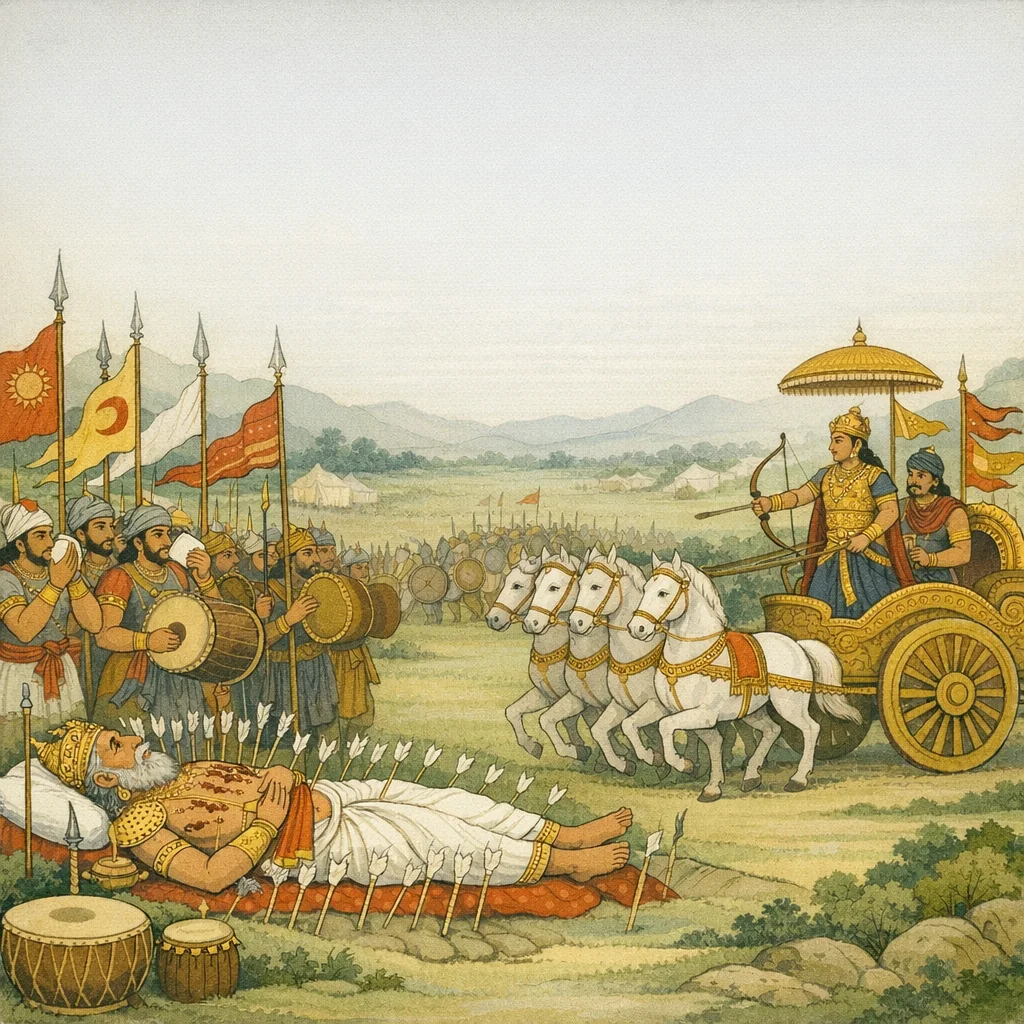
Janamejaya asks Vaiśaṃpāyana how Dhṛtarāṣṭra responded after hearing that Devavrata (Bhīṣma), renowned for unmatched strength and valor, had been brought down through Śikhaṇḍin’s agency. Vaiśaṃpāyana describes the king’s persistent agitation and the arrival of Saṃjaya from the camp to Nāgāhvaya (Hastināpura). Dhṛtarāṣṭra questions Saṃjaya about what the Kurus did after Bhīṣma’s fall and how such a vast host could proceed while submerged in grief. Saṃjaya reports that both sides paused separately, expressed astonishment and admiration for the kṣatra code, arranged a bed for Bhīṣma with arrows, established protective watch, circumambulated him, and then returned to renewed engagement. He depicts the Kaurava army as structurally and psychologically diminished without Bhīṣma, using multiple similes of disorientation and loss. In this vacuum, Kauravas and allied kings repeatedly call upon Karṇa as a hoped-for stabilizer, while the narrative recalls Karṇa’s earlier resentment and vow not to fight while Bhīṣma lived, and Dhṛtarāṣṭra anxiously asks whether Karṇa can now ‘fill the breach’ and restore the Kauravas’ prospects.
Chapter Arc: व्यास-स्मरण और ‘जय’ का मंगलाचरण होते ही दृश्य कुरुक्षेत्र पर टिकता है—भीष्म के पतन के बाद धृतराष्ट्र शोकाकुल होकर संजय से पूछते हैं: अब क्या हुआ? → धृतराष्ट्र की चिंता दुर्योधन की राज्य-लालसा और भीष्म-द्रोण जैसे महारथियों पर आश्रित युद्धनीति से जुड़ती है। शंख-भेरी-तूर्य के निनाद के साथ दोनों सेनाएँ फिर से व्यवस्थित होती हैं, पर कौरव-सेना भीष्म-विहीन होकर नक्षत्रहीन आकाश-सी डगमगाती है। → भीष्म के धराशायी होते ही कौरव-वाहिनी का मनोबल टूटता है—रथ, अश्व, गज व्याकुल; सैनिकों के हृदय में शून्य और भय। इसी रिक्ति को भरने के लिए कर्ण का उभार निर्णायक क्षण बनता है: वह खंडित अंश की पूर्ति कर शत्रुओं में आतंक जगाने वाला ‘पुरुषव्याघ्र’ रूप धारण करता है। → अध्याय का निष्कर्ष एक संक्रमण है—भीष्म-युग का अंत और नई धुरी का आरंभ। कौरव पक्ष अपने टूटे मनोबल को कर्ण के पराक्रम और निष्ठा पर टिकाकर आगे बढ़ने का संकल्प करता है। → भीष्म के बाद नेतृत्व और विजय-आशा किसके हाथ टिकेगी—और कर्ण का यह उभार युद्ध की दिशा को कहाँ मोड़ेगा?
Shlokas
Verse 1
नारायणं नमस्कृत्य नरं चैव नरोत्तमम् | देवीं सरस्वतीं व्यासं ततो जयमुदीरयेत् ।। अन्तर्यामी नारायणस्वरूप भगवान् श्रीकृष्ण, (उनके नित्य सखा) नरस्वरूप नरश्रेष्ठ अर्जुन, (उनकी लीला प्रकट करनेवाली) भगवती सरस्वती और (उन लीलाओंका संकलन करनेवाले) महर्षि वेदव्यासको नमस्कार करके जय (महाभारत)-का पाठ करना चाहिये। जनमेजय उवाच तमप्रतिमसत्त्वीजोबलवीर्यसमन्वितम् । हतं देवव्रतं श्रुव्वा पाउ्चाल्येन शिखण्डिना,जनमेजयने पूछा--ब्रह्मन! अनुपम सत्त्व, ओज, बल और पराक्रमसे सम्पन्न देवव्रत भीष्मको पांचालराज शिखण्डीके हाथसे मारा गया सुनकर राजा धूृतराष्ट्रके नेत्र शोकसे व्याकुल हो उठे होंगे। ब्रह्मर्ष! अपने ज्येष्ठ पिताके मारे जानेपर पराक्रमी धृतराष्ट्रने कैसी चेष्टा की? इति श्रीमहाभारते द्रोणपर्वणि द्रोणाभिषेकपर्वणि धृतराष्ट्रप्रश्ने प्रथमो5ध्याय:
Having bowed to Nārāyaṇa, and also to Nara—the best of men—together with the goddess Sarasvatī and Vyāsa, one should then recite ‘Jaya’ (the Mahābhārata). The verse frames the epic’s narration as a disciplined, reverential act: knowledge (Sarasvatī), authorship and transmission (Vyāsa), and the divine-human axis of dharma (Nārāyaṇa–Nara) are invoked so that the telling of war and moral conflict proceeds under the guidance of truth, right speech, and ethical clarity.
Verse 2
धृतराष्ट्रस्ततो राजा शोकव्याकुललोचन: । किमचेष्टत विप्रर्षे हते पितरि वीर्यवान्,जनमेजयने पूछा--ब्रह्मन! अनुपम सत्त्व, ओज, बल और पराक्रमसे सम्पन्न देवव्रत भीष्मको पांचालराज शिखण्डीके हाथसे मारा गया सुनकर राजा धूृतराष्ट्रके नेत्र शोकसे व्याकुल हो उठे होंगे। ब्रह्मर्ष! अपने ज्येष्ठ पिताके मारे जानेपर पराक्रमी धृतराष्ट्रने कैसी चेष्टा की?
Janamejaya said: “Then King Dhṛtarāṣṭra, his eyes distressed and clouded by grief—O best of brahmarṣis—what did that valiant one do when his elder father-figure (Bhīṣma) had been slain?”
Verse 3
तस्य पुत्रो हि भगवन् भीष्मद्रोणमुखै रथै: । पराजित्य महेष्वासान् पाण्डवान् राज्यमिच्छति,भगवन्! उनका पुत्र दुर्योधन भीष्म, द्रोण आदि महारथियोंके द्वारा महाधनुर्धर पाण्डवोंको पराजित करके स्वयं राज्य हथिया लेना चाहता था
Janamejaya said: “Revered sir, his son Duryodhana—relying on the chariot-warriors led by Bhīṣma and Droṇa—seeks to defeat the great bowmen, the Pāṇḍavas, and then seize the kingdom for himself.”
Verse 4
तस्मिन् हते तु भगवन् केतौ सर्वधनुष्मताम् | यदचेष्टत कौरव्यस्तन्मे ब्रूहि तपोधन,भगवन्! तपोधन! सम्पूर्ण धनुर्धरोंके ध्वजस्वरूप भीष्मजीके मारे जानेपर कुरुवंशी दुर्योधनने जो प्रयत्न किया हो, वह सब मुझे बताइये
O revered sage, when Bhīṣma—who stood like the very banner of all master-archers—had been slain, what efforts did Duryodhana of the Kuru line undertake? Tell me, O ascetic rich in austerity.
Verse 5
वैशम्पायन उवाच निहतं पितरं श्रुत्वा धृतराष्ट्री जनाधिप: । लेभे न शान्तिं कौरव्यश्चिन्ताशोकपरायण:,वैशम्पायनजीने कहा--जनमेजय! ज्येष्ठ पिताको मारा गया सुनकर कुरुवंशी राजा धृतराष्ट्र चिन्ता और शोकमें डूब गये। उन्हें क्षणभरको भी शान्ति नहीं मिल रही थी
Vaiśampāyana said: Hearing that his father had been slain, Dhṛtarāṣṭra—the Kuru king—found no peace. Overwhelmed by anxious brooding and grief, he could not attain even a moment’s calm.
Verse 6
तस्य चिन्तयतो दुःखमनिशं पार्थिवस्य तत् | आजगाम विशुद्धात्मा पुनर्गावल्गणिस्तदा,वे भूपाल निरन्तर उस दुःखदायिनी घटनाका ही चिन्तन करते रहे। उसी समय विशुद्ध अन्त:ःकरणवाला गवल्गणपुत्र संजय पुनः उनके पास आया
As the king brooded incessantly over that sorrow, at that very time Sañjaya—the son of Gāvalgaṇa, pure in heart—came to him again.
Verse 7
शिबिरात् संजयं प्राप्त निशि नागाह्यं पुरम् आम्बिकेयो महाराज धृतराष्ट्रोडन्वपृच्छत,महाराज! रातके समय कुरुक्षेत्रके शिविरसे हस्तिनापुरमें आये हुए संजयसे अम्बिकानन्दन धृतराष्ट्रने वहाँका समाचार पूछा
Vaiśampāyana said: When Sañjaya arrived by night from the camp at Kurukṣetra to the city called Nāgāhvaya (Hastināpura), King Dhṛtarāṣṭra, son of Ambikā, questioned him—asking for the news of what had occurred there.
Verse 8
श्रुत्वा भीष्मस्य निधनमप्रहृष्टमना भूशम् । पुत्राणां जयमाकाड्क्षन् विललापातुरों यथा
Hearing of Bhīṣma’s death, the king’s heart sank; he was deeply joyless. Still longing for victory for his sons, he lamented aloud—like a man stricken and in distress.
Verse 9
भीष्मकी मृत्युका वृत्तान्त सुनकर उनका मन सर्वथा अप्रसन्न एवं उत्साहशून्य हो गया था। वे अपने पुत्रोंकी विजय चाहते हुए आतुरकी भाँति विलाप कर रहे थे ।। धृतराष्ट्र रवाच संशोच्य तु महात्मानं भीष्म॑ं भीमपराक्रमम् | किमकार्षु: परं॑ तात कुरव: कालचोदिता:,धृतराष्ट्रने पूछा--तात! संजय! भयंकर पराक्रमी महात्मा भीष्मके लिये अत्यन्त शोक करके कालप्रेरित कौरवोंने आगे कौन-सा कार्य किया
Dhṛtarāṣṭra said: “After grieving deeply for the great-souled Bhīṣma of terrible prowess, what did the Kurus—driven onward by Time—do next, dear Sañjaya?”
Verse 10
कि नु स्वित् कुरवो5कार्षु्निमग्ना: शोकसागरे,उन दुर्धर्ष वीर महात्मा भीष्मके मारे जानेपर तो समस्त कुरुवंशी शोकके समुद्रमें डूब गये होंगे; फिर उन्होंने कौन-सा कार्य किया?
Vaiśampāyana said: “When the unconquerable hero, the great-souled Bhīṣma, was slain, the Kuru lineage must have sunk into an ocean of grief. In that state of overwhelming sorrow, what course of action did they take?”
Verse 11
तदुदीर्ण महत् सैन्यं त्रैलोक्यस्यापि संजय । भयमुत्पादयेत् तीव्रं पाण्डवानां महात्मनाम्,संजय! महात्मा पाण्डवोंकी वह विशाल एवं प्रचण्ड सेना तो तीनों लोकोंके हृदयमें तीव्र भय उत्पन्न कर सकती है
Vaiśampāyana said: “That vast host, once roused, O Sañjaya, could stir intense fear even in the three worlds—how much more so in the hearts of the high-souled Pāṇḍavas.”
Verse 12
को हि दौर्योधने सैन्ये पुमानासीन्महारथ: । य॑ं प्राप्प समरे वीरा न त्रस्यन्ति महाभये,उस महान् भयके अवसरपर दुर्योधनकी सेनामें कौन ऐसा वीर महारथी पुरुष था, जिसका आश्रय पाकर समरांगणमें वीर कौरव भयभीत नहीं हुए हैं
Vaiśampāyana said: “Indeed, within Duryodhana’s army, who was that heroic great chariot-warrior—taking refuge in whom, the Kaurava fighters did not tremble on the battlefield even amid the great terror of war?”
Verse 13
देवव्रते तु निहते कुरूणामृषभे तदा । किमकार्षु्नुपतयस्तन्ममाचक्ष्व संजय
Vaiśampāyana said: “When Devavrata—Bhīṣma, the bull among the Kurus—had been slain, what did the kings then do? Tell me that, Sañjaya.”
Verse 14
संजय! कुरुश्रेष्ठ देवव्रतके मारे जानेपर उस समय सब राजाओंने कौन-सा कार्य किया? यह मुझे बताओ ।। संजय उवाच शृणु राजन्नेकमना वचन ब्रुवतो मम । यत् ते पुत्रास्तदाकार्षुहते देवव्रते मृथे,संजयने कहा--राजन्! उस युद्धमें देवव्रत भीष्मके मारे जानेपर उस समय आपके पुत्रोंने जो कार्य किया, वह सब मैं बता रहा हूँ। मेरे इस कथनको आप एकाग्रचित्त होकर सुनिये
Sañjaya said: “O King, listen with a focused mind to the words I speak. I shall tell you what your sons did at that time, when Devavrata (Bhīṣma) had been slain in the battle.”
Verse 15
निहते तु तदा भीष्म॑ राजन् सत्यपराक्रमे । तावका: पाण्डवेयाश्र प्राध्यायन्त पृथक् पृथक्,राजन! जब सत्यपराक्रमी भीष्म मार दिये गये, उस समय आपके पुत्र और पाण्डव अलग-अलग चिन्ता करने लगे
Sañjaya said: “O King, when Bhīṣma—whose prowess never failed his pledged truth—had been slain, then your sons and the sons of Pāṇḍu, each in his own way, fell into separate and private deliberation.”
Verse 16
विस्मिताश्र प्रद्ष्टाश्न क्षत्रधर्म निशम्य ते । स्वधर्म निन्दमानास्ते प्रणिपत्य महात्मने,पुरुषसिंह! वे क्षत्रियरधर्मका विचार करके अत्यन्त विस्मित और प्रसन्न हुए। फिर अपने कठोरतापूर्ण धर्मकी निन््दा करते हुए उन्होंने महात्मा भीष्मको प्रणाम किया और उन अमित पराक्रमी भीष्मके लिये झुकी हुई गाँठवाले बाणोंद्वारा तकिये और शय्याकी रचना की
Sañjaya said: Hearing of the warrior’s code (kṣatriya-dharma), they were struck with wonder and filled with joy. Yet, censuring their own harsh duty, they bowed down to the great-souled Bhīṣma, the lion among men—honouring him even as the demands of kṣatriya-dharma compelled them onward in war.
Verse 17
शयनं कल्पयामासुर्भीष्मायामितकर्मणे | सोपधान नरव्याप्र शरै: संनतपर्वभि:,पुरुषसिंह! वे क्षत्रियरधर्मका विचार करके अत्यन्त विस्मित और प्रसन्न हुए। फिर अपने कठोरतापूर्ण धर्मकी निन््दा करते हुए उन्होंने महात्मा भीष्मको प्रणाम किया और उन अमित पराक्रमी भीष्मके लिये झुकी हुई गाँठवाले बाणोंद्वारा तकिये और शय्याकी रचना की
Sañjaya said: For Bhīṣma, whose deeds were boundless, they arranged a bed—complete with a pillow, O tiger among men—fashioning it from arrows whose joints were bent. The scene underscores a grim wartime ethic: even amid relentless violence, the warriors acknowledge Bhīṣma’s stature and seek to honor him with the best care their battlefield means allow.
Verse 18
विधाय रक्षां भीष्माय समाभाष्य परस्परम् | अनुमान्य च गाड़ेयं कृत्वा चापि प्रदक्षिणम्,इसी प्रकार परस्पर वार्तालाप करके भीष्मजीकी रक्षाकी व्यवस्था कर दी और उन गंगानन्दन देवव्रतकी अनुमति ले उनकी परिक्रमा करके आपसमें मिलकर वे कालवप्रेरित क्षत्रिय क्रोधसे लाल आँखें किये पुनः युद्धके लिये निकले
Sañjaya said: Having arranged protection for Bhīṣma, and after conversing among themselves, they sought the assent of Gāṅgeya (Devavrata) and circumambulated him in reverence. Then, united again, those kṣatriyas—driven on by Time and with eyes reddened by wrath—went forth once more for battle.
Verse 19
क्रोधसंरक्तनयना: समवेत्य परस्परम् । पुनर्युद्धाय निर्जग्मु: क्षत्रिया: कालचोदिता:,इसी प्रकार परस्पर वार्तालाप करके भीष्मजीकी रक्षाकी व्यवस्था कर दी और उन गंगानन्दन देवव्रतकी अनुमति ले उनकी परिक्रमा करके आपसमें मिलकर वे कालवप्रेरित क्षत्रिय क्रोधसे लाल आँखें किये पुनः युद्धके लिये निकले
Sañjaya said: With eyes reddened by anger, the kṣatriya warriors gathered together and conferred among themselves; then, driven onward as if by Time itself, they set out once more for battle. The verse underscores how wrath and the inexorable pressure of kāla (fate/time) propel even deliberating men back into the cycle of violence.
Verse 20
ततस्तूर्यनिनादैश्व॒ भेरीणां निनदेन च । तावकानामनीकानि परेषां च विनिर्ययु:,तदनन्तर बाजोंकी ध्वनि और नगाड़ोंकी गड़गड़ाहटके साथ आपकी तथा पाण्डवोंकी भी सेनाएँ युद्धके लिये निकलीं
Then, amid the blare of trumpets and the thunderous roll of kettle-drums, the battle-formations of your forces and of the opposing side as well moved out—both armies stepping forward into the fateful work of war, where duty, ambition, and consequence are about to be tested.
Verse 21
राजेन्द्र! जिस समय गंगानन्दन भीष्म रथसे गिरे थे, उस समय सूर्य पश्चिम दिशामें छल चुके थे। यद्यपि महात्मा गंगानन्दन भीष्मने उन सबको युद्ध बंद कर देनेकी सलाह दी थी, तथापि कालसे विवेकशक्ति नष्ट हो जानेके कारण वे भरतश्रेष्ठ क्षत्रिय उनके हितकर वचनकी अवहेलना करके अमर्षके वशीभूत हो हाथोंमें अस्त्र-शस्त्र लिये तुरंत ही युद्धके लिये निकल पड़े
Sanjaya said: O king, when Bhishma, the son of the Ganga, fell from his chariot, the sun had already set in the western quarter. Though that great-souled Bhishma urged everyone to cease fighting and spoke words meant for their welfare, time had robbed them of discernment. Those foremost Kshatriyas of Bharata’s line disregarded his beneficial counsel and, driven by resentment, immediately rushed out for battle with weapons in hand.
Verse 22
अनादृत्य वच: पथ्यं गाड़ेयस्य महात्मन: । निर्ययुर्भरतश्रेष्ठा: शस्त्राण्यादाय सत्वरा:,राजेन्द्र! जिस समय गंगानन्दन भीष्म रथसे गिरे थे, उस समय सूर्य पश्चिम दिशामें छल चुके थे। यद्यपि महात्मा गंगानन्दन भीष्मने उन सबको युद्ध बंद कर देनेकी सलाह दी थी, तथापि कालसे विवेकशक्ति नष्ट हो जानेके कारण वे भरतश्रेष्ठ क्षत्रिय उनके हितकर वचनकी अवहेलना करके अमर्षके वशीभूत हो हाथोंमें अस्त्र-शस्त्र लिये तुरंत ही युद्धके लिये निकल पड़े
Sañjaya said: Disregarding the wholesome, beneficial counsel of the great-souled descendant of Gādī, the foremost of the Bharatas hurried out at once, taking up their weapons. Ethically, the verse highlights how, when passion and the pressure of time eclipse discernment, even good advice from a venerable elder is cast aside, and violence is chosen over restraint.
Verse 23
व्यावृत्तेडर्यम्णि राजेन्द्र पतिते जाह्नवीसुते । अमर्षवशमापन्ना: कालोपहतचेतस:,मोहात् तव सपुत्रस्य वधाच्छान्तनवस्थ च । कौरव्या मृत्युसाद्धूता: सहिता: सर्वराजभि: पुत्रसहित आपके मोह (अविवेक)-से और शान्तनुनन्दन भीष्मका वध हो जानेसे समस्त राजाओंसहित सम्पूर्ण कुरुवंशी मृत्युके अधीन हो गये हैं
Sanjaya said: “O king, when the day had turned and the son of the Jāhnavī (Bhīṣma) had fallen, the Kauravas—overpowered by resentment and with their minds struck down by the force of Time—became, through delusion arising from your son’s course and through the slaying of Śāntanu’s descendant, as though swept into the grasp of Death, even while joined by all the allied kings.”
Verse 24
अजावय इवागोपा बने श्वापदसंकुले । भृशमुद्विग्नमनसो हीना देवव्रतेन ते,जैसे हिंसक जन्तुओंसे भरे हुए वनमें बिना रक्षककी भेड़ और बकरियाँ भयसे उद्विग्न रहती हैं, उसी प्रकार आपके पुत्र और सैनिक देवव्रतसे रहित हो मन-ही-मन अत्यन्त उद्धिग्न हो उठे थे
Sañjaya said: Like sheep and goats left without a herdsman in a forest teeming with predators, your sons and their troops—bereft of Devavrata (Bhīṣma)—became intensely anxious at heart. The verse underscores how the loss of a righteous, formidable protector in war breeds fear, disorder, and moral weakening among those who depended on his guardianship.
Verse 25
पतिते भरतश्रेष्ठे बभूव कुरुवाहिनी । द्यौरिवापेतनक्षत्रा हीनं खमिव वायुना,भरतशिरोमणि भीष्मके धराशायी हो जानेपर कौरव-सेना नक्षत्ररहित आकाश, वायुशून्य अन्तरिक्ष, नष्ट हुई खेतीवाली भूमि, असंस्कृत वाणी तथा राजा बलिके बाँध लिये जानेपर नायकविहीन हुई असुरोंकी सेनाके समान उद्विग्न, असमर्थ और श्रीहीन हो गयी
Sañjaya said: When Bhīṣma—the foremost of the Bharatas—fell, the Kuru host became shaken and diminished in splendor. It was like the sky bereft of its stars, like the open firmament emptied of wind: leaderless, dispirited, and unable to act with its former strength. The verse underscores how the fall of a righteous, stabilizing elder in war brings not only tactical loss but a moral and psychological collapse in the army that depended on him.
Verse 26
विपन्नसस्थेव मही वाक् चैवासंस्कृता तथा । आसुरीव यथा सेना निगृहीते नृूपे बलौ,भरतशिरोमणि भीष्मके धराशायी हो जानेपर कौरव-सेना नक्षत्ररहित आकाश, वायुशून्य अन्तरिक्ष, नष्ट हुई खेतीवाली भूमि, असंस्कृत वाणी तथा राजा बलिके बाँध लिये जानेपर नायकविहीन हुई असुरोंकी सेनाके समान उद्विग्न, असमर्थ और श्रीहीन हो गयी
Sañjaya said: When Bhīṣma—the crest-jewel of the Bharatas—had fallen to the ground, the Kaurava host became agitated, powerless, and bereft of splendor: like a land whose crops are ruined, like speech left unrefined, and like the army of the Asuras when their king Bali has been subdued—leaderless and shaken.
Verse 27
विधवेव वरारोहा शुष्कतोयेव निम्नगा । वृकैरिव वने रुद्धा पृषती हतयूथपा
Sañjaya said: She appeared like a widow bereft of her lord, like a river whose waters have dried up; like a doe hemmed in by wolves within a forest—her leader of the herd slain.
Verse 28
शरभाहतसिंहेव महती गिरिकन्दरा । भारती भरतश्रेष्ठे पतिते जाह्नवीसुते
Sañjaya said: When the best of the Bharatas—the son of the Jāhnavī (Gaṅgā)—fell, the great Bhārata host collapsed, like a vast mountain-cavern when a lion within it has been struck down by a śarabha.
Verse 29
गंगानन्दन भरतश्रेष्ठ भीष्मके धराशायी होनेपर भरत-वंशियोंकी सेना विधवा सुन्दरीके समान, जिसका पानी सूख गया हो, उस नदीके समान, जिसे भेड़ियोंने वनमें घेर रखा हो और जिसका साथी यूथप मार डाला गया हो, उस चितकबरी मृगीके समान तथा शरभने जिसमें रहनेवाले सिंहको मार डाला हो, उस विशाल कन्दराके समान भयभीत, विचलित और श्रीहीन जान पड़ती थी ।। विष्वग्वाताहता रुग्णा नौरिवासीन्महार्णवे । बलिभि: पाण्डवैवीरिरलब्धलक्षैर्भुशार्दिता,वीर और बलवान पाण्डव अपने लक्ष्यको सफलतापूर्वक मार गिरानेवाले थे, उनके द्वारा अत्यन्त पीड़ित होकर आपकी सेना महासागरमें चारों ओरसे वायुके थपेड़े खाकर टूटी हुई नौकाके समान बड़ी विपत्तिमें फँस गयी
Sañjaya said: O best of the Bharatas, when Bhīṣma, the son of Gaṅgā, had fallen to the ground, the Kuru host appeared terrified, shaken, and stripped of its splendor—like a beautiful woman suddenly widowed; like a river whose waters have dried up; like a dappled doe hemmed in by wolves in the forest after her leader has been slain; and like a vast cavern whose resident lion has been killed by a śarabha. Tormented by the mighty Pāṇḍava heroes—men who did not miss their mark—your army was caught in great calamity, like a ship in the open ocean battered on all sides by violent winds and left crippled.
Verse 30
सा तदा55सीद् भशं सेना व्याकुलाश्चरथद्विपा । विपन्नभूयिष्ठनरा कृपणा ध्वस्तमानसा,उस समय आपकी सेनाके घोड़े, रथ और हाथी सब अत्यन्त व्याकुल हो उठे थे। उसके अधिकांश सैनिक अपने प्राण खो चुके थे। उसका दिल बैठ गया था और वह अत्यन्त दीन हो रही थी
Sañjaya said: At that time your army was thrown into utter disarray; its chariots and elephants were in panic. Most of its warriors had fallen, and the host—its courage broken and its mind shaken—sank into a pitiable state.
Verse 31
तस्यां त्रस्ता नृपतयः सैनिकाश्न पृथग्विधा: । पाताल इव मज्जन्तो हीना देवव्रतेन ते,उस सेनाके भिन्न-भिन्न सैनिक, नरेशगण अत्यन्त भयभीत हो देवव्रत भीष्मके बिना मानो पातालमें डूब रहे थे
Sañjaya said: In that situation, the kings and the many divisions of soldiers, seized by fear, seemed—bereft of Devavrata (Bhīṣma)—to be sinking as though into Pātāla, the netherworld.
Verse 32
कर्ण हि कुरवो<स्मार्षु: स हि देवव्रतोपम: । सर्वशस्त्रभृतां श्रेष्ठ रोचमानमिवातिथिम्,उस समय कौरवोंने कर्णका स्मरण किया। जैसे गृहस्थका मन अतिथिकी ओर तथा आपत्तिमें पड़े हुए मनुष्यका मन अपने मित्र या भाई-बन्धुकी ओर जाता है, उसी प्रकार कौरवोंका मन समस्त श्त्रधारियोंमें श्रेष्ठ एवं तेजस्वी वीर कर्णकी ओर गया; क्योंकि वही भीष्मके समान पराक्रमी समझा जाता था। भारत! वहाँ सब राजा “कर्ण! कर्ण!” की पुकार करने लगे
Sañjaya said: Then the Kauravas thought of Karṇa, for he was deemed comparable to Devavrata (Bhīṣma). Their minds turned toward that radiant hero—foremost among all bearers of weapons—just as a householder’s attention goes to an arriving guest, or as a man in distress turns to a trusted friend or kinsman. There, the kings began to cry out again and again, “Karṇa! Karṇa!”
Verse 33
बन्धुमापद्गतस्येव तमेवोपागमन्मन: । चुक्रुशु: कर्ण कर्णेति तत्र भारत पार्थिवा:,उस समय कौरवोंने कर्णका स्मरण किया। जैसे गृहस्थका मन अतिथिकी ओर तथा आपत्तिमें पड़े हुए मनुष्यका मन अपने मित्र या भाई-बन्धुकी ओर जाता है, उसी प्रकार कौरवोंका मन समस्त श्त्रधारियोंमें श्रेष्ठ एवं तेजस्वी वीर कर्णकी ओर गया; क्योंकि वही भीष्मके समान पराक्रमी समझा जाता था। भारत! वहाँ सब राजा “कर्ण! कर्ण!” की पुकार करने लगे
Sañjaya said: Their minds turned toward him alone—just as the mind of one in distress turns to a kinsman. There, O Bhārata, the kings cried out, “Karṇa! Karṇa!”
Verse 34
राधेयं हितमस्माकं सूतपुत्रं तनुत्यजम् । स हि नायुध्यत तदा दशाहानि महायशा:
Sañjaya said: “Rādheya—Karṇa, the charioteer’s son—devoted to our cause and ready to lay down his life, did not fight at that time for ten days, though he was a man of great renown.”
Verse 35
भीष्मेण हि महाबाहु: सर्वक्षत्रस्थ पश्यत:,राजन! बात यह हुई थी कि जब बल और पराक्रमसे सुशोभित रथियोंकी गणना की जा रही थी, उस समय समस्त क्षत्रियोंके देखते-देखते भीष्मजीने महाबाहु नरश्रेष्ठ कर्णको अर्धरथी बता दिया। यद्यपि वह दो रथियोंके समान है
Sañjaya said: O King, when the warriors—resplendent with strength and valor—were being assessed and ranked, Bhīṣma, in full view of all the kṣatriyas, declared the mighty-armed Karṇa to be only a half-ratha. Yet in truth Karṇa was the equal of two full chariot-warriors.
Verse 36
रथेषु गण्यमानेषु बलविक्रमशालिषु । संख्यातो<र्धरथ: कर्णो द्विगुण: सन् नरर्षभ:,राजन! बात यह हुई थी कि जब बल और पराक्रमसे सुशोभित रथियोंकी गणना की जा रही थी, उस समय समस्त क्षत्रियोंके देखते-देखते भीष्मजीने महाबाहु नरश्रेष्ठ कर्णको अर्धरथी बता दिया। यद्यपि वह दो रथियोंके समान है
Sañjaya said: As the chariot-warriors—splendid in strength and valor—were being counted and ranked, Karṇa was declared to be only an “ardha-ratha” (a half-ratha). Yet that bull among men was in truth equal to two rathas. Spoken in the very sight of the assembled kṣatriyas, the pronouncement reveals a deliberate diminishing of Karṇa’s standing—an ethically charged public appraisal that shapes honor, rivalry, and the moral atmosphere of the coming battle.
Verse 37
रथातिरथसंख्यायां यो5ग्रणी: शूरसम्मत: । सासुरानपि देवेशान् रणे यो योद्धुमुत्सहेत्,रथियों और अतिरथियोंकी संख्यामें वह अग्रगण्य और शूरवीरके सम्मानका पात्र है। रणक्षेत्रमें असुरोंसहित सम्पूर्ण देवेश्वरोंके साथ भी वह युद्ध करनेका उत्साह रखता है
Sañjaya said: “In the reckoning of chariot-warriors and great chariot-warriors, he stands foremost, acknowledged as a true hero; and on the battlefield he would be eager to fight even the lords of the gods, together with the Asuras.”
Verse 38
स तु तेनैव कोपेन राजन् गाड़्रेयमुक्तवान् | त्वयि जीवति कौरव्य नाहं योत्स्ये कदाचन,राजन! अर्धरथी बतानेके कारण ही क्रोधवश उसने गंगानन्दन भीष्मसे कहा --'कुरुनन्दन! आपके जीते-जी मैं कदापि युद्ध नहीं करूँगा। कौरव! यदि आप उस महासमरमें पाण्डुपुत्रोंको मार डालेंगे तो मैं दुर्योधनकी अनुमति लेकर वनको चला जाऊँगा
Sañjaya said: “O King, inflamed by that very anger, he addressed Bhīṣma, the son of the Gaṅgā: ‘O scion of the Kurus, while you are still alive, I will never fight—at any time.’”
Verse 39
त्वया तु पाण्डवेयेषु निहतेषु महामृधे । दुर्योधनमनुज्ञाप्य वनं यास्यामि कौरव,राजन! अर्धरथी बतानेके कारण ही क्रोधवश उसने गंगानन्दन भीष्मसे कहा --'कुरुनन्दन! आपके जीते-जी मैं कदापि युद्ध नहीं करूँगा। कौरव! यदि आप उस महासमरमें पाण्डुपुत्रोंको मार डालेंगे तो मैं दुर्योधनकी अनुमति लेकर वनको चला जाऊँगा
Sañjaya said: “O Kaurava king, if in that great and terrible battle the sons of Pāṇḍu are slain by you, then, having obtained Duryodhana’s permission, I shall depart for the forest.”
Verse 40
पाण्डवैर्वा हते भीष्मे त्वयि स्वर्गमुपेयुषि । हन्तास्म्येकरथेनैव कृत्स्नान् यान् मन्यसे रथान्,“अथवा यदि पाण्डवोंके द्वारा मारे जाकर आप स्वर्गलोकमें पहुँच गये तो मैं एकमात्र रथकी सहायतासे उन सबको मार डालूँगा, जिन्हें आप रथी मानते हैं!
Sañjaya said: “If Bhīṣma is slain by the Pāṇḍavas and you yourself depart to heaven, then I, relying on a single chariot alone, will kill all those whom you regard as great chariot-warriors.”
Verse 41
एवमुक्त्वा महाबाहुर्दशाहानि महायशा: । नायुध्यत ततः कर्ण: पुत्रस्य तव सम्मते,ऐसा कहकर महाबाहु महायशस्वी कर्ण आपके पुत्रकी सम्मति ले दस दिनोंतक युद्धमें सम्मिलित नहीं हुआ
Sañjaya said: Having spoken thus, the mighty-armed, greatly renowned Karṇa—acting with the approval of your son—did not take part in the fighting for ten days thereafter.
Verse 42
भीष्म: समरविक्रान्त: पाण्डवेयस्य भारत । जघान समरे योधानसंख्येयपराक्रम:,भारत! समरभूमिमें पराक्रम प्रकट करनेवाले अनन्त पराक्रमी भीष्मने युद्धस्थलमें पाण्डुनन्दन युधिष्ठिरके बहुत-से योद्धाओंको मार डाला
Sañjaya said: O Bhārata, Bhīṣma—valiant in battle—slew in that combat many warriors belonging to the son of Pāṇḍu. On the battlefield he displayed immeasurable prowess.
Verse 43
तस्मिंस्तु निहते शूरे सत्यसंधे महौजसि । त्वत्सुता: कर्णमस्मार्षुस्ततुकामा इव प्लवम्
Sañjaya said: When that heroic warrior—true to his vow and of great might—had been slain, your sons turned their thoughts to Karṇa, as men longing to cross turn to a boat.
Verse 44
उन महापराक्रमी सत्यप्रतिज्ञ शूरवीर भीष्मके मारे जानेपर आपके पुत्रोंने कर्णका उसी प्रकार स्मरण किया, जैसे पार जानेकी इच्छावाले पुरुष नावकी इच्छा करते हैं ।। तावकास्तव पुत्रा श्न सहिता: सर्वराजभि: । हा कर्ण इति चाक्रन्दन् कालोड्यमिति चाब्रुवन्,समस्त राजाओंसहित आपके पुत्र और सैनिक 'हा कर्ण" कहकर विलाप करने लगे और बोले--'कर्ण! तुम्हारे पराक्रमका यह अवसर आया है”
Sañjaya said: When Bhīṣma—of great prowess, steadfast in his vow, and a heroic warrior—had been slain, your sons, along with the kings allied to them, began to wail, crying, “Alas, Karṇa!” They declared, “Karṇa, the time has come for your valor to rise.” In their distress they turned their minds to Karṇa just as men who long to cross a river yearn for a boat.
Verse 45
एवं ते सम हि राधेयं सूतपुत्र तनुत्यजम् | चुक्कुशु: सहिता योधास्तत्र तत्र महाबला:,इस प्रकार आपके महाबली योद्धालोग राधानन्दन सूतपुत्र कर्णको, जो दुर्योधनके लिये अपना शरीर निछावर किये बैठा था, एक साथ पुकारने लगे
Sañjaya said: Thus, your mighty warriors, gathered together, repeatedly cried out to Rādheya—Karna, the charioteer’s son—who was ready to lay down his very body for Duryodhana.
Verse 46
जामदग्न्याभ्यनुज्ञातमस्त्रे दुर्वारपौरुषम् । अगमन्नो मन: कर्ण बन्धुमात्ययिकेष्विव,राजन! कर्णने जमदग्निनन्दन परशुरामजीसे अस्त्र-विद्याकी शिक्षा प्राप्त की है और उसका पराक्रम दुर्निवार्य है। इसीलिये हमलोगोंका मन कर्णकी ओर गया, ठीक वैसे ही, जैसे बड़ी भारी आपत्तिके समय मनुष्यका मन अपने मित्रों तथा सगे-सम्बन्धियोंकी ओर जाता है
Sañjaya said: O King, our minds turned toward Karṇa—whose irresistible prowess in weapons had been sanctioned by Jāmadagnya (Paraśurāma)—just as, in a time of grave calamity, a person’s thoughts naturally go to friends and close kin for support.
Verse 47
स हि शक्तो रणे राजंस्त्रातुमस्मान् महाभयात् | त्रिदशानिव गोविन्द: सततं सुमहाभयात्,राजन! जैसे भगवान् विष्णु देवताओंकी सदा अत्यन्त महान् भयसे रक्षा करते हैं, उसी प्रकार कर्ण हमें भारी भयसे उबारनेमें समर्थ है
Sañjaya said: O King, he is indeed capable, in battle, of rescuing us from a great terror—just as Govinda (Viṣṇu) continually protects the gods from exceedingly great fear.
Verse 48
वैशम्पायन उवाच तथा तु संजयं कर्ण कीर्तयन्तं पुन: पुनः । आशीविषवदुच्छवस्य धृतराष्ट्रोडब्रवीदिदम्,वैशम्पायनजी कहते हैं--जनमेजय! जब संजय इस प्रकार बार-बार कर्णका नाम ले रहा था, उस समय राजा धूृतराष्ट्रने विषधर सर्पके समान उच्छवास लेकर इस प्रकार कहा
Vaiśampāyana said: O Janamejaya, as Sañjaya again and again spoke in praise of Karṇa, King Dhṛtarāṣṭra heaved a breath like a venomous serpent and said this.
Verse 49
घतराट्र उवबाच यत् तद्वैकर्तनं कर्णमगमद् वो मनस्तदा । अप्यपश्यत राधेयं सूतपुत्र॑ तनुत्यजम्
Dhṛtarāṣṭra said: “When your thoughts then turned toward Karṇa, the son of Vikartana, did you also see Rādheya—the charioteer’s son—lying there, having given up his body?”
Verse 50
धृतराष्ट्रने कहा--संजय! जब तुमलोगोंका मन विकर्तनपुत्र कर्णकी ओर गया, तब क्या तुमने शरीर निछावर करनेवाले सूतपुत्र राधानन्दन कर्णको वहाँ देखा? ।। अपि तन्न मृषाकार्षीत् कच्चित् सत्यपराक्रम: । सम्भ्रान्तानां तदारततानां त्रस्तानां त्राणमिच्छताम्
Dhṛtarāṣṭra said: “Sañjaya, when your attention turned toward Karṇa, the son of Vikarṭana, did you then see there Karṇa—Rādhā’s son, the charioteer’s son—one who is ready to lay down his very body? Surely that man of proven valour did not act falsely, did he? At that moment, for those who were bewildered, hard-pressed, and terrified—longing for protection—did he seek to be their refuge?”
Verse 51
कहीं ऐसा तो नहीं हुआ कि संकटमें पड़कर घबराये हुए और भयभीत होकर अपनी रक्षा चाहते हुए कौरवोंकी प्रार्थनाको सत्यपराक्रमी कर्णने निष्फल कर दिया हो? ।। अपि तत् पूरयांचक्रे धनुर्धरवरो युधि । यत्तद् विनिहते भीष्मे कौरवाणामपाकृतम्,भीष्मके मारे जानेपर युद्धस्थलमें कौरवोंके पक्षमें जो कमी आ गयी थी, क्या उसे धनुर्धारियोंमें श्रेष्ठ कर्णने पूरा कर दिया?
Vaiśampāyana said: “Did Karṇa—renowned for true prowess and foremost among archers—fulfil the Kauravas’ anxious plea for protection when they were shaken by danger and fear? And after Bhīṣma had been struck down, did Karṇa in the battlefield make good the deficiency that had arisen on the Kaurava side?”
Verse 52
तत् खण्डं पूरयन् कर्ण: परेषामादधद् भयम् । स हि वै पुरुषव्याप्रो लोके संजय कथ्यते,क्या उस खण्डित अंशकी पूर्ति करके कर्णने शत्रुओंके मनमें भय उत्पन्न किया? संजय! जगतमें कर्णको 'पुरुषसिंह” कहा जाता है
Filling up that broken gap, Karṇa struck fear into the hearts of the opposing warriors. For indeed, O Sañjaya, in the world Karṇa is spoken of as a ‘tiger among men’—one whose prowess restores a faltering line and intimidates foes in the very midst of battle.
Verse 53
आर्तानां बान्धवानां च क्रन्दतां च विशेषत: । परित्यज्य रणे प्राणांस्तत्त्राणार्थ च शर्म च । कृतवान् मम पुत्राणां जयाशां सफलामपि,क्या उसने रणभूमिमें शोकार्त होकर विशेषरूपसे क्रन्दन करनेवाले अपने उन बन्धुजनोंकी रक्षा एवं कल्याणके लिये अपने प्राणोंका परित्याग करके मेरे पुत्रोंकी विजयाभिलाषाको सफल किया?
Vaiśampāyana said: “Did he, on the battlefield, abandon his very life—especially for the protection and welfare of those distressed kinsmen who were crying out in grief—and thereby make even the hope of victory of my sons come true?”
Verse 346
सामात्यबन्धु: कर्णो वै तमानयत मा चिरम् | वे कहने लगे कि “राधानन्दन सूतपुत्र कर्ण हमारा हितैषी है। हमारे लिये अपना शरीर निछावर किये हुए है। अपने मन्त्रियों और बन्धुओंके साथ महायशस्वी कर्णने दस दिनोंतक युद्ध नहीं किया है। उसे शीघ्र बुलाओ। देर न करो
Sañjaya said: “Bring Karṇa at once—do not delay.” Thus they urged, recalling that Rādhā’s son, the charioteer-born Karṇa, was their well-wisher, one who had offered his very body for their cause; and that, together with his ministers and kinsmen, the greatly renowned Karṇa had not fought for ten days. Therefore they insisted he be summoned quickly, without hesitation.
Frequently Asked Questions
The dilemma is institutional: how a ruler and his side proceed with duty-bound action when the moral authority and stabilizing presence of an elder commander has fallen, leaving grief to compete with strategic necessity.
The chapter illustrates that collective action depends on counsel, ritual acknowledgment of loss, and disciplined reorganization; it also warns that hope placed in a single heroic substitute can be psychologically powerful yet ethically and strategically precarious.
No explicit phalaśruti appears in this adhyāya; its meta-function is historiographic—preserving how grief, reputation, and command transitions shape decisions within the broader dharma-inquiry of the epic.