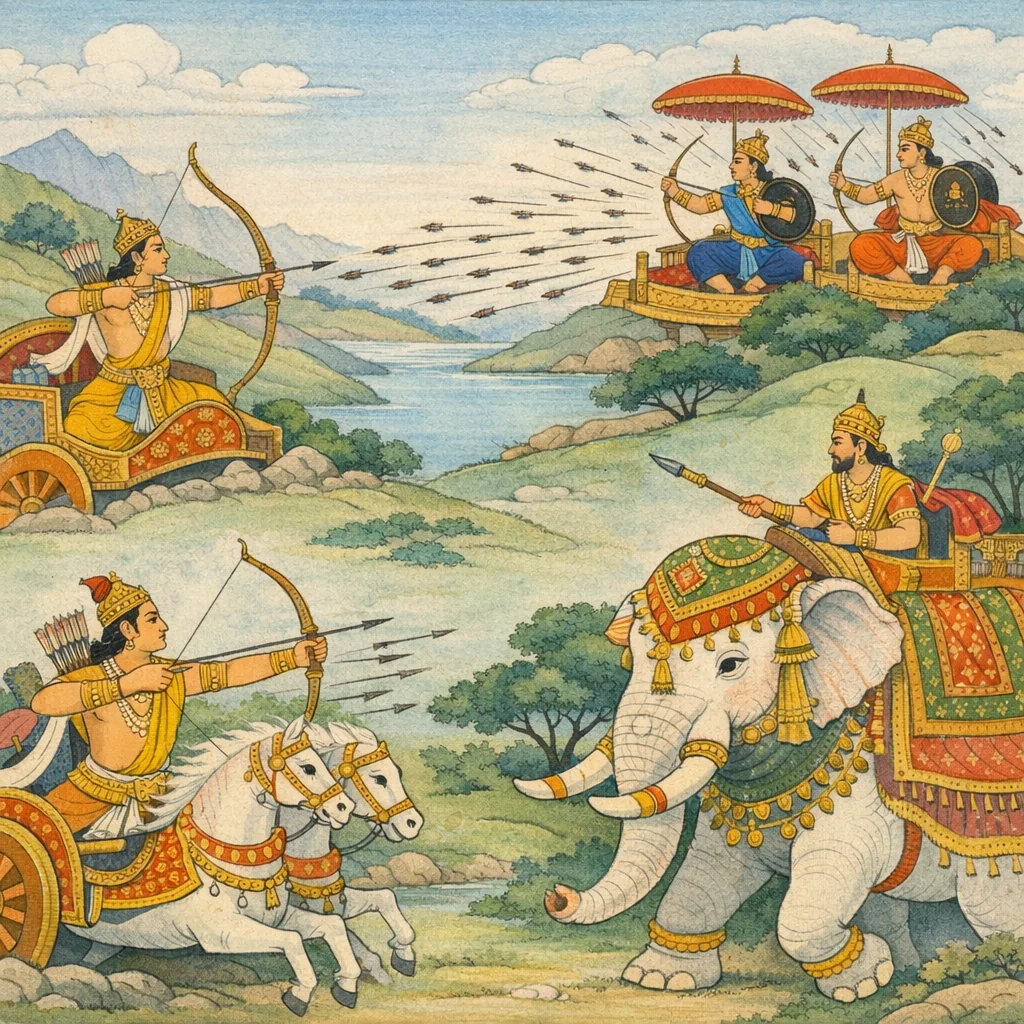
Adhyaya 86
Adhyāya 86: Irāvān’s Lineage, Cavalry Clash, and the Māyā-Duel Ending in Irāvān’s Fall
Upa-parva: Bhīṣmābhiṣeka–Yuddha-pravṛtti (Early War Engagements under Bhīṣma)
Saṃjaya reports a fiercely congested phase of battle marked by cavalry-on-cavalry collision and rapid attrition. Śakuni Saubala and Hārdikya Kṛtavarmā press the Pāṇḍava forces, while the narrative enumerates prominent horse contingents from multiple regions, emphasizing speed, armor, and formation pressure. The chapter then introduces Irāvān—Arjuna’s son, born of a Nāga princess—detailing his upbringing in the Nāga realm and his later reunion with Arjuna in Indra’s domain, where Irāvān is tasked to provide wartime assistance. On the field, Irāvān confronts the Saubala brothers (Gaja, Gavākṣa, Vṛṣaka, Carmavān, Ārjava, Śuka), breaks their assault, and inflicts severe losses despite being struck by many spears. Duryodhana, alarmed by the depletion of his force, deploys a formidable rākṣasa (Ārśyaśṛṅgin) skilled in māyā. A duel follows in which both sides employ deceptive transformations; Irāvān counters with Nāga-based manifestations, but the rākṣasa assumes a Garuḍa-like form to consume the Nāgas, creating a moment of disorientation. Exploiting this, the rākṣasa kills Irāvān and casts down his adorned head. The chapter closes by noting Kaurava relief, renewed battlefield turbulence, and the sense that fighters no longer prioritize self-preservation amid daitya-like ferocity.
Chapter Arc: धृतराष्ट्र संजय को कटु प्रश्नों से घेर लेते हैं—क्यों वह निरन्तर पाण्डुपुत्रों को हर्षित, अभंग और विजयी बताता है, और ‘मेरे’ पक्ष की कोई शुभ-वार्ता क्यों नहीं सुनाता। → रणभूमि में वीर-राजा स्वर्ग-प्राप्ति की आकांक्षा से सेना में घुसते हैं; अवन्ती के महाधनुर्धर विन्द और अनुविन्द इरावान को लक्ष्य कर रणोत्कट होकर बढ़ते हैं। इरावान क्रोध में शरवर्षा करता है, उनके रथ-तंत्र को अस्त-व्यस्त करता है और सारथि तक को गिरा देता है। तभी प्राग्ज्योतिष का राजा भगदत्त नागराज/ऐरावत पर आरूढ़ होकर इन्द्रवत् गर्जना करता हुआ घटोत्कच के सम्मुख आता है। → दोहरी धुरी पर युद्ध चरम पर पहुँचता है—इरावान द्वारा विन्द-अनुविन्द का दमन, और भगदत्त-ऐरावत की प्रचण्ड धावा-रेखा से घटोत्कच का दबना; हाथी-रथ-धनुष की टक्कर में कौरव-सेना में इन्द्र-उपेन्द्र की भाँति भगदत्त का आतंक छा जाता है। → अध्याय का निष्कर्ष पाण्डव-पक्ष के स्थानीय उत्कर्ष और कौरव-पक्ष के प्रतिउत्तर—इरावान की विजय-रेखा (विन्द-अनुविन्द पर) तथा भगदत्त द्वारा घटोत्कच को पीछे ढकेलने—के रूप में बैठता है; साथ ही मद्रराज के विरुद्ध नकुल-सहदेव की बढ़त का संकेत युद्ध-चित्र को और विस्तृत करता है। → भगदत्त-घटोत्कच का संघर्ष और मद्रराज के मोर्चे पर नकुल-सहदेव की निर्णायक टक्कर अगले प्रसंग के लिए अधर में लटकती है।
Shlokas
Verse 1
ऑपन--माज छा -जड:: तग्रयस्शीतितमो<ध्याय: इरावानके द्वारा विन्दर और अनुविन्दकी पराजय, भगदत्तसे घटोत्कचका हारना तथा मद्रराजपर नकुल और सहदेवकी विजय धृतराष्ट्र रवाच बहूनि हि विचित्राणि द्वैरथानि सम संजय । पाण्डूनां मामकै: सार्थमश्रीषं तव जल्पत:,धृतराष्ट्र बोले--संजय! मैंने तुम्हारे मुखसे अबतक पाण्डवोंके मेरे पुत्रोंके साथ जो बहुत-से विचित्र द्वैरथ युद्ध हुए हैं, उनका वर्णन सुना
Dhṛtarāṣṭra said: “Sañjaya, I have heard from your narration of many wondrous single-chariot duels fought between the sons of Pāṇḍu and my own men. Continue to recount them.”
Verse 2
न चैव मापकं किंचिद्धृष्ट शंससि संजय । नित्यं पाण्डुसुतान् हृष्टानभग्नान् सम्प्रशंससि,परंतु सूत! तुमने अभीतक मेरे पक्षमें घटित हुई कोई हर्षकी बात नहीं कही है; उलटे पाण्डवोंको प्रतिदिन हर्षसे पूर्ण और अभग्न (अपराजित) बताते हो
Dhṛtarāṣṭra said: “And yet, Sañjaya, you report nothing at all that I might take as a favorable sign for my side. Instead, day after day you keep praising the sons of Pāṇḍu as joyful and unbroken—still undefeated.”
Verse 3
जीयमानान् विमनसो मामकान् विगतौजस: । वदसे संयुगे सूत दिष्टमेतन्न संशय:,मेरे पुत्रोंको तेज और बलसे हीन, खिन्नचित्त और युद्धमें पराजित बताते हो। संजय! यह सब प्रारब्धका ही खेल है, इसमें संशय नहीं है
You describe my own sons as being overcome—downcast in mind and stripped of vigor—defeated in the battle, O charioteer. This, indeed, is the working of destiny; of that there is no doubt.
Verse 4
संजय उवाच यथाशक्ति यथोत्साहं युद्धे चेष्टन्ति तावका: । दर्शयाना: परं शक््त्या पौरुषं पुरुषर्षभ,संजय बोले--पुरुषश्रेष्ठ! आपके पुत्र भी पूरी शक्तिसे पुरुषार्थ दिखाते हुए अपने बल और उत्साहके अनुसार युद्धमें सफलता प्राप्त करनेकी चेष्टा करते हैं
Sañjaya said: “O bull among men, your own sons strive in battle according to their strength and according to their ardor, exerting themselves to the utmost and displaying their valor with all the power they can command.”
Verse 5
गड़ाया: सुरनद्या वै स्वादु भूत्वा यथोदकम् | महोददथेर्गुणा भ्यासाललवण त्वं निगच्छति,परंतप! नरेश! जैसे देवनदी गंगाजीका जल स्वादिष्ट होकर भी महासागरके संयोगसे उसीके गुणका सम्मिश्रण हो जानेके कारण खारा हो जाता है, उसी प्रकार आपके पुत्रोंका पुरुषार्थ युद्धमें वीर पाण्डवोंतक पहुँचकर व्यर्थ हो जाता है
Sañjaya said: “Just as the water of the divine river Gaṅgā, though naturally sweet, becomes brackish when it meets the great ocean—its qualities blending with the sea—so too the manly effort of your sons, once it reaches the heroic Pāṇḍavas on the battlefield, loses its force and comes to nothing. In the face of superior valor and right resolve, mere aggression is dissolved, as a river’s sweetness is overwhelmed by the ocean’s salt.”
Verse 6
तथा तत् पौरुष॑ राजंस्तावकानां परंतप । प्राप्प पाण्डुसुतान् वीरान् व्यर्थ भवति संयुगे,परंतप! नरेश! जैसे देवनदी गंगाजीका जल स्वादिष्ट होकर भी महासागरके संयोगसे उसीके गुणका सम्मिश्रण हो जानेके कारण खारा हो जाता है, उसी प्रकार आपके पुत्रोंका पुरुषार्थ युद्धमें वीर पाण्डवोंतक पहुँचकर व्यर्थ हो जाता है
Sañjaya said: “So too, O king, O scorcher of foes: the valor of your men, when it meets the heroic sons of Pāṇḍu in battle, becomes fruitless. Just as the sweet waters of the divine river Gaṅgā, upon joining the great ocean, lose their distinct sweetness and take on the ocean’s salinity, so does the effort of the Kaurava host, on reaching the Pāṇḍavas, get absorbed and nullified.”
Verse 7
घटमानान् यथाशक्ति कुर्वाणान् कर्म दुष्करम् | न दोषेण कुरुश्रेष्ठ कौरवान् गन्तुमहसि,कुरुश्रेष्ठ! कौरव यथाशक्ति प्रयत्न करते और दुष्कर कर्म कर दिखाते हैं। अतः उनके ऊपर आपको दोषारोपण नहीं करना चाहिये
Sañjaya said: “O best of the Kurus, the Kauravas are exerting themselves to the best of their power and accomplishing deeds that are hard to perform. Therefore, O foremost of the Kurus, you ought not to go so far as to blame them.”
Verse 8
तवापराधात् सुमहान् सपुत्रस्य विशाम्पते । पृथिव्या: प्रक्षयो घोरो यमराष्ट्रविवर्धन:,प्रजानाथ! पुत्रसहित आपके अपराधसे ही यह भूमण्डलका घोर एवं महान् संहार हो रहा है, जो यमलोककी वृद्धि करनेवाला है
Sañjaya said: “O lord of the people, O king of men—because of your wrongdoing, a vast and dreadful destruction of the earth is taking place, involving your sons as well; it is a slaughter that swells the realm of Yama. The ethical burden of this war, and the ruin it brings, is thus laid at your door.”
Verse 9
आत्मदोषात् समुत्पन्नं शोचितुं नार्हसे नृप । न हि रक्षन्ति राजान: सर्वथात्रापि जीवितम्,नरेश्वर! अपने ही अपराधसे जो संकट प्राप्त हुआ है, उसके लिये आपको शोक नहीं करना चाहिये। (आपके अपराधके कारण) राजालोग भी इस भूतलमें सर्वथा अपने जीवनकी रक्षा नहीं कर पाते हैं
Sañjaya said: “O king, you should not grieve over a calamity that has arisen from your own fault. Even kings, O lord of men, are not able to safeguard their lives in every way upon this earth.”
Verse 10
युद्धे सुकृतिनां लोकानिच्छन्तो वसुधाधिपा: । चमूं विगाहा युध्यन्ते नित्यं स्वर्गपरायणा:,वसुधाके नरेश युद्धमें पुण्यात्माओंके लोकोंकी इच्छा करते हुए शत्रुकी सेनामें घुसकर युद्ध करते हैं और सदा स्वर्गको ही परम लक्ष्य मानते हैं
Sañjaya said: “Seeking, through battle, the worlds attained by the meritorious, the kings—lords of the earth—plunge into the enemy host and fight, ever holding heaven as their highest aim.”
Verse 11
पूर्वाह्ने तु महाराज प्रावर्तत जनक्षय: । त॑ त्वमेकमना भूत्वा शृणु देवासुरोपमम्,महाराज! उस दिन पूर्वह्नकालमें बड़ा भारी जनसंहार हुआ था। आप एकचित्त होकर देवासुर-संग्रामके समान उस भयंकर युद्धका वृत्तान्त सुनिये
Sañjaya said: “O great king, in the forenoon a tremendous destruction of men began. Therefore, gather your mind into single-pointed attention and hear the account of that dreadful battle, comparable to the war between gods and demons.”
Verse 12
आव्न्त्यौ तु महेष्वासौ महासेनौ महाबलौ | इरावन्तमभिप्रेक्ष्य समेयातां रणोत्कटौ,अवन्तीके महाबली महाधनुर्धर और विशाल सेनासे युक्त राजकुमार विन्द और अनुविन्द, जो युद्धमें उनन््मत्त होकर लड़नेवाले हैं, अर्जुनपुत्र इरावानूकों सामने देखकर उसीसे भिड़ गये
Sañjaya said: “The two princes of Avanti—Vindā and Anuvindā—both mighty archers, commanding great forces and possessed of great strength, fierce in the ardor of battle, set upon Irāvān as soon as they beheld him, closing with him in combat.”
Verse 13
तेषां प्रववृते युद्ध सुमहललोमहर्षणम् । इरावांस्तु सुसंक़्रुद्धो भ्रातरी देवरूपिणौ,उन तीनों वीरोंका युद्ध अत्यन्त रोमांचकारी हुआ। इरावानने कुपित होकर देवताओंके समान रूपवान् दोनों भाई विन्द और अनुविन्दको झुकी हुई गाँठवाले तीखे बाणोंसे तुरंत घायल कर दिया। वे भी समरांगणमें विचित्र युद्ध करनेवाले थे। अतः उन्होंने भी इरावान्को बींध डाला
Sañjaya said: “Among those warriors, a battle commenced that was exceedingly fierce and hair-raising. Irāvān, inflamed with anger, struck the two brothers Vindā and Anuvindā—handsome as gods—wounding them at once with sharp, knot-jointed arrows. The brothers too, skilled in wondrous combat upon the field, pierced Irāvān in return.”
Verse 14
विव्याध निशितैस्तूर्ण शरै: संनतपर्वभि: | तावेन॑ प्रत्यविध्येतां समरे चित्रयोधिनौ,उन तीनों वीरोंका युद्ध अत्यन्त रोमांचकारी हुआ। इरावानने कुपित होकर देवताओंके समान रूपवान् दोनों भाई विन्द और अनुविन्दको झुकी हुई गाँठवाले तीखे बाणोंसे तुरंत घायल कर दिया। वे भी समरांगणमें विचित्र युद्ध करनेवाले थे। अतः उन्होंने भी इरावान्को बींध डाला
Sañjaya said: Irāvān swiftly pierced those two with sharp arrows whose joints were bent. Then those two—fighters famed for their varied and artful combat—struck back in the battle and pierced Irāvān in return. The encounter of these heroes became intensely charged, each answering injury with injury in the relentless rhythm of war.
Verse 15
युध्यतां हि तथा राजन् विशेषो न व्यदृश्यत । यततां शत्रुनाशाय कृतप्रतिकृतेषिणाम्,नरेश्वर! दोनों ही पक्षवाले अपने शत्रुका नाश करनेके लिये प्रयत्नशील थे। दोनों ही एक-दूसरेके अस्त्रोंका निवारण करनेकी इच्छा रखते थे। अतः युद्ध करते समय उनमें कोई अन्तर नहीं दिखायी देता था
Sañjaya said: “O King, as they fought in that manner, no distinction could be seen between them. Both sides, intent on destroying their enemies and eager to repay blow for blow, strove to counter one another’s weapons; thus, in the very act of battle, they appeared alike.”
Verse 16
इरावांस्तु ततो राजन्ननुविन्दस्य सायकै: । चतुर्भिश्चतुरो वाहाननयद् यमसादनम्,राजन्! उस समय इरावानने अपने चार बाणोंद्वारा अनुविन्दके चारों घोड़ोंको यमलोक पहुँचा दिया
Sañjaya said: Then, O King, Irāvān, with four arrows, struck down Anuvinda’s four horses, sending them to the abode of Yama. In the relentless ethics of battlefield duty, the warrior disables the enemy’s mobility, turning the tide through decisive, targeted force rather than indiscriminate slaughter.
Verse 17
भल्लाभ्यां च सुतीक्ष्णाभ्यां धनु: केतुं च मारिष । चिच्छेद समरे राज॑स्तदद्भुतमिवाभवत्,आर्य! राजन! तदनन्तर दो तीखे भल्लोंद्वारा उन्होंने युद्धस्थलमें उसके धनुष और ध्वज काट डाले। वह अदभुत-सी बात हुई
Sañjaya said: “O noble one, with two exceedingly sharp bhalla-arrows the king, in the midst of battle, cut down his opponent’s bow and his banner. It appeared almost wondrous—an act displaying decisive martial skill and the relentless momentum of war.”
Verse 18
त्यक्त्वानुविन्दो5थ रथं विन्दस्य रथमास्थित: । भधनुर्गहीत्वा परमं भारसाधनमुत्तमम्,तत्पश्चात् अनुविन्द अपना रथ त्यागकर विन्दके रथपर जा बैठा और भार वहन करनेमें समर्थ दूसरा परम उत्तम धनुष लेकर युद्धके लिये डट गया
Sañjaya said: Then Anuvinda abandoned his own chariot, mounted the chariot of Vinda, and, taking up an excellent supreme bow capable of bearing great strain, stood firm for battle. The scene underscores the warrior’s resolve and adaptability amid the press of war—choosing effective means and steadfastness in the performance of kṣatriya-duty.
Verse 19
तावेकस्थौ रणे वीरावावन्त्यौ रथिनां वरौ । शरान् मुमुचतुस्तूर्णमिरावति महात्मनि,रथियोंमें श्रेष्ठ वे दोनों आवन्त्य वीर रणभूमिमें एक ही रथपर बैठकर बड़ी शीघ्रताके साथ महामना इरावानपर बाणोंकी वर्षा करने लगे
Sañjaya said: Those two Avanti heroes—foremost among chariot-warriors—stood together in the battle and, with great speed, began to discharge volleys of arrows at the high-souled Irāvān.
Verse 20
ताभ्यां मुक्ता महावेगा: शरा: काउ्चनभूषणा: । दिवाकरपथं प्राप्प च्छादयामासुरम्बरम्,उन दोनोंके छोड़े हुए महान् वेगशाली सुवर्णभूषित बाणोंने सूर्यके पथपर पहुँचकर आकाशको आच्छादित कर दिया
Sañjaya said: Released by those two, the arrows—driven with tremendous speed and adorned with gold—reached the sun’s course and spread out so densely that they seemed to veil the sky itself.
Verse 21
इरावांस्तु रणे क्रुद्धों भ्रातरो तौ महारथौ | ववर्ष शरवर्षेण सारथिं चाप्पपातयत्,तब इरावानने भी रणक्षेत्रमें क्ुद्ध होकर उन दोनों महारथी बन्धुओंपर बाणोंकी वर्षा आरम्भ कर दी और उनके सारथिको मार गिराया
Sañjaya said: In the fury of battle, Irāvān showered the two brother-mahārathas with a storm of arrows, and he struck down their charioteer as well.
Verse 22
तस्मिंस्तु पतिते भूमौ गतसत्त्वे तु सारथौ । रथ: प्रदुद्राव दिश: समुद्भ्रान्नहयस्तत:,सारथिके प्राणशून्य होकर पृथ्वीपर गिर जानेके पश्चात् उस रथके घोड़े घबराकर भागने लगे और इस प्रकार वह रथ सम्पूर्ण दिशाओंमें दौड़ने लगा
Sañjaya said: When the charioteer had fallen to the ground, his life-force gone, the horses—thrown into panic—bolted, and the chariot careened wildly, rushing about in all directions.
Verse 23
तौ स जित्वा महाराज नागराजसुतासुत: । पौरुष॑ ख्यापयंस्तूर्ण व्यधमत् तव वाहिनीम्,महाराज! इरावान् नागराजकन्या उलूपीका पुत्र था। उसने विन्दर और अनुविन्दको जीतकर अपने पुरुषार्थका परिचय देते हुए तुरंत ही आपकी सेनाका संहार आरम्भ कर दिया
Sañjaya said: O King, having defeated those two, Irāvān—born of Ulūpī, the Nāga princess—swiftly displayed his valor and at once began to shatter your army.
Verse 24
सा वध्यमाना समरे धार्तराष्ट्री महाचमू: । वेगान् बहुविधांक्षक्रे विषं पीत्वेव मानव:,युद्धक्षेत्रमें इरावानसे पीड़ित होकर आपकी विशाल सेना विषपान किये हुए मनुष्यकी भाँति नाना प्रकारसे उद्वेग प्रकट करने लगी
Sañjaya said: As it was being struck down in battle, the great Kaurava host—Dhṛtarāṣṭra’s army—began to show many kinds of agitation, like a man who has drunk poison.
Verse 25
हैडिम्बो राक्षसेन्द्रस्तु भगदत्तं समाद्रवत् । रथेनादित्यवर्णेन सध्वजेन महाबल:,दूसरी ओर राक्षसराज महाबली घटोत्कचने सूर्यके समान तेजस्वी एवं ध्वजयुक्त रथके द्वारा भगदत्तपर आक्रमण किया
Sañjaya said: The mighty Ghaṭotkaca, lord of the Haiḍimba rākṣasas, charged straight at Bhagadatta, advancing in a chariot radiant like the sun and crowned with a banner.
Verse 26
ततः प्राग्ज्योतिषो राजा नागराजं समास्थित: । यथा वज्रधर: पूर्व संग्रामे तारकामये,जैसे पूर्वकालमें तारकामय-संग्रामके अवसरपर वज्रधारी इन्द्र ऐरावत नामक हाथीपर आरूढ़ होकर युद्धके लिये गये थे, उसी प्रकार इस महायुद्धमें प्राग्ज्योतिषपुरके स्वामी राजा भगदत्त एक गजराजपर चढ़कर आये थे
Sañjaya said: Then the king of Prāgjyotiṣa, mounted upon a lordly elephant, advanced—just as, in former times during the Tārakāmaya war, Indra the wielder of the thunderbolt went forth to battle seated upon Airāvata.
Verse 27
तत्र देवा: सगन्धर्वा ऋषयश्न समागता: । विशेषं न सम विविदुर्हैडिम्बभगदत्तयो:,वहाँ युद्ध देखनेके लिये आये हुए देवताओं, गन्धर्वों तथा ऋषियोंकी भी समझमें यह नहीं आया कि घटोत्कच और भगदत्तमें पराक्रमकी दृष्टिसे क्या अन्तर है
Sañjaya said: There, even the gods, together with the Gandharvas and the assembled seers who had come to witness the battle, could not discern any difference in prowess between Ghaṭotkaca of the Haiḍimba line and Bhagadatta.
Verse 28
यथा सुरपति: शक्रस्त्रासयामास दानवान् | तथैव समरे राजा द्रावयामास पाण्डवान्,जैसे देवराज इन्द्रने दानवोंकों भयभीत किया था, उसी प्रकार भगदत्तने पाण्डवसैनिकोंको भयभीत करके भगाना आरम्भ किया
Sañjaya said: Just as Śakra, lord of the gods, once struck terror into the Dānavas, so too in that battle the king Bhagadatta began to rout the Pāṇḍavas, driving them back in fear.
Verse 29
तेन विद्राव्यमाणास्ते पाण्डवा: सर्वतो दिशम् । त्रातारं नाभ्यगच्छन्त: स्वेष्वनीकेषु भारत,भारत! भगदत्तके द्वारा खदेड़े हुए पाण्डवसैनिक सम्पूर्ण दिशाओंमें भागते हुए अपनी सेनाओंमें भी कहीं कोई रक्षक नहीं पाते थे
Sañjaya said: Driven into flight by him, the Pāṇḍavas’ warriors scattered in every direction; and even within their own battle-formations, O Bhārata, they could find no protector to rally them.
Verse 30
भैमसेनिं रथस्थं तु तत्रापश्याम भारत । शेषा विमनसो भूत्वा प्राद्रवन्त महारथा:,भरतनन्दन! उस समय वहाँ हमलोगोंने केवल भीमपुत्र घटोत्कचको ही रथपर स्थिरभावसे बैठा देखा। शेष महारथी खिन्नचित्त होकर वहींसे भाग रहे थे
Sañjaya said: “O Bhārata, there we saw only Bhīma’s son, Ghaṭotkaca, seated firmly upon his chariot. The other great chariot-warriors, their hearts cast down, fled away from that place.”
Verse 31
निवत्तेषु तु पाण्डूनां पुन: सैन्येषु भारत । आसीज्निष्ठानको घोरस्तव सैन्यस्य संयुगे,भारत! जब पाण्डवोंकी सेनाएँ पुनः युद्धभूमिमें लौट आयीं, तब उस युद्ध क्षेत्रमें आपकी सेनाके भीतर घोर हाहाकार होने लगा
Sañjaya said: “But when the Pāṇḍavas, having withdrawn, returned again with their forces, O Bhārata, a dreadful uproar and confusion arose within your army in the thick of battle.”
Verse 32
घटोत्कचस्ततो राजन् भगदत्तं महारणे । शरै: प्रच्छादयामास मेरुं गिरिमिवाम्बुद:,राजन्! उस समय उस महायुद्धमें घटोत्कचने अपने बाणोंद्वारा भगदत्तको उसी प्रकार आच्छादित कर दिया, जैसे बादल मेरुपर्वतको ढक लेता है
Sañjaya said: Then, O King, in that great battle, Ghaṭotkaca covered Bhagadatta with a shower of arrows—just as a cloud veils Mount Meru.
Verse 33
निहत्य तान् शरान् राजा राक्षसस्य धनुश्नुतान् | भैमसेनिं रणे तूर्ण सर्वमर्मस्वताडयत्,राक्षस घटोत्कचके धनुषसे छूटे हुए उन सभी बाणोंको नष्ट करके राजा भगदत्तने रणक्षेत्रमें तुरंत ही घटोत्कचके सभी मर्मस्थानोंपर प्रहार किया
Sañjaya said: Having struck down those arrows that had been released from the Rākṣasa’s bow, King Bhagadatta swiftly attacked Bhīmasena’s son in the thick of battle, aiming his blows at all the vital points.
Verse 34
स ताड्यमानो बहुभि: शरै: संनतपर्वभि: । न विव्यथे राक्षसेन्द्रो भिद्यमान इवाचल:,झुकी हुई गाँठवाले बहुत-से बाणोंद्वारा आहत होकर भी विदीर्ण किये जानेवाले पर्वतकी भाँति राक्षसराज घटोत्कच व्यथित एवं विचलित नहीं हुआ
Sañjaya said: Though struck by many arrows with bent joints, the lord of the Rākṣasas—Ghaṭotkaca—did not waver or feel distress, standing firm like a mountain being split yet unmoved.
Verse 35
तस्य प्राग्ज्योतिष: क्रुद्धस्तोमरांश्व चतुर्दश । प्रेषयामास समरे तांश्षिच्छेद स राक्षस:
Sañjaya said: Enraged, the lord of Prāgjyotiṣa hurled fourteen iron javelins in the thick of battle; but that Rākṣasa cut them down.
Verse 36
प्राग्ज्योतिषपुरके नरेशने कुपित हो उस राक्षसपर चौदह तोमर चलाये, परंतु उसने समरभूमिमें उन सबको काट दिया ।। स तांश्छित्त्वा महाबाहुस्तोमरान् निशितै: शरै: । भगदत्तं च विव्याध सप्तत्या कड़्कपत्रिभि:,उन तोमरोंको तीखे बाणोंसे काटकर महाबाहु घटोत्कचने कंकपत्रयुक्त सत्तर बाणोंद्वारा भगदत्तको भी घायल कर दिया
Sañjaya said: Having cut down those javelins with his razor-sharp arrows, the mighty-armed Ghaṭotkaca then struck King Bhagadatta as well with seventy arrows feathered with heron-plumes.
Verse 37
ततः प्राग्ज्योतिषो राजा प्रहसन्निव भारत । तस्याश्चांश्व॒तुरः संख्ये पातयामास सायकै:,भारत! तब राजा प्राग्ज्योतिष (भगदत्त)-ने हँसते हुए-से उस युद्धमें अपने सायकोंद्वारा घटोत्कचके चारों घोड़ोंको मार गिराया
Then the king of Prāgjyotiṣa, as if laughing, O Bhārata, struck down in the thick of battle the four horses of his opponent’s chariot with his arrows.
Verse 38
स हताश्वे रथे तिष्ठन् राक्षसेन्द्र: प्रतापवान् । शक्ति चिक्षेप वेगेन प्राग्ज्योतिषगजं प्रति,घोड़ोंके मारे जानेपर भी उसी रथपर खड़े हुए प्रतापी राक्षसराज घटोत्कचने भगदत्तके हाथीपर बड़े वेगसे शक्तिका प्रहार किया
Sañjaya said: Though his horses had been slain, the mighty lord of the Rākṣasas, Ghaṭotkaca, still stood firm upon the same chariot. With great speed he hurled a śakti-weapon at the elephant of Bhagadatta of Prāgjyotiṣa.
Verse 39
तामापतन्तीं सहसा हेमदण्डां सुवेगिनीम् । त्रिधा चिच्छेद नृपति: सा व्यकीर्यत मेदिनीम्
Sañjaya said: The golden-shafted weapon, rushing with great speed and suddenly descending, was cut by the king into three pieces; and those fragments scattered upon the earth.
Verse 40
उस शक्तिमें सोनेका डंडा लगा हुआ था। वह अत्यन्त वेगशालिनी थी। उसे सहसा आती देख राजा भगदत्तने उसके तीन टुकड़े कर डाले। फिर वह पृथ्वीपर बिखर गयी ।। शक्ति विनिहतां दृष्टवा हैडिम्ब: प्राद्रवद् भयात् । यथेन्द्रस्य रणात् पूर्व नमुचिर्देत्यसत्तम:,अपनी शक्तिको कटी हुई देखकर हिडिम्बाकुमार घटोत्कच भगदत्तके भयसे उसी प्रकार भाग गया, जैसे पूर्वकालमें देवराज इन्द्रके साथ युद्ध करते समय दैत्यराज नमुचि रणभूमिसे भागा था
Seeing his śakti weapon shattered, Haiḍimba’s son (Ghaṭotkaca) fled in fear, just as in ancient times Namuci, foremost of the Dānavas, once fled the battlefield before Indra.
Verse 41
त॑ विजित्य रणे शूरं विक्रान्तं ख्यातपौरुषम् । अजेयं समरे वीरं यमेन वरुणेन च,राजन्! घटोत्कच अपने पौरुषके लिये विख्यात, पराक्रमी, शूरवीर था। वरुण और यमराज भी उस वीरको समरभूमिमें परास्त नहीं कर सकते थे। उसीको वहाँ रणक्षेत्रमें जीतकर भगदत्तका वह हाथी समरांगणमें पाण्डवसेनाका उसी प्रकार मर्दन करने लगा, जैसे वनैला हाथी सरोवरमें कमलिनीको रौंदता हुआ विचरता है
Sañjaya said: O King, having overcome in battle that heroic warrior—renowned for his prowess, deemed unconquerable in combat even by Yama and Varuṇa—Bhagadatta’s elephant then began to crush the Pāṇḍava army on the field, as a wild elephant tramples a lotus-pond while roaming through it.
Verse 42
पाण्डवीं समरे सेनां सम्ममर्द स कुज्जर: । यथा वनगजो राजन मृदनंश्चवरति पद्मिनीम्,राजन्! घटोत्कच अपने पौरुषके लिये विख्यात, पराक्रमी, शूरवीर था। वरुण और यमराज भी उस वीरको समरभूमिमें परास्त नहीं कर सकते थे। उसीको वहाँ रणक्षेत्रमें जीतकर भगदत्तका वह हाथी समरांगणमें पाण्डवसेनाका उसी प्रकार मर्दन करने लगा, जैसे वनैला हाथी सरोवरमें कमलिनीको रौंदता हुआ विचरता है
Sañjaya said: In the battle, that elephant crushed the Pāṇḍava army, O King, just as a wild forest-elephant tramples and roams through a lotus-filled lake.
Verse 43
मद्रेश्वरस्तु समरे यमा भ्यां समसज्जत | स्वस्रीयौं छादयांचक्रे शरौचै: पाण्डुनन्दनौ,दूसरी ओर मद्रराज शल्य युद्धमें अपने भानजे नकुल और सहदेवसे उलझे हुए थे। उन्होंने पाण्डुकुलको आनन्दित करनेवाले भानजोंको अपने बाणसमूहोंसे आच्छादित कर दिया
Sañjaya said: In the thick of battle, the lord of Madra, Śalya, engaged the twin brothers (the ‘Yamas’), Nakula and Sahadeva. Then, with swift volleys of arrows, he covered those sons of Pāṇḍu—his own nephews.
Verse 44
सहदेवस्तु समरे मातुल॑ दृश्य संगतम् । अवारयच्छरौचेण मेघो यद्धद् दिवाकरम्,सहदेवने समरभूमिमें अपने मामाको युद्धमें आसक्त देखकर जैसे बादल सूर्यको ढक लेता है, उसी प्रकार उन्हें अपने बाणसमूहोंसे आच्छादित करके आगे बढ़नेसे रोक दिया
Sañjaya said: In the thick of battle, Sahadeva, seeing his maternal uncle engaged in the fight, checked his advance by covering him with a torrent of arrows—just as a cloud veils the sun.
Verse 45
छाद्यमान: शरौघेण हृष्टरूपतरो5भवत् | तयोश्वाप्यभवत् प्रीतिरतुला मातृकारणात्,उनके बाणसमूहोंसे आच्छादित होकर भी शल्य अत्यन्त प्रसन्न ही हुए। माताके नाते नकुल और सहदेवके मनमें भी उनके प्रति अनुपम प्रेमका भाव था
Sañjaya said: Though covered over by a torrent of arrows, Śalya only grew more radiant and exhilarated. And in Nakula and Sahadeva too there arose an incomparable affection for him, born of their bond through their mother.
Verse 46
ततः प्रहस्य समरे नकुलस्य महारथ: । (ध्वजं चिच्छेद बाणेन धनुश्वैकेन मारिष । अथैनं छिन्नथन्वानं छादयन्निव भारत ।। निजघान रणे तं तु सूतं चास्य न्यपातयत् ।।) अश्वांश्व चतुरो राज॑श्षतुर्भि: सायकोत्तमै:
Sañjaya said: Then, laughing in the midst of battle, the great chariot-warrior struck down Nakula’s banner with an arrow and, with a single shaft, cut his bow. Thereafter, O Bhārata, as though covering him over, he assailed the now bowless Nakula in the fight; he struck down his charioteer as well and made him fall. And the king then felled the four horses with four excellent arrows.
Verse 47
प्रेषयामास समरे यमस्य सदन प्रति । हताश्चात् तु रथात् तूर्णमवप्लुत्य महारथ:
Sañjaya said: In that battle he dispatched his foes toward Yama’s abode. And then, after the slaying, the great chariot-warrior swiftly leapt down from his chariot.
Verse 48
आरुरोह ततो यान भ्रातुरेव यशस्विन: । आर्य! तब महारथी शल्यने समरभूमिमें हँस्कर एक बाणसे नकुलके ध्वजको और दूसरेसे उनके धनुषको भी काट दिया। भारत! धनुष कट जानेपर उन्हें बाणोंसे आच्छादित- से करते हुए युद्धस्थलमें उनके सारथिको भी मार गिराया। राजन! फिर उन्होंने उस युद्धमें चार उत्तम सायकोंद्वारा नकुलके चारों घोड़ोंको यमराजके घर भेज दिया। घोड़ोंके मारे जानेपर महारथी नकुल उस रथसे तुरंत ही कूदकर अपने यशस्वी भाई सहदेवके ही रथपर जा बैठे ।। एकस्थोौ तु रणे शूरौ दृढे विक्षिप्य कार्मुकौ
Sañjaya said: Then Nakula mounted the chariot of his illustrious brother. On the battlefield, the great car-warrior Shalya, smiling in confidence, with a single arrow cut down Nakula’s banner, and with another severed his bow as well. When the bow was broken, Shalya showered him with arrows as though covering him, and even struck down Nakula’s charioteer in the midst of the fight. Then, O King, with four excellent shafts he dispatched Nakula’s four horses to the abode of Yama. When the horses were slain, the mighty Nakula leapt down at once from that chariot and took his seat upon the chariot of his renowned brother Sahadeva.
Verse 49
मद्रराजरथं तूर्ण छादयामासतु: क्षणात् | तदनन्तर एक ही रथपर बैठे हुए उन दोनों शूरवीरोंने क्षणभरमें अपने सुदृढ़ धनुषको खींचकर रणभूमिमें मद्रराजके रथको तुरंत ही आच्छादित कर दिया || ४८ है ।। स छाद्यमानो बहुभि: शरै: संनतपर्वभि:,अपने भानजोंके चलाये हुए झुकी हुई गाँठवाले बहुसंख्यक बाणोंसे आच्छादित होनेपर भी नरश्रेष्ठ शल्य पर्वतकी भाँति अडिगभावसे खड़े रहे; कम्पित या विचलित नहीं हुए। उन्होंने हँसते हुए-से उस शस्त्र-वर्षाको भी नष्ट कर दिया
Sañjaya said: Though King Śalya was wholly covered by a multitude of arrows—each with bent joints—shot by his nephews, that best of men stood firm like a mountain, unshaken and undisturbed. Smiling as if in contempt, he also neutralized that very shower of weapons.
Verse 50
स्वस््रीयाभ्यां नरव्याप्रो नाकम्पत यथाचल: । प्रहसन्निव तां चापि शस्त्रवृष्टिं जघान ह,अपने भानजोंके चलाये हुए झुकी हुई गाँठवाले बहुसंख्यक बाणोंसे आच्छादित होनेपर भी नरश्रेष्ठ शल्य पर्वतकी भाँति अडिगभावसे खड़े रहे; कम्पित या विचलित नहीं हुए। उन्होंने हँसते हुए-से उस शस्त्र-वर्षाको भी नष्ट कर दिया
Sañjaya said: Though covered by the countless, knot-jointed arrows shot by his sister’s sons, the foremost of men—Śalya—stood firm like a mountain, unshaken and unmoved. As if smiling, he shattered that very rain of weapons.
Verse 51
सहदेवस्तत: क्रुद्ध: शरमुदगृह वीर्यवान् । मद्रराजमभिप्रेक्ष्य प्रेषयामास भारत,भारत! तब पराक्रमी सहदेवने कुपित होकर एक बाण हाथमें लिया और उसे मद्रराजको लक्ष्य करके चला दिया
Sañjaya said: Then the valiant Sahadeva, angered, took up an arrow; fixing his gaze upon the king of Madra, he discharged it.
Verse 52
स शर: प्रेषितस्तेन गरुडानिलवेगवान् । मद्रराजं विनिर्भिद्य निपषात महीतले,उनके द्वारा चलाया हुआ वह बाण गरुड और वायुके समान वेगशाली था। वह मद्रराजको विदीर्ण करके पृथ्वीपर जा गिरा
Sañjaya said: The arrow he released sped forth with the swiftness of Garuḍa and the wind. Piercing through the king of Madra, it then fell upon the earth.
Verse 53
स गाढविद्धो व्यथितो रथोपस्थे महारथ: । निषसाद महाराज कश्मलं च जगाम ह,महाराज! उसके गहरे आघातसे पीड़ित एवं व्यथित होकर महारथी शल्य रथके पिछले भागमें जा बैठे और मूर्च्छित हो गये
Sañjaya said: Struck with a deep wound and shaken by pain, the great warrior Śalya sank down upon the rear part of his chariot, O King, and fell into a swoon.
Verse 54
7॑८...- >> (५-.२+ विक्डसंसाप्कमेप तछ त॑ विसंज्ञं निपतितं सूतः सम्प्रेक्ष्य संयुगे । अपोवाह रथेनाजौ यमाभ्यामभिपीडितम्,युद्धस्थलमें नकुल और सहदेवद्वारा पीड़ित होकर उन्हें अचेत हो रथपर गिरा हुआ देख सारथि रथद्वारा रणभूमिसे बाहर हटा ले गया
Sañjaya said: Seeing him on the battlefield—struck down by Nakula and Sahadeva, senseless and fallen upon the chariot—the charioteer, in the midst of the fight, swiftly carried him away from the field in the chariot.
Verse 55
दृष्टवा मद्रेश्वररथं धार्तराष्ट्रा: पराड्मुखम् । सर्वे विमनसो भूत्वा नेदमस्तीत्यचिन्तयन्,मद्रराजके रथको युद्धसे विमुख हुआ देख आपके सभी पुत्र मन-ही-मन दुःखी हो सोचने लगे--शायद अब मद्रराजका जीवन शेष नहीं है
Sañjaya said: Seeing the chariot of the lord of Madra turned away from the fight, the sons of Dhṛtarāṣṭra all became downcast. In their hearts they thought, “This cannot be”—as if the king of Madra’s life were no longer secure.
Verse 56
निर्जित्य मातुल॑ संख्ये माद्रीपुत्री महारथौ | दध्यतुर्मुदिती शड्खौ सिंहनादं च नेदतु:,महारथी माद्रीपुत्र युद्धमें अपने मामाको परास्त करके प्रसन्नतापूर्वक शंख बजाने और सिंहनाद करने लगे
Sañjaya said: Having defeated their maternal uncle in the press of battle, the two great chariot-warriors—the sons of Mādrī—rejoiced, blew their conches, and raised a lion-like roar.
Verse 57
अभिदुद्रुवतुर्हष्टी तव सैन्यं विशाम्पते । यथा दैत्यचमूं राजन्निन्द्रोपेन्द्राविवामरी,प्रजानाथ! जैसे इन्द्रदेव और उपेन्द्रदेव दैत्योंकी सेनाको मार भगाते हैं, उसी प्रकार नकुल-सहदेव हर्षमें भरकर आपकी सेनाको खदेड़ने लगे
Sañjaya said: O lord of the people, the two (Nakula and Sahadeva), exultant, charged straight at your army. Just as Indra and Upendra rout the host of the Daityas, so did those heroes drive your forces back.
Verse 82
इस प्रकार श्रीमह्याभारत भीष्मपर्वके अन्तर्गत भीष्मवधपर्वमें द्वैरथयुद्धविषयक बयासीवाँ अध्याय पूरा हुआ
Sañjaya said: Thus, in the revered Mahabharata, within the Bhishma Parva—specifically in the section concerning the slaying of Bhishma—the eighty-second chapter, dealing with the duel between two chariots, comes to its conclusion.
Verse 83
इति श्रीमहाभारते भीष्मपर्वणि भीष्मवधपर्वणि द्न्द्युद्धे न्यशीतितमो5ध्याय: ।। ८३ || इस प्रकार श्रीमह्ाभारत भीष्मपर्वके अन्तर्गत भीष्यवधपर्वमें द्धयुद्धविषयक तिरासीवाँ अध्याय पूरा हुआ
Sañjaya said: “Thus, in the Śrī Mahābhārata, within the Bhīṣma Parva—specifically in the section concerning Bhīṣma’s fall—this is the eighty-third chapter, dealing with the duel in battle, now concluded.” This closing formula sets the episode within the larger moral and historical record of the war, marking the end of a unit of narration centered on combat and its grave consequences.
Frequently Asked Questions
The episode stages a dharma-tension between valor-based combat and victory-seeking deception: Irāvān’s direct resistance and leadership is met with māyā tactics, raising the question of what methods remain acceptable when force preservation and outcome dominate.
The chapter underscores the instability of agency in war: lineage and vows bring one to the field, but outcomes are shaped by contingency, asymmetry of tactics, and the rapid collapse of protective structures—highlighting the cost of action within unavoidable duty.
No formal phalaśruti is stated here; the meta-commentary is embedded in Saṃjaya’s concluding observation that fighters appear not to guard their lives in a daitya-like battle, functioning as an interpretive frame for the chapter’s escalation and moral exhaustion.