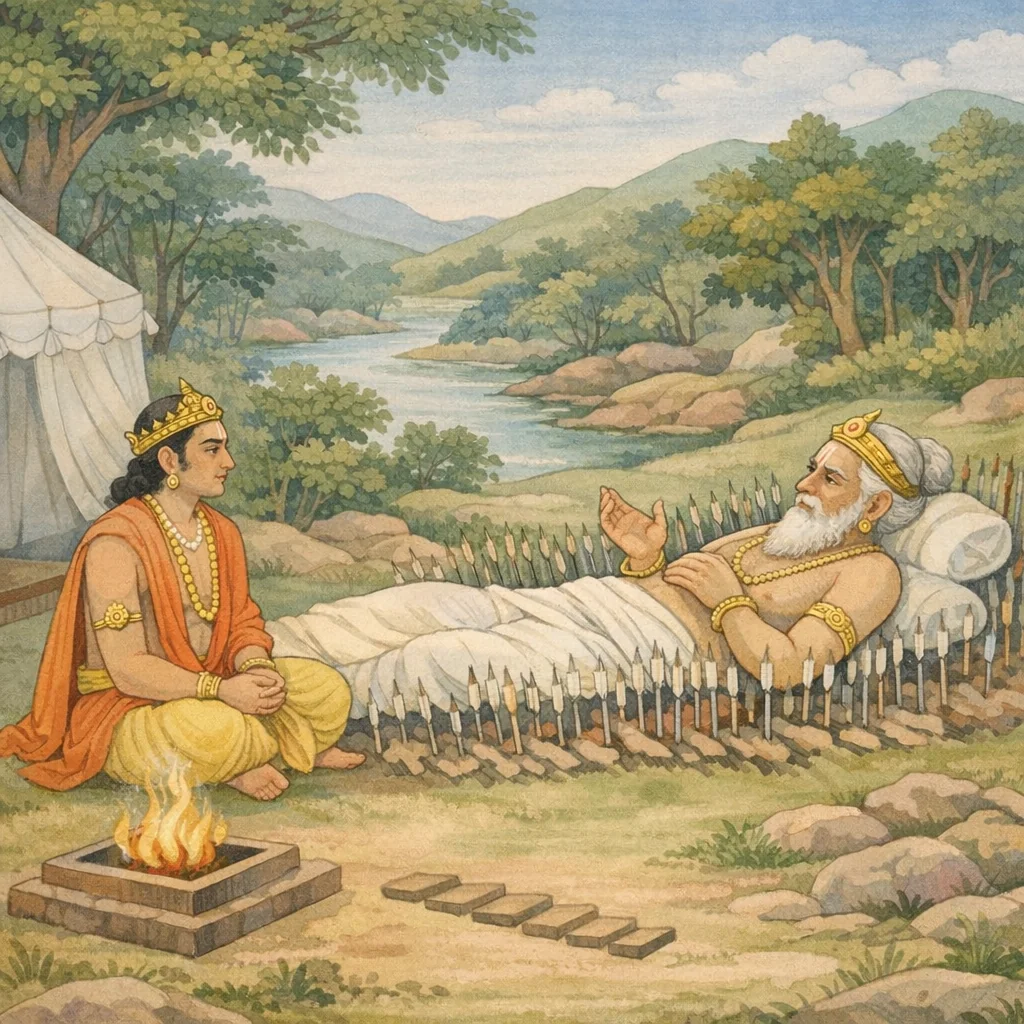
Adhyaya 47
Dāyavibhāga (Inheritance Apportionment) and Household Precedence — Dialogue of Yudhiṣṭhira and Bhīṣma
Upa-parva: Dāyavibhāga–Niyama (Rules of Inheritance and Apportionment) — Anuśāsana-parva Discourses
Chapter 47 presents a technical dharma inquiry: Yudhiṣṭhira requests clarification on how inheritance should be apportioned when a householder has multiple wives recognized in a graded order, and when sons are born from those unions. Bhīṣma answers by laying out ranked shares and conditional entitlements, repeatedly emphasizing that certain portions—especially for the son born from the lowest-recognized union—are to be taken only if explicitly given by the father, while still recommending provision on grounds of non-cruelty (ānṛśaṃsya). The chapter further explains the rationale for unequal division by appealing to precedence within the household: the senior wife’s ritual and domestic roles are treated as determinative of status, and this precedence is used to justify differential shares among offspring. The discourse then extends the same logic to other social categories, specifying different division schemes (e.g., tenfold, eightfold, fivefold) and restating that among sons of the same category, shares are equal, with an additional senior portion for the eldest. Overall, the chapter functions as casuistic guidance intended to minimize disputes by defining hierarchy, conditions of transfer, and a bounded ethic of provision.
Chapter Arc: युधिष्ठिर धर्मराज भीष्म से पूछते हैं—सब धर्मों में सबसे अधिक विचारणीय यह प्रश्न है कि कन्या किस प्रकार के पुरुष को दी जाए। → भीष्म विवाह-धर्म के सूक्ष्म मानदण्ड खोलते हैं—वर के शील-वृत्त, विद्या, कुल/योनि, कर्म और गुणों की जाँच; कन्या की सहमति/अभिप्राय का स्थान; मातृ-सपिण्ड और पितृ-गोत्र निषेध; और यह भी कि आभूषण-उपहार लेकर किया गया कन्यादान ‘मूल्य’ या ‘विक्रय’ नहीं है। मतभेद उभरते हैं कि पाणिग्रहण से पहले/बीच का ‘अन्तर’ क्या अर्थ रखता है और किस बिन्दु पर विवाह-बंधन अटल होता है। → विवाह-संस्कार की निर्णायक रेखा स्थापित होती है—सप्तपदी के सातवें पद पर पाणिग्रहण-मन्त्रों की निष्ठा/पूर्णता मानी जाती है; वहीं से स्त्री ‘भार्या’ के रूप में निश्चित होती है। → भीष्म समन्वय करते हैं—जहाँ उत्तम पात्र मिले वहीं कन्या देनी चाहिए; जीवित रहते हुए भी कुल-परिवार को विचार करना चाहिए; सत्यवचन और विधि-पालन अनिवार्य है; और अनुकूल, वंशानुरूप, विधिपूर्वक अग्नि के सम्मुख परिक्रमा आदि से विवाह की मर्यादा पूर्ण होती है। → कन्या की ‘इच्छा’ (गान्धर्व-धर्म) और कुल-परिवार की ‘विचारणा’ के बीच, व्यवहार में किसे कितना प्रधान माना जाए—यह प्रश्न अगले उपदेशों की ओर संकेत करता है।
Shlokas
Verse 1
(दाक्षिणात्य अधिक पाठके २ श्लोक मिलाकर कुल २९ श्लोक हैं) ऑपनआक्राता छा अर: चतुश्नत्वारिशो< ध्याय: कन्या-विवाहके सम्बन्धमें पात्रविषयक विभिन्न विचार युधिछिर उवाच यन्मूलं सर्वधधर्माणां स्वजनस्य गृहस्य च । पितृदेवातिथीनां च तनमे ब्रूहि पितामह,युधिष्ठिरने पूछा--पितामह! जो समस्त धर्मोंका, कुटुम्बीजनोंका, घरका तथा देवता, पितर और अतिथियोंका मूल है, उस कन्यादानके विषयमें मुझे कुछ उपदेश कीजिये
Yudhiṣṭhira said: “Grandfather, please tell me about that act of giving a maiden in marriage—an act regarded as the root of all dharma, the foundation of one’s kin and household, and the sustaining basis for honoring the ancestors, the gods, and guests.”
Verse 2
अयं हि सर्वधर्माणां धर्मश्चिन्त्यतमो मतः । कीदृशस्य प्रदेया स्थात् कन्येति वसुधाधिप,पृथ्वीनाथ! सब धर्मोंसे बढ़कर यही चिन्तन करने योग्य धर्म माना गया है कि कैसे पात्रको कन्या देनी चाहिये?
Yudhiṣṭhira said: “Among all duties, this is held to be the most worthy of careful reflection: to what kind of man should a daughter be given in marriage, O lord of the earth?”
Verse 3
भीष्म उवाच शीलवृत्ते समाज्ञाय विद्यां योनिं च कर्म च । सद्/रिरेवं प्रदातव्या कन्या गुणयुते वरे,भीष्मजीने कहा--बेटा! सत्पुरुषोंको चाहिये कि वे पहले वरके शील-स्वभाव, सदाचार, विद्या, कुल, मर्यादा और कार्योंकी जाँच करें। फिर यदि वह सभी दृष्टियोंसे गुणवान् प्रतीत हो तो उसे कन्या प्रदान करें
Bhishma said: Having first ascertained a prospective bridegroom’s character and conduct—his learning, lineage, and manner of action—one should give the maiden only to a worthy match. Thus, when the suitor is found to be endowed with virtues on all sides, the daughter should be bestowed upon him.
Verse 4
ब्राह्मणानां सतामेष ब्राह्मो धर्मो युधिष्ठिर । आवाह्गामावहेदेवं यो दद्यादनुकूलत:
Bhīṣma said: “O Yudhiṣṭhira, this is the Brahmanical dharma of virtuous brāhmaṇas: when one is respectfully invited and received, one should give (in charity) in a manner that is agreeable and supportive—according to what benefits the recipient.”
Verse 5
आत्माभिप्रेतमुत्सूज्य कन्याभिप्रेत एव यः:
Bhīṣma said: “He who sets aside what he himself desires and acts solely according to what the maiden wishes…”
Verse 6
अभिप्रेता च या यस्य तस्मै देया युधिष्ठिर । गान्धर्वमिति तं॑ धर्म प्राहुरवेदविदो जना:
Bhīṣma said: “O Yudhiṣṭhira, the woman who is mutually chosen and desired by a man should be given to him. The learned—those who know the Veda—declare that form of marriage to be the ‘Gāndharva’ mode, grounded in consent and personal choice.”
Verse 7
युधिष्ठिर! जब कन्याके माता-पिता अपने पसंद किये हुए वरको छोड़कर जिसे कन्या पसंद करती हो तथा जो कन्याको चाहता हो ऐसे वरके साथ उस कन्याका विवाह करते हैं, तब वेदवेत्ता पुरुष उस विवाहको गान्धर्व धर्म (गान्धर्व विवाह) कहते हैं ।। धनेन बहुधा क्रीत्वा सम्प्रलोभ्य च बान्धवान् । असुराणां नृपैतं वै धर्ममाहुर्मनीषिण:,नरेश्वर! कन्याके बन्धु-बान्धवोंको लोभमें डालकर उन्हें बहुत-सा धन देकर जो कन्याको खरीद लिया जाता है, इसे मनीषी पुरुष असुरोंका धर्म (आसुर विवाह) कहते हैं
Bhishma said: “Yudhishthira, when a maiden’s parents set aside the suitor they themselves had chosen and instead marry her to the man she prefers—who also desires her—learned men of the Vedas call that form of marriage the Gandharva mode. But when, O king, her kinsmen are enticed and won over, and the maiden is in effect ‘purchased’ by giving abundant wealth, the wise declare that to be the Asura mode of marriage.”
Verse 8
हत्वा छित्त्वा च शीर्षाणि रुदतां रुदतीं गृहात् । प्रसहम हरणं तात राक्षसो विधिरुच्यते,तात! इसी प्रकार कन्याके रोते हुए अभिभावकोंको मारकर, उनके मस्तक काटकर रोती हुई कनन््याको उसके घरसे बलपूर्वक हर लाना राक्षसोंका काम (राक्षस विवाह) बताया जाता है
Bhishma said: “After killing and even severing the heads of her weeping protectors, and then forcibly carrying away the girl—herself in tears—from her home: this, dear one, is declared to be the ‘Rākṣasa’ mode (of marriage).” The verse frames the act as a named social category while simultaneously exposing its violent, adharma-leaning character through the imagery of grief, coercion, and bloodshed.
Verse 9
पज्चानां तु त्रयो धर्म्या द्वावधर्म्यों युधिष्ठिर । पैशाचश्चासुरश्चैव न कर्तव्यो कथंचन,युधिष्ठिर! इन पाँच (त्राह्म, प्राजापत्य, गान्धर्व, आसुर और राक्षस) विवाहोंमेंसे पूर्वकथित तीन विवाह धर्मानुकूल हैं और शेष दो पापमय हैं। आसुर और राक्षस विवाह किसी प्रकार भी नहीं करने चाहियेः
Bhīṣma said: “Of the five forms of marriage, O Yudhiṣṭhira, three are in accordance with dharma, while two are contrary to dharma. The Paiśāca and the Āsura forms should never be practiced under any circumstances.”
Verse 10
ब्राह्मः क्षात्रो5थ गान्धर्व एते धर्म्या नरर्षभ । पृथग् वा यदि वा मिश्रा: कर्तव्या नात्र संशय:,नरश्रेष्ठ! ब्राह्य, क्षात्र (प्राजापत्य) तथा गान्धर्व--ये तीन विवाह धर्मानुकूल बताये गये हैं। ये पृथक् हों या अन्य विवाहोंसे मिश्रित--करने ही योग्य हैं। इसमें संशय नहीं है
Bhīṣma said: “O bull among men, the Brāhma, the Kṣātra, and the Gāndharva—these are declared to be marriages in accordance with dharma. Whether performed separately in their distinct forms or combined in mixed forms, they are to be undertaken; there is no doubt about this.”
Verse 11
तिस्रो भार्या ब्राह्मणस्य द्वे भायें क्षत्रियस्य तु । वैश्य: स्वजात्यां विन्देत तास्वपत्यं समं भवेत्,ब्राह्मणके लिये तीन भार्याएँ बतायी गयी हैं (ब्राह्मण-कन्या, क्षत्रिय-कन्या और वैश्य- कन्या), क्षत्रियके लिये दो भार्याएँ कही गयी हैं (क्षत्रिय-कन्या और वैश्य-कन्या)। वैश्य केवल अपनी ही जातिकी कन्याके साथ विवाह करे। इन स्त्रियोंसे जो संतानें उत्पन्न होती हैं वे पिताके समान वर्णवाली होती हैं (माताओंके कुल या वर्णके कारण उनमें कोई तारतम्य नहीं होता)
Bhīṣma said: “For a Brāhmaṇa, three wives are prescribed; for a Kṣatriya, two. A Vaiśya should marry only within his own varṇa. The children born from these wives are regarded as equal and as belonging to the father’s varṇa—no hierarchy is to be drawn among them on account of the mothers’ lineage.”
Verse 12
ब्राह्मणी तु भवेज्ज्येष्ठा क्षत्रिया क्षत्रियस्य तु रत्यर्थमपि शूद्रा स्यान्नेत्याहुरपरे जना:,ब्राह्मणकी पत्रियोंमें ब्राह्मण-कन्या श्रेष्ठ मानी जाती है, क्षत्रियके लिये क्षत्रिय-कन्या श्रेष्ठ है (वैश्यकी तो एक ही पत्नी होती है; अतः वह श्रेष्ठ है ही) कुछ लोगोंका मत है कि रतिके लिये शूद्र-जातिकी कन्यासे भी विवाह किया जा सकता है; परंतु और लोग ऐसा नहीं मानते (वे शूद्र-कन्याको त्रैवर्णिकोंके लिये अग्राह्म बतलाते हैं)
Bhishma said: “Among wives, a Brahmin woman is regarded as the foremost; for a Kshatriya, a Kshatriya woman is foremost. Some people say that, for the sake of sexual union, even a Shudra woman may be taken; but others do not accept this.”
Verse 13
अपत्यजन्म शूद्रायां न प्रशंसन्ति साधव: । शूद्रायां जनयन् वि्र: प्रायश्चित्ती विधीयते
Bhīṣma said: “The virtuous do not commend the begetting of offspring through a Śūdra woman. If a brāhmaṇa fathers a child in a Śūdra woman, an act of expiation is prescribed for him.”
Verse 14
श्रेष्ठ पुरुष ब्राह्मणका शूद्र-कन्याके गर्भसे संतान उत्पन्न करना अच्छा नहीं मानते। शूद्राके गर्भसे संतान उत्पन्न करनेवाला ब्राह्मण प्रायश्चित्तका भागी होता है ।। त्रिंशद्वर्षो दशवर्षा भार्या विन्देत नग्निकाम् । एकविंशतिवर्षो वा सप्तवर्षामवाप्रुयात्,तीस वर्षका पुरुष दस वर्षकी कन्याको, जो रजस्वला न हुई हो, पत्नीरूपमें प्राप्त करे। अथवा इक्कीस वर्षका पुरुष सात वर्षकी कुमारीके साथ विवाह करे
Bhishma said: “A man of thirty years should take as wife a girl of ten years who has not yet begun menstruation; or a man of twenty-one years may obtain a girl of seven years in marriage.”
Verse 15
यस्यास्तु न भवेद् भ्राता पिता वा भरतर्षभ । नोपयच्छेत तां जातु पुत्रिकाधर्मिणी हि सा,भरतश्रेष्ठ! जिस कन्याके पिता अथवा भाई न हों, उसके साथ कभी विवाह नहीं करना चाहिये; क्योंकि वह पुत्रिका-धर्मवाली मानी जाती है
Bhishma said: “O bull among the Bharatas, if a maiden has neither a brother nor a father, one should never accept her in marriage; for she is regarded as one who stands under the rule of the putrikā-duty, where the daughter functions as the means for continuing the lineage.”
Verse 16
त्रीणि वर्षाण्युदी क्षेत्र कन्या ऋतुमती सती । चतुर्थे त्वथ सम्प्राप्ते स्वयं भर्तारमर्जयेत्,(यदि पिता, भ्राता आदि अभिभावक ऋतुमती होनेके पहले कन्याका विवाह न कर दें तो) ऋतुमती होनेके पश्चात् तीन वर्षतक कन्या अपने विवाहकी बाट देखे। चौथा वर्ष लगनेपर वह स्वयं ही किसीको अपना पति बना ले
Bhīṣma said: “If a maiden has attained puberty and remains unmarried, she should wait for three years for a suitable marriage to be arranged. When the fourth year arrives, she may, of her own choice, secure a husband for herself.”
Verse 17
प्रजा न हीयते तस्या रतिश्ष भरतर्षभ । अतोडन््यथा वर्तमाना भवेद् वाच्या प्रजापते:,भरतश्रेष्ठ] ऐसा करनेपर उस कन्याका उस पुरुषके साथ किया हुआ सम्बन्ध तथा उससे होनेवाली संतान निम्न श्रेणीकी नहीं समझी जाती। इसके विपरीत बर्ताव करनेवाली स्त्री प्रजापतिकी दृष्टिमें निन्दनीय होती है
Bhishma said: “O bull among the Bharatas, in such a case the woman’s offspring is not regarded as diminished in status, nor is her union (with that man) considered blameworthy. But a woman who acts contrary to this proper course becomes censurable in the eyes of Prajāpati (the Lord of creatures), for she departs from the ordained rule of conduct.”
Verse 18
असपिण्डा च या मातुरसगोत्रा च या पितु: । इत्येतामनुगच्छेत तं धर्म मनुरब्रवीत्,जो कन्या माताकी सपिण्ड और पिताके गोत्रकी न हो, उसीका अनुगमन करे। इसे मनुजीने धर्मानुकूल बताया है?
Bhishma said: “One should follow (choose in marriage) that maiden who is not a sapinda relative on the mother’s side and who is not of the same gotra on the father’s side. Manu has declared this to be the rule of dharma.”
Verse 19
युधिछिर उवाच शुल्कमन्येन दत्तं स्याद् ददानीत्याह चापर: । बलादन्य: प्रभाषेत धनमन्य: प्रदर्शयेत्,युधिष्ठिरने पूछा--पितामह! यदि एक मनुष्यने विवाह पक्का करके कन्याका मूल्य दे दिया हो, दूसरेने मूल्य देनेका वादा करके विवाह पक्का किया हो, तीसरा उसी कन्याको बलपूर्वक ले जानेकी बात कर रहा हो, चौथा उसके भाई-बन्धुओंको विशेष धनका लोभ दिखाकर ब्याह करनेको तैयार हो और पाँचवाँ उसका पाणिग्रहण कर चुका हो तो धर्मतः उसकी कन्या किसकी पत्नी मानी जायगी? हमलोग इस विषयमें यथार्थ तत्त्वको जानना चाहते हैं। आप हमारे लिये नेत्र (पथ-प्रदर्शक) हों
Yudhiṣṭhira said: “O Grandsire, in a case where one man has already paid the bride-price, another has secured the match by promising, ‘I will pay,’ a third speaks of taking the girl by force, and yet another tries to win her relatives by displaying greater wealth—while a fifth has already performed the act of taking her hand in marriage—whose wife, according to dharma, is that maiden to be regarded? We wish to know the true principle in this matter. Be our guide.”
Verse 20
पाणिग्रहीता चान्य: स्यात् कस्य भार्या पितामह | तत्त्वं जिज्ञासमानानां चक्षुर्भवतु नो भवान्,युधिष्ठिरने पूछा--पितामह! यदि एक मनुष्यने विवाह पक्का करके कन्याका मूल्य दे दिया हो, दूसरेने मूल्य देनेका वादा करके विवाह पक्का किया हो, तीसरा उसी कन्याको बलपूर्वक ले जानेकी बात कर रहा हो, चौथा उसके भाई-बन्धुओंको विशेष धनका लोभ दिखाकर ब्याह करनेको तैयार हो और पाँचवाँ उसका पाणिग्रहण कर चुका हो तो धर्मतः उसकी कन्या किसकी पत्नी मानी जायगी? हमलोग इस विषयमें यथार्थ तत्त्वको जानना चाहते हैं। आप हमारे लिये नेत्र (पथ-प्रदर्शक) हों
Yudhiṣṭhira said: “Grandfather, in a case where one man has secured the marriage by paying the bride-price, another has secured it by promising payment, a third seeks to carry the girl off by force, a fourth tries to win the consent of her kinsmen by offering them special wealth, and a fifth has already taken her hand in the marriage rite—by the standard of dharma, whose wife is she to be regarded as? We wish to know the true principle in this matter; be our eyes and guide.”
Verse 21
भीष्म उवाच यत् किंचित् कर्म मानुष्यं संस्थानाय प्रदृश्यते । मन्त्रवन्मन्त्रितं तस्थ मृषावादस्तु पातक:
Bhishma said: “Whatever human action is seen to be undertaken for the sake of establishing order and stability, even if it is carried out with the secrecy and deliberation of a counsel, still—false speech is a sin.”
Verse 22
भीष्मजीने कहा--भारत! मनुष्योंके हितसे सम्बन्ध रखनेवाला जो कोई भी कर्म है, वह व्यवस्थाके लिये देखा जाता है। समस्त विचारवान् पुरुष एकत्र होकर जब यह विचार कर लें कि “अमुक कन्या अमुक पुरुषको देनी चाहिये” तो यह व्यवस्था ही विवाहका निश्चय करनेवाली होती है। जो झूठ बोलकर इस व्यवस्थाको उलट देता है, वह पापका भागी होता है।। भार्यापत्यृत्रिगाचार्या: शिष्योपाध्याय एव च । मृषोक्ते दण्डमर्हन्ति नेत्याहुरपरे जना:,भार्या, पति, ऋत्विज, आचार्य, शिष्य और उपाध्याय भी यदि उपर्युक्त व्यवस्थाके विरुद्ध झूठ बोलें तो दण्डके भागी होते हैं। परंतु दूसरे लोग उन्हें दण्डके भागी नहीं मानते हैं
Bhishma said: “O Bharata, whatever act bears upon human welfare is examined with a view to the settled order. When all prudent men assemble and conclude, ‘Such a maiden should be given to such a man,’ that very settlement determines the marriage. He who, by falsehood, overturns that settlement becomes a sharer in sin. A wife, a husband, a sacrificial priest (ṛtvij), a teacher (ācārya), a student, and an instructor (upādhyāya)—if any of these speak falsely against that order—are held to deserve punishment; yet others maintain that such persons are not to be punished for it.”
Verse 23
न हाकामेन संवासं मनुरेवं प्रशंसति । अयशस्यथमधर्म्य च यन्मृषा धर्मकोपनम्,अकाम पुरुषके साथ सकामा कन्याका सहवास हो, इसे मनु अच्छा नहीं मानते हैं। अतः सर्वसम्मतिसे निश्चित किये हुए विवाहको मिथ्या करनेका प्रयत्न अयश और अधर्मका कारण होता है। वह धर्मको नष्ट करनेवाला माना गया है
Bhishma said: “Manu does not approve of cohabitation that is not mutually desired. Therefore, to attempt to invalidate a marriage settled by common consent is a cause of disgrace and adharma; it is regarded as an act that undermines dharma itself.”
Verse 24
नैकान्तो दोष एकस्मिंस्तदा केनोपपद्यते | धर्मतो यां प्रयच्छन्ति यां च क्रीणन्ति भारत,भारत! कन्याके भाई-बन्धु जिस कन्याको धर्मपूर्वक पाणिग्रहणकी विधिसे दान कर देते हैं अथवा जिसे मूल्य लेकर दे डालते हैं, उस कन्याको थधर्मपूर्वक विवाह करनेवाला अथवा मूल्य देकर खरीदनेवाला यदि अपने घर ले जाय तो इसमें किसी प्रकारका दोष नहीं होता। भला उस दशामें दोषकी प्राप्ति कैसे हो सकती है?
Bhishma said: “A fault does not arise absolutely on one side alone—how, then, could blame be established in such a case? O Bharata, when a maiden is given in marriage according to dharma by the rite of taking the hand (pāṇigrahaṇa), or even when she is handed over for a price, if the man who marries her in due form—or the one who has paid the price—takes her to his home, no moral fault is incurred. In that situation, how could culpability be said to arise?”
Verse 25
बन्धुभि: समनुज्ञाते मन्त्रहोमौ प्रयोजयेत् । तथा सिद्धयन्ति ते मन्त्रा नादत्ताया: कथंचन,कन््याके कुट॒म्बीजनोंकी अनुमति मिलनेपर वैवाहिक मन्त्र और होमका प्रयोग करना चाहिये, तभी वे मन्त्र सिद्ध (सफल) होते हैं, अर्थात् वह मन्त्रोंद्वारा विवाह किया हुआ माना जाता है। जिस कन्याका माता-पिताके द्वारा दान नहीं किया गया उसके लिये किये गये मन्त्र-प्रयोग किसी तरह सिद्ध नहीं होते, अर्थात् वह विवाह मन्त्रोंद्वारा किया हुआ नहीं माना जाता
Bhishma said: “When the girl’s kinsmen have given their consent, one should employ the marriage mantras and perform the accompanying fire-offering (homa). Only then do those mantras become effective and accomplish their purpose. For a girl who has not been duly given in marriage by her guardians, the ritual application of mantras does not succeed in any way—such a union is not regarded as a properly sanctified marriage by Vedic rite.”
Verse 26
यस्त्वत्र मन्त्रसमयो भारयपत्योर्मिथ: कृत: । तमेवाहुर्गरीयांसं यश्चासौ ज्ञातिभि: कृत:,पति और पत्नीमें भी परस्पर मन्त्रोच्चारणपूर्वक जो प्रतिज्ञा होती है वही श्रेष्ठ मानी जाती है, और यदि उसके लिये बन्धु-बान्धवोंका समर्थन प्राप्त हो तब तो और उत्तम बात है
Bhishma said: “Among the forms of marital commitment, the pledge made mutually by husband and wife in due ritual manner—accompanied by sacred recitation—is regarded as the weightiest. And if that very bond is further affirmed and supported by one’s kinsmen, it is considered even more commendable, for it unites personal vow with social sanction and stability.”
Verse 27
देवदत्तां पतिर्भा्या वेत्ति धर्मस्य शासनात् । स दैवीं मानुषी वाचमनृतां पर्युदस्यति,धर्मशास्त्रकी आज्ञाके अनुसार न्यायतः प्राप्त हुई पत्नीको पति अपने प्रारब्धकर्मके अनुसार मिली हुई भार्या समझता है। इस प्रकार वह दैवयोगसे प्राप्त हुई पत्नीको ग्रहण करता है। तथा मनुष्योंकी झूठी बातको--उस विवाहको अयोग्य बतानेवाली वार्ताको अग्राह्म कर देता है
Bhishma said: “In obedience to the ordinances of dharma, a husband recognizes as his wife the woman who has lawfully come to him as a divine allotment. Therefore he accepts her as granted by fate and dismisses as false the merely human talk that would declare such a marriage improper.”
Verse 28
युधिछिर उवाच कन्यायां प्राप्तशुल्कायां ज्यायांश्वैदाव्रजेद् वर: । धर्मकामार्थसम्पन्नो वाच्यमत्रानृतं न वा,युधिष्ठिरने पूछा--पितामह! यदि एक वरसे कन्याका विवाह पक्का करके उसका मूल्य ले लिया गया हो और पीछे उससे भी श्रेष्ठ धर्म, अर्थ और कामसे सम्पन्न अत्यन्त योग्य वर मिल जाय तो पहले जिससे मूल्य लिया गया है उससे झूठ बोलना--उसको कन्या देनेसे इनकार कर देना चाहिये या नहीं?
Yudhiṣṭhira said: “O grandsire, when a maiden has already had her bride-price received (and thus her marriage is considered settled), but afterward a superior bridegroom appears—one more excellent and endowed with dharma, prosperity, and rightful desire—should one speak untruth in this matter or not? In other words, is it permissible to deny the earlier suitor and refuse to give him the maiden after having accepted the price?”
Verse 29
तस्मिन्नुभयतोदोषे कुर्वन् श्रेय: समाचरेत् । अयं नः सर्वधर्माणां धर्मश्षिन्त्यतमो मत:,इसमें दोनों दशाओंमें दोष प्राप्त होता है--यदि बन्धुजनोंकी सम्मतिसे मूल्य लेकर निश्चित किये हुए विवाहको उलट दिया जाय तो वचन-भंगका दोष लगता है और श्रेष्ठ वरका उल्लंघन करनेसे कनन््याके हितको हानि पहुँचानेका दोष प्राप्त होता है। ऐसी दशामें कन्यादाता क्या करे; जिससे वह कल्याणका भागी हो? हम तो सम्पूर्ण धर्मोमें इस कन्यादानरूप धर्मको ही अधिक चिन्तन अर्थात् विचारके योग्य मानते हैं
When fault seems to arise on both sides, one should act so as to secure the greater good. In our view, among all duties, this duty—concerning the giving of a maiden in marriage—is the one most deserving of careful reflection.
Verse 30
तत्त्वं जिज्ञासमानानां चक्षुर्भवतु नो भवान् | तदेतत् सर्वमाचक्ष्व न हि तृप्पामि कथ्यताम्,हम इस विषयमें यथार्थ तत्त्वको जानना चाहते हैं। आप हमारे पथप्रदर्शक होइये। इन सब बातोंको स्पष्टरूपसे बताइये। मैं आपकी बातें सुननेसे तृप्त नहीं हो रहा हूँ। अतः आप इस विषयका प्रतिपादन कीजिये
Yudhiṣṭhira said: “We seek to know the true reality of this matter; therefore, be our guiding eye. Explain all of it clearly and in full. I am not satisfied merely by hearing a little—so please expound it.”
Verse 31
भीष्य उवाच नैव निष्ठाकरं शुल्कं ज्ञात्वा5डसीत् तेन नाहतम् | न हि शुल्कपरा: सन्त: कनन््यां ददति कहिचित्,भीष्मजीने कहा--राजन! मूल्य दे देनेसे ही विवाहका अन्तिम निश्चय नहीं हो जाता (उसमें परिवर्तनकी सम्भावना रहती ही है)। यह समझकर ही मूल्य देनेवाला मूल्य देता है और फिर उसे वापस नहीं माँगता। सज्जन पुरुष कभी-कभी मूल्य लेकर भी किसी विशेष कारणवश कन्यादान नहीं करते हैं
Bhishma said: “The bride-price does not, by itself, make the marriage irrevocably settled; knowing that the arrangement may still change, a man gives the payment and is not thereby wronged. For respectable people, even when money is involved, do not invariably give the maiden in every case.”
Verse 32
अन्यैर्गुणैरुपेतं तु शुल्क॑ याचन्ति बान्धवा: । अलंकृत्वा वहस्वेति यो दद्यादनुकूलत:,कन्याके भाई-बन्धु किसीसे मूल्य तभी माँगते हैं जब वह विपरीत गुण (अधिक अवस्था आदि)-से युक्त होता है। यदि वरको बुलाकर कहा जाय कि “तुम मेरी कन्याको आभूषण पहनाकर इसके साथ विवाह कर लो” और ऐसा कहनेपर वह उसके लिये आभूषण देकर विवाह करे तो यह धर्मानुकूल ही है
Bhīṣma said: The girl’s relatives ask for a bride-price only when she is burdened with other unfavourable conditions or qualities. But if the prospective bridegroom is invited and told, “Adorn her and take her as your wife,” and he then provides ornaments for her and marries her, that act is in accordance with dharma.
Verse 33
यच्च तां च ददत्येवं न शुल्क विक्रयो न सः । प्रतिगृह्म भवेद् देयमेष धर्म: सनातन:
And when one gives her in this manner, it is not a sale for a bride-price—he is not a trader. What is given should be accepted as a gift; this is the eternal rule of dharma.
Verse 34
क्योंकि इस प्रकार जो कन्याके लिये आभूषण लेकर कन्यादान किया जाता है, वह न तो मूल्य है और न विक्रय ही; इसलिये कन्याके लिये कोई वस्तु स्वीकार करके कन्याका दान करना सनातन धर्म है ।। दास्यामि भवते कन्यामिति पूर्व न भाषितम् । ये चाहुयें च नाहुयें ये चावश्यं वदन्त्युत,जो लोग भिन्न-भिन्न व्यक्तियोंसे कहते हैं कि 'मैं आपको अपनी कन्या दूँगा", जो कहते हैं “नहीं दूँगा! और जो कहते हैं “अवश्य दूँगा' उनकी ये सभी बातें कन्या देनेके पहले नही कही हुई के ही तुल्य हैं
Bhishma said: When ornaments are taken on the occasion of giving a maiden in marriage, that is neither a ‘price’ nor a ‘sale’; therefore, accepting some customary gift for the maiden and then giving her is held to be an ancient rule of dharma. But the words, “I will give you my daughter,” are not to be treated as firmly spoken beforehand: whether people say to different suitors “I will give,” or “I will not give,” or even “I will certainly give,” all such statements, until the actual act of giving the maiden is completed, are regarded as not truly binding.
Verse 35
तस्मादा ग्रहणात् पाणेर्याचयन्ति परस्परम् । कन्यावर: पुरा दत्तो मरुद्धिरिति न: श्रुतम्,जबतक कन्याका पाणिग्रहण संस्कार सम्पन्न न हो जाय तबतक कन्याको माँगना चाहिये। ऐसा कन्याओंके लिये मरुदगणोंने पहले वर दिया है, अर्थात् अधिकार दिया है-- यह हमारे सुननेमें आया है। इसलिये पाणिग्रहण होनेके पहलेतक वर और कन्या आपसमें एक-दूसरेके लिये प्रार्थना कर सकते हैं
Bhīṣma said: Therefore, before the rite of taking the bride’s hand (pāṇigrahaṇa) is completed, the man and the maiden may seek one another—each may make a request of the other. We have heard that in ancient times the Maruts granted this ‘choice of a maiden and a suitor’ as a sanctioned right. Hence, until the hand-taking is performed, mutual solicitation between prospective bride and groom is permissible.
Verse 36
नानिष्टाय प्रदातव्या कन्या इत्यूषिचोदितम् | तन्मूलं काममूलस्य प्रजनस्येति मे मति:,महर्षियोंका मत है कि अयोग्य वरको कन्या नहीं देनी चाहिये; क्योंकि सुयोग्य पुरुषको कन्यादान करना ही काम-सम्बन्धी सुख और सुयोग्य संतानकी उत्पत्तिका कारण है। ऐसा मेरा विचार है
In the view of the great ṛṣis, a maiden should not be given to an unworthy suitor; for giving her to a worthy man alone is, in my judgment, the cause of happiness in kāma and the source of good offspring.
Verse 37
समीक्ष्य च बहून् दोषान् संवासाद् विद्धि पाणयो: । यथा निष्ठाकरं शुल्क न जात्वासीत् तथा शूणु,कन्याके क्रय-विक्रयमें बहुत-से दोष हैं। इस बातको तुम अधिक कालतक सोचने- विचारनेके बाद स्वयं समझ लोगे। केवल मूल्य दे देनेसे विवाहका अन्तिम निश्चय नहीं हो जाता है। पहले भी कभी ऐसा नहीं हुआ था, इस विषयमें तुम सुनो
Bhīṣma said: “Reflect well on the many faults that arise from treating marriage as a mere cohabitation secured by payment. Know that a ‘fee’ does not by itself bring a marriage to final certainty. Such a practice was never accepted as a settled norm in former times—listen as I explain.”
Verse 38
अहं विचित्रवीर्यस्य द्वे कन्ये समुदावहम् । जित्वा च मागधान् सर्वान् काशीनथ च कोसलान्,मैं विचित्रवीर्यके विवाहके लिये मगध, काशी तथा कोशलदेशके समस्त वीरोंको पराजित करके काशिराजकी दो- कन्याओंको हर लाया था
Bhishma said: “For Vicitravīrya’s marriage, I carried off two princesses—having first defeated all the warriors of Magadha, the lord of Kāśī, and those of Kosala.”
Verse 39
गृहीतपाणिरेका5<सीत् _प्राप्तशुल्का पराभवत् | कन्या गृहीता तत्रैव विसर्ज्या इति मे पिता,उनमेंसे एक कन्या अम्बा अपना हाथ शाल्वराजके हाथमें दे चुकी थी; अर्थात् मन-ही- मन उनको अपना पति मान चुकी थी। दूसरी (दो कन््याओं)-का काशिराजको शुल्क प्राप्त हो गया था। इसलिये मेरे पिता (चाचा) कुरुवंशी बाह्नीकने वहीं कहा कि “जो कन्या पाणिगृहीत हो चुकी है उसका त्याग कर दो और दूसरी कन्याका (जिनके लिये शुल्कमात्र लिया गया है) विवाह करो।' मुझे चाचाजीके इस कथनमें संदेह था, इसलिये मैंने दूसरोंसे भी इसके विषयमें पूछा
Bhishma said: “One of the maidens had already given her hand—she had, in her heart, accepted Shalva as her husband. In the case of the other maiden(s), the bride-price had already been received by the king of Kāśī. Therefore the elder of our line declared on the spot: ‘The maiden whose hand has already been taken should be released here and now; the other maiden(s), for whom only the bride-price has been taken, should be married.’ Yet I felt uncertainty about this statement, and so I asked others as well about the proper course.”
Verse 40
अब्रवीदितरां कन्यामावहेति स कौरव: । अप्यन्याननुपप्रच्छ शड्कमान: पितुर्वच:,उनमेंसे एक कन्या अम्बा अपना हाथ शाल्वराजके हाथमें दे चुकी थी; अर्थात् मन-ही- मन उनको अपना पति मान चुकी थी। दूसरी (दो कन््याओं)-का काशिराजको शुल्क प्राप्त हो गया था। इसलिये मेरे पिता (चाचा) कुरुवंशी बाह्नीकने वहीं कहा कि “जो कन्या पाणिगृहीत हो चुकी है उसका त्याग कर दो और दूसरी कन्याका (जिनके लिये शुल्कमात्र लिया गया है) विवाह करो।' मुझे चाचाजीके इस कथनमें संदेह था, इसलिये मैंने दूसरोंसे भी इसके विषयमें पूछा
Bhishma said: “That Kaurava elder declared, ‘Marry the other maiden.’ Yet, doubting the propriety of the elder’s instruction, I also questioned others about it.”
Verse 41
अतीव हास्य धर्मेच्छा पितुर्मेडभ्यधिका भवत् । ततो5हमन्रुवं राजन्नाचारेप्सुरिदं वच: । आचार ं तत्त्वतो वेत्तुमिच्छामि च पुन: पुन:,परंतु इस विषयमें मेरे चाचाजीकी बहुत प्रबल इच्छा थी कि धर्मका पालन हो (अत: वे पाणिगृहीता कन्याके त्यागपर अधिक जोर दे रहे थे)। राजन! तदनन्तर मैं आचार जाननेकी इच्छासे बोला--'पिताजी! मैं इस विषयमें यह ठीक-ठीक जानना चाहता हूँ कि परम्परागत आचार क्या है?'
Bhishma said: “My paternal uncle’s desire for the observance of dharma was exceedingly strong, even more insistent than my father’s. Then, O King, wishing to understand proper conduct, I spoke these words: ‘Father, I wish to know precisely—again and again—what the traditional rule of conduct truly is in this matter.’”
Verse 42
ततो मयैवमुक्ते तु वाक्ये धर्मभृतां वर: । पिता मम महाराज बाह्लीको वाक्यमब्रवीत्,महाराज! मेरे ऐसा कहनेपर धर्मात्माओंमें श्रेष्ठ मेरे चाचा बाह्नीक इस प्रकार बोले --
Then, when I had spoken these words, O great king, Bāhlīka—foremost among the upholders of dharma, my elder kinsman on my father’s side—addressed me in reply. The tale thus turns to the counsel of an elder whose authority rests on righteousness and the duty of the family line.
Verse 43
शिष्टानां क्षत्रियाणां च धर्म एब सनातन: । युधिष्ठिर! इस प्रकार ब्याहने योग्य वरको बुलाकर उसके साथ कन्याका विवाह करना उत्तम ब्राह्मणोंका धर्म-ब्राह्मविवाह है। जो धन आदिके द्वारा वरपक्षको अनुकूल करके कन्यादान किया जाता है, वह शिष्ट ब्राह्मण और क्षत्रियोंका सनातन धर्म कहा जाता है। (इसीको प्राजापत्य विवाह कहते हैं),यदि व: शुल्कतो निष्ठा न पाणिग्रहणात् तथा । लाजान्तरमुपासीत प्राप्तशुल्क इति स्मृति:
Bhishma said: “O Yudhishthira, this is the ancient, established rule of conduct for the cultured and for Kshatriyas: to summon a suitable bridegroom and marry the maiden to him—this is the Brahma form of marriage, praised among the best of Brahmins. But when the bride’s family, by means of wealth and other inducements, makes the groom’s side favorable and then gives the maiden, that too is described as an ancient practice among respectable Brahmins and Kshatriyas; it is what is called the Prajapatya form of marriage. A Smriti rule further states: if one’s commitment is to the bride-price rather than to the rite of taking the hand (pāṇigrahaṇa), then one should seek another match; such a person is remembered as one who has ‘obtained the bride-price.’”
Verse 44
“यदि तुम्हारे मतमें मूल्य देनेमात्रसे ही विवाहका पूर्ण निश्चय हो जाता है, पाणिग्रहणसे नहीं, तब तो स्मृतिका यह कथन ही व्यर्थ होगा कि कन््याका पिता एक वरसे शुल्क ले लेनेपर भी दूसरे किसी गुणवान् वरका आश्रय ले सकता है। अर्थात् पहलेको छोड़कर दूसरे गुणवान् वरसे अपनी कन्याका विवाह कर सकता है ।। न हि धर्मविद: प्राहु: प्रमाणं वाक्यतः स्मृतम् । येषां वै शुल्कतो निष्ठा न पाणिग्रहणात् तथा,जिनका यह मत है कि शुल्कसे ही विवाहका निश्चय होता है, पाणिग्रहणसे नहीं, उनके इस कथनको धर्मज्ञ पुरुष प्रमाण नहीं मानते हैं इति श्रीमहाभारते अनुशासनपर्वणि दानधर्मपर्वणि विवाहधर्मक थने चतुश्नत्वारिंशो5ध्याय:
Bhishma said: If, in your view, a marriage becomes fully settled merely by the giving of a bride-price, and not by the rite of taking the bride’s hand (pāṇigrahaṇa), then a well-known rule of the Smritis would become pointless—namely, that even after a girl’s father has accepted a fee from one suitor, he may still take refuge in another suitor of superior merit; that is, he may set aside the first and marry his daughter to the more worthy man. For the knowers of dharma do not accept as authoritative the claim that “finality” rests on the fee alone and not, as it should, on the solemn act of pāṇigrahaṇa. The ethical point is that commercial payment cannot override the dharmic completion of marriage, nor can it bind a family against choosing a more virtuous match.
Verse 45
प्रसिद्ध भाषितं दाने नैषां प्रत्यायकं पुन: । ये मन्यन्ते क्रयं शुल्क न ते धर्मविदो नरा:,“कन्यादानके विषयमें तो लोगोंका कथन भी प्रसिद्ध है” अर्थात् सब लोग यही कहते हैं कि कन्यादान हुआ है। अतः जो शुल्कसे ही विवाह निश्चय मानते हैं उनके कथनकी प्रतीति करानेवाला कोई प्रमाण उपलब्ध नहीं होता। जो क्रय और शुल्कको मान्यता देते हैं वे मनुष्य धर्मज्ञ नहीं हैं
Bhishma said: “In the matter of gifting (especially the gift of a maiden), a well-known saying is current among people: everyone speaks of it as ‘a gift of the daughter.’ Therefore, for those who treat a marriage as established merely by a fee or purchase-price, there is no reliable proof that can truly validate their claim. Men who accept ‘purchase’ and ‘bride-price’ as authoritative are not knowers of dharma.”
Verse 46
न चैतेभ्य: प्रदातव्या न वोढव्या तथाविधा । न होव भार्या क्रेतव्या न विक्रय्या कथंचन,'ऐसे लोगोंको कन्या नहीं देनी चाहिये और जो बेची जा रही हो ऐसी कनन््याके साथ विवाह नहीं करना चाहिये; क्योंकि भार्या किसी प्रकार भी खरीदने या विक्रय करनेकी वस्तु नहीं है
Bhīṣma said: “A daughter should not be given in marriage to such men, nor should one marry a girl who is being ‘sold’ in that manner; for a wife is never, under any circumstance, an object to be bought or sold.”
Verse 47
ये च क्रीणन्ति दासीं च विक्रीणन्ति तथैव च । भवेत् तेषां तथा निष्ठा लुब्धानां पापचेतसाम्,“जो दासियोंको खरीदते और बेचते हैं वे बड़े लोभी और पापात्मा हैं। ऐसे ही लोगोंमें पत्नीको भी खरीदने-बेचनेकी निष्ठा होती है
Bhīṣma says: “Those who buy female slaves and likewise sell them are driven by greed and a sinful disposition. In such people there arises the same settled attitude—treating even a wife as something to be bought and sold—revealing a grave ethical collapse in their understanding of dharma.”
Verse 48
अस्मिन्नर्थे सत्यवन्तं पर्यपृच्छन्त वै जना: । कन्याया: प्राप्तशुल्काया: शुल्कद: प्रशमं गत:,इस विषयमें पहलेके लोगोंने सत्यवानसे पूछा था कि “महाप्राज्ञ! यदि कन्याका शुल्क देनेके पश्चात् शुल्क देनेवालेकी मृत्यु हो जाय तो उसका पाणिग्रहण दूसरा कोई कर सकता है या नहीं? इसमें हमें धर्मविषयक संदेह हो गया है। आप इसका निवारण कीजिये; क्योंकि आप ज्ञानी पुरुषोंद्वारा सम्मानित हैं
Bhīṣma said: “On this matter, people of former times questioned Satyavān: ‘O great sage, if the bride-price has already been received for a maiden, and the man who was to pay that bride-price then dies, may someone else perform her marriage-rite (take her hand) or not? A doubt concerning dharma has arisen for us. Please remove it, for you are honored by the wise.’”
Verse 49
पाणिग्रहीता वान्य: स्यादत्र नो धर्मसंशय: । तन्नश्छिन्धि महाप्राज्ञ त्वं हि वै प्राज्ञसम्मत:,इस विषयमें पहलेके लोगोंने सत्यवानसे पूछा था कि “महाप्राज्ञ! यदि कन्याका शुल्क देनेके पश्चात् शुल्क देनेवालेकी मृत्यु हो जाय तो उसका पाणिग्रहण दूसरा कोई कर सकता है या नहीं? इसमें हमें धर्मविषयक संदेह हो गया है। आप इसका निवारण कीजिये; क्योंकि आप ज्ञानी पुरुषोंद्वारा सम्मानित हैं
Bhīṣma said: “In this matter we are in doubt about dharma: can another man become the ‘hand-taker’ (lawful husband) if the one who had secured the bride dies? O greatly wise one, remove this uncertainty for us, for you are acknowledged and honored by the learned.”
Verse 50
तत्त्वं जिज्ञासमानानां चक्षुर्भवतु नो भवान् | तानेवं ब्रुवत: सर्वान् सत्यवान् वाक््यमब्रवीत्,“हमलोग इस विषयमें यथार्थ बात जानना चाहते हैं। आप हमारे लिये पथप्रदर्शक होइये।” उन लोगोंके इस प्रकार कहनेपर सत्यवान्ने कहा--
“We seek to know the truth of this matter as it really is. Please be our guiding eye.” When all of them spoke thus, Satyavān replied with his words.
Verse 51
यत्रेष्ट तत्र देया स्याज्नात्र कार्या विचारणा । कुर्वते जीवतो<प्येवं मृते नैवास्ति संशय:,“जहाँ उत्तम पात्र मिलता हो वहीं कन्या देनी चाहिये। इसके विपरीत कोई विचार मनमें नहीं लाना चाहिये। मूल्य देनेवाला यदि जीवित हो तो भी सुयोग्य वरके मिलनेपर सज्जन पुरुष उसीके साथ कन्याका विवाह करते हैं। फिर उसके मर जानेपर अन्यत्र करें--इसमें तो संदेह ही नहीं है
Bhishma says: “A daughter should be given in marriage wherever an excellent and suitable groom is found; one should not entertain contrary deliberations. Even if the one who offers a bride-price or other consideration is still alive, honorable people marry the girl to the worthy groom when he is available; and if that person has died, then giving her elsewhere admits of no doubt at all.”
Verse 52
देवरं प्रविशेत् कन्या तप्येद् वापि तप: पुन: । तमेवानुगता भूत्वा पाणिग्राहस्य काम्यया,“शुल्क देनेवालेकी मृत्यु हो जानेपर उसके छोटे भाईको वह कन्या पतिरूपमें ग्रहण करे अथवा जन्मान्तरमें उसी पतिको पानेकी इच्छासे उसीका अनुसरण (चिन्तन) करती हुई आजीवन कुमारी रहकर तपस्या करे
Bhishma said: If the man who paid the bride-price dies, the maiden should either enter into union with his younger brother (as husband), or else undertake austerities again—remaining devoted in thought to that very bridegroom, with the wish of attaining him (even in another birth), and living lifelong as a maiden.
Verse 53
लिखन्त्येव तु केषांचिदपरेषां शनैरपि । इति ये संवदन्त्यत्र त एतं॑ निश्चयं विदु:,'किन्हींके मतमें अक्षतयोनि कन््याको स्वीकार करनेका अधिकार है। दूसरोंके मतमें यह मन्दप्रवृत्ति--अवैध कार्य है। इस प्रकार जो विवाद करते हैं, वे अन्तमें इसी निश्चयपर पहुँचते हैं कि कन्याका पाणिग्रहण होनेसे पहलेका वैवाहिक मंगलाचार और मन्त्रप्रयोग हो जानेपर भी जहाँ अन्तर या व्यवधान पड़ जाय; अर्थात् अयोग्य वरको छोड़कर किसी दूसरे योग्य वरके साथ कन्या ब्याह दी जाय तो दाताको केवल मिथ्याभाषणका पाप लगता है (पाणिग्रहणसे पूर्व कन्या विवाहित नहीं मानी जाती है)
Bhīṣma said: “Some record it in writing at once, while others do so only gradually. Those who debate this matter here ultimately arrive at this settled conclusion.”
Verse 54
तत्पाणिग्रहणात् पूर्वमन्तरं यत्र वर्तते । सर्वमड्रलमन्त्रं वै मृषावादस्तु पातक:,'किन्हींके मतमें अक्षतयोनि कन््याको स्वीकार करनेका अधिकार है। दूसरोंके मतमें यह मन्दप्रवृत्ति--अवैध कार्य है। इस प्रकार जो विवाद करते हैं, वे अन्तमें इसी निश्चयपर पहुँचते हैं कि कन्याका पाणिग्रहण होनेसे पहलेका वैवाहिक मंगलाचार और मन्त्रप्रयोग हो जानेपर भी जहाँ अन्तर या व्यवधान पड़ जाय; अर्थात् अयोग्य वरको छोड़कर किसी दूसरे योग्य वरके साथ कन्या ब्याह दी जाय तो दाताको केवल मिथ्याभाषणका पाप लगता है (पाणिग्रहणसे पूर्व कन्या विवाहित नहीं मानी जाती है)
Bhīṣma said: If, before the formal taking of the bride’s hand, some interval or impediment arises—so that, even after auspicious rites and mantras have been performed, the girl is given instead to another suitable groom—then the giver (guardian) incurs only the sin of false speech.
Verse 55
पाणिग्रहणमन्त्राणां निष्ठा स्यात् सप्तमे पदे । पाणिग्रहस्य भार्या स्याद् यस्य चाद्ि: प्रदीयते । इति देयं वदन्त्यत्र त एन॑ निश्चयं विदु:,'सप्तपदीके सातवें पदमें पाणिग्रहणके मन्त्रोंकी सफलता होती है (और तभी पति- पत्नीभावका निश्चय होता है)। जिस पुरुषको जलसे संकल्प करके कन्याका दान दिया जाता है वही उसका पाणिग्रहीता पति होता है और उसीकी वह पत्नी मानी जाती है। विद्वान् पुरुष इसी प्रकार कन्यादानकी विधि बताते हैं। वे इसी निश्चयपर पहुँचे हुए हैं
Bhishma said: “The binding efficacy of the marriage mantras reaches its completion at the seventh step (of the saptapadī); only then is the marital status decisively established. The woman becomes the wife of that man to whom she is formally given—after the ritual resolve and the offering of water—so he alone is her ‘pāṇigrahītā’ (the one who takes her hand in marriage). Learned authorities describe the procedure of giving the maiden in precisely this way, having arrived at this settled determination.”
Verse 56
अनुकूलामनुवंशां क्रात्रा दत्तामुपाग्निकाम् । परिक्रम्य यथान्यायं भार्या विन्देद् द्विजोत्तम:,“जो अनुकूल हो, अपने वंशके अनुरूप हो, अपने पिता-माता या भाईके द्वारा दी गयी हो और प्रज्वलित अग्निके समीप बैठी हो, ऐसी पत्नीको श्रेष्ठ द्विज अग्निकी परिक्रमा करके शास्त्रविधिके अनुसार ग्रहण करे
Bhishma said: A best of the twice-born should accept as wife a woman who is agreeable in disposition, suitable to his lineage, duly given by her brother, and seated near the kindled sacred fire; having circumambulated the fire in the proper manner, he should take her according to scriptural rule.
Frequently Asked Questions
How patrimonial wealth should be divided when household relationships are ranked, including how to assign shares among sons from different unions while preventing unjust seizure and minimizing domestic conflict.
Define inheritance rules in advance, respect household precedence tied to duties, and treat some claims as conditional on explicit transfer—while still ensuring humane provision to reduce social grievance.
Yes: it invokes ānṛśaṃsya (non-cruelty) as a higher framing ethic, recommending limited provision even where entitlement is constrained, thereby balancing rule-based order with humane obligation.