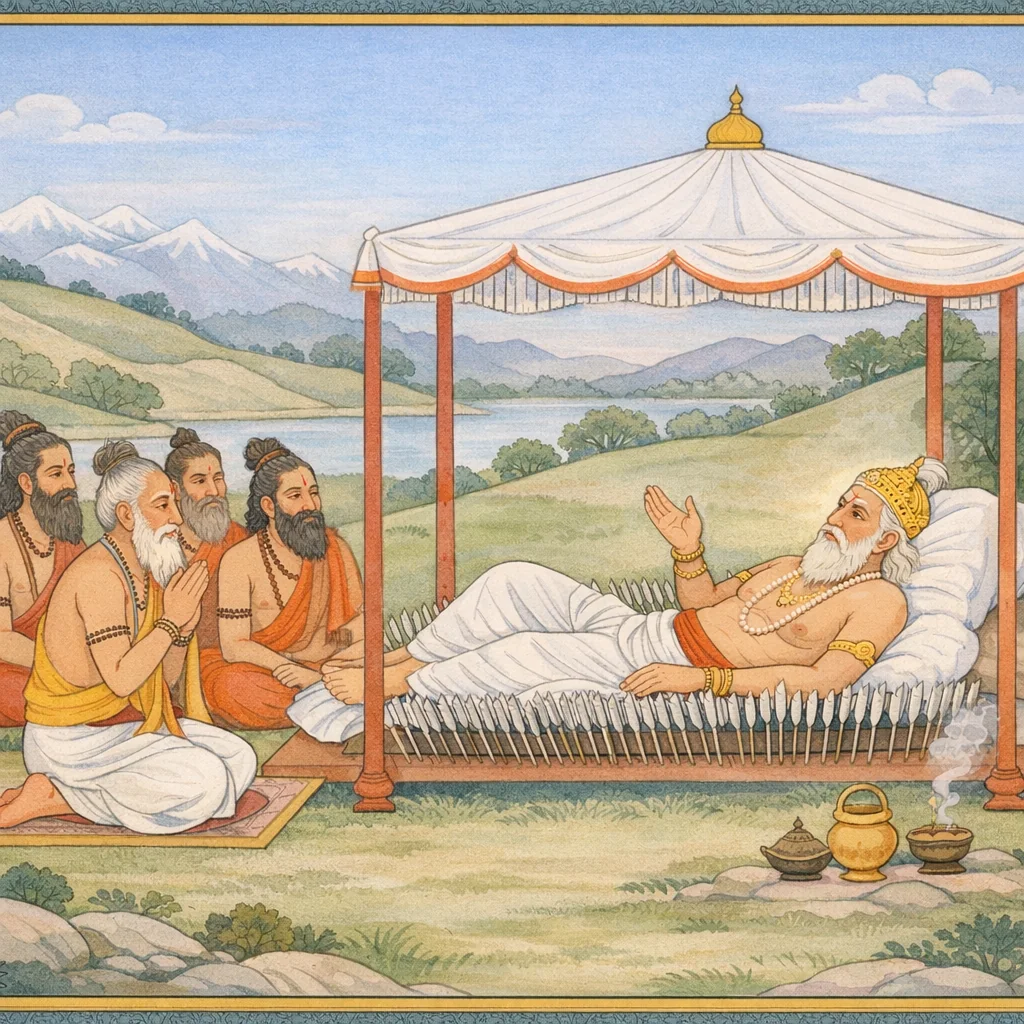
Adhyaya 108
ज्येष्ठ-कनिष्ठ-धर्मः — Duties of Elders and Juniors (Anuśāsana-parva 108)
Upa-parva: Ācāra–Jyeṣṭha-Dharma (Conduct and Duties toward Elders) — discourse unit within Anuśāsana-parva
Yudhiṣṭhira asks Bhīṣma to define correct reciprocal conduct between elder and younger siblings. Bhīṣma replies that Yudhiṣṭhira should embody the steadiness of an elder, stressing that a teacher’s (guru’s) conduct carries greater weight than a student’s and that one cannot properly ‘manage’ an unwise superior—highlighting asymmetry of authority and the need for discernment. He advises that even the capable may appear ineffective in adverse conditions, and that speech should be framed with ‘parihāra’ (avoidance/mitigation) to prevent transgression and escalation. The chapter warns that people with divided hearts, including rivals, exploit fissures—especially when prosperity inflames envy—so family unity must be actively protected. The elder can elevate or ruin the lineage; an elder who harms a younger forfeits status and may be subject to regulation by rulers. Unjust conduct leads to demerit and reputational collapse. Norms of fair shares are indicated: wrongdoing disqualifies from portions, and an elder should not arrange marriage-wealth without providing for juniors; paternal inheritance is distinguished from self-earned property. The text forbids unequal allotment among sons and prohibits contempt toward elders even if one perceives personal excellence, grounding hierarchy in dharma. It ranks authorities—mother, father, teacher—and states that after the father’s death the elder brother functions as a father, maintaining and protecting juniors, who in turn honor and depend upon him. It closes by extending maternal equivalence to the elder sister and certain affinal relations, emphasizing kinship as a moral infrastructure.
Chapter Arc: राजा से कहा जाता है कि जो इस प्रसंग को नित्य सुनता और कहता है, वह शुभ लोकों को प्राप्त होता है—इस वचन से अध्याय का द्वार ‘श्रवण-कीर्तन’ की पुण्य-प्रतिज्ञा पर खुलता है। → फिर उपदेश सूक्ष्म आचार-विधानों में उतरता है: रात्रि-आचरण, भोजन के बाद की मर्यादा, कुछ पदार्थों का निषेध (विशेषतः रात में), और ऐसे व्यवहार जिनसे आयु, यश और कुल-प्रतिष्ठा क्षीण होती है। → स्त्री-रक्षा और काम-नियमन का कठोर शिखर आता है—ईर्ष्या को अनायुष्य बताकर त्यागने की आज्ञा, परस्त्रीगमन को आयु-नाशक पाप कहकर दृढ़ निषेध, तथा गृहस्थ-धर्म की मर्यादा को ‘यत्नतः’ साधने का आग्रह। → अध्याय सामाजिक-धर्म के व्यावहारिक निष्कर्ष पर टिकता है: विवाह-योग्य कन्या का योग्य वर से विवाह, संतान-व्यवस्था, और कुल-पालन—गृहस्थ के लिए नीति को कर्म-रूप में बाँधकर।
Shlokas
Verse 104
(य इमं शृणुयान्नित्यं यश्चापि परिकीर्तयेत् स शुभानू प्राप्तुते लोकान् सदाचारव्रतान्नूप ।।) नरेश्वर! जो प्रतिदिन इस प्रसंगको सुनता और कहता है, वह सदाचार-व्रतके प्रभावसे शुभ लोकोंमें जाता है ।। इति श्रीमहाभारते अनुशासनपर्वणि दानधर्मपर्वणि आयुष्याख्याने चतुरधिकशततमो<ध्याय:
Bhishma said: “O king, whoever listens to this account daily, and whoever also recites it aloud, attains auspicious worlds through the power of vows grounded in good conduct.”
Verse 119
नक्तं न कुर्यात् पित्र्याणि भुक्त्वा चैव प्रसाधनम्
Bhishma said: “One should not perform the rites for the Pitṛs at night; and after eating, one should likewise not undertake ritual preparations or acts of ceremonial purification.”
Verse 120
वर्जनीयाश्रैव नित्यं सक्तवो निशि भारत
Bhīṣma said: “O Bhārata, certain acts and indulgences are to be avoided at all times—especially those to which one becomes attached in the night.”
Verse 121
शेषाणि चैव पानानि पानीयं चापि भोजने । भरतनन्दन! रातमें सत्तू खाना सर्वथा वर्जित है। अन्न-भोजनके पश्चात् जो पीनेयोग्य पदार्थ और जल शेष रह जाते हैं, उनका भी त्याग कर देना चाहिये ।। सौहित्यं न च कर्तव्यं रात्री न च समाचरेत्
Bhishma said: “O delight of the Bharatas, eating sattu at night is to be avoided entirely. After taking one’s meal, whatever drinkable substances and even water remain should also be renounced. One should not indulge to the point of full satiety, nor should one engage in such practices at night.”
Verse 122
महाकुले प्रसूतां च प्रशस्तां लक्षणैस्तथा
Bhīṣma said: “(One should choose) a woman born in a great and reputable lineage, and likewise one who is commended for her auspicious marks and qualities.”
Verse 123
अपत्यमुत्पाद्य तत: प्रतिष्ठाप्प कुलं तथा
Bhīṣma said: “Having begotten offspring, one should then duly establish and uphold the family line as well.”
Verse 124
पुत्रा: प्रदेया ज्ञानेषु कुलधर्मेषु भारत । भारत! उसके गर्भसे संतान उत्पन्न करके वंश-परम्पराको प्रतिष्ठित करे और ज्ञान तथा कुलधर्मकी शिक्षा पानेके लिये पुत्रोंको गुरुके आश्रममें भेज दे ।। कन्या चोत्पाद्य दातव्या कुलपुत्राय धीमते
Bhishma said: “O Bharata, sons should be entrusted to a teacher for instruction in sacred knowledge and the duties of the family line. And when a daughter is born, she should be given in marriage to a worthy and wise young man of a good family.”
Verse 125
शिर:स्नातो<थ कुर्वीत दैवं पित्रमथापि च,भारत! मस्तकपरसे स्नान करके देवकार्य तथा पितृकार्य करे। जिस नक्षत्रमें अपना जन्म हुआ हो उसमें एवं पूर्वा और उत्तरा दोनों भाद्रपदाओंमें तथा कृत्तिका नक्षत्रमें भी श्राद्धका निषेध है
Bhīṣma said: “O Bhārata, after bathing the head, one should then perform the rites for the gods and also the rites for the ancestors.” (In this context of ritual discipline, the passage further notes restrictions: śrāddha is prohibited on one’s birth-nakṣatra, on both Pūrvabhādrapadā and Uttarabhādrapadā, and on Kṛttikā.)
Verse 126
नक्षत्रे न च कुर्वीत यस्मिन् जातो भवेन्नर: । न प्रोष्ठपदयो: कार्य तथाग्नेये च भारत,भारत! मस्तकपरसे स्नान करके देवकार्य तथा पितृकार्य करे। जिस नक्षत्रमें अपना जन्म हुआ हो उसमें एवं पूर्वा और उत्तरा दोनों भाद्रपदाओंमें तथा कृत्तिका नक्षत्रमें भी श्राद्धका निषेध है
Bhīṣma said: “A man should not perform the rite on the lunar mansion in which he himself was born. Nor should it be done on the two Proṣṭhapadā (Bhādrapadā) constellations, and likewise on the Agneya constellation (Kṛttikā), O Bhārata. The teaching frames ritual timing as part of dharma: even meritorious acts like ancestral offerings are to be done with due regard for prescribed auspicious and inauspicious stars.”
Verse 127
दारुणेषु च सर्वेषु प्रत्यरें च विवर्जयेत् । ज्योतिषे यानि चोक्तानि तानि सर्वाणि वर्जयेत्,(आश्लेषा, आर्द्रा, ज्येष्ठा और मूल आदि) सम्पूर्ण दारुण नक्षत्रों और प्रत्यरिताराका- भी परित्याग कर देना चाहिये। सारांश यह है कि ज्योतिष-शास्त्रके भीतर जिन-जिन नक्षत्रोंमें श्राद्धछक्ता निषिध किया गया है, उन सबमें देवकार्य और पितृकार्य नहीं करना चाहिये
Bhishma said: “One should avoid all inauspicious (harsh) lunar mansions, and also the so-called pratyari (hostile) stars. In short, whatever constellations are declared in the astrological tradition as unsuitable, those should all be avoided for sacred rites—neither divine offerings nor ancestral rites should be performed under them.”
Verse 128
प्राडमुख: श्मश्रुकर्माणि कारयेत् सुसमाहित: । उदड्मुखो वा राजेन्द्र तथायुर्विन्दते महत्,राजेन्द्र! मनुष्य एकाग्रचित्त होकर पूर्व या उत्तरकी ओर मुँह करके हजामत बनवाये, ऐसा करनेसे बड़ी आयु प्राप्त होती है
Bhīṣma said: “O king, a man should have shaving and related grooming rites performed while fully composed, facing either the east or the north. By doing so, O best of kings, he is said to obtain great longevity.”
Verse 129
(सतां गुरूणां वृद्धानां कुलस्त्रीणां विशेषतः ।) परिवादं न च ब्रूयात् परेषामात्मनस्तथा | परिवादो ह्वाधर्माय प्रोच्यते भरतर्षभ,भरतश्रेष्ठ! सत्पुरुषों, गुरुजनों, वृद्धों और विशेषतः कुलांगनाओंकी, दूसरे लोगोंकी और अपनी भी निन्दा न करे; क्योंकि निन्दा करना अधर्मका हेतु बताया गया है
Bhishma said: One should not speak words of slander—especially against the virtuous, one’s teachers, the elderly, and above all the women of noble families; nor should one malign other people, or even oneself. For, O bull among the Bharatas, slander is declared to be a cause that leads toward adharma.
Verse 130
वर्जयेद् व्यंगिनीं नारीं तथा कन्यां नरोत्तम | समार्षा व्यड्धितां चैव मातु: स्वकुलजां तथा,नरश्रेष्ठी जो कन्या किसी अंगसे हीन हो अथवा जो अधिक अंगवाली हो, जिसके गोत्र और प्रवर अपने ही समान हो तथा जो माताके कुलमें (नानाके वंशमें) उत्पन्न हुई हो, उसके साथ विवाह नहीं करना चाहिये
Bhishma said: “O best of men, a man should avoid marrying a maiden who is physically defective, as well as one with excessive or abnormal bodily features; likewise he should not marry a girl whose gotra and pravara are the same as his own, nor one born in his mother’s own clan (i.e., from the maternal lineage).”
Verse 131
वृद्धां प्रवजितां चैव तथैव च पतिव्रताम् । तथा निकृष्टवर्णा च वर्णोत्कृष्टां च वर्जयेत्
Bhīṣma said: One should refrain from harming or violating a woman who is aged, or who has renounced worldly life, or who is devoted to her husband; likewise, one should also refrain from targeting a woman of a socially ‘lower’ varṇa as well as one of a ‘higher’ varṇa. The ethical point is restraint: certain persons are to be treated as inviolable, and one must not let social distinctions become a pretext for wrongdoing.
Verse 132
जो बूढ़ी, संन्यासिनी, पतिव्रता, नीच वर्णकी तथा ऊँचे वर्णकी स्त्री हो, उसके सम्पर्कसे दूर रहना चाहिये ।। अयोनिं च वियोनिं च न गच्छेत विचक्षण: । पिंगलां कुष्ठिनीं नारीं न त्वमुद्रोढुमर्हसि,जिसकी योनि अर्थात् कुलका पता न हो तथा जो नीच कुलमें पैदा हुई हो, उसके साथ विद्वान् पुरुष समागम न करे। युधिष्ठिर! जिसके शरीरका रंग पीला हो तथा जो कुष्ठ रोगवाली हो, उसके साथ तुम्हें विवाह नहीं करना चाहिये
Verse 133
अपस्मारिकुले जातां निहीनां चापि वर्जयेत् । श्वित्रिणां च कुले जातां क्षयिणां मनुजेश्वर,नरेश्वर! जो मृगीरोगसे दूषित कुलमें उत्पन्न हुई हो, नीच हो, सफेद कोढ़वाले और राजयक्ष्माके रोगी मनुष्यके कुलमें पैदा हुई हो, उसको भी त्याग देना चाहिये
Verse 134
लक्षणैरन्विता या च प्रशस्ता या च लक्षणै: । मनोज्ञां दर्शनीयां च तां भवान् वोढुमहति,जो उत्तम लक्षणोंसे सम्पन्न, श्रेष्ठ आचरणोंद्वारा प्रशंसित, मनोहारिणी तथा दर्शनीय हो, उसीके साथ तुम्हें विवाह करना चाहिये
Bhishma said: “You should marry that woman who is endowed with auspicious marks, whose conduct is praised as excellent, and who is pleasing to the mind and worthy to behold.”
Verse 135
महाकुले निवेष्टव्यं सदृशे वा युधिष्िर । अवरा पतिता चैव न ग्राह्मा भूतिमिच्छता,युधिष्ठिर! अपना कल्याण चाहनेवाले पुरुषको अपनी अपेक्षा महान् या समान कुलमें विवाह करना चाहिये। नीच जातिवाली तथा पतिता कन्याका पाणिग्रहण कदापि नहीं करना चाहिये
Bhīṣma said: “O Yudhiṣṭhira, one who seeks his own welfare and prosperity should contract marriage into a great family, or at least into one equal in standing. A woman of inferior birth, and especially one who is fallen from right conduct, should not be accepted in marriage by a man who desires lasting well-being.”
Verse 136
अग्नीनुत्पाद्य यत्नेन क्रिया: सुविहिताश्च या: । वेदे च ब्राह्मणै: प्रोक्तास्ताश्न सर्वा: समाचरेत्,(अरणी-मन्थनद्वारा) अग्निका उत्पादन एवं स्थापन करके ब्राह्मणोंद्वारा बतायी हुई सम्पूर्ण वेदविहित क्रियाओंका यत्नपूर्वक अनुष्ठान करना चाहिये
Bhishma said: Having carefully kindled the sacred fires (by due means), one should diligently perform all the rites that are properly enjoined—those prescribed in the Veda and taught by the Brahmins. The teaching emphasizes disciplined adherence to Vedic duty through correctly established ritual fire and conscientious practice.
Verse 137
न चेर्ष्या स्त्रीषु कर्तव्या रक्ष्या दाराश्व सर्वश: । अनायुष्या भवेदीर्ष्या तस्मादीर्ष्या विवर्जयेत्,सभी उपायोंसे अपनी स्त्रीकी रक्षा करनी चाहिये। स्त्रियोंसे ईर्ष्या रखना उचित नहीं है। ईर्ष्या करनेसे आयु क्षीण होती है। इसलिये उसे त्याग देना ही उचित है
Verse 138
अनायुष्यं दिवा स्वप्न तथाभ्युदितशायिता । प्रगे निशामाशु तथा नैवोच्छिष्टा: स्वपन्ति वै,दिनमें एवं सूर्योदयके पश्चात् शयन आयुको क्षीण करनेवाला है। प्रातः:काल एवं रात्रिके आरम्भमें नहीं सोना चाहिये। अच्छे लोग रातमें अपवित्र होकर नहीं सोते हैं
Bhishma said: Sleeping during the daytime, and likewise lying down after sunrise, diminishes one’s lifespan. One should not sleep at dawn, nor at the beginning of the night. The well-conducted do not sleep at night while remaining impure (uncleansed after eating).
Verse 139
पारदार्यमनायुष्यं नापितोच्छिष्टता तथा । यत्नतो वै न कर्तव्यमभ्यासश्रैव भारत,परस्त्रीसे व्यभिचार करना और हजामत बनवाकर बिना नहाये रह जाना भी आयुका नाश करनेवाला है। भारत! अपवित्रावस्थामें वेदोंका अध्ययन यत्नपूर्वक त्याग देना चाहिये
Bhīṣma said: “Consorting with another man’s wife shortens one’s life; likewise, remaining in the impure state after a barber’s service (without bathing) is harmful. Therefore, O Bhārata, one should carefully avoid such conduct, and one should also refrain from Vedic study while in a state of impurity.”
Verse 140
संध्यायां च न भुज्जीत न स्नायेन्न तथा पठेत् । प्रयतश्न॒ भवेत् तस्यां न च किंचित् समाचरेत्,संध्याकालमें स्नान, भोजन और स्वाध्याय कुछ भी न करे। उस बेलामें शुद्ध चित्त होकर ध्यान एवं उपासना करनी चाहिये। दूसरा कोई कार्य नहीं करना चाहिये
Bhishma said: At the time of twilight (saṃdhyā), one should not eat, nor bathe, nor even engage in study/recitation. In that sacred interval one should remain self-restrained and purified in mind, devoted to contemplation and worship, and should not undertake any other activity.
Verse 141
ब्राह्मणान् पूजयेच्चापि तथा स्नात्वा नराधिप । देवांश्व॒ प्रणमेत् स्नातो गुरूंश्वाप्पभिवादयेत्
Bhīṣma said: “O king, after bathing, one should also honor the brāhmaṇas. Having thus purified oneself, one should bow to the gods and respectfully salute one’s teachers and elders.”
Verse 142
नरेश्वर! ब्राह्मणोंकी पूजा, देवताओंको नमस्कार और गुरुजनोंको प्रणाम स्नानके बाद ही करने चाहिये ।। अनिमन्त्रितो न गच्छेत यज्ञं गच्छेत दर्शक: । अनर्चिते हानायुष्यं गमनं तत्र भारत,बिना बुलाये कहीं भी न जाय, परंतु यज्ञ देखनेके लिये मनुष्य बिना बुलाये भी जा सकता है। भारत! जहाँ अपना आदर न होता हो, वहाँ जानेसे आयुका नाश होता है
Bhīṣma said: “O king, one should worship Brahmins, offer salutations to the gods, and bow to elders only after bathing. One should not go anywhere uninvited; however, a person may go uninvited to a sacrifice merely as a spectator. O Bhārata, going to a place where one is not honored diminishes one’s lifespan.”
Verse 143
न चैकेन परिव्रज्यं न गन्तव्यं तथा निशि । अनागतायां संध्यायां पश्चिमायां गृहे वसेत्,अकेले परदेश जाना और रातमें यात्रा करना मना है। यदि किसी कामके लिये बाहर जाय तो संध्या होनेके पहले ही घर लौट आना चाहिये
Bhishma said: One should not wander about alone, nor should one travel at night. Before the evening twilight arrives—especially as the western dusk approaches—one should remain at home. The teaching underscores prudent conduct: avoid solitary journeys and nighttime travel, and return home before dusk for safety and propriety.
Verse 144
मातु: पितुर्गुरूणां च कार्यमेवानुशासनम् । हित॑ चाप्यहितं चापि न विचार्य नरर्षभ
Bhīṣma said: “The instruction of one’s mother, father, and teachers is to be carried out as a duty—without weighing whether it seems beneficial or harmful. O bull among men, do not sit in judgment over it.”
Verse 145
नरश्रेष्ठ) माता-पिता और गुरुजनोंकी आज्ञाका अविलम्ब पालन करना चाहिये। इनकी आज्ञा हितकर है या अहितकर, इसका विचार नहीं करना चाहिये ।। धनुर्वेदे च वेदे च यत्न: कार्यो नराधिप । हस्तिपृषछ्ेडश्चपृष्ठे च रथचर्यासु चैव ह,नरेश्वर! क्षत्रियको धनुर्वेद और वेदाध्ययनके लिये यत्न करना चाहिये। राजेन्द्र! तुम हाथी-घोड़ेकी सवारी और रथ हाँकनेकी कलामें निपुणता प्राप्त करनेके लिये प्रयत्नशील बनो, क्योंकि यत्न करनेवाला पुरुष सुखपूर्वक उन्नतिशील होता है। वह शत्रुओं, स्वजनों और भृत्योंके लिये दुर्धर्ष हो जाता है
Bhishma said: “O best of men, one should obey without delay the commands of one’s mother, father, and elders/teachers. One should not sit in judgment over whether their command is beneficial or harmful. And, O lord of men, a kshatriya must strive in the science of archery and in Vedic study. O king, apply yourself to mastery in riding elephants and horses and in the art of chariot-driving; for the man who makes steady effort rises prosperously, and becomes formidable—whether to enemies, to his own people, or to his servants.”
Verse 146
यत्नवान् भव राजेन्द्र यत्नवान् सुखमेधते । अप्रधृष्यश्न शत्रूणां भृत्यानां स्वजनस्य च,नरेश्वर! क्षत्रियको धनुर्वेद और वेदाध्ययनके लिये यत्न करना चाहिये। राजेन्द्र! तुम हाथी-घोड़ेकी सवारी और रथ हाँकनेकी कलामें निपुणता प्राप्त करनेके लिये प्रयत्नशील बनो, क्योंकि यत्न करनेवाला पुरुष सुखपूर्वक उन्नतिशील होता है। वह शत्रुओं, स्वजनों और भृत्योंके लिये दुर्धर्ष हो जाता है
Bhīṣma said: “Be diligent, O best of kings. The diligent person prospers with ease. Through sustained effort, a ruler becomes unassailable—whether in the eyes of enemies, or even among his own people and servants. Therefore, O lord of men, a kṣatriya should strive for mastery of archery and the science of weapons, for Vedic study, and for practical royal skills such as riding elephants and horses and driving the chariot; for effort is the root of secure advancement and authority.”
Verse 147
प्रजापालनयुक्तश्न न क्षतिं लभते क्वचित् । युक्तिशास्त्रं च ते ज्ञेयं शब्दशास्त्रं च भारत,जो राजा सदा प्रजाके पालनमें तत्पर रहता है, उसे कभी हानि नहीं उठानी पड़ती। भरतनन्दन! तुम्हें तर्कशास्त्र और शब्दशास्त्र दोनोंका ज्ञान प्राप्त करना चाहिये
Bhishma said: A king who is constantly devoted to the protection and welfare of his subjects does not incur harm anywhere. O Bharata (descendant of Bharata), you should also acquire knowledge of both the science of reasoning and the science of words (grammar and linguistic discipline).
Verse 148
गान्धर्वशास्त्रं च कला: परिज्ञेया नराधिप । पुराणमितिहासाश्च॒ तथाख्यानानि यानि च
Bhīṣma said: “O king, you should also become well-acquainted with the science of music (Gāndharva-śāstra) and with the arts. Likewise, you should know the Purāṇas, the Itihāsas (historical narratives), and the various traditional accounts and legends as well.”
Verse 149
महात्मनां च चरितं श्रोतव्यं॑ नित्यमेव ते । नरेश्वर! गान्धर्वशास्त्र (संगीत) और समस्त कलाओंका ज्ञान प्राप्त करना भी तुम्हारे लिये आवश्यक है। तुम्हें प्रतेदिन पुराण, इतिहास, उपाख्यान तथा महात्माओंके चरित्रका श्रवण करना चाहिये ।। १४८ $ ।। (मान्यानां मानन कुर्य न्निन्द्यानां निन्दनं तथा । गोब्राह्मणार्थ युध्येत प्राणानपि परित्यजेत् ।।) राजा माननीय पुरुषोंका सम्मान और निन्दनीय मनुष्योंकी निनन्दा करे। वह गौओं तथा ब्राह्मणोंके लिये युद्ध करे। उनकी रक्षाके लिये आवश्यकता हो तो प्राणोंको भी निछावर कर पत्नी रजस्वला या च नाभिगच्छेन्न चाह्ययेत्,अपनी पत्नी भी रजस्वला हो तो उसके पास न जाय और न उसे ही अपने पास बुलाये। जब चौथे दिन वह स्नान कर ले, तब रातमें बुद्धिमान् पुरुष उसके पास जाय। पाँचवें दिन गर्भाधान करनेसे कन्याकी उत्पत्ति होती है और छठे दिन पुत्रकी अर्थात् समरात्रिमें गर्भाधानसे पुत्रका और विषमरात्रिमें गर्भाधान होनेसे कन््याका जन्म होता है
Bhishma said: “O king, you should constantly listen to the accounts of great-souled men. Honor those who are worthy of honor, and censure those who deserve censure. For the sake of cows and Brahmins, fight—even to the point of giving up your life. If one’s wife is in her menstrual period, one should neither approach her nor summon her; after she has bathed on the fourth day, a wise man may approach her at night. Conception on the fifth day is said to result in a daughter, and on the sixth in a son; likewise, conception on an even night is said to yield a son, and on an odd night a daughter.”
Verse 150
स््नातां चतुर्थे दिवसे रात्रौ गच्छेद् विचक्षण: । पज्चमे दिवसे नारी षछ्ठे-हनि पुमान् भवेत्,अपनी पत्नी भी रजस्वला हो तो उसके पास न जाय और न उसे ही अपने पास बुलाये। जब चौथे दिन वह स्नान कर ले, तब रातमें बुद्धिमान् पुरुष उसके पास जाय। पाँचवें दिन गर्भाधान करनेसे कन्याकी उत्पत्ति होती है और छठे दिन पुत्रकी अर्थात् समरात्रिमें गर्भाधानसे पुत्रका और विषमरात्रिमें गर्भाधान होनेसे कन््याका जन्म होता है
Bhishma said: A discerning man should not approach a woman while she is in her menstrual period, nor summon her to himself. After she has bathed on the fourth day, he may approach her at night. Conception on the fifth day is said to result in a daughter, and on the sixth day in a son; moreover, conception on an even night is taught to lead to a son, and on an odd night to a daughter.
Verse 151
एतेन विधिना पत्नीमुपगच्छेत पण्डित: । ज्ञातिसम्बन्धिमित्राणि पूजनीयानि सर्वश:,इसी विधिसे विद्वान् पुरुष पत्नीके साथ समागम करे। भाई-बन्धु, सम्बन्धी और मित्र --इन सबका सब प्रकारसे आदर करना चाहिये
Bhishma said: “Following this prescribed rule, a wise man should approach his wife in conjugal union. And one should, in every way, show due honor to kinsmen, relatives by marriage, and friends.”
Verse 152
यष्टव्यं च यथाशक्ति यज्ैविविधदक्षिणै: । अत ऊर्ध्वमरण्यं च सेवितव्यं नराधिप,अपनी शक्तिके अनुसार भाँति-भाँतिकी दक्षिणावाले यज्ञोंका अनुष्ठान करना चाहिये। नरेश्वर! तदनन्तर गार्हस्थ्यकी अवधि समाप्त हो जानेपर वानप्रस्थके नियमोंका पालन करते हुए वनमें निवास करना चाहिये
Bhishma said: “One should perform sacrifices to the best of one’s ability, offering varied forms of sacrificial gifts (dakṣiṇā). Thereafter, O king, when the period of household life is complete, one should resort to the forest and live in accordance with the disciplines of the forest-dweller (vānaprastha).”
Verse 153
एष ते लक्षणोद्देश आयुष्याणां प्रकीर्तित: । शेषस्त्रैविद्यवृद्धेभ्य: प्रत्याहायों युधिछ्चिर,युधिष्ठिर! इस प्रकार मैंने तुमसे आयुकी वृद्धि करनेवाले नियमोंका संक्षेपसे वर्णन किया है। जो नियम बाकी रह गये हैं, उन्हें तुम तीनों वेदोंके ज्ञानमें बढ़े-चढ़े ब्राह्मणोंसे पूछकर जान लेना
Bhishma said: “Thus I have briefly set forth for you the marks and guidelines that promote longevity. Whatever remains unsaid, O Yudhishthira, you should learn by inquiring from Brahmins who are advanced in the knowledge of the three Vedas.”
Verse 154
आचारो भूतिजनन आचार: कीर्तिवर्धन: । आचाराद् वर्धते ह्यायुराचारो हन्त्यलक्षणम्,सदाचार ही कल्याणका जनक और सदाचार ही कीर्तिको बढ़ानेवाला है। सदाचारसे आयुकी वृद्धि होती है और सदाचार ही बुरे लक्षणोंका नाश करता है
Bhishma said: “Good conduct is the source of well-being, and good conduct increases one’s fame. From good conduct, indeed, one’s lifespan grows; and good conduct destroys inauspicious marks and tendencies.”
Verse 155
आगगमानां हि सर्वेषामाचार: श्रेष्ठ उच्यते । आचारप्रभवो धर्मों धर्मादायुर्विवर्धते,सम्पूर्ण आगमोंमें सदाचार ही श्रेष्ठ बतलाया जाता है। सदाचारसे धर्मकी उत्पत्ति होती है और धर्मसे आयु बढ़ती है
Bhishma said: “Among all the authoritative traditions and teachings, right conduct is declared the highest. From good conduct arises dharma, and from dharma one’s life-span is increased.”
Verse 156
एतद् यशस्यमायुष्य॑ स्वर्ग्य स्वस्त्ययनं महत् | अनुकम्प्य सर्ववर्णान् ब्रह्मणा समुदाह्॒तम्,पूर्वकालमें सब वर्णोके लोगोंपर दया करके ब्रह्माजीने यह सदाचार धर्मका उपदेश दिया था। यह यश, आयु और स्वर्गकी प्राप्ति करानेवाला तथा कल्याणका परम आधार है
Bhishma said: “In ancient times, Brahmā, moved by compassion for all the varnas, proclaimed this teaching of dharma—right conduct. It bestows fame, longevity, and heaven, and stands as the supreme foundation of well-being.”
Verse 1183
न भूज्जीत च मेधावी तथायुर्विन्दते महत् । राजन! बुद्धिमान् पुरुष सायंकालमें गोधूलिकी वेलामें न तो सोये, न विद्या पढ़े और न भोजन ही करे। ऐसा करनेसे वह बड़ी आयुको प्राप्त होता है
Bhishma said: “O King, a discerning man, during the evening ‘cow-dust’ hour (twilight), should neither sleep, nor engage in study, nor eat. By observing this discipline, he is said to gain great longevity.”
Verse 1196
पानीयस्य क्रिया नक्तं न कार्या भूतिमिच्छता । अपना कल्याण चाहनेवाले पुरुषको रातमें श्राद्धकर्म नहीं करना चाहिये। भोजन करके केशोंका संस्कार (क्षौरकर्म) भी नहीं करना चाहिये तथा रातमें जलसे स्नान करना भी उचित नहीं है
Bhīṣma said: “One who seeks welfare and prosperity should not perform at night the rites connected with drinking-water.” In the discipline of proper conduct (ācāra), certain purificatory and ritual acts—especially those tied to śrāddha, bodily grooming such as shaving or arranging the hair after eating, and bathing with water at night—are to be avoided by one intent on auspicious well-being.
Verse 1216
द्विजच्छेदं न कुर्वीत भुक्त्वा न च समाचरेत् । रातमें न स्वयं डटकर भोजन करे और न दूसरेको ही डटकर भोजन करावे। भोजन करके दौड़े नहीं। ब्राह्मणोंका वध कभी न करे
Bhīṣma said: “One should never commit violence against a twice-born (dvija), especially a Brahmin. After eating, one should not behave improperly. At night, one should neither eat in a forceful, domineering manner oneself nor compel others to eat in such a manner. Having eaten, one should not rush about. Above all, one should never kill Brahmins.”
Verse 1226
वयःस्थां च महाप्राज्ञ: कन्यामावोदुम्ति । जो श्रेष्ठ कुलमें उत्पन्न हुई हो, उत्तम लक्षणोंसे प्रशंसित हो तथा विवाहके योग्य अवस्थाको प्राप्त हो गयी हो, ऐसी सुलक्षणा कन्याके साथ श्रेष्ठ बुद्धिमान् पुरुष विवाह करे
Bhīṣma teaches that a truly wise man should seek a maiden who has reached the proper age for marriage—one born in a reputable family, praised for excellent qualities and auspicious marks—and should marry such a well-endowed girl. The ethical emphasis is on choosing a spouse with maturity, good character, and social responsibility, so that household life may proceed in accordance with dharma.
Verse 1243
पुत्रा निवेश्याश्व कुलाद् भृत्या लभ्याश्व भारत । भरतनन्दन! यदि कन्या उत्पन्न करे तो बुद्धिमान् एवं कुलीन वरके साथ उसका ब्याह कर दे। पुत्रका विवाह भी उत्तम कुलकी कन्याके साथ करे और भृत्य भी उत्तम कुलके मनुष्योंको ही बनावे
Bhīṣma said: “O Bharata, establish your sons properly and secure loyal servants from good families. O joy of the Bharatas, if a daughter is born, a wise man should marry her to an intelligent and well-born groom. He should also arrange his son’s marriage with a maiden from an excellent lineage, and he should appoint as servants only men of reputable families.”
Frequently Asked Questions
How to balance authority and humility within family hierarchy: seniors must protect and provide without abusing power, while juniors must respect elders without enabling wrongdoing or destabilizing the household.
Corrective or critical speech should be delivered with parihāra (mitigation/avoidance), recognizing that harsh confrontation can create breaches that rivals and envious actors exploit.
No explicit phalaśruti appears in the provided verses; the chapter’s framing implies pragmatic ‘fruit’ as social stability, preserved reputation (kīrti), and dharmic legitimacy within lineage and governance.