Adhyaya 170
Dhanvantari’s Therapeutics: Jvara to Vraṇa (Fever, GI Disorders, Bleeding, Respiratory, Urinary, Swelling, and Wound Care)
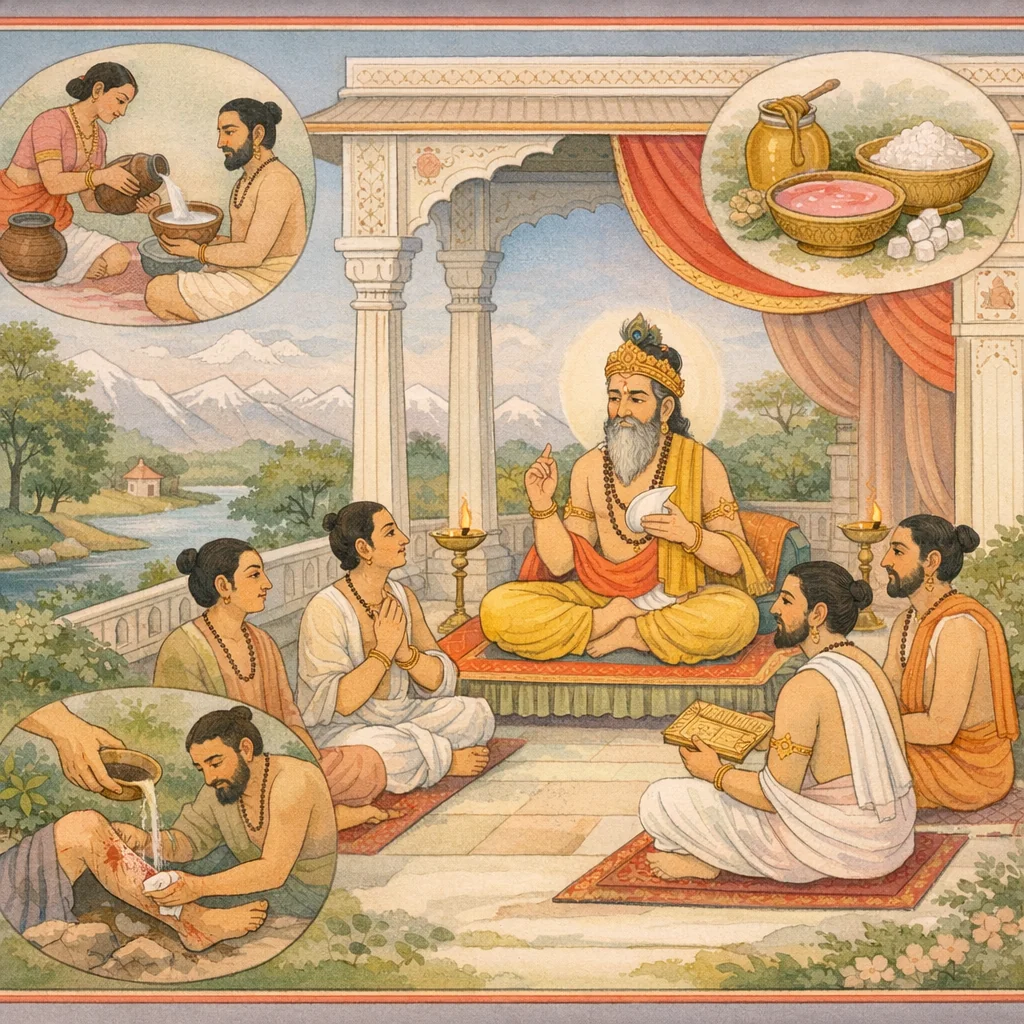
Continuing the Brahma Khanda’s practical Ayurveda stream, Dhanvantari arranges therapeutics by doṣa and disease-type. He begins with the eightfold classification of jvara (fever) and immediate measures for thirst, digestive kindling (pācana), purgative purification (virecana), and revival through nasya. The teaching then moves from fever to fever-complicated atisāra, and on to grahaṇī and arśas, stressing restoration of agni and simple dietary aids such as fresh takra. Next it treats pāṇḍu-kāmala and raktapitta with honey–sugar adjuncts and hemostatic plant groups, followed by respiratory syndromes (kāsa, śvāsa, hikkā), voice disorders, vomiting, and therapies for graha/apasmāra-unmāda. Thereafter come vāta-rakta, constipation/udāvarta/ānāha, gulma, urinary obstruction and meha, with regimen-based guidance for weight and abdominal enlargement. The closing section turns to swellings, tumors/abscesses, and finally a structured vranacikitsā: cleansing washes, cooling measures, deworming of wounds, and guggulu-based support—preparing continuity with adjacent chapters that typically deepen surgical/wound care and doṣa-specific management.
Shlokas
Verse 1
नामैकोनसप्तत्यधिकशततमो ऽध्यायः धन्वन्तरिरुवाच / ज्वरो ऽष्टधा पृथग्द्वन्द्वसंघातागन्तुजः स्मृतः / मुस्तपर्पटकोशीरचन्दनोदीच्यनागरैः / शृतशीतं जलं दद्यात्पिपासाज्वरशान्तये
Dhanvantari said: Fever (jvara) is remembered as eightfold—arising separately, from paired causes, from combined causes, and from external (āgantu) factors. Water boiled with musta, parpaṭa, kośīra, candana, udīcya, and nāgara, then cooled, should be given to relieve thirst and to calm fever.
Verse 2
नागरं देवकाष्ठञ्च धान्याकं बृहतीद्वयम् / दद्यात्पाचनकं पूर्वं ज्वरिताय ज्वरापहम्
Dry ginger, devakāṣṭha (sacred wood), coriander, and the two bṛhatīs should first be given to the fevered as a digestive preparation (pācana); it dispels the fever.
Verse 3
आरग्वधाभयामुस्तातिक्ताग्रन्थिकनिर्मितः / कषायः पाचनः सामे सशूले च ज्वरेहितः
A decoction (kaṣāya) prepared from āragvadha, abhayā, mustā, tiktā, and granthikā is digestive; it is beneficial in irregular sāma fevers, even when pain is present.
Verse 4
मधूकसारसिन्धूत्थवचोषणकणाः समाः / श्लक्ष्णं पिष्ट्वाम्भसा नस्यं कुर्यात्संज्ञाप्रबोधनम्
Equal parts of madhūka-sāra, rock-salt (sindhūttha), vacā, uṣaṇa, and kaṇā should be finely ground with water and given as nasya (nasal medication) to awaken and restore consciousness.
Verse 5
त्रिवृद्विशालात्रिफलाकटुकारग्वधैः कृतः / सक्षारो भेदनः क्वाथः पेयः सर्वज्वरापहः
A decoction (kvātha) made from trivṛt, viśālā, triphalā, kaṭukā, and āragvadha, with an added alkaline agent (kṣāra), acts as a purgative; taken as a drink, it removes all fevers.
Verse 6
महौषधामृतामुस्तचन्दनोशीरधान्यकैः / क्वाथस्तृतीयकं हन्ति शर्करामधुयोजितः
A decoction of the great medicinal herbs—amṛtā (guḍūcī), musta, sandalwood, uśīra (vetiver), and dhānyaka (coriander)—when given mixed with sugar and honey, destroys tertian fever (tṛtīyaka).
Verse 7
अपामगजटाकट्यां लोहितैः सप्ततन्तुभिः / बद्ध्वा वारे रवेर्नूनं ज्वरं हन्ति तृतीयकम्
On a Sunday, having bound a tuft of apāmārga as a sacred charm at the waist with seven red threads, one surely destroys tertian fever.
Verse 8
गङ्गाया उत्तरे कूले अपुत्रस्तापसो मृतः / तस्मै तिलोदकं दद्यान्मुञ्चत्यैकाहिको ज्वरः
On the northern bank of the Gaṅgā a sonless ascetic has died; if one offers him sesame-water (tilodaka), a one-day fever is released and cured.
Verse 9
गुडूच्याः क्वाथकल्काभ्यां विफलावासकस्य च / मृद्वीकाया बलायाश्च सिद्धाः स्नेहा ज्वरच्छिदः
Medicated ghee or oil, cooked with the decoction and paste of guḍūcī together with triphalā and vāsaka, and also with mṛdvīkā (raisins) and balā, is proven to cut down fever.
Verse 10
धात्रीशिवाकणावह्निक्वाथः सर्वज्वरान्तकः / ज्वरातिसारहरणमौषधं प्रवदाम्यथ
A decoction of dhātrī, śivā, kaṇā, and vahni destroys all fevers. Now I shall describe the medicine that removes fever accompanied by dysentery.
Verse 11
पृश्रिपर्णोबलाविल्वनागरोत्पलधान्यकैः / पाठेन्द्रयवभूनिम्बमुस्तपर्पटकैः शृताः / ज्यन्त्याममतीसारं सज्वरं समहौषधाः
Boiled with pṛśniparṇī, balā, bilva, nāgara, utpala, dhānyaka, pāṭhā, indrayava, bhūnimba, musta, and parpaṭaka, and administered with jyantī, these great medicines cure dysentery even when accompanied by fever.
Verse 12
नागरातिविषामुस्तभूनिम्बामृतवत्सकैः / सर्वज्वरहरः क्वथः सर्वातीसारनाशनः
A decoction made with dry ginger, ativishā, mustā, bhū-nimba, gudūcī (amṛtā), and vatsaka removes all fevers and destroys every kind of diarrhoea (atisāra).
Verse 13
मुस्तपर्पटकदिव्यशृङ्गवेरशृतं पयः / शालपर्णो पृश्रिपर्णो बृहती कण्टकारिका
Milk boiled with mustā, parpaṭaka, and śṛṅgavera (fresh ginger) is beneficial; śālaparṇī, pṛśniparṇī, bṛhatī, and kaṇṭakārikā are also recommended.
Verse 14
बलाश्वदंष्ट्राबिल्वादि पाठानागरधान्यकम् / एतदाहारसंयोगे हितं सर्वातिसारिणाम्
Balā, aśvadanṣṭrā, bilva and related ingredients—together with pāṭhā, dry ginger, and dhānyaka—when properly combined as food, are wholesome for all sufferers of diarrhoea (atisāra).
Verse 15
बिल्वचूतास्थिक्वाथश्च खण्डं मध्वतिसारनुत् / अतिसारे हिता तद्वत्कुटजत्वक्कणायुता
A decoction of bilva and the hard stones of mango seeds, mixed with jaggery (khaṇḍa) and honey, alleviates diarrhoea. In atisāra, a similar preparation is beneficial when combined with kutaja bark and kaṇā (long pepper).
Verse 16
वत्सकातिविषाविश्वकणाकन्दकषायकः / प्रयुक्तश्चामशूलाढ्ये ह्यतीसारे सशोणित
A decoction of vatsaka (kutaja), ativishā, viśvā (dry ginger), kaṇā (long pepper), and kanda (a root/tuber) is administered for diarrhoea accompanied by āma and colicky pain, even when there is bleeding.
Verse 17
चिकित्साथ ग्रहण्यास्तुग्रहणी चाग्रिनाशिनी / चित्रकाक्वाथक्लकाभ्यां ग्रहणीघ्नं क्षृतं हविः / गुल्मशोथोदरप्लीहशूलार्शोघ्नं प्रदीपनम्
Now the treatment for grahaṇī (malabsorption) is declared: grahaṇī destroys the digestive fire (agni). With a decoction of citrakā together with klakā, one should prepare medicated ghee as a havis offering; it destroys grahaṇī, kindles agni, and relieves abdominal masses, swelling, dropsy/abdominal enlargement, spleen disorders, pain, and hemorrhoids.
Verse 18
सौवर्चलं सैन्धवञ्च विडङ्गौद्भिदमेव च / सामुद्रेण समं पञ्चलवणान्यत्र योजयेत्
Combine in equal measure sauvarcala salt, saindhava (rock salt), viḍaṅga-salt, udbhida (mineral) salt, and samudra (sea) salt—thus are prepared the five salts to be used here.
Verse 19
भेषजं शस्त्रक्षाराग्न्यस्त्रिधा वै चार्शसां हरम् / विद्धि तच्चार्शसोघ्नन्तु यद्धि तक्रं नवोद्धृतम्
Know that the remedy for arśas (piles) is threefold—by surgery, by alkaline cauterization (kṣāra), and by fire (thermal cautery). Yet understand that fresh, newly-prepared takra (buttermilk) is indeed a destroyer of piles.
Verse 20
गुडूटीं पिप्पलीयुक्तामभयां घृतभर्जिताम् / त्रिवृदर्शोविनाशार्थं भक्षयेदम्ललोणिकाम्
For the destruction of piles, one should eat guḍūṭī (guḍūcī) mixed with pippalī, together with abhayā (harītakī) roasted in ghee (ghṛta), taken along with something sour and salty.
Verse 21
तिलेक्षुरससंयोगश्चार्शः कुष्ठ विनाशनः / पञ्चकोलं समरिचं सत्र्यूषणमथाग्निकृत्
A preparation made by combining sesame with sugarcane juice destroys hemorrhoids and kuṣṭha-like skin disorders. Likewise, pañcakola mixed with black pepper and the tri-uṣaṇa (three pungent spices) kindles the digestive fire (agni).
Verse 22
हरीतकी भक्ष्यमाणा नागेरण गुडेन वा / सैन्धवोपहिता वापि सातत्येनाग्निदीपनी
Harītakī, when eaten regularly—either with nāgara (dry ginger) and jaggery, or with saindhava (rock salt)—steadily kindles and strengthens the digestive fire (agni).
Verse 23
फलत्रिकामृतासातिक्ताभूनिम्बनिम्बजः / क्वाथः क्षौद्रयुतो हन्यात्पाण्डुरोगं सकामलम्
A decoction made from phalatrikā, guḍūcī (amṛtā), sātiktā, bhūnimba, and neem—taken with honey—destroys pāṇḍu (pallor/anemia-like disorder) along with kāmala (jaundice).
Verse 24
त्रिवृच्च त्रिफला श्यामा पिप्पली शर्कग मधु / मोदकः सन्निपातान्तो रक्तपित्तज्वरापहः
A bolus (modaka) made with trivṛt, triphalā, śyāmā, pippalī, sugar, and honey ends sannipāta (tridoṣic disorder) and relieves fevers arising from raktapitta (bleeding disorders).
Verse 25
वासायां विद्यमानायामाशायां जीवितस्य च / रक्तपित्ती क्षयी कासी किमर्थमवसीदति
When vāsā is available—and when hope for life still remains—why should one afflicted with raktapitta, kṣaya (consumption), and kāsa (cough) sink into despair?
Verse 26
आटरूपकमृद्वीकापथ्याक्वाथः सशर्करः / क्षौद्राढ्यः कासनिः श्वासरक्तपित्तनिबर्हणः
A decoction of āṭarūpaka, raisins (mṛdvīkā), and pathyā, taken with sugar and enriched with honey, alleviates cough and removes śvāsa (breathlessness/asthma), as well as raktapitta disorders.
Verse 27
वासारसः खण्डमधुयुतः पीतो ऽथरक्तजित् / सल्लकीबदरीजम्बुप्रियालाम्रार्जुनं धवः / पीतं क्षीरञ्च मध्वाढ्यं पृथक्छोणितवारणम्
When the essence of vāsā is drunk mixed with sugar and honey, it conquers disorders of the blood. Likewise, preparations from sallakī, badarī, jambu, priyāla, mango, arjuna, and dhava—together with milk enriched with honey—when taken separately, are said to restrain and stop bleeding.
Verse 28
समूलफलपत्राया निर्गुण्ड्याः स्वरसैर्घृतम् / सिद्धं पीत्वा क्षयक्षीणी निर्व्यादिर्भाति देववत्
Ghee cooked with the expressed juices of nirgundī—using its root, fruit, and leaves—when drunk, makes a person wasted by consumption (kṣaya) become free from disease and radiant, as if godlike.
Verse 29
हरीतकी कणा शुण्ठी मरिचं गुडसंयुतम् / कासघ्नो मोदकः प्रोक्तस्तृष्णारोचकनाशनः
A sweet bolus (modaka) made with harītakī, kaṇā (pippalī), dry ginger, and black pepper, combined with jaggery, is declared to destroy cough; it also removes excessive thirst and loss of appetite.
Verse 30
कण्टकारिगुडूचीभ्यां पृथक्त्रिंशत्पले रसे / प्रस्थं सिद्धं घृतं स्याच्च कासनुद्वह्निदापनम्
From the expressed juice (decoction) of kaṇṭakārī and guḍūcī—thirty palas of each—cook one prastha of ghee to completion. This medicated ghee alleviates cough and kindles the digestive fire.
Verse 31
कृष्णा धात्री शिता शुण्ठी हक्काघ्नी मधुसंयुता / हिक्काश्वासी पिवेद्भार्ङ्गो सविश्वामुष्णवारिणा
Black pepper (kṛṣṇā), āmalakī (dhātrī), sugar, and dry ginger—together with hikkā-ghnī—combined with honey form a remedy that destroys hiccup. One afflicted with hiccup and breathlessness should drink it with bhṛṅga and viśvā, taken with warm water.
Verse 32
तैलाक्तं स्वरभेदे वा खादिरं धारयेन्मुखे / पथ्यां पिप्पलिकायुक्तां संयुक्तां नागरेण वा
In hoarseness or impairment of the voice, one should hold khādira (acacia) in the mouth after anointing it with oil. Or one may take harītakī (pathyā) mixed with pippalī, or combined with dry ginger.
Verse 33
विडङ्गत्रिलाचूर्णं छर्दिहृन्मधुना सह / आम्रजम्बूकषायं वा पिबोन्माक्षिकसंयुतम्
One should drink a powder of viḍaṅga and trilā mixed with honey to relieve vomiting and discomfort of the heart; or else drink a decoction of mango and jambū (rose-apple) mixed with honey.
Verse 34
छर्दि सर्वां प्रणुदति तृष्णाञ्चैवापकर्षति / त्रिफला भ्रममूर्छाहृत्पीता सा मधुनापि वा
It drives away every kind of vomiting and also reduces excessive thirst. Triphalā, when taken, removes dizziness, fainting, and distress of the heart—whether taken alone or with honey.
Verse 35
पञ्चगव्यं हितं पानादपस्मारग्रहादिनुत् / कूष्माण्डकरसो वाज्यं सयष्टिकं तदर्थकृत्
Pañcagavya, when taken beneficially as a drink, alleviates epilepsy-like disorders such as apasmāra and afflictions attributed to grahas (seizing influences), and the like. Likewise, the juice of kūṣmāṇḍa (ash-gourd) or ghee taken with yaṣṭikā (licorice) serves the same purpose.
Verse 36
ब्राह्मीरसवचाकुष्ठशङ्खपुष्पीभिरेव च / पुराणं सेव्यमुन्मादग्रहापस्मारद्घृनुतम्
With the juice of brāhmī, along with vacā, kuṣṭha, and śaṅkhapuṣpī, this aged and well-matured preparation should be used; it alleviates unmada (insanity), graha-affliction, and apasmāra (epilepsy).
Verse 37
अश्वगन्धाकषाये च कल्के क्षीरे चतुर्गुणे / घृतपक्वन्तु वातघ्नं वृष्यं मां साय पुत्रकृत्
Cook ghee (ghṛta) with a decoction of aśvagandhā, its paste (kalka), and milk in fourfold measure; this ghee pacifies Vāta, is aphrodisiac, and for one nourished by wholesome food, promotes the begetting of a son.
Verse 38
नीलीमुण्डीरिकाचूर्णं मधुसर्पिः समन्वितम् / छिन्नाक्वाथं पिबन्हन्ति वातरक्तं सुदुस्तरम्
Powder of nīlī and muṇḍīrikā, blended with honey and ghee (ghṛta), when drunk with a decoction of chinnā, destroys even the most difficult vāta-rakta (a gout-like affliction).
Verse 39
सगुडाः पञ्च पथ्याश्च कुष्टार्शोवातसादनाः / गडचीस्वरसं कल्कं चूर्णं वा क्वाथमेव वा
Five preparations of harītakī (pathyā), taken together with jaggery, alleviate kuṣṭha (skin disease), arśas (hemorrhoids), and disorders of Vāta. Gudūcī (gaḍacī) may be given as expressed juice, as paste (kalka), as powder, or as a decoction.
Verse 40
वातरक्तान्तकं कालागुडूचीक्वाथकल्कतः / कुष्ठव्रणादिशमनं शृतमाज्यं सदुग्धकम्
A medicated ghee (ghṛta), cooked with milk using the decoction and paste (kalka) of kālā-gudūcī, is said to destroy vāta-rakta and to pacify skin diseases, wounds (vraṇa), and similar ailments.
Verse 41
त्रिफलागुग्गुलुर्वातरक्तमूर्छापहारकः / ऊरुस्तम्भविनाशाय गोमूत्रेण च गुग्गुलुः
Triphala-guggulu removes vāta-rakta and fainting (mūrcchā). And to destroy stiffness or immobility of the thigh (ūru-stambha), guggulu should be taken together with cow’s urine (gomūtra).
Verse 42
शुण्ठीगोक्षुरकक्वाथः सामवातार्तिशूलनुत् / दशमूलामृतैरण्डरास्नानागरदारुभिः
A decoction of dry ginger and gokṣura relieves pain and colic arising from vāta. It should be prepared together with daśamūla, guḍūcī (amṛtā), castor (eraṇḍa), rāsnā, dry ginger, and dāru (deodar wood).
Verse 43
क्वाथो हन्ति माहशोथं मरीचगुडसंयुतः / कासघ्नो मोदकः प्रोक्तस्तृष्णारोचकनाशनः
This decoction, combined with black pepper and jaggery, destroys severe swelling. A sweet bolus called modaka is also taught as a remedy that removes cough, thirst, and loss of appetite.
Verse 44
कण्टकारिगुडूचीभ्यां पृथक् त्रिंशत्पले रसे / प्रस्थसिद्धं घृतञ्चैव कासनुद्धृदि दीपनः
Using kaṇṭakārī and guḍūcī—thirty pala of juice from each—one should cook a prastha of ghee. This medicated ghee alleviates cough, kindles digestion, and strengthens the chest and heart region.
Verse 45
कृष्णाधात्रीसिताशुण्ठीमरीचसैन्धवान्वितः / क्वाथ एरण्डतैलेन सामं हन्त्यनिलं गुरुम्
A decoction of kṛṣṇā, āmalakī, sugar, dry ginger, black pepper, and rock-salt—taken together with castor oil—overcomes severe vāta disorder, even when deep-seated and accompanied by āma.
Verse 46
बला पुनर्नवैरण्डबृहतीद्वयगोक्षुरैः / सहिङ्गुलवर्ण पीतं वातशूलविमर्दनम्
Prepared with balā, punarnavā, castor (eraṇḍa), the two bṛhatīs, and gokṣura—when taken in a preparation of cinnabar-like hue (hingula)—it crushes and relieves colic pain caused by vāta.
Verse 47
त्रिफलानिम्बयष्टीककटुकारग्वधैः शृतम् / पाययेन्मधुना मिश्रं दाहशूलोपशान्तये
Boil a decoction of triphalā, neem, yaṣṭīka (licorice), kaṭukā, and rājavṛkṣa (aragvadha); administer it mixed with honey, to soothe burning sensation and pain.
Verse 48
त्रिफलापः सयष्टीकाः परिणामार्तिनाशनाः / गोमूत्रशुद्धमण्डूरं त्रिफलाचूर्णसंयुतम् / विलिहन्मधुसर्पिर्भ्यां शूलं हन्ति त्रिदोषजम्
A decoction of triphalā with yaṣṭī (licorice) destroys pain arising from indigestion and disordered digestion. Mandūra (iron oxide) purified in cow’s urine, combined with triphalā powder and licked with honey and ghee, removes colic born of imbalance of the three doṣas.
Verse 49
त्रिवृत्कृष्णाहरीतक्यो द्विचतुष्पञ्चभागिकाः / गुटिका गुडतुल्यास्ता विड्विबन्धगदापहाः
Take trivṛt, kṛṣṇā (pippalī), and harītakī in proportions of two, four, and five parts. Made into pills the size of jaggery lumps, they remove ailments arising from fecal obstruction (constipation).
Verse 50
हरीतकीयवक्षारपिप्पलीत्रिवृतस्तथा / घृतैश्चूर्णमिदं पेयमुदावर्ताविनाशनम्
Harītakī, yavakṣāra (alkali from barley), pippalī, and trivṛt—this powder should be taken with ghee; it destroys udāvarta (the upward-moving disorder caused by obstructed vāta, often linked with constipation and abdominal distress).
Verse 51
त्रिवृद्धरीतकीश्यामाः स्नुहीक्षीरेण भाविताः / वटिका मूत्रपीतास्ताः श्रेष्टाश्चानाहभेदिकाः
Pills made from trivṛt, harītakī, and śyāmā, impregnated with the milky latex of snuhī, and taken with urine as the drink—these are esteemed as excellent for breaking up ānāha, obstructed abdominal distension.
Verse 52
त्र्यूषणत्रिफलाधन्यविडङ्गचव्यचित्रकैः / कल्कीकृतैर्घृतं सिद्धं संस्कारं वातगुल्मनुत्
Ghee, cooked and brought to perfection by processing it with the paste of tryūṣaṇa, triphalā, dhānyaka, viḍaṅga, cavya, and citraka—this sacred preparation alleviates vāta-type gulma (abdominal masses and colicky lumps).
Verse 53
मूलं नागरमानीतं सक्षीरं हृदयार्तिनुत् / सौवचलं तदर्धन्तु शिवानाञ्च घृतं पिबेत्
The root of nāgara (dry ginger), taken with milk, relieves distress of the heart. One should also drink sauvarchala salt—half that measure—and ghee prepared with śivā (harītakī).
Verse 54
कणापाषाणभेदैर्वा शिलाजतुकचूर्णकम् / तण्डुलीभिर्गुडेनापि मूत्रकृच्छ्रीति जीवति
For one suffering from mūtrakṛcchra (painful or difficult urination), kaṇā, pāṣāṇabheda, or powdered śilājatu may be taken; when consumed with rice-gruel and jaggery, the afflicted person is relieved and sustained.
Verse 55
अमृतानागरीधात्रीवाजिगन्धात्रिकण्टकाम् / प्रपिबेद्वातरेगार्तः सशूलो मूत्रकृच्छ्रवान्
One afflicted with vāta‑type urinary disorder (vāta‑regha), with pain and mūtrakṛcchra, should drink a preparation of amṛtā, nāgarī, dhātrī, vājigandhā, and trikaṇṭakā.
Verse 56
सितातुल्यो यवक्षारः सर्वकृच्छ्रनिवारणः / निदिग्धिकारसो वापि सक्षौद्रः कृच्छ्रनाशनः
Yavakṣāra (barley-alkali), taken in a measure equal to sugar, removes all forms of kṛcchra (urinary difficulty). Or the juice of nidiṅgdhikā, taken with honey, likewise destroys that difficulty.
Verse 57
लवणं त्रिफलाकल्कैर्मूत्राघातहरं स्मृतम् / मूत्रे विरुद्धे कर्पूरचूर्णं लिङ्गे प्रवेशयेत्
Salt mixed with a paste of Triphalā is taught to relieve obstruction of urine. When urination is blocked, camphor powder should be introduced into the penis as a local measure.
Verse 58
क्वाथश्च शिग्रुमूलोत्थः कटूष्णोश्मानिपातनः / सर्वमेहहरोधात्र्या रसःक्षौद्रनिशायुतः / त्रिफलादारुदार्व्यष्टक्वाथः क्षौद्रेण मेहहा
A decoction made from the root of Śigru is pungent and warming, and it brings down excessive inner heat. The juice of Dhātrī (Āmalakī), taken with honey and Niśā (turmeric), removes every form of meha (urinary/metabolic disorder). A decoction of Triphalā with dāru and dārvī, taken with honey, likewise destroys meha.
Verse 59
अस्वप्नं च व्यवायं च व्यायामाश्चिन्तनानि च / स्थौल्यमिच्छन्पपरित्यक्तं क्रमेणाभिप्रवर्धयेत्
One who desires stoutness should, having abandoned sinful conduct, increase step by step wakefulness, sexual activity, exercise, and mental exertion.
Verse 60
यवश्यामाकभोजी स्यास्थौल्यकृन्मधुवारिणा / उष्णमन्नं समण्डं वा पिबन्कृशतनुर्भवेत्
One who eats yava (barley) and śyāmāka (millet) and drinks honey-water—though these tend to promote stoutness—becomes lean-bodied by drinking warm rice-gruel or warm broth (samanda) as a drink.
Verse 61
सचव्यजीरकं व्योषा हिङ्गुसौवर्चलामलाः / मधुना रक्तवः पीता मेधोघ्ना सर्वदीपनाः
Chavya and cumin, the three pungents (trikaṭu), hingu (asafoetida), black salt (sauvarcala), and āmalakī—taken with honey and with a decoction/juice of red-variety herbs—destroy fat and kindle every digestive fire.
Verse 62
चतुर्गुणे जले मूत्रे द्विगुणे चित्रकाणि च / कल्कैः सिद्ध घृत प्रस्थं सक्षीरं जठरी पिबेत्
In four parts water and cow’s urine, add two parts citraka; cook ghṛta (ghee) with the herbal pastes (kalkas) until perfected. One afflicted with abdominal enlargement or dropsy should drink one prastha of that prepared ghee together with milk.
Verse 63
क्रमवृद्ध्या दशाहानि दश पैप्पालिकं दिनम् / वर्धयेत्पयसा सार्धं तथैवापानयेत्पुनः
For ten days it should be increased gradually; then for another ten days one should follow the pippalī regimen. It is to be augmented along with milk, and thereafter reduced again in the same manner.
Verse 64
क्षीरषष्टिकभोजीस्यादेवं कृष्णसहस्रकम् / बृंहणं मुद्गमायुष्यं प्लीहोदरविनाशनम्
Thus one should subsist on milk and śaṣṭika rice; in this manner the regimen called “kṛṣṇa-sahasraka” is observed. It is nourishing, and mudga (green gram) is life-promoting; it destroys disorders of the spleen and abdominal enlargement.
Verse 65
पुनर्नवाक्वाथकल्कैः सिद्धं शोथहरं घृतम् / गावा मत्रेण संसेव्यं पिप्पली वा पयो ऽन्विताः / गुडन वाभयां तुल्यां विश्वं वा शोथरोगिणा
Ghee (ghṛta) cooked with the decoction and paste (kalkas) of punarnavā removes swelling (śotha). It should be taken in a proper measured dose; or pippalī may be taken along with milk. Or one afflicted with swelling may take harītakī in equal proportion with jaggery, or dry ginger.
Verse 66
तैलमेरण्डजं पीत्वा बलासिद्धं पयो ऽन्वितम् / आध्मानशूलोपचितामन्त्रवृद्धिञ्जयेन्नरः
By drinking castor oil together with milk prepared with Bala, a man overcomes abdominal distension, colicky pain, and the aggravated condition known as antra-vṛddhi (intestinal or scrotal swelling, hernia-like).
Verse 67
भ्रष्टोरुचकतैलेन कल्कः पथ्यासमुद्भवः / कृष्णसैन्धवसंयुक्तो वद्धिरोगहरः परः
A paste of Pathyā (Harītakī), blended with roasted Orucaka oil and joined with black salt and rock salt, is a supreme remedy that removes vaddhi-roga (swelling, a hernia-like disorder).
Verse 68
निर्गुण्डीमूलनस्येन गण्डमाला विनश्यति / स्मुहीगण्डीरिकास्वेदो नाशयेदर्बुदानि च
By nasal administration of the root of Nirgundī, gaṇḍamālā (goitre-like glandular swellings) is destroyed; and fomentation/steam prepared with Smuhī and Gaṇḍīrikā also destroys arbuda (tumors and hard swellings).
Verse 69
हस्तिकर्णपलाशस्य गलगण्डं तु लेपतः / धत्तूरैरण्डनिर्गुण्डीवर्षाभूशिग्रुसर्षपैः
A paste made from the leaves of the hastikarṇa plant is applied for galagaṇḍa (goitre/neck swelling), prepared together with dhattūra, castor, nirguṇḍī, varṣābhū, śigru, and mustard.
Verse 70
प्रलेपःश्लीपदं हन्ति चिरोत्थमतिदारुणम् / शोभाञ्जनकसिन्धृत्थहिङ्गुं विद्रधिनाशनम्
This medicinal paste destroys ślīpada (elephantiasis), even when long-standing and extremely severe. The combination including śobhāñjana, kasindhṛttha, and hiṅgu is said to eliminate vidradhi (abscess).
Verse 71
शरपुङ्खा मधुयुता यात्सर्स्वव्रणगेपणी / निम्बपत्रस्य वालेपः श्वयथुव्रणगेपणः
Śarapuṅkhā mixed with honey becomes a healing application for all wounds. Likewise, a paste of nimba (neem) leaves is a healing dressing for swellings and wounds.
Verse 72
त्रिफला खदिरो दार्वो न्यग्रोधो व्रणशोधनः / सद्यः क्षतं व्रणं वैद्यः सशूलं परिषेचयेत्
Triphala, khadira, dāru, and nyagrodha cleanse wounds. The physician should promptly irrigate a fresh injury or wound—especially a painful one—with a purifying wash prepared from these.
Verse 73
यष्टीमधुकयुक्तेन किञ्चिदुष्णेन सर्पिषा / बुद्ध्वागन्तुव्रणान्वैद्यो घृतक्षौद्रसमन्विताम्
With ghee that is slightly warm and mixed with yaṣṭīmadhuka (licorice), the physician—after identifying wounds caused by external factors—should apply a preparation combined with ghee and honey.
Verse 74
शीतां क्रियां प्रयुञ्जीत पित्तरक्तोष्मनाशिनीम् / क्वाथो वंशत्वगेरण्डश्वदंष्ट्रवनिदाकृतः
One should employ a cooling therapy that destroys the heat arising from pitta and blood. A decoction may be prepared from bamboo bark, castor (eraṇḍa), śvadaṃṣṭrā (gokṣura/tribulus), and vanidā.
Verse 75
सहिङ्गुसैन्धवः पीतः कोष्ठस्थं स्त्रावयेदसृक् / यवकोलकुलत्थानां निःस्नेहेन रसेन वा
When drunk with hiṅgu (asafoetida) and saindhava (rock-salt), it causes the blood lodged in the bowels to be discharged; alternatively, it may be taken with a fat-free decoction/juice of yava (barley), kola (jujube), or kulattha (horse-gram).
Verse 76
भुञ्जीतान्नं यवाग्वा वा पिवेत्सैन्धवसंयुतम् / करञ्जारिष्टनिर्गुण्डीरसो हन्याद्व्रणक्रिमीन्
One should eat food, or yavāgvā (barley-gruel), and drink it mixed with saindhava (rock-salt); the juice/decoction of karañja, ariṣṭa, and nirguṇḍī destroys worms (maggots) in wounds.
Verse 77
त्रिफलाचूर्णसंयुक्तो गुग्गुलुर्वटकीकृतः / निर्यन्त्रणो विबन्धघ्नो व्रधनगेपणः
Guggulu, blended with powdered Triphalā and formed into pills, is a remedy easy to take; it removes obstruction and constipation and promotes the healing of swellings and wounds.
Verse 78
दूर्वास्वरससिद्धं वा तलं कम्पिल्लकेन वा / दार्वोत्वचश्च कल्केन प्रधानं व्रणरोपणम्
A paste (kalka) prepared with the juice of dūrvā grass, or a preparation made with kampillaka, and likewise a paste from tree bark—these are regarded as foremost remedies for the healing of wounds.
Frequently Asked Questions
The chapter signals an eightfold model: fevers arising singly, from paired causes, from combined causes, and from external/agantu factors—an Ayurveda-style taxonomy that guides whether one uses pācana, śamana cooling, or śodhana like virecana.
Within Ayurvedic logic, piles often worsen with impaired agni and sticky/obstructive digestion; freshly prepared buttermilk is presented as a simple, accessible agni-supporting dietary medicine that reduces the condition’s persistence.