Adhyaya 4
Uddhava’s Departure to Badarikāśrama and Vidura’s Turn Toward Maitreya
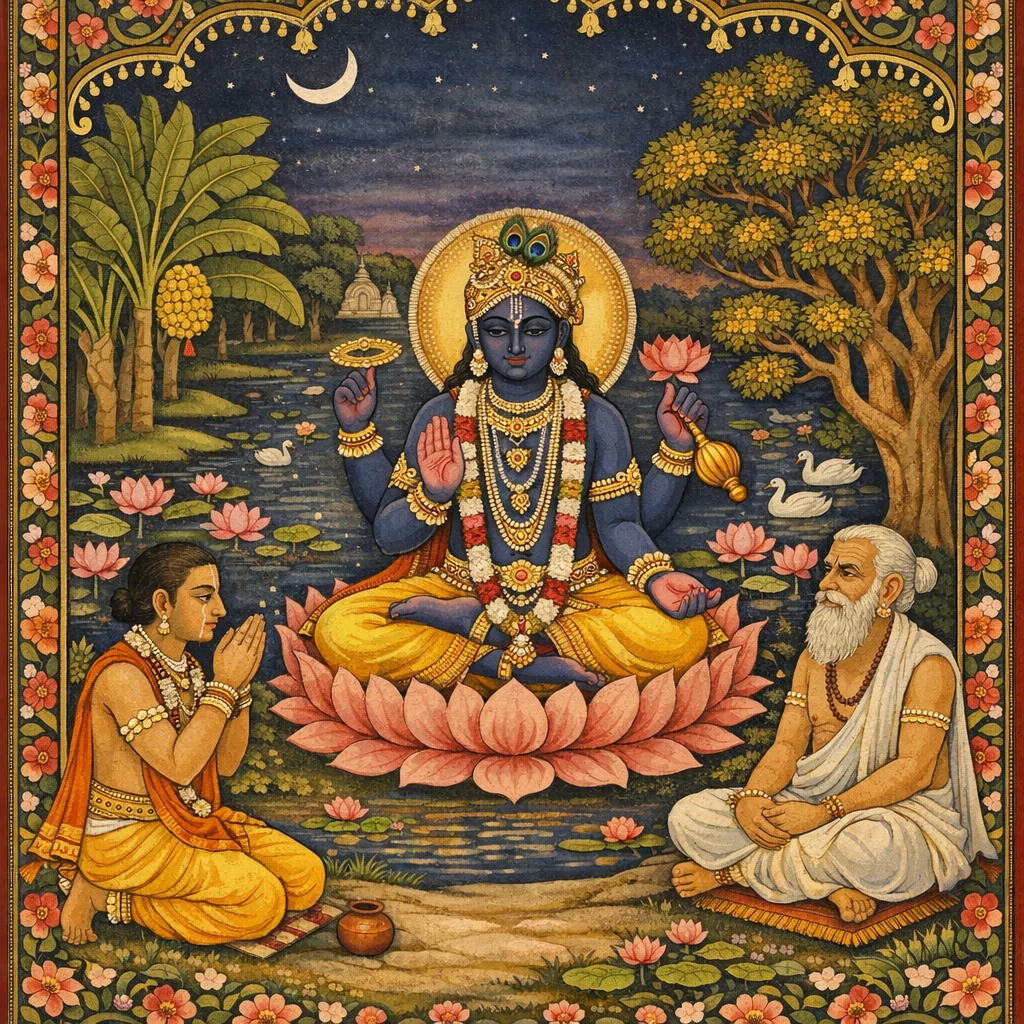
In the wake of the brāhmaṇas’ curse, the intoxicated Vṛṣṇis and Bhojas fall into a violent quarrel and destroy one another—an outward pretext for the Lord’s own will to withdraw His dynasty from the earth. Foreseeing the end by His internal potency, Śrī Kṛṣṇa sits alone on the bank of the Sarasvatī. Uddhava, unable to bear separation, follows and beholds the Lord’s serene four-armed form. The sage Maitreya arrives at the destined moment; the Lord honors Uddhava, recalls his ancient longing for divine association, and grants him leave to go to Vaikuṇṭha. Yet Uddhava asks for the confidential knowledge once spoken to Brahmā, and the Lord instructs him on His transcendental position, foreshadowing the Uddhava-gītā. Uddhava then departs for Badarikāśrama as ordered, while Vidura—grieving yet steadied by knowledge—seeks instruction. Uddhava directs him to Maitreya, linking this chapter to the next phase: Maitreya’s extended teachings on creation, dharma, and bhakti.
Shlokas
Verse 1
उद्धव उवाच अथ ते तदनुज्ञाता भुक्त्वा पीत्वा च वारुणीम् । तया विभ्रंशितज्ञाना दुरुक्तैर्मर्म पस्पृश: ॥ १ ॥
Uddhava said: Thereafter, permitted by the brāhmaṇas, they ate the remnants of prasāda and also drank varuṇī, liquor made from rice. Intoxicated, their minds became deluded; bereft of discernment, they pierced one another’s hearts with harsh words.
Verse 2
तेषां मैरेयदोषेण विषमीकृतचेतसाम् । निम्लोचति रवावासीद्वेणूनामिव मर्दनम् ॥ २ ॥
By the fault of intoxication from maireya, their minds became unbalanced. At sunset, destruction arose among them—just as the friction of bamboos brings about a devastating blaze.
Verse 3
भगवान् स्वात्ममायाया गतिं तामवलोक्य स: । सरस्वतीमुपस्पृश्य वृक्षमूलमुपाविशत् ॥ ३ ॥
The Bhagavān, Lord Śrī Kṛṣṇa, foreseeing the course of His own internal potency, went to the bank of the Sarasvatī, performed ācamana, and sat beneath a tree.
Verse 4
अहं चोक्तो भगवता प्रपन्नार्तिहरेण ह । बदरीं त्वं प्रयाहीति स्वकुलं संजिहीर्षुणा ॥ ४ ॥
The Lord, the remover of the distress of the surrendered, desiring to bring His own dynasty to an end, had previously told me: “Go to Badarikāśrama.”
Verse 5
तथापि तदभिप्रेतं जानन्नहमरिन्दम । पृष्ठतोऽन्वगमं भर्तु: पादविश्लेषणाक्षम: ॥ ५ ॥
Yet, O Arindama, though I knew His intention, I followed behind Him, for I could not bear separation from the lotus feet of my Lord.
Verse 6
अद्राक्षमेकमासीनं विचिन्वन् दयितं पतिम् । श्रीनिकेतं सरस्वत्यां कृतकेतमकेतनम् ॥ ६ ॥
Thus following and searching for my beloved master, I saw Śrī Kṛṣṇa—though He is the abode of Śrī—sitting alone on the bank of the Sarasvatī, absorbed in deep thought.
Verse 7
श्यामावदातं विरजं प्रशान्तारुणलोचनम् । दोर्भिश्चतुर्भिर्विदितं पीतकौशाम्बरेण च ॥ ७ ॥
The Lord’s form was śyāma-hued yet spotless and supremely beautiful; His eyes were serene, tinged red like the rising sun. By His four arms, divine emblems, and yellow silk (pītāmbara), I at once recognized Him as the Supreme Bhagavān.
Verse 8
वाम ऊरावधिश्रित्य दक्षिणाङ्घ्रि सरोरुहम् । अपाश्रितार्भकाश्वत्थमकृशं त्यक्तपिप्पलम् ॥ ८ ॥
The Lord sat at ease, leaning against a young banyan tree, His right lotus foot resting upon His left thigh. Though He had renounced all household comforts, He appeared serene and cheerful in that posture.
Verse 9
तस्मिन्महाभागवतो द्वैपायनसुहृत्सखा । लोकाननुचरन् सिद्ध आससाद यदृच्छया ॥ ९ ॥
At that time, Maitreya—the perfected sage, a great devotee of the Lord, and the friend and well-wisher of the mighty seer Kṛṣṇa-dvaipāyana Vyāsa—after wandering through many regions, arrived at that spot of his own accord.
Verse 10
तस्यानुरक्तस्य मुनेर्मुकुन्द: प्रमोदभावानतकन्धरस्य । आशृण्वतो मामनुरागहास- समीक्षया विश्रमयन्नुवाच ॥ १० ॥
Maitreya Muni was deeply attached to Him and listened with a pleased demeanor, his shoulder lowered in humility. Then Lord Mukunda, with an affectionate smile and a particular glance toward me, granted me rest and spoke as follows.
Verse 11
श्री भगवानुवाच वेदाहमन्तर्मनसीप्सितं ते ददामि यत्तद् दुरवापमन्यै: । सत्रे पुरा विश्वसृजां वसूनां मत्सिद्धिकामेन वसो त्वयेष्ट: ॥ ११ ॥
The Supreme Lord said: “O Vasu, I know the desire within your heart. What is difficult for others to attain, I grant to you. Long ago, at the great sacrificial assembly of the Vasus and other devas who expand the affairs of the universe, you worshiped with the longing to achieve My association.”
Verse 12
स एष साधो चरमो भवाना- मासादितस्ते मदनुग्रहो यत् । यन्मां नृलोकान् रह उत्सृजन्तं दिष्टया ददृश्वान् विशदानुवृत्त्या ॥ १२ ॥
O saintly one, your present life is the last and the most exalted, for in this very birth you have received My ultimate mercy. Now you may leave this world of conditioned beings and go to My transcendental abode, Vaikuṇṭha. That you have seen Me in this solitary place, by your pure and unwavering bhakti, is a great blessing for you.
Verse 13
पुरा मया प्रोक्तमजाय नाभ्ये पद्मे निषण्णाय ममादिसर्गे । ज्ञानं परं मन्महिमावभासं यत्सूरयो भागवतं वदन्ति ॥ १३ ॥
O Uddhava, in ancient times at the dawn of creation, I instructed Brahmā, the unborn one seated upon the lotus sprung from My navel, in the supreme knowledge that reveals My transcendental glories—what the great sages call the Śrīmad-Bhāgavatam.
Verse 14
इत्यादृतोक्त: परमस्य पुंस: प्रतिक्षणानुग्रहभाजनोऽहम् । स्नेहोत्थरोमा स्खलिताक्षरस्तं मुञ्चञ्छुच: प्राञ्जलिराबभाषे ॥ १४ ॥
Thus, favored at every moment by the Supreme Lord and addressed by Him with tender affection, my words broke amid tears and my body thrilled with ecstasy. Wiping away my tears, with folded hands I spoke to Vidura as follows.
Verse 15
को न्वीश ते पादसरोजभाजां सुदुर्लभोऽर्थेषु चतुर्ष्वपीह । तथापि नाहं प्रवृणोमि भूमन् भवत्पदाम्भोजनिषेवणोत्सुक: ॥ १५ ॥
O Lord, for those who lovingly serve Your lotus feet, nothing is difficult to attain among the four aims—dharma, wealth, pleasure, and liberation. Yet, O Great One, I choose only the eager service of Your lotus feet.
Verse 16
कर्माण्यनीहस्य भवोऽभवस्य ते दुर्गाश्रयोऽथारिभयात्पलायनम् । कालात्मनो यत्प्रमदायुताश्रम: स्वात्मन्रते: खिद्यति धीर्विदामिह ॥ १६ ॥
My Lord, even learned sages are bewildered when they see You perform fruitive deeds though desireless, take birth though unborn, flee in fear of an enemy and seek a fortress though You rule invincible Time, and enjoy household life amid many women though You delight in Your own Self.
Verse 17
मन्त्रेषु मां वा उपहूय यत्त्व- मकुण्ठिताखण्डसदात्मबोध: । पृच्छे: प्रभो मुग्ध इवाप्रमत्त- स्तन्नो मनो मोहयतीव देव ॥ १७ ॥
O my Lord, Your eternal Self is never divided by time, and Your perfect knowledge has no limit. Yet You called me for counsel and questioned me as if bewildered, though You are never bewildered. O Deva, this act of Yours bewilders my mind.
Verse 18
ज्ञानं परं स्वात्मरह:प्रकाशं प्रोवाच कस्मै भगवान् समग्रम् । अपि क्षमं नो ग्रहणाय भर्त- र्वदाञ्जसा यद् वृजिनं तरेम ॥ १८ ॥
My Lord, if You deem us fit to receive it, please reveal to us that supreme transcendental knowledge which illumines Your own Self, which You formerly spoke to Brahmā, so that we may easily cross beyond misfortune.
Verse 19
इत्यावेदितहार्दाय मह्यं स भगवान् पर: । आदिदेशारविन्दाक्ष आत्मन: परमां स्थितिम् ॥ १९ ॥
When I thus revealed the longing of my heart to the Supreme Bhagavān, the lotus-eyed Lord instructed me about His own supreme, transcendental position.
Verse 20
स एवमाराधितपादतीर्था- दधीततत्त्वात्मविबोधमार्ग: प्रणम्य पादौ परिवृत्य देव- मिहागतोऽहं विरहातुरात्मा ॥ २० ॥
I have learned from my spiritual master—the Personality of Godhead—the path that awakens knowledge of the self, worshiping the sacred tīrtha of His feet; then, bowing to His lotus feet and circumambulating Him, I have come here, my heart distressed by separation.
Verse 21
सोऽहं तद्दर्शनाह्लादवियोगार्तियुत: प्रभो । गमिष्ये दयितं तस्य बदर्याश्रममण्डलम् ॥ २१ ॥
My dear Vidura, bereft of the joy of seeing Him, I am tormented by the pain of separation; to soothe it, as He instructed, I am now going to the region of Badarikāśrama in the Himalayas.
Verse 22
यत्र नारायणो देवो नरश्च भगवानृषि: । मृदु तीव्रं तपो दीर्घं तेपाते लोकभावनौ ॥ २२ ॥
There, in Badarikāśrama, Nārāyaṇa the Lord and Nara the Bhagavān-sage—both benefactors of the world—have been performing great, long austerities since time without beginning, sometimes gentle and sometimes severe, for the welfare of all beings.
Verse 23
श्री शुक उवाच इत्युद्धवादुपाकर्ण्य सुहृदां दु:सहं वधम् । ज्ञानेनाशमयत्क्षत्ता शोकमुत्पतितं बुध: ॥ २३ ॥
Śrī Śukadeva Gosvāmī said: Hearing from Uddhava of the unbearable destruction of his friends and kinsmen, the wise Vidura (the kṣattā) calmed the grief that had surged up, by the power of transcendental knowledge.
Verse 24
स तं महाभागवतं व्रजन्तं कौरवर्षभ: । विश्रम्भादभ्यधत्तेदं मुख्यं कृष्णपरिग्रहे ॥ २४ ॥
As Uddhava—the foremost and most confidential among the Lord’s devotees—was departing, Vidura, the best of the Kurus, in affection and trust, put to him this essential question.
Verse 25
विदुर उवाच ज्ञानं परं स्वात्मरह:प्रकाशं यदाह योगेश्वर ईश्वरस्ते । वक्तुं भवान्नोऽर्हति यद्धि विष्णो- र्भृत्या: स्वभृत्यार्थकृतश्चरन्ति ॥ २५ ॥
Vidura said: O Uddhava, please speak to us of that supreme knowledge which illumines the hidden mystery of the self, taught to you directly by your Lord, the master of all yogīs. For the servants of Viṣṇu wander for the welfare of others, intent on service.
Verse 26
उद्धव उवाच ननु ते तत्त्वसंराध्य ऋषि: कौषारवोऽन्तिके । साक्षाद्भगवतादिष्टो मर्त्यलोकं जिहासता ॥ २६ ॥
Śrī Uddhava said: If you seek the truth, learn from the great sage Maitreya of the Kauṣārava line, who is nearby. He was instructed directly by Bhagavān as the Lord was about to depart this mortal world.
Verse 27
श्री शुक उवाच इति सह विदुरेण विश्वमूर्ते- र्गुणकथया सुधयाप्लावितोरुताप: । क्षणमिव पुलिने यमस्वसुस्तां समुषित औपगविर्निशां ततोऽगात् ॥ २७ ॥
Śukadeva Gosvāmī said: O King, on the bank of the Yamunā, Uddhava spoke with Vidura in the nectar of narrations about the Lord—the Universal Form—His holy name, fame, and qualities. Yet he was overwhelmed by deep anguish; he spent that night as if it were a moment, and then departed.
Verse 28
राजोवाच निधनमुपगतेषु वृष्णिभोजे- ष्वधिरथयूथपयूथपेषु मुख्य: । स तु कथमवशिष्ट उद्धवो यद्धरि- रपि तत्यज आकृतिं त्र्यधीश: ॥ २८ ॥
The King inquired: When the pastimes of Śrī Kṛṣṇa, Lord of the three worlds, came to their close, and the heroes of the Vṛṣṇi and Bhoja dynasties—the foremost commanders—had disappeared, why did Uddhava alone remain? Why did even Hari not abandon him?
Verse 29
श्री शुक उवाच ब्रह्मशापापदेशेन कालेनामोघवाञ्छित: । संहृत्य स्वकुलं स्फीतं त्यक्ष्यन्देहमचिन्तयत् ॥ २९ ॥
Śukadeva Gosvāmī replied: O King, the brāhmaṇas’ curse was only a pretext; in truth, the Lord’s infallible desire was being fulfilled through the course of time. Having withdrawn His greatly expanded family, He contemplated leaving His body.
Verse 30
अस्माल्लोकादुपरते मयि ज्ञानं मदाश्रयम् । अर्हत्युद्धव एवाद्धा सम्प्रत्यात्मवतां वर: ॥ ३० ॥
Now I shall withdraw from the sight of this worldly realm, and I see that knowledge of Me—resting in Me alone—can be directly entrusted only to Uddhava, the foremost among My devotees.
Verse 31
नोद्धवोऽण्वपि मन्न्यूनो यद्गुणैर्नार्दित: प्रभु: । अतो मद्वयुनं लोकं ग्राहयन्निह तिष्ठतु ॥ ३१ ॥
Uddhava is not inferior to Me in the slightest, for the modes of material nature never disturb him. Therefore he should remain in this world to impart specific knowledge of the Supreme Personality of Godhead.
Verse 32
एवं त्रिलोकगुरुणा सन्दिष्ट: शब्दयोनिना । बदर्याश्रममासाद्य हरिमीजे समाधिना ॥ ३२ ॥
Thus instructed by the Supreme Personality of Godhead—the spiritual master of the three worlds and the source of Vedic sound—Uddhava reached Badarikāśrama and there, absorbed in samādhi, worshiped Hari to please Him.
Verse 33
विदुरोऽप्युद्धवाच्छ्रुत्वा कृष्णस्य परमात्मन: । क्रीडयोपात्तदेहस्य कर्माणि श्लाघितानि च ॥ ३३ ॥
Vidura also heard from Uddhava of Śrī Kṛṣṇa, the Paramātmā—how, for His divine līlās, He appears and disappears in the mortal world—and of His deeds worthy of praise.
Verse 34
देहन्यासं च तस्यैवं धीराणां धैर्यवर्धनम् । अन्येषां दुष्करतरं पशूनां विक्लवात्मनाम् ॥ ३४ ॥
Thus the Lord’s laying aside of His body and His līlās increase the steadiness of the sober; but for others they are exceedingly hard to grasp, and for beastlike, agitated minds they are only a disturbance.
Verse 35
आत्मानं च कुरुश्रेष्ठ कृष्णेन मनसेक्षितम् । ध्यायन् गते भागवते रुरोद प्रेमविह्वल: ॥ ३५ ॥
Realizing that Śrī Kṛṣṇa had remembered him in His mind while departing this world, Vidura, the best of the Kurus, meditated on it and cried aloud, overwhelmed by ecstatic love.
Verse 36
कालिन्द्या: कतिभि: सिद्ध अहोभिर्भरतर्षभ । प्रापद्यत स्व:सरितं यत्र मित्रासुतो मुनि: ॥ ३६ ॥
O best of the Bharatas, after spending a few days on the bank of the Kālinḍī (Yamunā), the self-realized Vidura reached the bank of the celestial Gaṅgā, where the great sage Maitreya was staying.
Frequently Asked Questions
Śāstrically, the brāhmaṇas’ curse functions as nimitta (an apparent instrument), while the Lord’s desire is the primary cause. The episode establishes that Bhagavān’s līlā includes orderly withdrawal: when His earthly mission is complete, He removes even His own associates from mundane vision to prevent misuse of power and to conclude the narrative cycle. It also warns that pramāda (negligence) and mada (intoxication) amplify latent faults, leading to collective ruin—an ethical lesson embedded within divine orchestration.
Maitreya is a mahā-bhāgavata and a close associate within Vyāsa’s circle, who arrives to witness the Lord’s final manifest moments. Uddhava explicitly identifies Maitreya as directly instructed by the Lord at the time of His departure, making him uniquely qualified to transmit tattva (creation, the Lord’s governance, and devotional conclusions). This handoff establishes an authorized knowledge-line: Vidura’s questions will be answered not by speculation but by realized śruti-sāra in paramparā.