Adhyaya 14
The Rise of Soma-vaṁśa: Budha’s Birth and Purūravā–Urvaśī; The Origin of Karma-kāṇḍa in Tretā-yuga
Śukadeva shifts Parīkṣit from the Solar dynasty to the purifying glories of the Lunar dynasty, beginning with cosmic lineage: Atri, Brahmā’s son, begets Soma (Candra). Soma’s conquests and Rājasūya swell his pride, and his abduction of Tārā, Bṛhaspati’s wife, ignites a ruinous Deva–Asura war driven by guru rivalries (Bṛhaspati vs. Śukra) and shifting alliances, until Brahmā restores order. Tārā then reveals Soma as the father of Budha, who through Ilā begets Purūravā. The chapter recounts Purūravā’s conditional romance with Urvaśī, the Gandharvas’ lamb-stratagem, their separation, and the king’s lament; Urvaśī grants a yearly reunion. Seeking lasting union, Purūravā approaches the Gandharvas and, through meditation, in early Tretā-yuga institutes Vedic karma-kāṇḍa yajña with araṇis, pleasing Hari and attaining Gandharvaloka. Thus genealogy is joined to ritual theology, foreshadowing further Lunar-dynasty expansion.
Shlokas
Verse 1
श्रीशुक उवाच अथात: श्रुयतां राजन् वंश: सोमस्य पावन: । यस्मिन्नैलादयो भूपा: कीर्त्यन्ते पुण्यकीर्तय: ॥ १ ॥
Śrī Śukadeva said: “O King, now hear the most purifying and glorious account of the Moon dynasty, wherein are celebrated kings such as Aila (Purūravā), whose pious fame is auspicious to hear.”
Verse 2
सहस्रशिरस: पुंसो नाभिह्रदसरोरुहात् । जातस्यासीत् सुतो धातुरत्रि: पितृसमो गुणै: ॥ २ ॥
Viṣṇu, known as the thousand-headed Puruṣa, from the lake of His navel brought forth a lotus; upon that lotus Dhātā Brahmā was born. Atri, Brahmā’s son, was equal to his father in virtues.
Verse 3
तस्य दृग्भ्योऽभवत् पुत्र: सोमोऽमृतमय: किल । विप्रौषध्युडुगणानां ब्रह्मणा कल्पित: पति: ॥ ३ ॥
From Atri’s tears of joy was born a son named Soma—the Moon—filled with cool, nectar-like rays. Brahmā appointed him as lord over the brāhmaṇas, medicinal herbs, and the hosts of luminaries.
Verse 4
सोऽयजद् राजसूयेन विजित्य भुवनत्रयम् । पत्नीं बृहस्पतेर्दर्पात् तारां नामाहरद् बलात् ॥ ४ ॥
Having conquered the three worlds, Soma performed the great Rājasūya sacrifice; but, swollen with pride, he forcibly abducted Tārā, the wife of Bṛhaspati.
Verse 5
यदा स देवगुरुणा याचितोऽभीक्ष्णशो मदात् । नात्यजत् तत्कृते जज्ञे सुरदानवविग्रह: ॥ ५ ॥
Though Bṛhaspati, the guru of the devas, begged him again and again, Soma did not return Tārā, blinded by false pride. Thus a conflict arose between the devas and the dānavas.
Verse 6
शुक्रो बृहस्पतेर्द्वेषादग्रहीत् सासुरोडुपम् । हरो गुरुसुतं स्नेहात् सर्वभूतगणावृत: ॥ ६ ॥
Because of enmity between Bṛhaspati and Śukra, Śukra took the side of Soma, the moon-god, and the asuras joined him. But Lord Śiva, out of affection for the son of his spiritual master, stood with Bṛhaspati, accompanied by all the hosts of bhūtas and spirits.
Verse 7
सर्वदेवगणोपेतो महेन्द्रो गुरुमन्वयात् । सुरासुरविनाशोऽभूत् समरस्तारकामय: ॥ ७ ॥
Mahendra Indra, accompanied by all the demigods, joined Bṛhaspati’s side in loyalty to the guru. Thus, for the sake of Tārā, there arose the great battle called Tārakāmaya, bringing destruction to both devas and asuras.
Verse 8
निवेदितोऽथाङ्गिरसा सोमं निर्भर्त्स्य विश्वकृत् । तारां स्वभर्त्रे प्रायच्छदन्तर्वत्नीमवैत् पति: ॥ ८ ॥
When Aṅgirā informed Brahmā, the creator of the universe, of the entire affair, Brahmā sternly chastised Soma, the moon-god. Then Brahmā returned Tārā to her husband, Bṛhaspati, who could understand that she was pregnant.
Verse 9
त्यज त्यजाशु दुष्प्रज्ञे मत्क्षेत्रादाहितं परै: । नाहं त्वां भस्मसात् कुर्यां स्त्रियं सान्तानिकेऽसति ॥ ९ ॥
Bṛhaspati said: O foolish woman! The womb that was meant to be my field has been impregnated by another; deliver the child at once—deliver it at once. After the birth I shall not burn you to ashes; though you were unchaste, you longed for a son, therefore I will not punish you.
Verse 10
तत्याज व्रीडिता तारा कुमारं कनकप्रभम् । स्पृहामाङ्गिरसश्चक्रे कुमारे सोम एव च ॥ १० ॥
Śukadeva Gosvāmī continued: By Bṛhaspati’s order, the ashamed Tārā at once gave birth to a most beautiful son, radiant with a golden hue. Both Bṛhaspati (Aṅgirasa) and Soma longed for that charming child.
Verse 11
ममायं न तवेत्युच्चैस्तस्मिन् विवदमानयो: । पप्रच्छुऋर्षयो देवा नैवोचे व्रीडिता तु सा ॥ ११ ॥
Fighting again broke out between Bṛhaspati and Soma, the moon-god, as each cried, “This child is mine, not yours!” The sages and demigods present questioned Tārā about the newborn’s true father, but out of shame she could not answer at once.
Verse 12
कुमारो मातरं प्राह कुपितोऽलीकलज्जया । किं न वचस्यसद् वृत्ते आत्मावद्यं वदाशु मे ॥ १२ ॥
The child, angered by her needless shame, spoke to his mother: “What use is this false modesty? O woman of unchaste conduct, admit your fault and at once tell me the truth of your blameworthy behavior!”
Verse 13
ब्रह्मा तां रह आहूय समप्राक्षीच्च सान्त्वयन् । सोमस्येत्याह शनकै: सोमस्तं तावदग्रहीत् ॥ १३ ॥
Lord Brahmā then took Tārā to a secluded place and, soothing her, asked whose child the boy truly was. Very slowly she replied, “He is the son of Soma, the moon-god.” At once the moon-god took the child into his care.
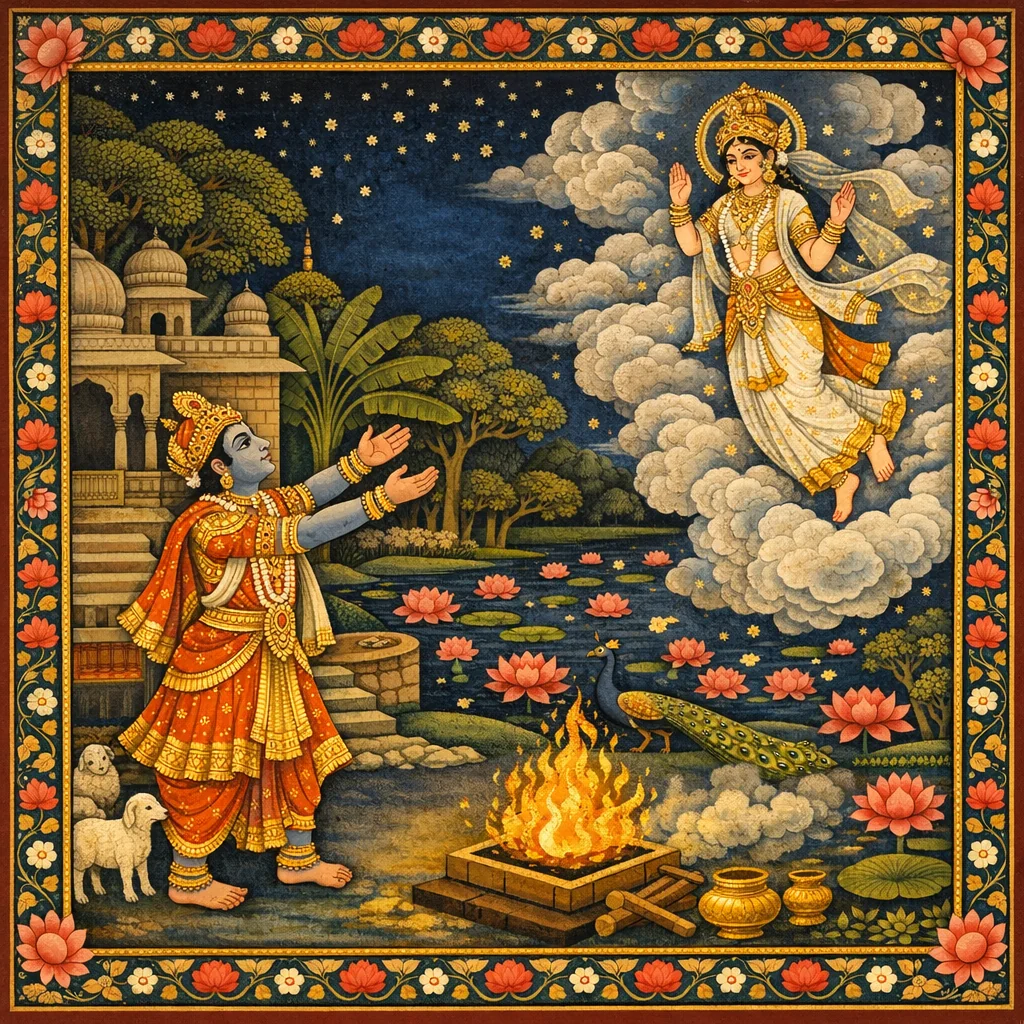
Verse 14
तस्यात्मयोनिरकृत बुध इत्यभिधां नृप । बुद्ध्या गम्भीरया येन पुत्रेणापोडुराण्मुदम् ॥ १४ ॥
O Mahārāja Parīkṣit, seeing the child’s profound intelligence, self-born Brahmā named him Budha. And Soma, lord of the stars, rejoiced greatly because of this son.
Verse 15
तत: पुरूरवा जज्ञे इलायां य उदाहृत: । तस्य रूपगुणौदार्यशीलद्रविणविक्रमान् ॥ १५ ॥ श्रुत्वोर्वशीन्द्रभवने गीयमानान् सुरर्षिणा । तदन्तिकमुपेयाय देवी स्मरशरार्दिता ॥ १६ ॥
Thereafter, from Budha, through the womb of Ilā, a son was born named Purūravā, as described at the beginning of the Ninth Canto. When Nārada sang in Lord Indra’s court of his beauty, virtues, magnanimity, conduct, wealth, and prowess, the celestial maiden Urvaśī—pierced by Cupid’s arrow—was drawn to him and approached.
Verse 16
तत: पुरूरवा जज्ञे इलायां य उदाहृत: । तस्य रूपगुणौदार्यशीलद्रविणविक्रमान् ॥ १५ ॥ श्रुत्वोर्वशीन्द्रभवने गीयमानान् सुरर्षिणा । तदन्तिकमुपेयाय देवी स्मरशरार्दिता ॥ १६ ॥
Thereafter, from Budha through the womb of Ilā, a son was born named Purūravā, spoken of at the beginning of the Ninth Canto. Hearing Nārada sing in Lord Indra’s court of his beauty, virtues, magnanimity, conduct, wealth, and might, the apsarā Urvaśī—pierced by Kāma’s arrow—was drawn to him and approached.
Verse 17
मित्रावरुणयो: शापादापन्ना नरलोकताम् । निशम्य पुरुषश्रेष्ठं कन्दर्पमिव रूपिणम् । धृतिं विष्टभ्य ललना उपतस्थे तदन्तिके ॥ १७ ॥ स तां विलोक्य नृपतिर्हर्षेणोत्फुल्ललोचन: । उवाच श्लक्ष्णया वाचा देवीं हृष्टतनूरुह: ॥ १८ ॥
Cursed by Mitra and Varuṇa, Urvaśī had taken on the ways of the human world. Seeing Purūravā—the best of men, beautiful like Kāma—she steadied herself and came near. King Purūravā, beholding her, had eyes blossoming with joy and hairs standing on end, and he addressed the goddess in gentle, pleasing words.
Verse 18
मित्रावरुणयो: शापादापन्ना नरलोकताम् । निशम्य पुरुषश्रेष्ठं कन्दर्पमिव रूपिणम् । धृतिं विष्टभ्य ललना उपतस्थे तदन्तिके ॥ १७ ॥ स तां विलोक्य नृपतिर्हर्षेणोत्फुल्ललोचन: । उवाच श्लक्ष्णया वाचा देवीं हृष्टतनूरुह: ॥ १८ ॥
Cursed by Mitra and Varuṇa, Urvaśī had taken on the ways of the human world. Seeing Purūravā—the best of men, beautiful like Kāma—she steadied herself and came near. King Purūravā, beholding her, had eyes blossoming with joy and hairs standing on end, and he addressed the goddess in gentle, pleasing words.
Verse 19
श्रीराजोवाच स्वागतं ते वरारोहे आस्यतां करवाम किम् । संरमस्व मया साकं रतिर्नौ शाश्वती: समा: ॥ १९ ॥
King Purūravā said: “Welcome, O most beautiful lady; please sit here. What may I do for you? Delight with me; may our rati—our loving union—endure for many years.”
Verse 20
उर्वश्युवाच कस्यास्त्वयि न सज्जेत मनो दृष्टिश्च सुन्दर । यदङ्गान्तरमासाद्य च्यवते ह रिरंसया ॥ २० ॥
Urvaśī replied: “O handsome one, what woman’s mind and gaze would not cling to you? When she takes shelter upon your chest, she surely yields, stirred by the longing to taste loving union.”
Verse 21
एतावुरणकौ राजन् न्यासौ रक्षस्व मानद । संरंस्ये भवता साकं श्लाघ्य: स्त्रीणां वर: स्मृत: ॥ २१ ॥
O King Purūravā, protect these two lambs that have fallen down with me, O bestower of honor. Though I am of the heavenly realms and you are of the earth, I shall surely enjoy conjugal union with you. I have no objection to accepting you as my husband, for you are superior in every way.
Verse 22
घृतं मे वीर भक्ष्यं स्यान्नेक्षे त्वान्यत्र मैथुनात् । विवाससं तत् तथेति प्रतिपेदे महामना: ॥ २२ ॥
Urvaśī said, “O hero, only foods prepared in ghee shall be my fare, and I do not wish to see you naked at any time, except during conjugal union.” The great-minded King Purūravā accepted these conditions, saying, “So be it.”
Verse 23
अहो रूपमहो भावो नरलोकविमोहनम् । को न सेवेत मनुजो देवीं त्वां स्वयमागताम् ॥ २३ ॥
Purūravā replied, “Ah, how wondrous is your beauty, and wondrous too are your gestures; you enchant the whole world of men. Therefore, since you have come of your own accord from the heavenly realms, who on earth would not consent to serve a goddess such as you?”
Verse 24
तया स पुरुषश्रेष्ठो रमयन्त्या यथार्हत: । रेमे सुरविहारेषु कामं चैत्ररथादिषु ॥ २४ ॥
Śukadeva Gosvāmī continued: Purūravā, the best of men, began to enjoy Urvaśī’s company freely as she delighted him in a fitting way, in the celestial pleasure-grounds of the devas—such as Caitraratha and Nandana-kānana—where the gods sport.
Verse 25
रममाणस्तया देव्या पद्मकिञ्जल्कगन्धया । तन्मुखामोदमुषितो मुमुदेऽहर्गणान् बहून् ॥ २५ ॥
Urvaśī’s body was fragrant like the saffron of a lotus. Enlivened and captivated by the perfume of her face and limbs, Purūravā rejoiced and enjoyed her company for many days in great jubilation.
Verse 26
अपश्यन्नुर्वशीमिन्द्रो गन्धर्वान् समचोदयत् । उर्वशीरहितं मह्यमास्थानं नातिशोभते ॥ २६ ॥
Not seeing Urvaśī in his celestial assembly, Lord Indra urged the Gandharvas: “Without Urvaśī my court no longer shines; bring her back to Svarga at once.”
Verse 27
ते उपेत्य महारात्रे तमसि प्रत्युपस्थिते । उर्वश्या उरणौ जह्रुर्न्यस्तौ राजनि जायया ॥ २७ ॥
The Gandharvas came down to earth, and at midnight, when darkness prevailed, they appeared in Purūravā’s house and stole the two lambs Urvaśī had entrusted to the king.
Verse 28
निशम्याक्रन्दितं देवी पुत्रयोर्नीयमानयो: । हतास्म्यहं कुनाथेन नपुंसा वीरमानिना ॥ २८ ॥
Urvaśī loved the two lambs as her own sons. Hearing their cries as they were carried off, she rebuked her husband: “I am undone under the protection of an unworthy spouse—thinking himself a hero, yet truly fearful and powerless!”
Verse 29
यद्विश्रम्भादहं नष्टा हृतापत्या च दस्युभि: । य: शेते निशि सन्त्रस्तो यथा नारी दिवा पुमान् ॥ २९ ॥
“Trusting in him, I am ruined—plunderers have taken my two ‘sons,’ those lambs. At night he lies in fear like a woman, though by day he appears a man.”
Verse 30
इति वाक्सायकैर्बिद्ध: प्रतोत्त्रैरिव कुञ्जर: । निशि निस्त्रिंशमादाय विवस्त्रोऽभ्यद्रवद् रुषा ॥ ३० ॥
Pierced by Urvaśī’s word-arrows, Purūravā—like an elephant goaded by a sharp driver’s rod—flared with wrath. In the night he seized his sword and, scarcely clothed, ran out to pursue the Gandharvas who had stolen the lambs.
Verse 31
ते विसृज्योरणौ तत्र व्यद्योतन्त स्म विद्युत: । आदाय मेषावायान्तं नग्नमैक्षत सा पतिम् ॥ ३१ ॥
After releasing the two lambs, the Gandharvas blazed like lightning, flooding Purūravā’s house with light. Urvaśī then saw her husband returning with the lambs in hand, yet naked, and therefore she departed from him.
Verse 32
ऐलोऽपि शयने जायामपश्यन् विमना इव । तच्चित्तो विह्वल: शोचन् बभ्रामोन्मत्तवन्महीम् ॥ ३२ ॥
Seeing his wife no longer upon the bed, Aila Purūravā became utterly despondent. His mind, bound by attachment to her, was thrown into turmoil; lamenting, he wandered the earth like a madman.
Verse 33
स तां वीक्ष्य कुरुक्षेत्रे सरस्वत्यां च तत्सखी: । पञ्च प्रहृष्टवदन: प्राह सूक्तं पुरूरवा: ॥ ३३ ॥
While wandering the world, Purūravā beheld Urvaśī at Kurukṣetra, upon the bank of the Sarasvatī, accompanied by five companions. His face bright with joy, he addressed her with sweet words.
Verse 34
अहो जाये तिष्ठ तिष्ठ घोरे न त्यक्तुमर्हसि । मां त्वमद्याप्यनिर्वृत्य वचांसि कृणवावहै ॥ ३४ ॥
Alas, my wife—stay, stay! O cruel one, you should not abandon me. I know that until now I have not made you happy; yet for that reason it is not fitting for you to forsake me. Even if you have resolved to leave my company, let us still speak for a little while.
Verse 35
सुदेहोऽयं पतत्यत्र देवि दूरं हृतस्त्वया । खादन्त्येनं वृका गृध्रास्त्वत्प्रसादस्य नास्पदम् ॥ ३५ ॥
O goddess, since you have refused me, this fair body will fall here. Unfit for your favor, it will be devoured by jackals and vultures.
Verse 36
उर्वश्युवाच मा मृथा: पुरुषोऽसि त्वं मा स्म त्वाद्युर्वृका इमे । क्वापि सख्यं न वै स्त्रीणां वृकाणां हृदयं यथा ॥ ३६ ॥
Urvaśī said: My dear King, you are a man, a hero. Don’t be impatient and give up your life. Be sober and don’t allow the senses to overcome you like foxes. Don’t let the foxes eat you. In other words, you should not be controlled by your senses. Rather, you should know that the heart of a woman is like that of a fox. There is no use making friendship with women.
Verse 37
स्त्रियो ह्यकरुणा: क्रूरा दुर्मर्षा: प्रियसाहसा: । घ्नन्त्यल्पार्थेऽपि विश्रब्धं पतिं भ्रातरमप्युत ॥ ३७ ॥
Women as a class are merciless and cunning. They cannot tolerate even a slight offense. For their own pleasure they can do anything irreligious, and therefore they do not fear killing even a faithful husband or brother.
Verse 38
विधायालीकविश्रम्भमज्ञेषु त्यक्तसौहृदा: । नवं नवमभीप्सन्त्य: पुंश्चल्य: स्वैरवृत्तय: ॥ ३८ ॥
Women are very easily seduced by men. Therefore, polluted women give up the friendship of a man who is their well-wisher and establish false friendship among fools. Indeed, they seek newer and newer friends, one after another.
Verse 39
संवत्सरान्ते हि भवानेकरात्रं मयेश्वर: । रंस्यत्यपत्यानि च ते भविष्यन्त्यपराणि भो: ॥ ३९ ॥
O my dear King, you will be able to enjoy with me as my husband at the end of every year, for one night only. In this way you will have other children, one after another.
Verse 40
अन्तर्वत्नीमुपालक्ष्य देवीं स प्रययौ पुरीम् । पुनस्तत्र गतोऽब्दान्ते उर्वशीं वीरमातरम् ॥ ४० ॥
Understanding that Urvasi was pregnant, Pururava returned to his palace. At the end of the year, there at Kuruksetra, he again obtained the association of Urvasi, who was then the mother of a heroic son.
Verse 41
उपलभ्य मुदा युक्त: समुवास तया निशाम् । अथैनमुर्वशी प्राह कृपणं विरहातुरम् ॥ ४१ ॥
At the end of the year, having regained Urvaśī, King Purūravā rejoiced greatly and spent one night with her in loving union. Yet, fearing separation, he became sorrowful and tormented by longing; then Urvaśī spoke to him as follows.
Verse 42
गन्धर्वानुपधावेमांस्तुभ्यं दास्यन्ति मामिति । तस्य संस्तुवतस्तुष्टा अग्निस्थालीं ददुर्नृप । उर्वशीं मन्यमानस्तां सोऽबुध्यत चरन् वने ॥ ४२ ॥
Urvaśī said, “O King, seek the shelter of the Gandharvas; they will be able to give me to you again.” The King pleased the Gandharvas with prayers, and, satisfied, they gave him a maiden named Agnisthālī who looked just like Urvaśī. Thinking her to be Urvaśī, he walked with her in the forest, but later understood she was not Urvaśī, but Agnisthālī.
Verse 43
स्थालीं न्यस्य वने गत्वा गृहानाध्यायतो निशि । त्रेतायां सम्प्रवृत्तायां मनसि त्रय्यवर्तत ॥ ४३ ॥
King Purūravā left Agnisthālī in the forest and returned home, where he meditated on Urvaśī throughout the night. As his meditation continued, the Tretā age began, and thus the principles of the three Vedas—along with the rites of yajña for attaining karmic fruits—arose within his heart.
Verse 44
स्थालीस्थानं गतोऽश्वत्थं शमीगर्भं विलक्ष्य स: । तेन द्वे अरणी कृत्वा उर्वशीलोककाम्यया ॥ ४४ ॥ उर्वशीं मन्त्रतो ध्यायन्नधरारणिमुत्तराम् । आत्मानमुभयोर्मध्ये यत् तत् प्रजननं प्रभु: ॥ ४५ ॥
When the rite of fruitive yajña awakened within his heart, King Purūravā went to the very place where he had left Agnisthālī. There he saw an aśvattha tree grown from within a śamī tree. Longing to reach the realm where Urvaśī dwelt, he took that wood and fashioned two araṇis. Chanting mantras, he meditated on the lower araṇi as Urvaśī, the upper as himself, and the piece between them as his son, and thus kindled the sacred fire.
Verse 45
स्थालीस्थानं गतोऽश्वत्थं शमीगर्भं विलक्ष्य स: । तेन द्वे अरणी कृत्वा उर्वशीलोककाम्यया ॥ ४४ ॥ उर्वशीं मन्त्रतो ध्यायन्नधरारणिमुत्तराम् । आत्मानमुभयोर्मध्ये यत् तत् प्रजननं प्रभु: ॥ ४५ ॥
When the fruitive yajña rite became manifest within him, King Purūravā returned to the place where he had left Agnisthālī and saw an aśvattha tree grown from within a śamī. Desiring to reach Urvaśī’s realm, he made two araṇis from that wood; chanting mantras, he meditated on the lower as Urvaśī, the upper as himself, and the piece between as his son, and thus kindled the sacred fire.
Verse 46
तस्य निर्मन्थनाज्जातो जातवेदा विभावसु: । त्रय्या स विद्यया राज्ञा पुत्रत्वे कल्पितस्त्रिवृत् ॥ ४६ ॥
From Purūravā’s churning of the araṇis arose the sacred fire, Jātavedā Vibhāvasu. Through the Trayi-vidyā embodied in the praṇava a‑u‑m, that fire grants success in worldly enjoyment and brings purification in conception, initiation, and the performance of yajña; therefore the king regarded the fire as his son.
Verse 47
तेनायजत यज्ञेशं भगवन्तमधोक्षजम् । उर्वशीलोकमन् विच्छन्सर्वदेवमयं हरिम् ॥ ४७ ॥
By that fire, Purūravā—longing to reach the realm where Urvaśī dwelt—performed a yajña and satisfied Bhagavān Adhokṣaja, Śrī Hari, the enjoyer of all sacrificial results, beyond the senses and the very reservoir of all the devas.
Verse 48
एक एव पुरा वेद: प्रणव: सर्ववाङ्मय: । देवो नारायणो नान्य एकोऽग्निर्वर्ण एव च ॥ ४८ ॥
In the ancient Satya-yuga, all Vedic mantras were contained in a single mantra—the praṇava (oṁ), the root of all sacred speech. The only worshipable Deity was Nārāyaṇa; no worship of other devas was enjoined. Fire was one alone, and human society knew but one order of life, called haṁsa.
Verse 49
पुरूरवस एवासीत् त्रयी त्रेतामुखे नृप । अग्निना प्रजया राजा लोकं गान्धर्वमेयिवान् ॥ ४९ ॥
O Mahārāja Parīkṣit, at the dawn of Tretā-yuga the Trayi—karma-kāṇḍa worship—was set in motion by Purūravā himself. Considering the sacrificial fire his son, the king established the yajña tradition and, with his subjects, attained Gandharvaloka as he desired.
Frequently Asked Questions
Soma’s abduction of Tārā follows his conquest and Rājasūya, which intensify false pride (mada). The Bhāgavata frames this as the ruinous effect of ego even in exalted beings: adharma in private conduct can ignite public catastrophe (a Deva–Asura war). The corrective intervention of Brahmā shows that cosmic order is restored through higher authority and truth, and that prestige or power cannot override dharma—especially regarding another’s spouse and the sanctity of guru relationships.
Budha is the son born from Tārā, later acknowledged as Soma’s child. The tension highlights the dharmic necessity of satya (truth) over shame and social concealment. Brahmā’s role in naming Budha underscores legitimization by higher wisdom, while the dispute between Soma and Bṛhaspati warns that possessiveness and rivalry—even among authorities—must submit to factual truth and cosmic adjudication.
Their separation dramatizes kāma’s instability and the psychological consequences of attachment. Urvaśī’s instruction about women’s ‘fox-like’ heart is not presented as a blanket metaphysics of gender but as a narrative device urging sobriety: do not let senses devour the self. The episode functions as vaṁśānucarita—teaching rulers and listeners that uncontrolled desire leads to humiliation, grief, and wandering, whereas regulated conduct and higher pursuit can redirect life toward dharma.
After failing to regain Urvaśī through ordinary means, Purūravā’s intense meditation coincides with the onset of Tretā-yuga, when Vedic ritual differentiation becomes manifest. He generates sacrificial fire through araṇis and performs yajña to satisfy Hari, the yajña-bhoktā. The text contrasts Satya-yuga’s unified praṇava-centric worship with Tretā’s expanded ritual system, showing yajña as a divinely sanctioned method for purification and regulated enjoyment—meant ultimately to please the Supreme Lord, not to inflate ego.