Adhyaya 5
Raivata and Cākṣuṣa Manvantaras; Brahmā’s Prayers at Śvetadvīpa (Prelude to Samudra-manthana)
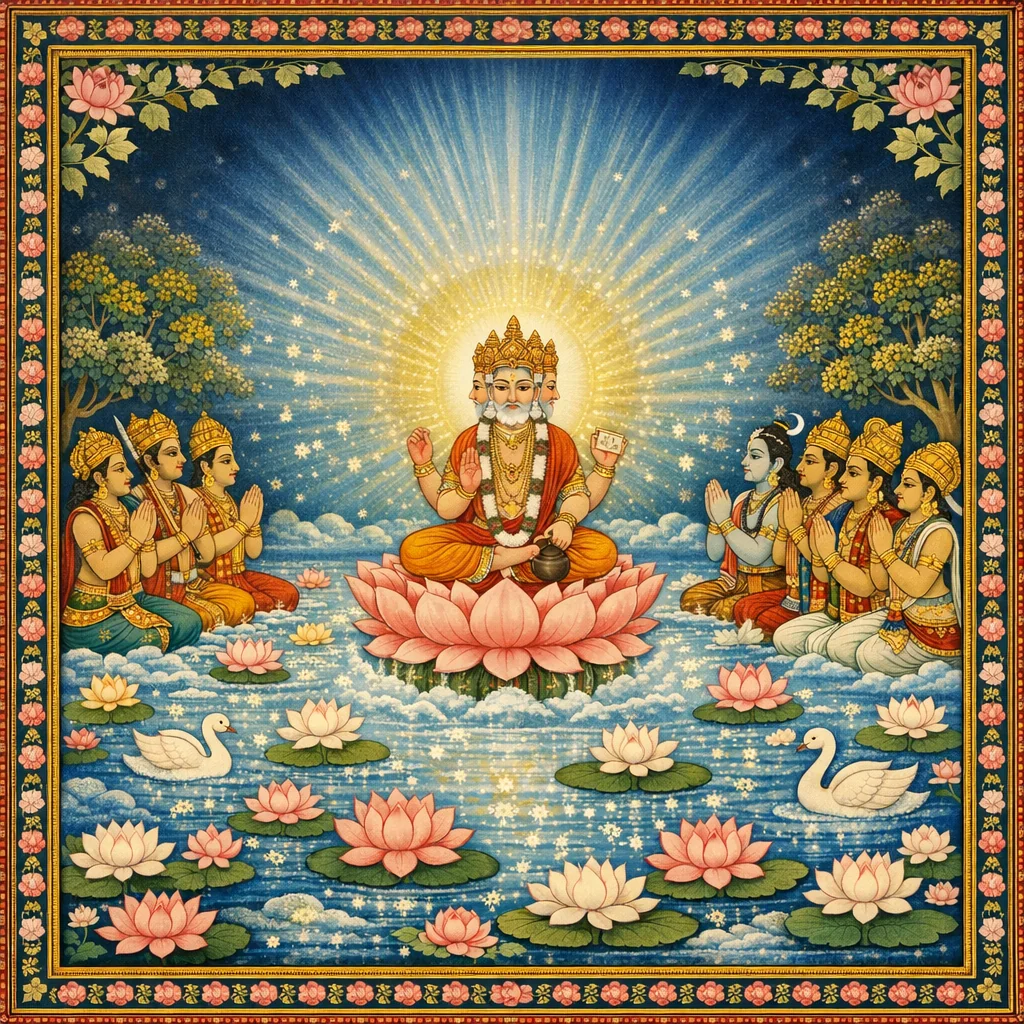
Śukadeva links the earlier account of Gajendra’s deliverance (Gajendra-mokṣaṇa) to the broader manvantara timeline, first describing the fifth Manu, Raivata—his sons, the Indra Vibhu, the deva host Bhūtarayas, and the saptarṣis. In that manvantara the Lord appears as Vaikuṇṭha from Śubhra and Vikuṇṭhā, and at Lakṣmī’s request manifests an additional Vaikuṇṭha planet, revealing His immeasurable glories. The narration then moves to the sixth Manu, Cākṣuṣa, naming his sons, the Indra Mantradruma, the devas Āpyas, and sages such as Haviṣmān and Vīraka. The Lord appears as Ajita, who will later enable the churning of the Ocean of Milk and support Mandara as Kūrma. Parīkṣit’s eager question bridges into the next unit: why the devas became powerless (Durvāsā’s curse, loss of prosperity and yajña), their appeal to Brahmā on Sumeru, and Brahmā’s guidance to seek Viṣṇu at Śvetadvīpa. The chapter culminates in Brahmā’s Vedic prayers, praising the Lord as transcendent, all-pervading Paramātmā, source of cosmic functions, and the ultimate shelter—laying the theological and plot foundation for the Samudra-manthana to follow.
Shlokas
Verse 1
श्रीशुक उवाच राजन्नुदितमेतत् ते हरे: कर्माघनाशनम् । गजेन्द्रमोक्षणं पुण्यं रैवतं त्वन्तरं शृणु ॥ १ ॥
Śukadeva Gosvāmī continued: O King, I have described to you the supremely pious narration of Gajendra’s deliverance, a deed of Hari that destroys sin. By hearing such pastimes of the Lord, all sinful reactions are dispelled. Now hear as I describe the manvantara of Raivata Manu.
Verse 2
पञ्चमो रैवतो नाम मनुस्तामससोदर: । बलिविन्ध्यादयस्तस्य सुता हार्जुनपूर्वका: ॥ २ ॥
The fifth Manu was named Raivata, the brother of Tāmasa Manu. His sons were led by Hārjuna, along with Arjuna, Bali, Vindhya, and others.
Verse 3
विभुरिन्द्र: सुरगणा राजन्भूतरयादय: । हिरण्यरोमा वेदशिरा ऊर्ध्वबाह्वादयो द्विजा: ॥ ३ ॥
O King, in the manvantara of Raivata Manu, the king of heaven (Indra) was known as Vibhu. Among the devas were the Bhūtarayas and others, and among the seven brāhmaṇas presiding over the seven worlds were Hiraṇyaromā, Vedaśirā, Ūrdhvabāhu, and the rest.
Verse 4
पत्नी विकुण्ठा शुभ्रस्य वैकुण्ठै: सुरसत्तमै: । तयो: स्वकलया जज्ञे वैकुण्ठो भगवान्स्वयम् ॥ ४ ॥
From the union of Śubhra and his wife Vikuṇṭhā, Bhagavān Vaikuṇṭha Himself appeared, accompanied by the most exalted devas who were His personal plenary expansions.
Verse 5
वैकुण्ठ: कल्पितो येन लोको लोकनमस्कृत: । रमया प्रार्थ्यमानेन देव्या तत्प्रियकाम्यया ॥ ५ ॥
To please the goddess Ramā, the goddess of fortune, Bhagavān Vaikuṇṭha, at her request, created another Vaikuṇṭha realm, worshiped and revered by all.
Verse 6
तस्यानुभाव: कथितो गुणाश्च परमोदया: । भौमान्रेणून्स विममे यो विष्णोर्वर्णयेद् गुणान् ॥ ६ ॥
Though the Lord’s mighty deeds and supremely gracious, transcendental qualities are spoken of in wondrous ways, we sometimes cannot fully grasp them; yet for Lord Viṣṇu everything is possible. Only one who could count the atoms of the universe could count the Lord’s qualities—but no one can do either.
Verse 7
षष्ठश्च चक्षुष: पुत्रश्चाक्षुषो नाम वै मनु: । पूरुपूरुषसुद्युम्नप्रमुखाश्चाक्षुषात्मजा: ॥ ७ ॥
Cākṣuṣa, the son of Cakṣu, was the sixth Manu. He had many sons, headed by Pūru, Pūruṣa, and Sudyumna.
Verse 8
इन्द्रो मन्त्रद्रुमस्तत्र देवा आप्यादयो गणा: । मुनयस्तत्र वै राजन्हविष्मद्वीरकादय: ॥ ८ ॥
During the reign of Cākṣuṣa Manu, the king of heaven, Indra, was known as Mantradruma. Among the devas were the Āpyas, and among the great sages were Haviṣmān and Vīraka, O King.
Verse 9
तत्रापि देवसम्भूत्यां वैराजस्याभवत् सुत: । अजितो नाम भगवानंशेन जगत: पति: ॥ ९ ॥
In this sixth manvantara, Lord Viṣṇu, the master of the universe, appeared as a partial expansion. Begotten by Vairāja in the womb of his wife Devasambhūti, He was known as Ajita, the unconquerable Lord.
Verse 10
पयोधिं येन निर्मथ्य सुराणां साधिता सुधा । भ्रममाणोऽम्भसि धृत: कूर्मरूपेण मन्दर: ॥ १० ॥
By churning the Ocean of Milk, Ajita brought forth nectar for the devas. Assuming the form of a tortoise, He moved within the waters, bearing the great Mandara Mountain upon His back.
Verse 11
श्रीराजोवाच यथा भगवता ब्रह्मन्मथित: क्षीरसागर: । यदर्थं वा यतश्चाद्रिं दधाराम्बुचरात्मना ॥ ११ ॥ यथामृतं सुरै: प्राप्तं किं चान्यदभवत् तत: । एतद् भगवत: कर्म वदस्व परमाद्भुतम् ॥ १२ ॥
King Parīkṣit inquired: O great brāhmaṇa, how and for what purpose did the Lord churn the Ocean of Milk? Why did He remain in the waters as a tortoise and uphold Mandara Mountain? How did the devas obtain the nectar, and what else arose from that churning? Please describe these supremely wondrous deeds of the Lord.
Verse 12
श्रीराजोवाच यथा भगवता ब्रह्मन्मथित: क्षीरसागर: । यदर्थं वा यतश्चाद्रिं दधाराम्बुचरात्मना ॥ ११ ॥ यथामृतं सुरै: प्राप्तं किं चान्यदभवत् तत: । एतद् भगवत: कर्म वदस्व परमाद्भुतम् ॥ १२ ॥
King Parīkṣit inquired: O great brāhmaṇa, how and for what purpose did the Lord churn the Ocean of Milk? Why did He remain in the waters as a tortoise and uphold Mandara Mountain? How did the devas obtain the nectar, and what else arose from that churning? Please describe these supremely wondrous deeds of the Lord.
Verse 13
त्वया सङ्कथ्यमानेन महिम्ना सात्वतां पते: । नातितृप्यति मे चित्तं सुचिरं तापतापितम् ॥ १३ ॥
Even as you recount the glory of the Lord, the master of the devotees, my heart—long troubled by the threefold miseries of material life—still does not feel satiated by hearing.
Verse 14
श्रीसूत उवाच सम्पृष्टो भगवानेवं द्वैपायनसुतो द्विजा: । अभिनन्द्य हरेर्वीर्यमभ्याचष्टुं प्रचक्रमे ॥ १४ ॥
Śrī Sūta said: O learned brāhmaṇas gathered at Naimiṣāraṇya, when Bhagavān Śukadeva Gosvāmī, the son of Dvaipāyana, was thus questioned by the King, he praised the King and then began to further describe the glories of Śrī Hari, the Supreme Personality of Godhead.
Verse 15
श्रीशुक उवाच यदा युद्धेऽसुरैर्देवा बध्यमाना: शितायुधै: । गतासवो निपतिता नोत्तिष्ठेरन्स्म भूरिश: ॥ १५ ॥ यदा दुर्वास: शापेन सेन्द्रा लोकास्त्रयो नृप । नि:श्रीकाश्चाभवंस्तत्र नेशुरिज्यादय: क्रिया: ॥ १६ ॥
Śrī Śukadeva said: When, in battle, the asuras grievously struck the demigods with sharp weapons, many demigods fell lifeless and could not rise again. At that time, O King, because of Durvāsā Muni’s curse, the three worlds with Indra became bereft of prosperity and splendor; thus yajñas and other Vedic rites could not be performed, and the consequences were most severe.
Verse 16
श्रीशुक उवाच यदा युद्धेऽसुरैर्देवा बध्यमाना: शितायुधै: । गतासवो निपतिता नोत्तिष्ठेरन्स्म भूरिश: ॥ १५ ॥ यदा दुर्वास: शापेन सेन्द्रा लोकास्त्रयो नृप । नि:श्रीकाश्चाभवंस्तत्र नेशुरिज्यादय: क्रिया: ॥ १६ ॥
Śrī Śukadeva said: When, in battle, the asuras grievously struck the demigods with sharp weapons, many demigods fell lifeless and could not rise again. At that time, O King, because of Durvāsā Muni’s curse, the three worlds with Indra became bereft of prosperity and splendor; thus yajñas and other Vedic rites could not be performed, and the consequences were most severe.
Verse 17
निशाम्यैतत् सुरगणा महेन्द्रवरुणादय: । नाध्यगच्छन्स्वयं मन्त्रैर्मन्त्रयन्तो विनिश्चितम् ॥ १७ ॥ ततो ब्रह्मसभां जग्मुर्मेरोर्मूर्धनि सर्वश: । सर्वं विज्ञापयां चक्रु: प्रणता: परमेष्ठिने ॥ १८ ॥
Śrī Śukadeva said: Seeing their plight, Indra, Varuṇa, and the other demigods consulted among themselves, yet by their own deliberation they could reach no certain solution. Then all the demigods assembled and went together to the summit of Mount Sumeru, to Lord Brahmā’s court; there they bowed down to Paramēṣṭhī Brahmā and informed him of everything that had occurred.
Verse 18
निशाम्यैतत् सुरगणा महेन्द्रवरुणादय: । नाध्यगच्छन्स्वयं मन्त्रैर्मन्त्रयन्तो विनिश्चितम् ॥ १७ ॥ ततो ब्रह्मसभां जग्मुर्मेरोर्मूर्धनि सर्वश: । सर्वं विज्ञापयां चक्रु: प्रणता: परमेष्ठिने ॥ १८ ॥
Śrī Śukadeva said: Seeing their plight, Indra, Varuṇa, and the other demigods consulted among themselves, yet by their own deliberation they could reach no certain solution. Then all the demigods assembled and went together to the summit of Mount Sumeru, to Lord Brahmā’s court; there they bowed down to Paramēṣṭhī Brahmā and informed him of everything that had occurred.
Verse 19
स विलोक्येन्द्रवाय्वादीन् नि:सत्त्वान्विगतप्रभान् । लोकानमङ्गलप्रायानसुरानयथा विभु: ॥ १९ ॥ समाहितेन मनसा संस्मरन्पुरुषं परम् । उवाचोत्फुल्लवदनो देवान्स भगवान्पर: ॥ २० ॥
Seeing Indra, Vāyu, and the other devas bereft of strength and splendor, the three worlds nearly stripped of auspiciousness, and the asuras flourishing while the devas were distressed, mighty Brahmā—above the demigods—fixed his mind in deep composure and remembered the Supreme Puruṣa, the Lord Bhagavān. His face then blossomed with hope, and he spoke to the devas.
Verse 20
स विलोक्येन्द्रवाय्वादीन् नि:सत्त्वान्विगतप्रभान् । लोकानमङ्गलप्रायानसुरानयथा विभु: ॥ १९ ॥ समाहितेन मनसा संस्मरन्पुरुषं परम् । उवाचोत्फुल्लवदनो देवान्स भगवान्पर: ॥ २० ॥
With his mind fully composed, Brahmā remembered the Supreme Puruṣa. His face brightened, and he said to the devas, “Hear my words.”
Verse 21
अहं भवो यूयमथोऽसुरादयो मनुष्यतिर्यग्द्रुमघर्मजातय: । यस्यावतारांशकलाविसर्जिता व्रजाम सर्वे शरणं तमव्ययम् ॥ २१ ॥
Brahmā said: I, Bhava (Śiva), all of you devas, the asuras, human beings, animals, trees and plants, and all creatures born of sweat, of eggs, and of the womb—every one of us is manifested from the portions and expansions of the avatāras of that imperishable Supreme Lord. Therefore let us all go and take shelter of Him.
Verse 22
न यस्य वध्यो न च रक्षणीयो नोपेक्षणीयादरणीयपक्ष: । तथापि सर्गस्थितिसंयमार्थं धत्ते रज:सत्त्वतमांसि काले ॥ २२ ॥
For the Supreme Personality of Godhead there is none to be slain, none to be protected, none to be neglected, and no side to be favored as an object of worship. Yet, for the work of creation, maintenance, and dissolution in due course of time, He accepts the guṇas—rajas, sattva, and tamas—and manifests in various forms.
Verse 23
अयं च तस्य स्थितिपालनक्षण: सत्त्वं जुषाणस्य भवाय देहिनाम् । तस्माद् व्रजाम: शरणं जगद्गुरुं स्वानां स नो धास्यति शं सुरप्रिय: ॥ २३ ॥
Now is the time for sattva, the mode of goodness, for the welfare of embodied beings; embracing sattva, the Lord upholds the world through protection and steady maintenance. Therefore let us take shelter of the Jagad-guru, the Supreme Personality of Godhead; beloved of the devas, He will surely bestow auspiciousness upon us.
Verse 24
श्रीशुक उवाच इत्याभाष्य सुरान्वेधा: सह देवैररिन्दम । अजितस्य पदं साक्षाज्जगाम तमस: परम् ॥ २४ ॥
Śrī Śuka said: O Parīkṣit, subduer of foes, having thus addressed the demigods, Brahmā went with them to the abode of Ajita, the Supreme Personality of Godhead, beyond the darkness of the material world.
Verse 25
तत्रादृष्टस्वरूपाय श्रुतपूर्वाय वै प्रभु: । स्तुतिमब्रूत दैवीभिर्गीर्भिस्त्ववहितेन्द्रिय: ॥ २५ ॥
There, though he had never seen the Lord’s form, Brahmā—having heard of Him through the Vedas—controlled his senses and offered prayers in divine, Veda-sanctioned words.
Verse 26
श्रीब्रह्मोवाच अविक्रियं सत्यमनन्तमाद्यं गुहाशयं निष्कलमप्रतर्क्यम् । मनोऽग्रयानं वचसानिरुक्तं नमामहे देववरं वरेण्यम् ॥ २६ ॥
Lord Brahmā said: O Supreme Lord—unchanging, true, limitless, and primeval—You dwell within the cave of the heart, stainless and inconceivable. The mind cannot reach You, nor can words define You. O best of the gods, most worshipable, we offer You our respectful obeisances.
Verse 27
विपश्चितं प्राणमनोधियात्मना- मर्थेन्द्रियाभासमनिद्रमव्रणम् । छायातपौ यत्र न गृध्रपक्षौ तमक्षरं खं त्रियुगं व्रजामहे ॥ २७ ॥
Therefore we take shelter of the lotus feet of the Supreme Lord—imperishable, all-pervading like the sky, and manifesting His majesty in three yugas. He knows, directly and indirectly, the workings of prāṇa, mind, and intelligence; He illumines all, never sleeps, is spotless, and bears no shadow of bias or heat of duality.
Verse 28
अजस्य चक्रं त्वजयेर्यमाणं मनोमयं पञ्चदशारमाशु । त्रिनाभि विद्युच्चलमष्टनेमि यदक्षमाहुस्तमृतं प्रपद्ये ॥ २८ ॥
Within the cycle of material action, this body is like the wheel of a chariot made of mind: the ten senses and five life-airs are its fifteen spokes; the three guṇas its hub; the eight elements of nature its rim; and the external māyā drives it swiftly like electricity. Its axle is the Paramātmā—Ajita, the ultimate Truth; to that immortal Lord we surrender.
Verse 29
य एकवर्णं तमस: परं त- दलोकमव्यक्तमनन्तपारम् । आसांचकारोपसुपर्णमेन- मुपासते योगरथेन धीरा: ॥ २९ ॥
The Supreme Lord abides in pure goodness (śuddha-sattva) and is therefore eka-varṇa—the praṇava, Oṁ. Beyond the cosmic manifestation deemed darkness, He is unmanifest and without limit; not separated by time or space, He is present everywhere. Seated upon Garuḍa, He is worshiped by steady yogīs through mystic yoga-power. Unto Him we offer our reverent obeisances.
Verse 30
न यस्य कश्चातितितर्ति मायां यया जनो मुह्यति वेद नार्थम् । तं निर्जितात्मात्मगुणं परेशं नमाम भूतेषु समं चरन्तम् ॥ ३० ॥
No one can cross beyond His māyā, so potent that it bewilders all and obscures life’s true aim. Yet that very māyā is subdued by the Supreme Lord—self-conquered, ruler of all, and equal toward every living being, present impartially within all. Unto Him we offer our obeisances.
Verse 31
इमे वयं यत्प्रिययैव तन्वा सत्त्वेन सृष्टा बहिरन्तरावि: । गतिं न सूक्ष्मामृषयश्च विद्महे कुतोऽसुराद्या इतरप्रधाना: ॥ ३१ ॥
We demigods, by the will of the beloved Lord, are fashioned with sattva-filled bodies and thus stand in goodness within and without; the great sages are likewise. Yet even we do not know the Lord’s subtle course—what then of the asuras and others, whose constitutions are ruled by passion and ignorance? How could they understand Him? Unto Him we offer our respectful obeisances.
Verse 32
पादौ महीयं स्वकृतैव यस्य चतुर्विधो यत्र हि भूतसर्ग: । स वै महापूरुष आत्मतन्त्र: प्रसीदतां ब्रह्म महाविभूति: ॥ ३२ ॥
This earth rests upon His lotus feet, and by His own power the fourfold creation of living beings comes forth here. He is the great Mahāpuruṣa, self-supreme, filled with vast opulence and might. O Brahmā, may that Lord be pleased with us.
Verse 33
अम्भस्तु यद्रेत उदारवीर्यं सिध्यन्ति जीवन्त्युत वर्धमाना: । लोकायतोऽथाखिललोकपाला: प्रसीदतां न: स महाविभूति: ॥ ३३ ॥
The entire cosmos has arisen from water, and by water all beings endure, live, and grow. That water is truly the Lord’s abundant vīrya—His divine seed. Therefore may the Supreme Lord, of such great potency, be pleased with us.
Verse 34
सोमं मनो यस्य समामनन्ति दिवौकसां यो बलमन्ध आयु: । ईशो नगानां प्रजन: प्रजानां प्रसीदतां न: स महाविभूति: ॥ ३४ ॥
Soma, the moon, bestows grains, strength, and longevity upon the demigods. He is the lord of vegetation and the source of generation for all beings; the learned declare the moon to be the mind of the Supreme Lord. May that supremely opulent Personality of Godhead be pleased with us.
Verse 35
अग्निर्मुखं यस्य तु जातवेदा जात: क्रियाकाण्डनिमित्तजन्मा । अन्त:समुद्रेऽनुपचन्स्वधातून् प्रसीदतां न: स महाविभूति: ॥ ३५ ॥
Agni, Jātaveda, born to accept oblations in sacrificial rites, is the mouth of the Supreme Personality of Godhead. That same fire dwells in the ocean’s depths to bring forth wealth, and in the belly as digestive fire, transforming food into sustaining secretions. May that supremely powerful Lord be pleased with us.
Verse 36
यच्चक्षुरासीत् तरणिर्देवयानं त्रयीमयो ब्रह्मण एष धिष्ण्यम् । द्वारं च मुक्तेरमृतं च मृत्यु: प्रसीदतां न: स महाविभूति: ॥ ३६ ॥
The sun-god is the Lord’s eye. He reveals the liberating path known as arcirādi-vartma, is the chief source for understanding the Vedas, the seat of worship of the Absolute Truth, the gateway to moksha, and both the source of immortality and the cause of death. May that supremely opulent Lord be pleased with us.
Verse 37
प्राणादभूद् यस्य चराचराणां प्राण: सहो बलमोजश्च वायु: । अन्वास्म सम्राजमिवानुगा वयं प्रसीदतां न: स महाविभूति: ॥ ३७ ॥
Air (Vāyu) is the vital force, courage, strength, and vigor of all beings, moving and unmoving. The life-power of air arises from the original life-power of the Supreme Personality of Godhead. We all follow air for our very life, as servants follow an emperor. May that Supreme Lord be pleased with us.
Verse 38
श्रोत्राद् दिशो यस्य हृदश्च खानि प्रजज्ञिरे खं पुरुषस्य नाभ्या: । प्राणेन्द्रियात्मासुशरीरकेत: प्रसीदतां न: स महाविभूति: ॥ ३८ ॥
May the supremely powerful Personality of Godhead be pleased with us. The directions arise from His ears, the body’s openings from His heart, and ākāśa (ether) from His navel; and from Him also come prāṇa, the senses, the mind, the inner air of the body, and the ether that shelters the body.
Verse 39
बलान्महेन्द्रस्त्रिदशा: प्रसादा- न्मन्योर्गिरीशो धिषणाद् विरिञ्च: । खेम्यस्तुछन्दांस्यृषयो मेढ्रत: क: प्रसीदतां न: स महाविभूति: ॥ ३९ ॥
From the Lord’s prowess arose Mahendra; from His mercy, the hosts of demigods; from His anger, Girīśa Śiva; and from His sober intelligence, Virinci Brahmā. From the openings of His body came forth the Vedic mantras, and from His generative organ arose the great ṛṣis and the prajāpatis. May that supremely powerful Lord be pleased with us.
Verse 40
श्रीर्वक्षस: पितरश्छाययासन् धर्म: स्तनादितर: पृष्ठतोऽभूत् । द्यौर्यस्य शीर्ष्णोऽप्सरसो विहारात् प्रसीदतां न: स महाविभूति: ॥ ४० ॥
From His chest arose Śrī Lakṣmī; from His shadow, the inhabitants of Pitṛloka; from His bosom, dharma; and from His back, adharma. From the crown of His head came the heavenly worlds, and from His enjoyment arose the Apsarās. May that supremely powerful Personality of Godhead be pleased with us.
Verse 41
विप्रो मुखाद् ब्रह्म च यस्य गुह्यं राजन्य आसीद् भुजयोर्बलं च । ऊर्वोर्विडोजोऽङ्घ्रिरवेदशूद्रौ प्रसीदतां न: स महाविभूति: ॥ ४१ ॥
From the mouth of the Supreme Personality of Godhead came the brāhmaṇas and Vedic knowledge; from His arms came the kṣatriyas and bodily strength; from His thighs came the vaiśyas and their skill in productivity and wealth; and from His feet came the śūdras, outside Vedic knowledge. May that all-powerful Lord be pleased with us.
Verse 42
लोभोऽधरात् प्रीतिरुपर्यभूद् द्युति- र्नस्त: पशव्य: स्पर्शेन काम: । भ्रुवोर्यम: पक्ष्मभवस्तु काल: प्रसीदतां न: स महाविभूति: ॥ ४२ ॥
From His lower lip arose greed; from His upper lip, affection; from His nose, bodily luster; from His sense of touch, animalistic lust. From His eyebrows arose Yamarāja, and from His eyelashes, beginningless time. May that Supreme Lord be pleased with us.
Verse 43
द्रव्यं वय: कर्म गुणान्विशेषं यद्योगमायाविहितान्वदन्ति । यद् दुर्विभाव्यं प्रबुधापबाधं प्रसीदतां न: स महाविभूति: ॥ ४३ ॥
The learned declare that the five elements, time, karma, the three guṇas of material nature, and the varieties born of those guṇas are all creations arranged by yoga-māyā. Therefore this material world is exceedingly difficult to fathom, and the most awakened sages have rejected it. May the Supreme Personality of Godhead, controller of all, be pleased with us.
Verse 44
नमोऽस्तु तस्मा उपशान्तशक्तये स्वाराज्यलाभप्रतिपूरितात्मने । गुणेषु मायारचितेषु वृत्तिभि- र्न सज्जमानाय नभस्वदूतये ॥ ४४ ॥
Obeisances unto the Bhagavān, the Supreme Personality of Godhead, whose power is perfectly pacified and who is fully satisfied by His own sovereign attainment. He never clings to the activities of the guṇas fashioned by māyā; even while enacting His līlās in this world, He remains unattached like the air.
Verse 45
स त्वं नो दर्शयात्मानमस्मत्करणगोचरम् । प्रपन्नानां दिदृक्षूणां सस्मितं ते मुखाम्बुजम् ॥ ४५ ॥
O Bhagavān, though we are surrendered to You, we long to see You. Please reveal to our eyes and senses Your original form and Your lotus face, graced with a gentle smile.
Verse 46
तैस्तै: स्वेच्छाभूतै रूपै: काले काले स्वयं विभो । कर्म दुर्विषहं यन्नो भगवांस्तत् करोति हि ॥ ४६ ॥
O Lord, O Bhagavān, by Your sweet will You appear in many forms, age after age. The wondrous deeds that are unbearable and impossible for us—You alone truly accomplish.
Verse 47
क्लेशभूर्यल्पसाराणि कर्माणि विफलानि वा । देहिनां विषयार्तानां न तथैवार्पितं त्वयि ॥ ४७ ॥
The works of karmīs, distressed by craving for sense objects, bring much hardship, little essence, and sometimes only frustration. But for devotees who have offered their lives to the Lord’s service it is not so: without excessive labor they attain great results, beyond expectation.
Verse 48
नावम: कर्मकल्पोऽपि विफलायेश्वरार्पित: । कल्पते पुरुषस्यैव स ह्यात्मा दयितो हित: ॥ ४८ ॥
Work offered to the Supreme Personality of Godhead, even in a small measure, is never in vain. Bhagavān, the supreme Father, is the dearest Self of all beings and is ever ready to act for their welfare.
Verse 49
यथा हि स्कन्धशाखानां तरोर्मूलावसेचनम् । एवमाराधनं विष्णो: सर्वेषामात्मनश्च हि ॥ ४९ ॥
As watering the root of a tree satisfies its trunk and branches, so worship of Lord Viṣṇu serves all beings, for He is the Paramātmā, the Supersoul within everyone.
Verse 50
नमस्तुभ्यमनन्ताय दुर्वितर्क्यात्मकर्मणे । निर्गुणाय गुणेशाय सत्त्वस्थाय च साम्प्रतम् ॥ ५० ॥
O Ananta Lord, I offer my obeisances unto You. Your deeds are beyond all reasoning. Though nirguṇa, You are the master of the three guṇas, and now You favor sattva. I bow to You again and again.
Frequently Asked Questions
Raivata is the fifth Manu, brother of Tāmasa Manu. His manvantara is marked by Indra named Vibhu, devas known as Bhūtarayas, and sages such as Hiraṇyaromā, Vedaśirā, and Ūrdhvabāhu. The Lord appears as Vaikuṇṭha (from Śubhra and Vikuṇṭhā), emphasizing that divine governance and transcendental abodes manifest within each cosmic administration to sustain dharma and worship.
The chapter states that the devas were afflicted by Durvāsā Muni’s curse, leading to loss of influence and prosperity across the three worlds. As a result, ritual ceremonies (yajña) could not be properly performed, producing severe downstream effects: devas weakened, asuras flourished, and cosmic auspiciousness diminished—necessitating recourse to Viṣṇu rather than relying on deva-strength alone.
Brahmā praises the Lord as changeless, all-pervading, beyond material qualities, and present in the atom and the heart. He describes prakṛti’s revolving system (senses, prāṇas, guṇas, elements) as moving around the Lord as the hub (Paramātmā), establishing Viṣṇu as the ultimate controller. Devotionally, the prayers affirm that māyā is unconquerable for conditioned beings but is fully under the Lord’s mastery, making surrender the practical and theological solution for both cosmic and personal crises.