Adhyaya 11
Kriyā-yoga, the Virāṭ-Puruṣa Mapping, and the Sun-God’s Monthly Expansions
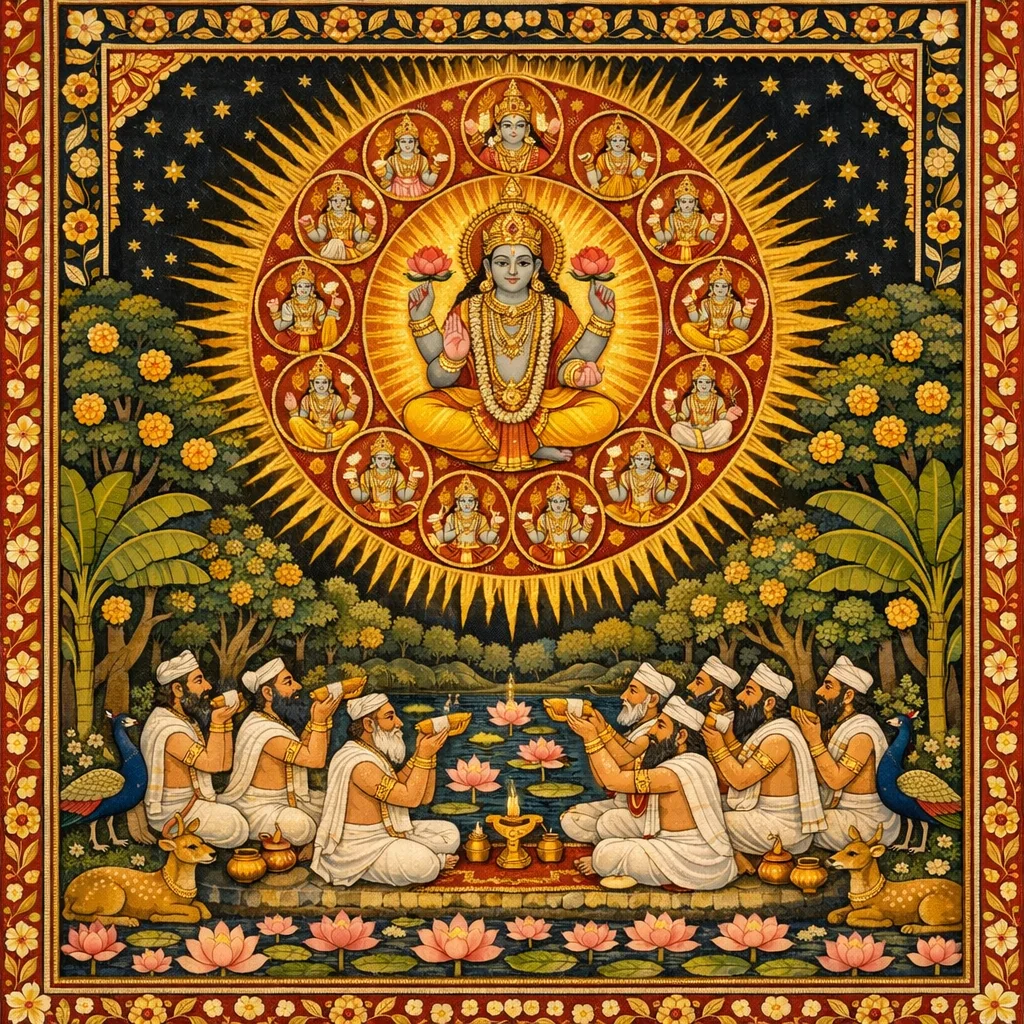
Continuing Skandha 12’s closing emphasis on practical realization, the sages at Naimiṣāraṇya ask Sūta Gosvāmī for the tantra-siddhānta: kriyā-yoga as regulated worship of Viṣṇu and the method of conceiving the Lord’s limbs, weapons, ornaments, and associates through material correspondences without reducing Him to matter. Sūta transmits an authoritative vibhūti-map beginning with the virāṭ conception—planetary systems and cosmic functions read as the Lord’s body—then moves to the emblematic theology of Viṣṇu’s adornments (Kaustubha, Śrīvatsa, garland, yellow cloth, sacred thread) and weapons (conch, disc, club, bow, etc.) as principles like elements, prāṇa, guṇas, time, and senses. The chapter then pivots: Śaunaka requests the monthly ‘sets of seven’ surrounding the sun-god; Sūta lists the sun’s twelve monthly manifestations with six associates (sage, gandharva, apsarā, nāga, yakṣa, rākṣasa), culminating in the liturgical promise that dawn-and-dusk remembrance purifies. This bridges contemplative cosmology to daily sādhana and prepares the canto’s final wrap-up by showing Hari’s governance through time and worship.
Shlokas
Verse 1
श्रीशौनक उवाच अथेममर्थं पृच्छामो भवन्तं बहुवित्तमम् । समस्ततन्त्रराद्धान्ते भवान् भागवत तत्त्ववित् ॥ १ ॥
Śrī Śaunaka said: O Sūta, you are the best of learned men and a great devotee of the Supreme Lord. Therefore we now inquire from you about the definitive conclusion of all tantra scriptures.
Verse 2
तान्त्रिका: परिचर्यायां केवलस्य श्रिय: पते: । अङ्गोपाङ्गायुधाकल्पं कल्पयन्ति यथा च यै: ॥ २ ॥ तन्नो वर्णय भद्रं ते क्रियायोगं बुभुत्सताम् । येन क्रियानैपुणेन मर्त्यो यायादमर्त्यताम् ॥ ३ ॥
All good fortune to you! Please explain to us, who are very eager to learn, the process of kriyā-yoga practiced through regulated worship of the transcendental Lord, the husband of the goddess of fortune. Please also explain how the Lord’s devotees conceive of His limbs, associates, weapons and ornaments in terms of particular material representations. By expertly worshiping the Supreme Lord, a mortal can attain immortality.
Verse 3
तान्त्रिका: परिचर्यायां केवलस्य श्रिय: पते: । अङ्गोपाङ्गायुधाकल्पं कल्पयन्ति यथा च यै: ॥ २ ॥ तन्नो वर्णय भद्रं ते क्रियायोगं बुभुत्सताम् । येन क्रियानैपुणेन मर्त्यो यायादमर्त्यताम् ॥ ३ ॥
All good fortune to you! Please explain to us, who are very eager to learn, the process of kriyā-yoga practiced through regulated worship of the transcendental Lord, the husband of the goddess of fortune. Please also explain how the Lord’s devotees conceive of His limbs, associates, weapons and ornaments in terms of particular material representations. By expertly worshiping the Supreme Lord, a mortal can attain immortality.
Verse 4
सूत उवाच नमस्कृत्य गुरून् वक्ष्ये विभूतीर्वैष्णवीरपि । या: प्रोक्ता वेदतन्त्राभ्यामाचार्यै: पद्मजादिभि: ॥ ४ ॥
Sūta Gosvāmī said: Offering obeisances to my spiritual masters, I shall repeat to you the description of the opulences of Lord Viṣṇu given in the Vedas and tantras by great authorities, beginning from lotus-born Brahmā.
Verse 5
मायाद्यैर्नवभिस्तत्त्वै: स विकारमयो विराट् । निर्मितो दृश्यते यत्र सचित्के भुवनत्रयम् ॥ ५ ॥
The universal form [virāṭ] of the Personality of Godhead includes the nine basic elements of creation, starting with the unmanifest nature, and their subsequent transformations. Once this universal form is instilled with consciousness, the three planetary systems become visible within it.
Verse 6
एतद् वै पौरुषं रूपं भू: पादौ द्यौ: शिरो नभ: । नाभि: सूर्योऽक्षिणी नासे वायु: कर्णौ दिश: प्रभो: ॥ ६ ॥ प्रजापति: प्रजननमपानो मृत्युरीशितु: । तद्बाहवो लोकपाला मनश्चन्द्रो भ्रुवौ यम: ॥ ७ ॥ लज्जोत्तरोऽधरो लोभो दन्ता ज्योत्स्ना स्मयो भ्रम: । रोमाणि भूरुहा भूम्नो मेघा: पुरुषमूर्धजा: ॥ ८ ॥
This is the representation of the Supreme Lord as the universal person, in which the earth is His feet, the sky His navel, the sun His eyes, the wind His nostrils, the demigod of procreation His genitals, death His anus and the moon His mind. The heavenly planets are His head, the directions His ears, and the demigods protecting the various planets His many arms. The god of death is His eyebrows, shame His lower lip, greed His upper lip, delusion His smile, and moonshine His teeth, while the trees are the almighty Puruṣa’s bodily hairs, and the clouds the hair on His head.
Verse 7
एतद् वै पौरुषं रूपं भू: पादौ द्यौ: शिरो नभ: । नाभि: सूर्योऽक्षिणी नासे वायु: कर्णौ दिश: प्रभो: ॥ ६ ॥ प्रजापति: प्रजननमपानो मृत्युरीशितु: । तद्बाहवो लोकपाला मनश्चन्द्रो भ्रुवौ यम: ॥ ७ ॥ लज्जोत्तरोऽधरो लोभो दन्ता ज्योत्स्ना स्मयो भ्रम: । रोमाणि भूरुहा भूम्नो मेघा: पुरुषमूर्धजा: ॥ ८ ॥
This is the representation of the Supreme Lord as the universal person, in which the earth is His feet, the sky His navel, the sun His eyes, the wind His nostrils, the demigod of procreation His genitals, death His anus and the moon His mind. The heavenly planets are His head, the directions His ears, and the demigods protecting the various planets His many arms. The god of death is His eyebrows, shame His lower lip, greed His upper lip, delusion His smile, and moonshine His teeth, while the trees are the almighty Puruṣa’s bodily hairs, and the clouds the hair on His head.
Verse 8
एतद् वै पौरुषं रूपं भू: पादौ द्यौ: शिरो नभ: । नाभि: सूर्योऽक्षिणी नासे वायु: कर्णौ दिश: प्रभो: ॥ ६ ॥ प्रजापति: प्रजननमपानो मृत्युरीशितु: । तद्बाहवो लोकपाला मनश्चन्द्रो भ्रुवौ यम: ॥ ७ ॥ लज्जोत्तरोऽधरो लोभो दन्ता ज्योत्स्ना स्मयो भ्रम: । रोमाणि भूरुहा भूम्नो मेघा: पुरुषमूर्धजा: ॥ ८ ॥
This is the representation of the Supreme Lord as the universal person, in which the earth is His feet, the sky His navel, the sun His eyes, the wind His nostrils, the demigod of procreation His genitals, death His anus and the moon His mind. The heavenly planets are His head, the directions His ears, and the demigods protecting the various planets His many arms. The god of death is His eyebrows, shame His lower lip, greed His upper lip, delusion His smile, and moonshine His teeth, while the trees are the almighty Puruṣa’s bodily hairs, and the clouds the hair on His head.
Verse 9
यावानयं वै पुरुषो यावत्या संस्थया मित: । तावानसावपि महापुरुषो लोकसंस्थया ॥ ९ ॥
Just as one can determine the dimensions of an ordinary person of this world by measuring his various limbs, one can determine the dimensions of the Mahāpuruṣa by measuring the arrangement of the planetary systems within His universal form.
Verse 10
कौस्तुभव्यपदेशेन स्वात्मज्योतिर्बिभर्त्यज: । तत्प्रभा व्यापिनी साक्षात् श्रीवत्समुरसा विभु: ॥ १० ॥
Upon His chest the almighty, unborn Personality of Godhead bears the Kaustubha gem, which represents the pure spirit soul, along with the Śrīvatsa mark, which is the direct manifestation of this gem’s expansive effulgence.
Verse 11
स्वमायां वनमालाख्यां नानागुणमयीं दधत् । वासश्छन्दोमयं पीतं ब्रह्मसूत्रं त्रिवृत् स्वरम् ॥ ११ ॥ बिभर्ति साङ्ख्यं योगं च देवो मकरकुण्डले । मौलिं पदं पारमेष्ठ्यं सर्वलोकाभयङ्करम् ॥ १२ ॥
His flower garland is His material energy, comprising various combinations of the modes of nature. His yellow garment is the Vedic meters, and His sacred thread the syllable om composed of three sounds. In the form of His two shark-shaped earrings, the Lord carries the processes of Sāṅkhya and yoga, and His crown, bestowing fearlessness on the inhabitants of all the worlds, is the supreme position of Brahmaloka.
Verse 12
स्वमायां वनमालाख्यां नानागुणमयीं दधत् । वासश्छन्दोमयं पीतं ब्रह्मसूत्रं त्रिवृत् स्वरम् ॥ ११ ॥ बिभर्ति साङ्ख्यं योगं च देवो मकरकुण्डले । मौलिं पदं पारमेष्ठ्यं सर्वलोकाभयङ्करम् ॥ १२ ॥
His flower garland is His material energy, comprising various combinations of the modes of nature. His yellow garment is the Vedic meters, and His sacred thread the syllable om composed of three sounds. In the form of His two shark-shaped earrings, the Lord carries the processes of Sāṅkhya and yoga, and His crown, bestowing fearlessness on the inhabitants of all the worlds, is the supreme position of Brahmaloka.
Verse 13
अव्याकृतमनन्ताख्यमासनं यदधिष्ठित: । धर्मज्ञानादिभिर्युक्तं सत्त्वं पद्ममिहोच्यते ॥ १३ ॥
Ananta, the Lord’s sitting place, is the unmanifest phase of material nature, and the Lord’s lotus throne is the mode of goodness, endowed with religion and knowledge.
Verse 14
ओज:सहोबलयुतं मुख्यतत्त्वं गदां दधत् । अपां तत्त्वं दरवरं तेजस्तत्त्वं सुदर्शनम् ॥ १४ ॥ नभोनिभं नभस्तत्त्वमसिं चर्म तमोमयम् । कालरूपं धनु: शार्ङ्गं तथा कर्ममयेषुधिम् ॥ १५ ॥
The club the Lord carries is the chief element, prāṇa, incorporating the potencies of sensory, mental and physical strength. His excellent conchshell is the element water, His Sudarśana disc the element fire, and His sword, pure as the sky, the element ether. His shield embodies the mode of ignorance, His bow, named Śārṅga, time, and His arrow-filled quiver the working sensory organs.
Verse 15
ओज:सहोबलयुतं मुख्यतत्त्वं गदां दधत् । अपां तत्त्वं दरवरं तेजस्तत्त्वं सुदर्शनम् ॥ १४ ॥ नभोनिभं नभस्तत्त्वमसिं चर्म तमोमयम् । कालरूपं धनु: शार्ङ्गं तथा कर्ममयेषुधिम् ॥ १५ ॥
The club the Lord carries is the chief element, prāṇa, incorporating the potencies of sensory, mental and physical strength. His excellent conchshell is the element water, His Sudarśana disc the element fire, and His sword, pure as the sky, the element ether. His shield embodies the mode of ignorance, His bow, named Śārṅga, time, and His arrow-filled quiver the working sensory organs.
Verse 16
इन्द्रियाणि शरानाहुराकूतीरस्य स्यन्दनम् । तन्मात्राण्यस्याभिव्यक्तिं मुद्रयार्थक्रियात्मताम् ॥ १६ ॥
His arrows are said to be the senses, and His chariot is the active, forceful mind. His external appearance is the subtle objects of perception, and the gestures of His hands are the essence of all purposeful activity.
Verse 17
मण्डलं देवयजनं दीक्षा संस्कार आत्मन: । परिचर्या भगवत आत्मनो दुरितक्षय: ॥ १७ ॥
The sun globe is the place where the Supreme Lord is worshiped, spiritual initiation is the means of purification for the spirit soul, and rendering devotional service to the Personality of Godhead is the process for eradicating all one’s sinful reactions.
Verse 18
भगवान् भगशब्दार्थं लीलाकमलमुद्वहन् । धर्मं यशश्च भगवांश्चामरव्यजनेऽभजत् ॥ १८ ॥
Playfully carrying a lotus, which represents the various opulences designated by the word bhaga, the Supreme Lord accepts service from a pair of cāmara fans, which are religion and fame.
Verse 19
आतपत्रं तु वैकुण्ठं द्विजा धामाकुतोभयम् । त्रिवृद्वेद: सुपर्णाख्यो यज्ञं वहति पूरुषम् ॥ १९ ॥
O brāhmaṇas, the Lord’s umbrella is His spiritual abode, Vaikuṇṭha, where there is no fear, and Garuḍa, who carries the Lord of sacrifice, is the threefold Veda.
Verse 20
अनपायिनी भगवती श्री: साक्षादात्मनो हरे: । विष्वक्सेनस्तन्त्रमूर्तिर्विदित: पार्षदाधिप: । नन्दादयोऽष्टौ द्वा:स्थाश्च तेऽणिमाद्या हरेर्गुणा: ॥ २० ॥
The goddess of fortune, Śrī, who never leaves the Lord’s side, appears with Him in this world as the representation of His internal potency. Viṣvaksena, the chief among His personal associates, is known to be the personification of the Pañcarātra and other tantras. And the Lord’s eight doorkeepers, headed by Nanda, are His mystic perfections, beginning with aṇimā.
Verse 21
वासुदेव: सङ्कर्षण: प्रद्युम्न: पुरुष: स्वयम् । अनिरुद्ध इति ब्रह्मन् मूर्तिव्यूहोऽभिधीयते ॥ २१ ॥
Vāsudeva, Saṅkarṣaṇa, Pradyumna and Aniruddha are the names of the direct personal expansions of the Supreme Godhead, O brāhmaṇa Śaunaka.
Verse 22
स विश्वस्तैजस: प्राज्ञस्तुरीय इति वृत्तिभि: । अर्थेन्द्रियाशयज्ञानैर्भगवान् परिभाव्यते ॥ २२ ॥
One can conceive of the Supreme Personality of Godhead in terms of awakened consciousness, sleep and deep sleep — which function respectively through external objects, the mind and material intelligence — and also in terms of the fourth, transcendental level of consciousness, which is characterized by pure knowledge.
Verse 23
अङ्गोपाङ्गायुधाकल्पैर्भगवांस्तच्चतुष्टयम् । बिभर्ति स्म चतुर्मूर्तिर्भगवान् हरिरीश्वर: ॥ २३ ॥
The Supreme Personality of Godhead, Lord Hari, thus appears in four personal expansions, each exhibiting major limbs, minor limbs, weapons and ornaments. Through these distinct features, the Lord maintains the four phases of existence.
Verse 24
द्विजऋषभ स एष ब्रह्मयोनि: स्वयंदृक् स्वमहिमपरिपूर्णो मायया च स्वयैतत् । सृजति हरति पातीत्याख्ययानावृताक्षो विवृत इव निरुक्तस्तत्परैरात्मलभ्य: ॥ २४ ॥
O best of brāhmaṇas, He alone is the self-luminous, original source of the Vedas, perfect and complete in His own glory. By His material energy He creates, destroys and maintains this entire universe. Because He is the performer of various material functions, He is sometimes described as materially divided, yet He always remains transcendentally situated in pure knowledge. Those who are dedicated to Him in devotion can realize Him to be their true Soul.
Verse 25
श्रीकृष्ण कृष्णसख वृष्ण्यृषभावनिध्रुग् राजन्यवंशदहनानपवर्गवीर्य । गोविन्द गोपवनिताव्रजभृत्यगीत- तीर्थश्रव: श्रवणमङ्गल पाहि भृत्यान् ॥ २५ ॥
O Kṛṣṇa, O friend of Arjuna, O chief among the descendants of Vṛṣṇi, You are the destroyer of those political parties that are disturbing elements on this earth. Your prowess never deteriorates. You are the proprietor of the transcendental abode, and Your most sacred glories, which are sung by Vṛndāvana’s cowherd men and women and their servants, bestow all auspiciousness just by being heard. O Lord, please protect Your devotees.
Verse 26
य इदं कल्य उत्थाय महापुरुषलक्षणम् । तच्चित्त: प्रयतो जप्त्वा ब्रह्म वेद गुहाशयम् ॥ २६ ॥
Anyone who rises early in the morning and, with a purified mind fixed upon the Mahāpuruṣa, quietly chants this description of His characteristics will realize Him as the Supreme Absolute Truth residing within the heart.
Verse 27
श्रीशौनक उवाच शुको यदाह भगवान् विष्णुराताय शृण्वते । सौरो गणो मासि मासि नाना वसति सप्तक: ॥ २७ ॥ तेषां नामानि कर्माणि नियुक्तानामधीश्वरै: । ब्रूहि न: श्रद्दधानानां व्यूहं सूर्यात्मनो हरे: ॥ २८ ॥
Śrī Śaunaka said: Please describe to us, who have great faith in your words, the different sets of seven personal features and associates the sun-god exhibits during each month, along with their names and activities. The associates of the sun-god, who serve their lord, are personal expansions of the Supreme Personality of Godhead Hari in His feature as the presiding deity of the sun.
Verse 28
श्रीशौनक उवाच शुको यदाह भगवान् विष्णुराताय शृण्वते । सौरो गणो मासि मासि नाना वसति सप्तक: ॥ २७ ॥ तेषां नामानि कर्माणि नियुक्तानामधीश्वरै: । ब्रूहि न: श्रद्दधानानां व्यूहं सूर्यात्मनो हरे: ॥ २८ ॥
Śrī Śaunaka said: Please describe to us, who have great faith in your words, the different sets of seven personal features and associates the sun-god exhibits during each month, along with their names and activities. The associates of the sun-god, who serve their lord, are personal expansions of the Supreme Personality of Godhead Hari in His feature as the presiding deity of the sun.
Verse 29
सूत उवाच अनाद्यविद्यया विष्णोरात्मन: सर्वदेहिनाम् । निर्मितो लोकतन्त्रोऽयं लोकेषु परिवर्तते ॥ २९ ॥
Sūta Gosvāmī said: The sun travels among all the planets and thus regulates their movements. It has been created by Lord Viṣṇu, the Supreme Soul of all embodied beings, through His beginningless material energy.
Verse 30
एक एव हि लोकानां सूर्य आत्मादिकृद्धरि: । सर्ववेदक्रियामूलमृषिभिर्बहुधोदित: ॥ ३० ॥
The sun-god, being nondifferent from Lord Hari, is the one soul of all the worlds and their original creator. He is the source of all the ritualistic activities prescribed in the Vedas and has been given many names by the Vedic sages.
Verse 31
कालो देश: क्रिया कर्ता करणं कार्यमागम: । द्रव्यं फलमिति ब्रह्मन् नवधोक्तोऽजया हरि: ॥ ३१ ॥
Being the source of the material energy, the Personality of Godhead Lord Hari in His expansion as the sun-god is described in nine aspects, O Śaunaka: the time, the place, the endeavor, the performer, the instrument, the specific ritual, the scripture, the paraphernalia of worship and the result to be achieved.
Verse 32
मध्वादिषु द्वादशसु भगवान् कालरूपधृक् । लोकतन्त्राय चरति पृथग्द्वादशभिर्गणै: ॥ ३२ ॥
The Supreme Personality of Godhead, manifesting His potency of time as the sun-god, travels about in each of the twelve months, beginning with Madhu, to regulate planetary motion within the universe. Traveling with the sun-god in each of the twelve months is a different set of six associates.
Verse 33
धाता कृतस्थली हेतिर्वासुकी रथकृन्मुने । पुलस्त्यस्तुम्बुरुरिति मधुमासं नयन्त्यमी ॥ ३३ ॥
My dear sage, Dhātā as the sun-god, Kṛtasthalī as the Apsarā, Heti as the Rākṣasa, Vāsuki as the Nāga, Rathakṛt as the Yakṣa, Pulastya as the sage and Tumburu as the Gandharva rule the month of Madhu.
Verse 34
अर्यमा पुलहोऽथौजा: प्रहेति: पुञ्जिकस्थली । नारद: कच्छनीरश्च नयन्त्येते स्म माधवम् ॥ ३४ ॥
Aryamā as the sun-god, Pulaha as the sage, Athaujā as the Yakṣa, Praheti as the Rākṣasa, Puñjikasthalī as the Apsarā, Nārada as the Gandharva and Kacchanīra as the Nāga rule the month of Mādhava.
Verse 35
मित्रोऽत्रि: पौरुषेयोऽथ तक्षको मेनका हहा: । रथस्वन इति ह्येते शुक्रमासं नयन्त्यमी ॥ ३५ ॥
Mitra as the sun-god, Atri as the sage, Pauruṣeya as the Rākṣasa, Takṣaka as the Nāga, Menakā as the Apsarā, Hāhā as the Gandharva and Rathasvana as the Yakṣa rule the month of Śukra.
Verse 36
वसिष्ठो वरुणो रम्भा सहजन्यस्तथा हुहू: । शुक्रश्चित्रस्वनश्चैव शुचिमासं नयन्त्यमी ॥ ३६ ॥
Vasiṣṭha as the sage, Varuṇa as the sun-god, Rambhā as the Apsarā, Sahajanya as the Rākṣasa, Hūhū as the Gandharva, Śukra as the Nāga and Citrasvana as the Yakṣa rule the month of Śuci.
Verse 37
इन्द्रो विश्वावसु: श्रोता एलापत्रस्तथाङ्गिरा: । प्रम्लोचा राक्षसो वर्यो नभोमासं नयन्त्यमी ॥ ३७ ॥
Indra as the sun-god, Viśvāvasu as the Gandharva, Śrotā as the Yakṣa, Elāpatra as the Nāga, Aṅgirā as the sage, Pramlocā as the Apsarā and Varya as the Rākṣasa rule the month of Nabhas.
Verse 38
विवस्वानुग्रसेनश्च व्याघ्र आसारणो भृगु: । अनुम्लोचा शङ्खपालो नभस्याख्यं नयन्त्यमी ॥ ३८ ॥
Vivasvān as the sun-god, Ugrasena as the Gandharva, Vyāghra as the Rākṣasa, Āsāraṇa as the Yakṣa, Bhṛgu as the sage, Anumlocā as the Apsarā and Śaṅkhapāla as the Nāga rule the month of Nabhasya.
Verse 39
पूषा धनञ्जयो वात: सुषेण: सुरुचिस्तथा । घृताची गौतमश्चेति तपोमासं नयन्त्यमी ॥ ३९ ॥
Pūṣā as the sun-god, Dhanañjaya as the Nāga, Vāta as the Rākṣasa, Suṣeṇa as the Gandharva, Suruci as the Yakṣa, Ghṛtācī as the Apsarā and Gautama as the sage rule the month of Tapas.
Verse 40
ऋतुर्वर्चा भरद्वाज: पर्जन्य: सेनजित्तथा । विश्व ऐरावतश्चैव तपस्याख्यं नयन्त्यमी ॥ ४० ॥
Ṛtu as the Yakṣa, Varcā as the Rākṣasa, Bharadvāja as the sage, Parjanya as the sun-god, Senajit as the Apsarā, Viśva as the Gandharva and Airāvata as the Nāga rule the month known as Tapasya.
Verse 41
अथांशु: कश्यपस्तार्क्ष्य ऋतसेनस्तथोर्वशी । विद्युच्छत्रुर्महाशङ्ख: सहोमासं नयन्त्यमी ॥ ४१ ॥
Aṁśu as the sun-god, Kaśyapa as the sage, Tārkṣya as the Yakṣa, Ṛtasena as the Gandharva, Urvaśī as the Apsarā, Vidyucchatru as the Rākṣasa and Mahāśaṅkha as the Nāga rule the month of Sahas.
Verse 42
भग: स्फूर्जोऽरिष्टनेमिरूर्ण आयुश्च पञ्चम: । कर्कोटक: पूर्वचित्ति: पुष्यमासं नयन्त्यमी ॥ ४२ ॥
Bhaga as the sun-god, Sphūrja as the Rākṣasa, Ariṣṭanemi as the Gandharva, Ūrṇa as the Yakṣa, Āyur as the sage, Karkoṭaka as the Nāga and Pūrvacitti as the Apsarā rule the month of Puṣya.
Verse 43
त्वष्टा ऋचीकतनय: कम्बलश्च तिलोत्तमा । ब्रह्मापेतोऽथ शतजिद् धृतराष्ट्र इषम्भरा: ॥ ४३ ॥
Tvaṣṭā as the sun-god; Jamadagni, the son of Ṛcīka, as the sage; Kambalāśva as the Nāga; Tilottamā as the Apsarā; Brahmāpeta as the Rākṣasa; Śatajit as the Yakṣa; and Dhṛtarāṣṭra as the Gandharva maintain the month of Iṣa.
Verse 44
विष्णुरश्वतरो रम्भा सूर्यवर्चाश्च सत्यजित् । विश्वामित्रो मखापेत ऊर्जमासं नयन्त्यमी ॥ ४४ ॥
Viṣṇu as the sun-god, Aśvatara as the Nāga, Rambhā as the Apsarā, Sūryavarcā as the Gandharva, Satyajit as the Yakṣa, Viśvāmitra as the sage and Makhāpeta as the Rākṣasa rule the month of Ūrja.
Verse 45
एता भगवतो विष्णोरादित्यस्य विभूतय: । स्मरतां सन्ध्ययोर्नृणां हरन्त्यंहो दिने दिने ॥ ४५ ॥
All these personalities are the opulent expansions of the Supreme Personality of Godhead, Viṣṇu, in the form of the sun-god. These deities take away all the sinful reactions of those who remember them each day at dawn and sunset.
Verse 46
द्वादशस्वपि मासेषु देवोऽसौ षड्भिरस्य वै । चरन् समन्तात्तनुते परत्रेह च सन्मतिम् ॥ ४६ ॥
Thus, throughout the twelve months, the lord of the sun travels in all directions with his six types of associates, disseminating among the inhabitants of this universe purity of consciousness for both this life and the next.
Verse 47
सामर्ग्यजुर्भिस्तल्लिङ्गैऋर्षय: संस्तुवन्त्यमुम् । गन्धर्वास्तं प्रगायन्ति नृत्यन्त्यप्सरसोऽग्रत: ॥ ४७ ॥ उन्नह्यन्ति रथं नागा ग्रामण्यो रथयोजका: । चोदयन्ति रथं पृष्ठे नैऋर्ता बलशालिन: ॥ ४८ ॥
While the sages glorify the sun-god with the hymns of the Sāma, Ṛg and Yajur Vedas, which reveal his identity, the Gandharvas also sing his praises and the Apsarās dance before his chariot. The Nāgas arrange the chariot ropes and the Yakṣas harness the horses to the chariot, while the powerful Rākṣasas push from behind.
Verse 48
सामर्ग्यजुर्भिस्तल्लिङ्गैऋर्षय: संस्तुवन्त्यमुम् । गन्धर्वास्तं प्रगायन्ति नृत्यन्त्यप्सरसोऽग्रत: ॥ ४७ ॥ उन्नह्यन्ति रथं नागा ग्रामण्यो रथयोजका: । चोदयन्ति रथं पृष्ठे नैऋर्ता बलशालिन: ॥ ४८ ॥
While the sages glorify the sun-god with the hymns of the Sāma, Ṛg and Yajur Vedas, which reveal his identity, the Gandharvas also sing his praises and the Apsarās dance before his chariot. The Nāgas arrange the chariot ropes and the Yakṣas harness the horses to the chariot, while the powerful Rākṣasas push from behind.
Verse 49
वालखिल्या: सहस्राणि षष्टिर्ब्रह्मर्षयोऽमला: । पुरतोऽभिमुखं यान्ति स्तुवन्ति स्तुतिभिर्विभुम् ॥ ४९ ॥
Facing the chariot, the sixty thousand brāhmaṇa sages known as Vālakhilyas travel in front and offer prayers to the almighty sun-god with Vedic mantras.
Verse 50
एवं ह्यनादिनिधनो भगवान् हरिरीश्वर: । कल्पे कल्पे स्वमात्मानं व्यूह्य लोकानवत्यज: ॥ ५० ॥
For the protection of all the worlds, the Supreme Personality of Godhead Hari, who is unborn and without beginning or end, thus expands Himself during each day of Brahmā into these specific categories of His personal representations.
Frequently Asked Questions
The chapter presents kriyā-yoga as disciplined worship (arcana) grounded in authoritative tantra and Vedic testimony, aimed at fixing consciousness on Viṣṇu through prescribed forms, meditations, and meanings. It is ‘conclusive’ because it integrates ritual precision with bhakti’s goal—purification, removal of sin, and realization of the Lord in the heart—rather than treating ritual as merely worldly merit.
Virāṭ description is a pedagogical upāsanā (meditative aid): it trains the mind to see the cosmos as ordered under the Supreme Person’s sovereignty. The Bhāgavata simultaneously safeguards transcendence by distinguishing the Lord’s self-luminous nature from material elements, using correspondences to elevate perception, not to equate Bhagavān with matter.
Kaustubha is identified with the pure jīva (pure spirit soul), while Śrīvatsa is described as the manifest effulgence expanding from that gem. The symbolism teaches that individuality and spiritual radiance are ultimately grounded in the Lord’s presence and that pure consciousness is most perfectly situated when connected to Him.
They are the catur-vyūha, direct personal expansions of the Supreme Godhead used in Pañcarātra theology to explain divine functions and cosmic maintenance. The chapter links these expansions to the Lord’s governance of the phases of existence and to contemplative frameworks like the four states of consciousness.
Each month features the sun-god’s ruling name along with six associates—typically a sage (ṛṣi), gandharva, apsarā, nāga, yakṣa, and rākṣasa—who serve the sun’s chariot and functions. This portrays time (kāla) as a divine administration under Hari, with liturgical remembrance at dawn and dusk recommended for purification.
Because the sun, as Hari’s expansion and regulator of time and ritual order, is tied to sandhyā (junction times) when consciousness is traditionally stabilized through mantra and remembrance. The chapter’s point is not mere astral piety but aligning daily life with the Lord’s governance, which purifies intention and action.