Adhyaya 9
Mārkaṇḍeya’s Request to See Māyā and the Vision of the Cosmic Deluge
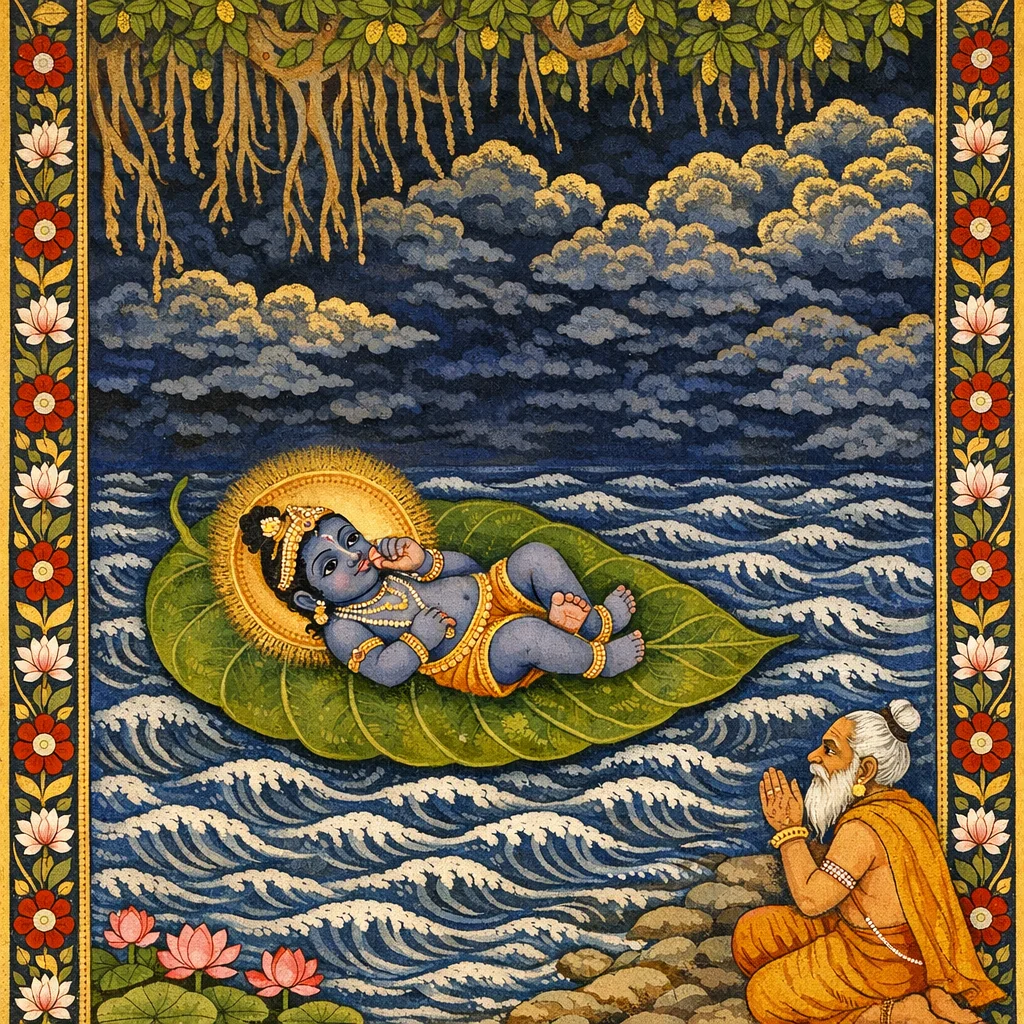
Following the sage Mārkaṇḍeya’s successful glorification of Nara-Nārāyaṇa (Bhagavān as the friend of Nara), the Lord appears and offers him a boon, praising his brahmacarya, tapas, Vedic study, niyama, and fixed meditation. Mārkaṇḍeya declines material benedictions, stating that darśana of the Lord is itself the highest gift, yet he requests one further grace: to witness the Lord’s illusory potency (māyā) by which the world appears materially variegated. The Lord consents and departs. Absorbed in contemplation, the sage continues worship—sometimes forgetting formal rites in bhāva. Then, during evening worship on the Puṣpabhadrā’s bank, a sudden apocalypse unfolds: fierce winds, thunderclouds, and a universal flood swallow the cosmos, leaving Mārkaṇḍeya alone, tormented by hunger, fear, and sea monsters across “millions of years.” He finally sees a tiny island with a banyan tree and a luminous infant on a leaf; the child inhales him, revealing the entire pre-dissolution universe within His body, and exhales him back into the deluge. When Mārkaṇḍeya rushes to embrace the Lord, the child vanishes, and instantly the deluge disappears, returning him to his hermitage—preparing the narrative for subsequent closure themes of nirodha, kāla, and āśraya.
Shlokas
Verse 1
सूत उवाच संस्तुतो भगवानित्थं मार्कण्डेयेन धीमता । नारायणो नरसख: प्रीत आह भृगूद्वहम् ॥ १ ॥
Sūta Gosvāmī said: The Supreme Lord Nārāyaṇa, the friend of Nara, was satisfied by the proper glorification offered by the intelligent sage Mārkaṇḍeya. Thus the Lord addressed that excellent descendant of Bhṛgu.
Verse 2
श्रीभगवानुवाच भो भो ब्रह्मर्षिवर्योऽसि सिद्ध आत्मसमाधिना । मयि भक्त्यानपायिन्या तप:स्वाध्यायसंयमै: ॥ २ ॥
The Supreme Personality of Godhead said: My dear Mārkaṇḍeya, you are indeed the best of all learned brāhmaṇas. You have perfected your life by practicing fixed meditation upon the Supreme Soul, as well as by focusing upon Me your undeviating devotional service, your austerities, your study of the Vedas and your strict adherence to regulative principles.
Verse 3
वयं ते परितुष्टा: स्म त्वद् बृहद्व्रतचर्यया । वरं प्रतीच्छ भद्रं ते वरदोऽस्मि त्वदीप्सितम् ॥ ३ ॥
We are perfectly satisfied with your practice of lifelong celibacy. Please choose whatever benediction you desire, since I can grant your wish. May you enjoy all good fortune.
Verse 4
श्रीऋषिरुवाच जितं ते देवदेवेश प्रपन्नार्तिहराच्युत । वरेणैतावतालं नो यद् भवान् समदृश्यत ॥ ४ ॥
The sage said: O Lord of lords, all glories to You! O Lord Acyuta, You remove all distress for the devotees who surrender unto You. That you have allowed me to see You is all the benediction I want.
Verse 5
गृहीत्वाजादयो यस्य श्रीमत्पादाब्जदर्शनम् । मनसा योगपक्वेन स भवान् मेऽक्षिगोचर: ॥ ५ ॥
Such demigods as Lord Brahmā achieved their exalted positions simply by seeing Your beautiful lotus feet after their minds had become mature in yoga practice. And now, my Lord, You have personally appeared before me.
Verse 6
अथाप्यम्बुजपत्राक्ष पुण्यश्लोकशिखामणे । द्रक्ष्ये मायां यया लोक: सपालो वेद सद्भिदाम् ॥ ६ ॥
O lotus-eyed Lord, O crest jewel of renowned personalities, although I am satisfied simply by seeing You, I do wish to see Your illusory potency, by whose influence the entire world, together with its ruling demigods, considers reality to be materially variegated.
Verse 7
सूत उवाच इतीडितोऽर्चित: काममृषिणा भगवान् मुने । तथेति स स्मयन् प्रागाद् बदर्याश्रममीश्वर: ॥ ७ ॥
Sūta Gosvāmī said: O wise Śaunaka, thus satisfied by Mārkaṇḍeya’s praise and worship, the Supreme Personality of Godhead, smiling, replied, “So be it,” and then departed for His hermitage at Badarikāśrama.
Verse 8
तमेव चिन्तयन्नर्थमृषि: स्वाश्रम एव स: । वसन्नग्न्यर्कसोमाम्बुभूवायुवियदात्मसु ॥ ८ ॥ ध्यायन् सर्वत्र च हरिं भावद्रव्यैरपूजयत् । क्वचित् पूजां विसस्मार प्रेमप्रसरसम्प्लुत: ॥ ९ ॥
Thinking always of his desire to see the Lord’s illusory energy, the sage remained in his āśrama, meditating constantly upon the Lord within fire, the sun, the moon, water, the earth, air, lightning and his own heart and worshiping Him with paraphernalia conceived in his mind. But sometimes, overwhelmed by waves of love for the Lord, Mārkaṇḍeya would forget to perform his regular worship.
Verse 9
तमेव चिन्तयन्नर्थमृषि: स्वाश्रम एव स: । वसन्नग्न्यर्कसोमाम्बुभूवायुवियदात्मसु ॥ ८ ॥ ध्यायन् सर्वत्र च हरिं भावद्रव्यैरपूजयत् । क्वचित् पूजां विसस्मार प्रेमप्रसरसम्प्लुत: ॥ ९ ॥
Thinking always of his desire to see the Lord’s illusory energy, the sage remained in his āśrama, meditating constantly upon the Lord within fire, the sun, the moon, water, the earth, air, lightning and his own heart and worshiping Him with paraphernalia conceived in his mind. But sometimes, overwhelmed by waves of love for the Lord, Mārkaṇḍeya would forget to perform his regular worship.
Verse 10
तस्यैकदा भृगुश्रेष्ठ पुष्पभद्रातटे मुने: । उपासीनस्य सन्ध्यायां ब्रह्मन् वायुरभून्महान् ॥ १० ॥
O brāhmaṇa Śaunaka, best of the Bhṛgus, one day while Mārkaṇḍeya was performing his evening worship on the bank of the Puṣpabhadrā, a great wind suddenly arose.
Verse 11
तं चण्डशब्दं समुदीरयन्तं बलाहका अन्वभवन् कराला: । अक्षस्थविष्ठा मुमुचुस्तडिद्भि: स्वनन्त उच्चैरभिवर्षधारा: ॥ ११ ॥
That wind created a terrible sound and brought in its wake fearsome clouds that were accompanied by lightning and roaring thunder and that poured down on all sides torrents of rain as heavy as wagon wheels.
Verse 12
ततो व्यदृश्यन्त चतु:समुद्रा: समन्तत: क्ष्मातलमाग्रसन्त: । समीरवेगोर्मिभिरुग्रनक्र- महाभयावर्तगभीरघोषा: ॥ १२ ॥
Then the four great oceans appeared on all sides, swallowing up the surface of the earth with their wind-tossed waves. In these oceans were terrible sea monsters, fearful whirlpools and ominous rumblings.
Verse 13
अन्तर्बहिश्चाद्भिरतिद्युभि: खरै: शतह्रदाभिरुपतापितं जगत् । चतुर्विधं वीक्ष्य सहात्मना मुनि- र्जलाप्लुतां क्ष्मां विमना: समत्रसत् ॥ १३ ॥
The sage saw all the inhabitants of the universe, including himself, tormented within and without by the harsh winds, the bolts of lightning, and the great waves rising beyond the sky. As the whole earth flooded, he grew perplexed and fearful.
Verse 14
तस्यैवमुद्वीक्षत ऊर्मिभीषण: प्रभञ्जनाघूर्णितवार्महार्णव: । आपूर्यमाणो वरषद्भिरम्बुदै: क्ष्मामप्यधाद् द्वीपवर्षाद्रिभि: समम् ॥ १४ ॥
Even as Mārkaṇḍeya looked on, the rain pouring down from the clouds filled the ocean more and more until that great sea, its waters violently whipped into terrifying waves by hurricanes, covered up all the earth’s islands, mountains and continents.
Verse 15
सक्ष्मान्तरिक्षं सदिवं सभागणं त्रैलोक्यमासीत् सह दिग्भिराप्लुतम् । स एक एवोर्वरितो महामुनि- र्बभ्राम विक्षिप्य जटा जडान्धवत् ॥ १५ ॥
The water inundated the earth, outer space, heaven and the celestial region. Indeed, the entire expanse of the universe was flooded in all directions, and out of all its inhabitants only Mārkaṇḍeya remained. His matted hair scattered, the great sage wandered about alone in the water as if dumb and blind.
Verse 16
क्षुत्तृट्परीतो मकरैस्तिमिङ्गिलै- रुपद्रुतो वीचिनभस्वता हत: । तमस्यपारे पतितो भ्रमन् दिशो न वेद खं गां च परिश्रमेषित: ॥ १६ ॥
Tormented by hunger and thirst, attacked by monstrous makaras and timiṅgila fish and battered by the wind and waves, he moved aimlessly through the infinite darkness into which he had fallen. As he grew increasingly exhausted, he lost all sense of direction and could not tell the sky from the earth.
Verse 17
क्वचिन्मग्नो महावर्ते तरलैस्ताडित: क्वचित् । यादोभिर्भक्ष्यते क्वापि स्वयमन्योन्यघातिभि: ॥ १७ ॥ क्वचिच्छोकं क्वचिन्मोहं क्वचिद्दु:खं सुखं भयम् । क्वचिन्मृत्युमवाप्नोति व्याध्यादिभिरुतार्दित: ॥ १८ ॥
At times he was engulfed by the great whirlpools, sometimes he was beaten by the mighty waves, and at other times the aquatic monsters threatened to devour him as they attacked one another. Sometimes he felt lamentation, bewilderment, misery, happiness or fear, and at other times he experienced such terrible illness and pain that he felt himself dying.
Verse 18
क्वचिन्मग्नो महावर्ते तरलैस्ताडित: क्वचित् । यादोभिर्भक्ष्यते क्वापि स्वयमन्योन्यघातिभि: ॥ १७ ॥ क्वचिच्छोकं क्वचिन्मोहं क्वचिद्दु:खं सुखं भयम् । क्वचिन्मृत्युमवाप्नोति व्याध्यादिभिरुतार्दित: ॥ १८ ॥
At times he was engulfed by the great whirlpools, sometimes he was beaten by the mighty waves, and at other times the aquatic monsters threatened to devour him as they attacked one another. Sometimes he felt lamentation, bewilderment, misery, happiness or fear, and at other times he experienced such terrible illness and pain that he felt himself dying.
Verse 19
अयुतायुतवर्षाणां सहस्राणि शतानि च । व्यतीयुर्भ्रमतस्तस्मिन् विष्णुमायावृतात्मन: ॥ १९ ॥
Countless millions of years passed as Mārkaṇḍeya wandered about in that deluge, his mind bewildered by the illusory energy of Lord Viṣṇu, the Supreme Personality of Godhead.
Verse 20
स कदाचिद् भ्रमंस्तस्मिन् पृथिव्या: ककुदि द्विज: । न्याग्रोधपोतं ददृशे फलपल्लवशोभितम् ॥ २० ॥
Once, while wandering in the water, the brāhmaṇa Mārkaṇḍeya discovered a small island, upon which stood a young banyan tree bearing blossoms and fruits.
Verse 21
प्रागुत्तरस्यां शाखायां तस्यापि ददृशे शिशुम् । शयानं पर्णपुटके ग्रसन्तं प्रभया तम: ॥ २१ ॥
Upon a branch of the northeast portion of that tree he saw an infant boy lying within a leaf. The child’s effulgence was swallowing up the darkness.
Verse 22
महामरकतश्यामं श्रीमद्वदनपङ्कजम् । कम्बुग्रीवं महोरस्कं सुनसं सुन्दरभ्रुवम् ॥ २२ ॥ श्वासैजदलकाभातं कम्बुश्रीकर्णदाडिमम् । विद्रुमाधरभासेषच्छोणायितसुधास्मितम् ॥ २३ ॥ पद्मगर्भारुणापाङ्गं हृद्यहासावलोकनम् । श्वासैजद्वलिसंविग्ननिम्ननाभिदलोदरम् ॥ २४ ॥ चार्वङ्गुलिभ्यां पाणिभ्यामुन्नीय चरणाम्बुजम् । मुखे निधाय विप्रेन्द्रो धयन्तं वीक्ष्य विस्मित: ॥ २५ ॥
The infant’s dark-blue complexion was the color of a flawless emerald, His lotus face shone with a wealth of beauty, and His throat bore marks like the lines on a conchshell. He had a broad chest, a finely shaped nose, beautiful eyebrows, and lovely ears that resembled pomegranate flowers and that had inner folds like a conchshell’s spirals. The corners of His eyes were reddish like the whorl of a lotus, and the effulgence of His corallike lips slightly reddened the nectarean, enchanting smile on His face. As He breathed, His splendid hair trembled and His deep navel became distorted by the moving folds of skin on His abdomen, which resembled a banyan leaf. The exalted brāhmaṇa watched with amazement as the infant took hold of one of His lotus feet with His graceful fingers, placed a toe within His mouth and began to suck.
Verse 23
महामरकतश्यामं श्रीमद्वदनपङ्कजम् । कम्बुग्रीवं महोरस्कं सुनसं सुन्दरभ्रुवम् ॥ २२ ॥ श्वासैजदलकाभातं कम्बुश्रीकर्णदाडिमम् । विद्रुमाधरभासेषच्छोणायितसुधास्मितम् ॥ २३ ॥ पद्मगर्भारुणापाङ्गं हृद्यहासावलोकनम् । श्वासैजद्वलिसंविग्ननिम्ननाभिदलोदरम् ॥ २४ ॥ चार्वङ्गुलिभ्यां पाणिभ्यामुन्नीय चरणाम्बुजम् । मुखे निधाय विप्रेन्द्रो धयन्तं वीक्ष्य विस्मित: ॥ २५ ॥
The infant’s dark-blue complexion was the color of a flawless emerald, His lotus face shone with a wealth of beauty, and His throat bore marks like the lines on a conchshell. He had a broad chest, a finely shaped nose, beautiful eyebrows, and lovely ears that resembled pomegranate flowers and that had inner folds like a conchshell’s spirals. The corners of His eyes were reddish like the whorl of a lotus, and the effulgence of His corallike lips slightly reddened the nectarean, enchanting smile on His face. As He breathed, His splendid hair trembled and His deep navel became distorted by the moving folds of skin on His abdomen, which resembled a banyan leaf. The exalted brāhmaṇa watched with amazement as the infant took hold of one of His lotus feet with His graceful fingers, placed a toe within His mouth and began to suck.
Verse 24
महामरकतश्यामं श्रीमद्वदनपङ्कजम् । कम्बुग्रीवं महोरस्कं सुनसं सुन्दरभ्रुवम् ॥ २२ ॥ श्वासैजदलकाभातं कम्बुश्रीकर्णदाडिमम् । विद्रुमाधरभासेषच्छोणायितसुधास्मितम् ॥ २३ ॥ पद्मगर्भारुणापाङ्गं हृद्यहासावलोकनम् । श्वासैजद्वलिसंविग्ननिम्ननाभिदलोदरम् ॥ २४ ॥ चार्वङ्गुलिभ्यां पाणिभ्यामुन्नीय चरणाम्बुजम् । मुखे निधाय विप्रेन्द्रो धयन्तं वीक्ष्य विस्मित: ॥ २५ ॥
The infant’s dark-blue complexion was the color of a flawless emerald, His lotus face shone with a wealth of beauty, and His throat bore marks like the lines on a conchshell. He had a broad chest, a finely shaped nose, beautiful eyebrows, and lovely ears that resembled pomegranate flowers and that had inner folds like a conchshell’s spirals. The corners of His eyes were reddish like the whorl of a lotus, and the effulgence of His corallike lips slightly reddened the nectarean, enchanting smile on His face. As He breathed, His splendid hair trembled and His deep navel became distorted by the moving folds of skin on His abdomen, which resembled a banyan leaf. The exalted brāhmaṇa watched with amazement as the infant took hold of one of His lotus feet with His graceful fingers, placed a toe within His mouth and began to suck.
Verse 25
महामरकतश्यामं श्रीमद्वदनपङ्कजम् । कम्बुग्रीवं महोरस्कं सुनसं सुन्दरभ्रुवम् ॥ २२ ॥ श्वासैजदलकाभातं कम्बुश्रीकर्णदाडिमम् । विद्रुमाधरभासेषच्छोणायितसुधास्मितम् ॥ २३ ॥ पद्मगर्भारुणापाङ्गं हृद्यहासावलोकनम् । श्वासैजद्वलिसंविग्ननिम्ननाभिदलोदरम् ॥ २४ ॥ चार्वङ्गुलिभ्यां पाणिभ्यामुन्नीय चरणाम्बुजम् । मुखे निधाय विप्रेन्द्रो धयन्तं वीक्ष्य विस्मित: ॥ २५ ॥
The infant’s dark-blue complexion was the color of a flawless emerald, His lotus face shone with a wealth of beauty, and His throat bore marks like the lines on a conchshell. He had a broad chest, a finely shaped nose, beautiful eyebrows, and lovely ears that resembled pomegranate flowers and that had inner folds like a conchshell’s spirals. The corners of His eyes were reddish like the whorl of a lotus, and the effulgence of His corallike lips slightly reddened the nectarean, enchanting smile on His face. As He breathed, His splendid hair trembled and His deep navel became distorted by the moving folds of skin on His abdomen, which resembled a banyan leaf. The exalted brāhmaṇa watched with amazement as the infant took hold of one of His lotus feet with His graceful fingers, placed a toe within His mouth and began to suck.
Verse 26
तद्दर्शनाद् वीतपरिश्रमो मुदा प्रोत्फुल्लहृत्पद्मविलोचनाम्बुज: । प्रहृष्टरोमाद्भुतभावशङ्कित: प्रष्टुं पुरस्तं प्रससार बालकम् ॥ २६ ॥
As Mārkaṇḍeya beheld the child, all his weariness vanished. Indeed, so great was his pleasure that the lotus of his heart, along with his lotus eyes, fully blossomed and the hairs on his body stood on end. Confused as to the identity of the wonderful infant, the sage approached Him.
Verse 27
तावच्छिशोर्वै श्वसितेन भार्गव: सोऽन्त: शरीरं मशको यथाविशत् । तत्राप्यदो न्यस्तमचष्ट कृत्स्नशो यथा पुरामुह्यदतीव विस्मित: ॥ २७ ॥
Just then the child inhaled, drawing Mārkaṇḍeya within His body like a mosquito. There the sage found the entire universe arrayed as it had been before its dissolution. Seeing this, Mārkaṇḍeya was most astonished and perplexed.
Verse 28
खं रोदसी भागणानद्रिसागरान् द्वीपान् सवर्षान् ककुभ: सुरासुरान् । वनानि देशान् सरित: पुराकरान् खेटान् व्रजानाश्रमवर्णवृत्तय: ॥ २८ ॥ महान्ति भूतान्यथ भौतिकान्यसौ कालं च नानायुगकल्पकल्पनम् । यत् किञ्चिदन्यद् व्यवहारकारणं ददर्श विश्वं सदिवावभासितम् ॥ २९ ॥
The sage saw the entire universe: the sky, heavens and earth, the stars, mountains, oceans, great islands and continents, the expanses in every direction, the saintly and demoniac living beings, the forests, countries, rivers, cities and mines, the agricultural villages and cow pastures, and the occupational and spiritual activities of the various social divisions. He also saw the basic elements of creation along with all their by-products, as well as time itself, which regulates the progression of countless ages within the days of Brahmā. In addition, he saw everything else created for use in material life. All this he saw manifested before him as if it were real.
Verse 29
खं रोदसी भागणानद्रिसागरान् द्वीपान् सवर्षान् ककुभ: सुरासुरान् । वनानि देशान् सरित: पुराकरान् खेटान् व्रजानाश्रमवर्णवृत्तय: ॥ २८ ॥ महान्ति भूतान्यथ भौतिकान्यसौ कालं च नानायुगकल्पकल्पनम् । यत् किञ्चिदन्यद् व्यवहारकारणं ददर्श विश्वं सदिवावभासितम् ॥ २९ ॥
The sage saw the entire universe: the sky, heavens and earth, the stars, mountains, oceans, great islands and continents, the expanses in every direction, the saintly and demoniac living beings, the forests, countries, rivers, cities and mines, the agricultural villages and cow pastures, and the occupational and spiritual activities of the various social divisions. He also saw the basic elements of creation along with all their by-products, as well as time itself, which regulates the progression of countless ages within the days of Brahmā. In addition, he saw everything else created for use in material life. All this he saw manifested before him as if it were real.
Verse 30
हिमालयं पुष्पवहां च तां नदीं निजाश्रमं यत्र ऋषी अपश्यत । विश्वं विपश्यञ्छ्वसिताच्छिशोर्वै बहिर्निरस्तो न्यपतल्लयाब्धौ ॥ ३० ॥
He saw before him the Himālaya Mountains, the Puṣpabhadrā River, and his own hermitage, where he had had the audience of the sages Nara-Nārāyaṇa. Then, as Mārkaṇḍeya beheld the entire universe, the infant exhaled, expelling the sage from His body and casting him back into the ocean of dissolution.
Verse 31
तस्मिन् पृथिव्या: ककुदि प्ररूढं वटं च तत्पर्णपुटे शयानम् । तोकं च तत्प्रेमसुधास्मितेन निरीक्षितोऽपाङ्गनिरीक्षणेन ॥ ३१ ॥ अथ तं बालकं वीक्ष्य नेत्राभ्यां धिष्ठितं हृदि । अभ्ययादतिसङ्क्लिष्ट: परिष्वक्तुमधोक्षजम् ॥ ३२ ॥
In that vast sea he again saw the banyan tree growing on the tiny island and the infant boy lying within the leaf. The child glanced at him from the corner of His eyes with a smile imbued with the nectar of love, and Mārkaṇḍeya took Him into his heart through his eyes. Greatly agitated, the sage ran to embrace the transcendental Personality of Godhead.
Verse 32
तस्मिन् पृथिव्या: ककुदि प्ररूढं वटं च तत्पर्णपुटे शयानम् । तोकं च तत्प्रेमसुधास्मितेन निरीक्षितोऽपाङ्गनिरीक्षणेन ॥ ३१ ॥ अथ तं बालकं वीक्ष्य नेत्राभ्यां धिष्ठितं हृदि । अभ्ययादतिसङ्क्लिष्ट: परिष्वक्तुमधोक्षजम् ॥ ३२ ॥
In that vast sea he again saw the banyan tree growing on the tiny island and the infant boy lying within the leaf. The child glanced at him from the corner of His eyes with a smile imbued with the nectar of love, and Mārkaṇḍeya took Him into his heart through his eyes. Greatly agitated, the sage ran to embrace the transcendental Personality of Godhead.
Verse 33
तावत् स भगवान् साक्षाद् योगाधीशो गुहाशय: । अन्तर्दध ऋषे: सद्यो यथेहानीशनिर्मिता ॥ ३३ ॥
At that moment the Supreme Personality of Godhead, who is the original master of all mysticism and who is hidden within everyone’s heart, became invisible to the sage, just as the achievements of an incompetent person can suddenly vanish.
Verse 34
तमन्वथ वटो ब्रह्मन् सलिलं लोकसम्प्लव: । तिरोधायि क्षणादस्य स्वाश्रमे पूर्ववत्स्थित: ॥ ३४ ॥
After the Lord disappeared, O brāhmaṇa, the banyan tree, the great water and the dissolution of the universe all vanished as well, and in an instant Mārkaṇḍeya found himself back in his own hermitage, just as before.
Frequently Asked Questions
His request is not for entertainment or skepticism but for tattva-jijñāsā: to understand how the Lord’s śakti makes the one reality appear as many and binds conditioned beings (including rulers of the cosmos) to mistaken notions of material variegation as ultimate. The episode teaches that māyā is apprehended correctly only when seen as Bhagavān’s controlled potency, not as an independent principle.
Śāstric narration presents pralaya as a real cosmic process governed by kāla and the Lord’s will (nirodha), while also functioning pedagogically: it dramatizes the fragility of all worlds and identities under time. The double function is central to Purāṇic method—cosmology that simultaneously instructs vairāgya (detachment) and directs the mind to āśraya, the only stable refuge.
The child is Bhagavān Himself in the vatapatra-śāyī manifestation, revealing that the cosmos rests within Him even when it seems dissolved. By inhaling Mārkaṇḍeya and showing him the complete universe inside His body, the Lord demonstrates that creation, maintenance, and dissolution occur within His sovereignty; the sage’s “external” experience of chaos is thus reframed as māyā under divine control.
The disappearance underscores that mystical experience cannot be seized by personal effort alone; Bhagavān remains svatantra (fully independent). The point is not denial of intimacy, but instruction: the Lord reveals and withdraws visions to deepen surrender, preventing the devotee from mistaking extraordinary experiences for final attainment and directing him instead to steady bhakti anchored in the Lord as āśraya.