Adhyaya 10
Mārkaṇḍeya Ṛṣi Meets Lord Śiva: Devotee as Living Tīrtha and the Lord’s Māyā
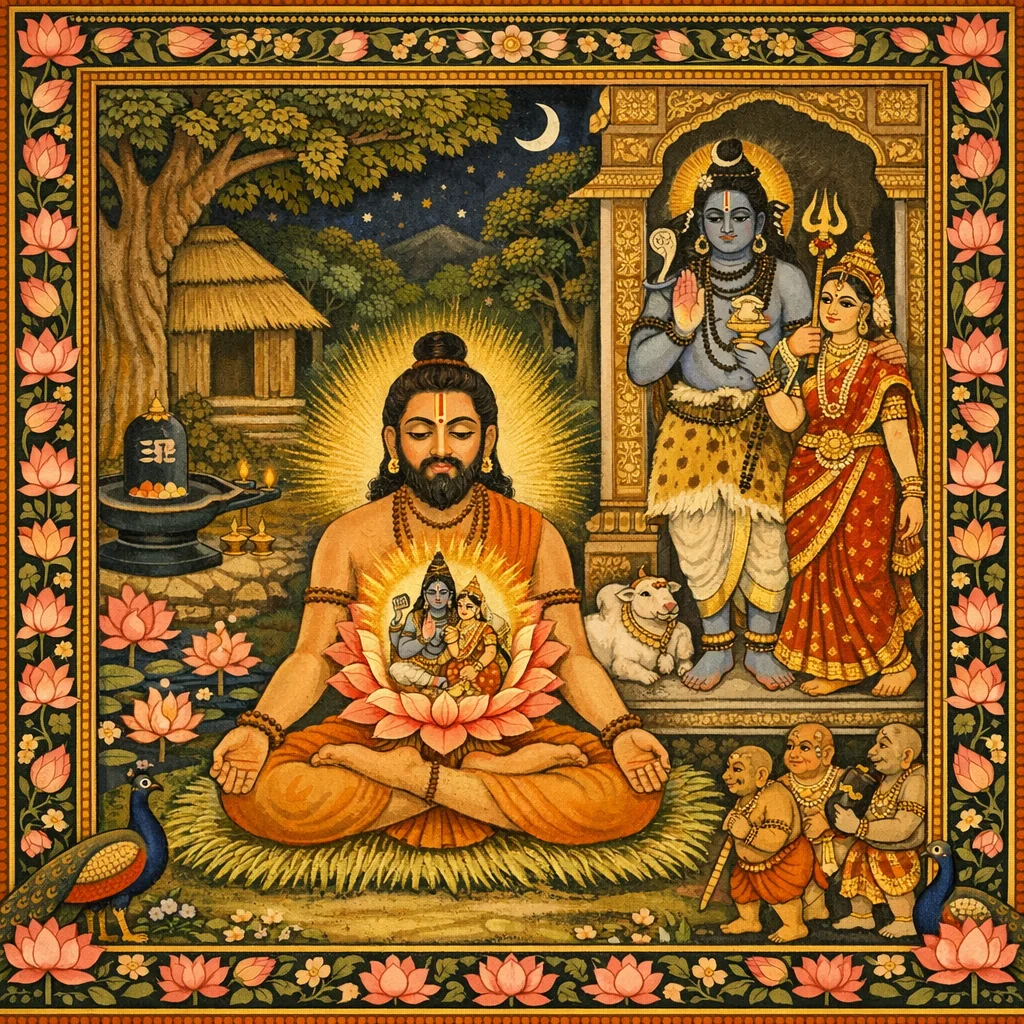
After Mārkaṇḍeya Ṛṣi has been shown the Supreme Lord’s bewildering potency (māyā) and takes exclusive shelter, this chapter pivots from the internal vision to its recognition by the cosmic controllers. Lord Śiva, accompanied by Umā and his attendants, finds Mārkaṇḍeya absorbed in deep samādhi, unresponsive to external reality. To awaken him without disturbing his spiritual absorption, Śiva enters the ‘sky of the heart’ through yogic power, appearing within the sage’s meditation. Mārkaṇḍeya then opens his eyes, offers formal hospitality (arghya, pādya, āsana, ārati), and praises Śiva’s transcendental position across the guṇas. Śiva responds by glorifying saintly brāhmaṇas and pure devotees as immediate purifiers—superior to holy waters or mere icons when approached externally. Pressed to ask a boon, Mārkaṇḍeya requests only unfailing bhakti to Lord Adhokṣaja and to His devotees. Śiva grants longevity, freedom from decay, tri-kāla-jñāna (knowledge of past-present-future), and Purāṇic ācārya status, then departs—bridging the prior māyā episode to the canto’s concluding emphasis on liberation through hearing and devotion.
Shlokas
Verse 1
सूत उवाच स एवमनुभूयेदं नारायणविनिर्मितम् । वैभवं योगमायायास्तमेव शरणं ययौ ॥ १ ॥
Sūta Gosvāmī said: The Supreme Lord Nārāyaṇa had arranged this opulent display of His bewildering potency. Mārkaṇḍeya Ṛṣi, having experienced it, took shelter of the Lord.
Verse 2
श्रीमार्कण्डेय उवाच प्रपन्नोऽस्म्यङ्घ्रिमूलं ते प्रपन्नाभयदं हरे । यन्माययापि विबुधा मुह्यन्ति ज्ञानकाशया ॥ २ ॥
Śrī Mārkaṇḍeya said: O Lord Hari, I take shelter of the soles of Your lotus feet, which bestow fearlessness upon all who surrender to them. Even the great demigods are bewildered by Your illusory energy, which appears to them in the guise of knowledge.
Verse 3
सूत उवाच तमेवं निभृतात्मानं वृषेण दिवि पर्यटन् । रुद्राण्या भगवान् रुद्रो ददर्श स्वगणैर्वृत: ॥ ३ ॥
Sūta Gosvāmī said: Lord Rudra, traveling in the sky on his bull and accompanied by his consort, Rudrāṇī, as well as his personal associates, observed Mārkaṇḍeya in trance.
Verse 4
अथोमा तमृषिं वीक्ष्य गिरिशं समभाषत । पश्येमं भगवन् विप्रं निभृतात्मेन्द्रियाशयम् ॥ ४ ॥
Goddess Umā, seeing the sage, addressed Lord Giriśa: My lord, just see this learned brāhmaṇa, his body, mind and senses motionless in trance.
Verse 5
निभृतोदझषव्रातो वातापाये यथार्णव: । कुर्वस्य तपस: साक्षात् संसिद्धिं सिद्धिदो भवान् ॥ ५ ॥
He is as calm as the waters of the ocean when the wind has ceased and the fish remain still. Therefore, my lord, since you bestow perfection on the performers of austerity, please award this sage the perfection that is obviously due him.
Verse 6
श्रीभगवानुवाच नैवेच्छत्याशिष: क्वापि ब्रह्मर्षिर्मोक्षमप्युत । भक्तिं परां भगवति लब्धवान् पुरुषेऽव्यये ॥ ६ ॥
Lord Śiva replied: Surely this saintly brāhmaṇa does not desire any benediction, not even liberation itself, for he has attained pure devotional service unto the inexhaustible Personality of Godhead.
Verse 7
अथापि संवदिष्यामो भवान्येतेन साधुना । अयं हि परमो लाभो नृणां साधुसमागम: ॥ ७ ॥
Still, my dear Bhavānī, let us talk with this saintly personality. After all, association with saintly devotees is man’s highest achievement.
Verse 8
सूत उवाच इत्युक्त्वा तमुपेयाय भगवान् स सतां गति: । ईशान: सर्वविद्यानामीश्वर: सर्वदेहिनाम् ॥ ८ ॥
Sūta Gosvāmī said: Having spoken thus, Lord Śaṅkara — the shelter of pure souls, master of all spiritual sciences and controller of all embodied living beings — approached the sage.
Verse 9
तयोरागमनं साक्षादीशयोर्जगदात्मनो: । न वेद रुद्धधीवृत्तिरात्मानं विश्वमेव च ॥ ९ ॥
Because Mārkaṇḍeya’s material mind had stopped functioning, the sage failed to notice that Lord Śiva and his wife, the controllers of the universe, had personally come to see him. Mārkaṇḍeya was so absorbed in meditation that he was unaware of either himself or the external world.
Verse 10
भगवांस्तदभिज्ञाय गिरिशो योगमायया । आविशत्तद्गुहाकाशं वायुश्छिद्रमिवेश्वर: ॥ १० ॥
Understanding the situation very well, the powerful Lord Śiva employed his mystic power to enter within the sky of Mārkaṇḍeya’s heart, just as the wind passes through an opening.
Verse 11
आत्मन्यपि शिवं प्राप्तं तडित्पिङ्गजटाधरम् । त्र्यक्षं दशभुजं प्रांशुमुद्यन्तमिव भास्करम् ॥ ११ ॥ व्याघ्रचर्माम्बरं शूलधनुरिष्वसिचर्मभि: । अक्षमालाडमरुककपालं परशुं सह ॥ १२ ॥ बिभ्राणं सहसा भातं विचक्ष्य हृदि विस्मित: । किमिदं कुत एवेति समाधेर्विरतो मुनि: ॥ १३ ॥
Śrī Mārkaṇḍeya saw Lord Śiva suddenly appear within his heart. Lord Śiva’s golden hair resembled lightning, and he had three eyes, ten arms and a tall body that shone like the rising sun. He wore a tiger skin, and he carried a trident, a bow, arrows, a sword and a shield, along with prayer beads, a ḍamaru drum, a skull and an ax. Astonished, the sage came out of his trance and thought, “Who is this, and where has he come from?”
Verse 12
आत्मन्यपि शिवं प्राप्तं तडित्पिङ्गजटाधरम् । त्र्यक्षं दशभुजं प्रांशुमुद्यन्तमिव भास्करम् ॥ ११ ॥ व्याघ्रचर्माम्बरं शूलधनुरिष्वसिचर्मभि: । अक्षमालाडमरुककपालं परशुं सह ॥ १२ ॥ बिभ्राणं सहसा भातं विचक्ष्य हृदि विस्मित: । किमिदं कुत एवेति समाधेर्विरतो मुनि: ॥ १३ ॥
Śrī Mārkaṇḍeya saw Lord Śiva suddenly appear within his heart. Lord Śiva’s golden hair resembled lightning, and he had three eyes, ten arms and a tall body that shone like the rising sun. He wore a tiger skin, and he carried a trident, a bow, arrows, a sword and a shield, along with prayer beads, a ḍamaru drum, a skull and an ax. Astonished, the sage came out of his trance and thought, “Who is this, and where has he come from?”
Verse 13
आत्मन्यपि शिवं प्राप्तं तडित्पिङ्गजटाधरम् । त्र्यक्षं दशभुजं प्रांशुमुद्यन्तमिव भास्करम् ॥ ११ ॥ व्याघ्रचर्माम्बरं शूलधनुरिष्वसिचर्मभि: । अक्षमालाडमरुककपालं परशुं सह ॥ १२ ॥ बिभ्राणं सहसा भातं विचक्ष्य हृदि विस्मित: । किमिदं कुत एवेति समाधेर्विरतो मुनि: ॥ १३ ॥
Śrī Mārkaṇḍeya saw Lord Śiva suddenly appear within his heart. Lord Śiva’s golden hair resembled lightning, and he had three eyes, ten arms and a tall body that shone like the rising sun. He wore a tiger skin, and he carried a trident, a bow, arrows, a sword and a shield, along with prayer beads, a ḍamaru drum, a skull and an ax. Astonished, the sage came out of his trance and thought, “Who is this, and where has he come from?”
Verse 14
नेत्रे उन्मील्य ददृशे सगणं सोमयागतम् । रुद्रं त्रिलोकैकगुरुं ननाम शिरसा मुनि: ॥ १४ ॥
Opening his eyes, the sage saw Lord Rudra, the spiritual master of the three worlds, together with Umā and Rudra’s followers. Mārkaṇḍeya then offered his respectful obeisances by bowing his head.
Verse 15
तस्मै सपर्यां व्यदधात् सगणाय सहोमया । स्वागतासनपाद्यार्घ्यगन्धस्रग्धूपदीपकै: ॥ १५ ॥
Mārkaṇḍeya worshiped Lord Śiva, along with Umā and Śiva’s associates, by offering them words of welcome, sitting places, water for washing their feet, scented drinking water, fragrant oils, flower garlands and ārati lamps.
Verse 16
आह त्वात्मानुभावेन पूर्णकामस्य ते विभो । करवाम किमीशान येनेदं निर्वृतं जगत् ॥ १६ ॥
Mārkaṇḍeya said: O mighty lord, what can I possibly do for you, who are fully satisfied by your own ecstasy? Indeed, by your mercy you satisfy this entire world.
Verse 17
नम: शिवाय शान्ताय सत्त्वाय प्रमृडाय च । रजोजुषेऽथ घोराय नमस्तुभ्यं तमोजुषे ॥ १७ ॥
Again and again I offer my obeisances unto you, O all-auspicious transcendental personality. As the lord of goodness you give pleasure, in contact with the mode of passion you appear most fearful, and you also associate with the mode of ignorance.
Verse 18
सूत उवाच एवं स्तुत: स भगवानादिदेव: सतां गति: । परितुष्ट: प्रसन्नात्मा प्रहसंस्तमभाषत ॥ १८ ॥
Sūta Gosvāmī said: Lord Śiva, the foremost demigod and the shelter of the saintly devotees, was satisfied by Mārkaṇḍeya’s praise. Pleased, he smiled and addressed the sage.
Verse 19
श्रीभगवानुवाच वरं वृणीष्व न: कामं वरदेशा वयं त्रय: । अमोघं दर्शनं येषां मर्त्यो यद् विन्दतेऽमृतम् ॥ १९ ॥
Lord Śiva said: Please ask me for some benediction, since among all givers of benedictions, we three — Brahmā, Viṣṇu and I — are the best. Seeing us never goes in vain, because simply by seeing us a mortal achieves immortality.
Verse 20
ब्राह्मणा: साधव: शान्ता नि:सङ्गा भूतवत्सला: । एकान्तभक्ता अस्मासु निर्वैरा: समदर्शिन: ॥ २० ॥ सलोका लोकपालास्तान् वन्दन्त्यर्चन्त्युपासते । अहं च भगवान् ब्रह्मा स्वयं च हरिरीश्वर: ॥ २१ ॥
The inhabitants and ruling demigods of all planets, along with Lord Brahmā, the Supreme Lord Hari and I, glorify, worship and assist those brāhmaṇas who are saintly, always peaceful, free of material attachment, compassionate to all living beings, purely devoted to us, devoid of hatred and endowed with equal vision.
Verse 21
ब्राह्मणा: साधव: शान्ता नि:सङ्गा भूतवत्सला: । एकान्तभक्ता अस्मासु निर्वैरा: समदर्शिन: ॥ २० ॥ सलोका लोकपालास्तान् वन्दन्त्यर्चन्त्युपासते । अहं च भगवान् ब्रह्मा स्वयं च हरिरीश्वर: ॥ २१ ॥
The inhabitants and ruling demigods of all planets, along with Lord Brahmā, the Supreme Lord Hari and I, glorify, worship and assist those brāhmaṇas who are saintly, always peaceful, free of material attachment, compassionate to all living beings, purely devoted to us, devoid of hatred and endowed with equal vision.
Verse 22
न ते मय्यच्युतेऽजे च भिदामण्वपि चक्षते । नात्मनश्च जनस्यापि तद् युष्मान् वयमीमहि ॥ २२ ॥
These devotees do not differentiate between Lord Viṣṇu, Lord Brahmā and me, nor do they differentiate between themselves and other living beings. Therefore, because you are this kind of saintly devotee, we worship you.
Verse 23
न ह्यम्मयानि तीर्थानि न देवाश्चेतनोज्झिता: । ते पुनन्त्युरुकालेन यूयं दर्शनमात्रत: ॥ २३ ॥
Mere bodies of water do not constitute holy places, nor are lifeless statues of the demigods actual worshipable deities. Because external vision fails to appreciate the higher essence of the holy rivers and the demigods, these purify only after a considerable time. But devotees like you purify immediately, just by being seen.
Verse 24
ब्राह्मणेभ्यो नमस्यामो येऽस्मद्रूपं त्रयीमयम् । बिभ्रत्यात्मसमाधानतप:स्वाध्यायसंयमै: ॥ २४ ॥
By meditating upon the Supreme Soul, performing austerities, engaging in Vedic study and following regulative principles, the brāhmaṇas sustain within themselves the three Vedas, which are nondifferent from Lord Viṣṇu, Lord Brahmā and me. Therefore I offer my obeisances unto the brāhmaṇas.
Verse 25
श्रवणाद् दर्शनाद् वापि महापातकिनोऽपि व: । शुध्येरन्नन्त्यजाश्चापि किमु सम्भाषणादिभि: ॥ २५ ॥
Even the worst sinners and social outcastes are purified just by hearing about or seeing personalities like you. Imagine, then, how purified they become by directly speaking with you.
Verse 26
सूत उवाच इति चन्द्रललामस्य धर्मगुह्योपबृंहितम् । वचोऽमृतायनमृषिर्नातृप्यत् कर्णयो: पिबन् ॥ २६ ॥
Sūta Gosvāmī said: Drinking with his ears Lord Śiva’s nectarean words, full of the confidential essence of religion, Mārkaṇḍeya Ṛṣi could not be satiated.
Verse 27
स चिरं मायया विष्णोर्भ्रामित: कर्शितो भृशम् । शिववागमृतध्वस्तक्लेशपुञ्जस्तमब्रवीत् ॥ २७ ॥
Mārkaṇḍeya, having been forced by Lord Viṣṇu’s illusory energy to wander about for a long time in the water of dissolution, had become extremely exhausted. But Lord Śiva’s words of nectar vanquished his accumulated suffering. Thus he addressed Lord Śiva.
Verse 28
श्रीमार्कण्डेय उवाच अहो ईश्वरलीलेयं दुर्विभाव्या शरीरिणाम् । यन्नमन्तीशितव्यानि स्तुवन्ति जगदीश्वरा: ॥ २८ ॥
Śrī Mārkaṇḍeya said: It is indeed most difficult for embodied souls to understand the pastimes of the universal controllers, for such lords bow down to and offer praise to the very living beings they rule.
Verse 29
धर्मं ग्राहयितुं प्राय: प्रवक्तारश्च देहिनाम् । आचरन्त्यनुमोदन्ते क्रियमाणं स्तुवन्ति च ॥ २९ ॥
Generally it is to induce embodied souls to accept religious principles that the authorized teachers of religion exhibit ideal behavior while encouraging and praising the proper behavior of others.
Verse 30
नैतावता भगवत: स्वमायामयवृत्तिभि: । न दुष्येतानुभावस्तैर्मायिन: कुहकं यथा ॥ ३० ॥
This apparent humility is simply a show of mercy. Such behavior of the Supreme Lord and His personal associates, which the Lord effects by His own bewildering potency, does not spoil His power any more than a magician’s powers are diminished by his exhibition of tricks.
Verse 31
सृष्ट्वेदं मनसा विश्वमात्मनानुप्रविश्य य: । गुणै: कुर्वद्भिराभाति कर्तेव स्वप्नदृग् यथा ॥ ३१ ॥ तस्मै नमो भगवते त्रिगुणाय गुणात्मने । केवलायाद्वितीयाय गुरवे ब्रह्ममूर्तये ॥ ३२ ॥
I offer my obeisances to that Supreme Personality of Godhead, who has created this entire universe simply by His desire and then entered into it as the Supersoul. By making the modes of nature act, He seems to be the direct creator of this world, just as a dreamer seems to be acting within his dream. He is the owner and ultimate controller of the three modes of nature, yet He remains alone and pure, without any equal. He is the supreme spiritual master of all, the original personal form of the Absolute Truth.
Verse 32
सृष्ट्वेदं मनसा विश्वमात्मनानुप्रविश्य य: । गुणै: कुर्वद्भिराभाति कर्तेव स्वप्नदृग् यथा ॥ ३१ ॥ तस्मै नमो भगवते त्रिगुणाय गुणात्मने । केवलायाद्वितीयाय गुरवे ब्रह्ममूर्तये ॥ ३२ ॥
I offer my obeisances to that Supreme Personality of Godhead, who has created this entire universe simply by His desire and then entered into it as the Supersoul. By making the modes of nature act, He seems to be the direct creator of this world, just as a dreamer seems to be acting within his dream. He is the owner and ultimate controller of the three modes of nature, yet He remains alone and pure, without any equal. He is the supreme spiritual master of all, the original personal form of the Absolute Truth.
Verse 33
कं वृणे नु परं भूमन् वरं त्वद् वरदर्शनात् । यद्दर्शनात् पूर्णकाम: सत्यकाम: पुमान् भवेत् ॥ ३३ ॥
O all-pervading lord, since I have received the benediction of seeing you, what other benediction can I ask for? Simply by seeing you, a person fulfills all his desires and can achieve anything imaginable.
Verse 34
वरमेकं वृणेऽथापि पूर्णात् कामाभिवर्षणात् । भगवत्यच्युतां भक्तिं तत्परेषु तथा त्वयि ॥ ३४ ॥
But I do request one benediction from you, who are full of all perfection and able to shower down the fulfillment of all desires. I ask to have unfailing devotion for the Supreme Personality of Godhead and for His dedicated devotees, especially you.
Verse 35
सूत उवाच इत्यर्चितोऽभिष्टुतश्च मुनिना सूक्तया गिरा । तमाह भगवाञ्छर्व: शर्वया चाभिनन्दित: ॥ ३५ ॥
Sūta Gosvāmī said: Thus worshiped and glorified by the eloquent statements of the sage Mārkaṇḍeya, Lord Śarva [Śiva], encouraged by his consort, replied to him as follows.
Verse 36
कामो महर्षे सर्वोऽयं भक्तिमांस्त्वमधोक्षजे । आकल्पान्ताद् यश: पुण्यमजरामरता तथा ॥ ३६ ॥
O great sage, because you are devoted to Lord Adhokṣaja, all your desires will be fulfilled. Until the very end of this creation cycle, you will enjoy pious fame and freedom from old age and death.
Verse 37
ज्ञानं त्रैकालिकं ब्रह्मन् विज्ञानं च विरक्तिमत् । ब्रह्मवर्चस्विनो भूयात् पुराणाचार्यतास्तु ते ॥ ३७ ॥
O brāhmaṇa, may you have perfect knowledge of past, present and future, along with transcendental realization of the Supreme, enriched by renunciation. You have the brilliance of an ideal brāhmaṇa, and thus may you achieve the post of spiritual master of the Purāṇas.
Verse 38
सूत उवाच एवं वरान् स मुनये दत्त्वागात् त्र्यक्ष ईश्वर: । देव्यै तत्कर्म कथयन्ननुभूतं पुरामुना ॥ ३८ ॥
Sūta Gosvāmī said: Having thus granted Mārkaṇḍeya Ṛṣi benedictions, Lord Śiva went on his way, continuing to describe to goddess Devī the accomplishments of the sage and the direct exhibition of the Lord’s illusory power that he had experienced.
Verse 39
सोऽप्यवाप्तमहायोगमहिमा भार्गवोत्तम: । विचरत्यधुनाप्यद्धा हरावेकान्ततां गत: ॥ ३९ ॥
Mārkaṇḍeya Ṛṣi, the best of the descendants of Bhṛgu, is glorious because of his achievement of perfection in mystic yoga. Even today he travels about this world, fully absorbed in unalloyed devotion for the Supreme Personality of Godhead.
Verse 40
अनुवर्णितमेतत्ते मार्कण्डेयस्य धीमत: । अनुभूतं भगवतो मायावैभवमद्भुतम् ॥ ४० ॥
I have thus narrated to you the activities of the highly intelligent sage Mārkaṇḍeya, especially how he experienced the amazing power of the Supreme Lord’s illusory energy.
Verse 41
एतत् केचिदविद्वांसो मायासंसृतिरात्मन: । अनाद्यावर्तितं नृणां कादाचित्कं प्रचक्षते ॥ ४१ ॥
Although this event was unique and unprecedented, some unintelligent persons compare it to the cycle of illusory material existence the Supreme Lord has created for the conditioned souls — an endless cycle that has been continuing since time immemorial.
Verse 42
य एवमेतद् भृगुवर्य वर्णितं रथाङ्गपाणेरनुभावभावितम् । संश्रावयेत् संशृणुयादु तावुभौ तयोर्न कर्माशयसंसृतिर्भवेत् ॥ ४२ ॥
O best of the Bhṛgus, this account concerning Mārkaṇḍeya Ṛṣi conveys the transcendental potency of the Supreme Lord. Anyone who properly narrates or hears it will never again undergo material existence, which is based on the desire to perform fruitive activities.
Frequently Asked Questions
Mārkaṇḍeya’s mind is withdrawn from external function due to deep samādhi, so ordinary approach would not register. Śiva uses yogic siddhi to appear within the sage’s inner awareness, demonstrating mastery over subtle existence while honoring the sage’s absorption. The episode also teaches that the Lord’s associates can interface with consciousness directly, and that genuine trance is characterized by forgetfulness of self and world, not performative stillness.
Śiva states that water-bodies and externally viewed deities purify ‘after a considerable time’ because people often approach them with external vision and mixed motives. A pure devotee, however, purifies immediately by darśana because devotion carries the Lord’s presence (bhagavat-sambandha) and awakens remembrance and surrender in others. The teaching elevates sādhu-saṅga as the most potent tīrtha.
Śiva names Brahmā, Viṣṇu (Hari), and himself as foremost among benedictors, emphasizing that contact with cosmic rulers is not meaningless. Yet the chapter’s conclusion reframes the highest boon: Mārkaṇḍeya asks not for wealth, siddhi, or even mokṣa, but for unwavering bhakti—showing that devotion is superior to all benedictions and that devas ultimately honor bhakti.
Śiva grants enduring fame, freedom from old age and death until the end of the creation cycle, tri-kāla-jñāna (knowledge of past, present, and future), and realization enriched by renunciation—culminating in eligibility as a Purāṇic spiritual master. These gifts validate Mārkaṇḍeya as a trustworthy transmitter (paramparā) while keeping bhakti central: the boons are secondary confirmations of his devotion to Adhokṣaja.