Adhyaya 2
Kali-yuga’s Degradation, the Advent of Kalki, and the Reset of the Yuga Cycle
Continuing the Twelfth Canto’s closing survey of history and time, Śukadeva Gosvāmī now gives Parīkṣit Mahārāja a diagnostic portrait of Kali-yuga: day-by-day erosion of dharma’s pillars (truth, cleanliness, mercy, tolerance), social identity reduced to wealth and external markers, and governance degenerating into predation. As corrupt populations swell, the strongest seize power; citizens, crushed by taxes and famine, flee and survive on wild foods, while lifespan contracts dramatically. Śukadeva then pivots from decline to divine intervention: Lord Viṣṇu appears as Kalki in Śambhala, annihilates impostor kings, purifies survivors, and ushers in Satya-yuga’s renewal, marked by auspicious astronomical configurations. The chapter also stitches eschatology to chronology: it references dynastic timelines, the Saptarṣi constellation’s movement through nakṣatras as a time-marker for Kali’s onset and intensification, and the immediate beginning of Kali upon Kṛṣṇa’s departure. It concludes by preparing the next movement of the canto’s finale: a sobering meditation on the futility of royal possessiveness under time’s supremacy.
Shlokas
Verse 1
श्रीशुक उवाच ततश्चानुदिनं धर्म: सत्यं शौचं क्षमा दया । कालेन बलिना राजन् नङ्क्ष्यत्यायुर्बलं स्मृति: ॥ १ ॥
Śukadeva Gosvāmī said: Then, O King, religion, truthfulness, cleanliness, tolerance, mercy, duration of life, physical strength and memory will all diminish day by day because of the powerful influence of the Age of Kali.
Verse 2
वित्तमेव कलौ नृणां जन्माचारगुणोदय: । धर्मन्यायव्यवस्थायां कारणं बलमेव हि ॥ २ ॥
In Kali-yuga, wealth alone will be considered the sign of a man’s good birth, proper behavior and fine qualities. And law and justice will be applied only on the basis of one’s power.
Verse 3
दाम्पत्येऽभिरुचिर्हेतुर्मायैव व्यावहारिके । स्त्रीत्वे पुंस्त्वे च हि रतिर्विप्रत्वे सूत्रमेव हि ॥ ३ ॥
Men and women will live together merely because of superficial attraction, and success in business will depend on deceit. Womanliness and manliness will be judged according to one’s expertise in sex, and a man will be known as a brāhmaṇa just by his wearing a thread.
Verse 4
लिङ्गमेवाश्रमख्यातावन्योन्यापत्तिकारणम् । अवृत्त्या न्यायदौर्बल्यं पाण्डित्ये चापलं वच: ॥ ४ ॥
A person’s spiritual position will be ascertained merely according to external symbols, and on that same basis people will change from one spiritual order to the next. A person’s propriety will be seriously questioned if he does not earn a good living. And one who is very clever at juggling words will be considered a learned scholar.
Verse 5
अनाढ्यतैवासाधुत्वे साधुत्वे दम्भ एव तु । स्वीकार एव चोद्वाहे स्नानमेव प्रसाधनम् ॥ ५ ॥
A person will be judged unholy if he does not have money, and hypocrisy will be accepted as virtue. Marriage will be arranged simply by verbal agreement, and a person will think he is fit to appear in public if he has merely taken a bath.
Verse 6
दूरे वार्ययनं तीर्थं लावण्यं केशधारणम् । उदरंभरता स्वार्थ: सत्यत्वे धार्ष्ट्यमेव हि । दाक्ष्यं कुटुम्बभरणं यशोऽर्थे धर्मसेवनम् ॥ ६ ॥
A sacred place will be taken to consist of no more than a reservoir of water located at a distance, and beauty will be thought to depend on one’s hairstyle. Filling the belly will become the goal of life, and one who is audacious will be accepted as truthful. He who can maintain a family will be regarded as an expert man, and the principles of religion will be observed only for the sake of reputation.
Verse 7
एवं प्रजाभिर्दुष्टाभिराकीर्णे क्षितिमण्डले । ब्रह्मविट्क्षत्रशूद्राणां यो बली भविता नृप: ॥ ७ ॥
As the earth thus becomes crowded with a corrupt population, whoever among any of the social classes shows himself to be the strongest will gain political power.
Verse 8
प्रजा हि लुब्धै राजन्यैर्निर्घृणैर्दस्युधर्मभि: । आच्छिन्नदारद्रविणा यास्यन्ति गिरिकाननम् ॥ ८ ॥
Losing their wives and properties to such avaricious and merciless rulers, who will behave no better than ordinary thieves, the citizens will flee to the mountains and forests.
Verse 9
शाकमूलामिषक्षौद्रफलपुष्पाष्टिभोजना: । अनावृष्टया विनङ्क्ष्यन्ति दुर्भिक्षकरपीडिता: ॥ ९ ॥
Harassed by famine and excessive taxes, people will resort to eating leaves, roots, flesh, wild honey, fruits, flowers and seeds. Struck by drought, they will become completely ruined.
Verse 10
शीतवातातपप्रावृड्हिमैरन्योन्यत: प्रजा: । क्षुत्तृड्भ्यां व्याधिभिश्चैव सन्तप्स्यन्ते च चिन्तया ॥ १० ॥
The citizens will suffer greatly from cold, wind, heat, rain and snow. They will be further tormented by quarrels, hunger, thirst, disease and severe anxiety.
Verse 11
त्रिंशद्विंशतिवर्षाणि परमायु: कलौ नृणाम् ॥ ११ ॥
The maximum duration of life for human beings in Kali-yuga will become fifty years.
Verse 12
क्षीयमाणेषु देहेषु देहिनां कलिदोषत: । वर्णाश्रमवतां धर्मे नष्टे वेदपथे नृणाम् ॥ १२ ॥ पाषण्डप्रचुरे धर्मे दस्युप्रायेषु राजसु । चौर्यानृतवृथाहिंसानानावृत्तिषु वै नृषु ॥ १३ ॥ शूद्रप्रायेषु वर्णेषुच्छागप्रायासु धेनुषु । गृहप्रायेष्वाश्रमेषु यौनप्रायेषु बन्धुषु ॥ १४ ॥ अणुप्रायास्वोषधीषु शमीप्रायेषु स्थास्नुषु । विद्युत्प्रायेषु मेघेषु शून्यप्रायेषु सद्मसु ॥ १५ ॥ इत्थं कलौ गतप्राये जनेषु खरधर्मिषु । धर्मत्राणाय सत्त्वेन भगवानवतरिष्यति ॥ १६ ॥
By the time the Age of Kali ends, the bodies of all creatures will be greatly reduced in size, and the religious principles of followers of varṇāśrama will be ruined. The path of the Vedas will be completely forgotten in human society, and so-called religion will be mostly atheistic. The kings will mostly be thieves, the occupations of men will be stealing, lying and needless violence, and all the social classes will be reduced to the lowest level of śūdras. Cows will be like goats, spiritual hermitages will be no different from mundane houses, and family ties will extend no further than the immediate bonds of marriage. Most plants and herbs will be tiny, and all trees will appear like dwarf śamī trees. Clouds will be full of lightning, homes will be devoid of piety, and all human beings will have become like asses. At that time, the Supreme Personality of Godhead will appear on the earth. Acting with the power of pure spiritual goodness, He will rescue eternal religion.
Verse 13
क्षीयमाणेषु देहेषु देहिनां कलिदोषत: । वर्णाश्रमवतां धर्मे नष्टे वेदपथे नृणाम् ॥ १२ ॥ पाषण्डप्रचुरे धर्मे दस्युप्रायेषु राजसु । चौर्यानृतवृथाहिंसानानावृत्तिषु वै नृषु ॥ १३ ॥ शूद्रप्रायेषु वर्णेषुच्छागप्रायासु धेनुषु । गृहप्रायेष्वाश्रमेषु यौनप्रायेषु बन्धुषु ॥ १४ ॥ अणुप्रायास्वोषधीषु शमीप्रायेषु स्थास्नुषु । विद्युत्प्रायेषु मेघेषु शून्यप्रायेषु सद्मसु ॥ १५ ॥ इत्थं कलौ गतप्राये जनेषु खरधर्मिषु । धर्मत्राणाय सत्त्वेन भगवानवतरिष्यति ॥ १६ ॥
By the time the Age of Kali ends, the bodies of all creatures will be greatly reduced in size, and the religious principles of followers of varṇāśrama will be ruined. The path of the Vedas will be completely forgotten in human society, and so-called religion will be mostly atheistic. The kings will mostly be thieves, the occupations of men will be stealing, lying and needless violence, and all the social classes will be reduced to the lowest level of śūdras. Cows will be like goats, spiritual hermitages will be no different from mundane houses, and family ties will extend no further than the immediate bonds of marriage. Most plants and herbs will be tiny, and all trees will appear like dwarf śamī trees. Clouds will be full of lightning, homes will be devoid of piety, and all human beings will have become like asses. At that time, the Supreme Personality of Godhead will appear on the earth. Acting with the power of pure spiritual goodness, He will rescue eternal religion.
Verse 14
क्षीयमाणेषु देहेषु देहिनां कलिदोषत: । वर्णाश्रमवतां धर्मे नष्टे वेदपथे नृणाम् ॥ १२ ॥ पाषण्डप्रचुरे धर्मे दस्युप्रायेषु राजसु । चौर्यानृतवृथाहिंसानानावृत्तिषु वै नृषु ॥ १३ ॥ शूद्रप्रायेषु वर्णेषुच्छागप्रायासु धेनुषु । गृहप्रायेष्वाश्रमेषु यौनप्रायेषु बन्धुषु ॥ १४ ॥ अणुप्रायास्वोषधीषु शमीप्रायेषु स्थास्नुषु । विद्युत्प्रायेषु मेघेषु शून्यप्रायेषु सद्मसु ॥ १५ ॥ इत्थं कलौ गतप्राये जनेषु खरधर्मिषु । धर्मत्राणाय सत्त्वेन भगवानवतरिष्यति ॥ १६ ॥
By the time the Age of Kali ends, the bodies of all creatures will be greatly reduced in size, and the religious principles of followers of varṇāśrama will be ruined. The path of the Vedas will be completely forgotten in human society, and so-called religion will be mostly atheistic. The kings will mostly be thieves, the occupations of men will be stealing, lying and needless violence, and all the social classes will be reduced to the lowest level of śūdras. Cows will be like goats, spiritual hermitages will be no different from mundane houses, and family ties will extend no further than the immediate bonds of marriage. Most plants and herbs will be tiny, and all trees will appear like dwarf śamī trees. Clouds will be full of lightning, homes will be devoid of piety, and all human beings will have become like asses. At that time, the Supreme Personality of Godhead will appear on the earth. Acting with the power of pure spiritual goodness, He will rescue eternal religion.
Verse 15
क्षीयमाणेषु देहेषु देहिनां कलिदोषत: । वर्णाश्रमवतां धर्मे नष्टे वेदपथे नृणाम् ॥ १२ ॥ पाषण्डप्रचुरे धर्मे दस्युप्रायेषु राजसु । चौर्यानृतवृथाहिंसानानावृत्तिषु वै नृषु ॥ १३ ॥ शूद्रप्रायेषु वर्णेषुच्छागप्रायासु धेनुषु । गृहप्रायेष्वाश्रमेषु यौनप्रायेषु बन्धुषु ॥ १४ ॥ अणुप्रायास्वोषधीषु शमीप्रायेषु स्थास्नुषु । विद्युत्प्रायेषु मेघेषु शून्यप्रायेषु सद्मसु ॥ १५ ॥ इत्थं कलौ गतप्राये जनेषु खरधर्मिषु । धर्मत्राणाय सत्त्वेन भगवानवतरिष्यति ॥ १६ ॥
By the time the Age of Kali ends, the bodies of all creatures will be greatly reduced in size, and the religious principles of followers of varṇāśrama will be ruined. The path of the Vedas will be completely forgotten in human society, and so-called religion will be mostly atheistic. The kings will mostly be thieves, the occupations of men will be stealing, lying and needless violence, and all the social classes will be reduced to the lowest level of śūdras. Cows will be like goats, spiritual hermitages will be no different from mundane houses, and family ties will extend no further than the immediate bonds of marriage. Most plants and herbs will be tiny, and all trees will appear like dwarf śamī trees. Clouds will be full of lightning, homes will be devoid of piety, and all human beings will have become like asses. At that time, the Supreme Personality of Godhead will appear on the earth. Acting with the power of pure spiritual goodness, He will rescue eternal religion.
Verse 16
क्षीयमाणेषु देहेषु देहिनां कलिदोषत: । वर्णाश्रमवतां धर्मे नष्टे वेदपथे नृणाम् ॥ १२ ॥ पाषण्डप्रचुरे धर्मे दस्युप्रायेषु राजसु । चौर्यानृतवृथाहिंसानानावृत्तिषु वै नृषु ॥ १३ ॥ शूद्रप्रायेषु वर्णेषुच्छागप्रायासु धेनुषु । गृहप्रायेष्वाश्रमेषु यौनप्रायेषु बन्धुषु ॥ १४ ॥ अणुप्रायास्वोषधीषु शमीप्रायेषु स्थास्नुषु । विद्युत्प्रायेषु मेघेषु शून्यप्रायेषु सद्मसु ॥ १५ ॥ इत्थं कलौ गतप्राये जनेषु खरधर्मिषु । धर्मत्राणाय सत्त्वेन भगवानवतरिष्यति ॥ १६ ॥
By the time the Age of Kali ends, the bodies of all creatures will be greatly reduced in size, and the religious principles of followers of varṇāśrama will be ruined. The path of the Vedas will be completely forgotten in human society, and so-called religion will be mostly atheistic. The kings will mostly be thieves, the occupations of men will be stealing, lying and needless violence, and all the social classes will be reduced to the lowest level of śūdras. Cows will be like goats, spiritual hermitages will be no different from mundane houses, and family ties will extend no further than the immediate bonds of marriage. Most plants and herbs will be tiny, and all trees will appear like dwarf śamī trees. Clouds will be full of lightning, homes will be devoid of piety, and all human beings will have become like asses. At that time, the Supreme Personality of Godhead will appear on the earth. Acting with the power of pure spiritual goodness, He will rescue eternal religion.
Verse 17
चराचरगुरोर्विष्णोरीश्वरस्याखिलात्मन: । धर्मत्राणाय साधूनां जन्म कर्मापनुत्तये ॥ १७ ॥
Lord Viṣṇu — the Supreme Personality of Godhead, the spiritual master of all moving and nonmoving living beings, and the Supreme Soul of all — takes birth to protect the principles of religion and to relieve His saintly devotees from the reactions of material work.
Verse 18
शम्भलग्राममुख्यस्य ब्राह्मणस्य महात्मन: । भवने विष्णुयशस: कल्कि: प्रादुर्भविष्यति ॥ १८ ॥
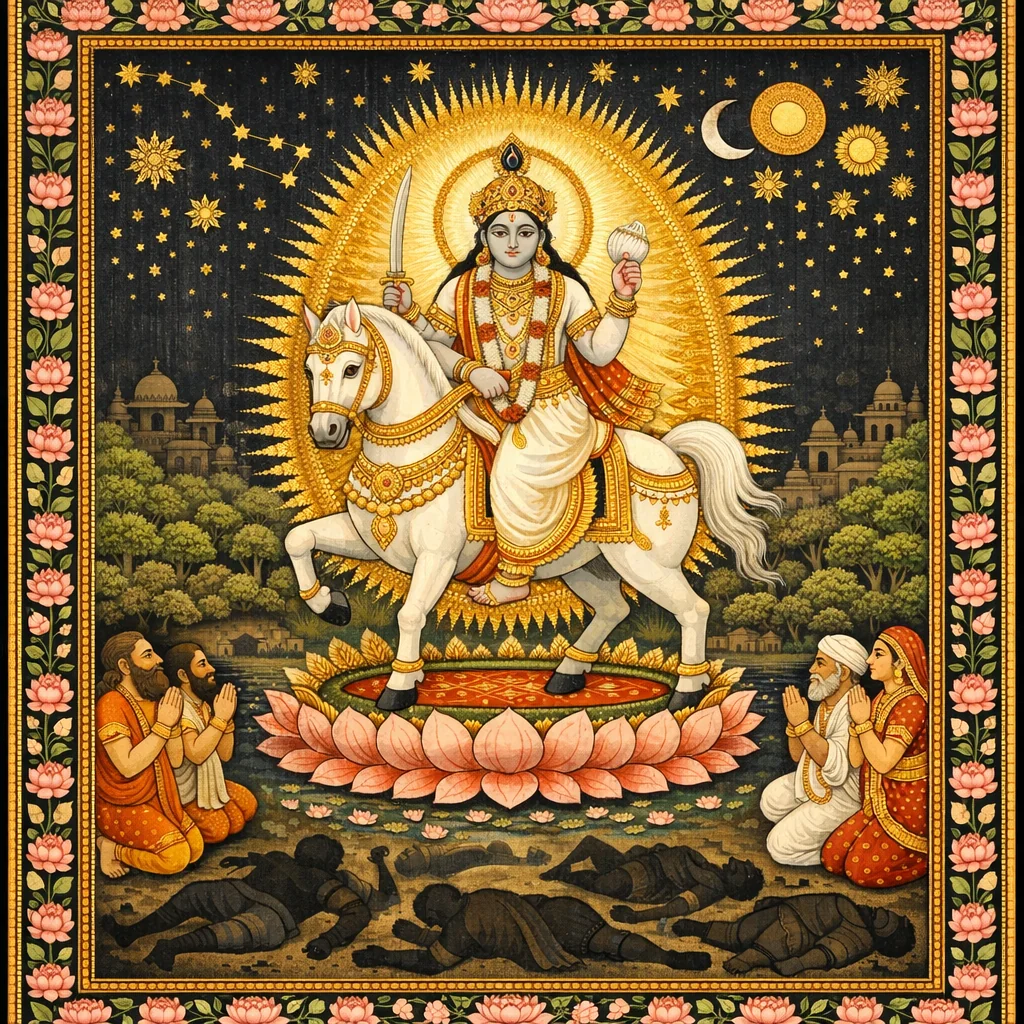
Lord Kalki will appear in the home of the most eminent brāhmaṇa of Śambhala village, the great soul Viṣṇuyaśā.
Verse 19
अश्वमाशुगमारुह्य देवदत्तं जगत्पति: । असिनासाधुदमनमष्टैश्वर्यगुणान्वित: ॥ १९ ॥ विचरन्नाशुना क्षौण्यां हयेनाप्रतिमद्युति: । नृपलिङ्गच्छदो दस्यून्कोटिशो निहनिष्यति ॥ २० ॥
Lord Kalki, the Lord of the universe, will mount His swift horse Devadatta and, sword in hand, travel over the earth exhibiting His eight mystic opulences and eight special qualities of Godhead. Displaying His unequaled effulgence and riding with great speed, He will kill by the millions those thieves who have dared dress as kings.
Verse 20
अश्वमाशुगमारुह्य देवदत्तं जगत्पति: । असिनासाधुदमनमष्टैश्वर्यगुणान्वित: ॥ १९ ॥ विचरन्नाशुना क्षौण्यां हयेनाप्रतिमद्युति: । नृपलिङ्गच्छदो दस्यून्कोटिशो निहनिष्यति ॥ २० ॥
Lord Kalki, the Lord of the universe, will mount His swift horse Devadatta and, sword in hand, travel over the earth exhibiting His eight mystic opulences and eight special qualities of Godhead. Displaying His unequaled effulgence and riding with great speed, He will kill by the millions those thieves who have dared dress as kings.
Verse 21
अथ तेषां भविष्यन्ति मनांसि विशदानि वै । वासुदेवाङ्गरागातिपुण्यगन्धानिलस्पृशाम् । पौरजानपदानां वै हतेष्वखिलदस्युषु ॥ २१ ॥
After all the impostor kings have been killed, the residents of the cities and towns will feel the breezes carrying the most sacred fragrance of the sandalwood paste and other decorations of Lord Vāsudeva, and their minds will thereby become transcendentally pure.
Verse 22
तेषां प्रजाविसर्गश्च स्थविष्ठ: सम्भविष्यति । वासुदेवे भगवति सत्त्वमूर्तौ हृदि स्थिते ॥ २२ ॥
When Lord Vāsudeva, the Supreme Personality of Godhead, appears in their hearts in His transcendental form of goodness, the remaining citizens will abundantly repopulate the earth.
Verse 23
यदावतीर्णो भगवान् कल्किर्धर्मपतिर्हरि: । कृतं भविष्यति तदा प्रजासूतिश्च सात्त्विकी ॥ २३ ॥
When the Supreme Lord has appeared on earth as Kalki, the maintainer of religion, Satya-yuga will begin, and human society will bring forth progeny in the mode of goodness.
Verse 24
यदा चन्द्रश्च सूर्यश्च तथा तिष्यबृहस्पती । एकराशौ समेष्यन्ति भविष्यति तदा कृतम् ॥ २४ ॥
When the moon, the sun and Bṛhaspatī are together in the constellation Karkaṭa, and all three enter simultaneously into the lunar mansion Puṣyā — at that exact moment the age of Satya, or Kṛta, will begin.
Verse 25
येऽतीता वर्तमाना ये भविष्यन्ति च पार्थिवा: । ते त उद्देशत: प्रोक्ता वंशीया: सोमसूर्ययो: ॥ २५ ॥
Thus I have described all the kings — past, present and future — who belong to the dynasties of the sun and the moon.
Verse 26
आरभ्य भवतो जन्म यावन्नन्दाभिषेचनम् । एतद् वर्षसहस्रं तु शतं पञ्चदशोत्तरम् ॥ २६ ॥
From your birth up to the coronation of King Nanda, 1,150 years will pass.
Verse 27
सप्तर्षीणां तु यौ पूर्वौ दृश्येते उदितौ दिवि । तयोस्तु मध्ये नक्षत्रं दृश्यते यत् समं निशि ॥ २७ ॥ तेनैव ऋषयो युक्तास्तिष्ठन्त्यब्दशतं नृणाम् । ते त्वदीये द्विजा: काल अधुना चाश्रिता मघा: ॥ २८ ॥
Of the seven stars forming the constellation of the seven sages, Pulaha and Kratu are the first to rise in the night sky. If a line running north and south were drawn through their midpoint, whichever of the lunar mansions this line passes through is said to be the ruling asterism of the constellation for that time. The Seven Sages will remain connected with that particular lunar mansion for one hundred human years. Currently, during your lifetime, they are situated in the nakṣatra called Maghā.
Verse 28
सप्तर्षीणां तु यौ पूर्वौ दृश्येते उदितौ दिवि । तयोस्तु मध्ये नक्षत्रं दृश्यते यत् समं निशि ॥ २७ ॥ तेनैव ऋषयो युक्तास्तिष्ठन्त्यब्दशतं नृणाम् । ते त्वदीये द्विजा: काल अधुना चाश्रिता मघा: ॥ २८ ॥
Of the seven stars forming the constellation of the seven sages, Pulaha and Kratu are the first to rise in the night sky. If a line running north and south were drawn through their midpoint, whichever of the lunar mansions this line passes through is said to be the ruling asterism of the constellation for that time. The Seven Sages will remain connected with that particular lunar mansion for one hundred human years. Currently, during your lifetime, they are situated in the nakṣatra called Maghā.
Verse 29
विष्णोर्भगवतो भानु: कृष्णाख्योऽसौ दिवं गत: । तदाविशत् कलिर्लोकं पापे यद् रमते जन: ॥ २९ ॥
The Supreme Lord, Viṣṇu, is brilliant like the sun and is known as Kṛṣṇa. When He returned to the spiritual sky, Kali entered this world, and people then began to take pleasure in sinful activities.
Verse 30
यावत् स पादपद्माभ्यां स्पृशनास्ते रमापति: । तावत् कलिर्वै पृथिवीं पराक्रन्तुं न चाशकत् ॥ ३० ॥
As long as Lord Śrī Kṛṣṇa, the husband of the goddess of fortune, touched the earth with His lotus feet, Kali was powerless to subdue this planet.
Verse 31
यदा देवर्षय: सप्त मघासु विचरन्ति हि । तदा प्रवृत्तस्तु कलिर्द्वादशाब्दशतात्मक: ॥ ३१ ॥
When the constellation of the seven sages is passing through the lunar mansion Maghā, the Age of Kali begins. It comprises twelve hundred years of the demigods.
Verse 32
यदा मघाभ्यो यास्यन्ति पूर्वाषाढां महर्षय: । तदा नन्दात् प्रभृत्येष कलिर्वृद्धिं गमिष्यति ॥ ३२ ॥
When the great sages of the Saptarṣi constellation pass from Maghā to Pūrvāsāḍhā, Kali will have his full strength, beginning from King Nanda and his dynasty.
Verse 33
यस्मिन् कृष्णो दिवं यातस्तस्मिन्नेव तदाहनि । प्रतिपन्नं कलियुगमिति प्राहु: पुराविद: ॥ ३३ ॥
Those who scientifically understand the past declare that on the very day that Lord Śrī Kṛṣṇa departed for the spiritual world, the influence of the Age of Kali began.
Verse 34
दिव्याब्दानां सहस्रान्ते चतुर्थे तु पुन: कृतम् । भविष्यति तदा नृणां मन आत्मप्रकाशकम् ॥ ३४ ॥
After the one thousand celestial years of Kali-yuga, the Satya-yuga will manifest again. At that time the minds of all men will become self-effulgent.
Verse 35
इत्येष मानवो वंशो यथा सङ्ख्यायते भुवि । तथा विट्शूद्रविप्राणां तास्ता ज्ञेया युगे युगे ॥ ३५ ॥
Thus I have described the royal dynasty of Manu, as it is known on this earth. One can similarly study the history of the vaiśyas, śūdras and brāhmaṇas living in the various ages.
Verse 36
एतेषां नामलिङ्गानां पुरुषाणां महात्मनाम् । कथामात्रावशिष्टानां कीर्तिरेव स्थिता भुवि ॥ ३६ ॥
These personalities, who were great souls, are now known only by their names. They exist only in accounts from the past, and only their fame remains on the earth.
Verse 37
देवापि: शान्तनोर्भ्राता मरुश्चेक्ष्वाकुवंशज: । कलापग्राम आसाते महायोगबलान्वितौ ॥ ३७ ॥
Devāpi, the brother of Mahārāja Śāntanu, and Maru, the descendant of Ikṣvāku, both possess great mystic strength and are living even now in the village of Kalāpa.
Verse 38
ताविहैत्य कलेरन्ते वासुदेवानुशिक्षितौ । वर्णाश्रमयुतं धर्मं पूर्ववत् प्रथयिष्यत: ॥ ३८ ॥
At the end of the Age of Kali, these two kings, having received instruction directly from the Supreme Personality of Godhead, Vāsudeva, will return to human society and reestablish the eternal religion of man, characterized by the divisions of varṇa and āśrama, just as it was before.
Verse 39
कृतं त्रेता द्वापरं च कलिश्चेति चतुर्युगम् । अनेन क्रमयोगेन भुवि प्राणिषु वर्तते ॥ ३९ ॥
The cycle of four ages — Satya, Tretā, Dvāpara and Kali — continues perpetually among living beings on this earth, repeating the same general sequence of events.
Verse 40
राजन्नेते मया प्रोक्ता नरदेवास्तथापरे । भूमौ ममत्वं कृत्वान्ते हित्वेमां निधनं गता: ॥ ४० ॥
My dear King Parīkṣit, all these kings I have described, as well as all other human beings, come to this earth and stake their claims, but ultimately they all must give up this world and meet their destruction.
Verse 41
कृमिविड्भस्मसंज्ञान्ते राजनाम्नोऽपि यस्य च । भूतध्रुक् तत्कृते स्वार्थं किं वेद निरयो यत: ॥ ४१ ॥
Even though a person’s body may now have the designation “king,” in the end its name will be “worms,” “stool” or “ashes.” What can a person who injures other living beings for the sake of his body know about his own self-interest, since his activities are simply leading him to hell?
Verse 42
कथं सेयमखण्डा भू: पूर्वैर्मे पुरुषैर्धृता । मत्पुत्रस्य च पौत्रस्य मत्पूर्वा वंशजस्य वा ॥ ४२ ॥
[The materialistic king thinks:] “This unbounded earth was held by my predecessors and is now under my sovereignty. How can I arrange for it to remain in the hands of my sons, grandsons and other descendants?”
Verse 43
तेजोऽबन्नमयं कायं गृहीत्वात्मतयाबुधा: । महीं ममतया चोभौ हित्वान्तेऽदर्शनं गता: ॥ ४३ ॥
Although the foolish accept the body made of earth, water and fire as “me” and this earth as “mine,” in every case they have ultimately abandoned both their body and the earth and passed away into oblivion.
Verse 44
ये ये भूपतयो राजन् भुञ्जते भुवमोजसा । कालेन ते कृता: सर्वे कथामात्रा: कथासु च ॥ ४४ ॥
My dear King Parīkṣit, all these kings who tried to enjoy the earth by their strength were reduced by the force of time to nothing more than historical accounts.
Frequently Asked Questions
Bhagavatam 12.2 describes a systematic inversion of values: virtue declines daily; wealth becomes the primary credential for status; justice follows power rather than dharma; relationships rest on superficial attraction; spiritual identity becomes external and performative; rulers behave like thieves; and common life is destabilized by taxation, famine, climate hardship, disease, and anxiety—culminating in shortened lifespan and societal fragmentation.
Viṣṇuyaśā is named as the eminent brāhmaṇa in whose home Kalki appears. Śambhala is significant as the prophesied locus of Kalki’s advent, functioning as a narrative anchor that emphasizes dharma’s restoration emerging from brāhmaṇical integrity (right knowledge and conduct) rather than from corrupt political power.
The chapter states that Kali’s influence began on the very day Lord Śrī Kṛṣṇa departed for the spiritual world, and it further correlates Kali’s onset with the Saptarṣi constellation’s position in the nakṣatra Maghā. This dual framing—historical-theological (Kṛṣṇa’s departure) and astronomical-chronological (nakṣatra markers)—presents Kali as both a moral condition and a time cycle.
The phrase indicates rulers who possess the title and regalia of kingship but act against the king’s dharmic function of protection. Kalki’s action is portrayed as dharma-saṁsthāpana: removing predatory governance that drives society into fear, famine, and irreligion, thereby enabling a renewed social order conducive to sattva and spiritual practice.
By showing that even the greatest rulers become only names in history and that bodily designations collapse into decay, the chapter undermines bodily and territorial possessiveness (“I” and “mine”). The intended conclusion is vairāgya (detachment) grounded in bhakti: recognizing time’s supremacy and turning toward the Lord, who alone restores dharma and grants lasting welfare.