Adhyaya 7
Paramparā of the Atharva Veda and Purāṇas; Definition of a Purāṇa (Daśa-lakṣaṇam)
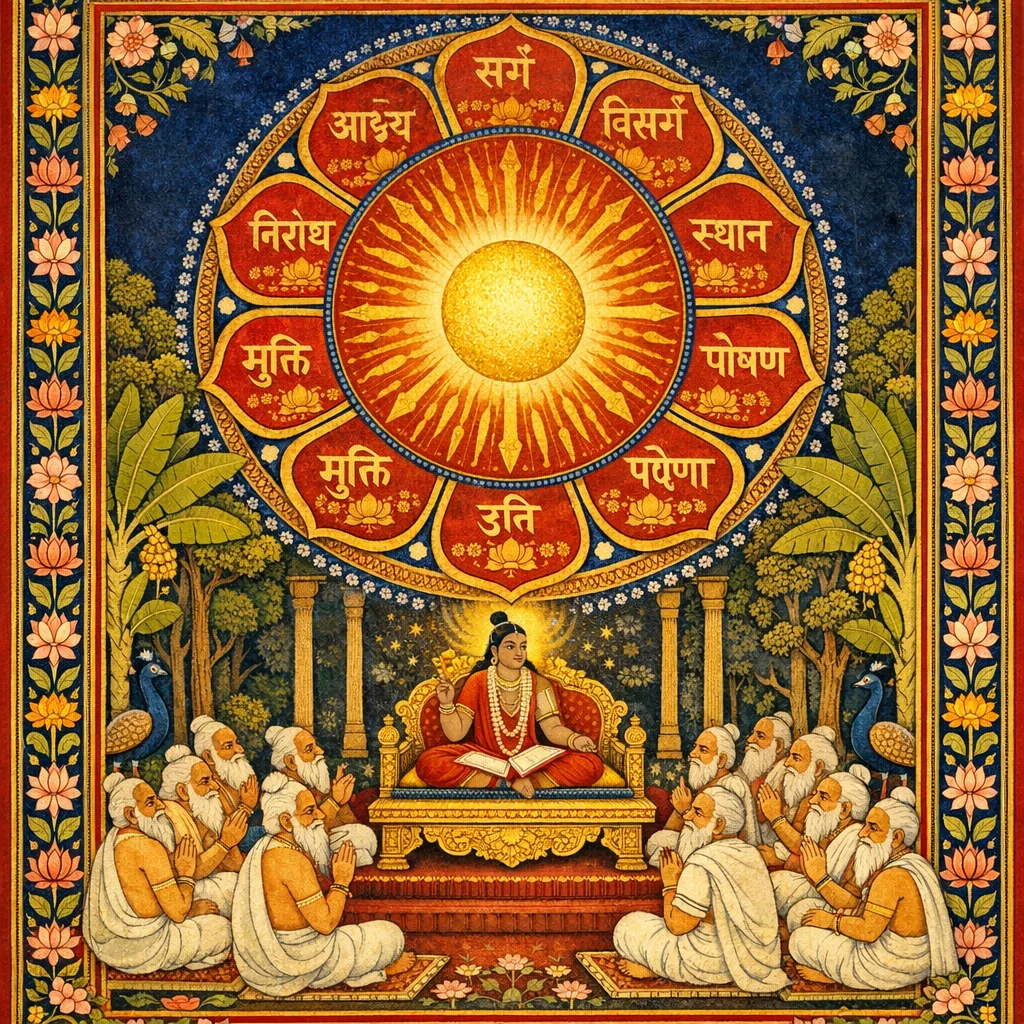
Continuing the canto’s concluding emphasis on safeguarding revelation in Kali-yuga, Sūta Gosvāmī traces the disciplic succession of the Atharva Veda from Sumantu Ṛṣi through Kabandha and onward to multiple branches of disciples, demonstrating how śruti is preserved by authorized teachers. He then shifts to Purāṇic authority, naming six principal masters of Purāṇas who learned from Romaharṣaṇa (Vyāsa’s disciple), and explains the division of Purāṇas into foundational compilations. The chapter then provides a formal definition of a Purāṇa via the ten characteristic topics (daśa-lakṣaṇam): sarga, visarga, sthāna, poṣaṇa, ūti, manvantara, īśānukathā, nirodha, mukti, and āśraya—clarifying that major Purāṇas treat all ten, while minor works may treat five. These topics are briefly unpacked with philosophical precision, culminating in āśraya—the Absolute Truth as the ultimate shelter present within and beyond all states. The chapter closes by listing the eighteen Mahāpurāṇas and affirming that hearing this lineage narrative strengthens spiritual potency, preparing the reader for the Bhāgavata’s final consolidations that follow.
Shlokas
Verse 1
सूत उवाच अथर्ववित्सुमन्तुश्च शिष्यमध्यापयत् स्वकाम् । संहितां सोऽपि पथ्याय वेददर्शाय चोक्तवान् ॥ १ ॥
Sūta Gosvāmī said: Sumantu Ṛṣi, the authority on the Atharva Veda, taught his saṁhitā to his disciple Kabandha, who in turn spoke it to Pathya and Vedadarśa.
Verse 2
शौक्लायनिर्ब्रह्मबलिर्मोदोष: पिप्पलायनि: । वेददर्शस्य शिष्यास्ते पथ्यशिष्यानथो शृणु । कुमुद: शुनको ब्रह्मन् जाजलिश्चाप्यथर्ववित् ॥ २ ॥
Śauklāyani, Brahmabali, Modoṣa and Pippalāyani were disciples of Vedadarśa. Hear from me also the names of the disciples of Pathya. My dear brāhmaṇa, they are Kumuda, Śunaka and Jājali, all of whom knew the Atharva Veda very well.
Verse 3
बभ्रु: शिष्योऽथाङ्गिरस: सैन्धवायन एव च । अधीयेतां संहिते द्वे सावर्णाद्यास्तथापरे ॥ ३ ॥
Babhru and Saindhavāyana, disciples of Śunaka, studied the two divisions of their spiritual master’s compilation of the Atharva Veda. Saindhavāyana’s disciple Sāvarṇa and disciples of other great sages also studied this edition of the Atharva Veda.
Verse 4
नक्षत्रकल्प: शान्तिश्च कश्यपाङ्गिरसादय: । एते आथर्वणाचार्या: शृणु पौराणिकान् मुने ॥ ४ ॥
Nakṣatrakalpa, Śāntikalpa, Kaśyapa, Āṅgirasa and others were also among the ācāryas of the Atharva Veda. Now, O sage, listen as I name the authorities on Purāṇic literature.
Verse 5
त्रय्यारुणि: कश्यपश्च सावर्णिरकृतव्रण: । वैशम्पायनहारीतौ षड् वै पौराणिका इमे ॥ ५ ॥
Trayyāruṇi, Kaśyapa, Sāvarṇi, Akṛtavraṇa, Vaiśampāyana and Hārīta are the six masters of the Purāṇas.
Verse 6
अधीयन्त व्यासशिष्यात् संहितां मत्पितुर्मुखात् । एकैकामहमेतेषां शिष्य: सर्वा: समध्यगाम् ॥ ६ ॥
Each of them studied one of the six anthologies of the Purāṇas from my father, Romaharṣaṇa, who was a disciple of Śrīla Vyāsadeva. I became the disciple of these six authorities and thoroughly learned all their presentations of Purāṇic wisdom.
Verse 7
कश्यपोऽहं च सावर्णी रामशिष्योऽकृतव्रण: । अधीमहि व्यासशिष्याच्चत्वारो मूलसंहिता: ॥ ७ ॥
Romaharṣaṇa, a disciple of Vedavyāsa, divided the Purāṇas into four basic compilations. The sage Kaśyapa and I, along with Sāvarṇi and Akṛtavraṇa, a disciple of Rāma, learned these four divisions.
Verse 8
पुराणलक्षणं ब्रह्मन् ब्रह्मर्षिभिर्निरूपितम् । शृणुष्व बुद्धिमाश्रित्य वेदशास्त्रानुसारत: ॥ ८ ॥
O Śaunaka, please hear with attention the characteristics of a Purāṇa, which have been defined by the most eminent learned brāhmaṇas in accordance with Vedic literature.
Verse 9
सर्गोऽस्याथ विसर्गश्च वृत्तिरक्षान्तराणि च । वंशो वंशानुचरितं संस्था हेतुरपाश्रय: ॥ ९ ॥ दशभिर्लक्षणैर्युक्तं पुराणं तद्विदो विदु: । केचित् पञ्चविधं ब्रह्मन् महदल्पव्यवस्थया ॥ १० ॥
O brāhmaṇa, authorities on the matter understand a Purāṇa to contain ten characteristic topics: the creation of this universe, the subsequent creation of worlds and beings, the maintenance of all living beings, their sustenance, the rule of various Manus, the dynasties of great kings, the activities of such kings, annihilation, motivation and the supreme shelter. Other scholars state that the great Purāṇas deal with these ten topics, while lesser Purāṇas may deal with five.
Verse 10
सर्गोऽस्याथ विसर्गश्च वृत्तिरक्षान्तराणि च । वंशो वंशानुचरितं संस्था हेतुरपाश्रय: ॥ ९ ॥ दशभिर्लक्षणैर्युक्तं पुराणं तद्विदो विदु: । केचित् पञ्चविधं ब्रह्मन् महदल्पव्यवस्थया ॥ १० ॥
O brāhmaṇa, authorities on the matter understand a Purāṇa to contain ten characteristic topics: the creation of this universe, the subsequent creation of worlds and beings, the maintenance of all living beings, their sustenance, the rule of various Manus, the dynasties of great kings, the activities of such kings, annihilation, motivation and the supreme shelter. Other scholars state that the great Purāṇas deal with these ten topics, while lesser Purāṇas may deal with five.
Verse 11
अव्याकृतगुणक्षोभान्महतत्रिस्त्रवृतोऽहम: । भूतसूक्ष्मेन्द्रियार्थानां सम्भव: सर्ग उच्यते ॥ ११ ॥
From the agitation of the original modes within the unmanifest material nature, the mahat-tattva arises. From the mahat-tattva comes the element false ego, which divides into three aspects. This threefold false ego further manifests as the subtle forms of perception, as the senses and as the gross sense objects. The generation of all these is called creation.
Verse 12
पुरुषानुगृहीतानामेतेषां वासनामय: । विसर्गोऽयं समाहारो बीजाद् बीजं चराचरम् ॥ १२ ॥
The secondary creation, which exists by the mercy of the Lord, is the manifest amalgamation of the desires of the living entities. Just as a seed produces additional seeds, activities that promote material desires in the performer produce moving and nonmoving life forms.
Verse 13
वृत्तिर्भूतानि भूतानां चराणामचराणि च । कृता स्वेन नृणां तत्र कामाच्चोदनयापि वा ॥ १३ ॥
Vṛtti means the process of sustenance, by which the moving beings live upon the nonmoving. For a human, vṛtti specifically means acting for one’s livelihood in a manner suited to his personal nature. Such action may be carried out either in pursuit of selfish desire or in accordance with the law of God.
Verse 14
रक्षाच्युतावतारेहा विश्वस्यानु युगे युगे । तिर्यङ्मर्त्यर्षिदेवेषु हन्यन्ते यैस्त्रयीद्विष: ॥ १४ ॥
In each age, the infallible Lord appears in this world among the animals, human beings, sages and demigods. By His activities in these incarnations He protects the universe and kills the enemies of Vedic culture.
Verse 15
मन्वन्तरं मनुर्देवा मनुपुत्रा: सुरेश्वरा: । ऋषयोऽशांवताराश्च हरे: षड्विधमुच्यते ॥ १५ ॥
In each reign of Manu, six types of personalities appear as manifestations of Lord Hari: the ruling Manu, the chief demigods, the sons of Manu, Indra, the great sages and the partial incarnations of the Supreme Personality of Godhead.
Verse 16
राज्ञां ब्रह्मप्रसूतानां वंश त्रैकालिकोऽन्वय: । वंशानुचरितं तेषां वृत्तं वंशधराश्च ये ॥ १६ ॥
Dynasties are lines of kings originating with Lord Brahmā and extending continuously through past, present and future. The accounts of such dynasties, especially of their most prominent members, constitute the subject of dynastic history.
Verse 17
नैमित्तिक: प्राकृतिको नित्य आत्यन्तिको लय: । संस्थेति कविभि: प्रोक्तश्चतुर्धास्य स्वभावत: ॥ १७ ॥
There are four types of cosmic annihilation — occasional, elemental, continuous and ultimate — all of which are effected by the inherent potency of the Supreme Lord. Learned scholars have designated this topic dissolution.
Verse 18
हेतुर्जीवोऽस्य सर्गादेरविद्याकर्मकारक: । यं चानुशायिनं प्राहुरव्याकृतमुतापरे ॥ १८ ॥
Out of ignorance the living being performs material activities and thereby becomes in one sense the cause of the creation, maintenance and destruction of the universe. Some authorities call the living being the personality underlying the material creation, while others say he is the unmanifest self.
Verse 19
व्यतिरेकान्वयो यस्य जाग्रत्स्वप्नसुषुप्तिषु । मायामयेषु तद् ब्रह्म जीववृत्तिष्वपाश्रय: ॥ १९ ॥
The Supreme Absolute Truth is present throughout all the stages of awareness — waking consciousness, sleep and deep sleep — throughout all the phenomena manifested by the illusory energy, and within the functions of all living entities, and He also exists separate from all these. Thus situated in His own transcendence, He is the ultimate and unique shelter.
Verse 20
पदार्थेषु यथा द्रव्यं सन्मात्रं रूपनामसु । बीजादिपञ्चतान्तासु ह्यवस्थासु युतायुतम् ॥ २० ॥
Although a material object may assume various forms and names, its essential ingredient is always present as the basis of its existence. Similarly, both conjointly and separately, the Supreme Absolute Truth is always present with the created material body throughout its phases of existence, beginning with conception and ending with death.
Verse 21
विरमेत यदा चित्तं हित्वा वृत्तित्रयं स्वयम् । योगेन वा तदात्मानं वेदेहाया निवर्तते ॥ २१ ॥
Either automatically or because of one’s regulated spiritual practice, one’s mind may stop functioning on the material platform of waking consciousness, sleep and deep sleep. Then one understands the Supreme Soul and withdraws from material endeavor.
Verse 22
एवंलक्षणलक्ष्याणि पुराणानि पुराविद: । मुनयोऽष्टादश प्राहु: क्षुल्लकानि महान्ति च ॥ २२ ॥
Sages expert in ancient histories have declared that the Purāṇas, according to their various characteristics, can be divided into eighteen major Purāṇas and eighteen secondary Purāṇas.
Verse 23
ब्राह्मं पाद्मं वैष्णवं च शैवं लैङ्गं सगारुडं । नारदीयं भागवतमाग्नेयं स्कान्दसंज्ञितम् ॥ २३ ॥ भविष्यं ब्रह्मवैवर्तं मार्कण्डेयं सवामनम् । वाराहं मात्स्यं कौर्मं च ब्रह्माण्डाख्यमिति त्रिषट् ॥ २४ ॥
The eighteen major Purāṇas are the Brahma, Padma, Viṣṇu, Śiva, Liṅga, Garuḍa, Nārada, Bhāgavata, Agni, Skanda, Bhaviṣya, Brahma-vaivarta, Mārkaṇḍeya, Vāmana, Varāha, Matsya, Kūrma and Brahmāṇḍa Purāṇas.
Verse 24
ब्राह्मं पाद्मं वैष्णवं च शैवं लैङ्गं सगारुडं । नारदीयं भागवतमाग्नेयं स्कान्दसंज्ञितम् ॥ २३ ॥ भविष्यं ब्रह्मवैवर्तं मार्कण्डेयं सवामनम् । वाराहं मात्स्यं कौर्मं च ब्रह्माण्डाख्यमिति त्रिषट् ॥ २४ ॥
The eighteen major Purāṇas are the Brahma, Padma, Viṣṇu, Śiva, Liṅga, Garuḍa, Nārada, Bhāgavata, Agni, Skanda, Bhaviṣya, Brahma-vaivarta, Mārkaṇḍeya, Vāmana, Varāha, Matsya, Kūrma and Brahmāṇḍa Purāṇas.
Verse 25
ब्रह्मन्निदं समाख्यातं शाखाप्रणयनं मुने: । शिष्यशिष्यप्रशिष्याणां ब्रह्मतेजोविवर्धनम् ॥ २५ ॥
I have thoroughly described to you, O brāhmaṇa, the expansion of the branches of the Vedas by the great sage Vyāsadeva, his disciples and the disciples of his disciples. One who listens to this narration will increase in spiritual strength.
Frequently Asked Questions
Bhagavatam 12.7 defines a Mahāpurāṇa as treating ten topics: sarga (primary creation), visarga (secondary creation), sthāna (cosmic situation/maintenance), poṣaṇa (the Lord’s protection of devotees and the universe), ūti/vṛtti (impetus and livelihood—how beings act and subsist), manvantara (Manu periods and their administrations), vaṁśa (dynasties), vaṁśānucarita/īśānukathā (histories of kings and narrations of the Lord and His incarnations), nirodha (dissolution), mukti (liberation), and āśraya (the Supreme Absolute Truth as ultimate shelter).
The chapter shows that revealed knowledge is preserved through authorized teachers who transmit it intact across generations. By naming lineages (śākhās) and principal Purāṇa-ācāryas, the Bhāgavata anchors its authority in paramparā—especially crucial in Kali-yuga—so that spiritual practice rests on reliable, living transmission rather than speculation.
Romaharṣaṇa is presented as a disciple of Vedavyāsa who systematized Purāṇic material into major compilations. Sūta identifies himself as Romaharṣaṇa’s son and explains that six Purāṇa-masters learned from Romaharṣaṇa, and that Sūta then learned from those authorities—establishing a layered chain of custody for Purāṇic wisdom.
Āśraya is defined as the Supreme Absolute Truth who pervades waking, dreaming, and deep sleep, is present within all manifestations of māyā and all living functions, and yet exists separately in His own transcendence. He is the stable basis underlying all changing names and forms, and realization of Him enables withdrawal from material endeavor.