Adhyaya 8
Mārkaṇḍeya Ṛṣi Tested by Indra and Blessed by Nara-Nārāyaṇa
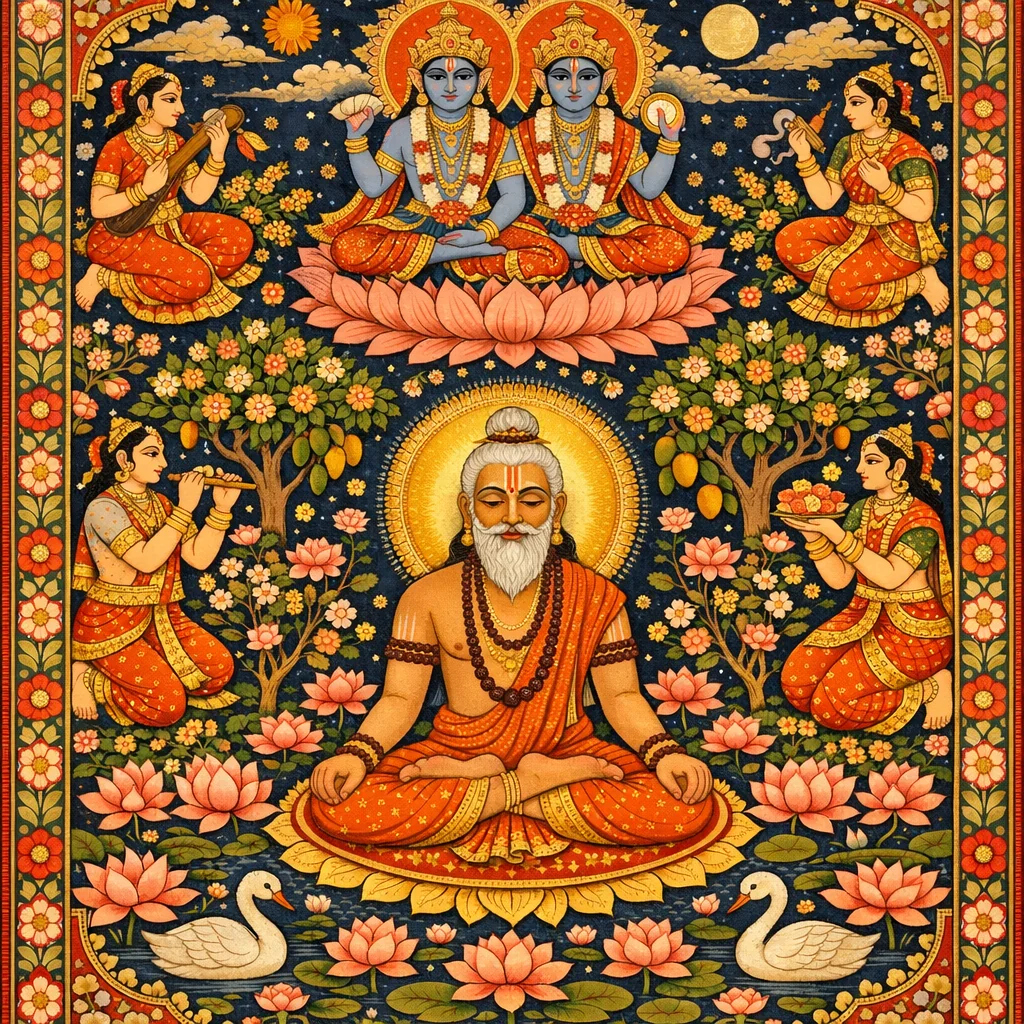
Continuing the Bhagavata’s late-canto emphasis on kāla, pralaya, and the sure refuge of Nārāyaṇa-kathā, Śaunaka asks Sūta to resolve an apparent paradox about Mārkaṇḍeya Ṛṣi: he is famed as a survivor of Brahmā’s day-end dissolution and as the seer of the divine infant on a banyan leaf, yet he is also said to appear within the current day of Brahmā where such total pralaya has not occurred. Sūta affirms that this inquiry itself dispels Kali’s illusion because it leads to the Lord’s topics. He then outlines Mārkaṇḍeya’s lifelong brahmacarya, rigorous tapas, Vedic study, disciplined daily worship (pañca-ārādhana), and mastery over death through sustained devotion. Alarmed by the sage’s growing potency, Indra sends Kāma, Apsarās, Gandharvas, Spring, and personified temptations to disturb him, but their seduction fails and they are scorched by his spiritual power. Pleased with his steadiness, the Supreme Lord appears directly as Nara and Nārāyaṇa, whom Mārkaṇḍeya reverently worships and praises, establishing the chapter’s bridge to the ensuing revelations about the Lord’s supremacy, māyā, and the true shelter beyond time.
Shlokas
Verse 1
श्रीशौनक उवाच सूत जीव चिरं साधो वद नो वदतां वर । तमस्यपारे भ्रमतां नृणां त्वं पारदर्शन: ॥ १ ॥
Śrī Śaunaka said: O Sūta, may you live a long life! O saintly one, best of speakers, please continue speaking to us. Indeed, only you can show men the path out of the ignorance in which they are wandering.
Verse 2
आहुश्चिरायुषमृषिं मृकण्डतनयं जना: । य: कल्पान्ते ह्युर्वरितो येन ग्रस्तमिदं जगत् ॥ २ ॥ स वा अस्मत्कुलोत्पन्न: कल्पेऽस्मिन् भार्गवर्षभ: । नैवाधुनापि भूतानां सम्प्लव: कोऽपि जायते ॥ ३ ॥ एक एवार्णवे भ्राम्यन् ददर्श पुरुषं किल । वटपत्रपुटे तोकं शयानं त्वेकमद्भुतम् ॥ ४ ॥ एष न: संशयो भूयान् सूत कौतूहलं यत: । तं नश्छिन्धि महायोगिन् पुराणेष्वपि सम्मत: ॥ ५ ॥
Authorities say that Mārkaṇḍeya Ṛṣi, the son of Mṛkaṇḍu, was an exceptionally long-lived sage who was the only survivor at the end of Brahmā’s day, when the entire universe was merged in the flood of annihilation. But this same Mārkaṇḍeya Ṛṣi, the foremost descendant of Bhṛgu, took birth in my own family during the current day of Brahmā, and we have not yet seen any total annihilation in this day of Brahmā. Also, it is well known that Mārkaṇḍeya, while wandering helplessly in the great ocean of annihilation, saw in those fearful waters a wonderful personality — an infant boy lying alone within the fold of a banyan leaf. O Sūta, I am most bewildered and curious about this great sage, Mārkaṇḍeya Ṛṣi. O great yogī, you are universally accepted as the authority on all the Purāṇas. Therefore kindly dispel my confusion.
Verse 3
आहुश्चिरायुषमृषिं मृकण्डतनयं जना: । य: कल्पान्ते ह्युर्वरितो येन ग्रस्तमिदं जगत् ॥ २ ॥ स वा अस्मत्कुलोत्पन्न: कल्पेऽस्मिन् भार्गवर्षभ: । नैवाधुनापि भूतानां सम्प्लव: कोऽपि जायते ॥ ३ ॥ एक एवार्णवे भ्राम्यन् ददर्श पुरुषं किल । वटपत्रपुटे तोकं शयानं त्वेकमद्भुतम् ॥ ४ ॥ एष न: संशयो भूयान् सूत कौतूहलं यत: । तं नश्छिन्धि महायोगिन् पुराणेष्वपि सम्मत: ॥ ५ ॥
Authorities say that Mārkaṇḍeya Ṛṣi, the son of Mṛkaṇḍu, was an exceptionally long-lived sage who was the only survivor at the end of Brahmā’s day, when the entire universe was merged in the flood of annihilation. But this same Mārkaṇḍeya Ṛṣi, the foremost descendant of Bhṛgu, took birth in my own family during the current day of Brahmā, and we have not yet seen any total annihilation in this day of Brahmā. Also, it is well known that Mārkaṇḍeya, while wandering helplessly in the great ocean of annihilation, saw in those fearful waters a wonderful personality — an infant boy lying alone within the fold of a banyan leaf. O Sūta, I am most bewildered and curious about this great sage, Mārkaṇḍeya Ṛṣi. O great yogī, you are universally accepted as the authority on all the Purāṇas. Therefore kindly dispel my confusion.
Verse 4
आहुश्चिरायुषमृषिं मृकण्डतनयं जना: । य: कल्पान्ते ह्युर्वरितो येन ग्रस्तमिदं जगत् ॥ २ ॥ स वा अस्मत्कुलोत्पन्न: कल्पेऽस्मिन् भार्गवर्षभ: । नैवाधुनापि भूतानां सम्प्लव: कोऽपि जायते ॥ ३ ॥ एक एवार्णवे भ्राम्यन् ददर्श पुरुषं किल । वटपत्रपुटे तोकं शयानं त्वेकमद्भुतम् ॥ ४ ॥ एष न: संशयो भूयान् सूत कौतूहलं यत: । तं नश्छिन्धि महायोगिन् पुराणेष्वपि सम्मत: ॥ ५ ॥
Authorities say that Mārkaṇḍeya Ṛṣi, the son of Mṛkaṇḍu, was an exceptionally long-lived sage who was the only survivor at the end of Brahmā’s day, when the entire universe was merged in the flood of annihilation. But this same Mārkaṇḍeya Ṛṣi, the foremost descendant of Bhṛgu, took birth in my own family during the current day of Brahmā, and we have not yet seen any total annihilation in this day of Brahmā. Also, it is well known that Mārkaṇḍeya, while wandering helplessly in the great ocean of annihilation, saw in those fearful waters a wonderful personality — an infant boy lying alone within the fold of a banyan leaf. O Sūta, I am most bewildered and curious about this great sage, Mārkaṇḍeya Ṛṣi. O great yogī, you are universally accepted as the authority on all the Purāṇas. Therefore kindly dispel my confusion.
Verse 5
आहुश्चिरायुषमृषिं मृकण्डतनयं जना: । य: कल्पान्ते ह्युर्वरितो येन ग्रस्तमिदं जगत् ॥ २ ॥ स वा अस्मत्कुलोत्पन्न: कल्पेऽस्मिन् भार्गवर्षभ: । नैवाधुनापि भूतानां सम्प्लव: कोऽपि जायते ॥ ३ ॥ एक एवार्णवे भ्राम्यन् ददर्श पुरुषं किल । वटपत्रपुटे तोकं शयानं त्वेकमद्भुतम् ॥ ४ ॥ एष न: संशयो भूयान् सूत कौतूहलं यत: । तं नश्छिन्धि महायोगिन् पुराणेष्वपि सम्मत: ॥ ५ ॥
Authorities say that Mārkaṇḍeya Ṛṣi, the son of Mṛkaṇḍu, was an exceptionally long-lived sage who was the only survivor at the end of Brahmā’s day, when the entire universe was merged in the flood of annihilation. But this same Mārkaṇḍeya Ṛṣi, the foremost descendant of Bhṛgu, took birth in my own family during the current day of Brahmā, and we have not yet seen any total annihilation in this day of Brahmā. Also, it is well known that Mārkaṇḍeya, while wandering helplessly in the great ocean of annihilation, saw in those fearful waters a wonderful personality — an infant boy lying alone within the fold of a banyan leaf. O Sūta, I am most bewildered and curious about this great sage, Mārkaṇḍeya Ṛṣi. O great yogī, you are universally accepted as the authority on all the Purāṇas. Therefore kindly dispel my confusion.
Verse 6
सूत उवाच प्रश्नस्त्वया महर्षेऽयं कृतो लोकभ्रमापह: । नारायणकथा यत्र गीता कलिमलापहा ॥ ६ ॥
Sūta Gosvāmī said: O great sage Śaunaka, your very question will help remove everyone’s illusion, for it leads to the topics of Lord Nārāyaṇa, which cleanse away the contamination of this Kali age.
Verse 7
प्राप्तद्विजातिसंस्कारो मार्कण्डेय: पितु: क्रमात् । छन्दांस्यधीत्य धर्मेण तप:स्वाध्यायसंयुत: ॥ ७ ॥ बृहद्व्रतधर: शान्तो जटिलो वल्कलाम्बर: । बिभ्रत् कमण्डलुं दण्डमुपवीतं समेखलम् ॥ ८ ॥ कृष्णाजिनं साक्षसूत्रं कुशांश्च नियमर्द्धये । अग्न्यर्कगुरुविप्रात्मस्वर्चयन् सन्ध्ययोर्हरिम् ॥ ९ ॥ सायं प्रात: स गुरवे भैक्ष्यमाहृत्य वाग्यत: । बुभुजे गुर्वनुज्ञात: सकृन्नो चेदुपोषित: ॥ १० ॥ एवं तप:स्वाध्यायपरो वर्षाणामयुतायुतम् । आराधयन् हृषीकेशं जिग्ये मृत्युं सुदुर्जयम् ॥ ११ ॥
After being purified by his father’s performance of the prescribed rituals leading to Mārkaṇḍeya’s brahminical initiation, Mārkaṇḍeya studied the Vedic hymns and strictly observed the regulative principles. He became advanced in austerity and Vedic knowledge and remained a lifelong celibate. Appearing most peaceful with his matted hair and his clothing made of bark, he furthered his spiritual progress by carrying the mendicant’s waterpot, staff, sacred thread, brahmacārī belt, black deerskin, lotus-seed prayer beads and bundles of kuśa grass. At the sacred junctures of the day he regularly worshiped the Supreme Personality of Godhead in five forms — the sacrificial fire, the sun, his spiritual master, the brāhmaṇas and the Supersoul within his heart. Morning and evening he would go out begging, and upon returning he would present all the food he had collected to his spiritual master. Only when his spiritual master invited him would he silently take his one meal of the day; otherwise he would fast. Thus devoted to austerity and Vedic study, Mārkaṇḍeya Ṛṣi worshiped the supreme master of the senses, the Personality of Godhead, for countless millions of years, and in this way he conquered unconquerable death.
Verse 8
प्राप्तद्विजातिसंस्कारो मार्कण्डेय: पितु: क्रमात् । छन्दांस्यधीत्य धर्मेण तप:स्वाध्यायसंयुत: ॥ ७ ॥ बृहद्व्रतधर: शान्तो जटिलो वल्कलाम्बर: । बिभ्रत् कमण्डलुं दण्डमुपवीतं समेखलम् ॥ ८ ॥ कृष्णाजिनं साक्षसूत्रं कुशांश्च नियमर्द्धये । अग्न्यर्कगुरुविप्रात्मस्वर्चयन् सन्ध्ययोर्हरिम् ॥ ९ ॥ सायं प्रात: स गुरवे भैक्ष्यमाहृत्य वाग्यत: । बुभुजे गुर्वनुज्ञात: सकृन्नो चेदुपोषित: ॥ १० ॥ एवं तप:स्वाध्यायपरो वर्षाणामयुतायुतम् । आराधयन् हृषीकेशं जिग्ये मृत्युं सुदुर्जयम् ॥ ११ ॥
After being purified by his father’s performance of the prescribed rituals leading to Mārkaṇḍeya’s brahminical initiation, Mārkaṇḍeya studied the Vedic hymns and strictly observed the regulative principles. He became advanced in austerity and Vedic knowledge and remained a lifelong celibate. Appearing most peaceful with his matted hair and his clothing made of bark, he furthered his spiritual progress by carrying the mendicant’s waterpot, staff, sacred thread, brahmacārī belt, black deerskin, lotus-seed prayer beads and bundles of kuśa grass. At the sacred junctures of the day he regularly worshiped the Supreme Personality of Godhead in five forms — the sacrificial fire, the sun, his spiritual master, the brāhmaṇas and the Supersoul within his heart. Morning and evening he would go out begging, and upon returning he would present all the food he had collected to his spiritual master. Only when his spiritual master invited him would he silently take his one meal of the day; otherwise he would fast. Thus devoted to austerity and Vedic study, Mārkaṇḍeya Ṛṣi worshiped the supreme master of the senses, the Personality of Godhead, for countless millions of years, and in this way he conquered unconquerable death.
Verse 9
प्राप्तद्विजातिसंस्कारो मार्कण्डेय: पितु: क्रमात् । छन्दांस्यधीत्य धर्मेण तप:स्वाध्यायसंयुत: ॥ ७ ॥ बृहद्व्रतधर: शान्तो जटिलो वल्कलाम्बर: । बिभ्रत् कमण्डलुं दण्डमुपवीतं समेखलम् ॥ ८ ॥ कृष्णाजिनं साक्षसूत्रं कुशांश्च नियमर्द्धये । अग्न्यर्कगुरुविप्रात्मस्वर्चयन् सन्ध्ययोर्हरिम् ॥ ९ ॥ सायं प्रात: स गुरवे भैक्ष्यमाहृत्य वाग्यत: । बुभुजे गुर्वनुज्ञात: सकृन्नो चेदुपोषित: ॥ १० ॥ एवं तप:स्वाध्यायपरो वर्षाणामयुतायुतम् । आराधयन् हृषीकेशं जिग्ये मृत्युं सुदुर्जयम् ॥ ११ ॥
After being purified by his father’s performance of the prescribed rituals leading to Mārkaṇḍeya’s brahminical initiation, Mārkaṇḍeya studied the Vedic hymns and strictly observed the regulative principles. He became advanced in austerity and Vedic knowledge and remained a lifelong celibate. Appearing most peaceful with his matted hair and his clothing made of bark, he furthered his spiritual progress by carrying the mendicant’s waterpot, staff, sacred thread, brahmacārī belt, black deerskin, lotus-seed prayer beads and bundles of kuśa grass. At the sacred junctures of the day he regularly worshiped the Supreme Personality of Godhead in five forms — the sacrificial fire, the sun, his spiritual master, the brāhmaṇas and the Supersoul within his heart. Morning and evening he would go out begging, and upon returning he would present all the food he had collected to his spiritual master. Only when his spiritual master invited him would he silently take his one meal of the day; otherwise he would fast. Thus devoted to austerity and Vedic study, Mārkaṇḍeya Ṛṣi worshiped the supreme master of the senses, the Personality of Godhead, for countless millions of years, and in this way he conquered unconquerable death.
Verse 10
प्राप्तद्विजातिसंस्कारो मार्कण्डेय: पितु: क्रमात् । छन्दांस्यधीत्य धर्मेण तप:स्वाध्यायसंयुत: ॥ ७ ॥ बृहद्व्रतधर: शान्तो जटिलो वल्कलाम्बर: । बिभ्रत् कमण्डलुं दण्डमुपवीतं समेखलम् ॥ ८ ॥ कृष्णाजिनं साक्षसूत्रं कुशांश्च नियमर्द्धये । अग्न्यर्कगुरुविप्रात्मस्वर्चयन् सन्ध्ययोर्हरिम् ॥ ९ ॥ सायं प्रात: स गुरवे भैक्ष्यमाहृत्य वाग्यत: । बुभुजे गुर्वनुज्ञात: सकृन्नो चेदुपोषित: ॥ १० ॥ एवं तप:स्वाध्यायपरो वर्षाणामयुतायुतम् । आराधयन् हृषीकेशं जिग्ये मृत्युं सुदुर्जयम् ॥ ११ ॥
After being purified by his father’s performance of the prescribed rituals leading to Mārkaṇḍeya’s brahminical initiation, Mārkaṇḍeya studied the Vedic hymns and strictly observed the regulative principles. He became advanced in austerity and Vedic knowledge and remained a lifelong celibate. Appearing most peaceful with his matted hair and his clothing made of bark, he furthered his spiritual progress by carrying the mendicant’s waterpot, staff, sacred thread, brahmacārī belt, black deerskin, lotus-seed prayer beads and bundles of kuśa grass. At the sacred junctures of the day he regularly worshiped the Supreme Personality of Godhead in five forms — the sacrificial fire, the sun, his spiritual master, the brāhmaṇas and the Supersoul within his heart. Morning and evening he would go out begging, and upon returning he would present all the food he had collected to his spiritual master. Only when his spiritual master invited him would he silently take his one meal of the day; otherwise he would fast. Thus devoted to austerity and Vedic study, Mārkaṇḍeya Ṛṣi worshiped the supreme master of the senses, the Personality of Godhead, for countless millions of years, and in this way he conquered unconquerable death.
Verse 11
प्राप्तद्विजातिसंस्कारो मार्कण्डेय: पितु: क्रमात् । छन्दांस्यधीत्य धर्मेण तप:स्वाध्यायसंयुत: ॥ ७ ॥ बृहद्व्रतधर: शान्तो जटिलो वल्कलाम्बर: । बिभ्रत् कमण्डलुं दण्डमुपवीतं समेखलम् ॥ ८ ॥ कृष्णाजिनं साक्षसूत्रं कुशांश्च नियमर्द्धये । अग्न्यर्कगुरुविप्रात्मस्वर्चयन् सन्ध्ययोर्हरिम् ॥ ९ ॥ सायं प्रात: स गुरवे भैक्ष्यमाहृत्य वाग्यत: । बुभुजे गुर्वनुज्ञात: सकृन्नो चेदुपोषित: ॥ १० ॥ एवं तप:स्वाध्यायपरो वर्षाणामयुतायुतम् । आराधयन् हृषीकेशं जिग्ये मृत्युं सुदुर्जयम् ॥ ११ ॥
After being purified by his father’s performance of the prescribed rituals leading to Mārkaṇḍeya’s brahminical initiation, Mārkaṇḍeya studied the Vedic hymns and strictly observed the regulative principles. He became advanced in austerity and Vedic knowledge and remained a lifelong celibate. Appearing most peaceful with his matted hair and his clothing made of bark, he furthered his spiritual progress by carrying the mendicant’s waterpot, staff, sacred thread, brahmacārī belt, black deerskin, lotus-seed prayer beads and bundles of kuśa grass. At the sacred junctures of the day he regularly worshiped the Supreme Personality of Godhead in five forms — the sacrificial fire, the sun, his spiritual master, the brāhmaṇas and the Supersoul within his heart. Morning and evening he would go out begging, and upon returning he would present all the food he had collected to his spiritual master. Only when his spiritual master invited him would he silently take his one meal of the day; otherwise he would fast. Thus devoted to austerity and Vedic study, Mārkaṇḍeya Ṛṣi worshiped the supreme master of the senses, the Personality of Godhead, for countless millions of years, and in this way he conquered unconquerable death.
Verse 12
ब्रह्मा भृगुर्भवो दक्षो ब्रह्मपुत्राश्च येऽपरे । नृदेवपितृभूतानि तेनासन्नतिविस्मिता: ॥ १२ ॥
Lord Brahmā, Bhṛgu Muni, Lord Śiva, Prajāpati Dakṣa, the great sons of Brahmā, and many others among the human beings, demigods, forefathers and ghostly spirits — all were astonished by the achievement of Mārkaṇḍeya Ṛṣi.
Verse 13
इत्थं बृहद्व्रतधरस्तप:स्वाध्यायसंयमै: । दध्यावधोक्षजं योगी ध्वस्तक्लेशान्तरात्मना ॥ १३ ॥
In this way the devotional mystic Mārkaṇḍeya maintained rigid celibacy through penance, study of the Vedas and self-discipline. With his mind thus free of all disturbances, he turned it inward and meditated on the Supreme Personality of Godhead, who lies beyond the material senses.
Verse 14
तस्यैवं युञ्जतश्चित्तं महायोगेन योगिन: । व्यतीयाय महान् कालो मन्वन्तरषडात्मक: ॥ १४ ॥
While the mystic sage thus concentrated his mind by powerful yoga practice, the tremendous period of six lifetimes of Manu passed by.
Verse 15
एतत् पुरन्दरो ज्ञात्वा सप्तमेऽस्मिन् किलान्तरे । तपोविशङ्कितो ब्रह्मन्नारेभे तद्विघातनम् ॥ १५ ॥
O brāhmaṇa, during the seventh reign of Manu, the current age, Lord Indra came to know of Mārkaṇḍeya’s austerities and became fearful of his growing mystic potency. Thus he tried to impede the sage’s penance.
Verse 16
गन्धर्वाप्सरस: कामं वसन्तमलयानिलौ । मुनये प्रेषयामास रजस्तोकमदौ तथा ॥ १६ ॥
To ruin the sage’s spiritual practice, Lord Indra sent Cupid, beautiful celestial singers, dancing girls, the season of spring and the sandalwood-scented breeze from the Malaya Hills, along with greed and intoxication personified.
Verse 17
ते वै तदाश्रमं जग्मुर्हिमाद्रे: पार्श्व उत्तरे । पुष्पभद्रा नदी यत्र चित्राख्या च शिला विभो ॥ १७ ॥
O most powerful Śaunaka, they went to Mārkaṇḍeya’s hermitage, on the northern side of the Himālaya Mountains where the Puṣpabhadrā River passes by the famous peak Citrā.
Verse 18
तदाश्रमपदं पुण्यं पुण्यद्रुमलताञ्चितम् । पुण्यद्विजकुलाकीर्णं पुण्यामलजलाशयम् ॥ १८ ॥ मत्तभ्रमरसङ्गीतं मत्तकोकिलकूजितम् । मत्तबर्हिनटाटोपं मत्तद्विजकुलाकुलम् ॥ १९ ॥ वायु: प्रविष्ट आदाय हिमनिर्झरशीकरान् । सुमनोभि: परिष्वक्तो ववावुत्तम्भयन् स्मरम् ॥ २० ॥
Groves of pious trees decorated the holy āśrama of Mārkaṇḍeya Ṛṣi, and many saintly brāhmaṇas lived there, enjoying the abundant pure, sacred ponds. The āśrama resounded with the buzzing of intoxicated bees and the cooing of excited cuckoos, while jubilant peacocks danced about. Indeed, many families of maddened birds crowded that hermitage. The springtime breeze sent by Lord Indra entered there, carrying cooling drops of spray from nearby waterfalls. Fragrant from the embrace of forest flowers, that breeze entered the hermitage and began evoking the lusty spirit of Cupid.
Verse 19
तदाश्रमपदं पुण्यं पुण्यद्रुमलताञ्चितम् । पुण्यद्विजकुलाकीर्णं पुण्यामलजलाशयम् ॥ १८ ॥ मत्तभ्रमरसङ्गीतं मत्तकोकिलकूजितम् । मत्तबर्हिनटाटोपं मत्तद्विजकुलाकुलम् ॥ १९ ॥ वायु: प्रविष्ट आदाय हिमनिर्झरशीकरान् । सुमनोभि: परिष्वक्तो ववावुत्तम्भयन् स्मरम् ॥ २० ॥
Groves of pious trees decorated the holy āśrama of Mārkaṇḍeya Ṛṣi, and many saintly brāhmaṇas lived there, enjoying the abundant pure, sacred ponds. The āśrama resounded with the buzzing of intoxicated bees and the cooing of excited cuckoos, while jubilant peacocks danced about. Indeed, many families of maddened birds crowded that hermitage. The springtime breeze sent by Lord Indra entered there, carrying cooling drops of spray from nearby waterfalls. Fragrant from the embrace of forest flowers, that breeze entered the hermitage and began evoking the lusty spirit of Cupid.
Verse 20
तदाश्रमपदं पुण्यं पुण्यद्रुमलताञ्चितम् । पुण्यद्विजकुलाकीर्णं पुण्यामलजलाशयम् ॥ १८ ॥ मत्तभ्रमरसङ्गीतं मत्तकोकिलकूजितम् । मत्तबर्हिनटाटोपं मत्तद्विजकुलाकुलम् ॥ १९ ॥ वायु: प्रविष्ट आदाय हिमनिर्झरशीकरान् । सुमनोभि: परिष्वक्तो ववावुत्तम्भयन् स्मरम् ॥ २० ॥
Groves of pious trees decorated the holy āśrama of Mārkaṇḍeya Ṛṣi, and many saintly brāhmaṇas lived there, enjoying the abundant pure, sacred ponds. The āśrama resounded with the buzzing of intoxicated bees and the cooing of excited cuckoos, while jubilant peacocks danced about. Indeed, many families of maddened birds crowded that hermitage. The springtime breeze sent by Lord Indra entered there, carrying cooling drops of spray from nearby waterfalls. Fragrant from the embrace of forest flowers, that breeze entered the hermitage and began evoking the lusty spirit of Cupid.
Verse 21
उद्यच्चन्द्रनिशावक्त्र: प्रवालस्तबकालिभि: । गोपद्रुमलताजालैस्तत्रासीत् कुसुमाकर: ॥ २१ ॥
Springtime then appeared in Mārkaṇḍeya’s āśrama. Indeed, the evening sky, glowing with the light of the rising moon, became the very face of spring, and sprouts and fresh blossoms virtually covered the multitude of trees and creepers.
Verse 22
अन्वीयमानो गन्धर्वैर्गीतवादित्रयूथकै: । अदृश्यतात्तचापेषु: स्व:स्त्रीयूथपति: स्मर: ॥ २२ ॥
Cupid, the master of many heavenly women, then came there holding his bow and arrows. He was followed by groups of Gandharvas playing musical instruments and singing.
Verse 23
हुत्वाग्निं समुपासीनं ददृशु: शक्रकिङ्करा: । मीलिताक्षं दुराधर्षं मूर्तिमन्तमिवानलम् ॥ २३ ॥
These servants of Indra found the sage sitting in meditation, having just offered his prescribed oblations into the sacrificial fire. His eyes closed in trance, he seemed invincible, like fire personified.
Verse 24
ननृतुस्तस्य पुरत: स्त्रियोऽथो गायका जगु: । मृदङ्गवीणापणवैर्वाद्यं चक्रुर्मनोरमम् ॥ २४ ॥
The women danced before the sage, and the celestial singers sang to the charming accompaniment of drums, cymbals and vīṇās.
Verse 25
सन्दधेऽस्त्रं स्वधनुषि काम: पञ्चमुखं तदा । मधुर्मनो रजस्तोक इन्द्रभृत्या व्यकम्पयन् ॥ २५ ॥
While the son of passion [greed personified], spring and the other servants of Indra all tried to agitate Mārkaṇḍeya’s mind, Cupid drew his five-headed arrow and fixed it upon his bow.
Verse 26
क्रीडन्त्या: पुञ्जिकस्थल्या: कन्दुकै: स्तनगौरवात् । भृशमुद्विग्नमध्याया: केशविस्रंसितस्रज: ॥ २६ ॥ इतस्ततोभ्रमद्दृष्टेश्चलन्त्या अनुकन्दुकम् । वायुर्जहार तद्वास: सूक्ष्मं त्रुटितमेखलम् ॥ २७ ॥
The Apsarā Puñjikasthalī made a show of playing with a number of toy balls. Her waist seemed weighed down by her heavy breasts, and the wreath of flowers in her hair became disheveled. As she ran about after the balls, glancing here and there, the belt of her thin garment loosened, and suddenly the wind blew her clothes away.
Verse 27
क्रीडन्त्या: पुञ्जिकस्थल्या: कन्दुकै: स्तनगौरवात् । भृशमुद्विग्नमध्याया: केशविस्रंसितस्रज: ॥ २६ ॥ इतस्ततोभ्रमद्दृष्टेश्चलन्त्या अनुकन्दुकम् । वायुर्जहार तद्वास: सूक्ष्मं त्रुटितमेखलम् ॥ २७ ॥
The Apsarā Puñjikasthalī made a show of playing with a number of toy balls. Her waist seemed weighed down by her heavy breasts, and the wreath of flowers in her hair became disheveled. As she ran about after the balls, glancing here and there, the belt of her thin garment loosened, and suddenly the wind blew her clothes away.
Verse 28
विससर्ज तदा बाणं मत्वा तं स्वजितं स्मर: । सर्वं तत्राभवन्मोघमनीशस्य यथोद्यम: ॥ २८ ॥
Cupid, thinking he had conquered the sage, then shot his arrow. But all these attempts to seduce Mārkaṇḍeya proved futile, just like the useless endeavors of an atheist.
Verse 29
त इत्थमपकुर्वन्तो मुनेस्तत्तेजसा मुने । दह्यमाना निववृतु: प्रबोध्याहिमिवार्भका: ॥ २९ ॥
O learned Śaunaka, while Cupid and his followers tried to harm the sage, they felt themselves being burned alive by his potency. Thus they stopped their mischief, just like children who have aroused a sleeping snake.
Verse 30
इतीन्द्रानुचरैर्ब्रह्मन् धर्षितोऽपि महामुनि: । यन्नागादहमो भावं न तच्चित्रं महत्सु हि ॥ ३० ॥
O brāhmaṇa, the followers of Lord Indra had impudently attacked the saintly Mārkaṇḍeya, yet he did not succumb to any influence of false ego. For great souls such tolerance is not at all surprising.
Verse 31
दृष्ट्वा निस्तेजसं कामं सगणं भगवान् स्वराट् । श्रुत्वानुभावं ब्रह्मर्षेर्विस्मयं समगात् परम् ॥ ३१ ॥
The mighty King Indra was most astonished when he heard of the mystic prowess of the exalted sage Mārkaṇḍeya and saw how Cupid and his associates had become powerless in his presence.
Verse 32
तस्यैवं युञ्जतश्चित्तं तप:स्वाध्यायसंयमै: । अनुग्रहायाविरासीन्नरनारायणो हरि: ॥ ३२ ॥
Desiring to bestow His mercy upon the saintly Mārkaṇḍeya, who had perfectly fixed his mind in self-realization through penance, Vedic study and observance of regulative principles, the Supreme Personality of Godhead personally appeared before the sage in the forms of Nara and Nārāyaṇa.
Verse 33
तौ शुक्लकृष्णौ नवकञ्जलोचनौ चतुर्भुजौ रौरववल्कलाम्बरौ । पवित्रपाणी उपवीतकं त्रिवृत् कमण्डलुं दण्डमृजुं च वैणवम् ॥ ३३ ॥ पद्माक्षमालामुत जन्तुमार्जनं वेदं च साक्षात्तप एव रूपिणौ । तपत्तडिद्वर्णपिशङ्गरोचिषा प्रांशू दधानौ विबुधर्षभार्चितौ ॥ ३४ ॥
One of Them was of a whitish complexion, the other blackish, and They both had four arms. Their eyes resembled the petals of blooming lotuses, and They wore garments of black deerskin and bark, along with the three-stranded sacred thread. In Their hands, which were most purifying, They carried the mendicant’s waterpot, straight bamboo staff and lotus-seed prayer beads, as well as the all-purifying Vedas in the symbolic form of bundles of darbha grass. Their bearing was tall and Their yellow effulgence the color of radiant lightning. Appearing as austerity personified, They were being worshiped by the foremost demigods.
Verse 34
तौ शुक्लकृष्णौ नवकञ्जलोचनौ चतुर्भुजौ रौरववल्कलाम्बरौ । पवित्रपाणी उपवीतकं त्रिवृत् कमण्डलुं दण्डमृजुं च वैणवम् ॥ ३३ ॥ पद्माक्षमालामुत जन्तुमार्जनं वेदं च साक्षात्तप एव रूपिणौ । तपत्तडिद्वर्णपिशङ्गरोचिषा प्रांशू दधानौ विबुधर्षभार्चितौ ॥ ३४ ॥
One of Them was of a whitish complexion, the other blackish, and They both had four arms. Their eyes resembled the petals of blooming lotuses, and They wore garments of black deerskin and bark, along with the three-stranded sacred thread. In Their hands, which were most purifying, They carried the mendicant’s waterpot, straight bamboo staff and lotus-seed prayer beads, as well as the all-purifying Vedas in the symbolic form of bundles of darbha grass. Their bearing was tall and Their yellow effulgence the color of radiant lightning. Appearing as austerity personified, They were being worshiped by the foremost demigods.
Verse 35
ते वै भगवतो रूपे नरनारायणावृषी । दृष्ट्वोत्थायादरेणोच्चैर्ननामाङ्गेन दण्डवत् ॥ ३५ ॥
These two sages, Nara and Nārāyaṇa, were the direct personal forms of the Supreme Lord. When Mārkaṇḍeya Ṛṣi saw Them, he immediately stood up and then with great respect offered Them obeisances by falling down flat on the ground like a stick.
Verse 36
स तत्सन्दर्शनानन्दनिर्वृतात्मेन्द्रियाशय: । हृष्टरोमाश्रुपूर्णाक्षो न सेहे तावुदीक्षितुम् ॥ ३६ ॥
The ecstasy of seeing Them completely satisfied Mārkaṇḍeya’s body, mind and senses and caused the hairs on his body to stand on end and his eyes to fill with tears. Overwhelmed, Mārkaṇḍeya found it difficult to look at Them.
Verse 37
उत्थाय प्राञ्जलि: प्रह्व औत्सुक्यादाश्लिषन्निव । नमो नम इतीशानौ बभाशे गद्गदाक्षरम् ॥ ३७ ॥
Standing with his hands folded in supplication and his head bowed in humility, Mārkaṇḍeya felt such eagerness that he imagined he was embracing the two Lords. In a voice choked with ecstasy, he repeatedly said, “I offer You my humble obeisances.”
Verse 38
तयोरासनमादाय पादयोरवनिज्य च । अर्हणेनानुलेपेन धूपमाल्यैरपूजयत् ॥ ३८ ॥
He gave Them sitting places and washed Their feet, and then he worshiped Them with presentations of arghya, sandalwood pulp, fragrant oils, incense and flower garlands.
Verse 39
सुखमासनमासीनौ प्रसादाभिमुखौ मुनी । पुनरानम्य पादाभ्यां गरिष्ठाविदमब्रवीत् ॥ ३९ ॥
Mārkaṇḍeya Ṛṣi once again bowed down at the lotus feet of those two most worshipable sages, who were sitting at ease, ready to bestow all mercy upon him. He then addressed Them as follows.
Verse 40
श्रीमार्कण्डेय उवाच किं वर्णये तव विभो यदुदीरितोऽसु: संस्पन्दते तमनु वाङ्मनइन्द्रियाणि । स्पन्दन्ति वै तनुभृतामजशर्वयोश्च स्वस्याप्यथापि भजतामसि भावबन्धु: ॥ ४० ॥
Śrī Mārkaṇḍeya said: O Almighty Lord, how can I possibly describe You? You awaken the vital air, which then impels the mind, senses and power of speech to act. This is true for all ordinary conditioned souls and even for great demigods like Brahmā and Śiva. So it is certainly true for me. Nevertheless, You become the intimate friend of those who worship You.
Verse 41
मूर्ती इमे भगवतो भगवंस्त्रिलोक्या: क्षेमाय तापविरमाय च मृत्युजित्यै । नाना बिभर्ष्यवितुमन्यतनूर्यथेदं सृष्ट्वा पुनर्ग्रससि सर्वमिवोर्णनाभि: ॥ ४१ ॥
O Supreme Personality of Godhead, these two personal forms of Yours have appeared to bestow the ultimate benefit for the three worlds — the cessation of material misery and the conquest of death. My Lord, although You create this universe and then assume many transcendental forms to protect it, You also swallow it up, just like a spider who spins and later withdraws its web.
Verse 42
तस्यावितु: स्थिरचरेशितुरङ्घ्रिमूलं यत्स्थं न कर्मगुणकालरज: स्पृशन्ति । यद् वै स्तुवन्ति निनमन्ति यजन्त्यभीक्ष्णं ध्यायन्ति वेदहृदया मुनयस्तदाप्त्यै ॥ ४२ ॥
Because You are the protector and the supreme controller of all moving and nonmoving beings, anyone who takes shelter of Your lotus feet can never be touched by the contamination of material work, material qualities or time. Great sages who have assimilated the essential meaning of the Vedas offer their prayers to You. To gain Your association, they bow down to You at every opportunity and constantly worship You and meditate upon You.
Verse 43
नान्यं तवाङ्घ्र्युपनयादपवर्गमूर्ते: क्षेमं जनस्य परितोभिय ईश विद्म: । ब्रह्मा बिभेत्यलमतो द्विपरार्धधिष्ण्य: कालस्य ते किमुत तत्कृतभौतिकानाम् ॥ ४३ ॥
My dear Lord, even Lord Brahmā, who enjoys his exalted position for the entire duration of the universe, fears the passage of time. Then what to speak of those whom Brahmā creates, the conditioned souls. They encounter fearful dangers at every step of their lives. I do not know of any relief from this fear except shelter at Your lotus feet, which are the very form of liberation.
Verse 44
तद् वै भजाम्यृतधियस्तव पादमूलं हित्वेदमात्मच्छदि चात्मगुरो: परस्य । देहाद्यपार्थमसदन्त्यमभिज्ञमात्रं विन्देत ते तर्हि सर्वमनीषितार्थम् ॥ ४४ ॥
Therefore I worship Your lotus feet, having renounced my identification with the material body and everything else that covers my true self. These useless, insubstantial and temporary coverings are merely presumed to be separate from You, whose intelligence encompasses all truth. By attaining You — the Supreme Godhead and the master of the soul — one attains everything desirable.
Verse 45
सत्त्वं रजस्तम इतीश तवात्मबन्धो मायामया: स्थितिलयोदयहेतवोऽस्य । लीला धृता यदपि सत्त्वमयी प्रशान्त्यै नान्ये नृणां व्यसनमोहभियश्च याभ्याम् ॥ ४५ ॥
O my Lord, O supreme friend of the conditioned soul, although for the creation, maintenance and annihilation of this world You accept the modes of goodness, passion and ignorance, which constitute Your illusory potency, You specifically employ the mode of goodness to liberate the conditioned souls. The other two modes simply bring them suffering, illusion and fear.
Verse 46
तस्मात्तवेह भगवन्नथ तावकानां शुक्लां तनुं स्वदयितां कुशला भजन्ति । यत् सात्वता: पुरुषरूपमुशन्ति सत्त्वं लोको यतोऽभयमुतात्मसुखं न चान्यत् ॥ ४६ ॥
O Lord, because fearlessness, spiritual happiness and the kingdom of God are all achieved through the mode of pure goodness, Your devotees consider this mode, but never passion and ignorance, to be a direct manifestation of You, the Supreme Personality of Godhead. Intelligent persons thus worship Your beloved transcendental form, composed of pure goodness, along with the spiritual forms of Your pure devotees.
Verse 47
तस्मै नमो भगवते पुरुषाय भूम्ने विश्वाय विश्वगुरवे परदैवताय । नारायणाय ऋषये च नरोत्तमाय हंसाय संयतगिरे निगमेश्वराय ॥ ४७ ॥
I offer my humble obeisances to Him, the Supreme Personality of Godhead. He is the all-pervading and all-inclusive form of the universe, as well as its spiritual master. I bow down to Lord Nārāyaṇa, the supremely worshipable Deity appearing as a sage, and also to the saintly Nara, the best of human beings, who is fixed in perfect goodness, fully in control of his speech, and the propagator of the Vedic literatures.
Verse 48
यं वै न वेद वितथाक्षपथैर्भ्रमद्धी: सन्तं स्वकेष्वसुषु हृद्यपि दृक्पथेषु । तन्माययावृतमति: स उ एव साक्षा- दाद्यस्तवाखिलगुरोरुपसाद्य वेदम् ॥ ४८ ॥
A materialist, his intelligence perverted by the action of his deceptive senses, cannot recognize You at all, although You are always present within his own senses and heart and also among the objects of his perception. Yet even though one’s understanding has been covered by Your illusory potency, if one obtains Vedic knowledge from You, the supreme spiritual master of all, he can directly understand You.
Verse 49
यद्दर्शनं निगम आत्मरह:प्रकाशं मुह्यन्ति यत्र कवयोऽजपरा यतन्त: । तं सर्ववादविषयप्रतिरूपशीलं वन्दे महापुरुषमात्मनिगूढबोधम् ॥ ४९ ॥
My dear Lord, the Vedic literatures alone reveal confidential knowledge of Your supreme personality, and thus even such great scholars as Lord Brahmā himself are bewildered in their attempt to understand You through empirical methods. Each philosopher understands You according to his particular speculative conclusions. I worship that Supreme Person, knowledge of whom is hidden by the bodily designations covering the conditioned soul’s spiritual identity.
Frequently Asked Questions
In Purāṇic narrative logic, Indra often represents the anxious guardianship of heavenly status: when a sage’s tapas generates extraordinary tejas (spiritual potency), Indra fears displacement and sends temptations to break the vow (especially brahmacarya). The Bhagavata uses this as a teaching device: genuine yoga and bhakti are proven not by claims but by steadiness amid sensory provocation, showing that divine realization is superior to celestial enjoyments and political rank in Svarga.
He defeats it through long-established inner discipline: strict brahmacarya, regulated worship, Vedic study, and inward meditation on the Supreme Person beyond the senses. The text depicts the seducers as being ‘burned’ by his potency—meaning his mind does not grant them entry; his accumulated tapas and single-pointed devotion neutralize agitation at its source (citta-vṛtti), so the external stimulus cannot mature into desire.
Nara and Nārāyaṇa are direct personal forms of the Supreme Lord appearing as twin sages, embodying austerity, Vedic authority, and compassion. They appear to bestow mercy on Mārkaṇḍeya, confirming that the goal of tapas and yoga is not mere power or longevity but direct relationship with Bhagavān. Their manifestation also anchors the chapter’s theology: the Lord is knowable and approachable, yet remains beyond material senses and speculative methods.