Adhyaya 50
Mind as Charioteer; Kṣetrajña, Tapas, and Dhyāna-Yoga (Adhyātma-Upadeśa)
Upa-parva: Ādhyātmika-Upadeśa (Mind–Intellect–Kṣetrajña Discourse within Āśvamedhika Parva)
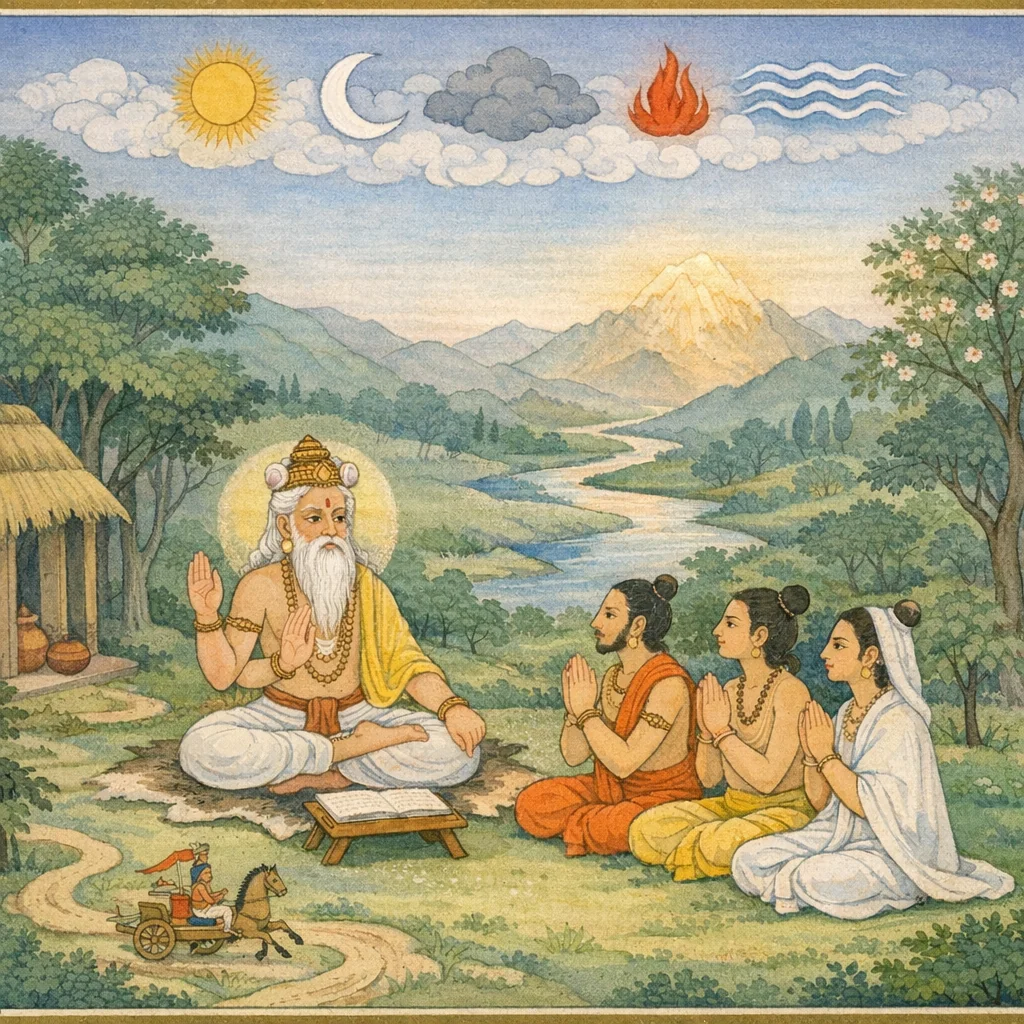
This chapter compiles an adhyātmika instruction attributed to Brahmā and relayed through a guru–disciple frame. It opens by defining mind (manas) as the governing principle over the five elements and as the constant superintendent of beings; intellect (buddhi) is presented as the indicator of sovereignty, while the kṣetrajña is named as the universal knower. A chariot allegory structures the psychology of agency: senses are yoked like horses by the mind, while the kṣetrajña continually yokes mind and intellect; the embodied complex is depicted as a ‘brahma-made chariot’ whose mastery prevents delusion. The discourse then sketches a cosmological tableau (from the unmanifest to particulars) and explains dissolution: beings resolve into qualities, and qualities into the five great elements, cyclically. Creation is linked to Prajāpati’s tapas, and tapas is praised as the root means for difficult attainments, purification, and ascent; meditative yoga with non-possessiveness and absence of ego is said to lead to an ‘unmanifest’ and ‘supreme’ state. The chapter distinguishes karmic generation of embodied beings from the knowledge-nature of the puruṣa, urging dispassion toward action and the abandonment of conceptual constructions. It defines marks of clarity (prasāda) and describes the ‘path of the liberated’ as equanimity, non-craving, and universal sameness of vision. The frame closes with Kṛṣṇa explaining to Arjuna that he is the guru and the mind is the disciple, urging disciplined practice; the narrative then turns to practical movement toward the capital and consultation with Yudhiṣṭhira.
Chapter Arc: ब्रह्मा-स्वर में उपदेश का आरम्भ होता है—सत्त्व और पुरुष की भिन्नता को समझो; अहिंसा को समस्त प्राणियों के प्रति परम कर्तव्य मानो; और जानो कि ‘ज्ञान’ ही निःश्रेयस का मार्ग है। → श्रोता के मन में सूक्ष्म जिज्ञासा तीव्र होती जाती है: यदि जगत पंचमहाभूतों के गुणों से बना है, तो भोगने वाला कौन है? सत्त्व (भोग्य प्रकृति) और पुरुष (भोक्ता चेतना) का संयोग कैसे बन्धन बनता है, और उससे छूटने का उपाय क्या है? → निर्णायक प्रतिपादन होता है—शुद्ध ज्ञान से ही समस्त किल्बिषों से मुक्ति है; पंचमहाभूतों के गुण-क्रम (आकाश-शब्द, वायु-शब्द/स्पर्श, तेज-शब्द/स्पर्श/रूप, आदि) का विश्लेषण कर यह दिखाया जाता है कि गुणों का यह विस्तार भोग्य क्षेत्र है, जबकि बुद्धिमानों की गति ध्यान-रथ के समान तीव्र होकर उसी परमात्मा की ओर जाती है। → उपदेश का निष्कर्ष स्थिर होता है: अहिंसा आचरण का शिखर है, और विवेक-जन्य ज्ञान साधना का शिखर; सत्त्व-पुरुष का भेद जानकर, गुणों के आकर्षण से ऊपर उठकर, साधक परम कल्याण की दिशा में अग्रसर होता है। → गुणों के सूक्ष्म भेद (रूप/स्पर्श आदि के अनेक प्रकार) का विस्तार आगे भी साधक को विवेक-मार्ग पर टिकाए रखने के लिए संकेतित रहता है।
Shlokas
Verse 1
ऑपन-माज बक। डे पजञ्चाशत्तमो<्ध्याय: सत्त्व और पुरुषकी भिन्नता, बुद्धिमानकी प्रशंसा, पज्चभूतोंके गुणोंका हे मजे परमात्माकी श्रेष्ठताका व ब्रह्मोवाच हन्त व: संप्रवक्ष्यामि यन्मां पृच्छथ सत्तमा: । गुरुणा शिष्यमासाद्य यदुक्त तन्निबोधत,ब्रह्माजी बोले--श्रेष्ठ महर्षियो! तुमलोगोंने जो विषय पूछा है, उसे अब मैं कहूँगा। गुरुने सुयोग्य शिष्यको पाकर जो उपदेश दिया है, उसे तुमलोग सुनो
Brahmā said: “Very well. I shall now explain to you, O best of sages, what you have asked me. Listen carefully to that instruction which a teacher imparts upon finding a worthy disciple.”
Verse 2
समस्तमिह तच्छुत्वा सम्यगेवावधार्यताम् | अहिंसा सर्वभूतानामेतत् कृत्यतमं मतम्
Having heard all this here, let it be grasped correctly and held firmly in mind: non-violence toward all beings is regarded as the most imperative duty. In this instruction, Vāyu frames ethical discernment not as mere listening but as careful internalization, culminating in ahiṃsā as the highest practical obligation.
Verse 3
ज्ञानं निःश्रेय इत्याहुर्वद्धा निश्चितदर्शिन:
Vāyu said: “Those who are firmly established and whose vision is settled declare that true knowledge is the highest good—leading to final well-being and liberation.”
Verse 4
हिंसापराश्न ये केचिद् ये च नास्तिकवृत्तय: । लोभमोहसमायुक्तास्ते वै निरयगामिन:,जो लोग प्राणियोंकी हिंसा करते हैं, नास्तिक-वृत्तिका आश्रय लेते हैं और लोभ तथा मोहमें फँसे हुए हैं, उन्हें नरकमें गिरना पड़ता है
Vāyu said: Those who are devoted to violence against living beings, who adopt an irreligious (atheistic) way of life, and who are entangled in greed and delusion—such people indeed proceed to hell. The verse frames non-violence, right belief, and freedom from greed and delusion as ethical foundations, warning that cruelty and moral denial lead to grave consequences.
Verse 5
आशीर्युक्तानि कर्माणि कुर्वते ये त्वतन्द्रिता: । तेडस्मिल्लॉके प्रमोदन््ते जायमाना: पुन: पुन:,जो लोग सावधान होकर सकाम कर्मोका अनुष्ठान करते हैं, वे बार-बार इस लोकमें जन्म ग्रहण करके सुखी होते हैं
Vāyu said: Those who, remaining vigilant and unslothful, perform desire-motivated rites accompanied by blessings and benedictory aims—such people repeatedly take birth in this very world and, again and again, experience enjoyment and satisfaction here. The teaching underscores that sakāma action yields pleasant but cyclical worldly results rather than final release.
Verse 6
कुर्वते ये तु कर्माणि श्रद्दधाना विपश्चित: । अनाशीर्योगसंयुक्तास्ते धीरा: साधुदर्शिन:,जो विद्वान् समत्वयोगमें स्थित हो श्रद्धाके साथ कर्तव्य-कर्मोंका अनुष्ठान करते हैं और उनके फलमें आसक्त नहीं होते, वे धीर और उत्तम दृष्टिवाले माने गये हैं
Vāyu said: Those wise persons who, with faith, perform the duties that ought to be done—disciplined in yoga and free from craving for results—are regarded as steady-minded and endowed with a noble, discerning vision. Ethically, the verse praises responsible action grounded in trust and insight, while warning against attachment to outcomes as the source of inner disturbance.
Verse 7
अतः: पर प्रवक्ष्यामि सच्त्वक्षेत्रज्ञयोर्यथा । संयोगो विप्रयोगश्न तन्निबोधत सत्तमा:,श्रेष्ठ महर्षियो! अब मैं यह बता रहा हूँ कि सत्त्व और क्षेत्रज्षका परस्पर संयोग और वियोग कैसे होता है? इस विषयको ध्यान देकर सुनो
Therefore, I shall now explain, in due order, how the vital principle (sattva) and the knower of the field (kṣetrajña) come into union and how they separate. Attend carefully to this teaching, O best among the virtuous, O foremost great seers—for it concerns the understanding that guides right conduct and inner freedom.
Verse 8
विषयो विषयित्वं च सम्बन्धो5यमिहोच्यते । विषयी पुरुषो नित्यं सत्त्वं च विषय: स्मृत:,इन दोनोंमें यहाँ यह विषय-विषयिभाव सम्बन्ध माना गया है। इनमें पुरुष तो सदा विषयी और सत्त्व विषय माना जाता है
Vāyudeva said: “Here, the relation being described is that of ‘object’ and ‘subject’—the object and the state of being the experiencer. In this pairing, the Puruṣa (the conscious self) is always the subject (the knower/experiencer), while sattva (the mental-psychic principle) is regarded as the object.”
Verse 9
व्याख्यातं पूर्वकल्पेन मशकोदुम्बरं यथा । भुज्यमानं न जानीते नित्यं सत्त्वमचेतनम् । यस्त्वेवं तं विजानीते यो भुड्धक्ते यश्व भुज्यते,पूर्व अध्यायमें मच्छर और गूलरके उदाहरणसे यह बात बतायी जा चुकी है कि भोगा जानेवाला अचेतन सत्त्व नित्य-स्वरूप क्षेत्रज्षको नहीं जानता, किंतु जो क्षेत्रज्ञ है वह इस प्रकार जानता है कि जो भोगता है वह आत्मा है और जो भोगा जाता है, वह सत्त्व है
Vāyu said: “As was explained earlier through the illustration of the mosquito and the udumbara (cluster fig), the ‘enjoyed’ principle—insentient sattva—does not truly know the eternal knower of the field. But the knower (kṣetrajña) understands correctly: the one who experiences is the Self, and that which is experienced is the material quality (sattva).”
Verse 10
नित्यं द्वन्द्धसमायुक्तं सत्त्वमाहुर्मनीषिण: । निर्दचन्दो निष्कलो नित्य: क्षेत्रज्ञो निर्गुणात्मक:,मनीषी पुरुष सत्त्वको द्वन्धयुक्त कहते हैं और क्षेत्रज्ञ निर्दन्द्ध, निष्कल, नित्य और निर्मुणस्वरूप है
Vāyu-deva said: “The wise declare that the embodied being’s sattva (its living disposition) is constantly entangled with pairs of opposites—pleasure and pain, gain and loss, praise and blame. But the Knower of the Field (the inner witness, the kṣetrajña) is free from such dualities: partless, ever-abiding, and of a nature beyond the guṇas. Thus, ethical steadiness is found by recognizing the changing play of opposites in the mind while resting in the non-dual, unaffected Self.”
Verse 11
सम॑ संज्ञानुगश्वचैव स सर्वत्र व्यवस्थित: । उपभुड्धक्ते सदा सत्त्वमप: पुष्करपर्णवत्,वह क्षेत्रज्ञ समभावसे सर्वत्र भलीभाँति स्थित हुआ ज्ञानका अनुसरण करता है। जैसे कमलका पत्ता निर्लिप्त रटरकर जलको धारण करता है, वैसे ही क्षेत्रज्ञ सदा सत्त्वका उपभोग करता है
Verse 12
सर्वैरपि गुणैरविंद्वान् व्यतिषक्तो न लिप्यते | जलबिन्दुर्यथा लोल: पद्मिनीपत्रसंस्थित:
Vāyu-deva said: Even when a person is surrounded and interwoven with all kinds of qualities and conditions, if he remains unattached, he is not stained by them. Just as a trembling drop of water, resting upon a lotus leaf, does not cling to it, so too the wise remain in the world without being tainted by its contacts.
Verse 13
द्रव्यमात्रभूत् सत्त्वं पुरुषस्येति निश्चय:
Vāyu said: “The settled conclusion is this: the ‘being’ (sattva) of a person is nothing but a mere material constituent—only a thing among things.”
Verse 14
यथा प्रदीपमादाय कश्चित् तमसि गच्छति । तथा सन्त्वप्रदीपेन गच्छन्ति परमैषिण:,जैसे कोई मनुष्य दीपक लेकर अन्धकारमें चलता है, वैसे ही परम तत्त्वको चाहनेवाले साधक सत्त्वरूप दीपकके प्रकाशमें साधनमार्गपर चलते हैं
Just as a person, taking a lamp, walks through darkness, so do seekers of the highest Reality proceed along the path of practice by the illumination of the lamp that is sattva—clarity and purity of mind. The verse frames inner refinement as an ethical necessity: without the light of a lucid disposition, the aspirant’s journey is obscured; with it, one can move steadily toward the supreme goal.
Verse 15
यावद् द्रव्यं गुणस्तावत् प्रदीप: सम्प्रकाशते । क्षीणे द्रव्ये गुणे ज्योतिरन्तर्धानाय गच्छति,जबतक दीपकमें द्रव्य और गुण रहते हैं, तभीतक वह प्रकाश फैलाता है। द्रव्य और गुणका क्षय हो जानेपर ज्योति भी अन्तर्धान हो जाती है
Vāyu-deva said: “So long as a lamp possesses its material fuel and its sustaining qualities, it shines forth and spreads light. When the substance and its qualities are exhausted, the flame too goes toward disappearance.” In ethical sense, the verse points to the dependence of visible power (splendour, influence, even life) upon its supporting causes; when the supports are spent, the manifestation naturally ceases.
Verse 16
व्यक्त: सत्त्वगुणस्त्वेवं पुरुषोडव्यक्त इष्यते । एतद् विप्रा विजानीत हन्त भूयो ब्रवीमि व:,ब्रह्माजीका ऋषियोंको उपदेश इस प्रकार सत्त्वगुण तो व्यक्त है और पुरुष अव्यक्त माना गया है। ब्रह्मर्षियो! इस तत्त्वको समझो। अब मैं तुमलोगोंसे आगेकी बात बताता हूँ
Verse 17
सहस्नेणापि दुर्मेधा न बुद्धिमधिगच्छति । चतुर्थेनाप्यथांशेन बुद्धिमान् सुखमेधते,जिसकी बुद्धि अच्छी नहीं है, उसे हजार उपाय करनेपर भी ज्ञान नहीं होता और जो बुद्धिमान् है वह चौथाई प्रयत्नसे भी ज्ञान पाकर सुखका अनुभव करता है
Vāyu said: Even with a thousand efforts, a person of poor understanding does not attain true discernment; but one who is intelligent, even with only a quarter of that effort, gains understanding and thereby flourishes in well-being. The verse underscores that inner fitness and clarity of mind matter more than sheer quantity of exertion.
Verse 18
एवं धर्मस्य विज्ञेयं संसाधनमुपायत: । उपायज्ञो हि मेधावी सुखमत्यन्तमश्लुते,ऐसा विचारकर किसी उपायसे धर्मके साधनका ज्ञान प्राप्त करना चाहिये; क्योंकि उपायको जाननेवाला मेधावी पुरुष अत्यन्त सुखका भागी होता है
Thus one should, through thoughtful consideration, come to know the practical means by which dharma is accomplished. For the wise person who understands the right means attains the highest happiness.
Verse 19
यथाध्वानमपाथेय: प्रपन्नो मनुज: क्वचित् । क्लेशेन याति महता विनश्येदन्तरापि च,जैसे कोई मनुष्य यदि राह-खर्चका प्रबन्ध किये बिना ही यात्रा करता है तो उसे मार्ममें बहुत क्लेश उठाना पड़ता है अथवा वह बीचहीमें मर भी सकता है
Vāyu said: “Just as a man who sets out on a journey without provisions for the road proceeds only with great hardship—and may even perish midway—so too one who undertakes life’s course without the necessary inner resources (right conduct, restraint, and preparedness) is exposed to suffering and ruin.”
Verse 20
तथा कर्मसु विज्ञेयं फलं भवति वा न वा । पुरुषस्यात्मनि:श्रेय: शुभाशुभनिदर्शनम्,ऐसे ही (पूर्वजन्मोंके पुण्योंसे हीन पुरुष) योगमार्गके साधनमें लगनेपर योगसिद्धिरूप फल कठिनतासे पाता है अथवा नहीं भी पाता। पुरुषका अपना कल्याण-साधन ही उसके पूर्वजन्मके शुभाशुभ-संस्कारोंको बतानेवाला है
So too, in the sphere of actions, one should understand that a result may arise—or it may not. A person’s own highest good, realized within oneself, becomes the indicator of the auspicious and inauspicious impressions carried from prior lives: when one takes up the disciplines of yoga, attainment may come only with difficulty, or may even fail to manifest, according to those latent formations.
Verse 21
यथा च दीर्घमध्वानं पद्भ्यामेव प्रपद्यते । अदृष्टपूर्व सहसा तत्त्वदर्शनवर्जित:,जैसे पहले न देखे हुए दूरके रास्तेपर जब मनुष्य सहसा पैदल ही चल पड़ता है (तो वह अपने गन्तव्य स्थानपर नहीं पहुँच पाता), यही दशा तत्त्वज्ञानसे रहित अज्ञानी पुरुषकी होती है
Just as a man, having never seen the route before, suddenly sets out on a long journey relying only on his feet, he fails to reach his intended destination; in the same way, an ignorant person who is devoid of the vision of truth cannot attain the true goal.
Verse 22
तमेव च यथाध्यानं रथेनेहाशुगामिना । गच्छत्यश्वप्रयुक्तेन तथा बुद्धिमतां गति:
Vāyu said: “Just as one reaches that very goal by means of focused contemplation, so too—here in this world—does one proceed swiftly in a chariot yoked with horses. In the same way, the course of the wise is to move toward the intended end with disciplined, well-directed intelligence.”
Verse 23
रथेन रथिनं पश्य क्लिश्यमानमचेतनम्,देखो, रथके द्वारा जानेवाला भी मूर्ख मनुष्य ऊँचे पर्वतके पास पहुँचकर कष्ट पाता रहता है, किंतु बुद्धिमान् मनुष्य जहाँतक रथ जानेका मार्ग है वहाँतक रथसे जाता है और जब रथका रास्ता समाप्त हो जाता है तब वह उसे छोड़कर पैदल यात्रा करता है
Vāyu said: “Look at the foolish man who, though carried by a chariot, still ends up suffering when he reaches the steep mountain. The wise man travels by chariot only as far as the road allows; when the chariot-road comes to an end, he leaves it behind and continues on foot.” The teaching is that one should use means and instruments appropriately—neither clinging to them beyond their proper scope nor rejecting them when they are helpful.
Verse 24
यावद् रथपथस्तावदू रथेन स तु गच्छति । क्षीणे रथपदे विद्वान् रथमुत्सूज्य गच्छति,देखो, रथके द्वारा जानेवाला भी मूर्ख मनुष्य ऊँचे पर्वतके पास पहुँचकर कष्ट पाता रहता है, किंतु बुद्धिमान् मनुष्य जहाँतक रथ जानेका मार्ग है वहाँतक रथसे जाता है और जब रथका रास्ता समाप्त हो जाता है तब वह उसे छोड़कर पैदल यात्रा करता है
Vāyu said: “So long as there is a carriage-road, one proceeds by the chariot. When the chariot-track comes to an end, the wise person leaves the chariot behind and continues on foot. In the same way, a foolish traveler clings to a single means and suffers when the terrain changes, but the discerning adapt their method to the limits of the path.”
Verse 25
एवं गच्छति मेधावी तत्त्वयोगविधानवित् । परिज्ञाय गुणज्ञश्न उत्तरादुत्तरोत्तरम्,इसी प्रकार तत्त्व और योगविधिको जाननेवाला बुद्धिमान एवं गुणज्ञ पुरुष अच्छी तरह समझ-बूझकर उत्तरोत्तर आगे बढ़ता जाता है
Thus the wise person—one who understands the principles of reality and the disciplines of yoga—moves onward. Having clearly discerned the qualities (guṇas) and their workings, he advances step by step, rising from one higher stage to the next, with steady understanding and self-mastery.
Verse 26
एतत् पदमनुद्धिग्नं वरिष्ठ धर्मलक्षणम् । उस विषयको यहाँ पूर्णतया सुनकर अच्छी प्रकार धारण करो। सब प्राणियोंकी अहिंसा ही सर्वोत्तम कर्तव्य है--ऐसा माना गया है। यह साधन उद्देगरहित, सर्वश्रेष्ठ और धर्मको लक्षित करानेवाला है,यथार्णवं महाघोरमप्लव: सम्प्रगाहते । बाहुभ्यामेव सम्मोहाद् वर्ध वाउ्छत्यसंशयम् जैसे कोई पुरुष मोहवश बिना नावके ही भयंकर समुद्रमें प्रवेश करता है और दोनों भुजाओंसे ही तैरकर उसके पार होनेका भरोसा रखता है तो निश्चय ही वह अपनी मौत बुलाना चाहता है (उसी प्रकार ज्ञान-नौकाका सहारा लिये बिना मनुष्य भवसागरसे पार नहीं हो सकता)
Vāyu said: “This is the unagitating (fearless) path, the highest mark of dharma. Just as a man, deluded, enters a vast and dreadful ocean without a boat and trusts that he will cross by swimming with his arms alone—so, without doubt, he is courting destruction. In the same way, without the support of true knowledge, one cannot cross the ocean of worldly existence.”
Verse 27
नावा चापि यथा प्राज्ञो विभागज्ञः स्वरित्रया । अश्रान्त: सलिले गच्छेच्छीघ्रं संतरते हृदम्,जिस तरह जलमार्गके विभागको जाननेवाला बुद्धिमान पुरुष सुन्दर डाँडवाली नावके द्वारा अनायास ही जलपर यात्रा करके शीघ्र समुद्रसे तर जाता है एवं पार पहुँच जानेपर नावकी ममता छोड़कर चल देता है; (उसी प्रकार संसार-सागरसे पार हो जानेपर बुद्धिमान् पुरुष पहलेके साधन-सामग्रीकी ममता छोड़ देता है।) यह बात रथपर चलनेवाले और पैदल चलनेवालेके दृष्टान्तसे पहले भी कही जा चुकी है
Vāyu said: “Just as a wise man—skilled in discerning the channels of the waterway—travels upon the waters without exhaustion in a well-oared boat and quickly crosses the expanse, so too does the discerning person cross beyond the ocean of worldly existence; and once the far shore is reached, he relinquishes attachment to the very means that carried him.”
Verse 28
तीर्णो गच्छेत् परं पारं नावमुत्सृज्य निर्मम: । व्याख्यातं पूर्वकल्पेन यथा रथपदातिनो:,जिस तरह जलमार्गके विभागको जाननेवाला बुद्धिमान पुरुष सुन्दर डाँडवाली नावके द्वारा अनायास ही जलपर यात्रा करके शीघ्र समुद्रसे तर जाता है एवं पार पहुँच जानेपर नावकी ममता छोड़कर चल देता है; (उसी प्रकार संसार-सागरसे पार हो जानेपर बुद्धिमान् पुरुष पहलेके साधन-सामग्रीकी ममता छोड़ देता है।) यह बात रथपर चलनेवाले और पैदल चलनेवालेके दृष्टान्तसे पहले भी कही जा चुकी है
Vāyu said: “Having crossed over, one should proceed to the further shore, abandoning the boat and free from possessiveness. This has already been explained earlier by the former illustration—like the case of one who rides in a chariot and one who goes on foot.” The ethical point is that spiritual means are to be used as instruments for crossing saṃsāra; once the goal is reached, the wise relinquish attachment even to the very aids that helped them.
Verse 29
स्नेहात् सम्मोहमापन्नो नावि दाशो यथा तथा । ममत्वेनाभिभूत: संस्तत्रैव परिवर्तते,परंतु स्नेहवश मोहको प्राप्त हुआ मनुष्य ममतासे आबद्ध होकर नावपर सदा बैठे रहनेवाले मल्लाहकी भाँति वहीं चक्कर काटता रहता है
Overcome by affection, a person falls into delusion; like a boatman who remains seated in his boat, he keeps circling in the same place. Conquered by possessiveness—the sense of ‘mine’—he stays bound there, turning again and again without reaching the farther shore. The ethical point is that attachment and ‘I–mine’ fixation trap one in repetitive, unfree motion rather than purposeful progress toward clarity and right action.
Verse 30
नावं न शक्यमारुह्ु स्थले विपरिवर्तितुम् । तथैव रथमारुहा नाप्सु चर्या विधीयते,नौकापर चढ़कर जिस प्रकार स्थलपर विचरण करना सम्भव नहीं है तथा रथपर चढ़कर जलमें विचरण करना सम्भव नहीं बताया गया है, इसी प्रकार किये हुए विचित्र कर्म अलग-अलग स्थानपर पहुँचानेवाले हैं। संसारमें जिनके द्वारा जैसा कर्म किया गया है, उन्हें वैसा ही फल प्राप्त होता है
Vāyu said: “Just as one cannot mount a boat and then move about on dry land, and just as one cannot mount a chariot and then be made to travel upon water, so too the diverse deeds performed by beings lead to different destinations. In this world, whatever kind of action a person has done, a corresponding result is obtained.”
Verse 31
एवं कर्म कृतं चित्र विषयस्थं पृथक् पृथक् । यथा कर्म कृतं लोके तथैतानुपपद्यते,नौकापर चढ़कर जिस प्रकार स्थलपर विचरण करना सम्भव नहीं है तथा रथपर चढ़कर जलमें विचरण करना सम्भव नहीं बताया गया है, इसी प्रकार किये हुए विचित्र कर्म अलग-अलग स्थानपर पहुँचानेवाले हैं। संसारमें जिनके द्वारा जैसा कर्म किया गया है, उन्हें वैसा ही फल प्राप्त होता है
Thus, actions—variegated in kind—bear their results in distinct and corresponding spheres. Just as one cannot move on land by mounting a boat, nor travel in water by mounting a chariot, so too do diverse deeds lead to different destinations. In this world, whatever action a person performs, that very kind of consequence befalls them.
Verse 32
यन्नैव गन्धिनो रस्यं न रूपस्पर्शशब्दवत् । मन्यन्ते मुनयो बुद्धया तत् प्रधान प्रचक्षते,जो गन्ध, रस, रूप, स्पर्श और शब्दसे युक्त नहीं है तथा मुनिलोग बुद्धिके द्वारा जिसका मनन करते हैं, वह 'प्रधान” कहलाता है
Vāyu-deva said: “That which has neither smell nor taste, and is not possessed of form, touch, or sound—yet which sages contemplate through discerning intellect—this is what they designate as Pradhāna, the primordial ground of nature.”
Verse 33
तत्र प्रधानमव्यक्तमव्यक्तस्य गुणो महान् । महत्प्रधानभूतस्य गुणो5हंकार एव च,प्रधानका दूसरा नाम अव्यक्त है। अव्यक्तका कार्य महत्तत्त्व है और प्रकृतिसे उत्पन्न महत्तत्त्वका कार्य अहंकार है
Vāyu said: “In that sequence, Pradhāna is the Unmanifest. From the Unmanifest arises the Great Principle (Mahat). And from Mahat—born of Prakṛti—arises indeed Ahaṅkāra (the sense of ‘I’).” In context, the teaching frames how inner bondage begins: when the ‘I’-sense emerges from primordial nature, ethical life (dharma) requires recognizing this process and not mistaking the constructed ego for the true Self.
Verse 34
अहंकारात् तु सम्भूतो महाभूतकृतो गुण: । पृथक्त्वेन हि भूतानां विषया वै गुणा: स्मृता:,अहंकारसे पञ्च महाभूतोंको प्रकट करनेवाले गुणकी उत्पत्ति हुई है। पठच महाभूतोंके कार्य हैं रूप, रस आदि विषय। वे पृथक्-पृथक् गुणोंके नामसे प्रसिद्ध हैं
Vāyu said: “From egoity (ahaṅkāra) arises the quality-principle that brings forth the great elements. And, in truth, the ‘qualities’ are remembered as the distinct sense-objects of the elements—each element having its own separate object of experience (such as form, taste, and the rest).”
Verse 35
बीजधर्म तथाव्यक्तं प्रसवात्मकमेव च । बीजधर्मा महानात्मा प्रसवश्चेति नः श्रुतम्,अव्यक्त प्रकृति कारणरूपा भी है और कार्यरूपा भी। इसी प्रकार महत्तत्त्वके भी कारण और कार्य दोनों ही स्वरूप सुने गये हैं
Vāyu said: “The Unmanifest (Avyakta) is spoken of as having the nature of a seed and as being productive—bringing forth creation. Likewise, the Great Principle (Mahat) too is heard of as both seed-like (a causal ground) and as ‘production’ (an effect that further generates).”
Verse 36
तस्माजउज्ञानेन शुद्धेन मुच्यते सर्वकिल्बिषै: । निश्चयको साक्षात् करनेवाले वृद्ध लोग कहते हैं कि "ज्ञान ही परम कल्याणका साधन है।” इसलिये परम शुद्ध ज्ञानके द्वारा ही मनुष्य सब पापोंसे छूट जाता है,बीजधर्मस्त्वहंकार: प्रसवश्च पुन: पुन: । बीजप्रसवधर्माणि महा भूतानि पञ्च वै अहंकार भी कारणरूप तो है ही, कार्यरूपमें भी बारम्बार परिणत होता रहता है। पठच महाभूतों (पञ्चतन्मात्राओं)-में भी कारणत्व और कार्यत्व दोनों धर्म हैं। वे शब्दादि विषयोंको उत्पन्न करते हैं, इसलिये ऐसा कहा जाता है कि वे बीजधर्मी हैं
Vāyu said: Therefore, by pure knowledge one is released from every stain of sin. The elders who have direct certainty and true agency declare that knowledge alone is the means to the highest good. The ego-principle (ahaṅkāra) is seed-like as a cause, and again and again it transforms into effects. Likewise, the five great elements possess both the nature of cause and effect; producing the objects of sense such as sound and the rest, they are therefore described as ‘seed-bearing.’
Verse 37
बीजधर्मिण इत्याहु: प्रसव॑ च प्रकुर्वते । विशेषा: पञ्चभूतानां तेषां चित्तं विशेषणम्,उन पाँचो भूतोंके विशेष कार्य शब्द आदि विषय हैं। उन विषयोंका प्रवर्तक चित्त है
Vāyu said: “They are called ‘seed-bearing’ because they bring forth generation. The five great elements have their own specific functions—such as sound and the other sense-objects—and it is the mind (citta) that sets those objects into operation and gives them their determinate character.”
Verse 38
तत्रैकगुणमाकाशं द्विगुणो वायुरुच्यते । त्रिगुणं ज्योतिरित्याहुरापश्चापि चतुर्गुणा:,पञ्चमहाभूतोंमेंसे आकाशमें एक ही गुण माना गया है। वायुके दो गुण बतलाये जाते हैं। तेज तीन गुणोंसे युक्त कहा गया है। जलके चार गुण हैं
Vāyu-deva said: “Among the five great elements, space is said to possess only one quality. Wind is described as having two. Fire is declared to be endowed with three qualities, and water too is said to have four.” The statement frames a graded view of nature, guiding the listener toward discernment of how subtle principles unfold into more complex forms.
Verse 39
पृथ्वी पञ्चगुणा ज्ञेया चरस्थावरसंकुला । सर्वभूतकरी देवी शुभाशुभनिदर्शिनी,पृथ्वीके पाँच गुण समझने चाहिये। यह देवी स्थावर-जंगम प्राणियोंसे भरी हुई, समस्त जीवोंको जन्म देनेवाली तथा शुभ और अशुभका निर्देश करनेवाली है
Vāyu said: “Know the Earth to be endowed with five qualities. She is a divine power, filled with moving and unmoving beings; she brings forth all creatures and, through her order and consequences, makes evident what is auspicious and what is inauspicious.”
Verse 40
शब्द: स्पर्शस्तथा रूप॑ रसो गन्धक्षु पञजचम: । एते पज्च गुणा भूमेवविज्ञेया द्विजसत्तमा:,विप्रवरो! शब्द, स्पर्श, रूप, रस और पाँचवाँ गन्ध--ये ही पृथ्वीके पाँच गुण जानने चाहिये
Vāyu-deva said: “Sound, touch, form, taste, and as the fifth, smell—these five are to be understood as the qualities of the earth, O best of the twice-born, O foremost brāhmaṇa.” In this instruction, the discourse frames ethical clarity through right knowledge: discerning the constituents of embodied experience supports steadiness of mind and discrimination on the path of dharma.
Verse 41
पार्थिवश्च सदा गन्धो गन्धश्न बहुधा स्मृत: । तस्य गन्धस्य वक्ष्यामि विस्तरेण बहून् गुणान्,इनमें भी गन्ध उसका खास गुण है। गन्ध अनेक प्रकारकी मानी गयी है। मैं उस गन्धके गुणोंका विस्तारके साथ वर्णन करूँगा
Vāyu-deva said: “In earth, fragrance is ever present as its distinctive quality, and ‘smell’ is spoken of as being of many kinds. I shall now describe, in detail, the many properties and virtues of that fragrance.”
Verse 42
इष्टश्वानिष्टगन्धश्व मधुरो5म्ल: कटुस्तथा | निहरि संहतः स्निग्धो रूक्षो विशद एव च
Vāyu said: “There are tastes and qualities that please, and fragrances that please; there is sweetness, sourness, and pungency as well. There are also qualities such as clarity, compactness, unctuousness, dryness, and purity.”
Verse 43
शब्द: स्पर्शस्तथा रूपं द्रवश्वाणां गुणा: स्मृता:
Vāyu-deva said: “Sound, touch, and likewise form are remembered as the qualities belonging to the fluid (watery) substances.”
Verse 44
रसज्ञानं तु वक्ष्यामि रसस्तु बहुधा स्मृतः । शब्द, स्पर्श, रूप, रस--ये जलके चार गुण माने गये हैं (इनमें रस ही जलका मुख्य गुण है)। अब मैं रस-विज्ञानका वर्णन करता हूँ। रसके बहुत-से भेद बताये गये हैं ।। ४३ $ई || मधुरो<म्ल: कटुस्तिक्त: कषायो लवणस्तथा
Vāyu-deva continues his exposition on the science of taste, enumerating the principal kinds of rasa (flavour): sweet, sour, pungent, bitter, astringent, and salty—thereby framing sensory knowledge as a structured field to be understood and applied with discernment.
Verse 45
शब्द: स्पर्शस्तथा रूपं त्रिगुणं ज्योतिरुच्यते
Vāyu-deva said: “Sound, touch, and form—this triad of qualities is spoken of as ‘light’ (jyotis),” indicating that what is perceived as luminous or manifest is understood through these three modes of sensory apprehension rather than as a merely physical phenomenon.
Verse 46
शुक्लं कृष्णं तथा रक्त नील॑ पीतारुणं तथा,विज्ञेयं ब्राह्मणैर्वद्धेर्धर्मज्ै: सत्यवादिभि: । शुक्रल, कृष्ण, रक्त, नील, पीत, अरुण, छोटा, बड़ा, मोटा, दुबला, चौकोना और गोल --इस प्रकार तैजस् रूपका बारह प्रकारसे विस्तार सत्यवादी धर्मज्ञ वृद्ध ब्राह्मणोंके द्वारा जानने योग्य कहा जाता है
Vāyu-deva said: “White, black, and red; blue, yellow, and tawny as well—these are to be understood (as distinctions of the radiant/fiery form) by aged Brāhmaṇas who are truthful and who know dharma.”
Verse 47
हस्व॑ दीर्घ कृशं स्थूलं चतुरस््र तु वृत्तवत् । एवं द्वादशविस्तारं तेजसो रूपमुच्यते
Vāyu said: “The form of radiant energy is described as having twelve modes of extension: it may appear short or long, thin or thick, square or else rounded. Thus, by these varied dimensions and shapes, the nature of ‘tejas’ is spoken of.”
Verse 48
शब्दस्पर्शीं च विज्ञेयौ द्विगुणो वायुरुच्यते
Vāyu-deva said: “Sound and touch are to be understood as its (proper) qualities; therefore the Wind is spoken of as ‘twofold’—bearing these two sensory properties.”
Verse 49
रूक्ष: शीतस्तथैवोष्ण: स्निग्धो विशद एव च,रूखा, ठंडा, गरम, स्निग्ध, विशद, कठिन, चिकना, श्लक्ष्ण (हलका), पिच्छिल, कठोर और कोमल--इन बारह प्रकारोंसे वायुके गुण स्पर्शका विस्तार तत्त्वदर्शी धर्मज्ञ सिद्ध ब्राह्मणोंद्वारा विधिवत् बतलाया गया है
Vāyu-deva said: “The qualities apprehended through touch are described as dry, cold, hot, unctuous, and clear. In this way, the wise—Brahmins who are accomplished, righteous, and devoted to true knowledge—have properly set forth, according to rule, the detailed account of the wind’s tactile attributes.”
Verse 50
कठिनश्विक्कण: श्लक्ष्ण: पिच्छिलो दारुणो मृदुः । एवं द्वादशविस्तारो वायव्यो गुण उच्यते,रूखा, ठंडा, गरम, स्निग्ध, विशद, कठिन, चिकना, श्लक्ष्ण (हलका), पिच्छिल, कठोर और कोमल--इन बारह प्रकारोंसे वायुके गुण स्पर्शका विस्तार तत्त्वदर्शी धर्मज्ञ सिद्ध ब्राह्मणोंद्वारा विधिवत् बतलाया गया है इति श्रीमहाभारते आश्वमेधिके पर्वणि अनुगीतापर्वणि गुरुशिष्यसंवादे पज्चाशत्तमोडथ्याय: इस प्रकार श्रीमह्याभारत आश्वमेधिकपववके अन्तर्गत अनुगीतापर्वनें गुरु-शिष्यसंवादविषयक पचासवाँ अध्याय पूरा हुआ
Vāyudeva said: “Hard, smooth, fine (even-textured), slimy/viscous, harsh, and soft—thus the quality belonging to Wind (vāyu), namely touch, is taught as having a twelvefold range.” In this instruction, the sages who know dharma and the principles of reality describe how the sense of touch manifests through multiple, even opposing, tactile modes, urging the student to understand nature’s qualities with disciplined discernment rather than confusion.
Verse 51
विधिवद् ब्राह्मणै: सिद्धेर्धर्मज्ैस्तत्त्वदर्शिभि:,रूखा, ठंडा, गरम, स्निग्ध, विशद, कठिन, चिकना, श्लक्ष्ण (हलका), पिच्छिल, कठोर और कोमल--इन बारह प्रकारोंसे वायुके गुण स्पर्शका विस्तार तत्त्वदर्शी धर्मज्ञ सिद्ध ब्राह्मणोंद्वारा विधिवत् बतलाया गया है
Vāyu-deva said: “In due and proper manner, accomplished Brahmins—knowers of dharma and seers of truth—have explained the full range of touch-qualities belonging to the Wind. These are twelve in kind: dry, cold, hot, unctuous, clear, hard, smooth, fine (light), slimy, rigid, and soft.”
Verse 52
तत्रैकगुणमाकाशं शब्द इत्येव च स्मृत: । आकाशका शब्दमात्र एक ही गुण माना गया है। उस शब्दके बहुत-से गुण हैं। उनका विस्तारके साथ वर्णन करता हूँ ।। ५१ है ।। तस्य शब्दस्य वक्ष्यामि विस्तरेण बहून् गुणान्
Vāyu-deva said: “In this context, space (ākāśa) is remembered as possessing a single quality—sound (śabda) alone. Now I shall describe, in detail, the many aspects and properties of that sound.”
Verse 53
षडजर्षभ: स गान्धारो मध्यम: पञ्चमस्तथा । अतः परं तु विज्ञेयो निषादो धैवतस्तथा । इष्टश्ानिष्टशब्दश्न॒ संहतः प्रविभागवान्
Vāyu-deva said: “The note called Ṣaḍja is the ‘bull’ (chief) among notes; then come Gāndhāra, Madhyama, and Pañcama. Beyond these, one should understand Niṣāda and likewise Dhaivata. Sound, whether pleasing or unpleasing, becomes meaningful when it is held together in proper combination and also distinguished into its parts.”
Verse 54
एवं दशविधो ज्ञेयः शब्द आकाशसम्भव: । षड़्ज, ऋषभ, गान्धार, मध्यम, पञ्चम, निषाद, धैवत, इष्ट (प्रिय), अनिष्ट (अप्रिय) और संहत (श्लिष्ट)--इस प्रकार विभागवाले आकाशजनित शब्दके दस भेद हैं ।। आकाशशमुत्तमं भूतमहंकारस्तत: पर:,आकाश सब भूतोंमें श्रेष्ठ है। उससे श्रेष्ठ अहंकार, अहंकारसे श्रेष्ठ बुद्धि, उस बुद्धिसे श्रेष्ठ आत्मा, उससे श्रेष्ठ अव्यक्त प्रकृति और प्रकृतिसे श्रेष्ठ पुरुष है
Vāyu said: “Sound, which arises from space (ākāśa), should be understood as tenfold—namely the seven musical notes (ṣaḍja, ṛṣabha, gāndhāra, madhyama, pañcama, niṣāda, dhaivata), along with what is pleasing, what is displeasing, and what is blended/combined. Thus the sound born of space is divided into ten kinds. Space is the foremost among the elements; higher than space is ego-sense (ahaṅkāra); higher than ego-sense is intellect (buddhi); higher than intellect is the self (ātman); higher than the self is unmanifest Nature (avyaktā prakṛti); and higher than Nature is the Person (puruṣa).”
Verse 55
अहंकारात् परा बुद्धिर्बुद्धेरात्मा तत: पर: । तस्मात् तु परमव्यक्तमव्यक्तात् पुरुष: पर:,आकाश सब भूतोंमें श्रेष्ठ है। उससे श्रेष्ठ अहंकार, अहंकारसे श्रेष्ठ बुद्धि, उस बुद्धिसे श्रेष्ठ आत्मा, उससे श्रेष्ठ अव्यक्त प्रकृति और प्रकृतिसे श्रेष्ठ पुरुष है
Verse 56
परापरज्ञो भूतानां विधिज्ञ: सर्वकर्मणाम् । सर्वभूतात्मभूतात्मा गच्छत्यात्मानमव्ययम्,जो मनुष्य सम्पूर्ण भूतोंकी श्रेष्ठठा और न्यूनताका ज्ञाता, समस्त कर्मोकी विधिका जानकार और सब प्राणियोंको आत्मभावसे देखनेवाला है, वह अविनाशी परमात्माको प्राप्त होता है
Verse 123
एवमेवाप्यसंयुक्त: पुरुष: स्यान्न संशय: । जैसे कमलके पत्तेपर पड़ी हुई जलकी चंचल बूँद उसे भिगो नहीं पाती, उसी प्रकार विद्वान् पुरुष समस्त गुणोंसे सम्बन्ध रखते हुए भी किसीसे लिप्त नहीं होता। अतः क्षेत्रज्ञ पुरुष वास्तविकमें असंग है, इसमें संदेह नहीं है
Vāyu-deva said: “So too, a person can remain unattached—there is no doubt. Just as a restless drop of water that falls upon a lotus leaf cannot wet it, in the same way a wise person, though moving among and dealing with all the guṇas (qualities of nature), is not stained by them. Therefore the knower of the field (kṣetrajña), in truth, is non-attached; of this there is no uncertainty.”
Verse 133
यथा द्रव्यं च कर्ता च संयोगो5प्यनयोस्तथा । यह निश्चित बात है कि पुरुषके भोगनेयोग्य द्रव्यमात्रकी संज्ञा सत्त्व है तथा जैसे द्रव्य और कर्ताका सम्बन्ध है, वैसे ही इन दोनोंका सम्बन्ध है
Vāyu said: “Just as there is a conjunction between a material object and the agent who acts, so too is there a conjunction between these two.” In context, the statement clarifies a Sāṃkhya-like ethical discernment: what is ‘enjoyed’ (the objective field of experience) and the ‘enjoyer/agent’ are distinct in principle, yet appear bound together through association—an association that must be understood to loosen attachment and restore right understanding.
Verse 226
ऊर्ध्व॑ पर्वतमारुह्[ नान्ववेक्षेत भूतलम् । किंतु उसी मार्गपर घोड़े जुते हुए शीघ्रगामी रथके द्वारा यात्रा करनेवाला पुरुष जिस प्रकार शीघ्र ही अपने लक्ष्य स्थानपर पहुँच जाता है तथा वह ऊँचे पर्वतपर चढ़कर नीचे पृथ्वीकी ओर नहीं देखता, उसी प्रकार ज्ञानी पुरुषोंकी गति होती है
Vāyu-deva said: “One who has climbed to a lofty mountain does not keep looking back down at the ground. In the same way, a man who travels the road in a swift chariot yoked with horses quickly reaches his intended destination; and having ascended the high mountain, he does not gaze down toward the earth. Such, indeed, is the course of the wise: once set upon the higher path, they do not turn their attention back to lower aims, but move steadily and swiftly toward their true goal.”
Verse 423
एवं दशविधो ज्ञेय: पार्थिवो गन्ध इत्युत । इष्ट (सुगन्ध), अनिष्ट (दुर्गन््ध), मधुर, अम्ल, कटु, निहारी (दुरतक फैलनेवाली), मिश्रित, स्निग्ध, रूक्ष और विशद--ये पार्थिव गन्धके दस भेद समझने चाहिये
Vāyu-deva said: “Thus the earthly (material) smell is to be understood as tenfold. It may be pleasing (fragrant) or unpleasing (foul); sweet, sour, or pungent; far-spreading; mixed; unctuous, dry, or clear. These are the ten varieties of the earth-born odor that one should recognize.”
Verse 446
एवं षड्विधविस्तारो रसो वारिमय: स्मृत: । मीठा, खट्टा, कड्आ, तीता, कसैला और नमकीन--इस प्रकार छ: भेदोंमें जलमय रसका विस्तार बताया गया है
Vāyudeva said: “Thus the ‘taste’ that is water-based is understood to expand in six distinct forms.” In context, the teaching frames sensory experience—especially taste—as a structured, knowable domain, encouraging disciplined understanding of the body and its perceptions rather than indulgent confusion.
Verse 456
ज्योतिषश्च गुणो रूप॑ं रूपं च बहुधा स्मृतम् शब्द, स्पर्श और रूप--ये तेजके तीन गुण कहे गये हैं। इनमें रूप ही तेजका मुख्य गुण है। रूपके भी कई भेद माने गये हैं
Vāyu-deva explains that for the element of fire (tejas), the recognized qualities are sound, touch, and form. Among these, form is regarded as the principal mark of fire, and even form itself is understood to have many varieties. The teaching frames perception as a disciplined inquiry: by knowing the defining qualities of things, one learns to distinguish reality from confusion and to act with clarity rather than impulse.
Verse 476
विज्ञेयं ब्राह्मणैर्वद्धेर्धर्मज्ै: सत्यवादिभि: । शुक्रल, कृष्ण, रक्त, नील, पीत, अरुण, छोटा, बड़ा, मोटा, दुबला, चौकोना और गोल --इस प्रकार तैजस् रूपका बारह प्रकारसे विस्तार सत्यवादी धर्मज्ञ वृद्ध ब्राह्मणोंके द्वारा जानने योग्य कहा जाता है
Vāyu said: “This should be understood from aged Brahmins who are truthful and who know dharma. The luminous (fiery) form is taught to have a twelvefold expansion—white, black, red, blue, yellow, tawny; small, great; thick, thin; square and round. Such is what the truthful elders, grounded in dharma, declare as fit to be known.”
Verse 486
वायोश्वापि गुण: स्पर्श: स्पर्शश्व॒ बहुधा स्मृतः । शब्द और स्पर्श--ये वायुके दो गुण जानने योग्य कहे जाते हैं। इनमें भी स्पर्श ही वायुका प्रधान गुण है। स्पर्श भी कई प्रकारका माना गया है
Vāyu-deva explains that the wind is known by its perceptible qualities—especially touch (tactile contact) and also sound. Among these, touch is regarded as the wind’s principal defining attribute, and even this ‘touch’ is understood in many distinct forms. The teaching frames a moral-psychological point: just as an element is recognized by its characteristic qualities, a person is known by the dominant qualities they cultivate and express.
Frequently Asked Questions
The chapter foregrounds the choice between attachment to karmic performance as self-affirmation (ahaṃkāra, ‘mama’) and a discipline of non-possessiveness (‘na mama’), where action is subordinated to clarity, restraint, and knowledge of the self as kṣetrajña.
Agency should be architected inwardly: regulate senses through mind and intellect, abandon egoic appropriation, and cultivate tapas and dhyāna-yoga so that one realizes the kṣetrajña and attains equanimity, described as the stable path of the liberated.
While not a formal phalaśruti formula, the chapter provides explicit benefit-claims: one who understands the ‘brahma-made chariot’ does not fall into delusion; those purified by meditation and ego-abandonment are said to enter the unmanifest/supreme state, framing comprehension as mokṣa-relevant.