Adhyaya 189
देवसत्रे मृत्युनिरोधः, पूर्वेन्द्राणां मानुषावतरणम्, द्रौपदी-वरकथनम् (Suspension of Death at the Devasatra; Former Indras’ Human Descent; Draupadī’s Boon Etiology)
Upa-parva: Sambhava Parva (Origins of the Bharata line and divine incarnations)
Vyāsa recounts an ancient episode at Naimiṣāraṇya where the gods conduct a sacrificial session (satra). Yama (Vaivasvata), being engaged in the rite, ceases to take life, resulting in unchecked human proliferation and the gods’ anxiety over loss of distinction between mortals and immortals. The gods approach Prajāpati (Brahmā), who explains that mortality will resume once Yama completes his ritual obligations and that a further corrective will occur through divine potency manifesting in humans. The gods then witness a wondrous scene near the Bhāgīrathī (Gaṅgā): a weeping woman’s tear becomes a golden lotus, leading Indra to follow her to a mountain summit where a radiant youthful figure plays at dice. Indra’s pride is checked; he is immobilized by the deity’s gaze and is instructed to enter a mountain cleft, where he sees four similarly luminous figures—former Indras—anticipating his own displacement. Rudra/Śiva (as the controlling deity) directs these former Indras to assume human births, perform difficult deeds, and later return to heaven by merit. The narrative then connects this cosmic directive to the terrestrial: the former Indras become the Pāṇḍavas (with Arjuna marked as Indra’s portion), Lakṣmī is designated as their wife in the form of Draupadī, and Drupada is granted divine sight by Vyāsa to perceive their prior divine forms. Finally, an etiological account explains Draupadī’s polyandrous destiny: a sage’s daughter, having asked Śaṅkara repeatedly for a husband, receives the boon that she will have five husbands in a later birth; she is reborn as Drupada’s daughter Kṛṣṇā (Draupadī), suited to the five brothers by prior ordinance.
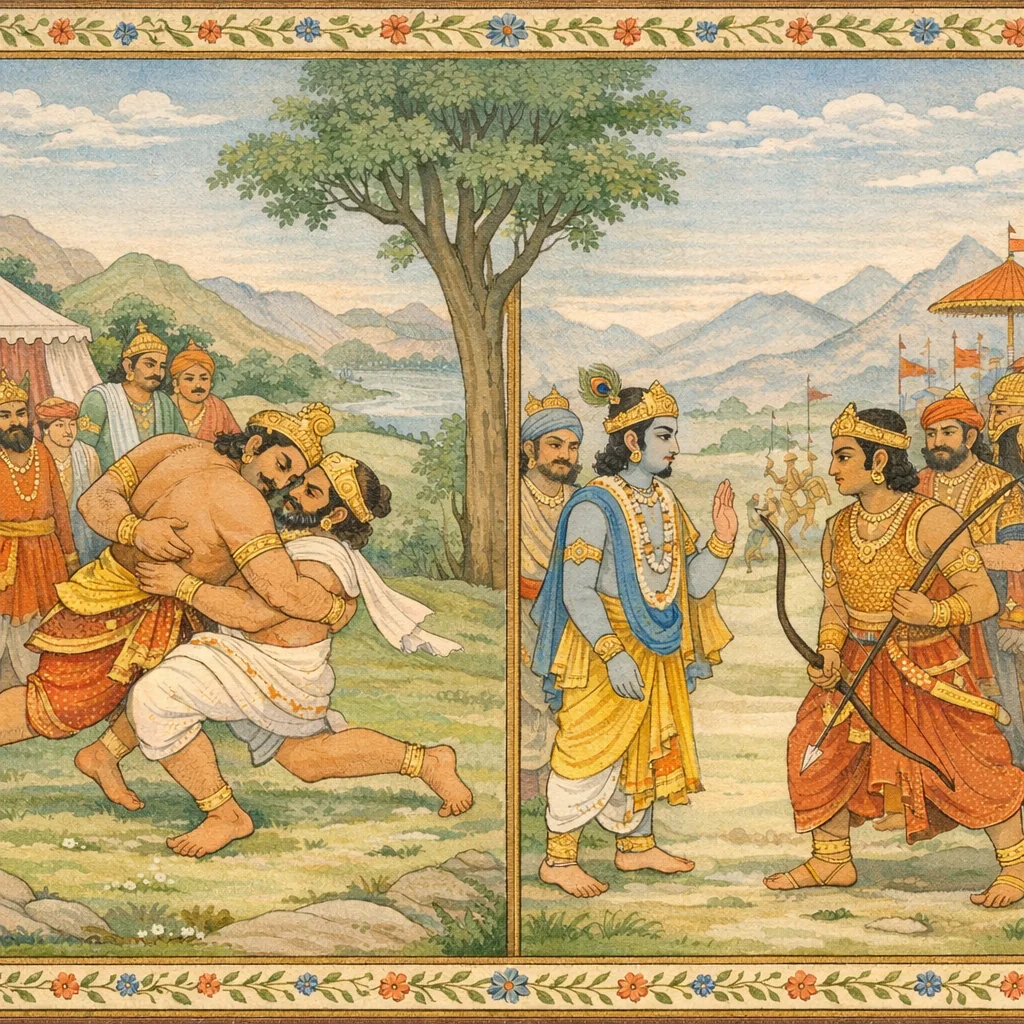
Chapter Arc: स्वयंवर-यात्रा के बाद पाण्डवों की वापसी के प्रसंग में सभा-स्थल पर वीरों की शक्ति-परख का वातावरण बनता है—मानो उत्सव के भीतर ही युद्ध का बीज अंकुरित हो उठा हो। → ब्राह्मणों की चर्चा और चुनौती के बीच अर्जुन हँसते-से दर्शक-समूह को पीछे रहने को कहता है और अकेले ही क्रुद्ध योद्धाओं को ‘मन्त्र-राशि’ और ‘विष’ की तरह रोक देने का दावा करता है। उधर दूसरे रण-क्षेत्र में भीम और शल्य मदमत्त गजराजों की भाँति भिड़ते हैं—घूँसों, घुटनों, धक्कों और खींचतान से संघर्ष उग्र होता जाता है। → भीम शल्य को पछाड़ देता है और अर्जुन के तेज से कर्ण शंकित होकर पीछे हटता है; इस दृश्य से समस्त राजाओं के मन में भय और विस्मय एक साथ उठता है—पाण्डवों की वास्तविक सामर्थ्य पहली बार खुलकर प्रकट होती है। → राजसभा का उन्माद शांत पड़ता है: शल्य की पराजय और कर्ण का युद्ध-त्याग संकेत देता है कि यह टकराव निर्णायक युद्ध नहीं, बल्कि पाण्डव-प्रताप की उद्घोषणा है। बलदेव के अतिरिक्त शल्य को परास्त करने में भीम की विशिष्टता स्वीकार की जाती है। → कर्ण का हटना अपमान की आग को बुझाता नहीं—यह शंका रह जाती है कि यह अपमान आगे किस रूप में प्रतिशोध बनेगा।
Shlokas
Verse 1
(दाक्षिणात्य अधिक पाठके २६ श्लोक मिलाकर कुल २६३ “लोक हैं।) नफमरशा+ (0) असऔ मनन - ऊर्ध्वविस्तृतदोर्माने तालमित्यभिधीयते। इस वचनके अनुसार एक मनुष्य अपनी बाँहको ऊपर उठाकर खड़ा हो तो उस हाथसे लेकर पैरतककी लम्बाईको “ताल” कहते हैं। एकोननवर्त्याधेकशततमो ध्याय: अर्जुन और भीमसेनके द्वारा कर्ण तथा शल्यकी पराजय द्रौोपदीसहित भीम-अर्जुनका अपने डेरेपर जाना वैशम्पायन उवाच अजिनानि विधुन्वन्त: करकांश्व द्विजर्षभा: । ऊचुस्ते भीर्न कर्तव्या वयं योत्स्यामहे परान्,वैशम्पायनजी कहते हैं--जनमेजय! उस समय अपने मृगचर्म और कमण्डलुओंको हिलाते और उछालते हुए वे श्रेष्ठ ब्राह्मण अर्जुनसे कहने लगे--“तुम डरना नहीं, हम (सब)- लोग (तुम्हारी ओरसे) शत्रुओंके साथ युद्ध करेंगे”
Vaiśampāyana said: Shaking their antelope-skins and their water-pots, those foremost of Brahmins spoke (to Arjuna): “Do not be afraid. We ourselves shall fight the enemies (on your behalf).” The scene underscores the protective resolve of ascetics and learned men, who, moved by duty and loyalty, offer support to the righteous in a moment of peril.
Verse 2
तानेवं वदतो विप्रानर्जुन: प्रहसन्निव । उवाच प्रेक्षका भूत्वा यूयं तिष्ठथ पार्श्चत:,इस प्रकारकी बातें करनेवाले उन ब्राह्मणोंसे अर्जुनने हँसते हुए-से कहा--“आपलोग दर्शक होकर बगलमें चुपचाप खड़े रहें
As those brāhmaṇas spoke in that manner, Arjuna—almost as if smiling—addressed them: “You remain at the side, standing quietly as mere spectators.”
Verse 3
अहमेनानजिद्याग्रै: शतशो विकिरज्छरै: | वारयिष्यामि संक्रुद्धान् मन्त्रराशीविषानिव,“मैं (अकेला ही) सीधी नोकवाले सैकड़ों बाणोंकी वर्षा करके क्रोधमें भरे हुए इन शत्रुओंको उसी प्रकार रोक दूँगा, जैसे मन्त्रज्ञ लोग अपने मन्त्रों (के बल)-से विषैले सर्पोंको कुण्ठित कर देते हैं”
Vaiśampāyana said: “Alone, I shall check these foes, swollen with wrath, by showering hundreds of sharp-pointed arrows—just as those skilled in mantras subdue venomous serpents through the power of their incantations.”
Verse 4
इति तद् धनुरानम्य शुल्कावाप्त॑ं महाबल: । भ्रात्रा भीमेन सहितस्तस्थौ गिरिरिवाचल:,यों कहकर महाबली अर्जुनने उसी स्वयंवरमें लक्ष्यवेधके लिये प्राप्त हुए धनुषको झुकाकर (उसपर प्रत्यंचा चढ़ा दी और उसे हाथमें लेकर) भाई भीमसेनके साथ वे पर्वतके समान अविचलभावसे खड़े हो गये
Vaiśampāyana said: Having thus spoken, the mighty Arjuna bent the bow that had been obtained as the bridal fee, strung it, and, holding it ready for the target, stood beside his brother Bhīma—steady and unmoving like a mountain. The scene underscores disciplined strength: power is shown not in haste, but in controlled readiness and resolve within the rules of the contest.
Verse 5
ततः कर्णमुखानू् दृष्ट्वा क्षत्रियान् युद्धदुर्मदान् । सम्पेततुरभीतौ तौ गजौ प्रतिगजानिव,तदनन्तर कर्ण आदि रणोन्मत्त क्षत्रियोंको आते देख वे दोनों भाई निर्भय हो उनपर उसी तरह टूट पड़े, जैसे दो (मतवाले) हाथी अपने विपक्षी हाथियोंकी ओर बढ़े जा रहे हों
Vaiśampāyana said: Then, seeing the Kṣatriya warriors—led by Karṇa—made arrogant by the frenzy of battle, the two brothers, fearless, rushed upon them, like two rut-maddened elephants charging against opposing elephants. The scene underscores the warrior code of confronting danger without retreat, even as it hints at how pride and intoxication with war can drive men toward ruin.
Verse 6
ऊचुश्न वाच: परुषास्ते राजानो युयुत्सव: । आहवे हि द्विजस्यापि वधो दृष्टो युयुत्मत:,तब युद्धके लिये उत्सुक उन राजाओंने कठोर स्वरमें ये बातें कहीं--युद्धकी इच्छावाले ब्राह्मणका भी रणभूमिमें वध शास्त्रानुकूल देखा गया है”
Vaiśampāyana said: Those kings, eager to fight, spoke in harsh words: “Indeed, in battle even the killing of a brāhmaṇa has been seen as sanctioned by the codes—when he is himself bent on fighting.” The statement frames a grim wartime ethic: the ordinary reverence owed to a brāhmaṇa is argued to be overridden when he adopts the role and intent of a combatant, and the speakers use this to justify severity in the coming conflict.
Verse 7
इत्येवमुक्त्वा राजान: सहसा दुद्रुवुर्द्धिजान । ततः: कर्णो महातेजा जिष्णुं प्रति ययौ रणे,यों कहकर वे राजालोग सहसा ब्राह्मणोंकी ओर दौड़े। महातेजस्वी कर्ण अर्जुनकी ओर युद्धके लिये बढ़ा
Having spoken thus, the kings at once rushed toward the brahmins. Then Karṇa, blazing with great prowess, advanced in battle toward Jiṣṇu (Arjuna). The scene underscores how a single utterance can instantly redirect collective action, while Karṇa’s choice to confront Arjuna highlights the ethical tension between personal valor and the consequences of escalating conflict.
Verse 8
युद्धार्थी वासिताहेतोर्गज: प्रतिगजं यथा । भीमसेनं ययौ शल्यो मद्राणामी श्वरो बली,ठीक उसी तरह, जैसे हथिनीके लिये लड़नेकी इच्छा रखकर एक हाथी अपने प्रतिद्वन्द्दी दूसरे हाथीसे भिड़नेके लिये जा रहा हो, महाबली मद्रराज शल्य भीमसेनसे जा भिड़े
Vaiśampāyana said: Just as an elephant, eager to fight for the sake of a she-elephant, advances to engage a rival elephant, so the mighty Śalya, lord of the Madras, went forth to meet Bhīmasena in combat. The simile underscores how desire and rivalry can drive even the powerful into direct confrontation, turning personal impulse into public violence on the battlefield.
Verse 9
दुर्योधनादय: सर्वे ब्राह्म॒णैः सह संगता: । मृदुपूर्वमयत्नेन प्रत्ययुध्यंस्तदाहवे,दुर्योधन आदि सभी (भूपाल) एक साथ अन्यान्य ब्राह्मणोंके साथ उस युद्धभूमिमें बिना किसी प्रयासके (खेल-सा करते हुए) कोमलतापूर्वक (शीत) युद्ध करने लगे
Vaiśampāyana said: Then Duryodhana and the others, having gathered together with the brāhmaṇas, began to engage in counter-fighting on that battlefield gently and without exertion—more like a restrained, almost playful contest than a harsh struggle. The scene underscores a moment where the outward form of war is present, yet its violence is moderated by decorum and the presence of revered persons.
Verse 10
ततो्र्जुन: प्रत्यविध्यदापतन्तं शितै: शरै: । कर्ण वैकर्तनं श्रीमान् विकृष्प बलवद् धनु:,तब तेजस्वी अर्जुनने अपने धनुषको जोरसे खींचकर अपनी ओर वेगसे आते हुए सूर्यपुत्र कर्णको कई तीक्ष्ण बाण मारे
Then the illustrious Arjuna, drawing his bow with great force, struck Karṇa—son of the Sun and known as Vaikartana—as he rushed toward him, piercing him with many keen arrows. The scene underscores the kṣatriya code in battle: meeting an oncoming foe directly with skill, resolve, and disciplined force rather than hesitation or retreat.
Verse 11
तेषां शराणां वेगेन शितानां तिग्मतेजसाम् | विमुह्यमानो राधेयो यत्नात् तमनुधावति,उन दुःसह तेजवाले तीखे बाणोंके वेगपूर्वक आघातसे राधानन्दन कर्णको मूर्च्छा आने लगी। वह बड़ी कठिनाईसे अर्जुनकी ओर बढ़ा
Vaiśampāyana said: Struck by the swift impact of those razor-sharp arrows, blazing with fierce power, Rādheya (Karna) began to reel and lose consciousness. Yet, with great effort, he pressed on in pursuit of him (Arjuna).
Verse 12
तावुभावप्यनिर्देश्यौ लाघवाज्जयतां वरौ । अयुध्येतां सुसंरब्धावन्योन्यविजिगीषिणौ,विजयी वीरोंमें श्रेष्ठ वे दोनों योद्धा हाथोंकी फुर्ती दिखानेमें बेजोड़ थे, उनमें कौन बड़ा है और कौन छोटा--यह बताना असम्भव था। दोनों ही एक-दूसरेको जीतनेकी इच्छा रखकर बड़े क्रोधसे लड़ रहे थे
Vaiśampāyana said: Those two foremost among victorious heroes were, by reason of their swift dexterity, impossible to distinguish as greater or lesser. Inflamed with fierce wrath and each intent on conquering the other, they fought on.
Verse 13
कृते प्रतिकृतं पश्य पश्य बाहुबलं च मे । इति शूरार्थवचनैरभाषेतां परस्परम्,“देखो, तुमने जिस अस्त्रका प्रयोग किया था, उसे रोकनेके लिये मैंने यह अस्त्र चलाया है। देख लो, मेरी भुजाओंका बल!” इस प्रकार शौर्यसूचक वचनोंद्वारा वे आपसमें बातें भी करते जाते थे
Verse 14
ततोडअर्जुनस्य भुजयोर्वीर्यमप्रतिमं भुवि । ज्ञात्वा वैकर्तनः कर्ण: संरब्ध: समयोधयत्,तदनन्तर अर्जुनके बाहुबलकी इस पृथ्वीपर कहीं समता नहीं है, यह जानकर सूर्यपुत्र कर्ण अत्यन्त क्रोधपूर्वक जमकर युद्ध करने लगा
Then, realizing that on this earth Arjuna’s strength in his arms was without equal, Karṇa—son of the Sun and known as Vaikartana—became fiercely enraged and engaged him in a determined fight. The verse highlights how recognition of another’s excellence can provoke rivalry and wrath, intensifying the moral tension of combat where pride and anger contend with restraint and right conduct.
Verse 15
अर्जुनेन प्रयुक्तांस्तान् बाणान् वेगवतस्तदा । प्रतिहत्य ननादोच्चै: सैन्यानि तदपूजयन्,उस समय अर्जुनद्वारा चलाये हुए उन सभी वेगशाली बाणोंको काटकर कर्ण बड़े जोरसे सिंहनाद करने लगा। समस्त सैनिकोंने उसके इस अद्भुत कार्यकी सराहना की
Vaiśampāyana said: Then Karṇa, having struck down and checked those swift arrows discharged by Arjuna, roared aloud like a lion. The assembled troops praised and acclaimed that extraordinary feat of his.
Verse 16
कर्ण उवाच तुष्यामि ते विप्रमुख्य भुजवीर्यस्य संयुगे । अविषादस्य चैवास्य शत्त्रास्त्रविजयस्थ च,कर्ण बोला--विप्रवर! युद्धमें आपके बाहुबलसे मैं (बहुत) संतुष्ट हूँ। आपमें थकावट या विषादका कोई चिह्न नहीं दिखायी देता और आपने सभी अस्त्र-शस्त्रोंकी जीतकर मानो अपने काबूमें कर लिया है। (आपकी यह सफलता देखकर मुझे बड़ी प्रसन्नता हुई है)
Karna said: “O foremost of Brahmins, I am pleased with you—your arm-strength in battle is evident. In you there is no sign of fatigue or dejection, and you have, as it were, mastered victory over weapons and missiles. Seeing this success, my heart is greatly satisfied.”
Verse 17
किं त्वं साक्षाद् धनुर्वेदो रामो वा विप्रसत्तम | अथ साक्षाद्धरिहय: साक्षाद् वा विष्णुरच्युत:,विप्रशिरोमणे! आप मूर्तिमान् धनुर्वेद हैं? या परशुराम? अथवा आप स्वयं इन्द्र या अपनी महिमासे कभी च्युत न होनेवाले साक्षात् भगवान् विष्णु हैं?
Karna said: “Who are you truly, O best of brahmins? Are you the very embodied science of archery, or Rama (Paraśurāma) himself? Or are you Indra, lord of the tawny steeds, or indeed Viṣṇu—Acyuta, the unfailing one—manifest before me?” In this moment Karna’s awe and uncertainty reveal how extraordinary the opponent appears, and how power can be read as a sign of divine presence, calling for reverence even amid rivalry.
Verse 18
आत्मप्रच्छादनार्थ वै बाहुवीर्यमुपाश्रित: । विप्ररूप॑ विधायेदं मन्ये मां प्रतियुध्यसे,मैं समझता हूँ, आप इन्हींमेंसे कोई हैं और अपने स्वरूपको छिपानेके लिये यह ब्राह्मणवेष धारण करके बाहुबलका आश्रय ले मेरे साथ युद्ध कर रहे हैं
Karna said: “Surely, to conceal your true identity, you have taken refuge in the strength of your arms and assumed this guise of a brahmin. I believe you are one of those (warriors), and that, hiding your real form, you are fighting against me.”
Verse 19
न हि मामाहवे क्रुद्धमन्य: साक्षाच्छचीपते: । पुमान् योधयितु शक्त: पाण्डवाद् वा किरीटिन:,क्योंकि युद्धमें मेरे कुपित होनेपर साक्षात् शचीपति इन्द्र अथवा किरीटधारी पाण्डु- नन्दन अर्जुनके अतिरिक्त दूसरा कोई मेरा सामना नहीं कर सकता
Karna said: “When I am enraged in battle, no other man is capable of engaging me—except Indra himself, the lord of Śacī, or the diadem-wearing Pāṇḍava, Arjuna.” In ethical tone, the line expresses Karna’s fierce self-assurance and his fixation on a single worthy rival, framing valor as measured by the caliber of one’s opponent.
Verse 20
तमेवं वादिनं तत्र फाल्गुन: प्रत्यभाषत । नास्मि कर्ण थनुर्वेदो नास्मि राम: प्रतापवान्,कर्णके ऐसा कहनेपर अर्जुनने उसे इस प्रकार उत्तर दिया--'कर्ण! न तो मैं धनुर्वेद हूँ और न प्रतापी परशुराम”
As Karṇa spoke in that manner, Phālguna (Arjuna) replied to him there: “Karṇa, I am not the very science of archery itself, nor am I the mighty Rāma (Paraśurāma).” In ethical tone, Arjuna rejects inflated comparisons and grounds the exchange in humility and realism, implying that prowess should be proved by conduct and deed rather than by boastful self-identification with legendary ideals.
Verse 21
ब्राह्मणो5स्मि युधां श्रेष्ठ: सर्वशस्त्रभूतां वर: । ब्राह्मे पौरंदरे चास्त्रे नेष्ठितो गुरुशआसनात्
Karna said: “I am a brāhmaṇa, O best of warriors; among all who bear weapons I am the foremost. In the Brahmā-weapon and in the weapon of Purandara (Indra) I have been fully trained, in accordance with my teacher’s command.”
Verse 22
वैशम्पायन उवाच एवमुक्तस्तु राधेयो युद्धात् कर्णो न्यवर्तत
Vaiśampāyana said: Thus addressed, Rādheya—Karna—turned back from the battle. The line underscores a moment where a warrior’s course is checked by words and circumstance, hinting at the ethical tension between steadfastness in combat and the prudence (or constraint) that can compel withdrawal.
Verse 23
अपरस्मिन् वनोद्देशे वीरोी शल्यवृकोदरौ,इसी समय दूसरे स्थानको अपना रणक्षेत्र बनाकर वहीं बलवान् वीर शल्य और भीमसेन एक-दूसरेको ललकारते हुए दो मतवाले गजराजोंकी भाँति युद्ध कर रहे थे। दोनों ही विद्या, बल और युद्धकी कलासे सम्पन्न थे
Vaiśampāyana said: In another tract of the forest, Śalya and Vṛkodara (Bhīma)—both mighty heroes—made that spot their battlefield. Challenging one another, they fought like two intoxicated lordly elephants. Each was accomplished in martial knowledge, physical strength, and the arts of war, showing how prowess and training, when set against each other in a righteous contest, can turn a wilderness into a formal arena of combat.
Verse 24
बलिनीौ युद्धसम्पन्नौ विद्यया च बलेन च । अन्योन्यमाह्दयन्तौ तु मत्ताविव महागजौ,इसी समय दूसरे स्थानको अपना रणक्षेत्र बनाकर वहीं बलवान् वीर शल्य और भीमसेन एक-दूसरेको ललकारते हुए दो मतवाले गजराजोंकी भाँति युद्ध कर रहे थे। दोनों ही विद्या, बल और युद्धकी कलासे सम्पन्न थे
Vaiśampāyana said: Mighty and fully trained in the arts of war—both in martial skill and in sheer strength—Śalya and Bhīmasena, having made another spot their battlefield, challenged one another and fought like two intoxicated lordly elephants. The scene underscores how prowess and training can intensify conflict when valor is driven into rivalry on the field of dharma-bound war.
Verse 25
मुष्टिभिर्जानुभिश्वैव निघ्नन्तावितरेतरम् । प्रकर्षणाकर्षणयोरभ्याकर्षविकर्षणै:,वे घूँसों और घुटनोंसे एक-दूसरेको मारने लगे। दोनों एक-दूसरेको दूरतक ठेल ले जाते, नीचे गिरानेका प्रयत्न करते, कभी अपनी ओर खींचते और कभी अगल-बगलसे पैतरें देकर गिरानेकी चेष्टा करते थे
Vaiśampāyana said: Striking one another with fists and knees, the two grappled at close quarters. In the contest of dragging and pulling, they alternately hauled each other near and shoved each other away—each seeking to unbalance the other and force him down. The scene underscores how, when rivalry hardens into violence, strength is spent not in righteousness but in domination.
Verse 26
आचर्कर्षतुरन्योन्यं मुष्टिभिश्वापि जघ्नतुः । ततश्नट्चटाशब्द: सुघोरो हूभवत् तयो:,इस प्रकार वे एक-दूसरेको खींचते और मुक्कोंसे मारते थे। उस समय घूँसोंकी मारसे दोनोंके शरीरोंपर अत्यन्त भयंकर “चट-चट” शब्द हो रहा था। वे परस्पर इस प्रकार प्रहार कर रहे थे, मानो पत्थर टकरा रहे हों। लगभग दो घड़ीतक दोनों उस युद्धमें एक-दूसरेको खींचते और ठेलते रहे
Vaiśampāyana said: They grappled with one another, dragging each other close, and struck each other with their fists. Then, between the two of them, a terribly harsh “chat-chat” sound arose—like stones clashing—so fierce was the impact of their blows. The scene underscores how, when rivalry hardens into rage, strength turns into brutality and the body becomes the immediate field where enmity is made audible and visible.
Verse 27
पाषाणसम्पातनिभीै: प्रहारैरभिजध्नतु: । मुहूर्त तौ तदान्योन्यं समरे पर्यकर्षताम्,इस प्रकार वे एक-दूसरेको खींचते और मुक्कोंसे मारते थे। उस समय घूँसोंकी मारसे दोनोंके शरीरोंपर अत्यन्त भयंकर “चट-चट” शब्द हो रहा था। वे परस्पर इस प्रकार प्रहार कर रहे थे, मानो पत्थर टकरा रहे हों। लगभग दो घड़ीतक दोनों उस युद्धमें एक-दूसरेको खींचते और ठेलते रहे
Vaiśampāyana said: Striking each other with blows that sounded like the crashing of stones, the two grappled in battle, dragging one another back and forth. For a time they pulled and shoved each other in the thick of combat, their bodies resounding with harsh, snapping impacts—like rocks colliding—showing how the contest had descended into sheer physical force rather than measured restraint.
Verse 28
ततो भीम: समुत्क्षिप्य बाहुभ्यां शल्यमाहवे । अपातयत् कुरुश्रेष्ठो ब्राह्मणा जहसुस्तदा,तदनन्तर कुरुश्रेष्ठ भीमसेनने दोनों हाथोंसे शल्यको ऊपर उठाकर उस युद्धभूमिमें पटक दिया। यह देख ब्राह्मणलोग हँसने लगे
Then Bhīma, lifting Śalya up with both arms in the midst of the combat, hurled him down upon the battlefield. Seeing this feat of strength, the brāhmaṇas present burst into laughter—an onlooker’s reaction that underscores the sudden reversal of advantage and the almost sportive display of power within a serious contest.
Verse 29
तत्राश्नर्य भीमसेनश्वकार पुरुषर्षभः । यच्छल्यं पातितं भूमौ नावधीद् बलिनं बली,कुरुश्रेष्ठ बलवान् भीमसेनने एक आश्चर्यकी बात यह की कि महाबली शल्यको पृथ्वीपर पटककर भी मार नहीं डाला
Vaiśampāyana said: There, Bhīmasena—the bull among men—performed a deed that was truly astonishing: though he had hurled the mighty Śalya down upon the earth, that powerful hero did not kill him. The moment highlights restraint in the midst of strength, suggesting that true prowess may include the capacity to spare, not merely to strike.
Verse 30
पातिते भीमसेनेन शल्ये कर्णे च शड्किते । शड्किता: सर्वराजान: परिवत्रुर्वकोदरम्,भीमसेनके द्वारा शल्यके पछाड़ दिये जाने और अर्जुनसे कर्णके डर जानेपर सभी राजा (युद्धका विचार छोड़) शंकित हो भीमसेनको चारों ओरसे घेरकर खड़े हो गये
Vaiśampāyana said: When Śalya had been struck down by Bhīmasena and Karṇa too was thrown into doubt and fear, all the kings—alarmed and losing heart for battle—surrounded Vṛkodara (Bhīma) on every side, standing encircling him. The scene underscores how swiftly morale shifts in war: the fall of a champion and the wavering of another can shake an entire host, driving rulers to act from anxiety rather than steady resolve.
Verse 31
ऊचुश्न सहितास्तत्र साध्विमौ ब्राह्मणर्षभौ । विज्ञायेतां क्वजन्मानौ क्वनिवासौ तथैव च,और एक साथ ही बोल उठे--'अहो! ये दोनों श्रेष्ठ ब्राह्मण धन्य हैं। पता तो लगाओ, इनकी जन्मभूमि कहाँ है तथा ये रहनेवाले कहाँके हैं?
Vaiśampāyana said: Then, all together, they exclaimed there, “Ah! These two are truly worthy—bulls among Brahmins. Find out where they were born and where they reside as well.” The crowd’s praise reflects a moral instinct to honor evident virtue and to seek the background of those whose conduct inspires reverence.
Verse 32
को हि राधासुतं कर्ण शक्तो योधयितुं रणे । अन्यत्र रामाद् द्रोणाद् वा पाण्डवाद् वा किरीटिन:,“परशुराम, द्रोण अथवा पाण्डुनन्दन अर्जुनके सिवा दूसरा ऐसा कौन है, जो युद्धमें राधानन्दन कर्णका सामना कर सके
Vaiśampāyana said: “Who indeed is capable of engaging Karṇa, the son of Rādhā, in battle—except Rāma (Paraśurāma), or Droṇa, or the Pāṇḍava Arjuna, the wearer of the diadem?” The statement underscores Karṇa’s formidable prowess while also marking the rare standards of martial excellence and disciplined dharma that alone can meet such power without collapse into mere violence.
Verse 33
कृष्णाद् वा देवकीपुत्रात् कृपाद् वापि शरद्वत: । को वा दुर्योधन शक्त: प्रतियोधयितुं रणे,“(इसी प्रकार) देवकीनन्दन श्रीकृष्ण अथवा शरद्वानके पुत्र कृपाचार्यके सिवा दूसरा कौन है, जो समरभूमिमें दुर्योधनके साथ लोहा ले सके
Vaiśampāyana said: “Who, indeed, is capable of standing against Duryodhana in battle—except Kṛṣṇa, the son of Devakī, or Kṛpa, the son of Śaradvat? Apart from these, who could truly meet him in combat?” The verse underscores a moral and strategic assessment: Duryodhana’s martial power is acknowledged, yet it is framed within the ethical reality that only exceptional figures—one revered for divine wisdom and protection (Kṛṣṇa) and one renowned for disciplined mastery of arms (Kṛpa)—can counterbalance such force on the battlefield.
Verse 34
तथैव मद्राधिपतिं शल्यं बलवतां वरम् | बलदेवादृते वीरात् पाण्डवाद् वा वृकोदरात्,“बलवानोंमें श्रेष्ठ मद्रराज शल्यको भी वीरवर बलदेव, पाण्डुनन्दन भीमसेन अथवा वीर दुर्योधनको छोड़कर दूसरा कौन रणभूमिमें गिरा सकता है। अतः ब्राह्मणोंसे घिरे हुए इस युद्धक्षेत्रसे हमलोगोंको हट जाना चाहिये
Vaiśampāyana said: “Likewise, who could cast down in battle Śalya, the lord of Madra and foremost among the mighty—except the heroic Baladeva, or the Pāṇḍava Vṛkodara (Bhīma)?” The statement underscores Śalya’s exceptional martial stature and implies that only a very small circle of extraordinary warriors could hope to defeat him, shaping the ethical calculus of whether to persist in a confrontation where the odds and the cost in lives are grave.
Verse 35
वीराद् दुर्योधनाद् वान्य: शक्तः पातयितुं रणे । क्रियतामवहारो<स्माद् युद्धाद् ब्राह्मणसंवृतात्,“बलवानोंमें श्रेष्ठ मद्रराज शल्यको भी वीरवर बलदेव, पाण्डुनन्दन भीमसेन अथवा वीर दुर्योधनको छोड़कर दूसरा कौन रणभूमिमें गिरा सकता है। अतः ब्राह्मणोंसे घिरे हुए इस युद्धक्षेत्रसे हमलोगोंको हट जाना चाहिये
Vaiśaṃpāyana said: “Other than the heroic Duryodhana, who else has the strength to strike down (such a warrior) in battle? Therefore, let a withdrawal be made from this battlefield, which is surrounded by brāhmaṇas.”
Verse 36
ब्राह्मणा हि सदा रक्ष्या: सापराधापि नित्यदा | अथैनानुपलभ्येह पुनर्योत्स्याम हृष्टवत्,'क्योंकि ब्राह्मण अपराधी हों, तो भी सदा ही उनकी रक्षा करनी चाहिये। पहले इनका ठीक-ठीक परिचय ले लें, फिर (ये चाहें तो) हम इनके साथ प्रसन्नतापूर्वक युद्ध करेंगे”!
Vaiśaṃpāyana said: “Brahmins must always be protected—even when they are at fault. Therefore, let us first ascertain who these people truly are; and then, if they so desire, we shall fight them again with a willing and untroubled mind.”
Verse 37
तांस्तथावादिन: सर्वान् प्रसमीक्ष्य क्षिती श्वरान् । अथान्यान् पुरुषांश्षापि कृत्वा तत् कर्म संयुगे,उन सब राजाओं तथा अन्य लोगोंको ऐसी बातें करते देख और युद्धमें वह महान् पराक्रम दिखाकर भीमसेन और अर्जुन बड़े प्रसन्न थे
Vaiśampāyana said: Having observed all those kings speaking in that manner, and having also dealt with the other men by performing that deed amid the clash of battle, the narrative underscores how public words and battlefield actions together shape reputation and moral judgment in a royal conflict.
Verse 38
वैशम्पायन उवाच तत् कर्म भीमस्य समीक्ष्य कृष्ण: कुन्तीसुतो तौ परिशड्कमान: । निवारयामास महीपतींस्तान् धर्मेण लब्धेत्यनुनीय सर्वान्,वैशम्पायनजी कहते हैं--जनमेजय! भीमसेनका वह अद्भुत कार्य देख भगवान् श्रीकृष्णने यह सोचते हुए कि ये दोनों भाई कुन्तीकुमार भीमसेन और अर्जुन ही हैं, उन सब राजाओंको यह समझाकर कि इन्होंने धर्मपूर्वक द्रौपदीको प्राप्त किया है” अनुनयपूर्वक युद्धसे रोका
Vaiśampāyana said: Seeing that extraordinary deed of Bhīma, Kṛṣṇa—suspecting that the two were indeed the sons of Kuntī (Bhīma and Arjuna)—gently restrained those kings from fighting, persuading them all that she had been won in accordance with dharma.
Verse 39
एवं ते विनिवृत्तास्तु युद्धाद् युद्धविशारदा: । यथावासं ययु: सर्वे विस्मिता राजसत्तमा:,इस प्रकार श्रीकृष्णके समझानेसे वे सभी युद्धकुशल श्रेष्ठ नरेश युद्धसे निवृत्त हो गये और विस्मित होकर अपने-अपने डेरोंको चले गये
Vaiśampāyana said: Thus, those foremost kings—skilled in the arts of war—desisted from battle; and, astonished, they all departed to their respective encampments. The moment underscores how wise counsel can restrain even the most battle-ready rulers, turning them from immediate violence toward order and self-control.
Verse 40
वृत्तो ब्रह्मोत्तरो रड्र: पाज्चाली ब्राह्मुणैर्वता । इति ब्रुवन्त: प्रययुर्ये तत्रासन् समागता:,वहाँ जो दर्शक एकत्र हुए थे, वे “इस रंग-मण्डपके उत्सवसे ब्राह्मणोंकी श्रेष्ठता सिद्ध हुई; पांचालराजकुमारी द्रौपदीको ब्राह्मणोंने प्राप्त किया“, यों कहते हुए (अपने-अपने निवासस्थानको) चले गये
Vaiśampāyana said: The spectators who had gathered there departed to their respective homes, saying, “By this festival in the arena, the pre-eminence of the Brāhmaṇas has been demonstrated; and the Pāñcāla princess Draupadī has been won by the Brāhmaṇas.” The scene underscores how public acclaim can frame events in terms of social dharma and perceived merit, attributing success to the status and conduct associated with the Brāhmaṇa ideal.
Verse 41
ब्राह्मणैस्तु प्रतिच्छन्नी रौरवाजिनवासिभि: । कृच्छेण जग्मतुस्ती तु भीमसेनधनंजयौ,रुरुमृगके चर्मको वस्त्रके रूपमें धारण करनेवाले ब्राह्मणोंसे घिरे होनेके कारण भीमसेन और अर्जुन बड़ी कठिनाईसे आगे बढ़ पाते थे
Vaiśampāyana said: Though concealed and surrounded by brāhmaṇas wearing garments of raurava (deerskin), Bhīmasena and Dhanañjaya could proceed only with great difficulty. The scene underscores how outward marks of sanctity can be used as a protective cover, creating a moral tension between genuine dharma and the strategic use of religious appearance amid danger.
Verse 42
विमुक्तीो जनसम्बाधाच्छत्रुभि: परिवीक्षितौ । कृष्णयानुगतौ तत्र नृवीरी तौ विरेजतु:,जनताकी भीड़से बाहर निकलनेपर शत्रुओंने उन्हें अच्छी तरह देखा। आगे-आगे वे दोनों नरवीर थे और उनके पीछे-पीछे द्रौपदी चली जा रही थी। द्रौपदीके साथ वहाँ उन दोनोंकी बड़ी शोभा हो रही थी
Verse 43
पौर्णमास्यां घनैर्मुक्तौ चन्द्रसूर्याविवोदितौ । तेषां माता बहुविधं विनाशं पर्यचिन्तयत्,वे ऐसे लगते थे, जैसे पूर्णमासी तिथिको मेघोंकी घटासे निकलकर चन्द्रमा और सूर्य प्रकाशित हो रहे हों। इधर भिक्षाका समय बीत जानेपर भी जब पुत्र नहीं लौटे, तब उनकी माता कुन्तीदेवी स्नेहवश अनेक प्रकारकी चिन्ताओंमें डूबकर उनके विनाशकी आशंका करने लगीं--“कहीं ऐसा तो नहीं हुआ कि धृतराष्ट्रके पुत्रोंने कुरुश्रेष्ठ पाण्डवोंको पहचानकर उनकी हत्या कर डाली हो? अथवा दृढ़तापूर्वक वैरभावको मनमें रखनेवाले महाभयंकर मायावी राक्षसोंने तो मेरे बच्चोंको नहीं मार डाला? क्या महात्मा व्यासके भी निश्चित मतके विपरीत कोई बात हो गयी?”
Vaiśampāyana said: On the full-moon night, freed from the mass of clouds, they shone forth like the moon and the sun newly risen. But when the time for alms had passed and her sons still had not returned, their mother Kuntī—out of deep affection—became immersed in many anxious thoughts, fearing their destruction: perhaps Dhṛtarāṣṭra’s sons, recognizing the foremost of the Kurus, the Pāṇḍavas, had slain them; or perhaps the dreadful, deceitful rākṣasas, holding firm to enmity, had killed her children; or perhaps something had occurred contrary even to the settled intention of the great-souled Vyāsa.
Verse 44
अनागच्छत्सु पुत्रेषु भैक्षकालेडभिगच्छति । धार्तराष्ट्रहता न स्युर्विज्ञाय कुरुपुज्वा:,वे ऐसे लगते थे, जैसे पूर्णमासी तिथिको मेघोंकी घटासे निकलकर चन्द्रमा और सूर्य प्रकाशित हो रहे हों। इधर भिक्षाका समय बीत जानेपर भी जब पुत्र नहीं लौटे, तब उनकी माता कुन्तीदेवी स्नेहवश अनेक प्रकारकी चिन्ताओंमें डूबकर उनके विनाशकी आशंका करने लगीं--“कहीं ऐसा तो नहीं हुआ कि धृतराष्ट्रके पुत्रोंने कुरुश्रेष्ठ पाण्डवोंको पहचानकर उनकी हत्या कर डाली हो? अथवा दृढ़तापूर्वक वैरभावको मनमें रखनेवाले महाभयंकर मायावी राक्षसोंने तो मेरे बच्चोंको नहीं मार डाला? क्या महात्मा व्यासके भी निश्चित मतके विपरीत कोई बात हो गयी?”
Vaiśampāyana said: When the time for alms had arrived and her sons still had not returned, Kuntī—overcome by maternal affection—sank into many anxious thoughts and began to fear their destruction: “Could it be that Dhṛtarāṣṭra’s sons, recognizing those foremost of the Kurus, have killed them?” The verse frames a moral tension between kinship and hostility: even within one lineage, envy and rivalry can turn recognition into violence, and a mother’s love anticipates the ethical catastrophe of fratricidal harm.
Verse 45
मायान्वितैर्वा रक्षोभि: सुघोरैर्दुढवैरिभि: । विपरीतं मतं जातं व्यासस्यापि महात्मन:,वे ऐसे लगते थे, जैसे पूर्णमासी तिथिको मेघोंकी घटासे निकलकर चन्द्रमा और सूर्य प्रकाशित हो रहे हों। इधर भिक्षाका समय बीत जानेपर भी जब पुत्र नहीं लौटे, तब उनकी माता कुन्तीदेवी स्नेहवश अनेक प्रकारकी चिन्ताओंमें डूबकर उनके विनाशकी आशंका करने लगीं--“कहीं ऐसा तो नहीं हुआ कि धृतराष्ट्रके पुत्रोंने कुरुश्रेष्ठ पाण्डवोंको पहचानकर उनकी हत्या कर डाली हो? अथवा दृढ़तापूर्वक वैरभावको मनमें रखनेवाले महाभयंकर मायावी राक्षसोंने तो मेरे बच्चोंको नहीं मार डाला? क्या महात्मा व्यासके भी निश्चित मतके विपरीत कोई बात हो गयी?”
Or perhaps some terrifying rākṣasas, skilled in deception and hardened in enmity, have done it. Has something occurred that runs contrary even to the settled judgment of the great-souled Vyāsa? (Thus Kuntī, as time passed and her sons did not return, sank into anxious foreboding about their safety.)
Verse 46
इत्येवं चिन्तयामास सुतस्नेहावृता पृथा । ततः सुप्तजनप्राये दुर्दिने मेघसम्प्लुते,इस प्रकार पुत्रस्नेहमें पगी कुन्तीदेवी जब चिन्तामें मग्न हो रही थीं, आकाशमें मेघोंकी भारी घटा घिर आनेके कारण जब दुर्दिन-सा हो रहा था और जनता सब काम छोड़कर सोये हुएकी भाँति अपने-अपने घरोंपर निश्चेष्ट होकर बैठी थी, उसी समय दिनके तीसरे पहरमें बादलोंसे घिरे हुए सूर्यके समान ब्राह्मणमण्डलीसे घिरे हुए अर्जुनने वहाँ उस कुम्हारके घरमें प्रवेश किया
Vaiśampāyana said: Thus Pṛthā (Kuntī), overwhelmed by motherly affection, kept turning these thoughts over in her mind. Then, on a gloomy day when the sky was flooded with heavy clouds and the people, abandoning their tasks, sat motionless in their homes as if asleep, Arjuna—surrounded by a circle of brāhmaṇas, like the sun veiled by clouds—entered there, into the potter’s house, in the third part of the day.
Verse 47
महत्यथापराह्ि तु घनै: सूर्य इवावृत: । ब्राह्मणै: प्राविशत् तत्र जिष्णुर्भार्गववेश्म तत्,इस प्रकार पुत्रस्नेहमें पगी कुन्तीदेवी जब चिन्तामें मग्न हो रही थीं, आकाशमें मेघोंकी भारी घटा घिर आनेके कारण जब दुर्दिन-सा हो रहा था और जनता सब काम छोड़कर सोये हुएकी भाँति अपने-अपने घरोंपर निश्चेष्ट होकर बैठी थी, उसी समय दिनके तीसरे पहरमें बादलोंसे घिरे हुए सूर्यके समान ब्राह्मणमण्डलीसे घिरे हुए अर्जुनने वहाँ उस कुम्हारके घरमें प्रवेश किया
Vaiśampāyana said: Then, in the great late afternoon, when the sun was as though veiled by dense clouds, Jiṣṇu (Arjuna), surrounded by a company of brāhmaṇas, entered there the house of Bhārgava. The scene underscores how, amid a darkening, ominous hour, Arjuna advances under the protective cover of a brāhmaṇa entourage—an ethically charged disguise that allows him to move without provoking immediate suspicion or violence.
Verse 189
इति श्रीमहाभारते आदिपर्वणि स्वयंवरपर्वणि पाण्डवप्रत्यागमने एकोननवत्यधिकशततमो< ध्याय:,इस प्रकार श्रीमहाभारत आदिपव॑के अन्तर्गत स्वयंवरपर्वमें पाण्डवप्रत्यागमनविषयक एक सौ नवासीवाँ अध्याय पूरा हुआ
Thus ends, in the Śrī Mahābhārata, within the Ādi Parva, in the section concerning the svayaṃvara, the one-hundred-and-eighty-ninth chapter, dealing with the return of the Pāṇḍavas. This colophon marks the completion of that chapter, formally closing the narrative unit and affirming the orderly transmission of the epic’s account.
Verse 216
स्थितो<स्म्यद्य रणे जेतुं त्वां वै वीर स्थिरो भव । मैं तो सम्पूर्ण शस्त्रधारियोंमें उत्तम और योद्धाओंमें श्रेष्ठ एक ब्राह्मण हूँ। गुरुका उपदेश पाकर ब्रह्मास्त्र तथा इन्द्रास्त्र दोनोंमें पारंगत हो गया हूँ। वीर! आज मैं तुम्हें युद्धमें जीतनेके लिये खड़ा हूँ, तुम भी स्थिरतापूर्वक खड़े रहो
Karna said: “Today I stand firm on the battlefield to defeat you. O hero, stand your ground with steadiness.” In this challenge, Karna frames combat as a test of resolve and martial discipline: victory is sought through unwavering courage and trained skill, not wavering or fear. The surrounding prose in the received Gita Press passage further heightens his self-assertion—claiming mastery of divine missiles through a teacher’s instruction—underscoring the epic tension between acquired power, rightful conduct, and the ethics of rivalry in war.
Verse 226
बाद्यां तेजस्तदाजय्यं मन्यमानो महारथ: । वैशम्पायनजी कहते हैं--जनमेजय! अर्जुनकी यह बात सुनकर महारथी कर्ण ब्राह्मतेजको अजेय मानता हुआ उस समय युद्ध छोड़कर हट गया
Vaiśampāyana said: O Janamejaya, hearing Arjuna’s words, the great chariot-warrior Karṇa—regarding the spiritual power of a brāhmaṇa as unconquerable—then withdrew from the fight. The moment underscores an ethical boundary in warfare: martial prowess yields before the perceived inviolability of sacred ascetic power.
Frequently Asked Questions
The dilemma concerns order versus exception: Yama’s temporary suspension of death (for ritual duty) produces societal imbalance, raising the ethical question of how sacred obligation should be reconciled with the maintenance of worldly stability.
The chapter teaches that roles and limits (mortality, duty, hierarchy) are instruments of balance; when pride or functional confusion arises, corrective knowledge and disciplined action restore differentiation and uphold dharma across cosmic and human domains.
No explicit phalaśruti is stated in the supplied passage; the meta-function is etiological—linking later events (Pāṇḍava origins and Draupadī’s marriage structure) to prior causes—thereby positioning comprehension of origins as integral to interpreting dharma and consequence.