Adhyaya 8
रुद्रसर्गः (नीललोहितः), अष्टनाम-स्थान-परिवारः, श्री-नारायणयोः अभेदव्याप्तिः
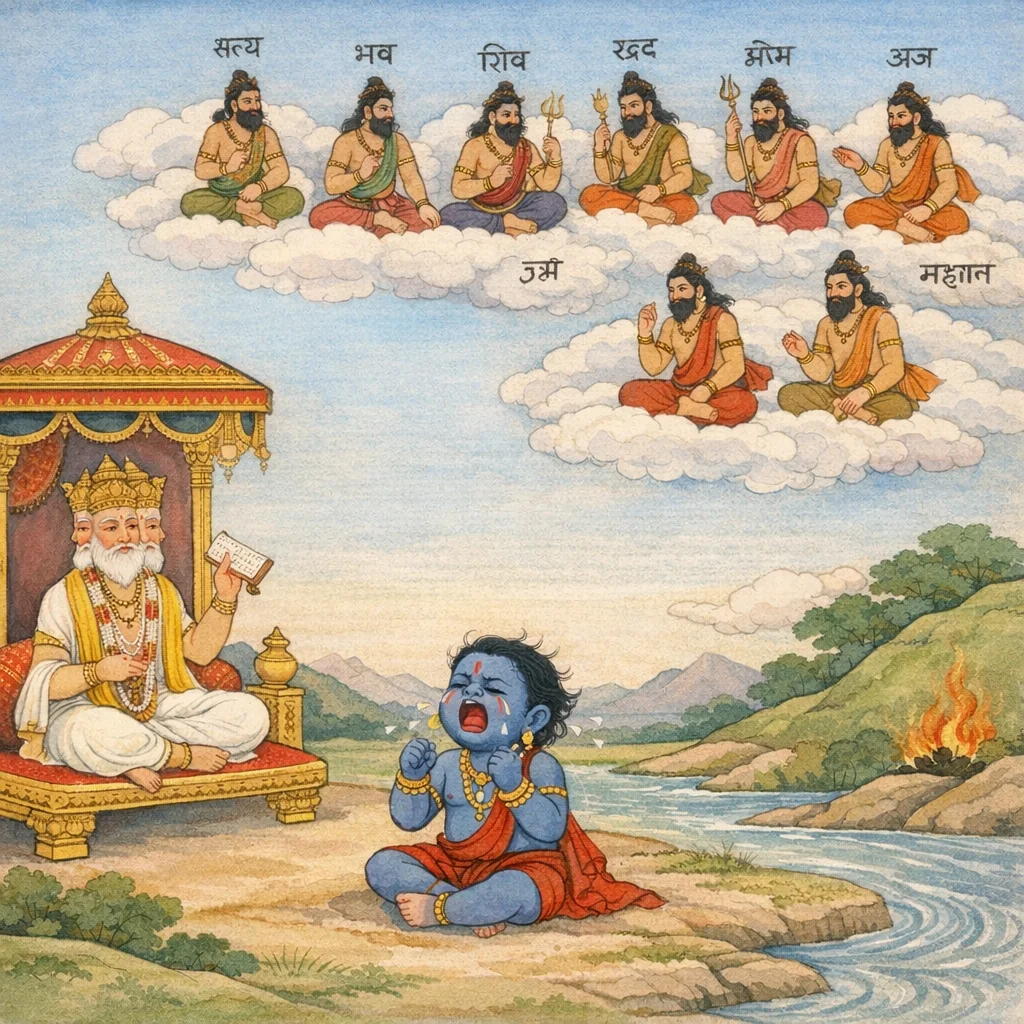
Parāśara moves from the tāmasa-sarga to the Rudra-sarga. At the beginning of the kalpa, Nīlalohita appears on Brahmā’s lap, weeps for a name, and is called Rudra; through repeated crying he receives seven further names, with their stations, wives, and sons assigned. The eightfold Rudra-form is tied to cosmic loci—Sun, Water, Earth, Wind, Fire, Space, the consecrated Brāhmaṇa, and Soma—and progeny such as Śanaiścara and Śukra are listed. The account notes Satī’s abandonment of her body due to Dakṣa’s hostility and her rebirth as Umā, again wedded to Bhava. Maitreya then questions an apparent contradiction about Śrī’s birth (from Khyāti vs. from the Milk Ocean). Parāśara resolves it by declaring Śrī eternal and inseparable from Viṣṇu, and teaches an expansive identification: Viṣṇu and Lakṣmī pervade meaning, speech, dharma, ritual elements, deities, measures of time, and all male/female naming—concluding that beyond Hari and Śrī there is no higher reality.
Shlokas
Verse 1
कथितस् तामसः सर्गो ब्रह्मणस् ते महामुने रुद्रसर्गं प्रवक्ष्यामि तन् मे निगदतः शृणु
O great sage, I have thus described to you Brahmā’s tāmasa creation. Now I shall expound the Rudra-creation; listen attentively as I relate it.
Verse 2
कल्पादाव् आत्मनस् तुल्यं सुतं प्रध्यायतस् ततः प्रादुर् आसीत् प्रभोर् अङ्के कुमारो नीललोहितः
At the beginning of the kalpa, as the Lord contemplated a son equal to Himself, there manifested upon the Lord’s own lap a youthful being named Nīlalohita.
Verse 3
रुदन् वै सुस्वरं सो ऽथ द्रवंश् च द्विजसत्तम किं रोदिषीति तं ब्रह्मा रुदन्तं प्रत्युवाच ह
Then, O best of the twice-born, he cried aloud in a clear, resonant voice; and as he wept he trembled and ran about. Seeing him weeping, Brahmā said to him, “Why do you weep?”
Verse 4
नाम देहीति तं सो ऽथ प्रत्युवाच प्रजापतिः रुद्रस् त्वं देव नाम्नासि मा रोदीर् धैर्यम् आवह एवम् उक्तः पुनः सो ऽथ सप्तकृत्वो रुरोद वै
Crying, “Give me a name!”, he was answered by Prajāpati: “O god, you are named Rudra. Do not weep—gather firmness within yourself.” Yet even after being thus addressed, he wept again—indeed, seven times.
Verse 5
ततो ऽन्यानि ददौ तस्मै सप्त नामानि स प्रभुः स्थानानि चैषाम् अष्टानां पत्नीः पुत्रांश् च वै विभुः
Thereupon the Lord granted him seven further names; and the all-pervading Master assigned to these eight their proper stations—together with their wives and their sons—thus establishing them within the ordered world.
Verse 6
भवं शर्वम् अथेशानं तथा पशुपतिं द्विज भीमम् उग्रं महादेवम् उवाच स पितामहः
Then Pitāmaha (Brahmā) addressed him as Bhava and Śarva, as Īśāna and Paśupati; O twice-born, he also hailed him as Bhīma, Ugra, and Mahādeva.
Verse 7
चक्रे नामान्य् अथैतानि स्थानान्य् एषां चकार सः सूर्यो जलं मही वायुर् वह्निर् आकाशम् एव च दीक्षितो ब्राह्मणः सोम इत्य् एतास् तनवः क्रमात्
Then he assigned those very names and established their appointed stations: the Sun, Water, Earth, Wind, Fire, and Space; next came the consecrated Brahmin, and Soma (the Moon). Thus, in due order, these were set forth as successive embodied manifestations.
Verse 8
सुवर्चला तथैवोषा विकेशी चापरा शिवा स्वाहा दिशस् तथा दीक्षा रोहिणी च यथाक्रमम्
Likewise (there arose) Suvarcalā and Uṣā; Vikeśī and another named Śivā; Svāhā; the Directions; Dīkṣā (consecration); and Rohiṇī—thus, in due order, these personified powers were set forth.
Verse 9
सूर्यादीनां नरश्रेष्ठ रुद्राद्यैर् नामभिः सह पत्न्यः स्मृता महाभाग तदपत्यानि मे शृणु
O best of men, O greatly fortunate one—having recalled the wives of Sūrya and the other deities together with their names, now hear from me of the children born of them.
Verse 10
येषां सूतिप्रसूतैश् च इदम् आपूरितं जगत्
By their births and the generations that followed, this entire world has been filled and made complete.
Verse 11
शनैश्चरस् तथा शुक्रो लोहिताङ्गो मनोजवः स्कन्दः स्वर्गो ऽथ सन्तानो बुधश् चानुक्रमात् सुताः
In due succession were born his sons—Śanaiścara, Śukra, Lohitāṅga, Manojava, Skanda, Svarga, Santāna, and Budha.
Verse 12
एवंप्रकारो रुद्रो ऽसौ सतीं भार्याम् अविन्दत दक्षकोपाच् च तत्याज सा सती स्वं कलेवरम्
Thus was Rudra in that mode of being: he obtained Satī as his wife; yet, because of Dakṣa’s wrath, Satī abandoned her own body.
Verse 13
हिमवद्दुहिता साभून् मेनायां द्विजसत्तम उपयेमे पुनश् चोमाम् अनन्यां भगवान् भवः
O best of the twice-born, the daughter of Himavān was born again from Menā; and the Blessed Lord Bhava (Śiva) once more took that steadfast, undivided Umā as his bride.
Verse 14
देवौ धातृविधातारौ भृगोः ख्यातिर् असूयत श्रियं च देवदेवस्य पत्नी नारायणस्य या
Khyāti, the wife of Bhṛgu, gave birth to two divine beings—Dhātṛ and Vidhātṛ—and also to Śrī, the consort of Nārāyaṇa, the God of gods.
Verse 15
क्षीराब्धौ श्रीः समुत्पन्ना श्रूयते ऽमृतमन्थने भृगोः ख्यात्यां समुत्पन्नेत्य् एतद् आह कथं भवान्
It is heard that Śrī (Lakṣmī) arose from the Ocean of Milk during the churning for nectar; yet you also say that she was born from Khyāti, the wife of Bhṛgu. How, then, are these two accounts to be understood from your teaching?
Verse 16
नित्यैवैषा जगन्माता विष्णोः श्रीर् अनपायिनी यथा सर्वगतो विष्णुस् तथैवेयं द्विजोत्तम
She—Śrī, the Mother of the universe—is eternal indeed, and never departs from Viṣṇu. O best of the twice-born, just as Viṣṇu is all-pervading, so too is She.
Verse 17
अर्थो विष्णुर् इयं वाणी नीतिर् एषा नयो हरिः बोधो विष्णुर् इयं बुद्धिर् धर्मो ऽसौ सत्क्रिया त्व् इयम्
Meaning itself is Viṣṇu; this very speech is Him. This policy of right conduct is He; this guiding course is Hari. Understanding is Viṣṇu; this discerning intellect is He. That is Dharma—and this, indeed, is righteous action.
Verse 18
स्रष्टा विष्णुर् इयं सृष्टिः श्रीर् भूमिर् भूधरो हरिः संतोषो भगवांल् लक्ष्मीस् तुष्टिर् मैत्रेय शाश्वती
Viṣṇu is the Creator; this manifested universe is His very creation. He is Śrī, He is the Earth; Hari is the Bearer of the Earth. He is contentment itself; and Lakṣmī—O Maitreya—is His everlasting satisfaction and abiding plenitude.
Verse 19
इच्छा श्रीर् भगवान् कामो यज्ञो ऽसौ दक्षिणा तु सा आज्याहुतिर् असौ देवी पुरोडाशो जनार्दनः
Desire itself is Bhagavān; Śrī is His śakti; love and longing are He. He is the yajña, and she is the dakṣiṇā; He is the ghee-offering, and the Goddess who receives it is she; Janārdana Himself is the sacred puroḍāśa—thus the whole rite is pervaded by Him alone.
Verse 20
पत्नीशाला मुने लक्ष्मीः प्राग्वंशो मधुसूदनः चितिर् लक्ष्मीर् हरिर् यूप इध्मा श्रीर् भगवान् कुशः
O sage, Lakṣmī is the wives’ hall; Madhusūdana is the eastern lineage. The altar is Lakṣmī; Hari is the sacrificial post; Śrī is the kindling-fuel; and the blessed Kuśa-grass is Bhagavān Himself—thus, in sacrifice and its implements, the Lord and His śakti are to be known as the inner reality.
Verse 21
सामस्वरूपी भगवान् उद्गीतिः कमलालया स्वाहा लक्ष्मीर् जगन्नाथो वासुदेवो हुताशनः
The Blessed Lord is the very form of the Sāman-chant—the Udgītha itself. He is Kamalālayā, the Lotus-abode; He is Svāhā, the sacred offering-call; He is Lakṣmī; He is Jagannātha, Lord of the universe; He is Vāsudeva; and He is Hutāśana, the all-consuming sacrificial Fire.
Verse 22
शंकरो भगवाञ् छौरिर् गौरी लक्ष्मीर् द्विजोत्तम मैत्रेय केशवः सूर्यस् तत्प्रभा कमलालया
O best of twice-born, Maitreya: Śaṅkara is that very Bhagavān Hari; Gaurī is Lakṣmī. Keśava is the Sun, and the radiance that streams from him is Kamalālayā—Kamalā, the Lotus-dwelling Goddess.
Verse 23
विष्णुः पितृगणः पद्मा स्वधा शाश्वतपुष्टिदा द्यौः श्रीः सर्वात्मको विष्णुर् अवकाशो ऽतिविस्तरः
Viṣṇu is the host of the Pitṛs; Viṣṇu is the lotus; Viṣṇu is Svadhā, the sacred oblation that sustains the ancestors. He is the giver of unfailing nourishment; He is the heavenly expanse; He is Śrī. Viṣṇu is the Self of all; Viṣṇu is space itself—vast, boundless, immeasurably extended.
Verse 24
शशाङ्कः श्रीधरः कान्तिः श्रीस् तस्यैवानपायिनी धृतिर् लक्ष्मीर् जगच्चेष्टा वायुः सर्वत्रगो हरिः
He is Śaśāṅka, the Moon; He is Śrīdhara, bearer of Śrī. He is Kānti, the splendor, and Śrī (Lakṣmī) never departs from Him. He is Dhṛti, steadfastness; He is Lakṣmī herself; He is the impulse and activity of the moving universe; He is Vāyu, the all-ranging life-breath—Hari, all-pervading.
Verse 25
जलधिर् द्विज गोविन्दस् तद्वेला श्रीर् महामते लक्ष्मीस्वरूपम् इन्द्राणी देवेन्द्रो मधुसूदनः
O twice-born one, Govinda is the ocean; and, O great-minded sage, its shoreline is Śrī herself. Indrāṇī is of the very nature of Lakṣmī, and the lord of the gods is Madhusūdana.
Verse 26
यमश् चक्रधरः साक्षाद् धूमोर्णा कमलालया ऋद्धिः श्रीः श्रीधरो देवः स्वयम् एव धनेश्वरः
Yama is in truth the very Lord who bears the discus; Dhūmorṇā and Kamalālayā are His own powers. Ṛddhi and Śrī are none other than He. The Deva who upholds Śrī is Himself—indeed—Dhanēśvara, sovereign of all wealth.
Verse 27
गौरी लक्ष्मीर् महाभागा केशवो वरुणः स्वयम् श्रीर् देवसेना विप्रेन्द्र देवसेनापतिर् हरिः
He is Gaurī; He is Lakṣmī, the greatly auspicious One. He is Keśava; He Himself is Varuṇa. He is Śrī; He is the divine host; O best of brāhmaṇas, He is Hari, commander of that divine host.
Verse 28
अवष्टम्भो गदापाणिः शक्तिर् लक्ष्मीर् द्विजोत्तम काष्ठा लक्ष्मीर् निमेषो ऽसौ मुहूर्तो ऽसौ कला तु सा
O best of the twice-born, He is the Upholder and the Mace-bearer; His power is Śakti, and His glory is Lakṣmī. He Himself is the unit called kāṣṭhā; He is the nimeṣa, the blink of time; He is the muhūrta; and she indeed is the kalā—thus the Lord and His divine energy pervade even the measures of time.
Verse 29
ज्योत्स्ना लक्ष्मीः प्रदीपो ऽसौ सर्वः सर्वेश्वरो हरिः लताभूता जगन्माता श्रीर् विष्णुर् द्रुमसंस्थितिः
He is the moonlight; He is Lakṣmī; He is the lamp. He is all, the Lord of all—Hari. The Mother of the universe, Śrī, becomes the creeper, and Viṣṇu stands as the tree itself, the very ground of its abiding.
Verse 30
विभावरी श्रीर् दिवसो देवश् चक्रगदाधरः वरप्रदो वरो विष्णुर् वधूः पद्मवनालया
He is the night; He is Śrī, the power of auspicious prosperity. He is the day; He is the God who bears discus and mace. He is the giver of boons, and He Himself is the highest boon. He is Viṣṇu—and He is also the Bride who dwells in the lotus-grove.
Verse 31
नदस्वरूपी भगवाञ् श्रीर् नदीरूपसंस्थिता ध्वजश् च पुण्डरीकाक्षः पताका कमलालया
The Blessed Lord abides as the very sound and flow of the river; and Śrī (Lakṣmī) is established in the form of the river. Puṇḍarīkākṣa, the Lotus‑eyed, is the banner, and Kamalālayā, the Lotus‑dweller, the pennant.
Verse 32
तृष्णा लक्ष्मीर् जगत्स्वामी लोभो नारायणः परः रतिरागौ च धर्मज्ञ लक्ष्मीर् गोविन्द एव च
O knower of dharma, even craving is called “Lakṣmī”; the Lord of the worlds is the supreme Nārāyaṇa; greed, too, is that transcendent Nārāyaṇa. Likewise passion and attachment—even Lakṣmī herself—are none other than Govinda; all conditions are grounded in the One sovereign Reality.
Verse 33
किं वात्र बहुनोक्तेन संक्षेपेणेदम् उच्यते
But why say more? In brief, this is what is to be stated.
Verse 34
देवतिर्यङ्मनुष्येषु पुंनाम्नि भगवान् हरिः स्त्रीनाम्नि लक्ष्मीर् मैत्रेय नानयोर् विद्यते परम्
Among gods, beasts, and human beings, O Maitreya, wherever a male name is uttered it denotes Bhagavān Hari; wherever a female name is spoken it denotes Śrī Lakṣmī. Beyond these two there is no higher Reality.
Frequently Asked Questions
Nīlalohita is the youthful form that appears at kalpa’s beginning on Brahmā’s lap; when he cries for a name, Brahmā names him Rudra and then bestows additional names and cosmic stations, establishing Rudra’s administrative role in the world-order.
Parāśara answers that Śrī is nityā (eternal) and anapāyinī (never departing) from Viṣṇu; her ‘birth’ narratives are contextual manifestations (prādurbhāva) within cosmic events, not an origin that limits her eternal status.
It teaches pervasion (vyāpti) and non-dual devotion: yajña, mantra, implements, time-measures, and divine offices are not independent realities but expressions of Hari and Śrī, grounding cosmology and ritual in Viṣṇu as Jagat-kāraṇa.