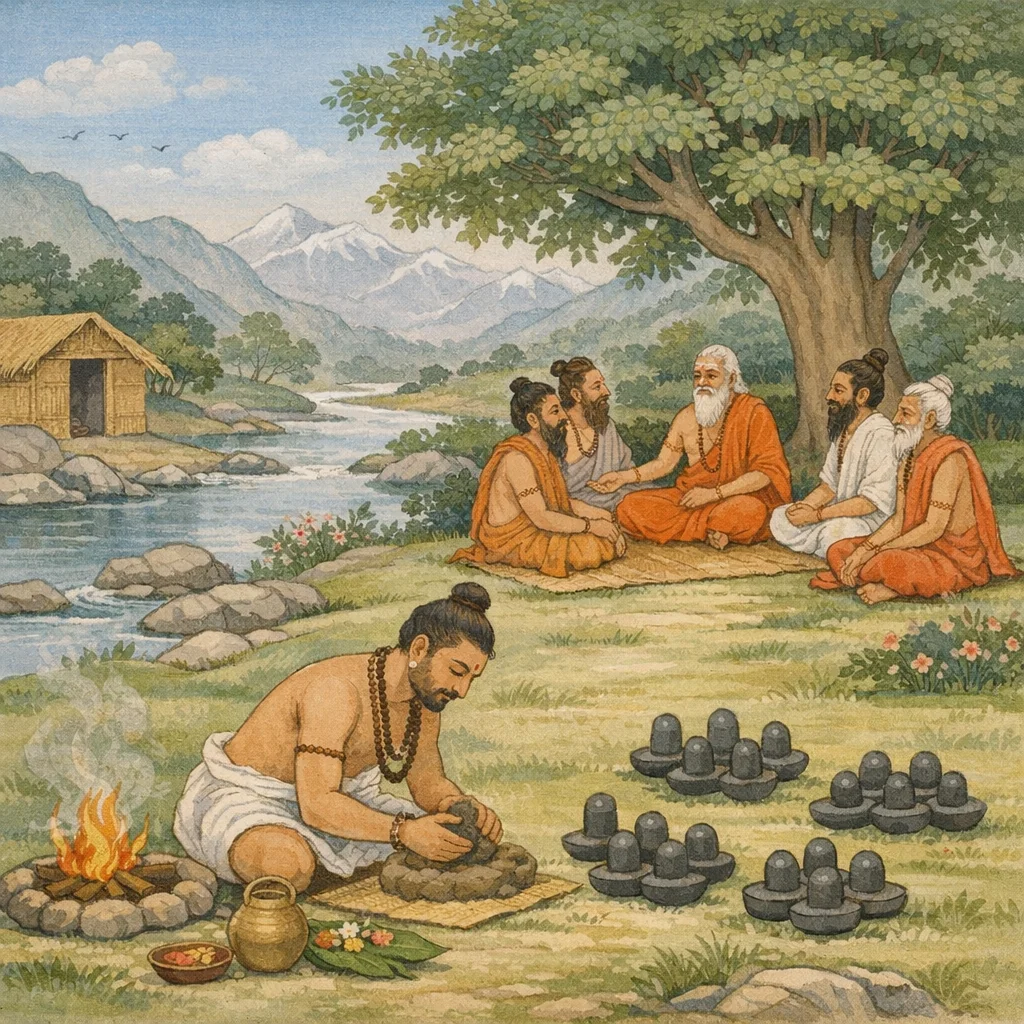
Pārthiva-Śiva-liṅga Saṃkhyā-vidhāna (Enumeration and Procedure of Earthen Liṅga Worship)
Adhyāya 21 is framed as a technical question-and-answer within a dialogue: the ṛṣis ask Sūta (Vyāsa’s disciple) for an exact enumeration (saṃkhyā) of how many earthen Śiva-liṅgas (pārthiva-Śiva-liṅga) should be worshiped for different intentions (kāmanā-bheda). Sūta replies that the practice itself is sufficient, making one “kṛtakṛtya” (one who has fulfilled what is to be done), and he states a sharp ritual rule: worship offered without first fashioning the earthen liṅga is “vṛthā” (ineffective), even if accompanied by ascetic virtues such as self-restraint and charity (dama, dāna). The chapter then lays out a classificatory scheme linking desired results—learning, wealth, progeny, clothing, land, pilgrimage, friendship, mastery, and other aims—to specific liṅga counts, treating number as a ritual parameter with immediate fruit. It also distinguishes the stages of āvāhana, pratiṣṭhā, and pūjana as separate operations, implying a modular ritual grammar. Overall, the adhyāya functions as a prescriptive index for intention-based Śaiva observance, grounding symbolic authority in the liṅga-form and operative authority in enumerated repetition.
Shlokas
Verse 1
ऋषय ऊचुः । सूत सूत महाभाग व्यासशिष्य नमोस्तु ते । सम्यगुक्तं त्वया तात पार्थिवार्चाविधानकम्
The sages said: “O Sūta, O Sūta, most fortunate one—disciple of Vyāsa—salutations to you. Dear one, you have correctly explained the procedure for pārthiva worship, the rite of adoring Śiva through a clay Liṅga.”
Verse 2
कामनाभेदमाश्रित्य संख्यां ब्रूहि विधानतः । शिवपार्थिवलिंगानां कृपया दीनवत्सल
Considering the different aims of devotees, kindly tell us—according to proper rule—the prescribed number of Śiva’s earthen Liṅgas to be made and worshipped. O compassionate one, tender to the distressed!
Verse 3
सूत उवाच । शृणुध्वमृषयः सर्वे पार्थिवार्चाविधानकम् । यस्यानुष्ठानमात्रेण कृतकृत्यो भवेन्नरः
Sūta said: “Listen, all you sages, to the prescribed method of pārthiva worship with earth (clay). By the mere performance of this observance, a person becomes one who has fulfilled the purpose of life.”
Verse 4
अकृत्वा पार्थिवं लिंगं योन्यदेवं प्रपूजयेत् । वृथा भवति सा पूजा दमदानादिकं वृथा
If, without first fashioning and worshipping the earthen (pārthiva) Liṅga, one worships another deity, that worship becomes vain; likewise, self-restraint, charity, and such disciplines become fruitless when severed from the proper worship of Śiva as the Liṅga.
Verse 5
संख्या पार्थिवलिंगानां यथाकामं निगद्यते । संख्या सद्यो मुनिश्रेष्ठ निश्चयेन फलप्रदा
The number of earthen (pārthiva) Liṅgas to be fashioned and worshipped may be prescribed according to one’s capacity and desire. Yet, O best of sages, that very act of counting and completing the intended number certainly yields its fruit immediately.
Verse 6
प्रथमावाहनं तत्र प्रतिष्ठा पूजनं पृथक् । लिंगाकारं समं तत्र सर्वं ज्ञेयं पृथक्पृथक्
There, first is the invocation (āvāhana); then the establishment (pratiṣṭhā) and the worship (pūjana)—each is to be performed as a distinct rite. In that worship, the liṅga-form is to be regarded as uniform and complete; yet all the ritual components are to be understood and carried out separately, each in its own proper manner.
Verse 7
विद्यार्थी पुरुषः प्रीत्या सहस्रमितपार्थिवम् । पूजयेच्छिवलिंगं हि निश्चयात्तत्फलप्रदम्
A man devoted to learning should, with heartfelt joy, worship a Śiva-liṅga fashioned of earth, measuring a thousand (units) in extent; for it surely bestows the intended fruit.
Verse 8
नरः पार्थिवलिंगानां धनार्थी च तदर्द्धकम् । पुत्रार्थी सार्द्धसाहस्रं वस्त्रार्थी शतपंचक्रम्
One who seeks prosperity should fashion a thousand earthen Śiva-liṅgas, and one who seeks wealth should do half of that. One who longs for a son should make fifteen hundred, and one who desires clothing should make five hundred.
Verse 9
मोक्षार्थी कोटिगुणितं भूकामश्च सहस्रकम् । दयार्थी च त्रिसाहस्रं तीर्थार्थी द्विसहस्रकम्
One who seeks liberation (mokṣa) gains merit multiplied a koṭi-fold; one who desires worldly enjoyments gains a thousand-fold; one who seeks compassion and benevolence gains three thousand-fold; and one who seeks the fruit of pilgrimage gains two thousand-fold merit.
Verse 10
सुहृत्कामी त्रिसाहस्रं वश्यार्थी शतमष्टकम् । मारणार्थी सप्तशतं मोहनार्थी शताष्टकम्
One who seeks the welfare of a friend should perform three thousand (recitations/offerings). One who desires subjugation should perform one hundred and eight. One who intends destruction should perform seven hundred. One who seeks to delude should perform one hundred and eight.
Verse 11
उच्चाटनपरश्चैव सहस्रं च यथोक्ततः । स्तंभनार्थी सहस्रं तु द्वेषणार्थी तदर्द्धकम्
For the rite aimed at expulsion (uccāṭana), one should perform a thousand repetitions, as prescribed. For the purpose of restraint or immobilization (stambhana) too, a thousand are enjoined; but for the rite intended to generate aversion (dveṣaṇa), half of that number is stated.
Verse 12
निगडान्मुक्तिकामस्तु सहस्रं सर्द्धमुत्तमम् । महाराजभये पंचशतं ज्ञेयं विचक्षणैः
One who longs to be freed from fetters should repeat it one thousand and a half times as the best measure. But in fear of a great king (royal punishment), the wise should know five hundred repetitions to be sufficient.
Verse 13
चौरादिसंकटे ज्ञेयं पार्थिवानां शतद्वयम् । डाकिन्यादिभये पंचशतमुक्तं जपार्थिवम्
In danger from thieves and similar threats, one should know the proper observance to be two hundred Pārthiva (earthen) liṅgas. In fears arising from ḍākinīs and the like, it is taught that five hundred Pārthiva-liṅga japas are to be performed.
Verse 14
दारिद्र ये पंचसाहस्रमयुतं सर्वकामदम् । अथ नित्यविधिं वक्ष्ये शृणुध्वं मुनिसत्तमाः
In times of poverty, the rite involving fifty thousand (repetitions/offerings) grants the fulfilment of all desires. Now I shall declare the daily discipline (nitya-vidhi); listen, O best of sages.
Verse 15
एकं पापहरं प्रोक्तं द्विलिंगं चार्थसिद्धिदम् । त्रिलिंगं सर्वकामानां कारणं परमीरितम्
It is declared that a single Liṅga is a remover of sins; a pair of Liṅgas bestows success in one’s aims and prosperity; and three Liṅgas are said, supremely, to be a cause for the fulfillment of all desires.
Verse 16
उत्तरोत्तरमेवं स्यात्पूर्वोक्तगणनाविधि । मतांतरमथो वक्ष्ये संख्यायां मुनिभेदतः
Thus, in each succeeding case, the method of reckoning should be as stated earlier. Now I shall explain another view regarding the count, since the sages differ in their enumerations.
Verse 17
लिंगानामयुतं कृत्वा पार्थिवानां सुबुद्धिमान् । निर्भयो हि भवेन्नूनं महाराजभयं हरेत्
A wise devotee who fashions ten thousand earthen Liṅgas will surely become fearless, and the dread of even a great king will be removed.
Verse 18
कारागृहादिमुक्त्यर्थमयुतं कारयेद्बुधः । डाकिन्यादिभये सप्तसहस्रं कारयेत्तथा
For release from imprisonment and similar afflictions, the wise person should perform ten thousand repetitions (japa) of Śiva’s mantra. Likewise, when tormented by fear of ḍākinīs and other malignant beings, one should perform seven thousand repetitions.
Verse 19
सहस्राणि पंचपंचाशदपुत्रः प्रकारयेत् । लिंगानामयुतेनैव कन्यकासंततिं लभेत्
A man without a son should have fifty-five thousand (Śiva-)liṅgas duly fashioned; and by worship through ten thousand liṅgas alone, he obtains a lineage of daughters.
Verse 20
लिंगानामयुतेनैव विष्ण्वादैश्वर्यमाप्नुयात् । लिंगानां प्रयुतेनैव ह्यतुलां श्रियमाप्नुयात्
By worshipping (or establishing) ten thousand Śiva-liṅgas alone, one attains prosperity and lordly greatness comparable to that of Viṣṇu and the other deities. By worshipping (or establishing) one hundred thousand liṅgas alone, one indeed attains incomparable fortune and splendour.
Verse 21
इति श्रीशिवमहापुराणे प्रथमायां विद्येश्वरसंहितायां साध्यसाधनखण्डे पार्थिवपूजनवर्णनं नामैकविंशोऽध्यायः
Thus, in the Śrī Śiva-Mahāpurāṇa, in the first Saṃhitā called the Vidyeśvara-saṃhitā, within the Sādhyasādhanakhaṇḍa, ends the twenty-first chapter entitled “The Description of Pārthiva (earthen) Worship.”
Verse 22
अर्चा पार्थिवलिंगानां कोटियज्ञफलप्रदा । भुक्तिदा मुक्तिदा नित्यं ततः कामर्थिनां नृणाम्
Worship of the earthen (Pārthiva) Liṅgas bestows the fruit of millions of sacrifices. It unfailingly grants both worldly enjoyments and liberation; therefore it is ever beneficial for people who seek their desired ends.
Verse 23
विना लिंगार्चनं यस्य कालो गच्छति नित्यशः । महाहानिर्भवेत्तस्य दुर्वृत्तस्य दुरात्मनः
He whose days pass continually without worship of the Śiva-liṅga incurs a great spiritual loss—such a one is of bad conduct and of a fallen disposition.
Verse 24
एकतः सर्वदानानि व्रतानि विविधानि च । तीर्थानि नियमा यज्ञा लिंगार्चा चैकतः स्मृता
On one side are all gifts (dānas), the many kinds of vows (vratas), sacred pilgrimages (tīrthas), disciplines (niyamas), and sacrificial rites (yajñas); and on the other side alone is remembered the worship of the Śiva-liṅga. (Liṅga-arcana is praised as surpassing them all in spiritual fruit.)
Verse 25
कलौ लिंगार्चनं श्रेष्ठं तथा लोके प्रदृश्यते । तथा नास्तीति शास्त्राणामेष सिद्धान्तनिश्चयः
In the Kali age, worship of the Śiva-liṅga is the highest practice, as is plainly seen in the world. To claim otherwise is not accepted; this is the settled and definitive conclusion of the śāstras.
Verse 26
भुक्तिमुक्तिप्रदं लिंगं विविधापन्निवारणम् । पूजयित्वा नरो नित्यं शिवसायुज्यमाप्नुयात्
This Liṅga bestows both worldly enjoyment and liberation, and it wards off many kinds of calamities. By worshipping it daily, one attains Śiva-sāyujya—union with Śiva.
Verse 27
शिवानाममयं लिंगं नित्यं पूज्यं महर्षिभिः । यतश्च सर्वलिंगेषु तस्मात्पूज्यं विधानतः
The Liṅga, formed of Śiva’s very Names, is ever to be worshipped by the great sages. And since it pervades and abides in all liṅgas, it should therefore be adored in accordance with the prescribed injunctions.
Verse 28
उत्तमं मध्यमं नीचं त्रिविधं लिंगमीरितम् । मानतो मुनिशार्दूलास्तच्छृणुध्वं वदाम्यहम्
The Liṅga is declared to be of three kinds—superior, middling, and inferior—according to its proper measure and standard. O tiger-like sages, listen as I set it forth.
Verse 29
चतुरंगुलमुच्छ्रायं रम्यं वेदिकया युतम् । उत्तमं लिंगमाख्यातं मुनिभिः शास्त्रकोविदैः
A beautiful Śiva-liṅga, four aṅgulas in height and joined with a proper pedestal (vedikā), is declared by sages skilled in the scriptures to be an excellent liṅga for worship.
Verse 30
तदर्द्धं मध्यमं प्रोक्तं तदर्द्धमघमं स्मृतम् । इत्थं त्रिविधमाख्यातमुत्तरोत्तरतः परम्
Half of that measure is declared to be of the middling grade, and half of that again is remembered as inferior and sinful. Thus it is described as threefold—each succeeding division being lower than the one before.
Verse 31
अनेकलिंगं यो नित्यं भक्तिश्रद्धासमन्वितः । पूजयेत्स लभेत्कामान्मनसा मानसेप्सितान्
Whoever, endowed with devotion and reverent faith, worships many Liṅgas daily, attains the desired fruits—those very wishes that he has conceived in his mind.
Verse 32
न लिंगाराधनादन्यत्पुण्यं वेदचतुष्टये । विद्यते सर्वशास्त्राणामेष एव विनिश्चयः
For one who seeks the full purport of the four Vedas, there is no merit superior to the worship of the Śiva-liṅga. This is indeed the settled conclusion of all the Śāstras.
Verse 33
सर्वमेतत्परित्यज्य कर्मजालमशेषतः । भक्त्या परमया विद्वां ल्लिंगमेकं प्रपूजयेत्
Casting aside, without remainder, this entire web of ritual actions, the wise should worship the one Śiva-Liṅga with supreme devotion.
Verse 34
लिंगेर्चितेर्चितं सर्वं जगत्स्थावरजंगमम् । संसारांबुधिमग्नानां नान्यत्तारणसाधनम्
When the Śiva-liṅga is worshipped, the entire universe—both the immovable and the moving—is as though worshipped. For those sunk in the ocean of saṃsāra, there is no other effective means of crossing over.
Verse 35
अज्ञानतिमिरांधानां विषयासक्तचेतसाम् । प्लवो नान्योस्ति जगति लिंगाराधनमंतरा
For those blinded by the darkness of ignorance and whose minds cling to sense-objects, there is no other raft in this world—apart from the worship of the Śiva-liṅga.
Verse 36
हरिब्रह्मादयो देवा मुनयो यक्षराक्षसाः । गंधर्वाश्चरणास्सिद्धा दैतेया दानवास्तथा
Vishnu, Brahmā, and the other gods; the sages; the Yakṣas and Rākṣasas; the Gandharvas; the Cāraṇas; the Siddhas; and likewise the Daityas and Dānavas—all of these orders of beings.
Verse 37
नागाः शेषप्रभृतयो गरुडाद्याःखगास्तथा । सप्रजापतयश्चान्ये मनवः किन्नरा नराः
The Nāgas—beginning with Śeṣa—along with the birds headed by Garuḍa; the Prajāpatis and other progenitors; the Manus, the Kinnaras, and human beings—all are included there.
Verse 38
पूजयित्वा महाभक्त्या लिंगं सर्वार्थसिद्धिदम् । प्राप्ताः कामानभीष्टांश्च तांस्तान्सर्वान्हृदि स्थितान्
Having worshipped the Śiva-Liṅga, the bestower of success in all aims, with great devotion, they attained every desired fulfillment, each one as it had dwelt within the heart.
Verse 39
ब्राह्मणः क्षत्रियो वैश्यः शूद्रो वा प्रतिलोमजः । पूजयेत्सततं लिंगं तत्तन्मंत्रेण सादरम्
Whether one is a brāhmaṇa, kṣatriya, vaiśya, śūdra, or even of mixed (pratiloma) birth, one should continually worship the Śiva-liṅga with reverence, using the mantra appropriate to one’s prescribed method of worship.
Verse 40
किं बहूक्तेन मुनयः स्त्रीणामपि तथान्यतः । अधिकारोस्ति सर्वेषां शिवलिंगार्चने द्विजाः
What need is there to say more, O sages? For women as well—and likewise for others—there is eligibility for all to worship the Śiva-liṅga, O twice-born.
Verse 41
द्विजानां वैदिकेनापि मार्गेणाराधनं वरम् । अन्येषामपि जंतूनां वैदिकेन न संमतम्
For the twice-born, worship by the Vedic path is indeed most excellent; but for other beings, worship by the Vedic method is not regarded as appropriate.
Verse 42
वैदिकानां द्विजानां च पूजा वैदिकमार्गतः । कर्तव्यानान्यमार्गेण इत्याह भगवाञ्छिवः
Bhagavān Śiva declared: “For those who follow the Vedas—especially the twice-born—worship must be performed according to the Vedic path; it should not be done by any other method.”
Verse 43
दधीचिगौतमादीनां शापेनादग्धचेतसाम् । द्विजानां जायते श्रद्धानैव वैदिककर्मणि
In the case of those twice-born whose minds have been scorched by the curse of Dadhīci, Gautama, and others, faith does not arise at all in Vedic rites and duties.
Verse 44
यो वैदिकमनादृत्य कर्म स्मार्तमथापि वा । अन्यत्समाचरेन्मर्त्यो न संकल्पफलं लभेत्
A mortal who disregards the Vedic duties—and even the Smārta rites—yet undertakes other practices, does not obtain the fruit he intended, the result of his saṅkalpa (vowed resolve).
Verse 45
इत्थं कृत्वार्चनं शंभोर्नैवेद्यांतं विधानतः । पूजयेदष्टमूर्तीश्च तत्रैव त्रिजगन्मयीः
Thus, having duly performed the worship of Śambhu in the prescribed manner up to the offering of naivedya, one should worship—there itself—the Aṣṭamūrti, the Eight Manifest Forms of Śiva, who pervade and embody the three worlds.
Verse 46
क्षितिरापोनलो वायुराकाशः सूर्य्यसोमकौ । यजमान इति त्वष्टौ मूर्तयः परिकीर्तिताः
Earth, water, fire, wind, and ākāśa (space); the Sun and the Moon; and the yajamāna (the sacrificer, the worshipper)—these are proclaimed as the eight mūrtis.
Verse 47
शर्वो भवश्च रुद्र श्च उग्रोभीम इतीश्वरः । महादेवः पशुपतिरेतान्मूर्तिभिरर्चयेत्
One should worship the Lord Īśvara in these manifest forms—Śarva, Bhava, Rudra, Ugra, and Bhīma—and also as Mahādeva and Paśupati, adoring Him through these divine embodiments (mūrti).
Verse 48
पूजयेत्परिवारं च ततः शंभोः सुभक्तितः । ईशानादिक्रमात्तत्र चंदनाक्षतपत्रकैः
Then, with sincere devotion, one should worship the attendant deities of Lord Śambhu. In that worship, proceed in order beginning with Īśāna, offering sandal paste, akṣata (unbroken rice), and sacred leaves.
Verse 49
ईशानं नंदिनं चंडं महाकालं च भृंगिणम् । वृषं स्कंदं कपर्दीशं सोमं शुक्रं च तत्क्रमात्
In that very order, one should remember and worship Īśāna, Nandin, Caṇḍa, Mahākāla, and Bhṛṅgin; then Vṛṣa, Skanda, Kapardīśa, Soma, and Śukra.
Verse 50
अग्रतो वीरभद्रं च पृष्ठे कीर्तिमुखं तथा । तत एकादशान्रुद्रा न्पूजयेद्विधिना ततः
He should place (and worship) Vīrabhadra in front and Kīrtimukha behind; thereafter, in the prescribed rite, he should worship the Eleven Rudras as enjoined.
Verse 51
ततः पंचाक्षरं जप्त्वा शतरुद्रि यमेव च । स्तुतीर्नानाविधाः कृत्वा पंचांगपठनं तथा
Thereafter, having repeated the five-syllabled mantra “Namaḥ Śivāya” and also recited the Śatarudrīya, and having offered hymns of praise in many forms, one should likewise recite the Pañcāṅga—the fivefold prayer—as well.
Verse 52
ततः प्रदक्षिणां कृत्वा नत्वा लिंगं विसर्जयेत् । इति प्रोक्तमशेषं च शिवपूजनमादरात्
Then, having performed circumambulation (pradakṣiṇā) and bowed down, one should reverently take leave of the Śiva-liṅga, thus concluding the rite. In this manner, the worship of Śiva has been taught in full, to be performed with devoted care.
Verse 53
रात्रावुदण्मुखः कुर्याद्देवकार्यं सदैव हि । शिवार्चनं सदाप्येवं शुचिः कुर्यादुदण्मुखः
At night, one should always perform divine rites facing north. In the same way, the worship of Śiva should ever be performed—pure and disciplined—facing north.
Verse 54
न प्राचीमग्रतः शंभोर्नोदीचीं शक्तिसंहितान् । न प्रतीचीं यतः पृष्ठमतो ग्राह्यं समाश्रयेत्
One should not take the eastern side as being in front of Śambhu, nor the northern side as the seat of the Śakti-assemblies; nor should one take the western side, for that is His back. Therefore, one should adopt the proper orientation that is to be accepted in worship.
Verse 55
विना भस्मत्रिपुंड्रेण विना रुद्रा क्षमालया । बिल्वपत्रं विना नैव पूजयेच्छंकरं बुधः
A wise devotee should not worship Śaṅkara without the Tripuṇḍra of sacred ash, without a rosary of Rudrākṣa, and indeed not without Bilva leaves.
Verse 56
भस्माप्राप्तौ मुनिश्रेष्ठाः प्रवृत्ते शिवपूजने । तस्मान्मृदापि कर्तव्यं ललाटे च त्रिपुंड्रकम्
O best of sages, when sacred ash (bhasma) is not obtainable and the worship of Lord Śiva has already commenced, then the Tripuṇḍra mark should be made upon the forehead even with clean earth (mṛdā), as an acceptable substitute.
Frequently Asked Questions
Rather than a mythic episode, the chapter advances a theological-ritual argument: without constructing the pārthiva-liṅga, worship and even associated virtues (e.g., dama, dāna) are deemed ineffective (vṛthā), establishing the earthen liṅga as a necessary ritual substrate for valid Śiva-pūjā.
The liṅga functions as a condensed symbol of Śiva’s presence that becomes ritually ‘addressable’ through form. The separation of āvāhana, pratiṣṭhā, and pūjana implies that presence is invoked, stabilized, and then honored—suggesting a layered ontology of sacred presence enacted through sequential operations.
The focus is not on a named iconographic form (e.g., Bhairava or Umā-maheśvara) but on Śiva’s worshipable presence as Śiva-liṅga—specifically the pārthiva-liṅga—treated as the operative manifestation through which diverse aims, including mokṣa, are pursued.