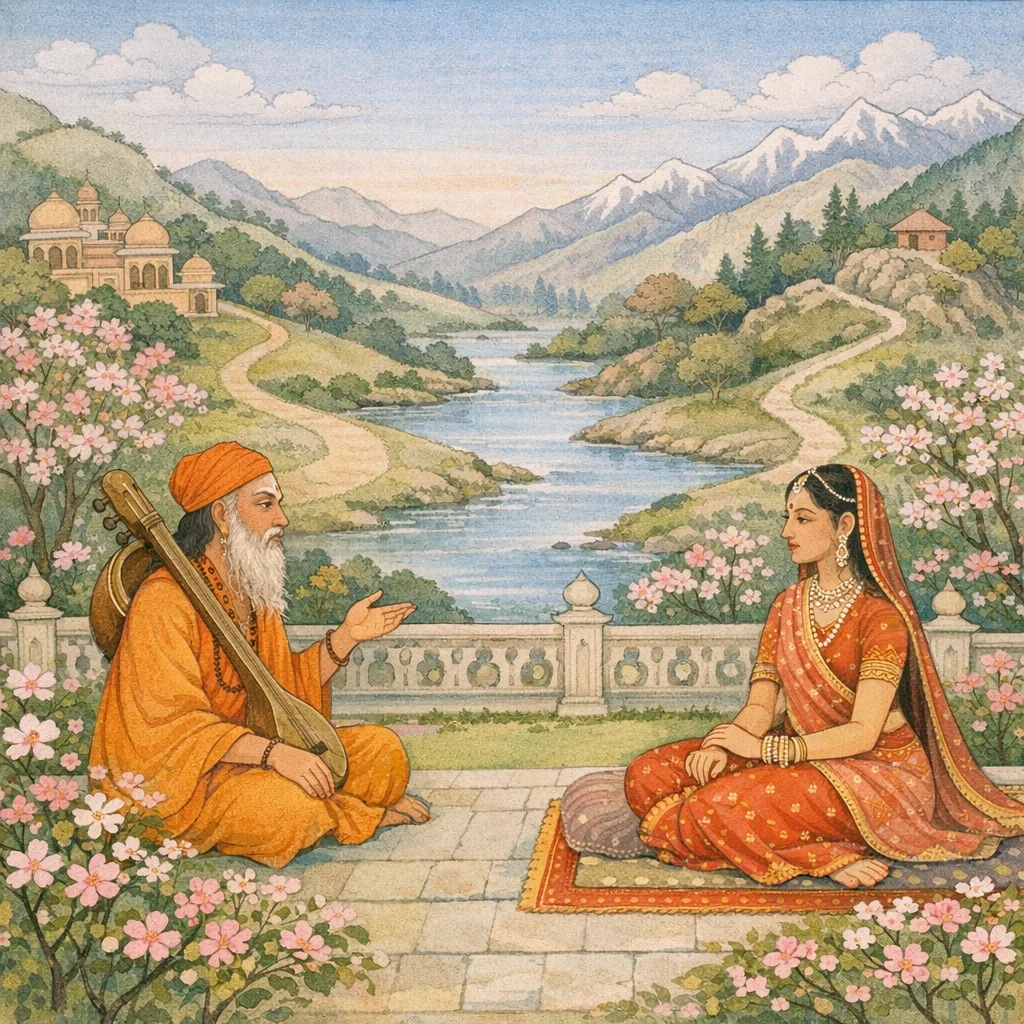
Strī-svabhāva-kathanam: Nārada–Pañcacūḍā-saṃvāda (Discourse on Dispassion via the Nārada–Pañcacūḍā Dialogue)
Adhyāya 24 opens with Vyāsa asking Sanatkumāra for a concise recollection of an earlier, morally cautionary teaching connected with Pañcacūḍā. Sanatkumāra announces an exposition on “strīṇāṃ svabhāva” (women’s nature), meant to kindle intense dispassion (vairāgya) simply by hearing. The chapter then cites an ancient exemplum (itihāsa): Devarṣi Nārada, wandering through the worlds, meets the apsaras Pañcacūḍā and questions her to resolve a doubt. She first requires competence and relevance; Nārada assures her he seeks no improper use, but knowledge of behavioral tendencies as a tool of discernment. Sanatkumāra presents her reply as a didactic means to diagnose attachment and to warn seekers of mokṣa against entanglement in sense-objects. The inner purport is not ethnography of women but renunciatory rhetoric—using sharp social imagery to intensify detachment, turn attention from kāma toward liberation, and stress vigilant non-negligence (apramāda) for spiritual aspirants.
Shlokas
Verse 1
व्यास उवाच । कुत्सितं योषिदर्थं यत्संप्रोक्तं पंचचूडया । तन्मे ब्रूहि समासेन यदि तुष्टोऽसि मे मुने
Vyāsa said: “O sage, if you are pleased with me, then tell me briefly what Pañcacūḍā spoke concerning that censurable matter connected with a woman.”
Verse 2
सनत्कुमार उवाच । स्त्रीणां स्वभावं वक्ष्यामि शृणु विप्र यथातथम् । यस्य श्रवणमात्रेण भवेद्वैराग्यमुत्तमम्
Sanatkumāra said: “I shall explain the nature of women—listen, O brāhmaṇa, exactly as it is. By merely hearing this, the highest dispassion (vairāgya) arises.”
Verse 3
स्त्रियो मूलं हि दोषाणां लघुचित्ताः सदा मुने । तदासक्तिर्न कर्तव्या मोक्षेप्सुभिरतन्द्रितैः
Women, O sage, are said to be a root-cause for many faults, being ever fickle-minded; therefore, vigilant seekers who desire liberation should not fall into attachment to them.
Verse 4
अत्राप्युदाहरंतीममितिहासं पुरातनम् । नारदस्य च संवादं पुंश्चल्या पंचचूडया
Here too, I shall cite an ancient sacred legend—namely, the dialogue of Nārada with the courtesan Pañcacūḍā.
Verse 5
लोकान्परिचरन्धीमान्देवर्षिर्नारदः पुरा । ददर्शाप्सरसं बालां पंचचूडामनुत्तमाम्
Once, the wise divine sage Nārada, roaming through the worlds, beheld an incomparable young apsarā named Pañcacūḍā.
Verse 6
पप्रच्छाप्सरसं सुभ्रूं नारदो मुनिसत्तमः । संशयो हृदि मे कश्चित्तन्मे ब्रूहि सुमध्यमे
Nārada, foremost among sages, questioned that fair-browed apsarā: “A certain doubt has arisen in my heart—O slender-waisted one, tell me the truth of it.”
Verse 7
एवमुक्ता तु सा विप्रं प्रत्युवाच वराप्सरा । विषये सति वक्ष्यामि समर्थां मन्यसेऽथ माम्
Thus addressed, that excellent apsarā replied to the brāhmaṇa: “If this matter is indeed to be spoken of, I shall tell it—provided you consider me competent to speak.”
Verse 8
नारद उवाच । न त्वामविषये भद्रे नियोक्ष्यामि कथंचन । स्त्रीणां स्वभावमिच्छामि त्वत्तः श्रोतुं सुमध्यमे
Nārada said: “O auspicious one, I will never, under any circumstance, engage you in what is improper. O slender-waisted lady, I wish to hear from you about the natural disposition of women.”
Verse 9
सनत्कुमार उवाच । एतच्छ्रुत्वा वचस्तस्य देवर्षेरप्सरोत्तमा । प्रत्युवाच मुनीशं तं देवर्षिं मुनिसत्तमम्
Sanatkumāra said: Hearing the words of that divine seer, the foremost of the apsarās replied to that noble sage—the devarṣi, the best among ascetics.
Verse 10
पंचचूडोवाच । मुने शृणु न शक्या स्त्री सती वै निंदितुं स्त्रिया । विदितास्ते स्त्रियो याश्च यादृश्यश्च स्वभावतः
Pañcacūḍa said: “O sage, listen. A virtuous woman (satī) cannot rightly be censured by another woman. You already know the nature of women—how they are, and how their dispositions arise from their own inborn character.”
Verse 11
न मामर्हसि देवर्षे नियोक्तुं प्रश्नमीदृशम् । इत्युक्त्वा साऽभवत्तूष्णीं पंचचूडाप्सरोवरा
Pañcacūḍā, the foremost of the apsarās, said: “O divine sage, it is not proper for you to press such a question upon me.” Having spoken thus, she fell silent.
Verse 12
अथ देवर्षिवर्यो हि श्रुत्वा तद्वाक्यमुत्तमम् । प्रत्युवाच पुनस्तां वै लोकानां हितकाम्यया
Then the best of the divine sages, having heard those excellent words, replied to her again, desiring the welfare of the worlds.
Verse 13
नारद उवाच । मृषावादे भवेद्दोषस्सत्ये दोषो न विद्यते । इति जानीहि सत्यं त्वं वदातस्तत्सुमध्यमे
Nārada said: “In speaking falsehood, a fault surely arises; in speaking truth, no fault exists. Therefore, understand this well and speak the truth, O fair-waisted one.”
Verse 14
सनत्कुमार उवाच । इत्युक्ता सा कृतमती रभसा चारुहासिनी । स्त्रीदोषाञ्शाश्वतान्सत्यान्भाषितुं संप्रचक्रमे
Sanatkumāra said: Thus addressed, she—steadfast in resolve, swift to reply, and smiling sweetly—began to speak of the enduring and truthful shortcomings commonly found in worldly womanly conduct.
Verse 15
पञ्चचूडोवाच । कुलीना नाथवंत्यश्च रूपवंत्यश्च योषितः । मर्यादासु न तिष्ठंति स दोषः स्त्रीषु नारद
Pañcacūḍa said: “Even women who are well-born, protected by their husbands, and endowed with beauty may not remain within proper bounds. O Nārada, this is a fault found among women.”
Verse 16
न स्त्रीभ्यः किंचिदन्यद्वै पापीयस्तरमस्ति हि । स्त्रियो मूलं हि पापानां तथा त्वमपि वेत्थ ह
“Indeed, there is nothing more degrading than unrestrained attachment to women; for women are said to be the root of sins—this you too surely know.”
Verse 17
समाज्ञातानर्थवतः प्रतिरूपान् यथेप्सितान् । यतीनन्तरमासाद्य नालं नार्य्यः प्रतीक्षितुम्
Having come to know of suitable, worthy men—matching the desired qualities—those women, upon finding the ascetics unavailable or delayed, were not able to wait any longer.
Verse 18
असद्धर्मस्त्वयं स्त्रीणामस्माकं भवति प्रभो । पापीयसो नरान् यद्वै लज्जां त्यक्त्वा भजामहे
O Lord, this indeed becomes an unrighteous course for us women—that, casting aside modesty, we associate with men of sinful conduct.
Verse 19
स्त्रियं च यः प्रार्थयते सन्निकर्षं च गच्छति । ईषच्च कुरुते सेवां तमेवेच्छति योषितः
A man who entreats a woman, approaches her closely, and renders her even a little service—him alone that woman comes to desire.
Verse 20
अनर्थित्वान्मनुष्याणां भयात्पतिजनस्य च । मर्यादायाममर्यादाः स्त्रियस्तिष्ठंति भर्तृषु
Because people are troublesome and because of fear of the husband’s own kin, even women who are otherwise unrestrained remain within the bounds of propriety when they are under the protection and authority of their husbands.
Verse 21
नासां कश्चिदमान्योऽस्ति नासां वयसि निश्चयः । सुरूपं वा कुरूपं वा पुमांसमुपभुंजते
Among them, no man is considered unworthy, and there is no fixed rule regarding age; whether handsome or ugly, they take a man for their enjoyment.
Verse 22
न भयादथ वाक्रोशान्नार्थहेतोः कथंचन । न ज्ञातिकुलसम्बन्धास्त्रियस्तिष्ठंति भर्तृषु
Women do not remain devoted to their husbands out of fear, nor because of harsh reproach, nor for the sake of wealth in any way; nor do they stay merely due to ties of kin and family lineage.
Verse 23
यौवने वर्तमानानामिष्टाभरणवाससाम् । नारीणां स्वैरवृत्तीनां स्पृहयन्ति कुलस्त्रियः
Women of noble family, seeing other women in the bloom of youth—adorned with pleasing ornaments and garments and living as they please—begin to long for the same.
Verse 24
इति श्रीशिवमहापुराणे पञ्चम्यामुमासंहितायां स्त्रीस्वभाववर्णनं नाम चतुर्विंशोऽध्यायः
Thus, in the Śrī Śiva Mahāpurāṇa, in the fifth book called the Umāsaṃhitā, ends the twenty-fourth chapter entitled “Description of the Nature of Women.”
Verse 25
पंगुष्वपि च देवर्षे ये चान्ये कुत्सिता नराः । स्त्रीणामगम्यो लोकेषु नास्ति कश्चिन्महामुने
O divine seer, even among the lame and among other base men, O great sage, there is none in the worlds who is truly inaccessible to women.
Verse 26
यदि पुंसां गतिर्ब्रह्मन्कथंचिन्नोपपद्यते । अप्यन्योन्यं प्रवर्तन्ते न च तिष्ठन्ति भर्तृषु
O Brahman, when the proper path and the higher end of men is not established in any way, they turn toward one another in restless pursuit and do not remain steadfast in devotion and loyalty to their rightful supports (their husbands/lords).
Verse 27
अलाभात्पुरुषाणां च भयात्परिजनस्य च । वधबन्धभयाच्चैव ता भग्नाशा हि योषितः
Because they could gain no men, and out of fear of their own relatives—and also from the dread of being slain or bound—those women became utterly hopeless.
Verse 28
चलस्वभाव दुश्चेष्टा दुर्गाह्या भवतस्तथा । प्राज्ञस्य पुरुषस्येह यथा रतिपरिग्रहात्
Your (mind’s) nature is fickle, its impulses are ill-directed, and it is hard to restrain; so too, in this world, even a discerning man becomes difficult to govern when he is seized by sensual attachment.
Verse 29
नाग्निस्तुष्यति काष्ठानां नापगानां महोदधि । नान्तकस्सर्वभूतानां न पुंसां वामलोचनाः
Fire is never satisfied by fuel; the great ocean is never filled by rivers. Death is never sated by consuming living beings—so too, for men, the charm of fair‑eyed women is never fully exhausted. Thus craving, when followed, only grows; contentment arises by restraint and by turning the mind toward Śiva, the Lord who grants liberation.
Verse 30
इदमन्यच्च देवर्षे रहस्यं सर्वयोषिताम् । दृष्ट्वैव पुरुषं सद्यो योनिः प्रक्लिद्यते स्त्रियाः
“And another secret, O divine sage, common to all women is this: the moment they merely see a man, the woman’s yoni immediately becomes moist, stirred by desire.”
Verse 31
सुस्नातं पुरुषं दृष्ट्वा सुगन्धं मलवर्जितम् । योनिः प्रक्लिद्यते स्त्रीणां दृतेः पात्रादिवोदकम्
“Seeing a man who is well-bathed, fragrant, and free from impurity, a woman’s yoni becomes moistened—just as water seeps through a leather vessel or container.”
Verse 32
कायानामपि दातारं कर्त्तारं मानसांत्वयोः । रक्षितारं न मृष्यंति भर्तारं परमं स्त्रियः
“Women do not tolerate as a husband one who merely provides material support and offers outward consolations. They accept as the supreme husband only the true protector—one who truly safeguards them.”
Verse 33
न कामभोगात्परमान्नालंकारार्थसंचयात् । तथा हितं न मन्यन्ते यथा रतिपरिग्रहात्
They do not deem their true good to arise from the enjoyment of pleasures, nor from the hoarding of ornaments and wealth; rather, they hold their welfare to lie in the pursuit and possession of sensual delight.
Verse 34
अन्तकश्शमनो मृत्युः पातालं वडवामुखम् । क्षुरधारा विषं सर्पो वह्निरित्येकतः स्त्रियः
Antaka, Yama, Death; the netherworlds; the mare-faced submarine fire; the razor’s edge; poison; a serpent; and fire—on one side stand these terrors; and on the other, women are spoken of as comparable in power to bewilder and bind the mind.
Verse 35
यतश्च भूतानि महांति पंच यतश्च लोको विहितो विधात्रा । यतः पुमांसः प्रमदाश्च निर्मिताः सदैव दोषः प्रमदासु नारद
From Him arise the five great elements; by Him this world is ordained by the Creator; and from Him men and women are brought forth—yet, O Nārada, blame is ever cast upon women.
Verse 36
सनत्कुमार उवाच । इति श्रुत्वा वचस्तस्या नारदस्तुष्टमानसः । तथ्यं मत्वा ततस्तद्वै विरक्तोभूद्धि तासु च
Sanatkumāra said: Having thus heard her words, Nārada became glad at heart. Taking them to be true, he indeed grew dispassionate, and likewise loosened his hold on those attachments.
Verse 37
इत्युक्तः स्त्री स्वभावस्ते पंचचूडोक्त आदरात् । वैराग्यकारणं व्यास किमन्यच्छ्रोतुमर्हसि
“Thus, with due reverence, Pañcacūḍa has explained to you the nature of women. O Vyāsa, the cause of dispassion has been stated—what more do you still wish to hear?”
Frequently Asked Questions
A framed exemplum is presented: Sanatkumāra recounts how Nārada questions the apsaras Pañcacūḍā, and her ensuing discourse is positioned as a rhetorical instrument to provoke vairāgya and warn liberation-seekers against attachment to sense-objects.
The “apsaras” functions symbolically as viṣaya (sense-allurement) and the dialogue as a diagnostic method: the text converts social/erotic imagery into a contemplative trigger for dispassion, teaching that mokṣa requires unwavering vigilance and the reorientation of attention away from kāma toward liberation.
No specific śiva-svarūpa or gaurī-svarūpa is foregrounded in the sampled passage; the chapter’s Śaiva contribution is primarily soteriological (vairāgya and restraint) rather than iconographic, functioning as preparatory instruction supportive of Śiva-centered practice.