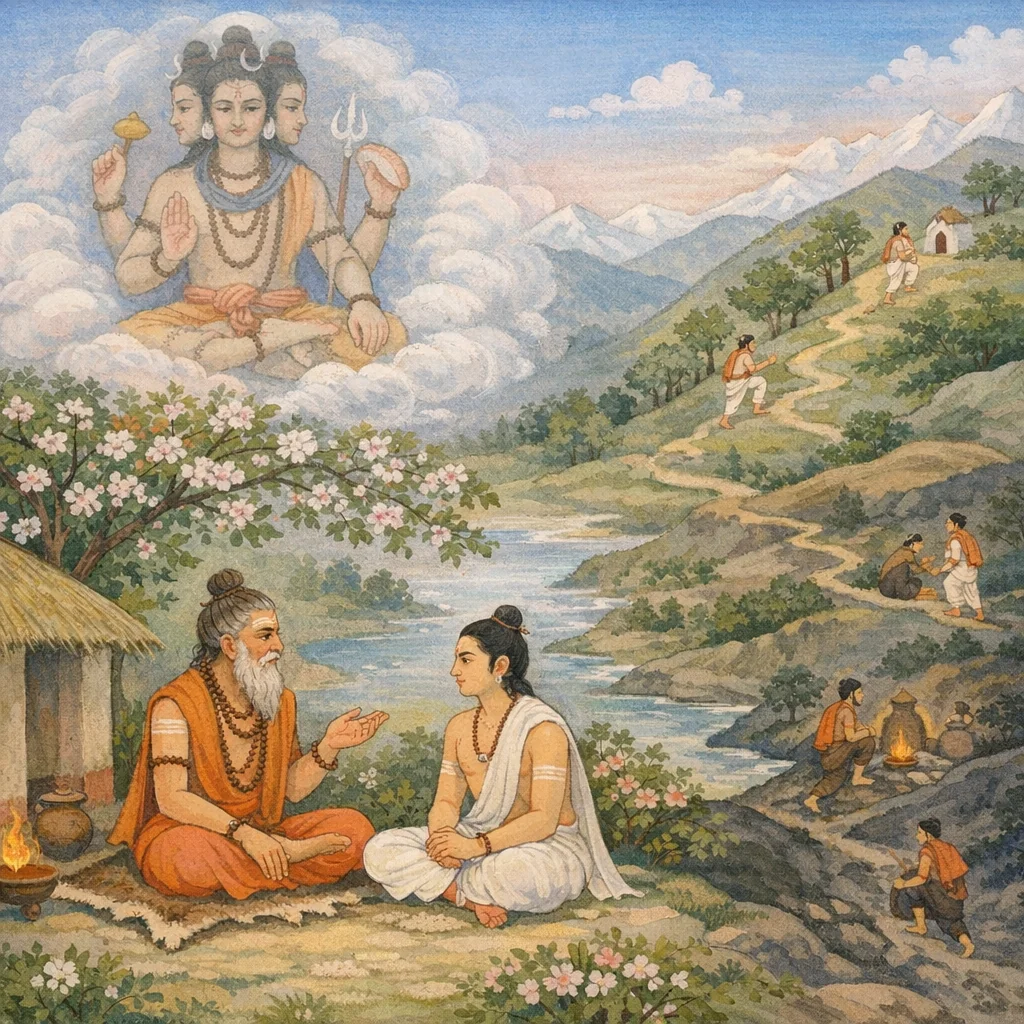
Varṇa-adhikāra, Karma, and the Protection of One’s Attained Spiritual Status (वर्णाधिकारः कर्म च स्वस्थानरक्षणम्)
This chapter unfolds as a dialogue: Vyāsa asks about the hierarchical origins and status-logic of the four varṇas, and Sanatkumāra replies by shifting attention from birth-based claims to karmic causality and ethical upkeep of one’s attained station. It presents (i) the traditional cosmological frame of varṇas arising from mouth/arms/thighs/feet, (ii) the teaching that moral failure and service to adharma (duṣkṛta) cause descent from higher to lower conditions across rebirths, and (iii) the practical injunction to protect an “excellent position” through vigilance, discipline, and discernment of proper and improper acts. The discourse also allows for mobility: conduct and prescribed duties (including śūdra service to the three higher varṇas, along with wealth and ritual competence) can condition upward movement, making karma and practice central to socio-religious eligibility. Overall, Adhyāya 21 serves as a normative ethical lesson in a Shaiva moral universe, warning of degradation through adharma and emphasizing sustained ācāra as the means to preserve spiritual and social standing.
Shlokas
Verse 1
व्यास उवाच । ब्राह्मणत्वं हि दुष्प्राप्यं निसर्गाद्ब्राह्मणो भवेत् । ईश्वरस्य मुखात्क्षत्रं बाहुभ्यामूरुतो विशः
Vyāsa said: “Brahminhood is indeed difficult to attain; one becomes a brāhmaṇa by innate disposition. From the Lord’s mouth arose the kṣatra (the warrior‑ruling order); from His arms and from His thighs arose the viś (the sustaining common order).”
Verse 2
पद्भ्यां शूद्रस्समुत्पन्न इति तस्य मुखाच्छ्रुतिः । किमु स्थितिमधःस्थानादाप्नुवन्ति ह्यतो वद
“The śruti declares that the Śūdra arose from His feet. Then tell me this: do they truly attain a ‘lower’ station merely because their origin is said to be from the lower place—the feet?”
Verse 3
सनत्कुमार उवाच । दुष्कृतेन तु कालेय स्थानाद्भ्रश्यन्ति मानवाः । श्रेष्ठं स्थानं समासाद्य तस्माद्रक्षेत पण्डितः
Sanatkumāra said: In times made adverse by evil deeds, people fall away from their proper station. Therefore, having attained the highest station, the wise person should guard it well.
Verse 4
यस्तु विप्रत्वमुत्सृज्य क्षत्रयोन्यां प्रसूयते । ब्राह्मण्यात्स परिभ्रष्टः क्षत्रियत्वं निषेवते
But one who abandons the state of a brāhmaṇa and is born from a kṣatriya womb—having fallen away from brāhmaṇahood—comes to live in the station and duties of a kṣatriya.
Verse 5
अधर्मसेवनान्मूढस्तथैव परिवर्तते । जन्मान्तरसहस्राणि तमस्याविशते यतः
Through the practice of adharma, the deluded one continues to revolve in the same way; for that very reason he enters the darkness (of ignorance and bondage) for thousands of births.
Verse 6
तस्मात्प्राप्य परं स्थानं प्रमाद्यन्न तु नाशयेत् । स्वस्थानं सर्वदा रक्षेत्प्राप्यापि विपदो नरः
Therefore, having attained the supreme state, one should not, through heedlessness, let it be ruined. Even if misfortunes arise, a person should always safeguard one’s own true station—steadfastness on Śiva’s path.
Verse 7
ब्राह्मणत्वं शुभं प्राप्य ब्राह्मण्यं योऽवमन्यते । भोज्याभोज्यं न जानाति स पुमान्क्षत्रियो भवेत्
Having attained the auspicious state of being a Brahmin, the man who belittles true Brahminhood and fails to discern what is fit to be eaten and what is unfit—such a person becomes counted as a Kshatriya.
Verse 8
कर्मणा येन मेधावी शूद्रो वैश्यो हि जायते । तत्ते वक्ष्यामि निखिलं येन वर्णोत्तमो भवेत्
I shall tell you in full of that discipline of action (karma) by which even a discerning one, though born a Śūdra, becomes established as a Vaiśya—and by which one may attain the highest station among the varṇas.
Verse 9
शूद्रकर्म यथोद्दिष्टं शूद्रो भूत्वा समाचरेत् । यथावत्परिचर्य्यां तु त्रिषु वर्णेषु नित्यदा
Having become established in the station of a Śūdra, one should duly perform the duties prescribed for a Śūdra; and, in the proper manner, render continual service to the three higher varṇas.
Verse 10
कुरुते कामयानस्तु शूद्रोऽपि वैश्यतां व्रजेत् । यो योजयेद्धनैर्वैश्यो जुह्वानश्च यथाविधि
Even a Śūdra, when he performs the sacred rites with a heartfelt longing to act rightly in dharma, may attain the standing of a Vaiśya. And one who, being a Vaiśya, rightly applies his wealth to due ritual offerings—making oblations according to rule—truly fulfills his ordained dharma.
Verse 11
अग्निहोत्रमुपादाय शेषान्न कृतभोजनः । स वैश्यः क्षत्रियकुले जायते नात्र संशयः
Having taken up the Agnihotra and eating only what remains thereafter as sanctified prasāda, that Vaiśya is born in a Kṣatriya family—of this there is no doubt.
Verse 12
क्षत्त्रियो जायते यज्ञैसंस्कृतैरात्तदक्षिणैः । अधीते स्वर्गमन्विच्छंस्त्रेताग्निशरणं सदा
A Kṣatriya is truly shaped through sacrifices (yajña) duly consecrated and completed with the proper dakṣiṇā. Seeking svarga, he studies the Veda and ever takes refuge in the three sacred fires (tretāgni), maintaining the ordained sacrificial discipline.
Verse 13
आर्द्रहस्तपदो नित्यं क्षितिं धर्मेण पालयेत् । ऋतुकालाभिगामी च स्वभार्य्याधर्मतत्परः
With hands and feet ever ready for compassionate service, he should protect the earth in accordance with dharma. He should approach his wife only in the proper season, devoted to the righteous duty of fidelity to his own spouse.
Verse 14
सर्वातिथ्यं त्रिवर्गस्य भूतेभ्यो दीयतामिति । गोब्राह्मणात्मनोऽर्थं हि संग्रामाभिहतो भवेत्
“Let complete hospitality, which upholds the three aims of life, be offered to all beings.” Indeed, for the sake of cows, Brahmins, and one’s own inner Self, one may accept hardship and sacrifice—even to be struck down in battle—in their protection.
Verse 15
तेनाग्निमन्त्रपूतात्मा क्षत्त्रियो ब्राह्मणो भवेत् । विधितो ब्राह्मणो भूत्वा याजकस्तु प्रजायते
By that rite—his self purified through the Agni-mantras—a Kṣatriya becomes a Brāhmaṇa. Having thus become a Brāhmaṇa according to proper ordinance, he is then recognized as a qualified officiating priest (yājaka).
Verse 16
स्वकर्मनिरतो नित्यं सत्यवादी जितेन्द्रियः । प्राप्यते विपुलस्स्वर्गो देवानामपि वल्लभः
One who is ever devoted to one’s own rightful duties, who speaks truth, and who has conquered the senses attains a vast heaven—dear even to the gods themselves.
Verse 17
ब्रह्मणत्वं हि दुष्प्राप्यं कृच्छ्रेण साध्यते नरैः । ब्राह्मण्यात्सकलं प्राप्य मोक्षश्चापि मुनीश्वर
“For brahmaṇa-hood is indeed difficult to attain; it is achieved by people only with arduous effort. From brāhmaṇya (the state and discipline of being a brāhmaṇa), having obtained all that is worthy, liberation too is attained, O lord of sages.”
Verse 18
तस्मात्सर्वप्रयत्नेन ब्राह्मणो धर्मतत्परः । साधनं सर्ववर्गस्य रक्षेद्ब्राह्मण्यमुत्तमम्
Therefore, with every effort, a Brāhmaṇa devoted to dharma should protect the supreme state of brāhmaṇahood, for it is the means of spiritual accomplishment for all orders and classes of society.
Verse 19
व्यास उवाच । संग्रामस्येह माहात्म्यं त्वयोक्तं मुनिसत्तम । एतदिच्छाम्यहं श्रोतुं ब्रूहि त्वं वदतां वर
Vyāsa said: “O best of sages, you have spoken here of the greatness of this battle. I long to hear it in full; therefore, O foremost among speakers, tell it to me.”
Verse 20
सनत्कुमार उवाच । अग्निष्टोमादिभिर्यज्ञैरिष्ट्वा विपुलदक्षिणैः । न तत्फलमवाप्नोति संग्रामे यदवाप्नुयात्
Sanatkumāra said: Even after performing Agniṣṭoma and other Vedic sacrifices, and lavishly offering abundant dakṣiṇā, one does not attain that fruit which one may attain in battle.
Verse 21
इति श्रीशिवमहापुराणे पञ्चम्यामुमासंहितायां रणफलवर्णनं नामैकविंशोऽध्यायः
Thus, in the holy Śiva Mahāpurāṇa, in the Fifth Book—the Umā-saṃhitā—concludes the twenty-first chapter entitled “Description of the Fruit of Battle.”
Verse 22
धर्मलाभोऽर्थलाभश्च यशोलाभस्तथैव च । यश्शूरो वांछते युद्धं विमृन्दन्परवाहिनीम्
There is gain of dharma, gain of wealth, and gain of fame as well. Indeed, the true hero longs for battle, crushing the enemy’s army.
Verse 23
तस्य धर्मार्थ कामाश्च यज्ञश्चैव सदक्षिणः । परं ह्यभिमुखं दत्त्वा तद्यानं योऽधिरोहति
For him, righteousness, prosperity, and lawful enjoyment are secured, and his sacrifices are duly completed with proper gifts. Having offered what is best with reverent intent, whoever mounts that sacred conveyance attains the highest good.
Verse 24
विष्णुलोके स जायेत यश्च युद्धेऽपराजितः । अश्वमेधानवाप्नोति चतुरो न मृतस्स चेत्
He who remains unconquered in battle is born in Vishnu’s world; and, if he does not die, he attains the merit of four Aśvamedha sacrifices.
Verse 25
यस्तु शस्त्रमनुत्सृज्य म्रियते वाहिनी मुखे । सम्मुखो वर्तते शूरस्स स्वर्गान्न निवर्तते
But the hero who, without casting away his weapon, dies at the very front of the battle-host—standing face to face with the foe—does not return from heaven.
Verse 26
राजा वा राजपुत्रो वा सेनापतिरथापि वा । हतक्षात्रेण यः शूरस्तस्य लोकोऽक्षयो भवेत्
Whether he is a king, a prince, or even a commander of armies—any heroic man who is slain in battle attains an imperishable realm.
Verse 27
यावंति तस्य रोमाणि भिद्यन्तेऽस्त्रैर्महाहवे । तावतो लभते लोकान्सर्वकामदुघाऽक्षयान्
In that great battle, as many hairs upon his body are struck and split by weapons, so many imperishable worlds—granting the fulfilment of every rightful desire—does he attain.
Verse 28
वीरासनं वीरशय्या वीरस्थानस्थितिस्स्थिरा । सर्वदा भवति व्यास इह लोके परत्र च
O Vyāsa, steadfastness in the heroic posture (vīrāsana), the heroic mode of resting (vīraśayyā), and firm abidance in the heroic station (vīrasthāna) always brings auspicious stability—both in this world and in the world hereafter.
Verse 29
गवार्थे ब्राह्मणार्थे च स्थानस्वाम्यर्थमेव च । ये मृतास्ते सुखं यांति यथा सुकृतिनस्तथा
Those who die while acting for the sake of cows, for the sake of brāhmaṇas, and indeed for the sake of protecting rightful ownership of a place (one’s sacred or lawful domain)—they attain happiness hereafter, just as do those endowed with meritorious deeds.
Verse 30
यः कश्चिद्ब्राह्मणं हत्वा पश्चात्प्राणान्परित्यजेत् । तत्रासौ स्वपतेर्युद्धे स स्वर्गान्न निवर्तते
If someone kills a brāhmaṇa and then later gives up his life, then—there, in the battle of his own lord—he does not return from heaven.
Verse 31
क्रव्यादैर्दतिभिश्चैव हतस्य गतिरुत्तमा । द्विजगोस्वामिनामर्थे भवेद्विपुलदाक्षया
Even if one is slain by flesh-eaters or by elephants, one attains an excellent destiny; and when the act is done for the sake of brāhmaṇas and the protectors of cows, it becomes a deed of abundant dākṣiṇā—a sacred offering—bearing great merit.
Verse 32
शक्नोत्विह समर्थश्च यष्टुं क्रतुशतैरपि । आत्मदेहपरित्यागः कर्तुं युधि सुदुष्करः
Even if a person here is capable and competent enough to perform hundreds of Vedic sacrifices, the deliberate renunciation of one’s own body—laying down the embodied self in battle—is exceedingly difficult to accomplish.
Verse 33
युद्धं पुण्यतमं स्वर्ग्यं रूपज्ञं सर्वतोमुखम् । सर्वेषामेव वर्णानां क्षत्रियस्य विशेषतः
Battle is declared the most meritorious and a giver of heaven; it reveals one’s true form (valor and character) and faces all directions (meeting every challenge). This is taught for all the social orders, but it is especially the distinctive duty of a kṣatriya.
Verse 34
भृशं चैव प्रवक्ष्यामि युद्धधर्मं सनातनम् । यादृशाय प्रहर्तव्यं यादृशं परिवर्जयेत्
Now I shall declare in full the eternal dharma of righteous combat—whom one should strike, and whom one should refrain from harming.
Verse 35
आततायिनमायांतमपि वेदांतगं द्विजम् । जिघांसंतं जिघांसेत्तु न तेन ब्रह्महा भवेत्
Even if the approaching aggressor is a twice-born brāhmaṇa, learned in Vedānta, if he comes intent on killing, one may counter-kill him; by that act one does not become a slayer of a brāhmaṇa. From the Shaiva standpoint, this upholds dharma and the protection of life, so that devotion to Lord Shiva is not stained by complicity in adharma.
Verse 36
हंतव्योऽपि न हंतव्यः पानीयं यश्च याचते । रणे हत्वातुरान्व्यास स नरो ब्रह्महा भवेत्
Even one who is otherwise fit to be slain should not be killed if he begs for water. O Vyāsa, a man who, in battle, kills the wounded and distressed incurs the sin of brahmahatyā, as though he were a slayer of a brāhmaṇa.
Verse 37
व्याधितं दुर्बलं बालं स्त्र्यनाथौ कृपणं ध्रुवम् । धनुर्भग्नं छिन्नगुणं हत्वा वै ब्रह्महा भवेत्
Whoever slays one who is ill, weak, a child, or destitute—indeed, one without protection (such as a woman without support or an orphan)—or one whose bow is broken and whose bowstring is cut, truly becomes a brahma-han, a “slayer of a brāhmaṇa,” and incurs the gravest sin.
Verse 38
एवं विचार्य्य सद्धीमान्भवेत्प्रीत्याः रणप्रियः । सजन्मनः फलं प्राप्य परत्रेह प्रमोदते
Thus, having reflected in this way, the truly wise one becomes joyfully devoted to righteous battle. Having gained the fruit of such a life, he rejoices both here in this world and hereafter.
Frequently Asked Questions
It argues that while varṇa is described through a cosmic-origin schema (Īśvara’s mouth/arms/thighs/feet), the decisive mechanism governing rise or fall is karma: adharma and duṣkṛta lead to degradation across births, whereas disciplined duty supports stability and improvement.
The rahasya is a soteriological reading of status: ‘sthāna’ is not merely social rank but a fragile achievement shaped by saṃskāra and conduct. Vigilance (apramāda) becomes a spiritual technology—preserving purity, discernment, and eligibility for higher practice.
No specific iconic manifestation (svarūpa) is foregrounded in the sampled material; Śiva appears primarily as Īśvara, the cosmic source invoked to anchor the traditional varṇa-origin model while the teaching emphasizes ethical causality rather than form-theology.