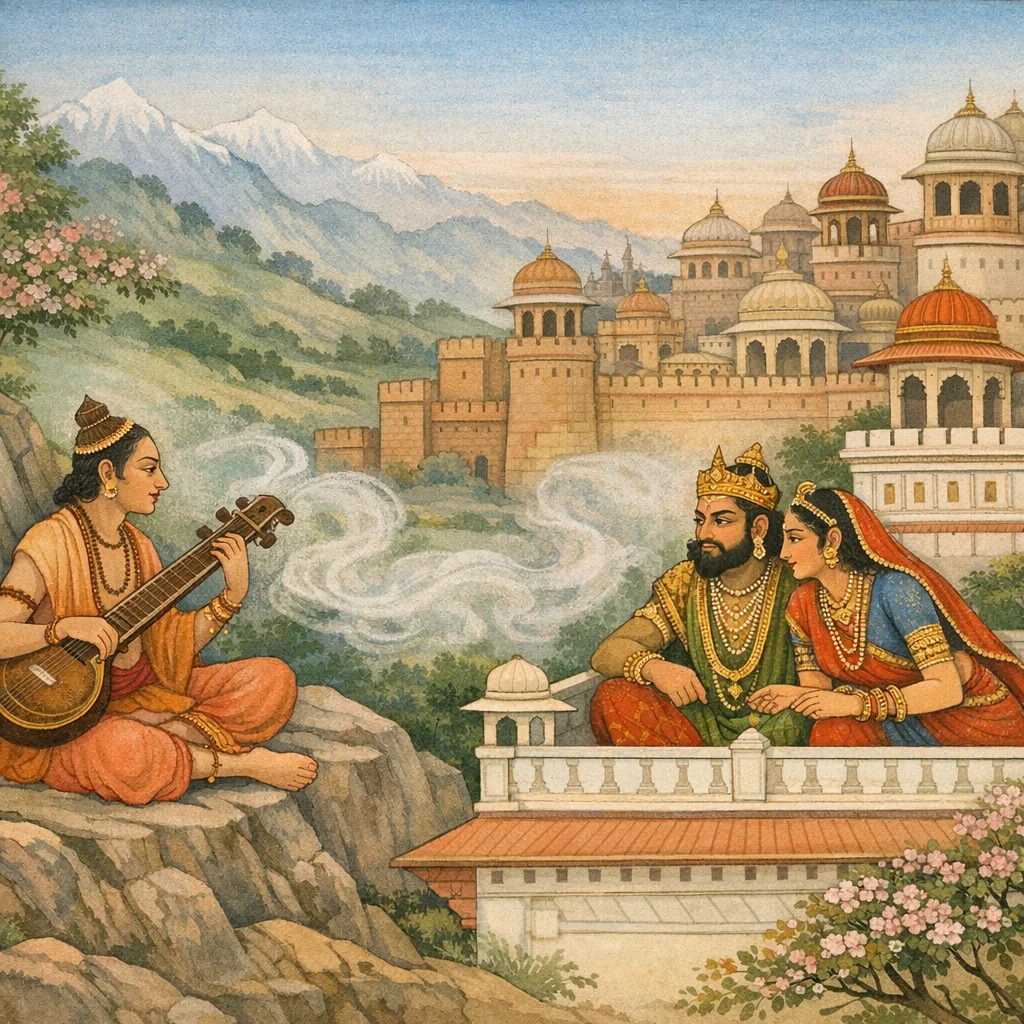
विदलोत्पलदैत्ययोरुत्पत्तिः देवपराजयः ब्रह्मोपदेशः नारदप्रेषणम् (Vidalotpala Daityas, Defeat of the Devas, Brahmā’s Counsel, and Nārada’s Mission)
Adhyāya 59 is told by Sanatkumāra to Vyāsa. Two mighty daityas, Vidalā and Utpala, rise up, made nearly invulnerable by boons and swollen with martial pride; they treat the three worlds as mere “straw” and defeat the devas in battle. Seeking a remedy, the devas take refuge with Brahmā, who counsels that these daityas are destined to be slain by Devī (Śivā/Śakti) and urges the devas to remain steadfast through remembrance of Śiva together with Śakti. Comforted, the devas return to their abodes. Thereafter Nārada, impelled by Śiva, goes to the daityas’ realm and, through māyā-laden speech, deludes them and stirs their intent to seize Devī—thus setting in motion the cause of their downfall. The chapter also preserves a colophonic closing formula (“samāpto’yaṃ yuddhakhaṇḍaḥ …”), suggesting proximity to the end of the khaṇḍa in some recensions and reflecting editorial layering in the transmitted text.
Shlokas
Verse 1
सनत्कुमार उवाच । शृणु व्यास सुसंप्रीत्या चरितं परमेशितुः । यथावधीत्स्वप्रियया दैत्यमुद्दिश्य संज्ञया
Sanatkumāra said: “Listen, O Vyāsa, with deep delight, to the sacred deeds of the Supreme Lord—how, by a sign given to His beloved consort, He struck down the Daitya, having indicated him by a signal.”
Verse 2
आस्तां पुरा महादैत्यो विदलोत्पलसंज्ञकौ । अपुंवध्यौ महावीरौ सुदृप्तौ वरतो विधेः
Formerly there were two great Daityas named Vidala and Utpala—mighty heroes, swollen with pride—who, by a boon granted by Vidhātr (Brahmā), were declared invulnerable to men.
Verse 3
तृणीकृतत्रिजगती पुरुषाभ्यां स्वदोर्ब लात् । ताभ्यां सर्वे सुरा ब्रह्मन् दैत्याभ्यां निर्जिता रणे
By the sheer strength of their own arms, those two Daityas made the three worlds as insignificant as a blade of grass. O Brahman, by those two the gods were all defeated in battle.
Verse 4
ताभ्यां पराजिता देवा विधेस्ते शरणं गताः । नत्वा तं विधिवत्सर्वे कथयामासुरादरात
Defeated by those two, the gods sought refuge with Vidhātā (Brahmā). Having bowed to him in the prescribed manner, they all respectfully related the matter to him.
Verse 5
इति ब्रह्मा ह्यवोचत्तान् देव्या वध्यौ च तौ ध्रुवम् । धैर्य्यं कुरुत संस्मृत्य सशिवं शिवमादरात्
Thus Brahmā spoke to them: “Those two are certainly destined to be slain by the Goddess. Therefore, take courage; and with reverence remember Lord Śiva—Śiva together with His Śakti.”
Verse 6
भक्तवत्सलनामासौ सशिवश्शंकरश्शिवः । शं करिष्यत्यदीर्घेण कालेन परमेश्वरः
That Supreme Lord—Śiva, the auspicious Śaṅkara, famed as “Bhakta-vatsala” (tender to His devotees)—will, before long, bring about welfare and peace.
Verse 7
सनत्कुमार उवाच । इत्युक्त्वा तांस्ततो ब्रह्मा तूष्णीमासीच्छिवं स्मरन् । तेपि देवा मुदं प्राप्य स्वंस्वं धाम ययुस्तदा
Sanatkumāra said: Having spoken thus to them, Brahmā then became silent, inwardly remembering Lord Śiva. Those gods too, having attained joy, departed at that time to their respective abodes.
Verse 8
अथ नारददेवर्षिश्शिवप्रेरणया तदा । गत्वा तदीयभवनं शिवासौंदर्यमाजगौ
Then the divine sage Nārada, impelled by Lord Śiva’s inspiration, went at that time to her residence and beheld the beauty and auspicious splendour of Śivā (Pārvatī).
Verse 9
श्रुत्वा तद्वचनं दैत्यावास्तां मायाविमोहितौ । देवीं परिजिहीर्षू तौ विषमेषु प्रपीडितौ
Hearing those words, the two daityas remained there, deluded by Māyā. Intent on seizing the Goddess, they were tormented and pressed hard by perilous difficulties.
Verse 10
विचारयामासतुस्तौ कदा कुत्र शिवा च सा । भविष्यति विधेः प्राप्तोदयान्नाविति सर्वदा
They both kept deliberating again and again: “When and where will that auspicious Goddess (Śivā) appear? Or will she never appear at all, since the ordained destiny has not yet risen (come to fruition)?”
Verse 11
एकस्मिन्समये शंभुर्विजहार सुलीलया । कौतुकेनैव चिक्रीडे शिवा कन्दुकलीलया
At one time, Śambhu sported about in a most charming and effortless play. Out of sheer delight, Śivā too played with Him in the pastime of tossing a ball.
Verse 12
सखीभिस्सह सुप्रीत्या कौतुकाच्छिवसन्निधौ
Together with her companions, in deep affection and joyful curiosity, she entered into the very presence of Lord Śiva.
Verse 13
उदंचंत्यंचदंगानां लाघवं परितन्वती । निश्वासामोदमुदितभ्रमराकुलितेक्षणा
She moved with agile lightness, her limbs rising and falling in swift rhythm; and her eyes grew restless, as delighted bees swarmed about, intoxicated by the fragrance of her breath.
Verse 14
भ्रश्यद्धम्मिल्लसन्माल्यस्वपुरीकृतभूमिका । स्विद्यत्कपोलपत्रालीस्रवदंबुकणोज्ज्वला
Her braided hair and garlands had slipped and fallen, leaving her dishevelled; and as sweat beaded upon her cheeks, the bright droplets streaming down shone with vivid luster.
Verse 15
स्फुटच्चोलांशुकपथतिर्यदंगप्रभावृता । उल्लसत्कंदुकास्फालातिश्रोणितकराम्बुजा
Her limbs were partly veiled by the clear, slanting line of her garment; and as she moved, her lotus-like hips and hands shone forth, lively with the playful bouncing of her youthful grace.
Verse 16
कंदुकानुगसद्दृष्टिनर्तितभ्रूलतांचला । मृडानी किल खेलंती ददृशे जगदम्बिका
Her steady gaze followed the ball, and the creeper-like arches of her eyebrows danced in play; thus the Jagadambikā—Mṛḍānī, the auspicious consort of Rudra—was seen, sporting in delight.
Verse 17
अंतरिक्षचराभ्यां च दितिजाभ्यां कटा क्षिता । क्रोडीकृताभ्यामिव वै समुपस्थितमृत्युना
By those two foes born of the Dānava line, who moved through the sky, the earth was struck and crushed; it was as though Death himself had arrived, holding the world fast as if in his very lap.
Verse 18
विदलोत्पलसंज्ञाभ्यां दृप्ताभ्यां वरतो विधेः । तृणीकृतत्रिजगती पुरुषाभ्यां स्वदोर्बलात्
By two proud heroes named Vidala and Utpala—boon-granted by Vidhātā (Brahmā)—the three worlds were, through the sheer strength of their own arms, treated as mere straw.
Verse 19
देवीं तां संजिहीर्षंतौ विषमेषु प्रपीडितौ । दिव उत्तेरतुः क्षिप्रं मायां स्वीकृत्य शांबरीम्
Intent on seizing that Goddess, and hard-pressed amid perilous conditions, they swiftly rose into the sky, adopting Śāmbharī māyā—an illusory power born of Śiva’s sphere.
Verse 20
धृत्वा पारिषदीं मायामायातावंबिकांतिकम् । तावत्यंतं सुदुर्वृत्तावतिचंचलमानसौ
Assuming, through māyā, a deceptive attendant-like disguise, the two drew near to Ambikā (the Goddess). Up to that point they were exceedingly wicked, their minds utterly restless and unsteady.
Verse 21
अथ दुष्टनिहंत्रा वै सावज्ञेन हरेण तौ । विज्ञातौ च क्षणादास्तां चांचल्याल्लोचनोद्भवात्
Then Hari—the destroyer of the wicked—noticed those two, regarding them with slight disdain. In an instant he knew them, for their restless motion arose from the movement of his eyes.
Verse 22
कटाक्षिताथ देवेन दुर्गा दुर्गतिघातिनी । दैत्याविमामिति गणौ नेति सर्वस्वरूपिणा
Then Durgā, the Destroyer of all evil destinies, was met by the Lord’s glance. The Gaṇas cried, “The Daityas have been subdued!”—yet the all-form Lord, the very essence of everything, replied, “Not so.”
Verse 23
अथ सा नेत्रसंज्ञां स्वस्वामिनस्तां बुबोध ह । महाकौतुकिनस्तात शंकरस्य परेशितुः
Then she understood the sign conveyed by the eyes of her own Lord—Śaṅkara, the Supreme Ruler—who, O dear one, was filled with great eagerness to act.
Verse 24
ततो विज्ञाय संज्ञां तां सर्वज्ञार्द्धशरीरिणी । तेनैव कंदुकेनाथ युगपन्निर्जघान तौ
Then the all-knowing Goddess—she who is the very half-body of the Lord—understood that signal; and with that very ball-like weapon, O Lord, she struck down both of them at once.
Verse 25
महाबलौ महादेव्या कंदुकेन समाहतौ । परिभ्रम्य परिभ्रम्य तौ दुष्टौ विनिपेततुः
Struck by the Goddess Mahādevī with a ball-like missile, those two mighty wicked ones spun round and round, and then fell down to the ground.
Verse 26
वृन्तादिव फले पक्वे तालेनानिललोलिते । दंभोलिना परिहते शृंगे इव महागिरेः
Like a ripe fruit shaken loose from its stalk when a palm tree is swayed by the wind, and like the peak of a mighty mountain struck by a thunderbolt, he was violently hurled down—his fall sudden, irresistible, and decisive.
Verse 27
तौ निपात्य महादैत्यावकार्यकरणोद्यतौ । ततः परिणतिं यातो लिंगरूपेण कंदुकः
Having struck down those two mighty demons who were intent on committing unrighteous deeds, Kaṃduka then underwent a transformation and assumed the form of the Śiva-liṅga.
Verse 28
कंदुकेश्वरसंज्ञां च तल्लिंगमभवत्तदा । ज्येष्ठेश्वरसमीपे तु सर्वदुष्टनिवारणम्
At that time, that Liṅga came to be known as Kaṇḍukeśvara. Established near Jyeṣṭheśvara, it became the remover and restrainer of all wickedness, granting protection through Śiva’s manifest (saguṇa) presence.
Verse 29
एतस्मिन्नेव समये हरिब्रह्मादयस्सुराः । शिवाविर्भावमाज्ञाय ऋषयश्च समाययुः
At that very moment, the gods—Viṣṇu, Brahmā, and the rest—together with the ṛṣis, came assembled, having learned of Lord Śiva’s manifestation.
Verse 30
अथ सर्वे सुराश्शम्भोर्वरान्प्राप्य तदाज्ञया । स्वधामानि ययुः प्रीतास्तथा काशीनिवासिनः
Then all the gods, having received boons from Śambhu and acting by His command, departed joyfully to their own abodes; likewise, the residents of Kāśī also returned, delighted.
Verse 31
सांबिकं शंकरं दृष्ट्वा कृतांजलिपुटाश्च ते । प्रणम्य तुष्टुवुर्भक्त्या वाग्भिरिष्टाभिरादरात्
Seeing Śaṅkara together with Ambikā (Pārvatī), they folded their hands in reverence; bowing down, they praised Him with devotion, respectfully offering words that were dear and fitting.
Verse 32
सांबिकोऽपि शिवो व्यास क्रीडित्वा सुविहारवित् । जगाम स्वालयं प्रीतस्सगणो भक्तवत्सलः
O Vyāsa, Śiva—together with Ambikā—having sported and wandered in delightful ease, joyfully returned to His own abode, accompanied by His gaṇas, for He is ever affectionate to His devotees.
Verse 33
कंदुकेश्वरलिंगं च काश्यां दुष्टनिबर्हणम् । भुक्तिमुक्तिप्रदं सर्वकामदं सर्वदा सताम्
In Kāśī is the Kāṃdukeśvara Liṅga, the destroyer of the wicked. It bestows both worldly enjoyment (bhukti) and liberation (mukti), and ever grants all desired aims to the virtuous devotees.
Verse 34
इदमाख्यानमतुलं शृणुयाद्यो मुदान्वितः । श्रावयेद्वा पठेद्यश्च तस्य दुःखभयं कुतः
Whoever, filled with joy, listens to this incomparable sacred account—or causes it to be heard, or recites it—how could any fear of sorrow remain for that person?
Verse 35
इह सर्वसुखं भुक्त्वा नानाविधमनुत्तमम् । परत्र लभते दिव्यां गतिं वै देवदुर्लभाम्
Having enjoyed in this world all manner of unsurpassed happiness, one thereafter attains a divine state of passage—an exalted destiny difficult even for the gods to obtain.
Verse 36
इति तं वर्णितं तात चरितं परमाद्भुतम् । शिवयोर्भक्तवात्सल्यसूचकं शिवदं सताम्
Thus, dear one, that supremely wondrous episode has been described—an account that reveals Śiva’s tender affection for His devotees and bestows Śiva’s grace and auspiciousness upon the virtuous.
Verse 37
ब्रह्मोवाच । इत्युक्त्वामंत्र्य तं व्यासं तन्नुतो मद्वरात्मजः । ययौ विहायसा काशीं चरितं शशिमौलिनः
Brahmā said: “Having spoken thus, and after respectfully taking leave of Vyāsa, my excellent son—praised by him—departed through the sky to Kāśī, the sacred city sanctified by the divine deeds of the Moon-crested Lord (Śiva).”
Verse 38
युद्धखंडमिदं प्रोक्तं मया ते मुनिसत्तम । रौद्रीयसंहितामध्ये सर्वकामफलप्रदम्
O best of sages, I have thus expounded to you this Yuddha-khaṇḍa. Within the Rudra Saṃhitā, it is declared to grant the fruits of every worthy desire.
Verse 39
इयं हि संहिता रौद्री सम्पूर्णा वर्णिता मया । सदाशिवप्रियतरा भुक्तिमुक्तिफलप्रदा
Thus have I fully expounded this Raudrī Saṃhitā. It is exceedingly dear to Sadāśiva and bestows the fruits of both worldly enjoyment and final liberation.
Verse 40
इमां यश्च पठेन्नित्यं शत्रुबाधानिवारिकाम् । सर्वान्कामानवाप्नोति ततो मुक्तिं लभेत ना
Whoever recites this regularly—this passage that wards off afflictions caused by enemies—attains all desired aims; yet from that alone, he does not obtain liberation.
Verse 41
सूत उवाच । इति ब्रह्मसुतश्श्रुत्वा पित्रा शिवयशः परम् । शतनामाप्य शंभोश्च कृतार्थोऽभूच्छिवानुगः
Sūta said: Thus, having heard from his father the supreme glory of Śiva—and also having received the hundred names of Śambhu—the son of Brahmā became fulfilled, for he had become a devoted follower of Śiva.
Verse 42
ब्रह्मनारदसम्वादः सम्पूर्णः कथितो मया । शिवस्सर्वप्रधानो हि किं भूयश्श्रोतुमिच्छसि
I have now narrated in full the dialogue between Brahmā and Nārada. Truly, Śiva is the supreme Lord, foremost of all; what more do you still wish to hear?
Verse 59
इति श्रीशिवमहापुराणे द्वितीयायां रुद्रसंहितायां पञ्चमे युद्धखंडे विदलोत्पलदैत्यवधवर्णनं नामैकोनषष्टितमोऽध्यायः
Thus, in the Śrī Śiva Mahāpurāṇa, in the Second section called the Rudra Saṃhitā, within the Fifth division known as the Yuddha Khaṇḍa, concludes the fifty-ninth chapter, entitled “The Description of the Slaying of the Demon Vidalotpala.”
Frequently Asked Questions
The emergence and triumph of the daityas Vidalā and Utpala over the devas, followed by the devas’ refuge with Brahmā, who declares that Devī will slay the daityas; Nārada then moves to catalyze the daityas’ actions through māyā-influenced counsel.
It foregrounds Śiva-Śakti governance: the resolution of cosmic disorder is not merely by deva force but by the higher salvific agency of Śakti aligned with Śiva, demonstrating the subordination of boon-based power to divine ordinance.
Parameśvara Śiva as the overarching ordainer (remembered and invoked), Devī/Śivā as the destined slayer and corrective force, and Nārada as Śiva’s impelled messenger who operationalizes the narrative turn.