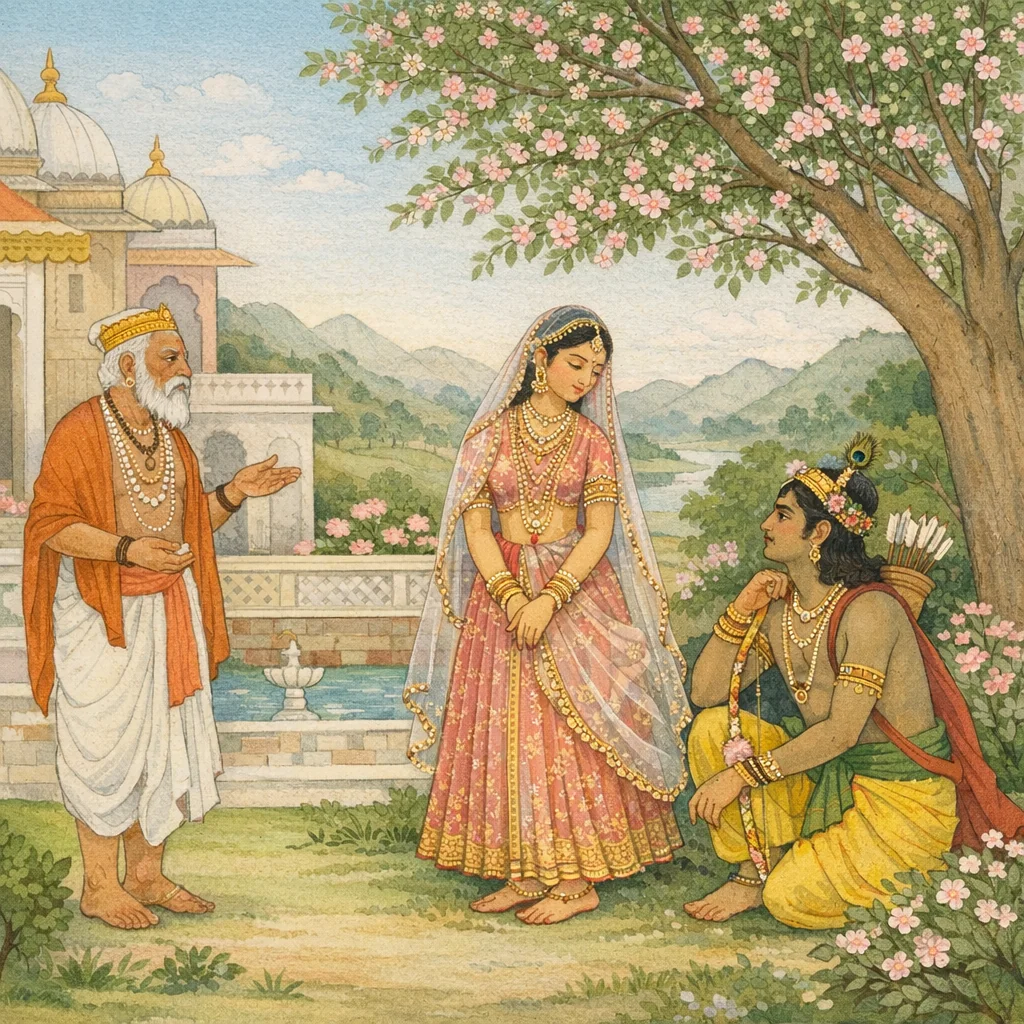
कामविवाहवर्णनम् / Description of Kāma’s Marriage
Adhyāya 4 unfolds as a dialogue: Nārada asks Brahmā to continue the story after Śiva has withdrawn to his own abode. Brahmā recounts Dakṣa’s deed—remembering Brahmā’s earlier words, Dakṣa addresses Kāma (Manmatha) and offers him a bride brought forth from Dakṣa’s own body, endowed with auspicious beauty and virtues, so that Kāma may accept a wife worthy of him. The bride is identified and named Ratī, and the marriage is duly performed. The chapter stresses the immediate emotional and cosmic effect: Kāma’s joy and enchantment on beholding Ratī, portraying desire as both personal experience and a function within the universe. It also hints at the Purāṇic theme that kāma is a principle regulated within dharma—through marriage, lineage, and sanctioned union—rather than merely a disruptive impulse. The sampled verses culminate in vivid praise of Ratī’s charm and Kāma’s infatuation, foreshadowing how desire will later meet Śiva’s ascetic power and cosmic governance.
Shlokas
Verse 1
नारद उवाच । विष्णुशिष्य महाप्राज्ञ विधे लोककर प्रभो । अद्भुतेयं कथा प्रोक्ता शिवलीलामृतान्विता
Nārada said: “O disciple of Viṣṇu, O greatly wise Vidhī (Brahmā), O Lord who brings forth the worlds—this wondrous narrative has been spoken, filled with the nectar of Śiva’s divine play.”
Verse 2
ततः किमभवत्तात चरितं तद्वदाधुना । अहं श्रद्धान्वितः श्रोतुं यदि शम्भुकथाश्रयम्
Then what happened, dear one? Tell that account now. I am filled with faith and long to hear, for my mind rests upon the sacred narrative of Śambhu (Śiva).
Verse 3
ब्रह्मोवाच । शंभौ गते निजस्थाने वेधस्यंतर्हिते मयि । दक्ष प्राहाथ कंदर्पं संस्मरन् मम तद्वचः
Brahmā said: When Śambhu had returned to His own abode, and when I—Vedhas, the Creator—had vanished from that place, Dakṣa, remembering my words, then addressed Kandarpa (the god of desire).
Verse 4
इति श्रीशिवमहापुराणे द्वितीयायां रुद्रसंहितायां द्वितीस० कामविवाहवर्णनं नाम चतुर्थोऽध्यायः
Thus, in the Śrī Śiva Mahāpurāṇa, in the Second Book, within the Rudra-saṃhitā (in the Satī-khaṇḍa), ends the fourth chapter, entitled “The Description of Kāma’s Marriage.”
Verse 5
एषा तव महा तेजास्सर्वदा सहचारिणी । भविष्यति यथाकामं धर्मतो वशवर्तिनी
“This radiant one will ever remain your companion. In harmony with dharma, she will be devotedly aligned to your will and will fulfill what is desired—without transgressing righteousness.”
Verse 6
ब्रह्मोवाच । इत्युक्त्वा प्रददौ तस्यै देहस्वेदांबुसम्भवाम् । कंदर्प्पायाग्रतः कृत्वा नाम कृत्वा रतीति ताम्
Brahmā said: Having thus spoken, he bestowed upon her—born from the moisture of his body’s perspiration—and, placing her before Kāma (Kandarpā), he gave her the name “Ratī.”
Verse 7
विवाह्य तां स्मरस्सोपि मुमोदातीव नारद । दक्षजां तनयां रम्यां मुनीनामपि मोहिनीम्
O Nārada, even Smara (Kāma), having brought about her marriage, rejoiced exceedingly—for she was the lovely daughter of Dakṣa, a maiden so enchanting that even sages could be stirred by her charm.
Verse 8
अथ तां वीक्ष्य मदनो रत्याख्यां स्वस्त्रियं शुभाम् । आत्मा गुणेन विद्धोसौ मुमोह रतिरंजितः
Then Kāma (Madana), seeing his own auspicious wife named Rati, was pierced by her captivating charm; his mind grew infatuated, fell into delusion, and was stirred by passion.
Verse 9
क्षणप्रदाऽभवत्कांता गौरी मृगदृशी मुदा । लोलापांग्यथ तस्यैव भार्या च सदृशी रतौ
In an instant, the beloved became Gaurī—deer‑eyed and filled with joy. With playful, sidelong glances, she became his very own wife, perfectly matched to him in love and delight.
Verse 10
तस्या भ्रूयुगलं वीक्ष्य संशयं मदनोकरोत् । उत्सादनं मत्कोदण्डं विधात्रास्यां निवेशितम्
Seeing her pair of eyebrows, Kāma fell into doubt; for the Creator (Vidhātṛ) had placed my bow—meant for subduing and overpowering—upon her face as that expressive arch of brow.
Verse 11
कटाक्षाणामाशुगतिं दृष्ट्वा तस्या द्विजोत्तम । आशु गन्तुं निजास्त्राणां श्रद्दधे न च चारुताम्
O best of the twice-born, seeing the swift movement of her sidelong glances, he no longer trusted that his own missiles could move so quickly—or be so effective and graceful.
Verse 12
तस्याः स्वभावसुरभिधीरश्वासानिलं तथा । आघ्राय मदनः श्रद्धां त्यक्तवान् मलयांतिके
Near the Malaya mountain, Madana (Kāma), having inhaled the breeze that carried the steady, naturally fragrant breath of Satī, at once abandoned his former resolve and became filled with reverent faith.
Verse 13
पूर्णेन्दुसदृशं वक्त्रं दृष्ट्वा लक्ष्मसुलक्षितम् । न निश्चिकाय मदनो भेदं तन्मुखचन्द्रयोः
Seeing her face, resembling the full moon and marked with auspicious signs, Kāma (the god of love) could not discern any difference between that moon-like face and the moon itself.
Verse 14
सुवर्ण पद्मकलिकातुल्यं तस्याः कुचद्वयम् । रेजे चूचुकयुग्मेन भ्रमरेणेव वेष्टितम्
Her pair of breasts shone like golden lotus-buds; and the twin nipples, as though encircled by a dark bee, enhanced their radiance.
Verse 15
दृढपीनोन्नतं तस्यास्तनमध्यं विलंबिनीम् । आनाभिप्रतलं मालां तन्वीं चन्द्रायितां शुभाम्
Her bosom was firm, full, and gently uplifted; and from between her breasts there hung a slender, auspicious garland, reaching down to the region of her navel—moonlike in its radiance and beauty.
Verse 16
ज्यां पुष्पधनुषः कामः षट्पदावलिसंभ्रमाम् । विसस्मार च यस्मात्तां विसृज्यैनां निरीक्षते
Kāma, wielder of the flower-bow, forgot even the twang of the bowstring and the buzzing stir of the line of bees; for he let the bow fall away and fixed his gaze upon her.
Verse 17
गम्भीरनाभिरंध्रांतश्चतुःपार्श्वत्वगादृतम् । आननाब्जेऽक्षणद्वंद्वमारक्तकफलं यथा
Her navel was deep, and its hollow was gracefully framed by the skin on the four sides. Upon her lotus-like face, her pair of eyes shone with a reddish hue—like the ripened fruit of the kāphala tree.
Verse 18
मध्येन वपुषा निसर्गाष्टापदप्रभा । रुक्मवेदीव ददृशे कामेन रमणी हि सा
With a slender waist and a body naturally radiant like refined gold, that lovely maiden appeared—by the power of Kāma—like a golden vedī, an altar itself.
Verse 19
रंभास्तंभायतं स्निग्धं यदूरुयुगलं मृदु । निजशक्तिसमं कामो वीक्षांचक्रे मनोहरम्
Kāma gazed upon her pair of thighs—soft, smooth, and lustrous, like the plantain-stem and like Rambhā’s—most charming, and equal to his own power of enchantment.
Verse 20
आरक्तपार्ष्णिपादाग्रप्रांतभागं पदद्वयम् । अनुरागमिवाऽनेन मित्रं तस्या मनोभवः
The pair of her feet—whose heels, toes, and outer edges were tinged with a gentle redness—appeared like embodied love itself; thus Manobhava (Kāma) became, as it were, her companion.
Verse 21
तस्याः करयुगं रक्तं नखरैः किंशुकोपमैः । वृत्ताभिरंगुलीभिश्च सूक्ष्माग्राभिर्मनोहरम्
Her pair of hands was rosy-red; her nails resembled the blossoms of the kiṃśuka tree. With rounded fingers and delicate, tapering tips, they were utterly enchanting to behold.
Verse 22
तद्बाहुयुगुलं कांतं मृणालयुगलायतम् । मृदु स्निग्धं चिरं राजत्कांतिलोहप्रवालवत्
Her lovely pair of arms were long like twin lotus-stalks—soft, smooth, and ever resplendent, gleaming like radiant red coral.
Verse 23
नीलनीरदसंकाशः केशपाशो मनोहरः । चमरीवाल भरवद्विभाति स्म स्मरप्रियः
His hair-tresses were enchanting, dark and lustrous like a blue rain-cloud. Adorned with a splendid yak-tail fan, he shone forth—one who was dear to Kāma (the god of love).
Verse 24
एतादृशीं रतिं नाम्ना प्रालेयाद्रिसमुद्भवाम् । गंगामिव महादेवो जग्राहोत्फुल्ललोचनः
Thus, Mahādeva—his eyes wide with joy—accepted that maiden named Rati, born of the snowy mountain, just as he had accepted the river Gaṅgā.
Verse 25
चक्रपद्मां चारुबाहुं मृणालशकलान्विताम् । भ्रूयुग्मविभ्रमव्राततनूर्मिपरिराजिताम्
He described her as bearing the auspicious signs of the discus and the lotus, with beautiful arms, adorned with ornaments as delicate as lotus-fibres; and as resplendent with the subtle waves of charm arising from the graceful play of her twin eyebrows.
Verse 26
कटाक्षपाततुंगौघां स्वीयनेत्रोत्पलान्विताम् । तनुलोमांबुशैवालां मनोद्रुमविलासिनीम्
Her lofty, cascading side-glances flowed in waves; her eyes were like lotus-blooms. The fine hairs upon her body were like soft water-plants, and she moved gracefully through the mind’s wish-fulfilling grove, enchanting the heart with her divine play.
Verse 27
निम्ननाभिह्रदां क्षामां सर्वांगरमणीयिकाम् । सर्वलावण्यसदनां शोभमानां रमामिव
Her navel was deep like a lovely pool, her waist slender, and her limbs enchanting in every way—an abode of all beauty—shining forth like Goddess Ramā (Lakṣmī) herself.
Verse 28
द्वादशाभरणैर्युक्तां शृंगारैः षोडशैर्युताम् । मोहनीं सर्वलोकानां भासयंतीं दिशो दश
Adorned with twelve ornaments and endowed with the sixteen embellishments of feminine grace, she enchanted all the worlds and shone forth, illuminating the ten directions.
Verse 29
इति तां मदनो वीक्ष्य रतिं जग्राह सोत्सुकः । रागादुपस्थितां लक्ष्मीं हृषीकेश इवोत्तमाम्
Seeing her thus, Kāma eagerly took hold of Rati—like Hṛṣīkeśa (Viṣṇu), who joyfully receives the excellent Lakṣmī when she comes near, drawn by loving attachment.
Verse 30
नोवाच च तदा दक्षं कामो मोदभवात्ततः । विस्मृत्य दारुणं शापं विधिदत्तं विमोहितः
Then Kāma, overcome by delight and thus deluded, spoke to Dakṣa—having forgotten the dreadful curse that had been bestowed by Brahmā.
Verse 31
तदा महोत्सवस्तात बभूव सुखवर्द्धनः । दक्षः प्रीततरश्चासीन्मुमुदे तनया मम
Then, dear one, a great festival arose, one that increased happiness. Dakṣa grew even more delighted and rejoiced greatly because of my daughter.
Verse 32
कामोतीव सुखं प्राप्य सर्वदुःखक्षयं गतः । दक्षजापि रतिः कामं प्राप्य चापि जहर्ष ह
Kāma, as though attaining supreme delight, felt all his sorrow come to an end. And Rati too—born of Dakṣa’s lineage—on obtaining Kāma again, rejoiced greatly.
Verse 33
रराज चेतयासार्द्धं भिन्नश्चारुवचः स्मरः । जीमूत इव संध्यायां सौदामन्या मनोज्ञया
Kāma (Smara), sweet of speech, shone brilliantly along with his retinue, yet remained distinct from them. He was like a cloud at twilight, made delightful by a charming flash of lightning.
Verse 34
इति रतिपतिरुच्चैर्मोहयुक्तो रतिं तां हृदुपरि जगृहे वै योगदर्शीव विद्याम् । रतिरपि पतिमग्र्यं प्राप्य सा चापि रेजे हरिमिव कमला वै पूर्णचन्द्रोपमास्या
Thus the Lord of Desire (Kāma), overcome with infatuation, clasped that Rati to his heart, as a yogic seer embraces true knowledge. And Rati too—having attained her foremost husband—shone resplendently, like Lakṣmī beside Hari, her face lovely as the full moon.
Frequently Asked Questions
Dakṣa gives Ratī—said to arise from his own body—to Kāma (Manmatha) as a wife, and Brahmā narrates the marriage and Kāma’s ensuing delight and enchantment.
It encodes kāma as a cosmic function that must be situated within dharma; by placing desire within sanctioned union, the text presents desire as generative power under moral-ritual regulation rather than mere passion.
Kāma’s force (madana/smara) is shown as immediately operative through Ratī’s beauty and guṇas; Śiva’s transcendence is implied by his withdrawal to his own abode, setting a contrast between ascetic sovereignty and desire’s creative role.