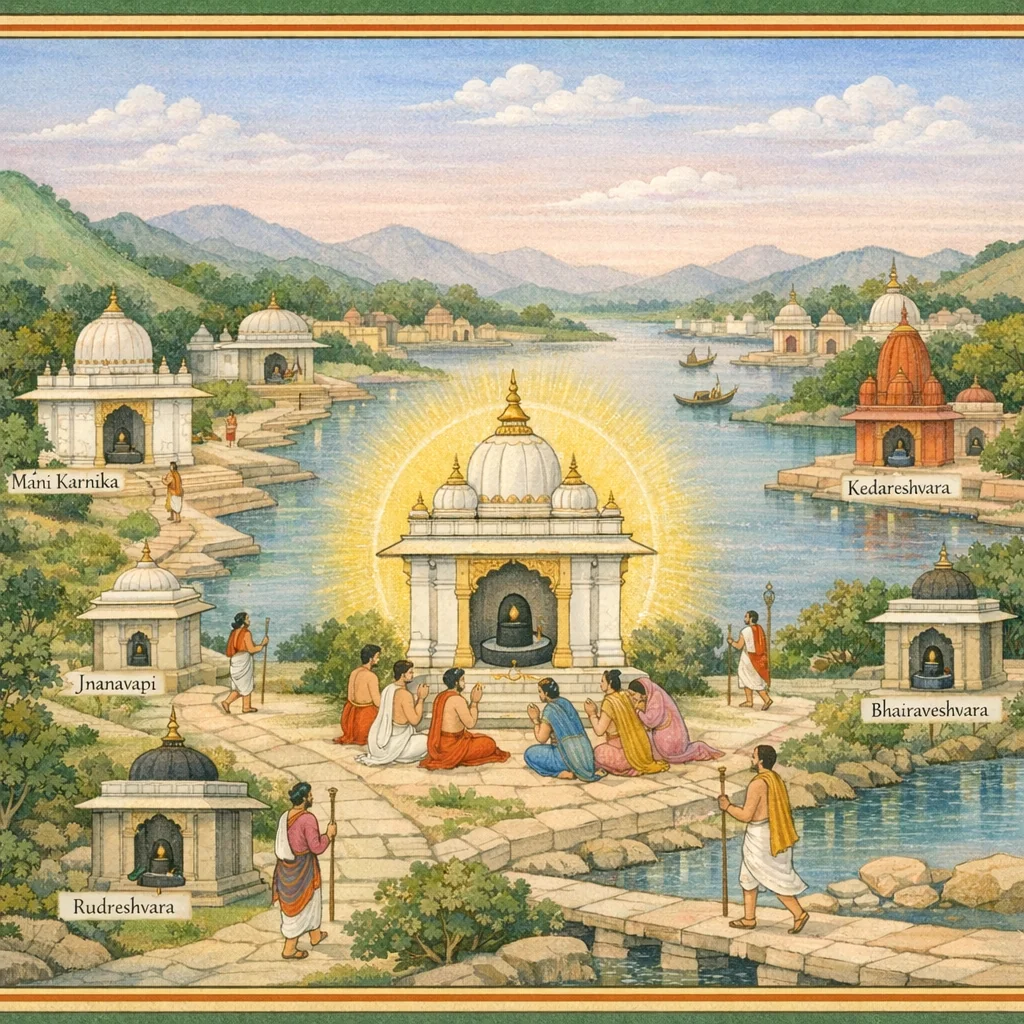
शिवलिङ्गमाहात्म्यवर्णनम् (Narration of the Greatness of the Śiva-liṅga)
This chapter, spoken by Sūta, functions as a sacred-geographical catalogue that anchors Śiva-tattva in recognizable ritual sites. It begins by praising Kāśī on the bank of the Gaṅgā as a liberating city (vimuktidā), “liṅga-mayī” and filled with liṅga-presence, the very abode of Śiva. The foremost liṅga there is Avimuktaka, linked with Kṛttivāseśvara, expressing “non-abandonment” (avimukta) as Śiva’s continual salvific availability within the kṣetra. The text then lists many named Śiva-liṅgas—Tilabhāṇḍeśvara, Daśāśvamedha, Saṃgameśa, Bhūteśvara, Nārīśvara, Baṭukeśvara, Pūreśvara, Siddhanātheśvara, Dūreśvara, Śṛṅgeśvara, Vaidyanātha, Japyeśvara, Gopeśvara, Raṃgeśvara, Vāmeśvara, Nāgeśa, Kājeśa, Vimaleśvara, Vyāseśvara, Sukeśa, Bhāṇḍeśvara, Huṃkāreśa—locating several by riverbanks or confluences. Its inner teaching is that Śiva’s transcendence is ritually encountered through localized liṅga-forms; darśana and nearness to these holy places are said to grant siddhi, sukha, and ultimately liberation through the kṣetra’s sacred being.
Shlokas
Verse 1
सूत उवाच । गंगातीरे सुप्रसिद्धा काशी खलु विमुक्तिदा । सा हि लिंगमयी ज्ञेया शिववासस्थली स्मृता
Sūta said: On the bank of the Gaṅgā, the city of Kāśī is indeed renowned as the giver of liberation. It should be understood as pervaded by the Liṅga—Śiva’s sacred emblem—and is remembered as the very abode where Śiva dwells.
Verse 2
लिंगं तत्रैव मुख्यं च सम्प्रोक्तमविमुक्तकम् । कृत्तिवासेश्वरः साक्षात्तत्तुल्यो वृद्धबालकः
There itself, the foremost Liṅga is declared to be Avimuktaka. Kṛttivāseśvara is directly Lord Śiva Himself and is equal to that (Avimuktaka); He is spoken of as both old and childlike.
Verse 3
तिलभाण्डेश्वरश्चैव दशाश्वमेध एव च । गंगा सागरसंयोगे संगमेश इति स्मृतः
He is also renowned as Tilabhāṇḍeśvara and Daśāśvamedha. At the confluence where the Gaṅgā meets the ocean, he is remembered as Saṅgameśa—the Lord of the sacred meeting-place.
Verse 4
भूतेश्वरो यः संप्रोक्तो भक्तसर्वार्थदः सदा । नारीश्वर इति ख्यातः कौशिक्याः स समीपगः
That Lord who is called Bhūteśvara—ever the giver of every desired good to His devotees—is also renowned as Nārīśvara; He abides near Kauśikī, the Goddess.
Verse 5
वर्तते गण्डकीतीरे बटुकेश्वर एव सः । पूरेश्वर इति ख्यातः फल्गुतीरे सुखप्रदः
He indeed abides on the bank of the Gaṇḍakī as Baṭukeśvara; and on the bank of the Phalgu He is renowned as Pūreśvara, bestower of well-being and happiness.
Verse 6
सिद्धनाथेश्वरश्चैव दर्शनात्सिद्धिदो नृणाम् । दूरेश्वर इति ख्यातः पत्तने चोत्तरे तथा
Siddhanātheśvara too—by the mere act of beholding Him—bestows siddhi, spiritual accomplishment, upon people. He is also renowned as Dūreśvara, and likewise is worshipped in the northern city of Pattana.
Verse 7
शृंगेश्वरश्च नाम्ना वै वैद्यनाथस्तथैव च । जप्येश्वरस्तथा ख्यातो यो दधी चिरणस्थले
He is indeed known by the name Śṛṅgeśvara, and likewise as Vaidyanātha. He is also renowned as Japyeśvara—He who abides at Dadhī-Ciraṇa-sthala—thus is the Lord spoken of.
Verse 8
गोपेश्वरः समाख्यातः रंगेश्वर इति स्मृतः । वामेश्वरश्च नागेशः काजेशो विमलेश्वरः
He is renowned as Gopeśvara and is remembered as Raṅgeśvara. He is also worshipped as Vāmeśvara and Nāgeśa, as well as Kājeśa and Vimaleśvara.
Verse 9
व्यासेश्वरश्च विख्यातः सुकेशश्च तथैव हि । भाण्डेश्वराश्च विख्यातो हुंकारेशस्तथैव च
“Vyāseśvara is renowned; so too is Sukeśa. Bhāṇḍeśvara is also famed, and likewise Huṃkāreśa.”
Verse 10
सुरोचनश्च विख्यातो भूतेश्वर इति स्वयम् । संगमेशस्तथा प्रोक्तो महापातकनाशनः
He is renowned as Surocana, and indeed as Bhūteśvara—the Lord of all beings. He is also declared to be Saṃgameśa, the Lord of the sacred confluence, the destroyer of even the greatest sins.
Verse 12
ततश्च तप्तकातीरे कुमारेश्वर एव च । सिद्धेश्वरश्च विख्यातः सेनेशश्च तथा स्मृतः । रामेश्वर इति प्रोक्तः कुंभेशश्च परो मतः । नन्दीश्वरश्च पुंजेशः पूर्णायां पूर्णकस्तथा
Then, on the bank of the Taptakā river, there is Kumāreśvara. There Siddheśvara is renowned, and Seneśa is also remembered. It is said to be Rāmeśvara, and Kumbheśa is regarded as supreme. Likewise there are Nandīśvara and Puñjeśa; and at Pūrṇā there is also Pūrṇaka.
Verse 13
ब्रह्मेश्वरः प्रयोगे च ब्रह्मणा स्थापितः पुरा । दशाश्वमेधतीर्थे हि चतुर्वर्गफलप्रदः
In Prayāga, Brahmā long ago established the Liṅga known as Brahmeśvara. Indeed, at the sacred ford called Daśāśvamedha-tīrtha, it bestows the fruits of the four aims of life—dharma, artha, kāma, and mokṣa.
Verse 14
तथा सोमेश्वरस्तत्र सर्ब्वापद्विनिवारकः । भारद्वाजेश्वरश्चैव ब्रह्मवर्चःप्रवर्द्धकः
Likewise, Someshvara is present there as the remover of all calamities; and Bhāradvājeśvara too—who increases brahma-varchas, the radiant spiritual lustre born of sacred discipline and divine knowledge.
Verse 15
शूलटंकेश्वरः साक्षात्कामनाप्रद ईरितः । माधवेशश्च तत्रैव भक्तरक्षाविधायकः
Śūlaṭaṃkeśvara is directly proclaimed as the bestower of desired aims. And there itself, Mādhaveśa is the protector who ensures the safeguarding of devotees.
Verse 16
नागेशाख्यः प्रसिद्धो हि साकेतनगरे द्विजा । सूर्य्यवंशोद्भवानां च विशेषेण सुखप्रदः
O twice-born sages, in the city of Sāketa the Lord is renowned as Nāgeśa. He bestows happiness—most especially upon those born in the Solar dynasty—by granting auspicious well-being through devotion to Śiva in the form of the Jyotirliṅga.
Verse 17
पुरुषोत्तमपुर्यां तु भुवनेशस्तु सिद्धिदः । लोकेशश्च महालिंगः सर्वानन्दप्रदायकः
In Puruṣottama-purī, the Lord as Bhuvaneśa bestows spiritual attainments (siddhis); and as Lokeśa, the Great Liṅga grants the bliss of all worlds—indeed, it bestows complete joy upon all.
Verse 18
कामेश्वरः शंभुलिंगो गंगेशः परशुद्धिकृत् । शक्रेश्वरः शुक्रसिद्धो लोकानां हितकाम्यया
He is Kāmeśvara; He is the Śaṃbhu-liṅga; He is Gaṅgeśa, the bestower of supreme purification. He is Śakreśvara, and He is Śukra-siddha—manifesting these sacred forms out of a desire for the welfare of the worlds.
Verse 19
तथा वटेश्वरः ख्यातः सर्वकामफलप्रदः । सिन्धुतीरे कपालेशो वक्त्रेशः सर्वपापहा
Likewise, (that sacred Liṅga) is renowned as Vaṭeśvara, the bestower of the fruits of all desired aims. On the bank of the Sindhu (Indus) is Kapāleśa; and Vaktreśa is the remover of all sins.
Verse 20
भीमेश्वर इति प्रोक्तः सूर्येश्वर इति स्मृतः
He is proclaimed as Bhīmeśvara, and is also remembered as Sūryeśvara.
Verse 21
नन्देश्वरश्च विज्ञेयो ज्ञानदो लोकपूजितः । नाकेश्वरो महापुण्यस्तथा रामेश्वरः स्मृतः
Know Nandeśvara as the bestower of spiritual knowledge, worshipped by all the worlds. Nākeśvara is proclaimed supremely meritorious; and Rāmeśvara is likewise remembered (as a sacred form and seat of Śiva).
Verse 22
विमलेश्वरनामा वै कंटकेश्वर एव च । पूर्णसागरसंयोगे धर्तुकेशस्तथैव च
He is indeed known as Vimaleśvara, and also as Kaṇṭakeśvara. And at the confluence with the Pūrṇa-sāgara (the “full ocean”), he is likewise worshipped as Dhartukeśa.
Verse 23
चन्द्रेश्वरश्च विज्ञेयश्चन्द्रकान्तिफलप्रदः । सर्वकाम प्रदश्चैव सिद्धेश्वर इति स्मृतः
He is to be known as Candreśvara, the Lord of the Moon, who bestows the fruit of moon-like radiance and grace. He also grants all rightful desires; therefore he is remembered as Siddheśvara, the Lord who perfects and fulfills.
Verse 24
बिल्वेश्वरश्च विख्यातश्चान्धकेशस्तथैव च । यत्र वा ह्यन्धको दैत्यः शंकरेण हतः पुरा
Bilveśvara is famed, and so too is Andhakeśa—the sacred place where, in ancient times, the demon Andhaka was slain by Śaṅkara (Lord Śiva).
Verse 25
अयं स्वरूपमंशेन धृत्वा शंभुः पुनः स्थितः । शरणेश्वरविख्यातो लोकानां सुखदः सदा
Assuming a portion of His own divine form, Śambhu (Lord Śiva) manifested and remained there again. Celebrated as Śaraṇeśvara, He is forever the giver of well-being and happiness to the worlds.
Verse 26
कर्दमेशः परः प्रोक्त कोटीशश्चार्बुदाचले । अचलेशश्च विख्यातो लोकानां सुखदः सदा
Kardameśa is proclaimed the Supreme; and Koṭīśa is manifest on Mount Arbuda. Acaleśa too is renowned—ever bestowing well-being and happiness upon the worlds.
Verse 27
नागेश्वरस्तु कौशिक्यास्तीरे तिष्ठति नित्यशः । अनन्तेश्वरसंज्ञश्च कल्याणशुभभाजनः
Nāgeśvara abides eternally on the bank of the Kauśikī river. He is also known as Ananteśvara—the abode and bestower of auspiciousness and spiritual welfare.
Verse 28
योगेश्वरश्च विख्यातो वैद्यनाथेश्वरस्तथा । कोटीश्वरश्च विज्ञेयः सप्तेश्वर इति स्मृतः
He is renowned as Yogeśvara; likewise as Vaidyanātheśvara. He is also to be known as Koṭīśvara, and is remembered too by the name Saptēśvara.
Verse 29
भद्रेश्वरश्च विख्यातो भद्रनामा हरः स्वयम् । चण्डीश्वरस्तथा प्रोक्तः संगमेश्वर एव च
He is renowned as Bhadreśvara; indeed, Hara Himself bears the name “Bhadra.” He is also declared to be Caṇḍīśvara, and likewise Saṅgameśvara.
Verse 30
पूर्वस्यां दिशि जातानि शिवलिंगानि यानि च । सामान्यान्यपि चान्यानि तानीह कथितानि ते
All the Śiva-liṅgas that manifested in the eastern direction—as well as the other commonly known liṅgas—have been described to you here.
Verse 31
दक्षिणस्यां दिशि तथा शिवलिंगानि यानि च । संजातानि मुनिश्रेष्ठ तानि ते कथयाम्यहम्
O best of sages, I shall now tell you about those Śiva-liṅgas as well that manifested in the southern direction.
Frequently Asked Questions
It argues for Śiva’s continuous salvific presence through localized liṅga-forms, with Kāśī depicted as intrinsically liberative and the Avimuktaka-liṅga serving as the chapter’s emblem of Śiva’s “non-abandoning” accessibility to devotees.
Calling Kāśī “liṅga-mayī” frames the city as a sacral field saturated with Śiva-presence, where the liṅga is not merely an icon but a mode of ontological participation—space itself becomes a medium for encountering Śiva-tattva through ritual acts and darśana.
Epithets such as Kṛttivāseśvara, Siddhanātheśvara, Bhūteśvara, and Saṃgameśa emphasize functional theology—Śiva as giver of siddhi, lord of beings, and sanctifier of confluences—thereby encoding ritual expectations (benefit, protection, liberation) into the very names of the liṅgas.