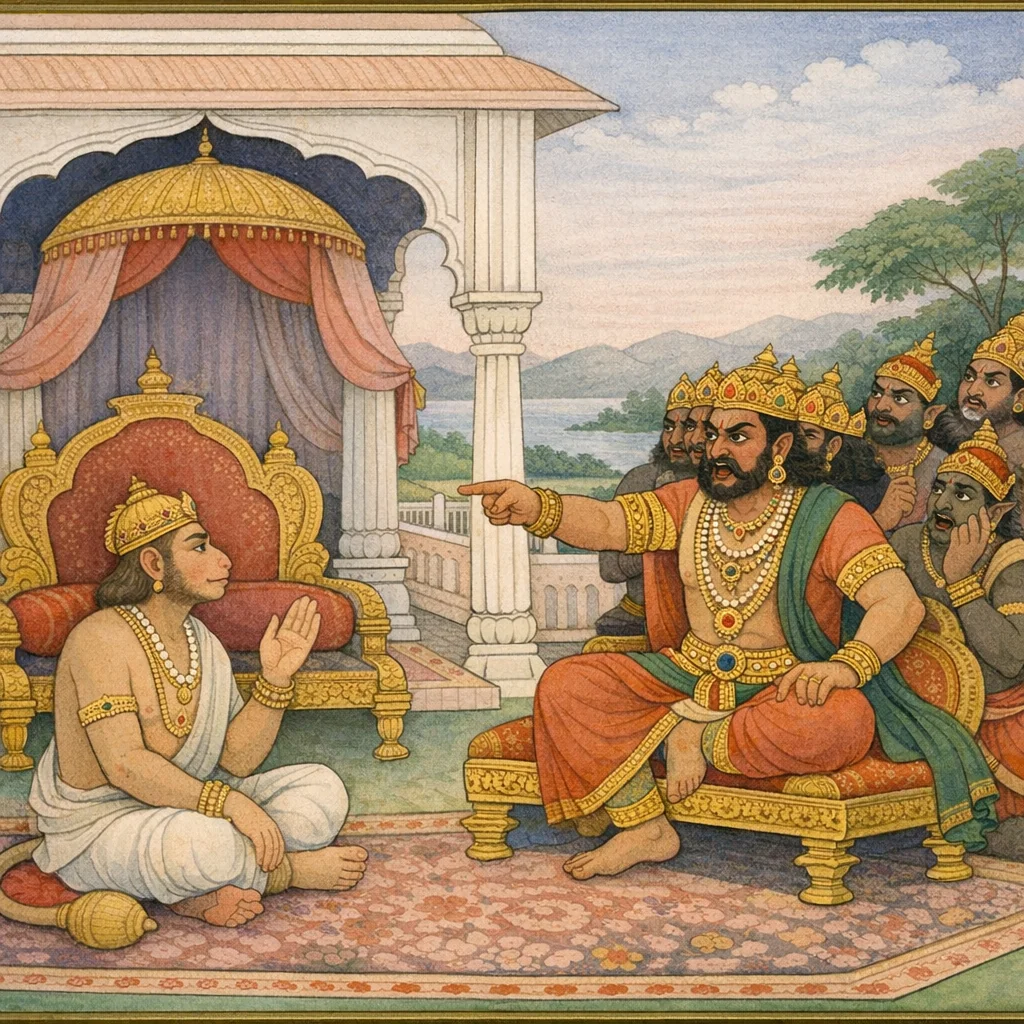
Sarga 51
हनूमदुपदेशः रावणस्य च कोपः (Hanuman’s Counsel to Ravana and Ravana’s Wrath)
सुन्दरकाण्ड
This sarga is framed as a formal dūta-vākya. After observing Rāvaṇa’s might, Hanumān speaks with deliberate restraint, declaring himself Sugrīva’s emissary and Śrī Rāma’s servant, and recounting the chain of events: Rāma’s exile with Sītā and Lakṣmaṇa, Sītā’s loss, the meeting with Sugrīva at Ṛṣyamūka, Vāli’s death by Rāma’s single arrow, and Sugrīva’s dispatch of vast search-parties across all directions and realms. Hanumān affirms his leap over the ocean (a hundred yojanas) and confirms that he has seen Sītā in Rāvaṇa’s house. He then turns to dharma: abducting another’s wife is root-destroying adharma, unworthy of a ruler famed for tapas and discernment. He warns of the irresistible martial power of Rāma and Lakṣmaṇa, calls Sītā a perilous “kālarātri” for Laṅkā, and urges the return of Jānakī as a tri-kāla-hita course—beneficial for past, present, and future. The sarga ends in Rāvaṇa’s wrath: hearing the unwelcome yet dignified counsel, the ten-headed king orders Hanumān’s execution, and the hope of diplomatic resolution collapses.
Shlokas
Verse 1
तं समीक्ष्य महासत्त्वं सत्त्ववान्हरिसत्तमः।वाक्यमर्थवदव्यग्रस्तमुवाच दशाननम्।।।।
Having observed the mighty Daśānana, Hanumān—best among the monkeys and steadfast in courage—addressed him calmly with words rich in meaning.
Verse 2
अहं सुग्रीवसंदेशादिह प्राप्तस्तवालयम्।राक्षसेन्द्र हरीशस्त्वां भ्राता कुशलमब्रवीत्।।।।
O lord of the Rākṣasas, I have come to your abode by Sugrīva’s message. The lord of monkeys—who is as a brother to you—sends you his greetings of well-being.
Verse 3
भ्रातुश्शृणु समादेशं सुग्रीवस्य महात्मनः।धर्मार्थोपहितं वाक्यमिह चामुत्र च क्षमम्।।।।
Hear the command of great-souled Sugrīva, as a brother to Rāma: words grounded in dharma and artha, beneficial in this world and the next.
Verse 4
राजा दशरथो नाम रथकुञ्जरवाजिमान्।पितेव बन्धुर्लोकस्य सुरेश्वरसमद्युतिः।।।।
There was an emperor named Daśaratha, richly furnished with chariots, elephants, and horses—like a father and a friend to the world, radiant like Indra, lord of the gods.
Verse 5
ज्येष्ठस्तस्य महाबाहुः पुत्रः प्रियकरः प्रभुः।पितुर्निदेशान्निष्क्रान्तः प्रविष्टो दण्डकावनम्।।।।लक्ष्मणेन सह भ्रात्रा सीतया चापि भार्यया।रामो नाम महातेजा धर्म्यं पन्थानमास्थितः।।।।
His eldest son—strong-armed, beloved, and noble—named Rāma, radiant with splendour, obeyed his father’s command. Taking the righteous path of dharma, he went forth into exile and entered the Daṇḍaka forest together with his brother Lakṣmaṇa and his wife Sītā.
Verse 6
ज्येष्ठस्तस्य महाबाहुः पुत्रः प्रियकरः प्रभुः।पितुर्निदेशान्निष्क्रान्तः प्रविष्टो दण्डकावनम्।।5.51.5।।लक्ष्मणेन सह भ्रात्रा सीतया चापि भार्यया।रामो नाम महातेजा धर्म्यं पन्थानमास्थितः।।5.51.6।।
Rāma, the eldest son—mighty-armed and radiant—obeyed his father’s command and took the righteous path of dharma, entering the Daṇḍaka forest with his brother Lakṣmaṇa and with Sītā, his wife.
Verse 7
तस्य भार्या वने नष्टा सीता पतिमनुव्रता।वैदेहस्य सुता राज्ञो जनकस्य महात्मनः।।।।
His wife Sītā, devoted to following her husband, was lost in the forest; she is the daughter of Janaka, the great-souled king of Videha.
Verse 8
स मार्गमाणस्तां देवीं राजपुत्रः सहानुजः।ऋश्यमूकमनुप्राप्त: सुग्रीवेण समागतः।।।।
Searching for that divine lady (Sītā), Prince Rāma, together with his younger brother, reached Mount Ṛśyamūka and there met and allied with Sugrīva.
Verse 9
तस्य तेन प्रतिज्ञातं सीतायाः परिमार्गणम्।सुग्रीवस्यापि रामेण हरिराज्यं निवेदितम्।।।।
Sugrīva pledged to Rāma the thorough search for Sītā; and Rāma, in return, assured Sugrīva that he would secure for him the kingship of the Vānara realm.
Verse 10
ततस्तेन मृधे हत्वा राजपुत्रेण वालिनम्।सुग्रीवः स्थापितो राज्ये हर्यृक्षाणां गणेश्वरः।।।।
Then that prince slew Vālin in battle and established Sugrīva in the kingdom as king—the lord of the hosts of monkeys and bears.
Verse 11
त्वया विज्ञातपूर्वश्च वाली वानरपुङ्गवः।रामेण निहतस्सङ्ख्ये शरेणैकेन वानरः।।।।
Vālin, the foremost of the Vānara—already known to you—was slain by Rāma in battle with a single arrow.
Verse 12
स सीतामार्गणे व्यग्रस्सुग्रीवः सत्यसङ्गरः।हरीन् सम्प्रेषयामास दिशस्सर्वा हरीश्वरः।।।।
That Sugrīva—true in battle and steadfast to his pledged word—anxiously sent bands of Vānara in every direction to search for Sītā.
Verse 13
तां हरीणां सहस्राणि शतानि नियुतानि च।दिक्षु सर्वासु मार्गन्ते ह्यधश्चोपरि चाम्बरे।।।।
For her sake, monkeys in hundreds, thousands, and countless multitudes search in every direction—below, above, and even across the sky.
Verse 14
वैनतेयसमाः केचित्केचित्तत्रानिलोपमाः।असङ्गगतयशशीघ्रा हरिवीरा महाबलाः।।।।
Some mighty Vānara heroes are like Vainateya (Garuḍa), and some are like the Wind in speed—swift and powerful, moving as though they do not even touch the ground.
Verse 15
अहं तु हनुमान्नाम मारुतस्यौरसस्सुतः।सीतायास्तु कृते तूर्णं शतयोजनमायतम्।।।।समुद्रं लङ्घयित्वैव तां दिदृक्षुरिहागतः।
I am Hanumān by name, the true-born son of Māruta. For Sītā’s sake, I swiftly leapt across the ocean—vast as a hundred yojanas—and came here, longing to behold her.
Verse 16
भ्रमता च मया दृष्टा गृहे ते जनकात्मजा।।।।तद्भवान् दृष्टधर्मार्थस्तपःकृतपरिग्रहः।परदारान् महाप्राज्ञ नोपरोद्धुं त्वमर्हसि।।।।
While roaming, I saw Janaka’s daughter in your house. Since you discern dharma and artha and are upheld by austerity, O great wise one, it does not befit you to seize another man’s wife.
Verse 17
भ्रमता च मया दृष्टा गृहे ते जनकात्मजा।।5.51.16।।तद्भवान् दृष्टधर्मार्थस्तपःकृतपरिग्रहः।परदारान् महाप्राज्ञ नोपरोद्धुं त्वमर्हसि।।5.51.17।।
While roaming, I saw Janaka’s daughter in your house. Since you know dharma and artha and are fortified by austerity, O wise one, you should not keep or abduct another man’s wife.
Verse 18
न हि धर्मविरुद्धेषु बह्वपायेषु कर्मसु।मूलघातिषु सज्जन्ते बुद्धिमन्तो भवद्विधाः।।।।
For the wise—people such as you—do not truly engage in deeds opposed to dharma, fraught with many dangers, and destructive at the very root.
Verse 19
कश्च लक्ष्मणमुक्तानां रामकोपानुवर्तिनाम्।शराणामग्रतः स्थातुं शक्तो देवासुरेष्वपि।।।।
Who—even among gods and asuras—could stand before the arrows released by Lakṣmaṇa, driven by Rāma’s wrath?
Verse 20
न चापि त्रिषु लोकेषु राजन्विद्येत कश्चन।राघवस्य व्यलीकं यः कृत्वा सुखमवाप्नुयात्।।।।
O king, in the three worlds there is no one who, having incurred Rāghava’s displeasure, could still attain happiness.
Verse 21
तत् त्रिकालहितं वाक्यं धर्म्यमर्थानुबन्धि च।मन्यस्व नरदेवाय जानकी प्रतिदीयताम्।।।।
Therefore consider these words—beneficial in all three times, righteous, and conducive to true prosperity: let Jānakī be returned to the lord among men, Rāma.
Verse 22
दृष्टा हीयं मया देवी लब्धं यदिह दुर्लभम्।उत्तरं कर्म यच्छेषं निमित्तं तत्र राघवः।।।।
Indeed I have seen the divine lady here—an attainment most difficult to gain. As for what remains to be done, Rāghava (Rāma) will be the guiding cause and the planner there.
Verse 23
लक्षितेयं मया सीता तथा शोकपरायणा।गृह्य यां नाभिजानासि पञ्चास्यामिव पन्नगीम्।।।।
I have seen Sītā, wholly given over to grief. Having seized her, you do not understand that you are keeping in your house a five-hooded she-serpent.
Verse 24
नेयं जरयितुं शक्या सासुरैरमरैरपि।विषसंसृष्टमत्यर्थं भुक्तमन्नमिवौजसा ।।।।
This woman cannot be endured or ‘digested’—even by the gods together with the asuras—just as food heavily mixed with poison, though eaten, cannot be assimilated by one’s strength.
Verse 25
तपस्सन्तापलब्धस्ते योऽयं धर्मपरिग्रहः।न स नाशयितुं न्याय्य आत्मप्राणपरिग्रहः।।।।
This store of dharma you have gained through the burning hardships of austerity—it is not right to destroy it by staking and losing your very life.
Verse 26
अवध्यतां तपोभिर्यां भवान् समनुपश्यति।आत्मनः सासुरैर्देवैर्हेतुस्तत्राप्ययं महान्।।।।
By your austerities you perceive in yourself an inviolability—even against the gods together with the asuras; yet even so, this very matter can become a great cause of your death.
Verse 27
सुग्रीवो न हि देवोऽयं नासुरो न च राक्षसः।न दानवो न गन्धर्वो न यक्षो न च पन्नगः।।।।तस्मात्प्राणपरित्राणं कथं राजन्करिष्यसि।
This Sugrīva is not a god, nor an asura, nor a rākṣasa—nor a dānava, nor a gandharva, nor a yakṣa, nor a serpent-being. Therefore, O king, how will you secure protection for your life?
Verse 28
न तु धर्मोपसंहारमधर्मफलसंहितम्।।।।तदेव फलमन्वेति धर्मश्चाधर्मनाशन:।
But the culmination of dharma does not become joined to the fruits of adharma. The fruit follows its own cause—and dharma destroys adharma.
Verse 29
प्राप्तं धर्मफलं तावद्भवता नात्र संशयः।फलमस्याप्यधर्मस्य क्षिप्रमेव प्रपत्स्यसे।।।।
Up to now you have indeed obtained the fruits of dharma—there is no doubt of it. But you will also very soon meet the fruit of this adharma.
Verse 30
जनस्थानवधं बुद्ध्वा बुद्ध्वा वालिवधं तथा।।।।रामसुग्रीवसख्यं च बुध्यस्व हितमात्मनः।
Reflect on the destruction at Janasthāna; reflect as well on Vāli’s slaying; and on the alliance of Rāma and Sugrīva—then discern what is beneficial for your own welfare.
Verse 31
कामं खल्वहमप्येकस्सवाजिरथकुञ्जराम्।।।।लङ्कां नाशयितुं शक्तस्तस्यैष तु न निश्चयः।
Even alone, I am indeed capable of destroying Laṅkā—teeming with horses, chariots, and elephants; yet this is not my resolve, for I have no such mandate.
Verse 32
रामेण हि प्रतिज्ञातं हर्यृक्षगणसन्निधौ।।।।उत्सादनममित्राणां सीता यैस्तु प्रधर्षिता।
For Rāma has vowed, in the presence of the hosts of monkeys and bears, to annihilate those enemies by whom Sītā was violated and wronged.
Verse 33
अपकुर्वन् हि रामस्य साक्षादपि पुरन्दरः।।।।न सुखं प्राप्नुयादन्यः किं पुनस्त्वद्विधो जनः।
Even Purandara (Indra), were he to offend Rāma face to face, would not attain happiness—how much less someone of your kind.
Verse 34
यां सीतेत्यभिजानासि येयं तिष्ठति ते वशे।।।।कालरात्रीति तां विद्धि सर्वलङ्काविनाशिनीम्।
She whom you recognize as “Sita,” though she now stands within your power—know her as Kālarātri, the Night of dissolution, destined to destroy all Lanka.
Verse 35
तदलं कालपाशेन सीताविग्रहरूपिणा।।।।स्वयं स्कन्धावसक्तेन क्षेममात्मनि चिन्त्यताम्।
Therefore, enough of this: the noose of Death, taking the very form of Sita, has been placed by you upon your own shoulder—think now of your own welfare.
Verse 36
सीतायास्तेजसा दग्धां रामकोपप्रपीडिताम्।।।।दह्यमानामिमां पश्य पुरीं साट्टप्रतोलिकाम्।
Behold this very city—its streets and market-ways included—burning: scorched by Sita’s spiritual radiance and pressed down by Rama’s wrath.
Verse 37
स्वानि मित्राणि मन्त्रींश्च ज्ञातीन् भ्रात्रून् सुतान् हितान्।।।।भोगान्दारांश्च लङ्कां च मा विनाशमुपानय।
Do not lead to destruction your own friends, ministers, kinsmen, brothers, sons, well-wishers—your enjoyments, your wives, and even Lanka itself.
Verse 38
सत्यं राक्षसराजेन्द्र शृणुष्व वचनं मम।।।।रामदासस्य दूतस्य वानरस्य विशेषतः।
Truly, O lord of the rākṣasas, listen to my words—spoken as Rama’s servant, as his messenger, and especially as a vānara.
Verse 39
सर्वान् लोकान् सुसंहृत्य सभूतान् सचराचरान्।।।।पुनरेव तथा स्रष्टुं शक्तो रामो महायशाः।
Illustrious Rāma has the power to withdraw and dissolve all worlds—with all beings, moving and unmoving—and then to create them anew just as before.
Verse 40
देवासुरनरेन्द्रेषु यक्षरक्षोगणेषु च।।।।विद्याधरेषु सर्वेषु गन्धर्वेषूरगेषु च।सिद्धेषु किन्नरेन्द्रेषु पतत्रिषु च सर्वतः।।।।सर्वभूतेषु सर्वत्र सर्वकालेषु नास्ति सः।यो रामं प्रतियुध्येत विष्णुतुल्यपराक्रमम्।।।।
Among the rulers of gods and asuras, among yakṣas and hosts of rākṣasas, among all vidyādharas, gandharvas, and serpents; among siddhas, kings of kinnaras, and even among birds everywhere—indeed, among all beings, in every place and at all times—there is none who could contend in battle with Rāma, whose prowess is equal to Viṣṇu’s.
Verse 41
देवासुरनरेन्द्रेषु यक्षरक्षोगणेषु च।।5.51.40।।विद्याधरेषु सर्वेषु गन्धर्वेषूरगेषु च।सिद्धेषु किन्नरेन्द्रेषु पतत्रिषु च सर्वतः।।5.51.41।।सर्वभूतेषु सर्वत्र सर्वकालेषु नास्ति सः।यो रामं प्रतियुध्येत विष्णुतुल्यपराक्रमम्।।5.51.42।।
Across every class of beings—vidyādharas, gandharvas, serpents, siddhas, kinnara-kings, and birds everywhere—at any place and at any time, none exists who could contend in battle with Rāma, whose valor matches Viṣṇu’s.
Verse 42
देवासुरनरेन्द्रेषु यक्षरक्षोगणेषु च।।5.51.40।।विद्याधरेषु सर्वेषु गन्धर्वेषूरगेषु च।सिद्धेषु किन्नरेन्द्रेषु पतत्रिषु च सर्वतः।।5.51.41।।सर्वभूतेषु सर्वत्र सर्वकालेषु नास्ति सः।यो रामं प्रतियुध्येत विष्णुतुल्यपराक्रमम्।।5.51.42।।
Among all beings—everywhere, at all times—there is none who could fight against Rāma, whose heroic power is like Viṣṇu’s.
Verse 43
सर्वलोकेश्वरस्यैवं कृत्वा विप्रियमुत्तमम्।रामस्य राजसिंहस्य दुर्लभं तव जीवितम्।।।।
Having thus committed so grave an offence against Rāma—the Lord of all worlds, the lion among kings—your life will be hard to preserve.
Verse 44
देवाश्च दैत्याश्च निशाचरेन्द्र गन्धर्वविद्याधरनागयक्षाः।रामस्य लोकत्रयनायकस्य स्थातुं न शक्तास्समरेषु सर्वे।।।।
O lord of the night-roamers, even the devas and daityas—gandharvas, vidyādharas, nāgas, and yakṣas—none has the power to stand firm in battle against Rāma, the leader of the three worlds.
Verse 45
ब्रह्मा स्वयम्भूश्चतुराननो वा रुद्रस्त्रिणेत्रस्त्रिपुरान्तको वा।इन्द्रो महेन्द्रस्सुरनायको वा त्रातुं न शक्ता युधि रामवध्यम्।।।।
Even Brahmā the self-born, the four-faced one; or Rudra, three-eyed, the destroyer of Tripura; or Indra, Mahendra, leader of the gods—none has the power in war to save one whom Rāma has marked for death.
Verse 46
स सौष्ठवोपेतमदीनवादिनः कपेर्निशम्याप्रतिमोऽप्रियं वचः।दशाननः कोपविवृत्तलोचनः समादिशत्तस्य वधं महाकपेः।।।।
Hearing the unpleasant yet well-crafted and undaunted words spoken by that monkey, the unrivalled Ten-headed one—his eyes rolling with anger—ordered the execution of great Hanumān.
Frequently Asked Questions
The dharma-crisis is Rāvaṇa’s retention of Sītā (another man’s wife). Hanumān argues that paradāra-abduction is adharma that destroys one’s foundations, urging immediate restitution to avert collective ruin.
Power without righteousness is self-defeating: accumulated merit from tapas cannot protect one who persists in adharma. The sarga teaches that wise governance is measured by restraint, receptivity to counsel, and alignment with tri-kāla-hita action.
Key loci include Laṅkā (Rāvaṇa’s seat and Sītā’s confinement), the ocean-crossing of a hundred yojanas (Hanumān’s feat), Ṛṣyamūka (Rāma–Sugrīva meeting), Daṇḍaka forest (exile setting), and Jana-sthāna (site of earlier conflict).