Sarga 54
लङ्कादाहः — The Burning of Lanka (Catuḥpañcāśaḥ Sargaḥ)
सुन्दरकाण्ड
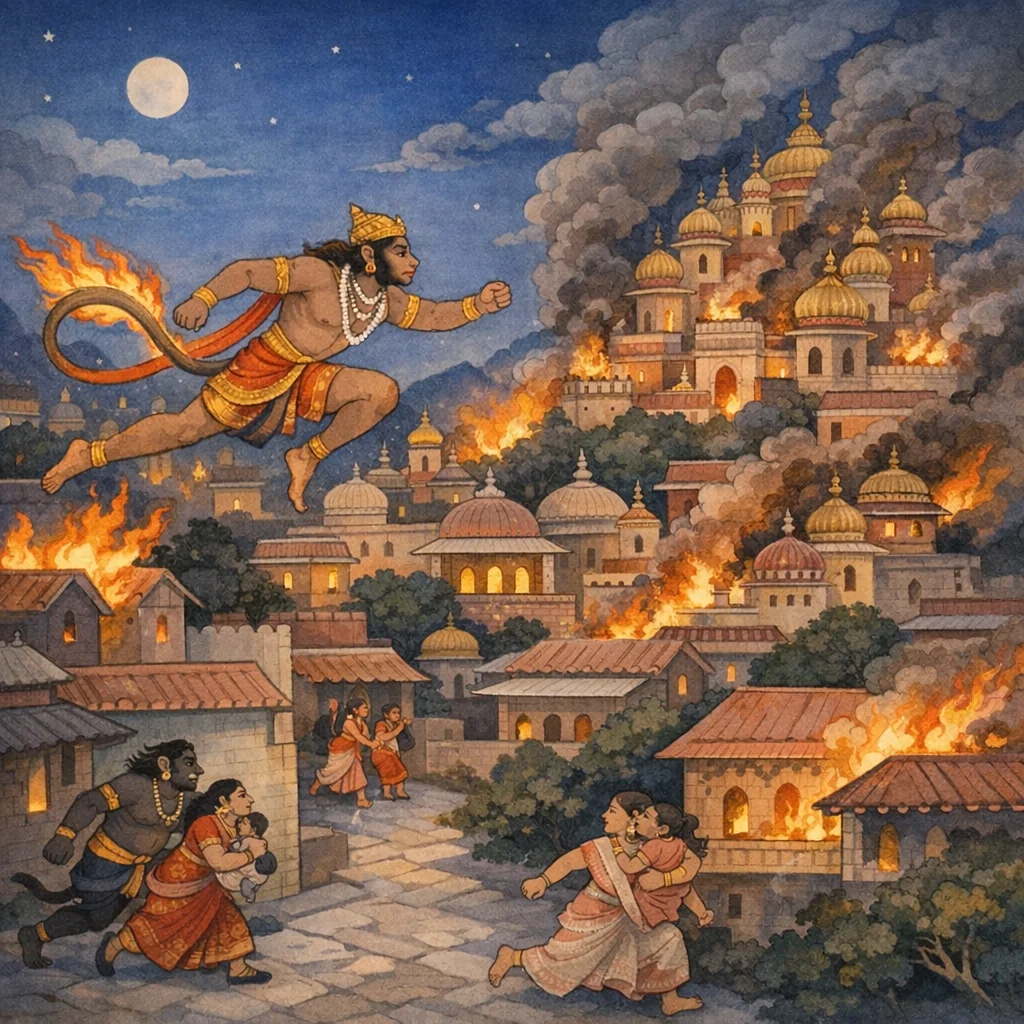
In Sarga 54, having completed his reconnaissance and contact mission, Hanumān turns to the remaining work: shaking Laṅkā at the level of its citadel. He makes the fire on his tail an instrument of punishment and deterrence, leaping from rooftop to rooftop and igniting the residences of leading rākṣasas—Prahasta, Mahāpārśva, Vajradaṃṣṭra, Śuka, Sāraṇa, Indrajit, Jambumālī, Sumālī, and many other elite householders—while deliberately sparing Vibhīṣaṇa’s dwelling as a sign of dharmic discernment and recognition of alliance. The action rises to the symbolic center of power: Hanumān reaches Rāvaṇa’s chief palace, gem-inlaid and radiant like Meru and Mandara, and sets it ablaze, roaring like a cloud at the time of dissolution. Wind drives the conflagration; golden latticework, pearl-and-gem structures, and molten metals collapse amid the panic of fleeing rākṣasas and terrified families. The chapter closes with cosmic similes (kālāgni, yugānta imagery), rākṣasa speculation that Hanumān may be Indra, Yama, Rudra, Viṣṇu, or Time itself, and divine acclaim for his disciplined ferocity—marking Laṅkā’s psychological and infrastructural weakening before the main invasion.
Shlokas
Verse 1
वीक्षमाणस्ततो लङ्कां कपिः कृतमनोरथः।।।।वर्धमानसमुत्साहः कार्यशेषमचिन्तयत्।
Then the monkey, his purpose fulfilled, surveyed Laṅkā; and as his ardor rose, he reflected on what yet remained to be done.
Verse 2
किन्नु खल्ववशिष्टं मे कर्तव्यमिह साम्प्रतम्।।।।यदेषां रक्षसां भूयः सन्तापजननं भवेत्।
“What, indeed, remains for me to do here now—what could again bring further torment upon these rākṣasas?”
Verse 3
वनं तावत्प्रमथितं प्रकृष्टा राक्षसा हताः।।।बलैकदेशः क्षपितश्शेषं दुर्गविनाशनम्।
“The grove has been utterly shattered; the foremost rākṣasas have been slain; one division of the forces has been destroyed—only the ruin of the fortress remains.”
Verse 4
दुर्गे विनाशिते कर्म भवेत्सुखपरिश्रमम्।अल्पयत्नेन कार्येऽस्मिन् मम स्यात्सफलश्श्रमः।।।।
If the fortress is destroyed, my labor will end in a happy fulfilment. In this task, with only a little effort, my exertion will become successful.
Verse 5
यो ह्ययं मम लाङ्गूले दीप्यते हव्यवाहनः।अस्य सन्तर्पणं न्याय्यं कर्तुमेभिर्गृहोत्तमैः।।।।
“Since this fire is blazing on my tail, it is only fitting to ‘feed’ it with these finest mansions.”
Verse 6
ततः प्रदीप्तलाङ्गूलस्सविद्युदिव तोयदः।भवनाग्रेषु लङ्काया विचचार महाकपिः।।।।
Then the great monkey, his tail aflame, moved across the rooftops of Laṅkā—like a rain-cloud streaked with lightning.
Verse 7
गृहाद्गृहं राक्षसानामुद्यानानि च वानरः।वीक्षमाणो ह्यसन्त्रस्तः प्रासादांश्च चचार सः।।।।
The vānara moved from one rākṣasa house to another, surveying their gardens and lofty mansions, wandering calmly and without fear.
Verse 8
अवप्लुत्य महावेगः प्रहस्तस्य निवेशनम्।अग्निं तत्र स निक्षिप्य श्वसनेन समो बली।।।।ततोऽन्यत्पुप्लुवे वेश्म महापार्श्वस्य वीर्यवान्।मुमोच हनुमानग्निं कालानलशिखोपमम्।।।।
Swift and powerful, equal to the Wind in speed, he leapt down upon Prahasta’s residence and cast fire there. Then the valiant Hanumān sprang to another mansion—Mahāpārśva’s—and released flames like the fire at the end of time.
Verse 9
अवप्लुत्य महावेगः प्रहस्तस्य निवेशनम्।अग्निं तत्र स निक्षिप्य श्वसनेन समो बली।।5.54.8।।ततोऽन्यत्पुप्लुवे वेश्म महापार्श्वस्य वीर्यवान्।मुमोच हनुमानग्निं कालानलशिखोपमम्।।5.54.9।।
Swift and powerful, equal to the Wind in speed, he leapt down upon Prahasta’s residence and cast fire there. Then the valiant Hanumān sprang to another mansion—Mahāpārśva’s—and released flames like the fire at the end of time.
Verse 10
वज्रदंष्ट्रस्य च तदा पुप्लुवे स महाकपिः।शुकस्य च महातेजास्सारणस्य च धीमतः।।।।
Then the mighty, radiant great monkey leapt upon the dwellings of Vajradaṁṣṭra, of Śuka, and of the wise Sāraṇa.
Verse 11
तथा चेन्द्रजितो वेश्म ददाह हरियूथपः।जम्बुमाले स्सुमालेश्च ददाह भवनं ततः।।।।
In the same way, the leader of the monkey-troops burned Indrajit’s residence; then he burned the houses of Jambumālī and Sumālī as well.
Verse 12
रश्मिकेतोश्च भवनं सूर्यशत्रोस्तथैव च।ह्रस्वकर्णस्य दंष्ट्रस्य रोमशस्य च रक्षसः।।।।युद्धोन्मत्तस्य मत्तस्य ध्वजग्रीवस्य रक्षसः।विद्युज्जिह्वस्य घोरस्य तथा हस्तिमुखस्य च।।।।करालस्य पिशाचस्य शोणिताक्षस्य चैव हि।कुम्भकर्णस्य भवनं मकराक्षस्य चैव हि।।।।यज्ञशत्रोश्च भवनं ब्रह्मशत्रोस्तथैव च।नरान्तकस्य कुम्भस्य निकुम्भस्य दुरात्मनः।।।।वर्जयित्वा महातेजा विभीषणगृहं प्रति।क्रममाणः क्रमेणैव ददाह हरिपुङ्गवः।।।।
The radiant leader among monkeys moved through the city, setting fire—one after another—to the mansions of Raśmiketu, Sūryaśatru, Hrasvakarṇa, Daṁṣṭra, Romaśa, Yuddhonmatta, Matta, Dhvajagrīva, the fearsome Vidyujjihva, Hastimukha, Karāla, Piśāca, Śoṇitākṣa, Kumbhakarṇa, Makarākṣa, Yajñaśatru, Brahmaśatru, Narāntaka, Kumbha, and the wicked Nikumbha; yet he deliberately spared the house of Vibhīṣaṇa as he went.
Verse 13
रश्मिकेतोश्च भवनं सूर्यशत्रोस्तथैव च।ह्रस्वकर्णस्य दंष्ट्रस्य रोमशस्य च रक्षसः।।5.54.12।।युद्धोन्मत्तस्य मत्तस्य ध्वजग्रीवस्य रक्षसः।विद्युज्जिह्वस्य घोरस्य तथा हस्तिमुखस्य च।।5.54.13।।करालस्य पिशाचस्य शोणिताक्षस्य चैव हि।कुम्भकर्णस्य भवनं मकराक्षस्य चैव हि।।5.54.14।।यज्ञशत्रोश्च भवनं ब्रह्मशत्रोस्तथैव च।नरान्तकस्य कुम्भस्य निकुम्भस्य दुरात्मनः।।5.54.15।।वर्जयित्वा महातेजा विभीषणगृहं प्रति।क्रममाणः क्रमेणैव ददाह हरिपुङ्गवः।।5.54.16।।
The radiant leader among monkeys moved through the city, setting fire—one after another—to the mansions of Raśmiketu, Sūryaśatru, Hrasvakarṇa, Daṁṣṭra, Romaśa, Yuddhonmatta, Matta, Dhvajagrīva, the fearsome Vidyujjihva, Hastimukha, Karāla, Piśāca, Śoṇitākṣa, Kumbhakarṇa, Makarākṣa, Yajñaśatru, Brahmaśatru, Narāntaka, Kumbha, and the wicked Nikumbha; yet he deliberately spared the house of Vibhīṣaṇa as he went.
Verse 14
रश्मिकेतोश्च भवनं सूर्यशत्रोस्तथैव च।ह्रस्वकर्णस्य दंष्ट्रस्य रोमशस्य च रक्षसः।।5.54.12।।युद्धोन्मत्तस्य मत्तस्य ध्वजग्रीवस्य रक्षसः।विद्युज्जिह्वस्य घोरस्य तथा हस्तिमुखस्य च।।5.54.13।।करालस्य पिशाचस्य शोणिताक्षस्य चैव हि।कुम्भकर्णस्य भवनं मकराक्षस्य चैव हि।।5.54.14।।यज्ञशत्रोश्च भवनं ब्रह्मशत्रोस्तथैव च।नरान्तकस्य कुम्भस्य निकुम्भस्य दुरात्मनः।।5.54.15।।वर्जयित्वा महातेजा विभीषणगृहं प्रति।क्रममाणः क्रमेणैव ददाह हरिपुङ्गवः।।5.54.16।।
The radiant leader among monkeys moved through the city, setting fire—one after another—to the mansions of Raśmiketu, Sūryaśatru, Hrasvakarṇa, Daṁṣṭra, Romaśa, Yuddhonmatta, Matta, Dhvajagrīva, the fearsome Vidyujjihva, Hastimukha, Karāla, Piśāca, Śoṇitākṣa, Kumbhakarṇa, Makarākṣa, Yajñaśatru, Brahmaśatru, Narāntaka, Kumbha, and the wicked Nikumbha; yet he deliberately spared the house of Vibhīṣaṇa as he went.
Verse 15
रश्मिकेतोश्च भवनं सूर्यशत्रोस्तथैव च।ह्रस्वकर्णस्य दंष्ट्रस्य रोमशस्य च रक्षसः।।5.54.12।।युद्धोन्मत्तस्य मत्तस्य ध्वजग्रीवस्य रक्षसः।विद्युज्जिह्वस्य घोरस्य तथा हस्तिमुखस्य च।।5.54.13।।करालस्य पिशाचस्य शोणिताक्षस्य चैव हि।कुम्भकर्णस्य भवनं मकराक्षस्य चैव हि।।5.54.14।।यज्ञशत्रोश्च भवनं ब्रह्मशत्रोस्तथैव च।नरान्तकस्य कुम्भस्य निकुम्भस्य दुरात्मनः।।5.54.15।।वर्जयित्वा महातेजा विभीषणगृहं प्रति।क्रममाणः क्रमेणैव ददाह हरिपुङ्गवः।।5.54.16।।
The radiant leader among monkeys moved through the city, setting fire—one after another—to the mansions of Raśmiketu, Sūryaśatru, Hrasvakarṇa, Daṁṣṭra, Romaśa, Yuddhonmatta, Matta, Dhvajagrīva, the fearsome Vidyujjihva, Hastimukha, Karāla, Piśāca, Śoṇitākṣa, Kumbhakarṇa, Makarākṣa, Yajñaśatru, Brahmaśatru, Narāntaka, Kumbha, and the wicked Nikumbha; yet he deliberately spared the house of Vibhīṣaṇa as he went.
Verse 16
रश्मिकेतोश्च भवनं सूर्यशत्रोस्तथैव च।ह्रस्वकर्णस्य दंष्ट्रस्य रोमशस्य च रक्षसः।।5.54.12।।युद्धोन्मत्तस्य मत्तस्य ध्वजग्रीवस्य रक्षसः।विद्युज्जिह्वस्य घोरस्य तथा हस्तिमुखस्य च।।5.54.13।।करालस्य पिशाचस्य शोणिताक्षस्य चैव हि।कुम्भकर्णस्य भवनं मकराक्षस्य चैव हि।।5.54.14।।यज्ञशत्रोश्च भवनं ब्रह्मशत्रोस्तथैव च।नरान्तकस्य कुम्भस्य निकुम्भस्य दुरात्मनः।।5.54.15।।वर्जयित्वा महातेजा विभीषणगृहं प्रति।क्रममाणः क्रमेणैव ददाह हरिपुङ्गवः।।5.54.16।।
The radiant leader among monkeys moved through the city, setting fire—one after another—to the mansions of Raśmiketu, Sūryaśatru, Hrasvakarṇa, Daṁṣṭra, Romaśa, Yuddhonmatta, Matta, Dhvajagrīva, the fearsome Vidyujjihva, Hastimukha, Karāla, Piśāca, Śoṇitākṣa, Kumbhakarṇa, Makarākṣa, Yajñaśatru, Brahmaśatru, Narāntaka, Kumbha, and the wicked Nikumbha; yet he deliberately spared the house of Vibhīṣaṇa as he went.
Verse 17
तेषु तेषु महार्हेषु भवनेषु महायशाः।गृहेष्वृद्धिमतामृद्धिं ददाह स महाकपिः।।।।
Moving from one costly mansion to another, the renowned great monkey burned down the wealth of those prosperous rākṣasas.
Verse 18
सर्वेषां समतिक्रम्य राक्षसेन्द्रस्य वीर्यवान्।आससादाथ लक्ष्मीवान् रावणस्य निवेशनम्।।।।
Having passed beyond all those residences, the valiant and illustrious one then reached the dwelling of Rāvaṇa, lord of the rākṣasas.
Verse 19
ततस्तस्मिन्गृहे मुख्ये नानारत्नविभूषिते।मेरुमन्दरसङ्काशे सर्वमङ्गळशोभिते।।।।प्रदीप्तमग्निमुत्सृज्य लाङ्गूलाग्रे प्रतिष्ठितम्।ननाद हनुमान्वीरो युगान्तजलदो यथा।।।।
Then, in that foremost palace—adorned with many kinds of jewels, resembling Meru and Mandara, and resplendent with every auspicious ornament—
Verse 20
ततस्तस्मिन्गृहे मुख्ये नानारत्नविभूषिते।मेरुमन्दरसङ्काशे सर्वमङ्गळशोभिते।।5.54.19।।प्रदीप्तमग्निमुत्सृज्य लाङ्गूलाग्रे प्रतिष्ठितम्।ननाद हनुमान्वीरो युगान्तजलदो यथा।।5.54.20।।
Casting forth the blazing fire fixed upon the tip of his tail, the hero Hanumān roared like a cloud thundering at the world’s end.
Verse 21
श्वसनेन च संयोगादतिवेगो महाबलः।कालाग्निरिव जज्वाल प्रावर्धत हुताशनः।।।।
Joined by the wind, the mighty fire surged with tremendous speed—blazing like the doom-fire at the end of time—and grew ever stronger.
Verse 22
प्रदीप्तमग्निं पवनस्तेषु वेश्मस्वचारयत्।अभूच्छ्वसनसंयोगादतिवेगो हुताशनः।।।।
The wind drove the blazing fire through those houses; by its union with the wind, the fire became exceedingly swift in its spread.
Verse 23
तानि काञ्चनजालानि मुक्तामणिमयानि च।भवनान्यवशीर्यन्त रत्नवन्ति महान्ति च।।।।
Those great mansions—latticed with gold and inlaid with pearls and gems, vast and jewel-filled—collapsed and fell apart.
Verse 24
संजज्ञे तुमुलश्शब्दो राक्षसानां प्रधावताम्।स्वगृहस्य परित्राणे भग्नोत्साहोर्जितश्रियाम्।।।।नूनमेषोऽग्निरायातः कपिरूपेण हा इति।
A tumultuous uproar arose among the rākṣasas as they ran about to save their own houses—their confidence shattered along with their amassed splendor—crying, “Surely this is Fire himself, come in the form of a monkey—alas!”
Verse 25
क्रन्दन्त्यस्सहसा पेतुः स्तनन्धयधराः स्त्रियः।।।।काश्चिदग्निपरीतेभ्यो हर्मेभ्यो मुक्तमूर्धजाः।पतन्त्यो रेजिरेऽभ्रेभ्यस्सौदामन्य इवाम्बरात्।।।।
Crying out, some women—still holding their suckling infants—suddenly leapt down from mansions encircled by fire, their hair loosened in terror. As they fell, they shone like lightning dropping from the clouds in the sky.
Verse 26
क्रन्दन्त्यस्सहसा पेतुः स्तनन्धयधराः स्त्रियः।।5.54.25।।काश्चिदग्निपरीतेभ्यो हर्मेभ्यो मुक्तमूर्धजाः।पतन्त्यो रेजिरेऽभ्रेभ्यस्सौदामन्य इवाम्बरात्।।5.54.26।।
Crying out, some women carrying their suckling infants suddenly leapt down; with their hair loosened, they sprang from mansions wrapped in fire. As they fell, they flashed like lightning descending from cloudbanks in the sky.
Verse 27
वज्रविद्रुमवैदूर्यमुक्तारजतसंहितान्।विचित्रान्भवनाद्धातून् स्यन्दमानान्ददर्श सः।।।।
He saw from the burning mansions streams of molten minerals—variegated and mingled with diamond, coral, vaidūrya gems, pearls, and silver—oozing and dripping down.
Verse 28
नाग्निस्तृप्यति काष्ठानां तृणानां च यथा तथा।हनूमान् राक्षसेन्दाणां विशस्तानां न तृप्यति।।।।
Just as fire is not sated by dry wood and grass, so Hanumān was not sated by the fall of the rākṣasa lords he had slain.
Verse 29
क्वचित्किंशुकसङ्काशाः क्वचिच्छाल्मलिसन्निभाः।।।।क्वचित्कुङ्कुमसङ्काशाश्शिखा वह्नेश्चकाशिरे।
In some places the flames shone like kiṃśuka blossoms, in others like śālmali, and elsewhere like saffron, flaring in many hues across the city.
Verse 30
हनूमता वेगवता वानरेण महात्मना।लङ्कापुरं प्रदग्धं तद्रुद्रेण त्रिपुरं यथा।।।।
That city of Laṅkā was burned by Hanumān—the great-souled vānarā of swift force—just as Rudra burned Tripura.
Verse 31
ततस्तु लङ्कापुरपर्वताग्रे समुत्थितो भीमपराक्रमोऽग्निः।प्रसार्य चूडावलयं प्रदीप्तो हनूमता वेगवता विसृष्टः।।।।
Then, on the mountain-top of Laṅkā-city, the fire of dreadful force—released by swift Hanumān—blazed up, spreading in a ring like a circling crown of flame.
Verse 32
युगान्तकालानलतुल्यवेग स्समारुतोऽग्निर्ववृधे दिविस्पृक्।विधूमरश्मिर्भवनेषु सक्तो रक्षश्शरीराज्यसमर्पतार्चिः।।।।
Fanned by the wind, the fire grew and leapt up to touch the sky, swift as the cosmic blaze at the end of an age. Clinging to the mansions, its smokeless radiance flared, fed by the fat and oils of rākṣasa bodies.
Verse 33
आदित्यकोटीसदृशस्सुतेजा लङ्कां समस्तां परिवार्य तिष्ठन्।शब्दैरनेकैरशनिप्ररूढैर्भिन्दन्निवाण्डं प्रबभौ महाग्निः।।।।
The great fire, radiant like ten million suns, stood encircling all of Laṅkā. With countless thunderbolt-like crashes, it blazed as though it were splitting the very shell of the world.
Verse 34
तत्राम्बरादग्निरतिप्रवृद्धो रूक्षप्रभः किंशुकपुष्पचूडः।निर्वाणधूमाकुलराजयश्च नीलोत्पलाभाः प्रचकाशिरेऽभ्राः।।।।
There the fire, flaring up violently into the sky, blazed with a harsh brilliance, crowned as it were with the red of kiṁśuka blossoms. And the clouds, streaked and thick with the smoke from the dying embers, shone like blue lotuses.
Verse 35
वज्री महेन्द्रस्त्रिदशेश्वरो वा साक्षाद्यमो वा वरुणोऽनिलो वा।रुद्रोऽग्निरर्को धनदश्च सोमो न वानरोऽयं स्वयमेव कालः।।।।
“Is he Indra, wielder of the thunderbolt, the lord of the gods? Or Yama himself? Or Varuṇa, or the Wind? Or Rudra—Fire—Sun—Kubera—or the Moon? He is no mere monkey; is he Time (Death) itself in person?”
Verse 36
किं ब्रह्मणस्सर्वपितामहस्य सर्वस्य धातुश्चतुराननस्य।इहाऽऽगतो वानररूपधारी रक्षोपसंहारकरः प्रकोपः।।।।
“Could this be the wrath of four-faced Brahmā—the grandsire of all, the creator of the worlds—come here wearing a monkey’s form, intent on the destruction of the rākṣasas?”
Verse 37
किं वैष्णवं वा कपिरूपमेत्य रक्षोविनाशाय परं सुतेजः।अनन्तमव्यक्तमचिन्त्यमेकं स्वमायया साम्प्रतमागतं वा।।।।
Or is it Viṣṇu’s supreme, blazing power—boundless, unmanifest, unthinkable, one—come now by its own māyā, taking a monkey’s form for the destruction of the rākṣasas?
Verse 38
इत्येवमूचुर्बहवो विशिष्टा रक्षोगणास्तत्र समेत्य सर्वे।सप्राणिसङ्घां सगृहां सवृक्षां दग्धां पुरीं तां सहसा समीक्ष्य।।।।
Thus spoke many eminent rākṣasas, all gathering there together. Swiftly surveying that city—burnt along with its living beings, its houses, and its trees—they conferred in alarm.
Verse 39
ततस्तु लङ्का सहसा प्रदग्धा सराक्षसा साश्वरथा सनागा।सपक्षिसङ्घा समृगा सवृक्षा रुरोद दीना तुमुलं सशब्दम्।।।।
Then Laṅkā, suddenly set ablaze—along with its rākṣasas, its horses and chariots, its elephants, its flocks of birds, its beasts, and its trees—seemed to wail in misery with a tumultuous roar.
Verse 40
हा तात हा पुत्रक कान्त मित्र हा जीवितं भोगयुतं सुपुण्यम्।रक्षोभिरेवं बहुधा ब्रुवद्भि श्शब्दः कृतो घोरतरस्सुभीमः।।।।
“Alas, father! Alas, son! Beloved! Friend! Alas—this life, once full of enjoyment and merit, is destroyed!” Thus, as the rākṣasas cried out in many ways, a dreadfully terrifying uproar arose.
Verse 41
हुताशनज्वालसमावृता सा हतप्रवीरा परिवृत्तयोधाहनूमतः क्रोधबलाभिभूता बभूव शापोपहतेव लङ्का।।।।
Wrapped in the flames of fire, its champions slain and its troops in retreat, Laṅkā—overpowered by the force of Hanumān’s wrath—appeared as though struck by a curse.
Verse 42
स सम्भ्रमत्रस्तविषण्णराक्षसां समुज्ज्वलज्ज्वालहुताशनाङ्किताम्।ददर्श लङ्कां हनुमान्महामनाः स्वयम्भूकोपोपहतामिवावनिम्।।।।
Great-souled Hanumān beheld Laṅkā—its rākṣasas bewildered, terrified, and despondent—marked by the fiercely blazing flames of fire, like the earth itself smitten by the wrath of Svayambhū (Brahmā) at the time of dissolution.
Verse 43
भङ्क्त्वा वनं पादपरत्नसङ्कुलं हत्वा तु रक्षांसि महान्ति संयुगे।दग्ध्वा पुरीं तां गृहरत्नमालिनीं तस्थौ हनूमान्पवनात्मजः कपिः।।।।
After shattering the grove rich with splendid trees, slaying mighty rākṣasas in battle, and burning that city adorned with rows of magnificent houses, Hanumān—the Wind-god’s son—stood firm.
Verse 44
त्रिकूटशृङ्गाग्रतले विचित्रे प्रतिष्ठितो वानरराजसिंहः।प्रदीप्तलाङ्गूलकृतार्चिमाली व्यराजताऽऽदित्य इवांशुमाली।।।।
Stationed upon the wondrous summit of Trikūṭa, the lion among the Vanara chiefs shone forth; his blazing tail, a garland of flames, gleamed like the radiant sun encircled by its rays.
Verse 45
स राक्षसांस्तान्सुबहूंश्च हत्वा वनं च भङ्क्त्वा बहुपादपं तत्।विसृज्य रक्षोभवनेषु चाग्निं जगाम रामं मनसा महात्मा।।।।
Having slain many Rakṣasas, shattered that grove thick with trees, and loosed fire into the demons’ dwellings, the great-souled one turned his mind toward Rama, seeking Him within.
Verse 46
ततस्तु तं वानरवीरमुख्यं महाबलं मारुततुल्यवेगम्।महामतिं वायुसुतं वरिष्ठं प्रतुष्टुवुर्देवगणाश्च सर्वे।।।।
Then all the hosts of gods praised him—the foremost of Vanara heroes, mighty in strength, swift as the wind, supremely wise, the excellent son of Vayu.
Verse 47
भङ्क्त्वा वनं महातेजा हत्वा रक्षांसि संयुगे।दग्ध्वा लङ्कापुरीं रम्यां रराज स महाकपिः।।।।
Having destroyed the grove, slain the Rakṣasas in battle, and burned the fair city of Lanka, that great monkey of blazing splendor shone forth in triumph.
Verse 48
तत्र देवास्सगन्धर्वास्सिद्धाश्च परमर्षयः।दृष्ट्वा लङ्कां प्रदग्धां तां विस्मयं परमं गताः।।।।
There the gods, together with the Gandharvas, Siddhas, and great Ṛṣis, beheld Lanka ablaze and were struck with the highest astonishment.
Verse 49
तं दृष्ट्वा वानरश्रेष्ठं हनुमन्तं महाकपिम्।कालाग्निरिति सञ्चिन्त्य सर्वभूतानि तत्रसुः।।।।
Seeing Hanumān—the best of the vānara, the great monkey—every being trembled, thinking him to be Kālāgni, the fire of the end of time.
Verse 50
देवाश्च सर्वे मुनिपुङ्गवाश्च गन्धर्वविद्याधरनागयक्षाः।भूतानि सर्वाणि महान्ति तत्र जग्मुः परां प्रीतिमतुल्यरूपाम्।।।।
All the devas and foremost sages—together with Gandharvas, Vidyādharas, Nāgas, Yakṣas, and other great beings—felt there a supreme joy, incomparable in its splendor and intensity.
Frequently Asked Questions
The pivotal action is Hanumān’s use of destructive force after completing reconnaissance: he chooses to burn Laṅkā’s strategic residences to weaken the enemy, yet spares Vibhīṣaṇa’s house. The episode frames ethical discrimination in warfare—harm directed toward hostile infrastructure while protecting a dharmic ally.
Purposeful action must remain governed by dharma even when power is overwhelming. Hanumān’s “remaining work” is not vengeance but mission-completion: he applies force as deterrence and proof of capability, while maintaining moral boundaries (non-random targeting, ally protection, and task-orientation).
Laṅkā’s palace-topography is emphasized: rooftops and mansions, the city’s citadel-like structure, and the Trikūṭa mountain peak where Hanumān is later depicted as resplendent. The chief landmark is Rāvaṇa’s gem-adorned palace likened to Meru and Mandara, anchoring the city’s political-sacral center.