Sarga 16
षोडशः सर्गः (Sarga 16): Hanumān’s Recognition of Sītā and Renewed Lament
सुन्दरकाण्ड
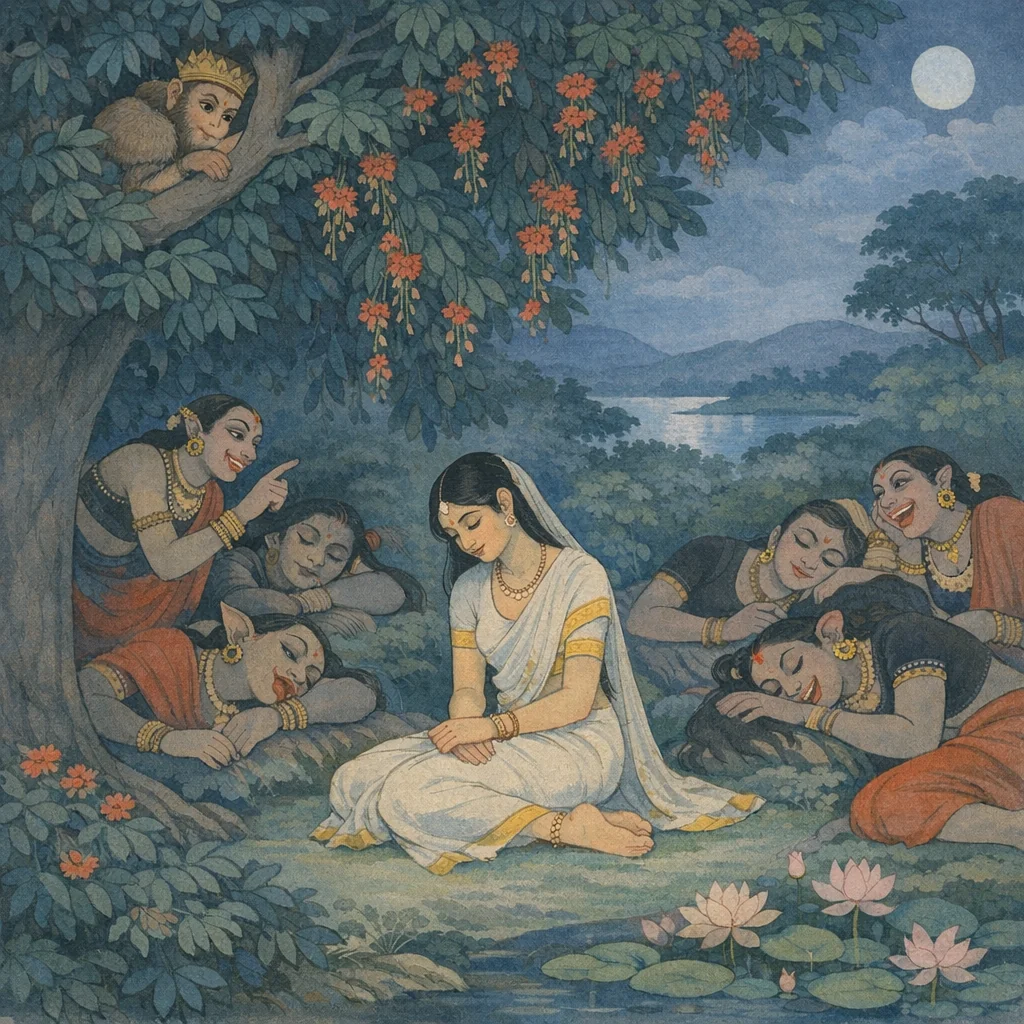
This sarga shows Hanumān inwardly confirming that the woman he sees in the Aśoka-grove is truly Sītā. After admiring her and recalling Rāma’s virtues, grief rises again (5.16.1–2), yet it is restrained by clear strategy: Sītā’s steadiness is sustained by her confidence in the prowess of Rāma and Lakṣmaṇa (5.16.4–5). Hanumān then shapes his lament into an ethical reckoning of Sītā’s worth and of Rāma’s dharmic capacity. He recounts the chain of battles fought “for her sake”—Vālī, Kabandha, Virādha, and the Janasthāna combats against Khara, Triśiras, Dūṣaṇa, and fourteen thousand rākṣasas (5.16.7–10)—and notes outcomes such as Sugrīva’s restored kingship (5.16.11). He frames his ocean-crossing and survey of Laṅkā as service to Sītā’s recovery (5.16.12) and affirms that even a world-upturning war would be justified for her (5.16.13–14). The chapter intensifies Sītā’s identity—Janaka’s daughter, born from the furrow, devoted wife, and Daśaratha’s eldest daughter-in-law (5.16.15–17)—and contrasts her former protection by Rāma-Lakṣmaṇa with her present guarding by rākṣasīs (5.16.18–29). Through layered similes (a lotus frost-blasted, a separated cakravākī, Aśoka blossoms and moonlight that deepen sorrow), captivity is portrayed as psychological and aesthetic inversion, ending with Hanumān concealed and watchful on the Śiṃśupā tree, settled in his conclusion (5.16.32).
Shlokas
Verse 1
प्रशस्य तु प्रशस्तव्यां सीतां तां हरिपुङ्गवः।गुणाभिरामं रामं च पुनश्चिन्तापरोऽभवत्।।5.16.1।।
Having praised Sītā, so worthy of praise, the foremost of the Vānaras again became absorbed in anxious reflection, remembering also Rāma, delightful through his virtues.
Verse 2
स मुहूर्तमिव ध्यात्वा बाष्पपर्याकुलेक्षणः।सीतामाश्रित्य तेजस्वी हनूमान्विललाप ह।।5.16.2।।
Hanumān, radiant, paused as if for a moment in contemplation; his eyes, clouded with tears as he dwelt on Sītā, then broke forth in lamentation.
Verse 3
मान्या गुरुविनीतस्य लक्ष्मणस्य गुरुप्रिया।यदि सीताऽऽपि दुःखार्ता कालो हि दुरतिक्रमः।।5.16.3।।
If even Sītā—honoured by the well-disciplined Lakṣmaṇa and beloved of the elders—is afflicted with such sorrow, then indeed Time is hard to overcome.
Verse 4
रामस्य व्यवसायज्ञा लक्ष्मणस्य च धीमतः।नात्यर्थं क्षुभ्यते देवी गङ्गेव जलदागमे।।5.16.4।।
Knowing Rāma’s resolve and the might of wise Lakṣmaṇa, the queen is not excessively shaken—like the Gaṅgā when rain-clouds arrive.
Verse 5
तुल्यशीलवयोवृत्तां तुल्याभिजनलक्षणाम्।राघवोऽऽर्हति वैदेहीं तं चेयमसितेक्षणा।।5.16.5।।
Rāghava is worthy of Vaidehī—she who matches him in character, age, conduct, lineage, and auspicious marks; and this dark-eyed lady is worthy of him.
Verse 6
तां दृष्ट्वा नवहेमाभां लोककान्तामिव श्रियम्।जगाम मनसा रामं वचनं चेदमब्रवीत्।।5.16.6।।
Seeing her—radiant like newly wrought gold, like Śrī (Lakṣmī) beloved of the whole world—Hanumān turned his mind to Rāma and then spoke these words.
Verse 7
अस्या हेतोर्विशालाक्ष्या हतो वाली महाबलः।रावणप्रतिमो वीर्ये कबन्धश्च निपातितः।।5.16.7।।
For her sake—the large-eyed lady—mighty Vālī was slain, and Kabandha too was brought down, a warrior in valor comparable to Rāvaṇa.
Verse 8
विराधश्च हतः सङ्ख्ये राक्षसो भीमविक्रमः।वने रामेण विक्रम्य महेन्द्रेणेव शम्बरः।।5.16.8।।
And Virādha, the rākṣasa of dreadful prowess, was slain in battle in the forest by Rāma—just as Śambara was overcome by great Indra.
Verse 9
चतुर्दश सहस्राणि रक्षसां भीमकर्मणाम्।निहतानि जनस्थाने शरैरग्निशिखोपमैः।।5.16.9।।
At Janasthāna, fourteen thousand rākṣasas of dreadful deeds were slain by arrows like tongues of fire.
Verse 10
खरश्च निहतसङ्ख्ये त्रिशिराश्च निपातितः।दूषणश्च महातेजा रामेण विदितात्मना।।5.16.10।।
In battle Khara was destroyed, Triśiras was struck down, and the mighty Dūṣaṇa too—by Rāma, self-knowing and steadfast in true discernment.
Verse 11
ऐश्वर्यं वानराणां च दुर्लभं वालिपालितम्।अस्या निमित्ते सुग्रीवः प्राप्तवान् लोकसत्कृतम्।।5.16.11।।
Because of her (Sītā), Sugrīva gained the hard-won sovereignty of the vānaras—once guarded by Vāli—and received honour and recognition in the world.
Verse 12
सागरश्च मया क्रान्तश्श्रीमान्नदनदीपतिः।अस्या हेतोर्विशालाक्ष्याः पुरी चेयमवेक्षिता।।5.16.12।।
For the sake of that large-eyed lady (Sītā), I crossed the ocean—the splendid lord of rivers and streams—and have now surveyed this city as well.
Verse 13
यदि रामः समुद्रान्तां मेदिनीं परिवर्तयेत्।अस्याः कृते जगच्चापि युक्तमित्येव मे मतिः।।5.16.13।।
If Rāma were to overturn the earth bounded by the ocean—or even the whole world—for her sake, I deem it wholly justified.
Verse 14
राज्यं वा त्रिषु लोकेषु सीता वा जनकात्मजा।त्रैलोक्यराज्यं सकलं सीताया नाप्नुयात्कलाम्।।5.16.14।।
Whether it be sovereignty over the three worlds or Sītā, Janaka’s daughter—complete dominion over the three worlds would not equal even a sixteenth part of Sītā’s worth.
Verse 15
इयं सा धर्मशीलस्य मैथिलस्य महात्मनः।सुता जनकराजस्य सीता भर्तृदृढव्रता।।5.16.15।।उत्थिता मेदिनीं भित्त्वा क्षेत्रे हलमुखक्षते।पद्मरेणुनिभैः कीर्णा शुभैः केदारपाम्सुभिः।।5.16.16।।
This is Sītā—the daughter of King Janaka of Mithilā, that great-souled and righteous man—steadfast in her vow of unwavering devotion to her husband.
Verse 16
इयं सा धर्मशीलस्य मैथिलस्य महात्मनः।सुता जनकराजस्य सीता भर्तृदृढव्रता।।5.16.15।।उत्थिता मेदिनीं भित्त्वा क्षेत्रे हलमुखक्षते।पद्मरेणुनिभैः कीर्णा शुभैः केदारपाम्सुभिः।।5.16.16।।
She arose by splitting the earth, in a field scarred by the plough’s edge, strewn with auspicious dust from the paddy-beds, like the pollen-dust of lotuses.
Verse 17
विक्रान्तस्यार्यशीलस्य संयुगेष्न्विवर्तिनः।स्नुषा दशरथस्यैषा ज्येष्ठा राज्ञो यशस्विनी।।5.16.17।।
This renowned lady is the eldest daughter-in-law of King Daśaratha—valiant, noble in conduct, and one who never turned back in battle.
Verse 18
धर्मज्ञस्य कृतज्ञस्य रामस्य विदितात्मनः।इयं सा दयिता भार्या राक्षसीवशमागता।।5.16.18।।
She is the beloved wife of Rāma—knower of dharma, grateful, and self-aware—who has now fallen under the control of the demonesses.
Verse 19
सर्वान् भोगान्परित्यज्य भर्तृस्नेहबलात्कृता।अचिन्तयित्वा दुःखानि प्रविष्टा निर्जनं वनम्।।5.16.19।।संतुष्टा फलमूलेन भर्तृशुश्रूषणे रता।या परां भजते प्रीतिं वनेऽऽपि भवने यथा।।5.16.20।।सेयं कनकवर्णाङ्गी नित्यं सुस्मितभाषिणी।सहते यातनामेतामनर्थानामभागिनी।।5.16.21।।
Moved by the strength of her love for her husband, she renounced every luxury; unmindful of hardships, she entered the lonely forest.
Verse 20
सर्वान् भोगान्परित्यज्य भर्तृस्नेहबलात्कृता।अचिन्तयित्वा दुःखानि प्रविष्टा निर्जनं वनम्।।5.16.19।।संतुष्टा फलमूलेन भर्तृशुश्रूषणे रता।या परां भजते प्रीतिं वनेऽऽपि भवने यथा।।5.16.20।।सेयं कनकवर्णाङ्गी नित्यं सुस्मितभाषिणी।सहते यातनामेतामनर्थानामभागिनी।।5.16.21।।
Content with fruits and roots, devoted to serving her husband, she found supreme joy even in the forest—just as if she were in a palace.
Verse 21
सर्वान् भोगान्परित्यज्य भर्तृस्नेहबलात्कृता।अचिन्तयित्वा दुःखानि प्रविष्टा निर्जनं वनम्।।5.16.19।।संतुष्टा फलमूलेन भर्तृशुश्रूषणे रता।या परां भजते प्रीतिं वनेऽऽपि भवने यथा।।5.16.20।।सेयं कनकवर्णाङ्गी नित्यं सुस्मितभाषिणी।सहते यातनामेतामनर्थानामभागिनी।।5.16.21।।
This very woman—golden-limbed, ever gentle and smiling in speech—who had never before shared in such misfortune, now endures this torment.
Verse 22
इमां तु शीलसम्पन्नां द्रष्टुमर्हति राघवः।रावणेन प्रमथितां प्रपामिव पिपासितः।।5.16.22।।
Rāghava deserves to see this woman of perfect virtue—tormented by Rāvaṇa—just as a thirsty man longs to reach a wellspring.
Verse 23
अस्या नूनं पुनर्लाभाद्राघवः प्रीतिमेष्यति।राजा राज्यपरिभ्रष्टः पुनः प्राप्येव मेदिनीम्।।5.16.23।।
Surely, by finding her again, Rāghava will regain joy—like a king who, having fallen from his kingdom, feels restored upon recovering the land.
Verse 24
कामभोगैः परित्यक्ता हीना बन्धुजनेन च।धारयत्यात्मनो देहं तत्समागमकाङ्क्षिणी।।5.16.24।।
Deprived of pleasures and cut off from her kin, she sustains her very body only by longing for reunion with them.
Verse 25
नैषा पश्यति राक्षस्यो नेमान्पुष्पफलद्रुमान्।एकस्थहृदया नूनं राममेवानुपश्यति।।5.16.25।।
She looks neither at the demonesses nor at these trees laden with flowers and fruit; her heart fixed on one point, she surely beholds only Rāma within her mind.
Verse 26
भर्ता नाम परं नार्या भूषणं भूषणादपि।एषा तु रहिता तेन भूषणार्हा न शोभते।।5.16.26।।
For a married woman, her husband is the highest ornament—greater than ornaments themselves. Separated from him, though she is worthy of adornment, she does not shine with it.
Verse 27
दुष्करं कुरुते रामो हीनो यदनया प्रभुः।धारयत्यात्मनो देहं न दुःखेनावसीदति।।5.16.27।।
Rāma, though a lord, accomplishes something very hard: separated from her, he still sustains his own body and does not sink under sorrow.
Verse 28
इमामसितकेशान्तां शतपत्रनिभेक्षणाम्।सुखार्हां दुःखितां दृष्ट्वा ममापि व्यथितं मनः।।5.16.28।।
Seeing her—dark-haired, lotus-eyed, worthy of happiness—now sunk in sorrow, even my own mind is pained.
Verse 29
क्षतिक्षमा पुष्करसन्निभाक्षी या रक्षिता राघवलक्ष्मणाभ्याम्।सा राक्षसीभिर्विकृतेक्षणाभिः संरक्ष्यते सम्प्रति वृक्षमूले।।5.16.29।।
She—patient as the earth, lotus-eyed—who was protected by Rāghava and Lakṣmaṇa, is now guarded beneath a tree by ogresses with distorted, fearsome eyes.
Verse 30
हिमहतनलिनीव नष्टशोभा व्यसनपरम्परया निपीड्यमाना।सहचररहितेव चक्रवाकी जनकसुता कृपणां दशां प्रपन्ना।।5.16.30।।
Her beauty faded like a lotus struck by frost, crushed by a succession of misfortunes; like a female cakravāka bereft of her mate, Janaka’s daughter has fallen into a pitiable state.
Verse 31
अस्या हि पुष्पावनताग्रशाखाः शोकं दृढं वै जनयन्त्यशोकाः।हिमव्यपायेन च शीतरश्मि रभ्युत्थितो नैकसहस्ररश्मि:।।5.16.31।।
For her, the aśoka trees—whose branch-tips bend beneath the weight of blossoms—bring forth only steadfast sorrow; and when winter has passed, even the cool-rayed moon and the thousand-rayed sun at rising intensify it.
Verse 32
इत्येवमर्थं कपिरन्ववेक्ष्य सीतेयमित्येव निविष्टबुद्धि:।संश्रित्य तस्मिन्निषसाद वृक्षे बली हरीणामृषभस्तरस्वी।।5.16.32।।
Thus, having considered the matter, the monkey became firmly convinced: “This is Sītā.” Taking refuge in that tree, the strong and swift bull among monkeys sat there.
Frequently Asked Questions
The pivotal action is epistemic and ethical: Hanumān must confirm Sītā’s identity without exposing himself or worsening her danger. His lament is not mere emotion; it functions as a disciplined verification and mission-alignment before any contact.
The sarga teaches that compassion and strategy are not opposites: grief can be ordered into truthful assessment, remembrance of dharmic deeds, and renewed resolve. Sītā’s value is framed as ethically incomparable, justifying strenuous action while still requiring restraint and timing.
Key landmarks include the ocean (Sāgara) crossed by Hanumān, Laṅkā as the surveyed objective-space, and the Aśoka-grove setting with the Śiṃśupā tree used for concealment; culturally, Sītā’s ‘furrow-birth’ (from ploughed earth) anchors her identity in agrarian-sacral imagery.
Read Valmiki Ramayana in the Vedapath app
Scan the QR code to open this directly in the app, with audio, word-by-word meanings, and more.