Sarga 43
चैत्यप्रासाद-विध्वंसः (Destruction of the Chaitya Palace and Hanuman’s Proclamation)
सुन्दरकाण्ड
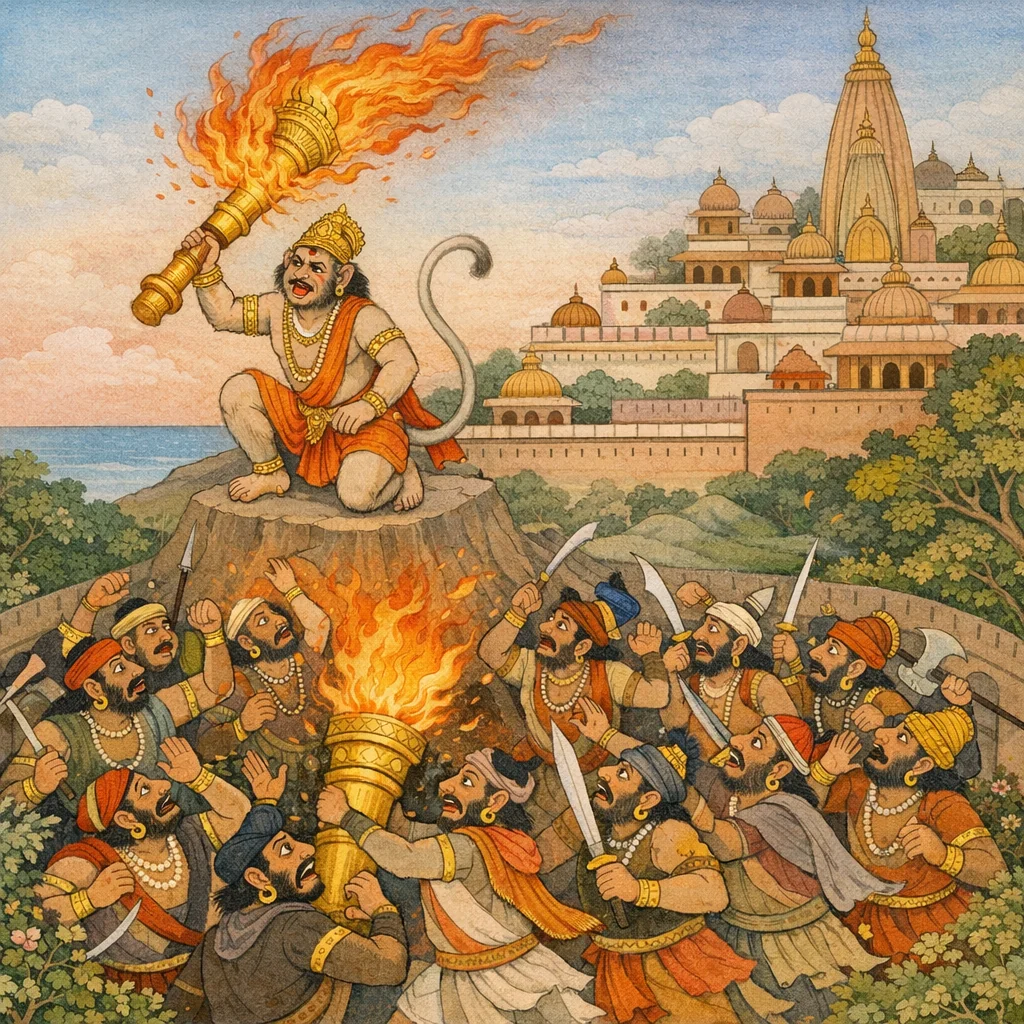
After slaying the kinkaras, Hanuman reflects that the grove has been ruined, yet the Chaitya Palace—like a divine shrine—still stands. To display his might, he climbs its summit, lofty as a peak of Meru, and fills Lanka with thunder by striking his own arms. He then proclaims, in the manner of a victory hymn, the triumph of Rama, Lakshmana, and Sugriva, and declares his identity: Rama’s servant and the destroyer of the enemy host. He magnifies his prowess, saying even a thousand Ravanas would not suffice to oppose him, and that with rocks and trees he can strike down foes by the thousands. Hearing his roar, a hundred Chaitya guards rush in with spears, swords, and axes and surround him. Enraged, Hanuman assumes a fearsome form, tears out a gold-adorned pillar, whirls it until fire is kindled, burns the palace, and slays hundreds of rakshasas. Poised in the sky, he again announces that Sugriva’s vanaras are countless, endowed with varied measures of strength (such as the might of ten elephants), and warns that through enmity with the lord of the Ikshvaku line, Lanka and Ravana will be left without refuge.
Shlokas
Verse 1
ततस्स किङ्करान्हत्वा हनुमान्ध्यानमास्थितः।वनं भग्नं मया चैत्यप्रासादो न विनाशितः।।।।तस्मात्प्रासादमप्येवं भीमं विध्वंसयाम्यहं।इति सञ्चिन्त्य मनसा हनुमान्दर्शयन्बलम्।।।।चैत्यप्रासादमाप्लुत्य मेरुशृङ्गमिवोन्नतम्।आरुरोह कपिश्रेष्ठो हनुमान्मारुतात्मजः।।।।
After slaying the kiṅkaras, Hanumān paused to reflect: “I have shattered the grove, yet I have not destroyed the temple-like palace. Therefore I shall demolish even this fearsome building.” Thus resolving to display his power, Hanumān leapt onto the lofty caitya-palace, towering like the peak of Mount Meru, and the best of monkeys, son of the Wind, climbed up.
Verse 2
ततस्स किङ्करान्हत्वा हनुमान्ध्यानमास्थितः।वनं भग्नं मया चैत्यप्रासादो न विनाशितः।।5.43.1।।तस्मात्प्रासादमप्येवं भीमं विध्वंसयाम्यहं।इति सञ्चिन्त्य मनसा हनुमान्दर्शयन्बलम्।।5.43.2।।चैत्यप्रासादमाप्लुत्य मेरुशृङ्गमिवोन्नतम्।आरुरोह कपिश्रेष्ठो हनुमान्मारुतात्मजः।।5.43.3।।
Therefore, I shall demolish this formidable palace as well. Thinking thus in his mind, Hanumān—intent on displaying his strength—prepared to destroy it.
Verse 3
ततस्स किङ्करान्हत्वा हनुमान्ध्यानमास्थितः।वनं भग्नं मया चैत्यप्रासादो न विनाशितः।।5.43.1।।तस्मात्प्रासादमप्येवं भीमं विध्वंसयाम्यहं।इति सञ्चिन्त्य मनसा हनुमान्दर्शयन्बलम्।।5.43.2।।चैत्यप्रासादमाप्लुत्य मेरुशृङ्गमिवोन्नतम्।आरुरोह कपिश्रेष्ठो हनुमान्मारुतात्मजः।।5.43.3।।
Leaping onto the lofty caitya-like palace—towering like the peak of Mount Meru—Hanumān, the best of monkeys and son of the Wind, climbed up upon it.
Verse 4
आरुह्य गिरिसङ्काशं प्रासादं हरियूथपः।बभौ स सुमहातेजाः प्रतिसूर्य इवोदितः।।।।
Having climbed the palace that resembled a mountain, the leader of the monkey-host shone with immense brilliance—like a second sun risen in the sky.
Verse 5
संप्रधृष्य च दुर्धर्षं चैत्यप्रासादमुत्तमम्।हनुमान्प्रज्वलन्लक्ष्म्या पारियात्रोपमोऽभवत्।।।।
After overpowering and wrecking that excellent, hard-to-assail shrine-palace, Hanumān blazed with splendor, appearing like the Pariyātra mountain.
Verse 6
स भूत्वा सुमहाकायः प्रभावान्मारुतात्मजः।धृष्टमास्फोटयामास लङ्कां शब्देन पूरयन्।।।।
Then the son of the Wind, swelling into a vast form through his might, boldly slapped and flexed his arms, filling Laṅkā with the thunder of that sound.
Verse 7
तस्यास्फोटितशब्देन महता श्रोत्रघातिना।पेतुर्विहङ्गमास्तत्र चैत्यपालाश्च मोहिताः।।।।
By that great, ear-smiting crack of his arm-slapping, birds there dropped down, and even the shrine-guards were stunned into confusion.
Verse 8
अस्त्रविज्जयतां रामो लक्ष्मणश्च महाबलः।राजा जयति सुग्रीवो राघवेणाभिपालितः।।।।
Victory to Rāma, knower and master of sacred weapons; victory to mighty Lakṣmaṇa; and victory to King Sugrīva, protected and guided by Rāghava (Rāma).
Verse 9
दासोऽहं कोसलेन्द्रस्य रामस्याक्लिष्टकर्मणः।हनुमान्शत्रुसैन्यानां निहन्ता मारुतात्मजः।।।।
I am a servant of Rāma, lord of Kosala, whose deeds are unwearied. I am Hanumān, son of the Wind, the slayer of hostile armies.
Verse 10
न रावणसहस्रं मे युद्धे प्रतिबलं भवेत्।शिलाभिस्तु प्रहरतः पादपैश्च सहस्रशः।।।।
Not even a thousand Rāvaṇas would match my might in battle when I begin striking, hurling rocks and trees in countless ways.
Verse 11
अर्दयित्वा पुरीं लङ्कामभिवाद्य च मैथिलीम्।समृद्धार्थो गमिष्यामि मिषतां सर्वरक्षसाम्।।।।
After crushing the city of Laṅkā and paying obeisance to Maithilī (Sītā), I shall depart with my purpose fulfilled, while all the rākṣasas can only look on.
Verse 12
एवमुक्त्वा विमानस्थश्चैत्यस्थान्हरियूथपः।ननाद भीमनिर्ह्रादो रक्षसां जनयन्भयम्।।।।
Thus having spoken, the leader of the monkey-host, standing upon the palace-vimāna by the caitya, let forth a dreadful roar, casting fear into the hearts of the rākṣasas.
Verse 13
तेन शब्देन महता चैत्यपालाश्शतं ययुः।गृहीत्वा विविधानस्त्रान्प्रासान्खङ्गान्परश्वथान्।।।।विसृजन्तो महाकाया मारुतिं पर्यवारयन्।
Stirred by that mighty sound, a hundred guards of the caitya rushed forth. Seizing diverse weapons—spears, swords, and axes—those huge-bodied warriors hurled them and surrounded Māruti (Hanumān).
Verse 14
ते गदाभिर्विचित्राभिः परिघैः काञ्चनाङ्गदैः।आजघ्नुर्वानरश्रेष्ठं बाणैश्चादित्यसन्निभैः।।।।
They struck the foremost of monkeys with wondrous maces, with heavy bars adorned with golden fittings, and with arrows blazing like the sun.
Verse 15
आवर्त इव गङ्गायास्तोयस्य विपुलो महान्।परिक्षिप्य हरिश्रेष्ठं स बभौ रक्षसां गणः।।।।
Having encircled the best of the monkeys, that host of rākṣasas appeared like a vast, mighty whirlpool in the waters of the Gaṅgā.
Verse 16
ततो वातात्मजः क्रुद्धो भीम रूपं समास्थितः।।।।प्रासादस्य महन्तस्य स्तम्बं हेमपरिष्कृतम्।उत्पाटयित्वा वेगेन हनुमान्पवनात्मजः।।।।ततस्तं भ्रामयामास शतधारं महाबलः।
Then the Wind’s son, enraged, assumed a terrifying form. Hanumān, the son of Pavana, swiftly tore from the great palace a pillar embellished with gold; and in his mighty strength he began to whirl that many-edged pillar about as a weapon.
Verse 17
ततो वातात्मजः क्रुद्धो भीम रूपं समास्थितः।।5.43.16।।प्रासादस्य महन्तस्य स्तम्बं हेमपरिष्कृतम्।उत्पाटयित्वा वेगेन हनुमान्पवनात्मजः।।5.43.17।।ततस्तं भ्रामयामास शतधारं महाबलः।
Then fire sprang up there, and the palace too began to burn. Seeing the palace aflame, the leader of the monkey-host slew a hundred rākṣasas—like Indra striking down asuras with his thunderbolt. Then, poised in the sky, the illustrious Hanumān spoke these words.
Verse 18
तत्र चाग्निस्समभवत्प्रासादश्चाप्यदह्यत।।।।दह्यमानं ततो दृष्ट्वा प्रासादं हरियूथपः।स राक्षसशतं हत्त्वा वज्रेणेन्द्र इवासुरान्।।।।अन्तरिक्षे स्थितश्श्तीमानिदं वचनमब्रवीत्।
Then fire sprang up there, and the palace too began to burn. Seeing the palace aflame, the leader of the monkey-host slew a hundred rākṣasas—like Indra striking down asuras with his thunderbolt. Then, poised in the sky, the illustrious Hanumān spoke these words.
Verse 19
तत्र चाग्निस्समभवत्प्रासादश्चाप्यदह्यत।।5.43.18।।दह्यमानं ततो दृष्ट्वा प्रासादं हरियूथपः।स राक्षसशतं हत्त्वा वज्रेणेन्द्र इवासुरान्।।5.43.19।।अन्तरिक्षे स्थितश्श्तीमानिदं वचनमब्रवीत्।
Then, seeing the palace ablaze, the leader of the monkey-host slew a hundred rākṣasas—just as Indra strikes down asuras with his thunderbolt. Standing in the air, the illustrious one spoke these words.
Verse 20
मादृशानां सहस्राणि विसृष्टानि महात्मनाम्।।।।बलिनां वानरेन्द्राणां सुग्रीववशवर्तिनाम्।अटन्ति वसुधां कृत्स्नां वयमन्ये च वानराः।।।।
Thousands of great-souled warriors like me have been dispatched.
Verse 21
मादृशानां सहस्राणि विसृष्टानि महात्मनाम्।।5.43.20।।बलिनां वानरेन्द्राणां सुग्रीववशवर्तिनाम्।अटन्ति वसुधां कृत्स्नां वयमन्ये च वानराः।।5.43.21।।
We—and other monkeys—wander over the entire earth: mighty leaders among vānaras, acting under Sugrīva’s command.
Verse 22
दशनागबलाः केचित्केचिद्दशगुणोत्तराः।केचिन्नागसहस्रस्य बभूवुस्तुल्यविक्रमाः।।।।
Some among them have the strength of ten elephants; some are ten times stronger; and some possess valor equal to that of a thousand elephants.
Verse 23
सन्ति चौघबलाः केचित्केचिद्वायुबलोपमाः।अप्रमेयबलाश्चान्ये तत्रासन्हरियूथपाः।।।।
Some have the force of a flood; some are comparable to the power of the wind; and others—monkey-leaders there—possess immeasurable strength.
Verse 24
ईदृग्विधैस्तु हरिभिर्वृतो दन्तनखायुधैः।शतैश्शतसहस्रैश्च कोटीभिरयुतैरपि।।।।आगमिष्यति सुग्रीवः सर्वेषां वो निषूदनः।
Surrounded by such monkeys—who fight with teeth and nails as their weapons—in hundreds, in hundreds of thousands, in crores, and even in tens of thousands, Sugrīva will come: the destroyer of you all.
Verse 25
नेयमस्ति पुरी लङ्का न यूयं न च रावणः।।।यस्मादिक्ष्वाकुनाथेन बद्धं वैरं महात्मना।
Neither will this city of Laṅkā remain, nor will you, nor even Rāvaṇa—since a great-souled lord of the Ikṣvāku line has bound this enmity in a righteous cause.
Frequently Asked Questions
Hanuman chooses escalated, targeted destruction: after ruining the garden he deliberately turns to the Chaitya-like palace to demonstrate strength, while keeping the act framed as war against hostile rākṣasa forces rather than indiscriminate violence.
Power is ethically meaningful when subordinated to rightful purpose: Hanuman’s self-identification as Rama’s servant and his victory proclamations show that might (bala) is legitimized by allegiance to dharma, not by personal conquest.
The Chaitya-prāsāda/Vimāna of Lanka is foregrounded as a cultural-symbolic monument; comparisons to Mount Meru and the Ganga’s whirlpool supply a cosmographic and poetic map that situates Lanka within classical Sanskrit imaginative geography.