Sarga 56
षट्पञ्चाशः सर्गः — वैदेही-आश्वासनम् तथा अरिष्टारोहणम् (Consoling Sita and Ascending Mount Arishta)
सुन्दरकाण्ड
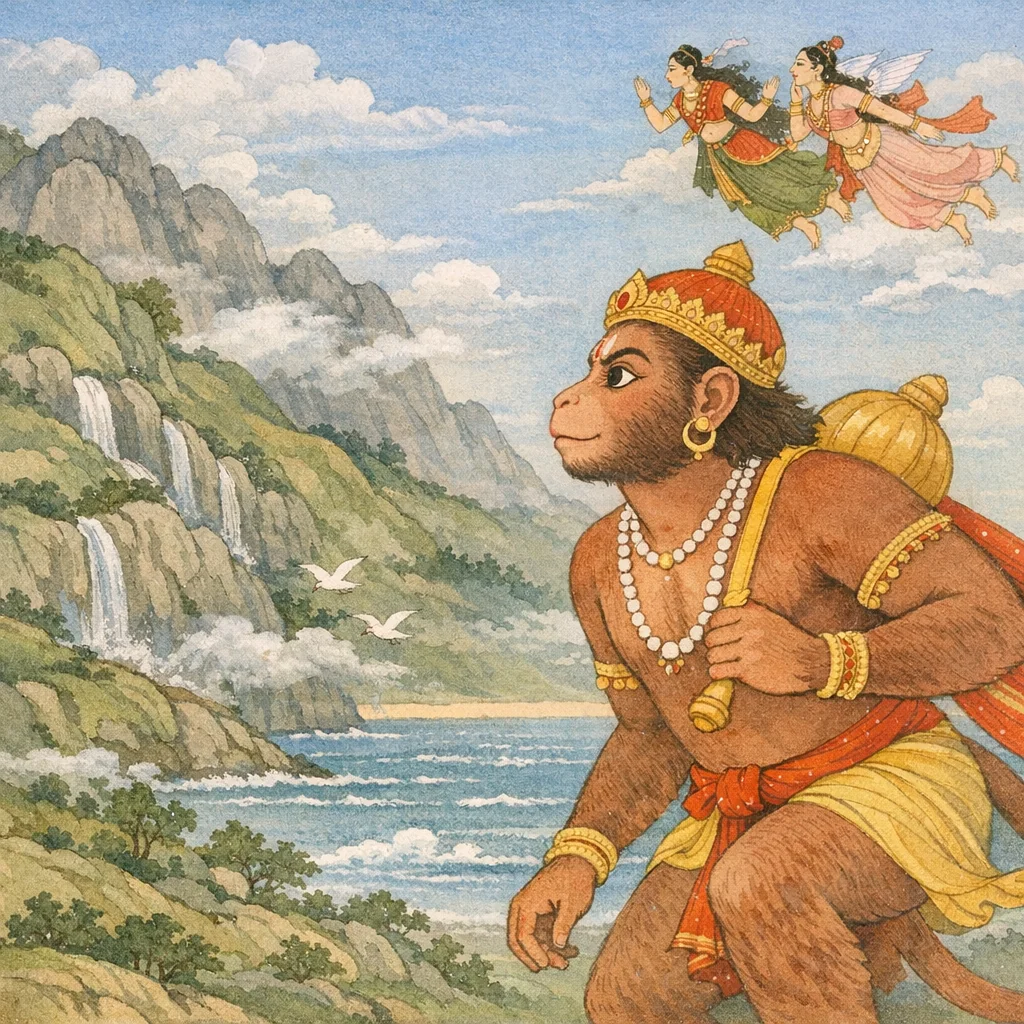
This sarga concludes Hanumān’s audience with Sītā and turns toward his return-leap. Hanumān offers reverent salutation at the śiṃśupā tree and explicitly bears witness that Vaidehī is uninjured, establishing the envoy’s first duty: truthful testimony and respectful address. Sītā, speaking with bhartṛ-sneha (spousal fidelity), affirms Hanumān’s competence and sets forth a strategic ethic: Rāma’s rescue should display his battle-worthy valor—Laṅkā must be overwhelmed by arrows, and she restored in a manner befitting his stature. Hanumān replies with reasoned reassurance that Rāma will soon arrive with elite vānaras and bears to remove her sorrow, and then he formally takes leave. The scene shifts to Mount Ariṣṭa in an extended poetic description that personifies the mountain—cloud-wrapped, mineral-eyed, with Veda-reciting waters and reverberant falls. Hanumān ascends, enlarges his body, and prepares to cross the lavaṇārṇava; his weight crushes rocks, shakes trees, terrifies lions, dislodges vidyādharīs, and drives supernatural beings skyward, as though the mountain sinks and levels beneath his force. The sarga culminates with Hanumān’s effortless leap into the sky to traverse the wave-lashed ocean toward the northern shore and reunion with Rāma.
Shlokas
Verse 1
ततस्तु शिंशुपामूले जानकीं पर्युपस्थिताम्।अभिवाद्याब्रवीद्दिष्ट्या पश्यामि त्वामिहाक्षताम्।।।।
Then Hanumān approached Jānakī, who stood at the foot of the śiṁśupā tree; bowing in reverence, he said: “By good fortune, I see you here unharmed.”
Verse 2
ततस्तं प्रस्थितं सीता वीक्षमाणा पुनः पुनः।भर्तृस्नेहान्वितं वाक्यं हनुमन्तमभाषत।।।।
Then Sītā, gazing again and again at Hanumān as he stood ready to depart, spoke to him words filled with steadfast love for her husband.
Verse 3
काममस्य त्वमेवैकः कार्यस्य परिसाधने।पर्याप्तः परवीरघ्न यशस्यस्ते बलोदयः।।।।
Indeed, O slayer of enemy heroes, you alone are sufficient to accomplish this task; your successful exertion will bring you glory and a fresh rise of strength.
Verse 4
शरैस्तु सङ्कुलां कृत्वा लङ्कां परबलार्दनः।मां नयेद्यदि काकुत्स्थस्तत्तस्य सदृशं भवेत्।।।।
“If Kakutstha Rāma—the destroyer of hostile forces—were to come to Laṅkā, fill it with his arrows, and take me back, that deed would be truly worthy of him.”
Verse 5
तद्यथा तस्य विक्रान्तमनुरूपं महात्मनः।भवत्याहवशूरस्य तथा त्वमुपपादय।।।।
“Therefore, act so that the mighty one’s heroic advance—of that great-souled, battle-valiant Rāma—may unfold in a way truly suited to his stature.”
Verse 6
तदर्थोपहितं वाक्यं प्रश्रितं हेतुसंहितम्।निशम्य हनुमांस्तस्या वाक्यमुत्तरमब्रवीत्।।।।
Having heard her words—purposeful, courteous, and supported by sound reasoning—Hanumān then spoke his reply to her.
Verse 7
क्षिप्रमेष्यति काकुत्स्थः हर्यृक्षप्रवरैर्वृतः।यस्ते युधि विजित्यारीन् शोकं व्यपनयिष्यति।।।।
Kakutstha Rāma will come very soon, surrounded by the foremost among the monkeys and bears; and, having conquered your enemies in battle, he will remove your grief.
Verse 8
एवमाश्वास्य वैदेहीं हनुमान् मारुतात्मजः।गमनाय मतिं कृत्वा वैदेहीमभ्यवादयत्।।।।
Thus, having consoled Vaidehī, Hanumān—the son of the Wind-god—resolved to depart and respectfully saluted her.
Verse 9
ततस्स कपिशार्दूलः स्वामिसन्दर्शनोत्सुकः।आरुरोह गिरिश्रेष्ठमरिष्टमरिमर्दनः।।।।
Then Hanumān—crusher of foes, a tiger among the Vānara host—eager to behold his lord again, climbed the excellent mountain Ariṣṭa.
Verse 10
तुङ्गपद्मकजुष्टाभिर्नीलाभिर्वनराजिभिः।सोत्तरीयमिवाम्भोदैः शृंगान्तरविलम्बिभिः।।।।
With dark bands of forest filled with tall padmaka trees, and rain-clouds hanging between its peaks, Mount Ariṣṭa appeared as though draped in an upper garment.
Verse 11
बोध्यमानमिव प्रीत्या दिवाकरकरैश्शुभैः।उन्मिषन्तमिवोद्धूतैर्लोचनैरिव धातुभिः।।।।
As though affectionately awakened by the auspicious rays of the sun, the mountain seemed to open its eyes—like minerals revealed as ‘eyes’ when dust is blown away.
Verse 12
तोयौघननिस्स्वनैर्मन्द्रैः प्राधीतमिव पर्वतम्।प्रगीतमिव विस्पष्टैर्नानाप्रस्रवणस्वनैः।।।।
With the deep, booming roar of rushing waters, the mountain seemed to be loudly reciting sacred chants; and with the clear, varied music of many waterfalls, it seemed to be singing.
Verse 13
देवदारुभिरत्युच्चैरूर्ध्वबाहुमिव स्थितम्।प्रपातजलनिर्घोषैः प्राक्रुष्टमिव सर्वतः।।।।
With its very tall deodāra trees, the mountain looked as if it stood with arms raised aloft; and with the thunder of falling waters, it seemed to cry out from every side.
Verse 14
वेपमानमिव श्यामैः कम्पमानैश्शरद्वनैः।वेणुभिर्मारुतोद्धूतैः कूजन्तमिव कीचकैः।।।।
With dark, quivering autumn clouds, the mountain seemed to tremble; and with bamboos shaken by the wind—like chirping kīcaka reeds—it seemed to warble with living sound.
Verse 15
निश्श्वसन्तमिवामर्षाद्घोरैराशीविषोत्तमैः।नीहारकृतगम्भीरैर्ध्यायन्तमिव गह्वरैः।।।।
With dreadful, eminent venomous serpents, it seemed to hiss in anger; and with deep caves made solemn by mist, it seemed to meditate in inward stillness.
Verse 16
मेघपादनिभैः पादैः प्रक्रान्तमिव सर्वतः।जृंम्भमाणमिवाऽकाशे शिखरैरभ्रमालिभिः।।।।
With foothills like the feet of clouds, it seemed to stride on every side; and with peaks wreathed in garlands of cloud, it seemed to yawn up into the sky.
Verse 17
कूटैश्च बहुधा कीर्णैश्शोभितं बहुकन्दरैः।सालतालाश्वकर्णैश्च वंशैश्च बहुभिर्वृतम्।।।।
Adorned with many caves and strewn with numerous peaks, it looked splendid; and it was covered with many sāla trees, palms, aśvakarṇas, and bamboos.
Verse 18
लतावितानैर्विततैः पुष्पवद्भिरलङ्कृतम्।नानामृगगणाकीर्णं धातुनिष्यन्दभूषितम्।।।।
It was adorned with spreading canopies of creepers laden with flowers, crowded with many herds of animals, and beautified by streams of colorful mineral ooze flowing down its sides.
Verse 19
बहुप्रस्रवणोपेतं शिलासञ्चयसङ्कटम्।महर्षियक्षगन्धर्वकिन्नरोरगसेवितम्।।।।
It was filled with many waterfalls, made rugged by heaps of rocks, and frequented by great sages, yakṣas, gandharvas, kinnaras, and serpentine beings.
Verse 20
लतापादपसङ्घातं सिंहाध्युषितकन्दरम्।व्याघ्रसङ्घसमाकीर्णं स्वादुमूलफलद्रुमम्।।।।
It was dense with clusters of creepers and trees; its caves were inhabited by lions; it was thronged with bands of tigers; and it abounded in trees bearing sweet roots and fruits.
Verse 21
तमारुरोह हनुमान् पर्वतं पवनात्मजः।रामदर्शनशीघ्रेण प्रहर्षेणाभिचोदितः।।।।
Urged on by joy and by his eagerness to behold Rāma again soon, Hanumān—the son of the Wind—climbed up that mountain.
Verse 22
तेन पादतलाक्रान्ता रम्येषु गिरिसानुषु।सघोषास्समशीर्यन्त शिलाश्चूर्णीकृतास्ततः।।।।
Crushed beneath his soles on the lovely mountain slopes, the rocks shattered with a loud crash and tumbled down, ground into dust.
Verse 23
स तमारुह्य शैलेन्द्रं व्यवर्धत महाकपिः।दक्षिणादुत्तरं पारं प्रार्थयन् लवणाम्भसः।।।।
Having climbed the mountain-king, that great ape expanded his body, longing to reach the northern shore of the salt ocean from the southern side.
Verse 24
अधिरुह्य ततो वीरः पर्वतं पवनात्मजः।ददर्श सागरं भीमं मीनोरगनिषेवितम्।।।।
Then the heroic son of the Wind, having climbed the mountain, beheld the dreadful ocean, frequented by fish and serpents.
Verse 25
स मारुत इवाऽकाशं मारुतस्यात्मसम्भवः।प्रपेदे हरिशार्दूलो दक्षिणादुत्तरां दिशम्।।।।
Born of the Wind, that tiger among monkeys sprang into the sky like the wind itself, moving from the southern direction toward the north.
Verse 26
स तदा पीडितस्तेन कपिना पर्वतोत्तमः।ररास सह तैर्भूतैः प्रविशन्वसुधातलम्।।।।कम्पमानैश्च शिखरैः पतद्भिरपि च द्रुमैः।
Pressed down then by that ape, the mighty mountain groaned as it sank into the earth along with its creatures—its peaks trembling and its trees falling.
Verse 27
तस्योरुवेगोन्मथिताः पादपाः पुष्पशालिनः।।।।निपेतुर्भूतले रुग्णाश्शक्रायुधहता इव।
Shaken by the violent surge of his thighs, blossom-laden trees fell to the ground, like sick men struck down by Indra’s weapon.
Verse 28
कन्दरान्तरसंस्थानां पीडितानां महौजसाम्।।।।सिंहानां निनदो भीमो नभो भिन्दन् स शुश्रुवे।
A terrifying roar of powerful lions dwelling within mountain caves was heard—so fierce it seemed to split the sky—as they were crushed in the upheaval.
Verse 29
त्रस्तव्यावृत्तवसना व्याकुलीकृतभूषणाः।।।।विद्याधर्यः समुत्पेतुस्सहसा धरणीधरात्।
Frightened, their garments displaced and their ornaments thrown into disarray, the Vidyādharī maidens suddenly rose and flew up from the mountain.
Verse 30
अतिप्रमाणा बलिनो दीप्तजिह्वा महाविषाः।।।।निपीडितशिरोग्रीवा व्यचेष्टन्त महाहयः।
Great, powerful serpents—glowing-tongued and highly venomous—thrashed about, their heads and necks pressed down by Hanumān’s crushing force.
Verse 31
किन्नरोरगन्धर्वयक्षविद्याधरास्तदा।।।।पीडितं तं नगवरं त्यक्त्वा गगनमास्थिता:।
Then the Kinnaras, Nāgas (uragas), Gandharvas, Yakṣas, and Vidyādharas—abandoning that tormented best of mountains—took to the sky.
Verse 32
स च भूमिधरः श्रीमान्बलिना तेन पीडितः।।।।सवृक्षशिखरोदग्रः प्रविवेश रसातलम्।
Crushed by that mighty one, the splendid mountain—its trees and lofty peaks still upon it—sank down into Rasātala, the netherworld.
Verse 33
दशयोजनविस्तारस्त्रिंशद्योजनमुच्छ्रितः।।।।धरण्यां समतां यातः स बभूव धराधरः।
That mountain—ten yojanas in breadth and thirty yojanas in height—was brought down to level ground, made even with the earth.
Verse 34
स लिलङ्घयिषुर्भीमं सलीलं लवणार्णवम्।।।।कल्लोलास्फालवेलान्तमुत्पपात नभो हरिः।
Wishing to cross the dreadful salt ocean, whose mighty waves crashed upon the shore, Hanumān—the Vānara hero—leapt into the sky with effortless ease.
Frequently Asked Questions
Sītā’s counsel creates a dharma-guided constraint on strategy: the rescue must be achieved in a way worthy of Rāma’s royal and martial stature—decisive yet principled—so that victory is not merely successful but morally and reputationally consonant with maryādā.
Right action includes right manner: Hanumān models disciplined service (salutation, truthful report, and reassurance), while Sītā articulates that ends and means must align—heroic capacity should express itself through ethically ordered kingship, not impulsive force.
The śiṃśupā tree as the intimate locus of Sītā’s captivity and testimony; Mount Ariṣṭa as a vividly personified launch-point for the return mission; and the lavaṇārṇava (salt ocean) as the liminal boundary Hanumān must cross to reunite intelligence with command.