Sarga 33
हनूमत्सीतासंवादः (Hanumān–Sītā Dialogue and Identity Verification)
सुन्दरकाण्ड
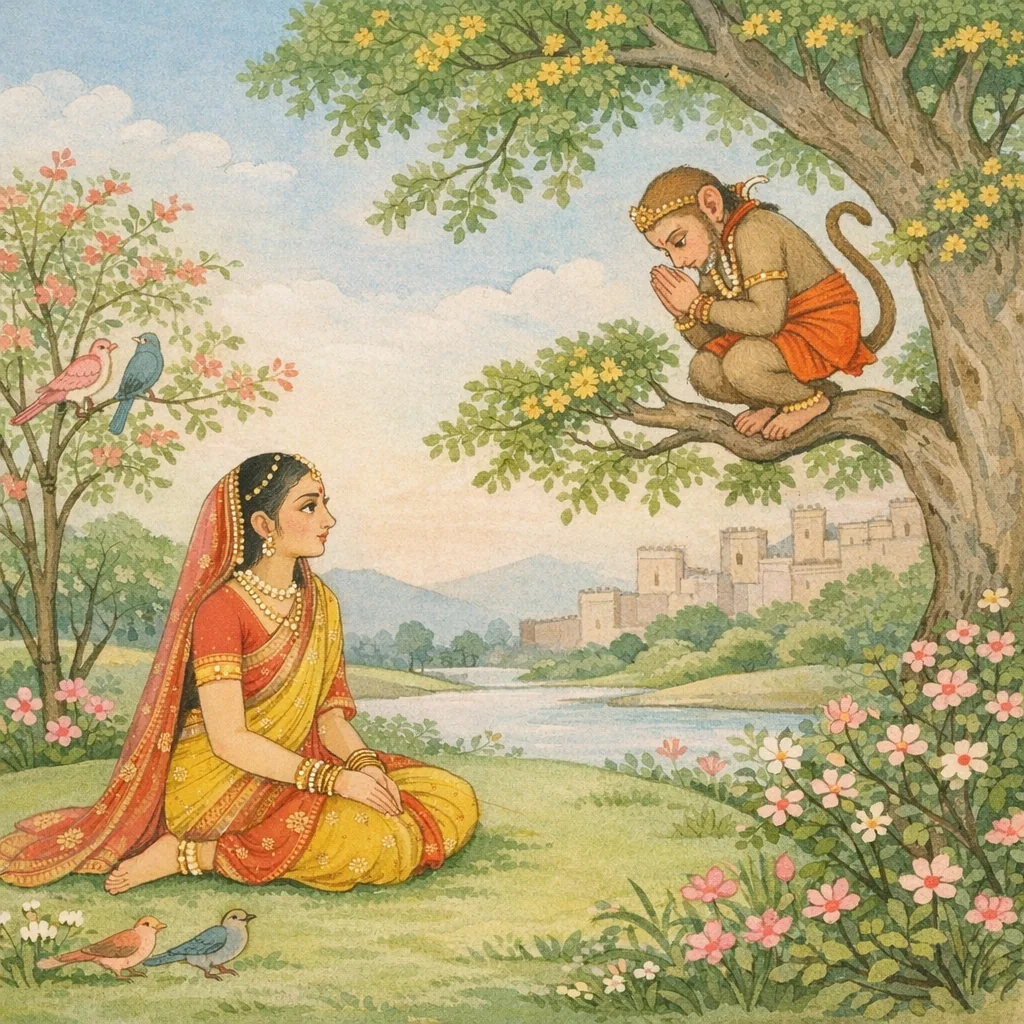
In Sarga 33, set in the Aśoka-vāṭikā, a careful sequence of approach and verification unfolds. Hanumān descends from the tree in a vinīta (sober, non-threatening) guise, offers pranipāta with folded palms placed upon his head, and addresses Sītā in madhura vāṇī, showing reverence and pure intent. He first reasons from observation: her tears, heavy sighs, and touching the earth indicate human embodiment rather than divinity, while her signs and qualities suggest royal lineage. He then proposes a direct test: if she is truly Sītā abducted by Rāvaṇa from Janasthāna, she should say so plainly. Heartened by the praise of Rāma, Sītā replies with genealogical and biographical identifiers—her connection to Daśaratha, her birth as Janaka’s daughter, her marriage to Rāma, the years of shared prosperity, and the coronation preparations disrupted by Kaikeyī’s demand. She recounts Rāma’s truth-centered conduct, his renunciation of royal garments, her own choice to follow him, Lakṣmaṇa’s readiness, their entry into the forest, and finally her abduction by Rāvaṇa with a two-month deadline. Thus the chapter turns suspicion into authenticated recognition through narrative detail and dharmic self-presentation.
Shlokas
Verse 1
सोऽवतीर्य द्रुमात्तस्माद्विद्रुमप्रतिमाननः।विनीतवेषः कृपणः प्रणिपत्योपसृत्य च।।।।तामब्रवीन्महातेजा हनूमान्मारुतात्मजः।शिरस्यञ्जलिमाधाय सीतां मधुरया गिरा।।।।
Descending from that tree, Hanumān—his face radiant like coral—came forward in a humble guise. With a piteous yet respectful bearing, he bowed low and drew near; the mighty, wind-born hero, placing his folded hands upon his head, addressed Sītā in gentle words.
Verse 2
सोऽवतीर्य द्रुमात्तस्माद्विद्रुमप्रतिमाननः।विनीतवेषः कृपणः प्रणिपत्योपसृत्य च।।5.33.1।।तामब्रवीन्महातेजा हनूमान्मारुतात्मजः।शिरस्यञ्जलिमाधाय सीतां मधुरया गिरा।।5.33.2।।
Descending from that tree, Hanumān—whose face shone like coral—took on a humble guise and a pleading demeanor; he bowed and approached her. Then the radiant son of the Wind addressed Sītā with sweet words, placing his folded palms upon his head in reverence.
Verse 3
का नु पद्मपलाशाक्षि क्लिष्टकौशेयवासिनि।द्रुमस्य शाखामालम्ब्य तिष्ठसि त्वमनिन्दिते।।।।
Who are you, O blameless one—lotus-petaled-eyed, clad in crumpled silk—standing here while holding to a tree-branch?
Verse 4
किमर्थम् तव नेत्राभ्यां वारि स्रवति शोकजम्।पुण्डरीकपलाशाभ्यां विप्रकीर्णमिवोदकम्।।।।
For what reason do grief-born tears flow from your eyes, like water scattered and trickling from the petals of a white lotus?
Verse 5
सुराणामसुराणां वा नागगन्धर्वरक्षसाम्।यक्षाणां किन्नराणां वा का त्वं भवसि शोभने।।।।
O radiant lady, who are you—of the gods or the asuras, of the nāgas, gandharvas, or rākṣasas, or of the yakṣas or kinnaras?
Verse 6
का त्वं भवसि रुद्राणां मरुतां वा वरानने।वसूनां हि वरारोहे देवता प्रतिभासि मे।।।।
O lovely-faced one, who are you—of the Rudras, the Maruts, or the Vasus? O fair-limbed lady, you appear to me like a goddess.
Verse 7
कि नु चन्द्रमसा हीना पतिता विबुधालयात्।रोहिणी ज्योतिषां श्रेष्ठा श्रेष्ठसर्वगुणान्विता।।।।
Could you be Rohiṇī—best among the luminaries, endowed with the finest virtues—fallen from the gods’ abode, separated from the Moon?
Verse 8
का त्वं भवसि कल्याणि त्वमनिन्दितलोचने।कोपाद्वा यदि वा मोहाद्भर्तारमसितेक्षणे।।।।वसिष्ठं कोपयित्वा त्वं नासि कल्याण्यरुन्धती।
O auspicious one, O blameless-eyed lady—who are you? O dark-eyed one, did you, out of anger or delusion, offend your husband? O blessed lady, are you not Arundhatī, displaced for angering Vasiṣṭha?
Verse 9
को नु पुत्रः पिता भ्राता भर्ता वा ते सुमध्यमे।।।।अस्माल्लोकादमुं लोकं गतं त्वमनुशोचसि।
O slender-waisted lady—who is it you mourn: a son, a father, a brother, or a husband—who has gone from this world to the next?
Verse 10
रोदनादतिनिश्श्वासाद्भूमिसंस्पर्शनादपि।।।।न त्वां देवीमहं मन्ये राज्ञ स्सर्वज्ञावधारणात्।
From your weeping, your heavy sighs, and even your touching the ground—and from the clear signs of royal bearing—I do not take you to be a goddess.
Verse 11
व्यञ्जनानि च ते यानि लक्षणानि च लक्षये।।।।महिषी भूमिपालस्य राजकन्या च मे मता।
From the signs and distinguishing marks I observe in you, I conclude that you are either a king’s chief queen or a princess.
Verse 12
रावणेन जनस्थानाद्बलादपदहृता यदि।।।।सीता त्वमसि भद्रं ते तन्ममाचक्ष्व पृच्छतः।
If you are Sita, carried off by Ravana from Janasthana by force, then—may good be yours—tell me so, as I ask you.
Verse 13
यथा हि तव वै दैन्यं रूपं चाप्यतिमानुषम्।।।।तपसा चान्वितो वेषस्त्वं राममहिषी ध्रुवम्।
For your wretched plight, your beauty that seems beyond the merely human, and your attire marked by austerity—these make it certain to me that you are Rama’s queen.
Verse 14
सा तस्य वचनं श्रुत्वा रामकीर्तनहर्षिता।।।।उवाच वाक्यं वैदेही हनुमन्तं द्रुमाश्रितम्।
Hearing his words and rejoicing at the mention and praise of Rama, Vaidehi spoke to Hanuman, who was stationed by the tree.
Verse 15
पृथिव्यां राजसिंहानां मुख्यस्य विदितात्मनः।।।।स्नुषा दशरथस्याहं शत्रुसैन्यप्रतापिनः।
I am the daughter-in-law of Dasharatha—foremost among the lion-like kings of the earth, a knower of the self, and a subduer of enemy armies.
Verse 16
दुहिता जनकस्याहं वैदेहस्य महात्मनः।।।।सीतेति नाम नाम्नाऽहं भार्या रामस्य धीमतः।
I am the daughter of Janaka, the great-souled king of Videha. My name is Sītā, and I am the wife of the wise Rāma.
Verse 17
समा द्वादश तत्राहं राघवस्य निवेशने।।।।भुञ्जाना मानुषान्भोगान्सर्वकामसमृद्धिनी।
For twelve years there, in Rāghava’s home, I lived enjoying human comforts, fulfilled in every desired prosperity.
Verse 18
तत्र त्रयोदशे वर्षे राज्येनेक्ष्वाकुनन्दनम्।।।।अभिषेचयितुं राजा सोपाध्यायः प्रचक्रमे।
Then, in the thirteenth year, the king—together with his royal preceptor—set in motion the preparations to consecrate Rāma, the delight of the Ikṣvāku line, as ruler of the kingdom.
Verse 19
तस्मिन्सम्भ्रियमाणे तु राघवस्याभिषेचने।।।।कैकयी नाम भर्तारं देवी वचनमब्रवीत्।
But as the preparations for Rāghava’s consecration were underway, the queen named Kaikeyī spoke words to her husband.
Verse 20
न पिबेयं न खादेयं प्रत्यहं मम भोजनम्।।।।एष मे जीवितस्यान्तो रामो यद्यभिषिच्यते।
I shall neither drink nor eat my daily food; this shall be the end of my life, if Rama is anointed and consecrated.
Verse 21
यत्तदुक्तं त्वया वाक्यं प्रीत्या नृपतिसत्तम।।।।तच्छेन्न वितथं कार्यं वनं गच्छतु राघवः।
O best of kings, if the words you once spoke in affection are not to be made false, then let Rāghava go to the forest.
Verse 22
स राजा सत्यवाग्देव्या वरदानमनुस्मरन्।।।।मुमोह वचनं श्रुत्वा कैकेय्याः क्रूरमप्रियम्।
That king—ever truthful in speech—remembering the boons he had granted the queen, swooned upon hearing Kaikeyī’s cruel and unwelcome words.
Verse 23
ततस्तु स्थविरो राजा सत्ये धर्मे व्यवस्थितः।।।।ज्येष्ठं यशस्विनं पुत्रं रुदन्राज्यमयाचत।
Then the aged king—steadfast in truth and dharma—begged, weeping, his glorious eldest son to accept the kingdom and rule.
Verse 24
स पितुर्वचनं श्रीमानभिषेकात्परं प्रियम्।।।।मनसा पूर्वमासाद्य वाचा प्रतिगृहीतवान्।
Illustrious Rama, holding his father’s word dearer even than consecration, accepted it first in his heart and then assented to it aloud.
Verse 25
दद्यान्न प्रतिगृह्णीयान्न ब्रूयात्किञ्चिदप्रियम्।।।।अपि जीवितहेतोर्वा रामस्सत्यपराक्रमः।
Rama—whose strength was truth—would give, yet would not take; and he would not speak even a little that was harsh, not even for the sake of his own life.
Verse 26
स विहायोत्तरीयाणि महार्हाणि महायशाः।।।।विसृज्य मनसा राज्यं जनन्यै मां समादिशत्।
That highly renowned Rama cast off his costly upper garments; renouncing the kingdom in his heart, he instructed me to attend upon his mother.
Verse 27
साहं तस्याग्रतस्तूर्णं प्रस्थिता वनचारिणी।।।।न हि मे तेन हीनाया वासस्स्वर्गेऽपि रोचते।
I myself, choosing the life of the forest, quickly set out ahead of him; for, separated from him, even dwelling in heaven holds no joy for me.
Verse 28
प्रागेव तु महाभागस्सौमित्रिर्मित्रनन्दनः।।5.33.28।।पूर्वजस्यानुयात्रार्थे द्रुमचीरैरलङ्कृतः।
And even before that, the noble Saumitri—delight of his friends—adorned in bark garments, prepared to follow his elder brother on the journey.
Verse 29
ते वयं भर्तुरादेशं बहुमान्य दृढव्रताः।।।।प्रविष्टास्स्म पुरादृष्टं वनं गम्भीरदर्शनम्।
Thus we, firmly resolved and honoring the king’s command, entered a forest never seen before—grim and impenetrable in its aspect.
Verse 30
वसतो दण्डकारण्ये तस्याहममितौजसः।।।।रक्षसाऽपहृता भार्या रावणेन दुरात्मना।
While that one of immeasurable might was dwelling in the Daṇḍaka forest, I—his wife—was abducted by the rākṣasa, the evil-minded Rāvaṇa.
Verse 31
द्वौ मासौ तेन मे कालो जीवितानुग्रहः कृतः।।।।ऊर्ध्वं द्वाभ्यां तु मासाभ्यां ततस्तक्ष्यामि जीवितम्।
By him, a reprieve of life for me has been granted for two months; once those two months pass, then I shall give up my life.
Frequently Asked Questions
The pivotal action is ethical identification under risk: Hanumān must approach a vulnerable captive without increasing fear or enabling deception. He adopts विनीतवेष, offers respectful salutations, and uses careful questioning to confirm identity before proceeding with the mission’s message.
Reliable knowledge precedes decisive action: observation (tears, breath, embodied conduct) and coherent self-narration (lineage, events, vows) function as pramāṇa. The dialogue also frames dharma as lived truth—Rāma’s सत्यपराक्रम and Sītā’s steadfast commitment become the moral ground for hope and strategy.
Geographically, Janasthāna and Daṇḍakāraṇya anchor the abduction and exile backstory; the scene occurs in Laṅkā’s garden setting (Aśoka-vāṭikā, contextually). Culturally, allusions to Rohiṇī, Arundhatī, and divine classes (Rudras, Maruts, Vasus) supply a shared mythic taxonomy for identifying extraordinary beings.
Read Valmiki Ramayana in the Vedapath app
Scan the QR code to open this directly in the app, with audio, word-by-word meanings, and more.