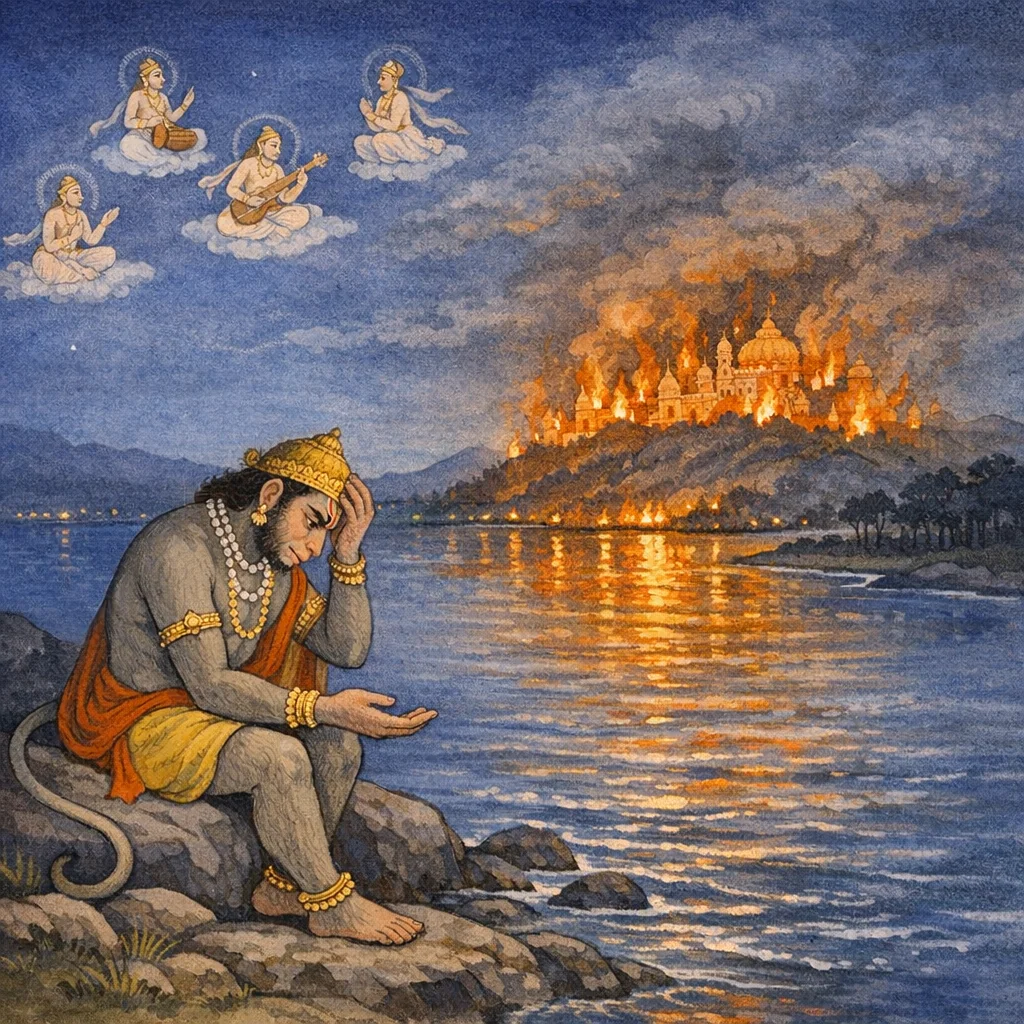
Sarga 55
लङ्कादाहानन्तरचिन्ता — Hanuman’s Post-Conflagration Self-Examination and Assurance of Sita’s Safety
सुन्दरकाण्ड
After setting Laṅkā ablaze with the fire on his tail and quenching it in the ocean, Hanumān surveys the burning city and is seized by fear and remorse. He offers an ethical diagnosis of krodha (anger): it destroys discernment, unleashes harsh speech and even violence toward elders, and makes any deed appear permissible. He dreads that by burning the city he may have harmed the very root of the mission—Sītā’s safety—so that thoughts of self-destruction arise, along with visions of cascading ruin for the Ikṣvāku line (Rāma, Lakṣmaṇa, Bharata, Śatrughna) and even Sugrīva’s alliance. Then, through nimitta (auspicious signs) and dharmic reasoning, the chapter turns to assurance: Sītā’s chastity, tapas, truthfulness, and Rāma’s protective power render her inviolable to fire—“fire cannot burn fire.” Hanumān hears celestial Cāraṇas confirm the marvel: Laṅkā is burned, yet Jānakī is unharmed. Reassured by proofs, omens, and praise, he resolves to see Sītā once more with his own eyes and then depart to report the mission’s success.
Shlokas
Verse 1
लङ्कां समस्तां सन्दीप्य लाङ्गूलाग्निं महाबलः।निर्वापयामास तदा समुद्रे हरिसत्तमः।।सन्दीप्यमानां विध्वस्तां त्रस्तरक्षोगणां पुरीम्।आवेक्ष्य हनुमान् लङ्कां चिन्तयामास वानरः।।।।
After setting all of Laṅkā ablaze, the mighty best of monkeys quenched the fire on his tail in the ocean. Seeing the city still burning—its structures ruined and the rākṣasa hosts thrown into panic—Hanumān began to reflect.
Verse 2
तस्याभूत्सुमहांस्त्रासः कुत्सा चात्मन्यजायत।लङ्कां प्रदहता कर्म किंस्वित्कृतमिदं मया।।।।
Overwhelmed by intense fear, Hanumān felt self-reproach within himself as he saw Laṅkā being consumed by fire, and he thought: “What dreadful deed has been done by me, burning Laṅkā?”
Verse 3
धन्यास्ते पुरुषश्रेष्ठा ये बुद्ध्या कोपमुत्थितम्।निरुन्धन्ति महात्मानो दीप्तमग्निमिवाम्भसा।।।।
Blessed are those best of men, the great-souled, who by wisdom restrain their rising anger—just as one quenches a blazing fire with water.
Verse 4
क्रुद्धः पापं न कुर्यात्कः क्रुद्धो हन्याद्गुरूनपि।क्रुद्धः परुषया वाचा नरस्साधूनधिक्षिपेत्।।।।
What sin would an angry man not commit? In anger he may even strike down his elders, and with harsh speech a man may revile the virtuous.
Verse 5
वाच्यावाच्यं प्रकुपितो न विजानाति कर्हिचित्।नाकार्यमस्ति क्रुद्धस्य नावाच्यं विद्यते क्वचित्।।।।
When enraged, a man cannot discern what should be said and what should not. For the angry, nothing seems improper to do, and nowhere does anything remain ‘unsayable’.
Verse 6
यस्समुत्पतितं क्रोधं क्षमयैव निरस्यति।यथोरगस्त्वचं जीर्णां स वै पुरुष उच्यते।।।।
He alone is truly a man who casts off rising anger through forgiveness—just as a snake sheds its worn-out skin.
Verse 7
धिगस्तु मां सुदुर्बुद्धिं निर्लज्जं पापकृत्तमम्।अचिन्तयित्वा तां सीतामग्निदं स्वामिघातुकम्।।।।
Shame on me—foolish, shameless, and steeped in sin—for setting the fire and betraying my lord’s cause without first thinking of Sītā.
Verse 8
यदि दग्धा त्वियं लङ्का नूनमार्याऽपि जानकी।दग्धा तेन मया भर्तुर्हितं कार्यमजानता।।।।
If this Laṅkā has been burned, then surely even noble Jānakī has been burned; thus, through my ignorance, I have destroyed my lord’s beneficial mission.
Verse 9
यदर्थमयमारम्भस्तत्कार्यमवसादितम्।मया हि दहता लङ्कां न सीता परिरक्षिता।।।।
The very objective for which this effort was undertaken has been brought to ruin; for while I burned Laṅkā, I did not protect Sītā.
Verse 10
ईषत्कार्यमिदं कार्यं कृतमासीन्न संशयः।तस्य क्रोधाभिभूतेन मया मूलक्षयः कृतः।।।।
This task has indeed been accomplished—there is no doubt. Yet, overpowered by anger, I have brought ruin upon the very foundation of my mission.
Verse 11
विनष्टा जानकी नूनं न ह्यदग्धः प्रदृश्यते।लङ्कायां कश्चिदुद्धेशस्सर्वा भस्मीकृता पुरी।।।।
Surely Jānakī has perished—for in Laṅkā not even a small spot appears unburnt; the whole city has been reduced to ashes.
Verse 12
यदि तद्विहतं कार्यं मम प्रज्ञाविपर्ययात्।इहैव प्राणसंन्यासो ममापि ह्यद्य रोचते।।।।
If, through my own perverted judgment, that mission has been ruined, then even for me, giving up my life here and now seems fitting.
Verse 13
किमग्नौ निपताम्यद्य आहोस्विद्बडबामुखे।शरीरमाहो सत्त्वानां दद्मि सागरवासिनाम्।।।।
Should I plunge into fire now, or into the mouth of the submarine blaze? Or should I offer my body as food to the creatures that dwell in the ocean?
Verse 14
कथं हि जीवता शक्यो मया द्रष्टुं हरीश्वरः।तौ वा पुरुषशार्दूलौ कार्यसर्वस्वघातिना।।।।
How could I, still alive, face the lord of the monkeys—or even those two tigers among men—after I have ruined everything that mattered in this undertaking?
Verse 15
मया खलु तदेवेदं रोषदोषात्प्रदर्शितम्।प्रथितं त्रिषु लोकेषु कपित्वमनवस्थितम्।।।।
Indeed, through the fault of anger, I have displayed precisely that fickle ‘monkey-nature’—and made it notorious across the three worlds.
Verse 16
धिगस्तु राजसं भावमनीशमनवस्थितम्।ईश्वरेणापि यद्रागान्मया सीता न रक्षिता।।।।
Shame upon this rājasic, uncontrolled, and unstable impulse—for though I had the power, out of passion I did not protect Sītā.
Verse 17
विनष्टायां तु सीतायां तावुभौ विनशिष्यतः।तयोर्विनाशे सुग्रीवः सबन्धुर्विनशिष्यति।।।।
If Sītā is lost, those two (Rāma and Lakṣmaṇa) will surely perish; and with their destruction, Sugrīva too—together with his kinsmen—will be ruined.
Verse 18
एतदेव वचश्श्रुत्वा भरतो भ्रातृवत्सलः।धर्मात्मा सहशत्रुघ्नः कथं शक्ष्यति जीवितुम्।।।।
Hearing only this news, how could Bharata—devoted to his brothers, righteous in soul—survive, even together with Śatrughna?
Verse 19
इक्ष्वाकुवंशे धर्मिष्ठे गते नाशमसंशयम्।भविष्यन्ति प्रजास्सर्वाश्शोकसन्तापपीडिताः।।।।
When the supremely righteous Ikṣvāku lineage comes to ruin—without doubt—all the people will be afflicted by grief and burning anguish.
Verse 20
तदहं भाग्यरहितो लुप्तधर्मार्थसङ्ग्रहः।।।।रोषदोषपरीतात्मा व्यक्तं लोकविनाशनः।
Then I—bereft of good fortune, having failed to secure dharma and artha—my mind overwhelmed by the fault of anger, am plainly a cause of the world’s ruin.
Verse 21
इति चिन्तयतस्तस्य निमित्तान्युपपेदिरे।पूर्वमप्युपलब्धानि साक्षात्पुनरचिन्तयत्।।।।
As he reflected thus, omens appeared to him—those that he had perceived earlier; and seeing them directly again, he reconsidered his conclusions.
Verse 22
अथवा चारुसर्वाङ्गी रक्षिता स्वेन तेजसा।न नशिष्यति कल्याणी नाग्निरग्नौ प्रवर्तते।।।।
Or else, that auspicious lady of lovely limbs is protected by her own radiance; she will not perish—for fire does not act upon fire.
Verse 23
न हि धर्मात्मनस्तस्य भार्याममिततेजसः।स्वचारित्राभिगुप्तां तां स्प्रष्टुमर्हति पावकः।।।।
For fire cannot rightly touch that woman—guarded by her own chastity—who is the wife of that righteous man of immeasurable splendour.
Verse 24
नूनं रामप्रभावेण वैदेह्यास्सुकृतेन च।यन्मां दहनकर्मायं नादहद्धव्यवाहनः।।।।
Surely, by Rāma’s power and by Vaidehī’s merit, this fire—whose very nature is to burn, the carrier of offerings—did not burn me.
Verse 25
त्रयाणां भरतादीनां भ्रात्रूणां देवता च या।रामस्य च मन: कान्ता सा कथं विनशिष्यति।।।।
She who is revered like a goddess by Bharata and the other two brothers, and who is beloved to Rama’s very heart—how could such a Sita ever be destroyed?
Verse 26
यद्वा दहनकर्मायं सर्वत्र प्रभुरव्ययः।न मे दहति लाङ्गूलं कथमार्यां प्रधक्ष्यति।।।
Or else—this unfailing lord of burning, fire, has not even burned my tail; how then could he burn the noble lady Sita?
Verse 27
पुनश्चाचिन्तयत्तत्र हनुमान्विस्मितस्तदा।हिरण्यनाभस्य गिरेर्जलमध्ये प्रदर्शनम्।।।।
Then, astonished, Hanuman again reflected there on the wondrous sight of Mount Hiraṇyanābha appearing in the midst of the waters.
Verse 28
तपसा सत्यवाक्येन अनन्यत्वाच्च भर्तरि।अपि सा निर्दहेदग्निं न तामग्निः प्रधक्ष्यति।।।।
By the power of her austerity, by her unwavering truthfulness, and by her exclusive devotion to her husband, she could even burn the fire itself; yet fire would not be able to consume her.
Verse 29
स तथा चिन्तयंस्तत्र देव्या धर्मपरिग्रहम्।शुश्राव हनुमान्वाक्यं चारणानां महात्मनाम्।।।।
As he reflected there on the queen’s steadfast hold upon dharma, Hanuman heard the words of the great Cāraṇas.
Verse 30
अहो खलु कृतं कर्म दुष्करं हि हनूमता।अग्निं विसृजताऽभीक्ष्णं भीमं राक्षसवेश्मनि।।।।
Ah indeed—Hanuman has accomplished a truly difficult deed, relentlessly unleashing a fearful fire throughout the rākṣasas’ dwellings.
Verse 31
प्रपलायितरक्षः स्त्रीबालवृद्धसमाकुला।जनकोलाहलाध्माता क्रन्दन्तीवाद्रिकन्दरै: ।।।।
The city swarmed with rākṣasa women, children, and the aged fleeing in panic; filled with the uproar of the people, it seemed to wail through its cave-like recesses.
Verse 32
दग्धेयं नगरी सर्वा साट्टप्राकारतोरणा।जानकी न च दग्धेति विस्मयोऽद्भुत एव नः।।।।
This entire city—its ramparts and gateways—has been burned; yet Janakī is not burned. For us, this is a wondrous astonishment indeed.
Verse 33
स निमित्तैश्च दृष्टार्थैः कारणैश्च महागुणैः।ऋषिवाक्यैश्च हनुमानभवत्प्रीतमानसः।।।।
Thus, through the clear omens he had witnessed, sound reasons, auspicious indications, and the words of seer-like beings, Hanuman became joyful at heart.
Verse 34
ततः कपिः प्राप्तमनोरथार्थस्तामक्षतां राजसुतां विदित्वा।प्रत्यक्षतस्तां पुनरेव दृष्टवा प्रतिप्रयाणाय मतिं चकार।।।।
Then Hanumān—his purpose fulfilled—knowing the king’s daughter (Sītā) to be unharmed, resolved to depart, after seeing her once again directly to be certain of her safety.
Frequently Asked Questions
Hanumān confronts a dharma-sankat: his necessary act of burning Laṅkā may have violated mission-priority if it endangered Sītā. The chapter stages a rigorous self-critique of krodha-driven action and its potential to nullify rightful objectives.
Anger erodes viveka (discernment) and makes harmful speech and deeds appear acceptable; true strength is the capacity to restrain rising anger like casting off a worn skin. Dharma is preserved through self-governance, evidence-based reflection, and recommitment to purpose.
Laṅkā’s burning cityscape and the ocean where the tail-fire is quenched frame the scene; Baḍabāmukha (submarine fire) appears in Hanumān’s contemplation of self-destruction; Hiraṇyanābha mountain’s appearance amid water is recalled as an auspicious wonder supporting Sītā’s safety.