Sarga 31
सुन्दरकाण्डे एकत्रिंशः सर्गः — Hanuman’s Sweet Address to Sita and Sita’s Recognition
सुन्दरकाण्ड
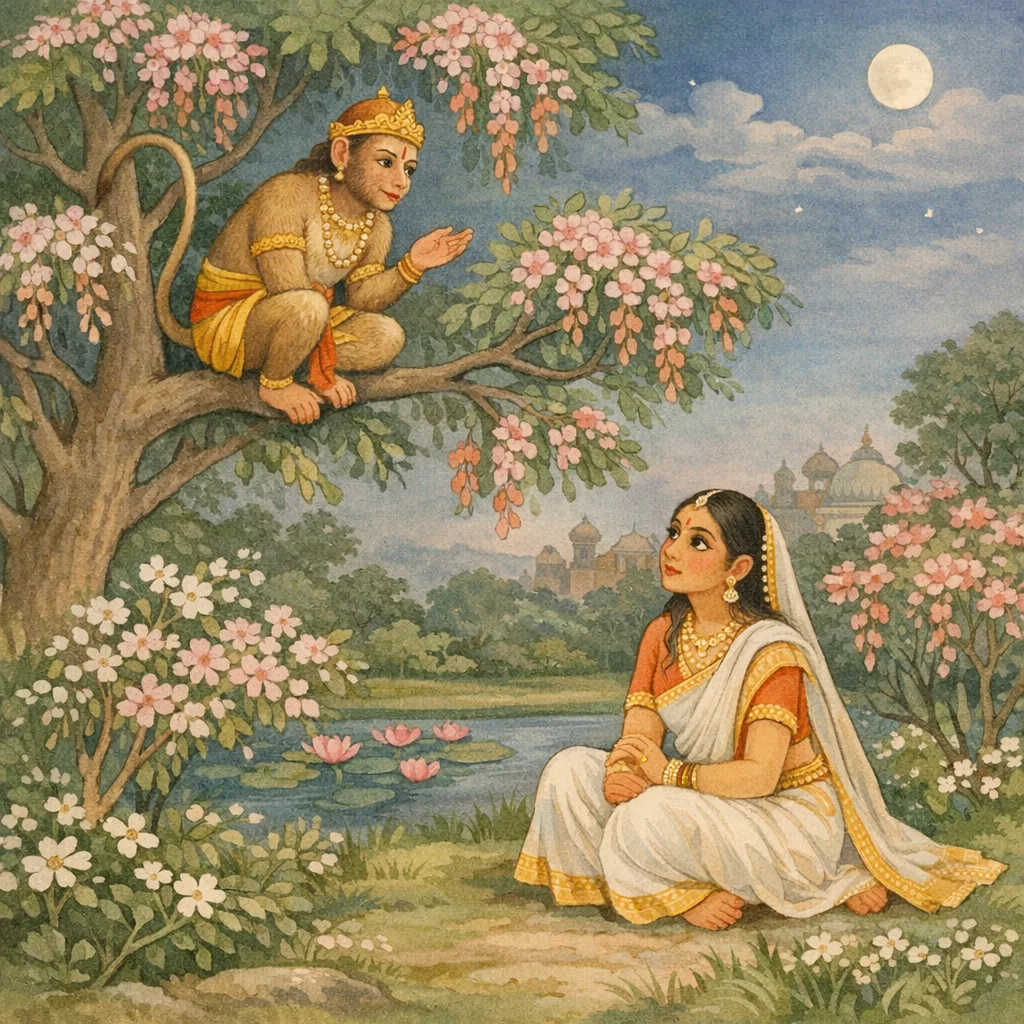
This sarga presents a carefully controlled revelation of identity. After much inward deliberation (bahuvidhā cintā), Hanumān begins speaking to Vaidehī in a sweet, confidence-giving tone. He recounts the Ikṣvāku lineage and Daśaratha’s royal virtues, and portrays Rāma as the foremost archer and guardian of dharma, establishing trust through precise genealogy and a true ethical portrait. He then narrates the forest exile, the Janasthāna conflict and the fall of Khara and Dūṣaṇa, and frames Sītā’s abduction as Rāvaṇa’s retaliation carried out through māyā—the deer-form deception. He tells of Rāma’s alliance with Sugrīva, Vālin’s death, and the dispatch of thousands of kāmarūpin vānaras to search in every direction. Hanumān offers his leap across the ocean as proof of his mission, declares that he has found the very Sītā described by Rāma, and pauses. Sītā, astonished, cautiously scans her surroundings, looks toward the śiṃśupā tree, and finally beholds Vāyu’s son—Sugrīva’s minister—radiant like the rising sun, and joy awakens anew in her as she remembers Rāma.
Shlokas
Verse 1
एवं बहुविधां चिन्तां चिन्तयित्वा महाकपिः।संश्रवे मधुरं वाक्यं वैदेह्या व्याजहार ह।।।।
After reflecting in many ways, the great ape Hanumān spoke sweet words within Vaidehī’s hearing.
Verse 2
राजा दशरथो नाम रथकुञ्जरवाजिमान्।पुण्यशीलो महाकीर्तिरिक्ष्वाकूणां महायशाः।।।।
There was a king named Daśaratha, abounding in chariots, elephants, and horses—virtuous in conduct, widely renowned, and a great glory of the Ikṣvāku line.
Verse 3
राजर्षीणां गुणश्रेष्ठस्तपसा चर्षिभि स्समः।चक्रवर्तिकुले जातः पुरन्दरसमो बले।।।।
Among royal sages he was the most virtuous; in austerity he was equal to the seers. Born in the line of emperors, he was in might like Purandara (Indra).
Verse 4
अहिंसारतिरक्षुद्रो घृणी सत्यपराक्रमः।मुख्यश्चेक्ष्वाकुवंशस्य लक्ष्मीवान् लक्ष्मिवर्धनः।।।।
He delighted in non-violence, was magnanimous and compassionate, and his valor was founded on truth. A foremost of the Ikṣvāku line, he was prosperous—and an increaser of prosperity.
Verse 5
पार्थिवव्यञ्जनैर्युक्तः पृथुश्रीः पार्थिवर्षभः।पृथिव्यां चतुरन्तायां विश्रुतस्सुखदस्सुखी।।।।
Endowed with the marks of kingship and broad prosperity, he was a bull among rulers. Across the four-bounded earth he was famed—happy himself, and a giver of happiness to others.
Verse 6
तस्य पुत्रः प्रियो ज्येष्ठस्ताराधिपनिभाननः।रामो नाम विशेषज्ञः श्रेष्ठ स्सर्वधनुष्मताम्।।।।
His beloved eldest son was named Rāma, moon-faced; skilled in discernment and knowledge, he was the foremost among all who bear the bow.
Verse 7
रक्षिता स्वस्य धर्मस्य स्वजनस्य च रक्षिता।रक्षिता जीवलोकस्य धर्मस्य च परन्तपः।।।।
A scorcher of foes, he is a protector of his own dharma and of his people; indeed he protects all living beings—and safeguards righteousness itself.
Verse 8
तस्य सत्याभिसन्धस्य वृद्धस्य वचनात्पितुः।सभार्यस्सह च भ्रात्रा वीरः प्रव्राजितो वनम्।।।।
To honor the word of his aged father—steadfast in truth—that hero went into exile in the forest, together with his wife and his brother.
Verse 9
तेन तत्र महारण्ये मृगयां परिधावता।राक्षसा निहताश्शूरा बहवः कामरूपिणः।।।।
There, in that great wilderness, as he ranged about in the hunt, many warrior Rākṣasas—shapeshifters at will—were slain by him.
Verse 10
जनस्थानवधं श्रुत्वा हतौ च खरदूषणौ।ततस्त्वमर्षापहृता जानकी रावणेन तु।।।।वञ्चयित्वा वने रामं मृगरूपेण मायया।
Hearing of the slaughter at Janasthāna and the fall of Khara and Dūṣaṇa, Rāvaṇa, seized by wrath, abducted you, O Jānakī—after deceiving Rāma in the forest by an illusion in the form of a deer.
Verse 11
स मार्गमाणस्तां देवीं रामस्सीतामनिन्दिताम्।।।।आससाद वने मित्रं सुग्रीवं नाम वानरम्।
While searching in the forest for that goddess-like, blameless Sītā, Rāma encountered a vānara named Sugrīva and gained him as a friend.
Verse 12
तत स्स वालिनं हत्वा रामः परपुरञ्जयः।।।।प्रायच्छत्कपिराज्यं तत्सुग्रीवाय महाबलः।
Then Rāma—mighty, a conqueror of enemy strongholds—slew Vālin and bestowed upon Sugrīva the sovereignty of the vānara.
Verse 13
सुग्रीवेणापि सन्दिष्टा हरयः कामरूपिणः।।।।दिक्षु सर्वासु तां देवीं विचिन्वन्ति सहस्रशः।
Commanded by Sugrīva, thousands of monkeys—able to assume forms at will—searched for that noble lady in every direction.
Verse 14
अहं सम्पातिवचनाच्छतयोजनमायतम्।।।।अस्या हेतोर्विशालाक्ष्याः सागरं वेगवान्प्लुतः।
Guided by Sampāti’s words, I swiftly leapt across the ocean—spanning a hundred yojanas—for the sake of that large-eyed lady.
Verse 15
यथारूपां यथावर्णां यथालक्ष्मीवतीं च निश्चिताम्।।।।अश्रौषं राघवस्याहं सेयमासादिता मया।
Just as I had heard from Rāghava—her form, her complexion, her radiance and beauty—so indeed she is; I have found her here.
Verse 16
विररामैवमुक्त्वासौ वाचं वानरपुङ्गवः।।।।जानकी चापि तच्छ्रुत्वा परं विस्मयमागता।
Having spoken thus, that foremost of monkeys fell silent; and Jānakī, hearing those words, was filled with profound astonishment.
Verse 17
ततस्सा वक्रकेशान्ता सुकेशी केशसंवृतम्।।।।उन्नम्य वदनं भीरुश्शिंशुपावृक्षमैक्षत।
Then that timid lady, with lovely hair curling at its ends, lifted her face—veiled by her tresses—and looked toward the śiṃśupā tree.
Verse 18
निशम्य सीता वचनं कपेश्च दिशश्च सर्वाः प्रदिशश्च वीक्ष्य।स्वयं प्रहर्षं परमं जगाम सर्वात्मना राममनुस्मरन्ती ।।।।
Hearing the monkey’s words, Sītā looked to all directions and quarters; and remembering Rāma with her whole being, she herself attained the highest joy.
Verse 19
सा तिर्यगूर्ध्वं च तथाप्यधस्तान्निरीक्षमाणा तमचिन्त्यबुद्धिम्।ददर्श पिङ्गाधिपतेरमात्यं वातात्मजं सूर्यमिवोदयस्थम्।।।।
Looking sideways, upward, and downward, she beheld him—of inconceivable intelligence—Hanumān, minister of the tawny-hued lord of monkeys, the son of the Wind-god, radiant like the rising sun.
Frequently Asked Questions
Hanumān’s pivotal action is a calibrated self-disclosure: he must convince Sītā he is Rāma’s messenger without alarming her or exposing her to rākṣasa surveillance. He solves this by leading with gentle speech and verifiable narrative markers (lineage, exile, alliance, search), prioritizing safety and truthfulness over dramatic revelation.
True reassurance is grounded in satya and pramāṇa: hope is ethically persuasive when supported by accurate knowledge, disciplined intent, and compassionate delivery. The sarga models how dharma operates through speech—words become protective when they are truthful, timely, and oriented toward the vulnerable.
Janasthāna anchors the causal chain leading to the abduction; the sāgara (hundred-yojana crossing) marks the extraordinary logistical threshold of the mission; and the śiṃśupā tree functions as a localized visual landmark in Sītā’s immediate environment, framing her cautious verification of Hanumān’s presence.