Sarga 66
चूडामणि-दर्शनम् — Rama Receives Sita’s Token and Questions Hanuman
सुन्दरकाण्ड
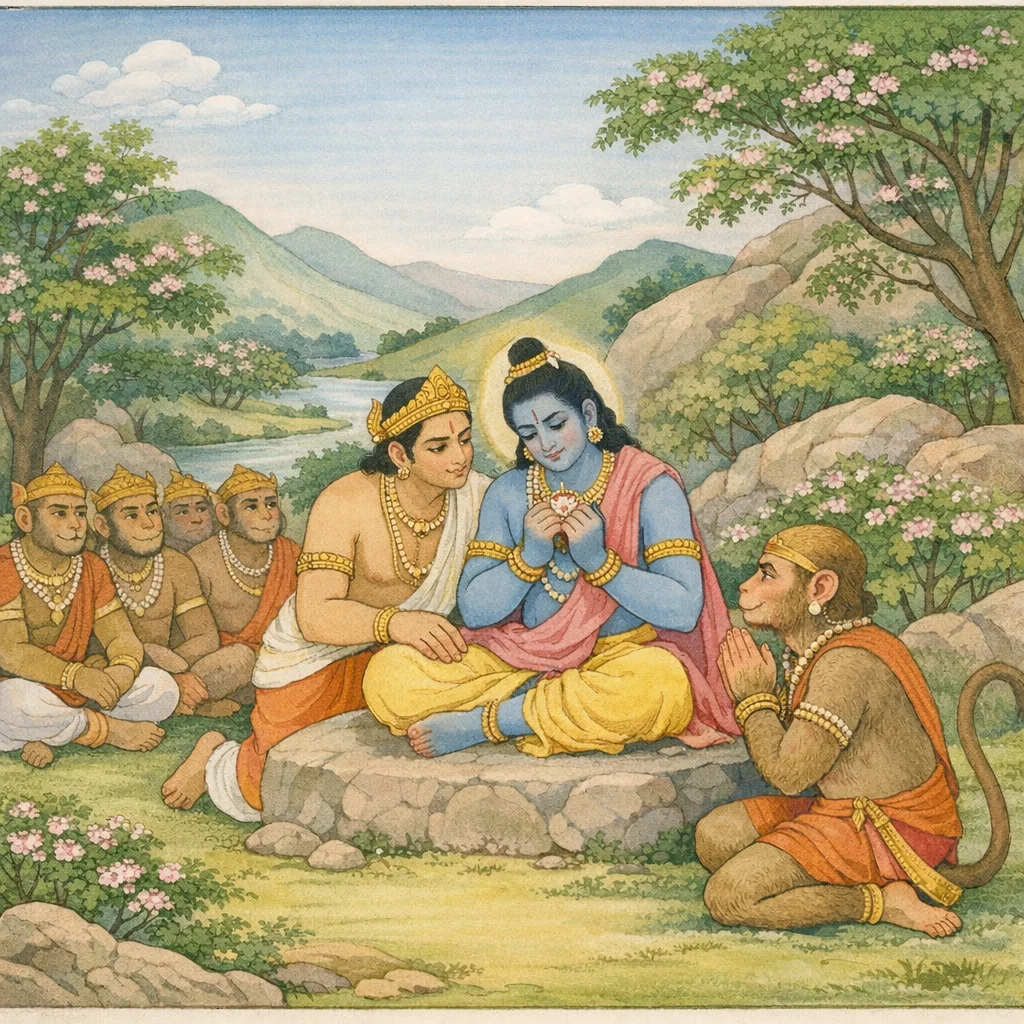
Sarga 66 records the immediate emotional and strategic impact of Hanumān’s successful return. Receiving Sītā’s token, the cūḍāmaṇi, Rāma presses it to his heart and weeps with Lakṣmaṇa, moving from anxious uncertainty to verified knowledge. Before Sugrīva and the gathered hosts, he identifies the jewel’s origin—given by Janaka (Vaideha) at the time of marriage and bound to the sanctity of the family—thereby confirming its authenticity and intensifying remembrance. A chain of similes conveys grief and recognition: the heart “melts” like a cow’s milk flowing at the sight of its calf, and Sītā’s hidden radiance is likened to the autumn moon veiled by clouds. Rāma repeatedly urges Hanumān to recount Sītā’s words, as life-giving “water” to one who is parched, highlighting the epistemic worth of truthful testimony and the healing power of message-bearing speech. The chapter culminates in urgency—Rāma cannot remain even a moment after learning her whereabouts—and in compassionate concern for Sītā’s fragility amid fearsome rākṣasas, framing the dharmic imperative for swift action.
Shlokas
Verse 1
एवमुक्तो हनुमता रामो दशरथात्मज:।तं मणिं हृदये कृत्वा प्ररुरोद सलक्ष्मणः।।।।
Thus addressed by Hanumān, Rāma—the son of Daśaratha—pressed that jewel-token to his heart and wept, with Lakṣmaṇa beside him.
Verse 2
तं तु दृष्ट्वा मणिश्रेष्ठं राघव श्शोककर्शितः।नेत्राभ्यामश्रुपूर्णाभ्यां सुग्रीवमिदमब्रवीत्।।।।
But on seeing that finest jewel, Rāghava—worn down by grief, his eyes brimming with tears—spoke these words to Sugrīva.
Verse 3
यथैव धेनु स्स्रवति स्नेहाद्वत्सस्य वत्सला।तथा ममापि हृदयं मणिरत्नस्य दर्शनात्।।।।
Just as a cow, out of affection for her calf, lets her milk flow at the calf’s sight, so too my heart melts on seeing this jewel-token.
Verse 4
मणिरत्नमिदं दत्तं वैदेह्याश्श्वशुरेण मे।वधूकाले यथाबद्धमधिकं मूर्ध्नि शोभते।।।।
This jewel was given to Vaidehī by my father-in-law; fastened upon her at the time of our marriage, it shone all the more upon her head.
Verse 5
अयं हि जलसम्भूतो मणिस्सज्जनपूजितः।यज्ञे परमतुष्टेन दत्तश्शक्रेण धीमता।।।।
This jewel, born from the waters and revered by the noble, was once given by wise Indra—delighted at a sacrifice (yajña)—to King Janaka; thus it became an honored family treasure.
Verse 6
इमं दृष्ट्वा मणिश्रेष्ठं यथा तातस्य दर्शनम्।अद्यास्म्यवगतस्सौम्य वैदेहस्य तथा विभोः।।।।
O noble one, on seeing this best of jewels, it is as though I behold my father—and likewise the mighty king of Videha—so vividly does this token bring them to mind.
Verse 7
अयं हि शोभते तस्याः प्रियाया मूर्ध्नि मे मणिः।अस्याद्य दर्शने नाहं प्राप्तां तामिव चिन्तये।।।।
This jewel indeed used to shine upon the head of my beloved; and now, merely by seeing it, I cannot but feel as though I have reached her herself.
Verse 8
किमाह सीता वैदेही ब्रूहि सौम्य पुनः पुनः।पिपासुमिव तोयेन सिञ्चन्ती वाक्यवारिणा।।।।
What did Sītā of Videha say? Tell me, noble one, again and again—watering me with the stream of her words, as water revives the thirsty.
Verse 9
इतस्तु किं दुःखतरं यदिमं वारिसम्भवम्।मणिं पश्यामि सौमित्रे वैदेहीमागतां विना।।।।
O Saumitri, what could be more painful than this—that I behold this jewel born of the waters, yet do not behold Vaidehī herself returned?
Verse 10
चिरं जीवति वैदेही यदि मासं धरिष्यति।क्षणं सौम्य न जीवेयं विना तामसितेक्षणाम्।।।।
If Vaidehī can endure for a month, that itself is a long time for her. But, dear one, I cannot live even for a moment without that dark-eyed lady.
Verse 11
नय मामपि तं देशं यत्र दृष्टा मम प्रिया।न तिष्ठेयं क्षणमपि प्रवृत्तिमुपलभ्य च।।।।
Take me too to that place where you saw my beloved. Once I know where she is, I cannot remain here even for an instant.
Verse 12
कथं सा मम सुश्रोणी भीरुभीरु स्सती सदा।भयावहानां घोराणां मध्ये तिष्ठति रक्षसाम्।।।।
How can my fair-hipped beloved—ever timid by nature—remain in the midst of those dreadful rākṣasas, fearsome in form?
Verse 13
शारद स्तिमिरोन्मुक्तो नूनं चन्द्रं इवांबुधैः।आवृतं वदनं तस्या न विराजति राक्षसैः।।।।
Surely her face—like the autumn moon freed from darkness—when covered over by cloud-like rākṣasas, does not shine forth as it should.
Verse 14
किमाह सीता हनुमंस्तत्त्वतः कथयाद्य मे।एतेन खलु जीविष्ये भेषजेनातुरो यथा।।।।
What did Sītā say? O Hanumān, tell me truly—tell me now. By that alone I shall live, like a sick man sustained by medicine.
Verse 15
मधुरा मधुरालापा किमाह मम भामिनी।मद्विहीना वरारोहा हनुमन् कथयस्व मे।।।।
What did my beloved say—she who is lovely and sweet-spoken, that noble lady now separated from me? O Hanumān, tell it to me.
Frequently Asked Questions
The pivotal action is the authentication and reception of Sītā’s token: Rāma treats the cūḍāmaṇi and Hanumān’s testimony as binding evidence, converting emotion into responsible decision-making rather than impulsive violence.
Truthful communication sustains life and purpose: Sītā’s words, conveyed accurately by the envoy, function like medicine or water—showing that pramāṇa (reliable knowledge) and compassionate speech are indispensable for dharma-guided action.
Cultural markers dominate: the marriage context of the jewel (wedding adornment), its royal provenance linked to Janaka of Videha, and the implied setting of Sītā amid Laṅkā’s rākṣasas (without naming specific city-sites in this sarga).