Sarga 62
मधुवनभङ्गः — The Disruption of Madhuvana and Dadhimukha’s Complaint
सुन्दरकाण्ड
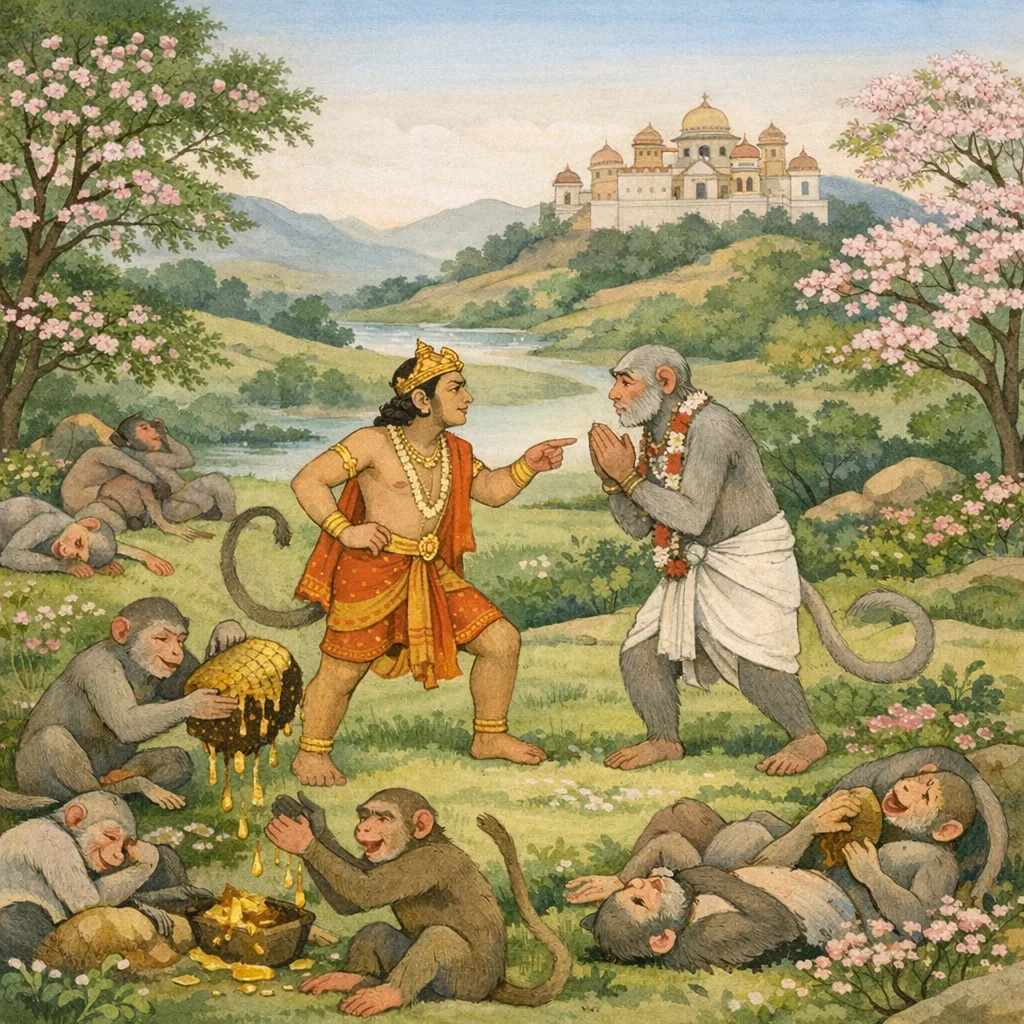
Sarga 62 recounts a moment of release after the vānaras receive the successful intelligence concerning Maithilī. Hanumān permits the troop to drink without fear the royal honey of Madhuvana, and Aṅgada—citing Hanumān’s accomplished standing—publicly confirms the leave. Rejoicing, the vānaras rush into the grove. The celebration, however, swells into intoxication and disorder: they drink from great vessels, fling honeycombs, shout and sing, stagger, sleep upon the ground, and even fall into indecent behavior. The garden guards (madhupālas) are beaten and scattered. Dadhimukha, the appointed guardian and an elder kinsman within the royal circle, tries to restrain them by force; a clash follows, and Aṅgada, blinded by drunken arrogance, violently subdues Dadhimukha, injuring him and leaving him briefly unconscious. When he recovers, Dadhimukha withdraws and resolves to report the violation to King Sugrīva, declaring Madhuvana a cherished, ancestral, restricted royal preserve. He then flies swiftly to Sugrīva—where Rāma and Lakṣmaṇa are also present—offers formal obeisance, and prepares to lodge his complaint. Thus the sarga balances the joy of mission-success with a sober ethic of power, property, and discipline among allies.
Shlokas
Verse 1
तानुवाच हरिश्रेष्ठो हनुमान्वानरर्षभः।अव्यग्रमनसो यूयं मधु सेवत वानराः।।5.62.1।।अहमावारयिष्यामि युष्माकं परिपन्थिनः।
Hanuman—the best of the monkeys, a bull among the vānara-s—said to them: “Be without anxiety in your minds and enjoy the honey, O vānara-s; I shall hold back anyone who tries to hinder you.”
Verse 2
श्रुत्वा हनुमतो वाक्यं हरीणां प्रवरोऽङ्गदः।।5.62.2।।प्रत्युवाच प्रसन्नात्मा पिबन्तु हरयो मधु।
Having heard Hanumān’s words, Aṅgada—foremost among the vānaras—replied with a pleased heart: “Let the vānaras drink the honey.”
Verse 3
अवश्यं कृतकार्यस्य वाक्यं हनुमतो मया।।5.62.3।।अकार्यमपि कर्तव्यं किमङ्ग पुनरीदृशम्।
Surely, I must heed the words of Hanumān, the one who has accomplished the task. Even if he were to tell me to do what should not be done, I would do it—how much more, then, when he speaks in a matter like this.
Verse 4
अङ्गदस्य मुखाच्छ्रुत्वावचनं वानरर्षभाः।।5.62.4।।साधुसाध्विति संहृष्टा वानराः प्रत्यपूजयन्।
Hearing the words spoken from Aṅgada’s mouth, the foremost of the Vānara leaders, delighted, praised him, saying, “Well said, well said!”
Verse 5
पूजयित्वाङ्गदं सर्वे वानरा वानरर्षभम्।।5.62.5।।जग्मुर्मधुवनं यत्र नदीवेग इव द्रुमम्।
Honouring Aṅgada, the bull among the Vānaras, all the Vānaras went to Madhuvana, surging like the force of a river rushing upon a tree.
Verse 6
ते प्रविष्टा मधुवनं पालानाक्रम्य वीर्यतः।।5.62.6।।अतिसर्गाच्च पटवो दृष्ट्वा श्रुत्वा च मैथिलीम्।पपुस्सर्वे मधु तदा रसवत्फलमाददुः।।5.62.7।।
Having entered Madhuvana, they overpowered the garden-guards with force.
Verse 7
ते प्रविष्टा मधुवनं पालानाक्रम्य वीर्यतः।।5.62.6।।अतिसर्गाच्च पटवो दृष्ट्वा श्रुत्वा च मैथिलीम्।पपुस्सर्वे मधु तदा रसवत्फलमाददुः।।5.62.7।।
Exulting in their success—having seen and heard of Maithilī—then all of them drank the honey and took the flavorful fruits.
Verse 8
उत्पत्य च ततस्सर्वे वनपालान् समागतान्।ताडयन्ति स्म शतश स्सक्तान्मधुवने तदा।।5.62.8।।
Then, leaping up together, they struck the assembled garden-guards in a hundred ways, while they were engaged there in Madhuvana.
Verse 9
मधूनि द्रोणमात्राणि बाहुभिः परिगृह्य ते।पिबन्ति सहिता स्सर्वे निघ्नन्ति स्म तथापरे।।5.62.9।।
Grasping great measures of honey in their arms, they all drank together; and others, meanwhile, kept striking and driving back the defenders.
Verse 10
केचित्पीत्वा प्रविध्यन्ति मधूनि मधुपिङ्गलाः।मधूच्छिष्टेन केचिच्च जग्मुरन्योन्यमुत्कटाः।।5.62.10।।
Some honey-golden monkeys drank and then flung the honey about; others, made wild with intoxication, wandered among one another with chunks of honeycomb.
Verse 11
अपरे वृक्षमूले तु शाखां गृह्य व्यवस्थिताः।अत्यर्थं च मदग्लानाः पर्णान्यास्तीर्य शेरते।।5.62.11।।
Others settled at the roots of trees, holding onto branches; and others, overcome by intoxication, lay down after spreading leaves as bedding.
Verse 12
उन्मत्तभूताः प्लवगा मधुमत्ताश्च हृष्टवत्।क्षिपन्ति च तथान्योन्यं स्खलन्ति च तथाऽपरे।।5.62.12।।
Drunk with honey, the leaping vānaras, exultant as if mad, shoved one another, while others reeled and stumbled.
Verse 13
केचित् क्ष्वेलां प्रकुर्वन्ति केचित् कूजन्ति हृष्टवत्।हरयोमधुना मत्ताः केचित्सुप्ता महीतले।।5.62.13।।
Some roared loudly, some chirped in delight; the vānaras, intoxicated by honey, grew drowsy—some even fell asleep upon the ground.
Verse 14
कृत्वा केचिद्धसन्त्यन्ये केचित्कुर्वन्ति चेतरत्।कृत्वा केचिद्वदन्त्यन्ये केचिद्बुध्यन्ति चेतरत्।।5.62.14।।
Having done one thing, some made the others laugh; some did something else. Having done one thing, some went on talking with their companions, while others turned their minds to different pursuits.
Verse 15
येऽप्यत्र मधुपाला स्स्युः प्रेष्या दधिमुखस्य तु।तेऽपि तैर्वानरैर्भीमैः प्रतिषिद्धा दिशो गताः।।5.62.15।।
Even the honey-guards stationed there—servants of Dadhimukha—were driven off by those fearsome vānaras and fled in all directions.
Verse 16
जानुभिस्तु प्रकृष्टाश्च देवमार्गं प्रदर्शिताः।अब्रुवन् परमोद्विग्ना गत्वा दधिमुखं वचः।।5.62.16।।
Dragged along on their knees and subjected to an obscene humiliation, the guards—utterly shaken—went to Dadhimukha and reported what had occurred.
Verse 17
हनूमता दत्तवरैर्हतं मधुवनं बलात्।वयं च जानुभिः कृष्टा देवमार्गं च दर्शिताः।।5.62.17।।
With Hanumān’s leave, they have violently ravaged Madhuvana; and we too were dragged along on our knees and subjected to a shameful, obscene display.
Verse 18
ततो दधिमुख: क्रुद्धो वनपस्तत्र वानरः।हतं मधुवनं श्रुत्वा सान्त्वयामास तान् हरीन्।।5.62.18।।
Then Dadhimukha, the grove’s guardian among the vānaras, grew angry on hearing that Madhuvana had been destroyed; yet he consoled those vānaras with reassuring words.
Verse 19
इहागच्छत गच्छामो वानरान् बलदर्पितान्।बलेन वारयिष्यामो मधु भक्षयतो वयम्।।5.62.19।।
“Come—let us go to those vānaras, swollen with pride of strength; as they consume the honey, we shall restrain them by force.”
Verse 20
श्रुत्वा दधिमुखस्येदं वचनं वानरर्षभाः।पुनर्वीरा मधुवनं तेनैव सहसा ययुः।।5.62.20।।
Hearing these words of Dadhimukha, those heroic leaders among the vānaras at once went back to Madhuvana—together with him, in haste.
Verse 21
मध्ये चैषां दधिमुखः प्रगृह्य तरसा तरुम्।समभ्यधावद्वेगेन ते च सर्वे प्लवङ्गमाः।।5.62.21।।
In their midst, Dadhimukha seized a tree with vigor and rushed forward at speed—and all the leaping vānaras followed him.
Verse 22
ते शिलाः पादपांश्चापि पर्वतांश्चापि वानराः।गृहीत्वाऽऽभ्यगमन् क्रुद्धा यत्र ते कपिकुञ्जराः।।5.62.22।।
Those vānaras, enraged, took up rocks and trees—even mountains—and advanced to the place where those mighty ‘elephants among monkeys’ were.
Verse 23
ते स्वामिवचनं वीरा हृदयेष्ववसज्य तत्।त्वरया ह्यभ्यधावन्त सालतालशिलायुधाः।।5.62.23।।
Holding their leader’s command firmly in their hearts, those heroic vanaras rushed forward at once, armed with sāla and tāla trees and with rocks.
Verse 24
वृक्षस्थांश्च तलस्थांश्च वानरान् बलदर्पितान्।अभ्यक्रामंस्ततो वीराः पालास्तत्र सहस्रशः।।5.62.24।।
Then, in their thousands, the heroic guards attacked those vanaras—proud of their strength—whether they stood upon the trees or on the ground beneath them.
Verse 25
अथ दृष्ट्वा दधिमुखं क्रुद्धं वानरपुङ्गवाः।अभ्यधावन्त वेगेन हनुमत्प्रमुखास्तदा।।5.62.25।।
Then, seeing Dadhimukha enraged, the foremost vanaras—led by Hanumān—rushed swiftly toward him.
Verse 26
तं सवृक्षं महाबाहुमापतन्तं महाबलम्।आर्यकं प्राहरत्तत्र बाहुभ्यां कुपितोऽङ्गदः।।5.62.26।।
As the mighty, strong-armed elder Dadhimukha came charging—tree in hand—Angada, enraged, struck and seized him there with both arms.
Verse 27
मदान्धश्च न वेदैनमार्यकोऽयं ममेति सः।अथैनं निष्पिपेषाशु वेगवद्वसुधातले।।5.62.27।।
Blinded by pride, he failed to recognize, “This is my venerable elder.” Then he swiftly crushed him down with force upon the ground.
Verse 28
स भग्नबाहूरुभुजो विह्वलश्शोणितोक्षितः।मुमोह सहसा वीरो मुहूर्तं कपिकुञ्जरः।।5.62.28।।
With his arms and limbs broken, battered and drenched in blood, that heroic ‘elephant among monkeys’ fainted at once—for a moment.
Verse 29
स समाश्वस्य सहसा सङ्कृद्धो राजमातुलः।वानरान्वारयामास दण्डेन मधुमोहितान्।।5.62.29।।
Regaining himself at once, Dadhimukha—the king’s maternal uncle—grew furious and tried to drive back the vanaras, deluded by honey-wine, using a staff.
Verse 30
स कथञ्चिद्विमुक्तस्स्तैर्वानरैर्वानरर्षभः।उवाचैकान्तमाश्रित्य भृत्यान् स्वान् समुपागतान्।।5.62.30।।
Freed with great difficulty from those Vānaras, Dadhimukha—the bull among monkeys—withdrew to a secluded place and spoke to his own attendants who had gathered around him.
Verse 31
एते तिष्ठन्तु गच्छामो भर्ता नो यत्र वानरः।सुग्रीवो विपुलग्रीवः सह रामेण तिष्ठति।।5.62.31।।
“Let these remain here. We shall go to where our lord, Sugrīva—the broad-necked king of the Vānaras—abides together with Rāma.”
Verse 32
सर्वं चैवाङ्गदे दोषं श्रावयिष्यामि पार्थिवे।अमर्षी वचनं श्रुत्वा घातयिष्यति वानरान्।।5.62.32।।
‘And I shall report to the king the whole fault of Aṅgada. When the king, quick to anger, hears these words, he will have the Vānaras put to death.’
Verse 33
इष्टं मधुवनं ह्येतत्पार्थिवस्य महात्मनः।पितृपैतामहं दिव्यं देवैरपि दुरासदम्।।5.62.33।।
For this Madhuvana is most dear to that great-souled king—an ancestral, wondrous, divine grove, forbidden to enter even for the gods.
Verse 34
स वानरानिमान् सर्वान् मधुलुब्धान् गतायुषः।घातयिष्यति दण्डेन सुग्रीवस्ससुहृज्जनान्।।5.62.34।।
Sugrīva will punish all these Vānaras—greedy for honey and as good as doomed—beating them with the rod, along with their companions.
Verse 35
वध्या ह्येते दुरात्मानो नृपाज्ञापरिभाविनः।अमर्षप्रभवो रोषस्सफलो नो भविष्यति।।5.62.35।।
Indeed, these evil-minded ones—who have scorned the king’s command—deserve to be slain; thus our anger, born of wounded forbearance, will not go in vain.
Verse 36
एवमुक्त्वा दधिमुखो वनपालान्महाबलः।जगाम सहसोत्पत्य वनपालैस्समन्वितः।।5.62.36।।
Having spoken thus to the grove-guards, mighty Dadhimukha at once leapt up and went forth, accompanied by those guards.
Verse 37
निमेषान्तरमात्रेण स हि प्राप्तो वनालयः।सहस्रांशुसुतो धीमान् सुग्रीवो यत्र वानरः।।5.62.37।।
In the space of a single blink, that forest-dweller reached the place where wise Sugrīva—the Vānara, son of the Sun—was.
Verse 38
रामं च लक्ष्मणं चैव दृष्ट्वा सुग्रीवमेव च।समप्रतिष्ठां जगतीमाकाशान्निपपात ह।।5.62.38।।
Seeing Rāma and Lakṣmaṇa, and Sugrīva as well, he descended from the sky and alighted upon level ground.
Verse 39
सन्निपत्य महावीर्यस्सर्वैस्तै: परिवारितः।हरिर्दधिमुखः पालैः पालानां परमेश्वरः।।5.62.39।।स दीनवदनो भूत्वा कृत्वा शिरसि चाञ्जलिम्।सुग्रीवस्य शुभौ मूर्ध्ना चरणौ पत्यपीडयत्।।5.62.40।।
There gathered the mighty Dadhimukha, lord of the guards, surrounded by all those guardians. With a sorrowful face, he lifted his folded hands to his head and, in reverent obeisance, pressed Sugrīva’s auspicious feet with his forehead.
Frequently Asked Questions
A sanctioned celebration (drinking the royal honey) devolves into excess and violence against guards, raising a dharma-tension between morale reward and maintaining maryādā, lawful boundaries, and respect for custodial authority.
Even justified joy after success requires self-governance: power without restraint produces disorder, harms innocents, and demands accountability through legitimate hierarchy (Dadhimukha’s recourse to Sugriva).
Madhuvana is highlighted as an ancestral, royal preserve—culturally framed as a restricted garden with appointed guardians—functioning as a symbol of sovereign order within the vānaras’ polity.