Sarga 18
अष्टादशः सर्गः (Sarga 18): रावणस्य प्रमदावनप्रवेशः — Ravana’s entry into the women’s grove
सुन्दरकाण्ड
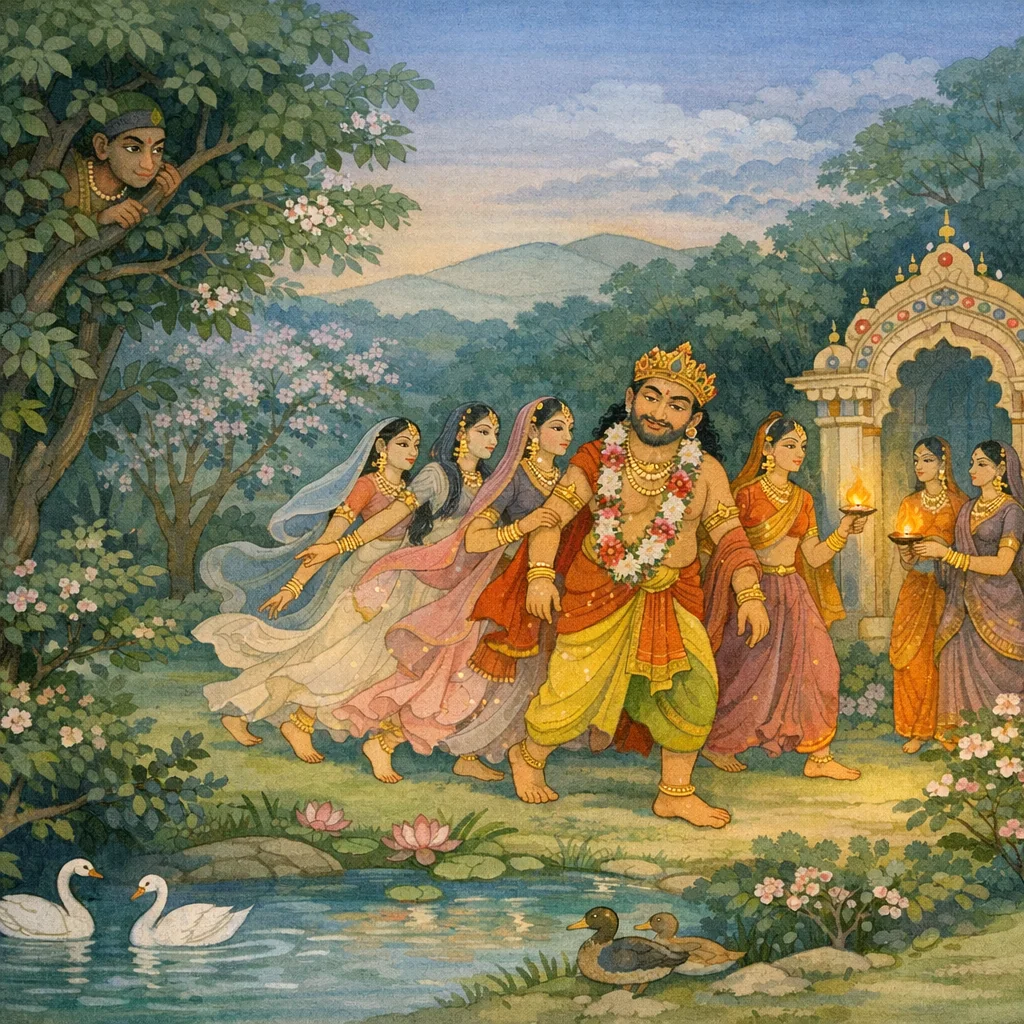
As Hanumān continues searching the flowering Aśokavanikā for Vaidehī, the night wanes and dawn draws near. Auspicious instruments awaken the mighty Daśagrīva, who rises with garland and garments in disarray, his mind fixed on Sītā and his passion undisguised. Adorned with ornaments, Rāvaṇa moves through a garden rich with trees, ponds, birds, animals, and gem-and-gold gateways, and enters the Aśoka grove. Women follow bearing lamps, fans, water-pitchers, seats, wine, and a moon-bright umbrella; his chief wives, dizzy with sleep and intoxication, trail him like lightning around a cloud, their ornaments and cosmetics disturbed. Hanumān hears the jingling of anklets and girdles, sees Rāvaṇa at the entrance lit by many oil lamps, and—hidden in the foliage—studies his lustful, proud, drunken, Cupid-like appearance. Longing to behold Sītā, Rāvaṇa turns into the grove, and the sarga ends with the imminent meeting of predatory power and steadfast virtue.
Shlokas
Verse 1
तथा विप्रेक्ष्यमाणस्य वनं पुष्पितपादपम्।विचिन्वतश्च वैदेहीं किंचिच्छेषा निशाऽभवत्।।5.18.1।।
As he kept scanning the grove with its flowering trees, and continued searching for Vaidehī, only a small part of the night remained.
Verse 2
षडङ्गवेदविदुषां क्रतुप्रवरयाजिनाम्।शुश्राव ब्रह्मघोषांश्च स विरात्रे ब्रह्मरक्षसाम्।।5.18.2।।
At the end of the night, he heard the Vedic chants (brahma-ghoṣa) of those brahmarākṣasas—learned in the Veda with its six auxiliaries and skilled in the performance of eminent sacrifices.
Verse 3
अथ मङ्गलवादित्रशब्दैः श्रुतिमनोहरैः।प्राबुध्यत महाबाहुर्दशग्रीवो महाबलः।।5.18.3।।
Then the mighty, strong-armed Ten-necked Rāvaṇa was awakened by the auspicious music—sounds that were pleasing to the ear and mind.
Verse 4
विबुध्यतु यथाकालं राक्षसेन्द्रः प्रतापवान्।स्रस्तमाल्याम्बरधरो वैदेहीमन्वचिन्तयत्।।5.18.4।।
Waking at the customary hour, the mighty lord of the rākṣasas—his garland and garments still dishevelled—turned his mind again to Vaidehī (Sītā).
Verse 5
भृशं नियुक्तस्तस्यां च मदनेन मदोत्कटः।न स तं राक्षसः कामं शशाकात्मनि गूहितुम्।।5.18.5।।
Overpowered by passion and swollen with intoxicated ardour, that rākṣasa could not conceal within himself the desire that drove him toward her.
Verse 6
स सर्वाभरणैर्युक्तो बिभ्रच्छ्रियमनुत्तमाम्।तां नगैर्बहुभिर्जुष्टां सर्वपुष्पफलोपगैः।।5.18.6।।
Adorned with every ornament and displaying unsurpassed splendour, he moved through that grove thick with many trees laden with all kinds of flowers and fruits.
Verse 7
वृतां पुष्करिणीभिश्च नानापुष्पोपशोभिताम्।सदा मदैश्च विहगैर्विचित्रां परमाद्भुताम्।।5.18.7।।
It was encircled by lotus-ponds adorned with many kinds of flowers, and made wondrously colorful by birds ever exhilarated in their calls.
Verse 8
ईहामृगैश्च विविधैर्जुष्टां दृष्टिमनोहरैः।वीधीः संप्रेक्षमाणश्च मणिकाञ्चनतोरणाः।।5.18.8।।नानामृगगणाकीर्णां फलैः प्रपतितैर्वृताम्।अशोकवनिकामेव प्राविशत्संततद्रुमाम्।।5.18.9।।
Observing the pleasing avenues and the archways set with gems and gold, he entered the Aśoka grove—dense with trees—teeming with many herds of animals, and strewn about with fruits fallen from the branches.
Verse 9
ईहामृगैश्च विविधैर्जुष्टां दृष्टिमनोहरैः।वीधीः संप्रेक्षमाणश्च मणिकाञ्चनतोरणाः।।5.18.8।।नानामृगगणाकीर्णां फलैः प्रपतितैर्वृताम्।अशोकवनिकामेव प्राविशत्संततद्रुमाम्।।5.18.9।।
Observing the pleasing avenues and the archways set with gems and gold, he entered the Aśoka grove—dense with trees—teeming with many herds of animals, and strewn about with fruits fallen from the branches.
Verse 10
अङ्गनाशतमात्रं तु तं व्रजन्तमनुव्रजत्।महेन्द्रमिव पौलस्त्यं देवगन्धर्वयोषितः।।5.18.10।।
As that Paulastya (Rāvaṇa) walked along, only a hundred women followed him—like Mahendra (Indra) attended by the women of gods and Gandharvas.
Verse 11
दीपिकाः काञ्चनीः काश्चिज्जगृहुस्तत्र योषितः।वालव्यजनहस्ताश्च तालवृन्तानि चापराः।।5.18.11।।
There, some women held golden lamps; some carried yak-tail fans in their hands, while others bore palm-leaf fans.
Verse 12
काञ्चनैरपि भृङ्गारैर्जह्रुः सलिलमग्रतः।मण्डलाग्रान् बृसीश्चापि गृह्यान्याः पृष्ठतो ययुः।।5.18.12।।
Some went in front carrying water in golden pitchers; others followed behind, bearing round seats and woven mats.
Verse 13
काचिद्रत्नमयीं स्थालीं पूर्णां पानस्य भामिनी।दक्षिणा दक्षिणेनैव तदा जग्राह पाणिना।।5.18.13।।
Then one radiant woman, gracious in manner, took up with her right hand a jewel-studded vessel completely filled with wine.
Verse 14
राजहंसप्रतीकाशं छत्रं पूर्णशशिप्रभम्।सौवर्णदण्डमपरा गृहीत्वा पृष्ठतो ययौ।।5.18.14।।
Another woman went behind, holding an umbrella with a golden staff—white like a royal swan and shining like the full moon.
Verse 15
निद्रामदपरीताक्ष्यो रावणस्योत्तमाः स्त्रियः।अनुजग्मुः पतिं वीरं घनं विद्युल्लता इव।।5.18.15।।
Rāvaṇa’s foremost women, their eyes heavy with sleep and intoxication, followed their heroic husband—like lightning streaks following a dark cloud.
Verse 16
व्याविद्धहारकेयूराः समामृदितवर्णकाः।समागळितकेशान्तास्सस्वेदवदनास्तथा।।5.18.16।।घूर्णन्त्यो मदशेषेण निद्रया च शुभाननाः।स्वेदक्लिष्टाङ्गकुसुमास्सुमाल्याकुलमूर्धजाः।।5.18.17।।प्रयान्तं नैऋतपतिं नार्यो मदिरलोचनाः।बहुमानाच्च कामाच्च प्रिया भार्यास्तमन्वयुः।।5.18.18।।
Their necklaces and armlets were in disarray; their cosmetic unguents were smeared; their hair had come loose, and their faces were wet with sweat as well.
Verse 17
व्याविद्धहारकेयूराः समामृदितवर्णकाः।समागळितकेशान्तास्सस्वेदवदनास्तथा।।5.18.16।।घूर्णन्त्यो मदशेषेण निद्रया च शुभाननाः।स्वेदक्लिष्टाङ्गकुसुमास्सुमाल्याकुलमूर्धजाः।।5.18.17।।प्रयान्तं नैऋतपतिं नार्यो मदिरलोचनाः।बहुमानाच्च कामाच्च प्रिया भार्यास्तमन्वयुः।।5.18.18।।
Beautiful-faced, they swayed from side to side from the remnants of intoxication and from sleep; the flowers on their limbs had wilted with sweat, and their hair was tangled with fine garlands.
Verse 18
व्याविद्धहारकेयूराः समामृदितवर्णकाः।समागळितकेशान्तास्सस्वेदवदनास्तथा।।5.18.16।।घूर्णन्त्यो मदशेषेण निद्रया च शुभाननाः।स्वेदक्लिष्टाङ्गकुसुमास्सुमाल्याकुलमूर्धजाः।।5.18.17।।प्रयान्तं नैऋतपतिं नार्यो मदिरलोचनाः।बहुमानाच्च कामाच्च प्रिया भार्यास्तमन्वयुः।।5.18.18।।
As the lord of the rākṣasas went forward, the dear wives—eyes made heavy with drink—followed him, driven both by esteem and by desire.
Verse 19
स च कामपराधीन: पतिस्तासां महाबलः।सीतासक्तमना मन्दो मन्दाञ्चितगतिर्बभौ।।5.18.19।।
And their husband—mighty though he was—appeared dulled, enslaved by desire, his mind fixed on Sītā, moving slowly with measured steps.
Verse 20
ततः काञ्चीनिनादं च नूपुराणां च निस्वनम्।शुश्राव परमस्त्रीणां स कपिर्मारुतात्मजः।।5.18.20।।
Then that monkey, the Wind-god’s son, heard the jingling of golden girdles and the ringing of anklets worn by those foremost women.
Verse 21
तं चाप्रतिमकर्माणमचिन्त्यबलपौरुषम्।द्वारदेशमनुप्राप्तं ददर्श हनुमान् कपिः।।5.18.21।।
And Hanumān, the monkey, saw him—of incomparable deeds and unimaginable strength and valor—arrived at the gateway area.
Verse 22
दीपिकाभिरनेकाभिः समन्तादवभासितम्।गन्धतैलावसिक्ताभिर्ध्रियमाणाभिरग्रतः।।5.18.22।।
He was lit up on all sides by many small lamps, held before him by rākṣasī attendants—lamps anointed with fragrant oil.
Verse 23
कामदर्पमदैर्युक्तं जिह्मताम्रायतेक्षणम्।समक्षमिव कन्दर्पमपविद्धशरासनम्।।5.18.23।।
He was steeped in lust, pride, and intoxication, his eyes long, crooked, and bloodshot—like Kāma himself standing near, having set aside his bow and arrows.
Verse 24
मथितामृतफेनाभमरजोवस्त्रमुत्तमम्।सलीलमनुकर्षन्तं विमुक्तं सक्तमङ्गदे।।5.18.24।।
Playfully he tugged at his superb, spotless garment—white as the foam of churned amṛta—which had slipped and caught upon his armlet.
Verse 25
तं पत्रविटपे लीनः पत्रपुष्पघनावृतः।समीपमिव संक्रान्तं निध्यातुमुपचक्रमे।।5.18.25।।
Hidden on a leafy bough, thickly screened by leaves and blossoms, he began to scrutinize him, who seemed to have come very near.
Verse 26
अवेक्षमाणस्तु ततो ददर्श कपिकुञ्जरः।रूपयौवनसम्पन्ना रावणस्य वरस्त्रियः।।5.18.26।।
As he continued to look about, the mighty monkey beheld Rāvaṇa’s principal wives—women endowed with beauty and youth.
Verse 27
ताभिः परिवृतो राजा सुरूपाभिर्महायशाः।तन्मृगद्विजसङ्घुष्टं प्रविष्टः प्रमदावनम्।।5.18.27।।
Surrounded by those charming women, the famed king entered that women’s grove, resonant with the calls of beasts and birds.
Verse 28
क्षीबो विचित्राभरणः शङ्कुकर्णो महाबलः।तेन विश्रवसः पुत्रः स दृष्टो राक्षसाधिपः।।5.18.28।।वृतः परमनारीभिस्ताराभिरिव चन्द्रमाः।तं ददर्श महातेजास्तेजोवन्तं महाकपिः।।5.18.29।।
He appeared intoxicated, adorned with splendid ornaments, long-eared and immensely strong—the lord of the rākṣasas, the son of Viśravas. Surrounded by exquisite women like the moon encircled by stars, that radiant one was beheld by the great, brilliant monkey.
Verse 29
क्षीबो विचित्राभरणः शङ्कुकर्णो महाबलः।तेन विश्रवसः पुत्रः स दृष्टो राक्षसाधिपः।।5.18.28।।वृतः परमनारीभिस्ताराभिरिव चन्द्रमाः।तं ददर्श महातेजास्तेजोवन्तं महाकपिः।।5.18.29।।
He appeared intoxicated, adorned with splendid ornaments, long-eared and immensely strong—the lord of the rākṣasas, the son of Viśravas. Surrounded by exquisite women like the moon encircled by stars, that radiant one was beheld by the great, brilliant monkey.
Verse 30
रावणोऽयं महाबाहुरिति सञ्चिन्त्य वानरः।अवप्लुतो महातेजा हनुमान्मारुतात्मजः।।5.18.30।।
Thinking, “This is Rāvaṇa, the mighty-armed,” the radiant monkey Hanumān, son of the Wind-god, dropped down slightly from his perch.
Verse 31
स तथाप्युग्रतेजाः सन्निर्धूतस्तस्य तेजसा।पत्रगुह्यान्तरे सक्तो हनुमान् संवृतोऽभवत्।।5.18.31।।
Yet even Hanumān—fierce in energy—was startled by the force of his (Rāvaṇa’s) radiance, and remained concealed, covered within the hidden recess of the leaves.
Verse 32
स तामसितकेशान्तां सुश्रोणीं संहतस्त्नीम्।दिदृक्षुरसितापाङ्गामुपावर्तत रावणः।।5.18.32।।
Desiring to see her—dark-haired, fair-hipped, full-breasted, and with dark-lashed sidelong glances—Rāvaṇa turned back toward her.
Frequently Asked Questions
The pivotal action is Hanumān’s choice to remain concealed while conducting close surveillance of Ravana. The ethical tension lies in balancing urgency (finding Sītā before time runs out) with prudence and non-disclosure, since premature engagement could endanger Sītā and compromise the mission.
The sarga contrasts disciplined agency with passion-driven power: Ravana is portrayed as kāma-parādhīna (ruled by desire), whereas Hanumān exemplifies controlled perception and restraint. The implied upadeśa is that effective action in dharma requires mastery over impulse and careful situational reading.
Key landmarks include the Aśokavanikā (Aśoka grove) and the pramadāvana (women’s grove) within Laṅkā’s garden complex, described with gem-and-gold gateways, ponds, and flowering trees. Culturally, the dawn Vedic recitation by brahmarākṣasas and the auspicious musical awakening frame the courtly-sacral atmosphere of Ravana’s domain.