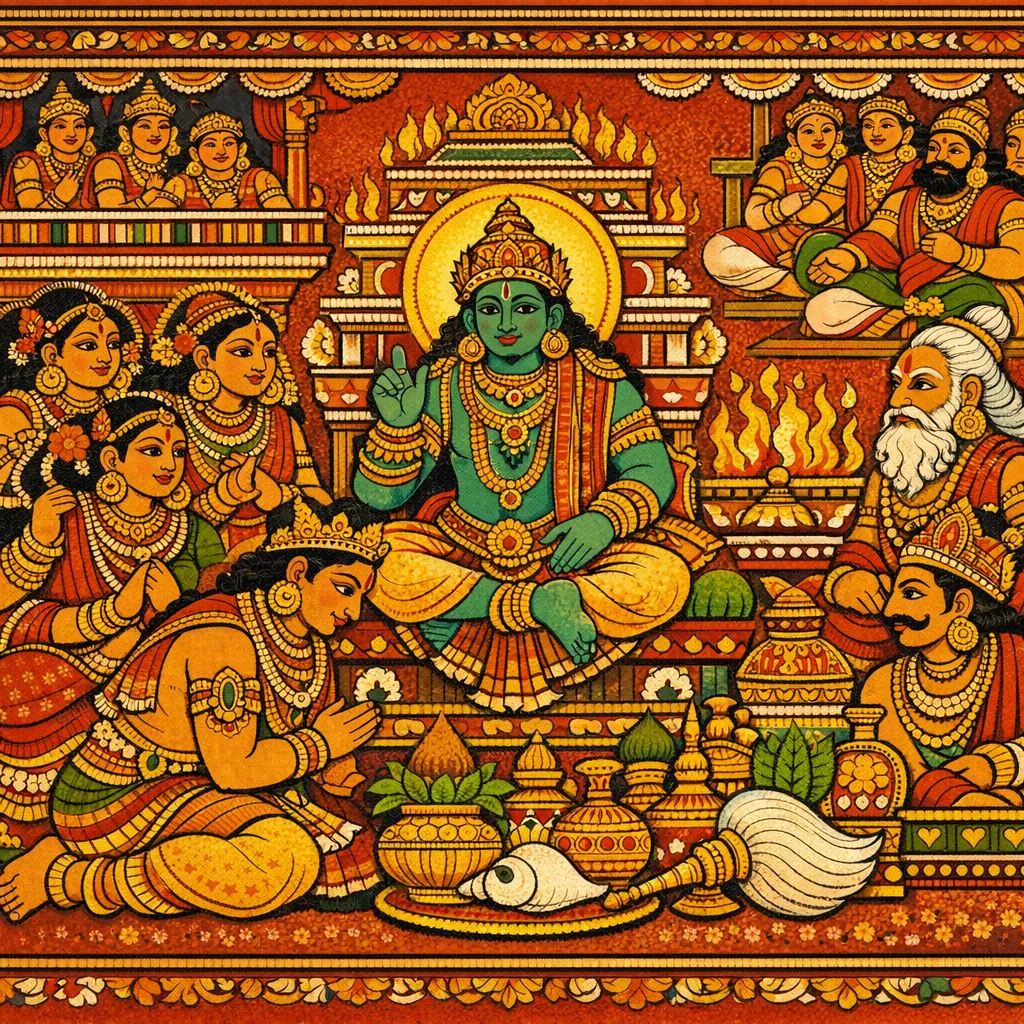
Adhyaya 34: Yayāti’s Rule, the Limits of Desire, and Pūru’s Coronation (Rajadharma & Genealogy)
ययातिचरिते राज्यधर्मः पूरुराज्याभिषेकश्च
Speaker: Śaunaka (narrator), Yayāti (speaker within the narrative), Brāhmaṇas and varṇas (assembly), Prakṛtayaḥ / ministers and citizens
Śaunaka recounts that Yayāti transfers his old age to his son and regains youth, yet rules as a dharmic king—performing yajñas and śrāddhas, giving gifts, honoring guests, protecting his subjects, and restraining criminals. After a thousand years he reflects on time and teaches Pūru that kāma is never satisfied by enjoyment and that true peace lies in śama, inner restraint and calm. He then returns youth to Pūru and takes back old age. When Yayāti seeks to consecrate the youngest son, the brāhmaṇa-led orders object on grounds of seniority (Yadu being eldest), but Yayāti declares that kingship belongs to the son who obeyed the father’s command; ministers and people agree, and Pūru is crowned. Yayāti departs for forest-life, and the chapter ends with the genealogical branches from Yayāti’s sons and the Paurava/Kuru line of sovereignty.
Key Concepts
Shlokas in Adhyaya 34
Verse 1
*शौनक उवाच एवमुक्तः स राजर्षिः काव्यं स्मृत्वा महाव्रतम् संक्रामयामास जरां तदा पुत्रे महात्मनि //
Śaunaka said: Thus addressed, that royal sage—remembering the great vow taught by Kāvya—then transferred his old age to his noble-minded son.
Verse 2
पौरवेणाथ वयसा ययातिर्नहुषात्मजः प्रीतियुक्तो नरश्रेष्ठश् चचार विषयान्प्रियान् //
Then Yayāti, the son of Nahusha, endowed with Puru’s youth, rejoicing as the best among men, moved about enjoying the pleasures and beloved objects of the senses.
Verse 3
यथाकामं यथोत्साहं यथाकालं यथासुखम् धर्माविरुद्धान्राजेन्द्रो यथार्हति स एव हि //
The best of kings should pursue (and grant) enjoyments as desired, as strength permits, at the proper time, and in a manner that brings ease—yet only those pleasures that do not conflict with dharma; for he alone truly deserves them.
Verse 4
देवान् अतर्पयद् यज्ञैः श्राद्धैरपि पितामहान् दीनाननुग्रहैरिष्टैः कामैश्च द्विजसत्तमान् //
By sacrifices (yajña) he satisfied the gods; by śrāddha rites he gratified the forefathers; and by compassionate aid to the poor and by granting desired gifts, he also pleased the foremost of the twice-born (brāhmaṇas).
Verse 5
अतिथीनन्नपानैश्च विशश्च प्रतिपालनैः आनृशंस्येन शूद्रांश्च दस्यून्निग्रहणेन च //
He should honor guests with food and drink, protect the common people by proper guardianship, treat Śūdras with compassion, and restrain bandits (dasyu) through firm control.
Verse 6
धर्मेण च प्रजाः सर्वा यथावद् अनुरञ्जयन् ययातिः पालयामास साक्षादिन्द्र इवापरः //
By righteousness (dharma), and by pleasing all his subjects in the proper manner, King Yayāti protected the people—like Indra himself, as though another Indra on earth.
Verse 7
स राजा सिंहविक्रान्तो युवा विषयगोचरः अविरोधेन धर्मस्य चचार सुखमुत्तमम् //
That king, lion-like in valor, though still young and engaged with the objects of sense, enjoyed the highest happiness—without ever coming into conflict with dharma.
Verse 8
स सम्प्राप्य शुभान्कामांस् तृप्तः खिन्नश्च पार्थिवः कालं वर्षसहस्रान्तं सस्मार मनुजाधिपः //
Having attained auspicious desires, the king—both satisfied and yet weary—began to reckon the passage of time, remembering the completion of a thousand years, O lord of men.
Verse 9
परिचिन्त्य स कालज्ञः कलाकाष्ठाश्च वीर्यवान् पूर्णम् मत्वा ततः कालं पूरुं पुत्रमुवाच ह //
Having reflected, that mighty one—skilled in discerning the proper time, even down to minutes and moments—judged the time to be fulfilled; then he spoke to his son Pūru.
Verse 10
न जातु कामः कामानाम् उपभोगेन शाम्यति हविषा कृष्णवर्त्मेव भूय एवाभिवर्धते //
Desire is never truly quenched by enjoying objects of desire; like a fire fed with oblations, it only blazes up all the more.
Verse 11
यत्पृथिव्यां व्रीहियवं हिरण्यं पशवः स्त्रियः नालमेकस्य तत्सर्वम् इति मत्वा शमं व्रजेत् //
Reflecting that all the rice and barley on earth, along with gold, cattle, and women, are not sufficient to satisfy even a single person completely, one should turn toward śama—tranquility and inner peace.
Verse 12
यथासुखं यथोत्साहं यथाकाममरिंदम सेविता विषयाः पुत्र यौवनेन मया तव //
O subduer of foes, my son—during youth I indulged in the sense-enjoyments as I pleased: according to comfort, according to my vigor, and according to my desire.
Verse 13
पूरो प्रीतो ऽस्मि भद्रं ते गृहाणेदं स्वयौवनम् राज्यं चैव गृहाणेदं त्वं हि मे प्रियकृत्सुतः //
“Pūru, I am pleased with you—may good be yours. Accept this very youthfulness of mine; accept the kingship as well, for you are the son who has done what is dear to me.”
Verse 14
*शौनक उवाच प्रतिपेदे जरां राजा ययातिर्नाहुषस्तदा यौवनं प्रतिपेदे स पूरुः स्वं पुनरात्मनः //
Śaunaka said: Then King Yayāti, the son of Nahuṣa, took old age upon himself; and Pūru, in turn, regained his own youth once again.
Verse 15
अभिषेक्तुकामं च नृपं पूरुं पुत्रं कनीयसम् ब्राह्मणप्रमुखा वर्णा इदं वचनमब्रुवन् //
When the king wished to consecrate (crown) Pūru—his youngest son—the social orders, headed by the Brāhmaṇas, spoke these words.
Verse 16
कथं शुक्रस्य दौहित्रं देवयान्याः सुतं प्रभो ज्येष्ठं यदुमतिक्रम्य राज्यं पूरोः प्रदास्यसि //
O Lord, how can you pass over Yadu—the eldest son, the grandson of Śukra and the son of Devayānī—and grant the kingdom to Pūru?
Verse 17
ज्येष्ठो यदुस्तव सुतस् तुर्वसुस्तदनन्तरम् शर्मिष्ठायाः सुतो द्रुह्युस् तथानुः पूरुरेव च //
Your eldest son was Yadu; next after him was Turvasu. From Śarmiṣṭhā were born Druhyu, Anu, and also Pūru.
Verse 18
कथं ज्येष्ठमतिक्रम्य कनीयान् राज्यमर्हति एतत्संबोधयामस्त्वां स्वधर्ममनुपालय //
How can the younger be fit to rule the kingdom, bypassing the elder? We admonish you about this—uphold your own dharma.
Verse 19
*ययातिरुवाच ब्राह्मणप्रमुखा वर्णाः सर्वे शृण्वन्तु मे वचः ज्येष्ठं प्रति यतो राज्यं न देयं मे कथंचन //
Yayāti said: “Let all the social orders, headed by the brāhmaṇas, listen to my words. Since the kingship is directed toward the eldest, I must not give it to anyone else, under any circumstances.”
Verse 20
मम ज्येष्ठेन यदुना नियोगो नानुपालितः प्रतिकूलः पितुर्यश्च न स पुत्रः सतां मतः //
My command was not obeyed by my eldest son Yadu; and whoever acts contrary to his father is not regarded by the virtuous as a true son.
Verse 21
मातापित्रोर्वचनकृद् धितः पथ्यश्च यः सुतः स पुत्रः पुत्रवद्यश्च वर्तते पितृमातृषु //
That son who carries out the words of his mother and father—who is beneficial and acts in a wholesome, proper way—he alone is truly a ‘son’; and likewise, whoever conducts himself toward his parents as a son should, is to be regarded as a son.
Verse 22
यदुनाहमवज्ञातस् तथा तुर्वसुनापि वा द्रुह्युणा चानुना चैवम् अप्यवज्ञा कृता भृशम् //
“I have been greatly slighted—by Yadu, and likewise by Turvasu, and also by Druhyu and Anu; thus, indeed, I have been treated with deep disrespect.”
Verse 23
पूरुणा मे कृतं वाक्यं मानितं च विशेषतः कनीयान्मम दायादो जरा येन धृता मम //
“Pūru has carried out my command and honored it with especial regard. Though he is my youngest heir, it is by him that my old age has been borne and supported.”
Verse 24
मम कामः स च कृतः पूरुणा पुत्ररूपिणा शुक्रेण च वरो दत्तः काव्येनोशनसा स्वयम् //
“My desire, too, has been fulfilled by Pūru, who has become to me as a son; and a boon was granted by Śukra—Kāvya Uśanā himself—of his own accord.”
Verse 25
पुत्रो यस्त्वानुवर्तेत स राजा पृथिवीपतिः भवन्तः प्रतिजानन्तु पूरू राज्ये ऽभिषिच्यताम् //
“That son who truly follows my command and dharma—he alone shall be the king, the lord of the earth. Let you all affirm this: let Pūru be consecrated to the sovereignty.”
Verse 26
*प्रकृतय ऊचुः यः पुत्रो गुणसम्पन्नो मातापित्रोर्हितः सदा सर्वं सो ऽर्हति कल्याणं कनीयानपि स प्रभुः //
The ministers said: “That son who is endowed with virtues and is ever devoted to the welfare of his mother and father deserves every blessing and prosperity; even if he is the younger, he is fit to be the lord.”
Verse 27
अर्हं पूरोरिदं राज्यं यः प्रियः प्रियकृत् तव वरदानेन शुक्रस्य न शक्यं वक्तुमुत्तरम् //
“This kingdom rightly belongs to Pūru, for he is dear to you and acts for your good. And because of the boon granted by Śukra, no contrary reply can be given.”
Verse 28
*शौनक उवाच पौरजानपदैस् तुष्टैर् इत्युक्तो नाहुषस्तदा अभिषिच्य ततः पूरुं राज्ये स्वसुतमात्मजम् //
Śaunaka said: Thus addressed by the delighted citizens and people of the countryside, Nahūṣa then consecrated his own son Pūru and installed him in the kingship.
Verse 29
दत्त्वा च पूरवे राज्यं वनवासाय दीक्षितः पुरात्स निर्ययौ राजा ब्राह्मणैस्तापसैः सह //
Having bestowed the kingdom upon Pūru, the king—consecrated for the forest-dwelling vow (vanavāsa)—departed from the ancient city, accompanied by Brāhmaṇas and ascetics (tapasvin).
Verse 30
यदोस्तु यादवा जातास् तुर्वसोर्यवनाः सुताः द्रुह्योश्चैव सुता भोजा अनोस्तु म्लेच्छजातयः //
From Yadu were born the Yādavas; from Turvasu, the Yavanas; from Druhyu, the Bhojas; and from Anu arose the various Mleccha peoples.
Verse 31
पूरोस्तु पौरवो वंशो यत्र जातो ऽसि पार्थिव इदं वर्षसहस्रात्तु राज्यं कुरुकुलागतम् //
From Pūru arises the Paurava lineage, in which you were born, O king. This sovereignty has come down in the Kuru family for a thousand years.
Frequently Asked Questions
The chapter teaches that a ruler may pursue pleasure only within dharma, and that desire (kāma) is not satisfied by indulgence—like fire fed by offerings it increases. Therefore, after experiencing the limits of enjoyment, one should cultivate śama (tranquility). It also instructs that true worthiness for kingship is grounded in obedience to righteous command and service to parents, not merely birth order.
This adhyāya is primarily Rajadharma and genealogy. It outlines kingly duties (yajña, śrāddha, charity, atithi-honor, protection of subjects, compassion to Śūdras, and suppression of bandits), gives a philosophical reflection on desire and inner peace, and closes with dynastic mapping from Yayāti’s sons—Yādavas (Yadu), Yavanas (Turvasu), Bhojas (Druhyu), Mleccha groups (Anu), and the Paurava/Kuru sovereignty through Pūru.
Yayāti argues that although kingship generally follows the eldest, his elder sons disobeyed his command regarding bearing his old age. Pūru alone accepted and fulfilled the father’s order, and Yayāti defines a ‘true son’ as one who carries out the beneficial words of mother and father. With ministerial and public assent—and supported by Śukra’s boon—Pūru is consecrated.
No. Adhyāya 34 is not a Vastu/architecture chapter; it is an ethical-political and genealogical narrative centered on Yayāti’s rule, the regulation of kāma by dharma, succession ethics, and lineage outcomes.