Adhyaya 132: The Terror of Tripura and the Gods’ Hymn to Śiva (Prelude to Tripuradahana)
त्रिपुरोपद्रव-वर्णनं रुद्रस्तुतिश्च
Speaker: Sūta, The Thirty-three Gods (Ādityas, Vasus, Sādhyas, Pitṛs, Maruts; with Indra), Brahmā (Pitamaha, Padmayoni), The Gods (as hymn-chanters to Śiva)
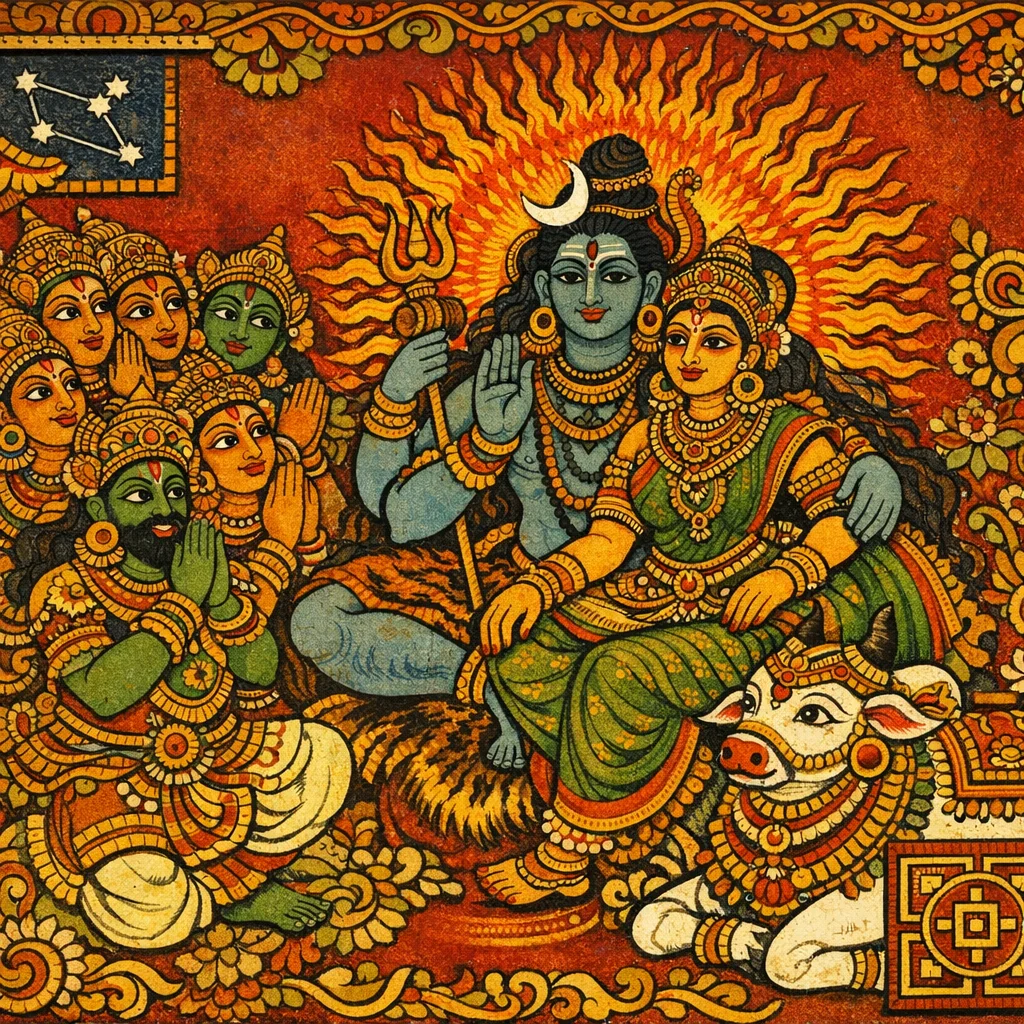
Sūta recounts how the Dānavas of Tripura ravage the three worlds, ruin devasthānas and the sages’ āśramas, and cast all beings into fear and darkness. The gods—Ādityas, Vasus, Sādhyas, Pitṛs, and Maruts—approach Brahmā on the golden lotus, begging for guidance and protection. Brahmā declares that the term of the former boon has ended and that Tripura must be destroyed by one decisive arrow; none among the gods can accomplish it except Mahādeva. He urges their united supplication to Hara, and points to the Viṣkambha rite and Puṣya-yoga as instant removers of obstacles. Brahmā and the gods then enter Śiva’s sabhā, behold him with Umā and Nandin, and offer a long hymn praising his many forms and functions—terrible and auspicious, cosmic, and compassionately responsive to the devotees’ hearts.
Key Concepts
Shlokas in Adhyaya 132
Verse 1
*सूत उवाच अशीलेषु प्रदुष्टेषु दानवेषु दुरात्मसु लोकेषूत्साद्यमानेषु तपोधनवनेषु च //
Sūta said: When the wicked Dānavas—bereft of right conduct and of evil nature—were laying waste to the worlds, and even the forest-hermitages of the ascetic sages, rich in tapas (tapodhana), were being ravaged,
Verse 2
सिंहनादे व्योमगानां तेषु भीतेषु जन्तुषु त्रैलोक्ये भयसंमूढे तमोन्धन्वम् उपागते //
As the sky-ranging beings roared like lions, all creatures became terrified; the three worlds, bewildered by fear, were overtaken by a blinding mass of darkness.
Verse 3
आदित्या वसवः साध्याः पितरो मरुतां गणाः भीताः शरणमाजग्मुर् ब्रह्माणां प्रपितामहम् //
Frightened, the Ādityas, the Vasus, the Sādhyas, the Pitṛs, and the hosts of the Maruts went for refuge to the Primeval Grandsire—Brahmā, the forefather of the gods.
Verse 4
ते तं स्वर्णोत्पलासीनं ब्रह्माणं समुपागताः नेमुरूचुश्च सहिताः पञ्चास्यं चतुराननम् //
Together they approached Brahmā, who was seated upon a golden lotus; and, bowing down in unison, they addressed that four-faced Lord—also praised as the five-faced one.
Verse 5
वरगुप्तास्तवैवेह दानवास्त्रिपुरालयाः बाधन्ते ऽस्मान्यथा प्रेष्यान् अनुशाधि ततो ऽनघ //
Though sheltered by your boons, the Dānavas dwelling in Tripura still torment us here, treating us as mere servants. Therefore, O sinless one, instruct us as to what should be done.
Verse 6
मेघागमे यथा हंसा मृगाः सिंहभयादिव दानवानां भयात्तद्वद् भ्रमामो हि पितामह //
Just as swans wander when the rains arrive, and as deer roam in fear of a lion, so too—out of fear of the Dānavas—we are driven to wander, O Pitāmaha (Grandfather).
Verse 7
पुत्राणां नामधेयानि कलत्राणां तथैव च दानवैर्भ्राम्यमाणानां विस्मृतानि ततो ऽनघ //
Thereupon, O sinless one, as they were driven about in confusion by the Dānavas, the very names of their sons—and likewise of their wives—were forgotten.
Verse 8
देववेश्मप्रभङ्गाश्च आश्रमभ्रंशनानि च दानवैर्लोममोहान्धैः क्रियन्ते च भ्रमन्ति च //
Temples of the gods are shattered, and hermitages (āśramas) are brought to ruin; deluded Dānavas—blinded by wild frenzy—commit these acts and roam about in disorder.
Verse 9
यदि न त्रायसे लोकं दानवैर्विद्रुतं द्रुतम् धर्षणानेन निर्देवं निर्मनुष्याश्रमं जगत् //
If you do not swiftly protect the world, which has been quickly thrown into panic by the Dānavas through this violent outrage, then the cosmos will become godless and devoid of the human āśrama order.
Verse 10
इत्येवं त्रिदशैरुक्तः पद्मयोनिः पितामहः प्रत्याह त्रिदशान् सेन्द्रान् इन्दुतुल्याननः प्रभुः //
Thus addressed by the thirty-three gods, the Lotus-born Grandsire (Brahmā)—the lord whose face was like the moon—replied to the gods, Indra included.
Verse 11
भयस्य यो वरो दत्तो मया मतिमतां वराः तस्यान्त एष सम्प्राप्तो यः पुरोक्तो मया सुराः //
O best of the wise, the boon concerning fear that I granted—its appointed conclusion has now arrived, O gods, exactly as I previously declared.
Verse 12
तच्च तेषामधिष्ठानं त्रिपुरं त्रिदशर्षभाः एकेषुपातमोक्षेण हन्तव्यं नेषुवृष्टिभिः //
And that stronghold of theirs—Tripura—O best of the gods, must be destroyed by the discharge of a single arrow, not by showers of arrows.
Verse 13
भवतां च न पश्यामि कमप्यत्र सुरर्षभाः यस्तु चैकप्रहारेण पुरं हन्यात् सदानवम् //
O foremost of the gods, I do not see anyone among you here who could, with a single blow, destroy that city together with its demons.
Verse 14
त्रिपुरं नाल्पवीर्येण शक्यं हन्तुं शरेण तु एकं मुक्त्वा महादेवं महेशानं प्रजापतिम् //
Tripura cannot be slain by an arrow wielded with only slight power; except for Mahādeva—Maheśāna, the Lord who is also the Prajāpati—no one is able to destroy it with a single shot.
Verse 15
ते यूयं यदि अन्ये च क्रतुविध्वंसकं हरम् याचामः सहिता देवं त्रिपुरं स हनिष्यति //
If you and the others unite, let us beseech Hara—the destroyer of sacrifices; joined together, we shall petition that god, and he will slay Tripura.
Verse 16
कृतः पुराणां विष्कम्भो योजमानां शतं शतम् यथा चैकप्रहारेण हन्यते वै भवेन तु पुष्ययोगेण युक्तानि तानि चैकक्षणेन तु //
When the rite called Viṣkambha is duly performed, even hundreds upon hundreds of accumulated obstacles are set aside; just as by sheer force a foe may be struck down with a single blow, so too, when the work is joined with Puṣya-yoga, those impediments are removed in an instant.
Verse 17
ततो देवैश्च सम्प्रोक्तो यास्याम इति दुःखितैः पितामहश्च तैः सार्धं भवसंसदमागतः //
Then, urged on by the sorrowing gods—saying, “Let us go”—the Grandfather (Brahmā) too, together with them, went to the assembly-hall of Bhava (Śiva).
Verse 18
तं भवं भूतभव्येशं गिरिशं शूलपाणिनम् पश्यन्ति चोमया सार्धं नन्दिना च महात्मना //
They behold Bhava—Lord of what has been and what will be—Girīśa, the Mountain-Lord, bearing the trident in his hand, together with Umā, and also with the great-souled Nandin.
Verse 19
अग्निवर्णमजं देवम् अग्निकुण्डनिभेक्षणम् अग्न्यादित्यसहस्राभम् अग्निवर्णविभूषितम् //
He should be depicted as the unborn divine Lord, fiery in hue—his gaze like a blazing fire-pit—radiant as a thousand fires and suns, and adorned with the splendor of flame-like color.
Verse 20
चन्द्रावयवलक्ष्माणं चन्द्रसौम्यतराननम् आगम्य तमजं देवम् अथ तं नीललोहितम् अस्तुवन्गोपतिं शम्भुं वरदं पार्वतीपतिम् //
Approaching that unborn God, marked with the auspicious signs of the moon and with a face made yet more gentle by the moon, they praised Nīlalohita—Śambhu, Lord of beings, bestower of boons, the husband of Pārvatī.
Verse 21
*देवा ऊचुः नमो भवाय शर्वाय रुद्राय वरदाय च पशूनां पतये नित्यम् उग्राय च कपर्दिने //
The gods said: “Salutations to Bhava, to Śarva, to Rudra, and to the bestower of boons; ever salutations to Paśupati, Lord of beings, to the fierce One, and to Him who bears the braided, matted hair (Kapardin).”
Verse 22
महादेवाय भीमाय त्र्यम्बकाय च शान्तये ईशानाय भयघ्नाय नमस्त्वन्धकघातिने //
Salutations to Mahādeva, to Bhīma, to Tryambaka, and to the giver of peace; salutations to Īśāna, the destroyer of fear—obeisance to the slayer of Andhaka.
Verse 23
नीलग्रीवाय भीमाय वेधसे वेधसा स्तुते कुमारशत्रुनिघ्नाय कुमारजनकाय च //
Salutations to the Blue-throated One (Nīlagrīva), to Bhīma, to the Creator (Vedhas)—praised by the Creator; and to the slayer of Kumāra’s foes, and to the father of Kumāra.
Verse 24
विलोहिताय धूम्राय वराय क्रथनाय च नित्यं नीलशिखण्डाय शूलिने दिव्यशायिने //
Ever do I bow to the tawny-red One (Vilohita), the smoke-hued One, the Excellent One, and the ever-crushing destroyer of evil; to Him with the dark-blue crest of matted hair, the wielder of the trident, who reposes in divine majesty.
Verse 25
उरगाय त्रिनेत्राय हिरण्यवसुरेतसे अचिन्त्यायाम्बिकाभर्त्रे सर्वदेवस्तुताय च //
Salutations to Him who is associated with serpents, to the Three-eyed Lord; to Him whose vital seed is golden and radiant; to the inconceivable One; to the consort of Ambikā (Pārvatī); and to Him who is praised by all the gods.
Verse 26
वृषध्वजाय मुण्डाय जटिने ब्रह्मचारिणे तप्यमानाय सलिले ब्रह्मण्यायाजिताय च //
Salutations to the Bull-bannered Lord; to the shaven-headed ascetic; to the matted-haired one; to the brahmacārin, the celibate student of Brahman; to Him who performs austerities in water; to the protector of sacred tradition; and to the Unconquered.
Verse 27
विश्वात्मने विश्वसृजे विश्वमावृत्य तिष्ठते नमो ऽस्तु दिव्यरूपाय प्रभवे दिव्यशम्भवे //
Salutations to Him who is the Soul of the universe, the Creator of the universe—who, pervading all, abides within it. Homage to the One of divine form, the supreme Lord, the auspicious Divine, Śambhu.
Verse 28
अभिगम्याय काम्याय स्तुत्यायार्च्याय सर्वदा भक्तानुकम्पिने नित्यं दिशते यन्मनोगतम् //
He is ever approachable, the fulfiller of desires, always worthy of praise and worship; and, out of constant compassion for His devotees, He continually grants whatever is in their hearts.
Frequently Asked Questions
The chapter teaches that when adharma overwhelms the worlds, protection requires both right counsel and the correct agent. Brahmā explains that Tripura’s destruction is bound by a condition: it must be ended by a single, decisive arrow, and only Mahādeva can fulfill that condition. The gods therefore must unite, seek refuge in Śiva, and praise him—showing that cosmic problems caused by boon-protected forces are resolved through divinely sanctioned timing, concentrated action, and surrender (śaraṇāgati) to the supreme.
This adhyāya is primarily Dharma and theology within a Devāsura narrative: it emphasizes the destruction of temples and āśramas (social-religious order), the limits of boons, and the necessity of Śiva for restoring cosmic stability. It is not a Vāstu-śāstra or genealogy chapter, though it contains iconographic description relevant to Śaiva visualization and worship, and it briefly references a ritual/astrological framework (Viṣkambha, Puṣya-yoga) for removing obstacles.
Brahmā states that Tripura is not to be destroyed by showers of arrows but by one arrow-release (ekēṣupāta), implying a boon-bound condition: ordinary force cannot override the protective structure of the Dānavas’ blessing. The single-arrow requirement also frames the coming act as a uniquely Śaiva, decisive intervention rather than a conventional battle.
The text says that when the rite called Viṣkambha is properly performed, even vast accumulations of obstacles are set aside, and that when the undertaking is joined with Puṣya-yoga, impediments are removed instantly. In context, these serve as ritual-astrological assurances that the gods’ mission to seek Śiva and remove Tripura’s threat can proceed with obstacles neutralized by correct rite and auspicious timing.