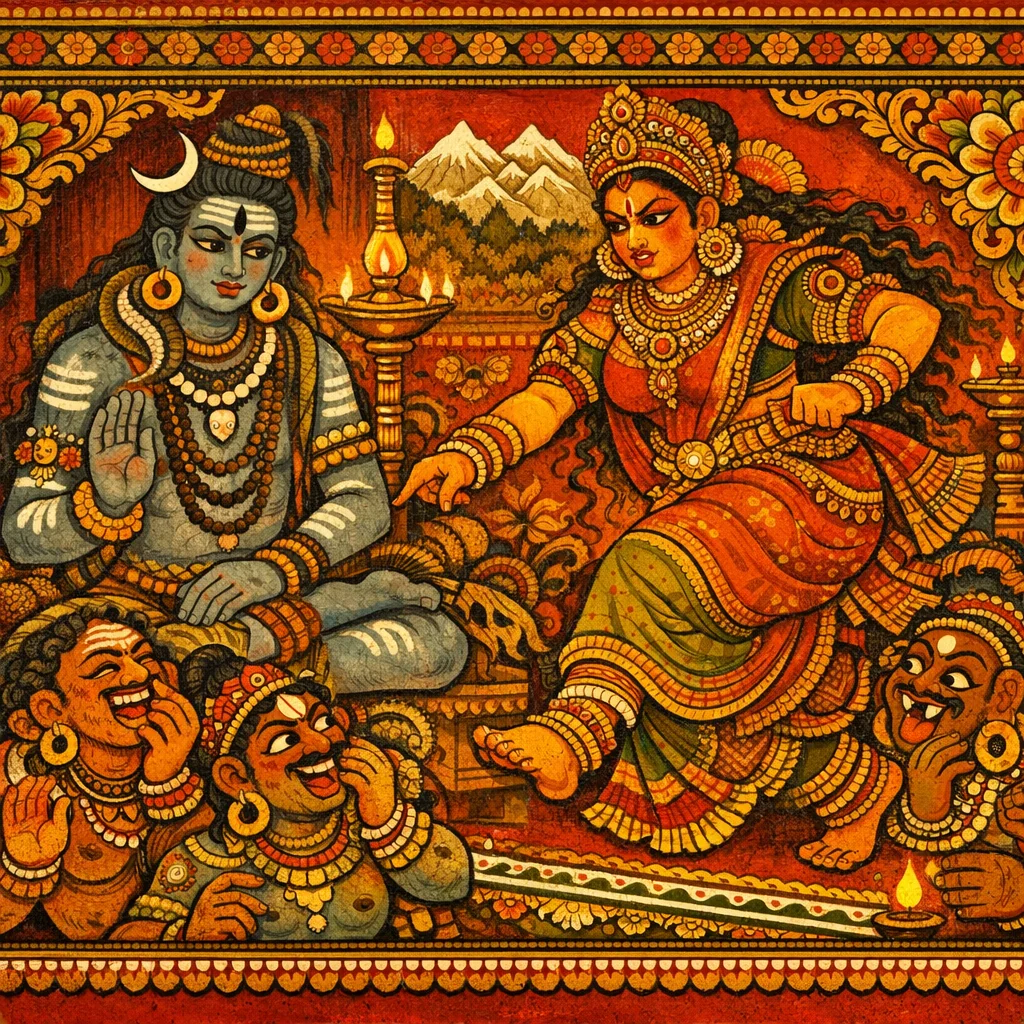
Adhyaya 155: Śiva–Pārvatī Quarrel and Pārvatī’s Resolve for Austerity to Attain Gaurī-hood
शर्व-गिरिजा-कलहः । गौरीत्व-प्राप्त्यर्थं तपो-निश्चयः
Speaker: Śarva (Śiva/Bhava/Pinākin/Purāntaka/Girīśa), Girijā/Umā/Satī/Himādrijā (Pārvatī), Sūta, Vīraka, Deveśa-gaṇas (divine hosts)
Śiva speaks to Pārvatī, likening a white, fragrant radiance clinging to his body to sandal paste, and remarks that her presence brings a “blemish” to his sight. Angered, Pārvatī reflects on social humiliation and accuses Śiva—despite her sincerity—of being famed as a refuge of faults. She rejects specific blame (Pūṣan’s teeth, Bhaga’s eyes) and declares she will depart for mountain-austerities. Śiva replies that she misunderstands him: out of devotion he invoked her Name as his refuge; he pleads gently and warns that jesting with an angry person only worsens harm. Still wounded, Pārvatī tries to leave as Śiva tugs her garment; he says she resembles Himavat and is hard to fathom like clouded Himalayan peaks. Pārvatī counters: do not slander the virtuous; association transmits taint, and she lists how Śiva’s emblems seem to imply defects, then exits. The gaṇas weep and follow; Vīraka clings to her feet. She consoles him, explains her tapas to attain Gaurī-hood, and orders strict door-guarding so no women enter Śiva’s private quarters; Vīraka accepts and returns within to bow.
Key Concepts
Shlokas in Adhyaya 155
Verse 1
*शर्व उवाच शरीरे मम तन्वङ्गि सिते भास्यसितद्युतिः भुजंगीवासिता शुद्धा संश्लिष्टा चन्दने तरौ //
Śarva (Śiva) said: “O slender-limbed fair one, upon My body there shines a radiant, pure, white splendour—made fragrant as if by serpents—closely clinging, like sandal-paste upon a tree.”
Verse 2
चन्द्रातपेन संपृक्ता रुचिराम्बरया तथा रजनीवासिते पक्षे दृष्टिदोषं ददासि मे //
Mixed with moonlight and sunlight, and likewise adorned with a lovely garment; in the fortnight perfumed by the night, you bring a blemish to my sight.
Verse 3
इत्युक्ता गिरिजा तेन मुक्तकण्ठा पिनाकिना उवाच कोपरक्ताक्षी भ्रुकुटीकुटिलानना //
Thus addressed by him—by Pinākin (Śiva), the bearer of the bow Pināka—Girijā (Pārvatī), her throat unrestrained, spoke with eyes reddened in anger and a face contorted by a knitted frown.
Verse 4
*देव्युवाच स्वकृतेन जनः सर्वो जाड्येन परिभूयते अवश्यमर्थी प्राप्नोति खण्डनां जनमण्डले //
The Goddess said: Every person is brought low by his own doing through dull-wittedness; and one who is inevitably driven by need comes to suffer humiliation and being “cut down” in the circle of people, that is, in society.
Verse 5
तपोभिर्दीर्घचरितैर् यच्च प्रार्थितवत्यहम् तस्या मे नियतस्त्वेष ह्य् अवमानः पदे पदे //
Yet for that very boon which I had sought through austerities and long, sustained observances—this is what has become fixed for me: humiliation at every step.
Verse 6
नैवास्मि कुटिला शर्व विषमा नैव धूर्जटे सविषयस्त्वं गतः ख्यातिं व्यक्तदोषाकराश्रयः //
“I am not deceitful, O Śarva; nor am I unfair, O Dhūrjaṭi. Yet you have become widely known—together with your attendant ‘domain’—as a manifest refuge of a mine of faults.”
Verse 7
नाहं पूष्णो ऽपि दशना नेत्रे चास्मि भगस्य हि आदित्यश्च विजानाति भगवान्द्वादशात्मकः //
“I am not the teeth of Pūṣan; nor indeed am I the eyes of Bhaga. The Lord Sun—who is twelvefold in nature—knows (and apportions) these (functions) as he truly is.”
Verse 8
मूर्ध्नि शूलं जनयसि स्वैर्दोषैर्मामधिक्षिपन् यस्त्वं मामाह कृष्णेति महाकालेति विश्रुतः //
You cause a piercing pain in my head, hurling abuse at me because of your own faults—though you are famed as the one who calls me “Kṛṣṇa,” and as “Mahākāla.”
Verse 9
यास्याम्यहं परित्यक्त्वा चात्मानं तपसा गिरिम् जीवन्त्या नास्ति मे कृत्यं धूर्तेन परिभूतया //
“I shall depart, abandoning myself to austerity upon the mountain. For me, while I yet live—having been deceived and dishonoured by a wicked man—there is nothing left to do.”
Verse 10
निशम्य तस्या वचनं कोपतीक्ष्णाक्षरं भवः उवाचाविष्टसंभ्रान्तिप्रणयोन्मिश्रया गिरा //
Hearing her words—sharp with anger—Bhava replied in a voice mingled with agitation, fluster, and lingering affection.
Verse 11
*शर्व उवाच अनात्मज्ञासि गिरिजे नाहं निन्दापरस्तव त्वद्भक्तिबुद्ध्या कृतवांस् तवाहं नामसंश्रयम् //
Śarva said: “O Girijā, you do not understand my inner intent. I am not one who is devoted to blaming you. Rather, it was with the attitude of devotion toward you that I resorted to your Name as my refuge.”
Verse 12
विकल्पः स्वस्थचित्ते ऽपि गिरिजे नैव कल्पना यद्येवं कुपिता भीरु त्वं तवाहं न वै पुनः //
O Girijā, even with a composed mind one should not indulge in wavering doubts or fanciful conjectures. If you are thus angered, timid one, then I am not yours—nor are you mine—any longer.
Verse 13
नर्मवादी भविष्यामि जहि कोपं शुचिस्मिते शिरसा प्रणतश्चाहं रचितस्ते मयाञ्जलिः //
“I shall speak gently and with pleasing words. Abandon your anger, O you of the pure smile. I bow my head before you, and with my hands I have formed this reverent salutation (añjali) for you.”
Verse 14
स्नेहेनाप्यवमानेन निन्दितेनैति विक्रियाम् तस्मान्न जातु रुष्टस्य नर्मस्पृष्टो जनः किल //
Even affectionate familiarity, when mixed with disrespect and blame, turns into distortion and harm. Therefore, one should never address an angry person with joking or playful speech—so it is said.
Verse 15
अनेकैश्चाटुभिर्देवी देवेन प्रतिबोधिता कोपं तीव्रं न तत्याज सती मर्मणि घट्टिता //
Though the Goddess was repeatedly placated by the god with many conciliatory words, Sati did not abandon her fierce anger, for she had been wounded at her very core.
Verse 16
अवष्टब्धम् अथास्फाल्य वासः शंकरपाणिना विपर्यस्तालका वेगाद् यातुमैच्छत शैलजा //
Then, with Śaṅkara’s hand clutching and tugging at her garment, the Mountain-born Goddess—her tresses thrown into disarray—sought to depart in haste.
Verse 17
तस्या व्रजन्त्याः कोपेन पुनराह पुरान्तकः सत्यं सर्वैरवयवैः सुतासि सदृशी पितुः //
As she departed in anger, Purāntaka spoke again: “Truly, in every limb and feature you are a daughter who resembles your father.”
Verse 18
हिमाचलस्य शृङ्गैस्तैर् मेघजालाकुलैर्नभः तथा दुरवगाह्येभ्यो हृदयेभ्यस्तवाशयः //
As the sky is thickly veiled by those cloud-masses around the peaks of the Himālaya, so too your inner intention remains hard to fathom for minds of difficult access.
Verse 19
काठिन्याङ्कस्त्वमस्मभ्यं वनेभ्यो बहुधा गता कुटिलत्वं च वर्त्मभ्यो दुःसेव्यत्वं हिमादपि संक्रान्तिं सर्वदैवेति तन्वङ्गि हिमशैलराट् //
O slender-limbed one, from the forests you have often brought us the mark of hardship; from the paths, their crookedness; from the cold itself, the difficulty of being approached and endured. Thus, at every saṅkrānti—the gods’ transitions—the sovereign of snowy mountains, Himavat, is remembered as the source of such trials.
Verse 20
इत्युक्ता सा पुनः प्राह गिरिशं शैलजा तदा कोपकम्पितमूर्धा च प्रस्फुरद्दशनच्छदा //
Thus addressed, Śailajā (Pārvatī) then spoke again to Girīśa (Śiva), her head trembling with anger, and her lips quivering as her teeth flashed.
Verse 21
*उमोवाच मा सर्वान्दोषदानेन निन्दान्यान्गुणिनो जनान् तवापि दुष्टसंपर्कात् संक्रान्तं सर्वमेव हि //
Umā said: “Do not, by imputing faults to all, slander other virtuous people. For through association with the wicked, every taint indeed gets transmitted to you as well.”
Verse 22
व्यालेभ्यो ऽनेकजिह्वत्वं भस्मना स्नेहबन्धनम् हृत्कालुष्यं शशाङ्कात्तु दुर्बोधित्वं वृषादपि //
From serpents arises the state of having many tongues; from ash comes the binding of affection (attachment). From the Moon comes the defilement of the heart; and from the bull as well comes dullness of understanding.
Verse 23
तथा बहु किमुक्तेन अलं वाचा श्रमेण ते श्मशानवासान् निर्भीस् त्वं नग्नत्वान्न तव त्रपा निर्घृणत्वं कपालित्वाद् दया ते विगता चिरम् //
But why say more? Enough—my words are wasted effort on you. Dwelling in cremation grounds, you have become fearless; because of your nakedness you feel no shame. And because you follow the skull-bearing way, you have become pitiless—your compassion has long since vanished.
Verse 24
*सूत उवाच इत्युक्त्वा मन्दिरात्तस्मान् निर्जगाम हिमाद्रिजा //
Sūta said: Having spoken thus, Himādrijā (Pārvatī, the daughter of Himālaya) departed from that temple.
Verse 25
तस्यां व्रजन्त्यां देवेशगणैः किलकिलो ध्वनिः क्व मातर्गच्छसि त्यक्त्वा रुदन्तो धाविताः पुनः //
As she was departing, a clamorous cry arose from the hosts of the lords of the gods: “Mother! Where are you going, leaving us behind?”—and they ran after her again, weeping.
Verse 26
विष्टभ्य चरणौ देव्या वीरको बाष्पगद्गदम् प्रोवाच मातः किंत्वेतत् क्व यासि कुपितान्तरा //
Clasping the feet of the goddess, Vīraka—his voice choked with tears—said: “Mother, what is this? Where are you going, with anger burning within you?”
Verse 27
अहं त्वामनुयास्यामि व्रजन्तीं स्नेहवर्जिताम् नो चेत्पतिष्ये शिखरात् तपोनिष्ठे त्वयोज्झितः //
I shall follow you as you depart, even if you go devoid of affection. Otherwise, O steadfast one in austerity, abandoned by you, I shall fall from the mountain peak.
Verse 28
उन्नाम्य वदनं देवी दक्षिणेन तु पाणिना उवाच वीरकं माता शोकं पुत्रक मा कृथाः //
Lifting up his face with her right hand, the goddess-like mother said to Vīraka: “My child, do not give way to grief.”
Verse 29
शैलाग्रात्पतितुं नैव न चागन्तुं मया सह युक्तं ते पुत्र वक्ष्यामि येन कार्येण तच्छृणु //
“It is not fitting for you to leap from the mountain peak, nor is it proper for you to come along with me. O son, I shall tell you what must be done—listen to that.”
Verse 30
कृष्णेत्युक्त्वा हरेणाहं निन्दिता चाप्यनिन्दिता सार्हं तपः करिष्यामि येन गौरीत्वमाप्नुयाम् //
“Having been addressed as ‘Kṛṣṇā’ by Hari, I was reproached, and yet I was not truly blameworthy. Therefore, with due observances, I shall undertake austerity, by which I may attain the state of Gaurī—fair and auspicious radiance.”
Verse 31
एष स्त्रीलम्पटो देवो यातायां मय्यनन्तरम् द्वाररक्षा त्वया कार्या नित्यं रन्ध्रान्ववेक्षिणा //
“This god is lustful toward women. After I have departed on my journey, you must keep watch at the door—ever vigilant, scrutinizing every opening and loophole.”
Verse 32
यथा न काचित् प्रविशेद् योषिदत्र हरान्तिकम् दृष्ट्वा परांस्त्रियं चात्र वदेथा मम पुत्रक //
See that no woman enters here into the private proximity of another man. And if you happen to see another man’s wife here, speak up at once: “She is mine, my son!”
Verse 33
शीघ्रम् एव करिष्यामि यथायुक्तम् अनन्तरम् एवमस्त्विति देवीं स वीरकः प्राह सांप्रतम् //
“I shall do it swiftly—exactly as is proper—without delay.” Thus, at that moment, Vīraka addressed the Goddess, saying, “So be it.”
Verse 34
मातुराज्ञामृताह्लादप्लाविताङ्गो गतज्वरः जगाम कक्षां संद्रष्टुं प्रणिपत्य च मातरम् //
His whole being, flooded with nectar-like joy at his mother’s command, and his fever now gone, he went to the inner chamber to see his mother and bowed down before her.
Frequently Asked Questions
The chapter teaches speech-dharma within close relationships: affectionate familiarity becomes harmful when mixed with disrespect and blame, and one should not use joking speech toward an angry person. It also highlights how misunderstanding intent escalates conflict, and how tapas (disciplined austerity) is presented as a means of inner transformation and restoration of auspicious identity (Umā’s resolve to attain ‘Gaurī’ after being called ‘Kṛṣṇā’).
This adhyāya is primarily mythic-theological and ethical (Shaiva narrative and dharma of speech), not Vastu Shastra, Rajadharma, creation cosmology, or genealogy. Its key themes are Śiva–Pārvatī samvāda, honor/shame dynamics, ascetic symbolism, and the vow of tapas aimed at attaining Gaurī-hood.
Read Matsya Purana in the Vedapath app
Scan the QR code to open this directly in the app, with audio, word-by-word meanings, and more.