Adhyaya 63: Rasakalyāṇinī Vrata: Magha-based Goddess Worship, Monthly Abstinences, and Merit
रसकल्याणिनीव्रतविधिः (कुमुदादेवीपूजा-लवणव्रतम्)
Speaker: Īśvara (speaker/instructor)
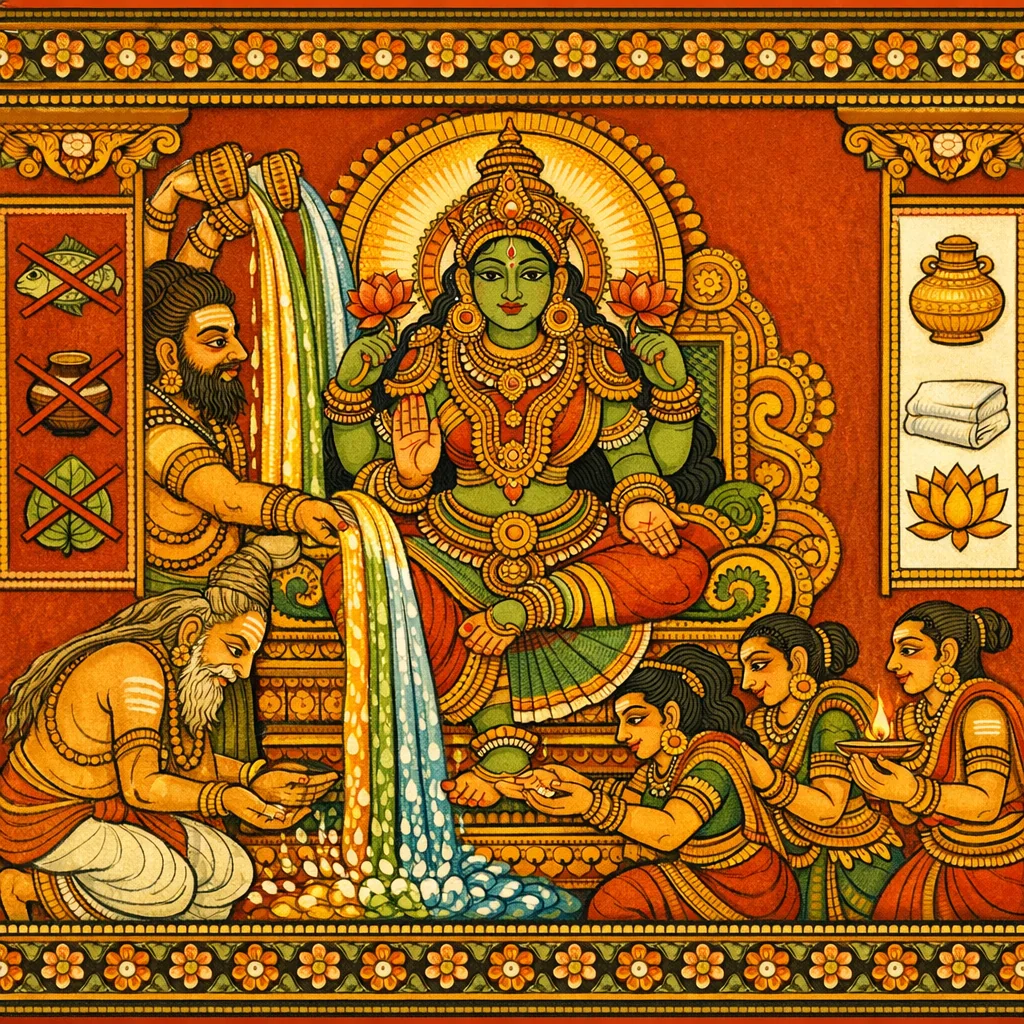
Īśvara continues the ritual sequence by introducing the “third” expiatory vow, the Rasakalyāṇinī Vrata. He specifies initiation in the month of Māgha with bathing rules, describes Devī’s abhiṣeka, and teaches limb-worship performed from right to left, assigning particular epithets of the Goddess to each bodily region. He then prescribes ongoing monthly observances: abstaining from designated foods each month, taking pañcagavya, fasting (or, if unable, eating only at night), and repeatedly giving gifts such as a kumbha, garments, and a golden lotus. The vow concludes with making a small golden icon of Gaurī and donating white cattle; Īśvara declares its fruits—immediate release from sins, vast merit equal to many Agniṣṭomas, special benefit for women, and merit even for those who recite or hear this chapter.
Key Concepts
Shlokas in Adhyaya 63
Verse 1
*ईश्वर उवाच अथान्यामपि वक्ष्यामि तृतीयां पापनाशिनीम् रसकल्याणिनीमेतां पुराकल्पविदो विदुः //
Īśvara said: “Now I shall also describe another procedure—the third, the sin-destroying one. This is called the Rasakalyāṇinī, and the knowers of the ancient ritual ordinances (kalpa) have recognized it as such.”
Verse 2
माघमासे तु सम्प्राप्ते तृतीयां शुक्लपक्षतः प्रातर्गव्येन पयसा तिलैः स्नानं समाचरेत् //
When the month of Māgha arrives, on the third lunar day of the bright fortnight, one should duly perform a morning bath using cow’s milk together with sesame seeds.
Verse 3
स्नापयेन्मधुना देवीं तथैवेक्षुरसेन च गन्धोदकेन तु पुनर् लेपयेत्कुङ्कुमेन तु दक्षिणाङ्गानि सम्पूज्य ततो वामानि पूजयेत् //
One should bathe the Goddess with honey, and likewise with sugarcane juice. Then again, with scented water, one should anoint her with saffron (kuṅkuma). Having fully worshipped the right-side limbs first, one should thereafter worship the left-side limbs.
Verse 4
ललितायै नमो देव्याः पादौ गुल्फौ ततो ऽर्चयेत् जङ्घां जानुं तथा शान्त्यै तथैवोरुं श्रियै नमः //
“Salutations to Goddess Lalitā.” Then one should worship her feet and ankles; (next) the calves and knees for peace; and likewise the thighs—salutations for prosperity.
Verse 5
मदालसायै तु कटिम् अमलायै तथोदरम् स्तनौ मदनवासिन्यै कुमुदायै च कन्दराम् //
For Madālasā, one should worship the waist; for Amalā, likewise the belly; for Madanavāsinī, the breasts; and for Kumudā, the cheeks (or the charming hollows/curves of the face).
Verse 6
भुजं भुजाग्रं माधव्यै कमलायै मुखस्मिते भूललाटं च रुद्राण्यै शंकरायै तथालकान् //
He assigns the arm and forearm to Mādhavī; the gentle smile upon the face to Kamalā; the brows and forehead to Rudrāṇī; and likewise the locks of hair to Śaṅkara.
Verse 7
मुकुटं विश्ववासिन्यै शिरः कान्त्यै तथार्चयेत् मदनायै ललाटं तु मोहनायै पुनर्भ्रुवौ //
One should worship the crown as belonging to Viśvavāsinī; likewise, the head to Kānti. The forehead is to be offered to Madanā, and again the eyebrows to Mohanā.
Verse 8
नेत्रे चन्द्रार्धधारिण्यै तुष्ट्यै च वदनं पुनः उत्कण्ठिन्यै नमः कण्ठम् अमृतायै नमः स्तनौ //
For the eyes, salutations to She who bears the half-moon; and again, for the face, to Tuṣṭi (Satisfaction). For the throat, salutations to Utkaṇṭhinī (Yearning); for the breasts, salutations to Amṛtā (Nectar-essence).
Verse 9
रम्भायै वामकुक्षिं च विशोकायै नमः कटिम् हृदयं मन्मथाधिष्ण्यै पाटलायै तथोदरम् //
Salutations to Rambhā—who presides over the left flank; salutations to Viśokā—who presides over the waist. (Salutations) to Manmathādhiṣṇyā—who presides over the heart; and to Pāṭalā—likewise, who presides over the abdomen.
Verse 10
कटिं सुरतवासिन्यै तथोरुं चम्पकप्रिये जानुजङ्घे नमो गौर्यै गायत्र्यै घुटिके नमः //
Salutations to the Goddess abiding in the waist as Suratavāsinī; and to the thigh, beloved as Campakapriyā. Reverence to Gaurī in the knees and shanks; and salutations to Gāyatrī in the ankles.
Verse 11
धराधरायै पादौ तु विश्वकायै नमः शिरः नमो भवान्यै कामिन्यै कामदेव्यै जगत्प्रिये //
Salutations to Her who upholds the earth—to Her feet. Salutations to Her whose body is the universe—to Her head. Homage to Bhavānī; homage to the enchanting one; homage to the Goddess of Love (Kāmadevī)—O beloved of the worlds.
Verse 12
आनन्दायै सुनन्दायै सुभद्रायै नमो नमः एवं सम्पूज्य विधिवद् द्विजदाम्पत्यम् अर्चयेत् भोजयित्वान्नपानेन मधुरेण विमत्सरः //
Obeisance again and again to Ānandā, Sunandā, and Subhadrā. Having thus duly worshipped according to rule, one should reverentially honour the twice-born couple; and, free from envy, feed them with sweet food and drink.
Verse 13
जलपूरितं तथा कुम्भं शुक्लाम्बरयुगद्वयम् दत्त्वा सुवर्णकमलं गन्धमाल्यैः समर्चयेत् //
Having offered a water-filled pot (kumbha) along with a pair of white garments, one should then present a golden lotus and worship it well with fragrances and garlands.
Verse 14
प्रीयतामत्र कुमुदा गृह्णीयाल्लवणव्रतम् अनेन विधिना देवी मासि मासि सदार्चयेत् //
“May Kumudā be pleased here. One should undertake the Salt-Vow (Lavaṇa-vrata); by this very procedure the Goddess should be worshipped continually, month after month.”
Verse 15
लवणं वर्जयेन्माघे फाल्गुने च गुडं पुनः तैलं राजिं तथा चैत्रे वर्ज्यं च मधु माधवे //
In the month of Māgha one should avoid salt; in Phālguna, jaggery (guḍa); likewise in Caitra, oil and rāji (a grain/seed); and in Mādhava (Vaiśākha), honey is to be avoided.
Verse 16
पानकं ज्येष्ठमासे तु आषाढे चाथ जीरकम् श्रावणे वर्जयेत्क्षीरं दधि भाद्रपदे तथा //
In the month of Jyeṣṭha one should avoid sweet drinks (pānaka); in Āṣāḍha, cumin (jīraka). In Śrāvaṇa one should abstain from milk, and likewise in Bhādrapada from curd (dadhi).
Verse 17
घृतमाश्वयुजे तद्वद् ऊर्जे वर्ज्यं च माक्षिकम् धान्यकं मार्गशीर्षे तु पौषे वर्ज्या च शर्करा //
In the month of Āśvayuja one should avoid ghee (ghṛta); likewise, in Ūrja (Kārtika) honey (mākṣika) is to be avoided. In Mārgaśīrṣa one should avoid coriander (dhānyaka), and in Pauṣa sugar (śarkarā) too is to be avoided.
Verse 18
व्रतान्ते करकं पूर्णम् एतेषां मासि मासि च दद्याद्द्विकालवेलायां पूर्णपात्रेण संयुतम् //
At the conclusion of the vow (vrata), one should give a water-pot (karaka) filled to the brim. And for these observances, month after month as well, one should make the gift at the two daily junction-times (morning and evening), accompanied by a filled vessel as an offering.
Verse 19
लड्डुकाञ्छ्वेतवर्णांश्च संयावमथ पूरिकाः घारिकान् अप्यपूपांश्च पिष्टापूपांश्च मण्डकान् //
White-colored laddus (laddūka), sweet saṃyāva, stuffed pūrikās, ghārikās, various apūpas (cakes), flour-made apūpas (piṣṭa-apūpa), and maṇḍakas (sweet pastries) should be prepared and offered.
Verse 20
क्षीरं शाकं च दध्यन्नम् इण्डर्यो ऽशोकवर्तिकाः माघादिक्रमशो दद्याद् एतानि करकोपरि //
Beginning with the month of Māgha and proceeding in due order, one should offer milk, vegetables, rice mixed with curds (dadhyanna), iṇḍarya, and wicks (vartikā) made from the aśoka tree—placing these items upon a water-pot (karaka).
Verse 21
कुमुदा माधवी गौरी रम्भा भद्रा जया शिवा उमा रतिः सती तद्वन् मङ्गला रतिलालसा //
She is Kumudā, Mādhavī, Gaurī, Rambhā, Bhadrā, Jayā, Śivā, Umā, Rati, and Satī; likewise she is Maṅgalā—she who delights in love (Ratī-lālasā).
Verse 22
क्रमान्माघादि सर्वत्र प्रीयतामिति कीर्तयेत् सर्वत्र पञ्चगव्येन प्राशनं समुदाहृतम् उपवासी भवेन्नित्यम् अशक्ते नक्तमिष्यते //
Beginning in due order with the month of Māgha and continuing likewise throughout the cycle, one should recite, “May (the Lord) be pleased.” In every such observance, the prescribed act is the sipping/partaking of pañcagavya. One should regularly keep fasts; but if one is unable, then taking a single meal at night (naktabhojana) is permitted.
Verse 23
पुनर्माघे तु सम्प्राप्ते शर्करां करकोपरि कृत्वा तु काञ्चनीं गौरीं पञ्चरत्नसमन्विताम् //
Then, when the month of Māgha arrives again, placing sugar upon a small pot as an offering, one should fashion an image of radiant Gaurī in gold, adorned with the five precious gems.
Verse 24
हैमीमङ्गुष्ठमात्रां च साक्षसूत्रकमण्डलुम् चतुर्भुजामिन्दुयुतां सितनेत्रपटावृताम् //
Fashion her in gold, measuring the size of a thumb; let her bear the sacred thread (yajñopavīta) and the water-pot (kamaṇḍalu). She should be four-armed, adorned with the moon, and her white eyes should be veiled with a cloth.
Verse 25
तद्वद्गोमिथुनं शुक्लं सुवर्णास्यं सिताम्बरम् सवस्त्रभाजनं दद्याद् भवानी प्रीयतामिति //
In the same manner, one should give a pair of white cattle, with golden-faced adornment, clothed in white garments, together with vessels and clothing, uttering: “May Bhavānī be pleased.”
Verse 26
अनेन विधिना यस्तु रसकल्याणिनीव्रतम् कुर्यात्स सर्वपापेभ्यस् तत्क्षणादेव मुच्यते //
Whoever performs the Rasakalyāṇinī vow according to this prescribed method is released from all sins immediately, at that very moment.
Verse 27
नवार्बुदसहस्रं तु न दुःखी जायते नरः सुवर्णकमलं गौरि मासि मासि ददन्नरः अग्निष्टोमसहस्रस्य यत्फलं तदवाप्नुयात् //
O Gaurī, a man who gives a golden lotus month after month is not born into suffering for nine thousand crores (of years); he attains the very merit obtained from performing a thousand Agniṣṭoma sacrifices.
Verse 28
नारी वा कुरुते या तु कुमारी वा वरानने विधवा या तथा नारी सापि तत्फलमाप्नुयात् सौभाग्यारोग्यसम्पन्ना गौरीलोके महीयते //
O fair-faced one, whether a woman performs it, or a maiden, or even a widow—such a woman too attains that same fruit. Endowed with good fortune and health, she is honored in the world (realm) of Gaurī.
Verse 29
इति पठति शृणोति श्रावयेद्यः प्रसङ्गात् कलिकलुषविमुक्तः पार्वतीलोकमेति मतिमपि च नराणां यो ददाति प्रियार्थं विबुधपतिविमाने नायकः स्यादमोघः //
Thus, whoever—even incidentally—recites this, listens to it, or causes it to be recited, becomes freed from the taint of the Kali age and attains the world of Pārvatī. And whoever, for the sake of what is dear and beneficial to others, imparts understanding even to people—he becomes an unfailing leader in the celestial car (vimāna) of the Lord of the gods.
Frequently Asked Questions
It teaches the full procedure of the Rasakalyāṇinī-vrata: starting in Māgha (śukla tṛtīyā), performing purification bath, Devī abhiṣeka and kuṅkuma anointing, executing a detailed aṅga-pūjā with specific Devī names for each body part, maintaining month-by-month abstentions (beginning with salt), observing pañcagavya sipping and fasting (or night-meal), and completing the vow with prescribed gifts—especially a golden lotus and a golden Gaurī image—promising immediate sin-destruction and great merit.
This chapter is primarily Dharma in the form of vrata-dharma and Devī-upāsanā (ritual discipline, abstentions, gifting, and merit). It does not address Vastu-śāstra measurements, royal statecraft (rājadharma), or genealogical/creation narratives in these verses.
The text prescribes avoiding: salt in Māgha; jaggery in Phālguna; oil and rāji in Caitra; honey in Vaiśākha (Mādhava); sweet drinks (pānaka) in Jyeṣṭha; cumin in Āṣāḍha; milk in Śrāvaṇa; curd in Bhādrapada; ghee in Āśvayuja; honey again in Kārtika (Ūrja); coriander in Mārgaśīrṣa; and sugar in Pauṣa—paired with recurring worship and gifts.
After bathing and abhiṣeka, the worshipper venerates Devī’s limbs in a defined order—right side first, then left—while invoking epithets assigned to specific regions (e.g., Lalitā for feet/ankles sequence, Madālasā for waist, Amalā for belly, Mādhavī for arm/forearm, Gaurī for knees/shanks, Gāyatrī for ankles, etc.), concluding with universal praises to Bhavānī and allied forms.
Performing the Rasakalyāṇinī-vrata ‘according to rule’ grants immediate release from sins. Monthly golden-lotus gifting yields vast freedom from suffering and merit likened to a thousand Agniṣṭoma sacrifices. Women—including maidens and widows—are explicitly said to attain the same fruit, gaining well-being and honor in Gaurī’s realm. Even reciting, hearing, or causing recitation is said to remove Kali-age taint and lead to Pārvatī-loka.