Adhyaya 116: Purūravas Beholds the Divine Himalayan River (Sacred River Eulogy and Landscape Vision)
हैमवतीसरित्-वर्णनम् (पुरूरवसा दर्शनम्)
Speaker: Suta
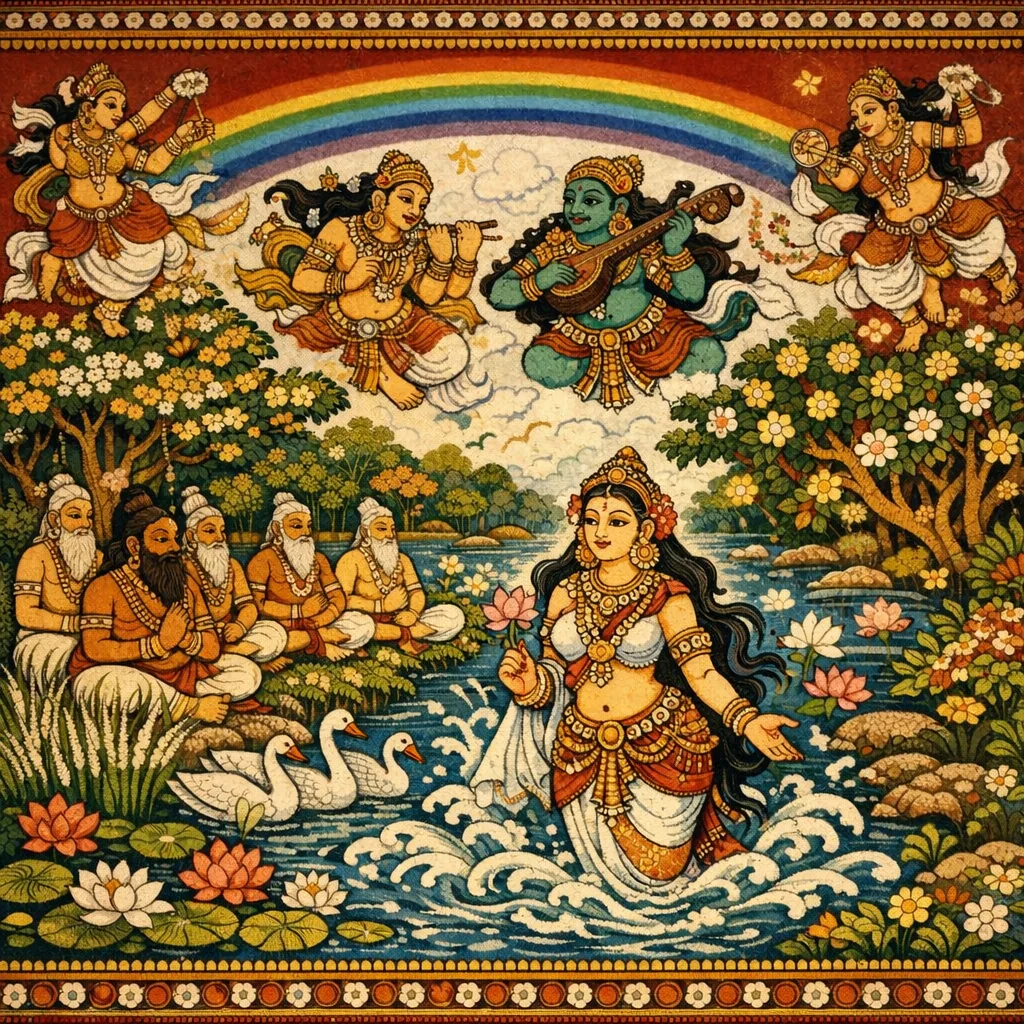
In Sūta’s narration, Purūravas reaches a sacred river-site in the Himalayas and beholds the divine stream. The water and its banks are ever-auspicious, radiant like a rainbow—Indra’s bow—cool and holy, filled with swans, cranes, lotuses, eddies, trees, and kāśa grass. Great brāhmaṇas, forest-sages, gods, Gandharvas, and midday-sporting Apsarases frequent the place; perfumes, saffron, sandalwood, and even the mythic image of Indra’s elephant’s rut-fluid heighten the sense of divine presence. The river is praised as nectar-sweet, undefiled, beneficial to society, and a “stairway to heaven” that swiftly destroys devotees’ sins and grants the virtuous their desired aims. Seeing this pure, sky-like water, the king advances toward it in delight.
Key Concepts
Shlokas in Adhyaya 116
Verse 1
*सूत उवाच स ददर्श नदीं पुण्यां दिव्यां हैमवतीं शुभाम् गन्धर्वैश्च समाकीर्णां नित्यं शक्रेण सेविताम् //
Sūta said: He beheld a holy river—divine, auspicious, and born of the Himālaya—thronged with Gandharvas and ever attended upon by Śakra (Indra).
Verse 2
सुरेभमदसंसिक्तां समन्तात्तु विराजिताम् मध्येन शक्रचापाभां तस्मिन्नहनि सर्वदा //
On that day, the place should ever appear resplendent on all sides, as though sprinkled with the intoxicating ichor of noble elephants; and in its midst it should shine with the appearance of Śakra’s bow (a rainbow).
Verse 3
तपस्विशरणोपेतां महाब्राह्मणसेविताम् ददर्श तपनीयाभां महाराजः पुरूरवाः //
King Purūravas beheld a golden-radiant place, attended by great Brahmins and furnished with a refuge for ascetics.
Verse 4
सितहंसावलिच्छन्नां काशचामरराजिताम् साभिषिक्तामिव सतां पश्यन्प्रीतिं परां ययौ //
Beholding it—covered with rows of white swans and resplendent with gleaming kāśa-grass flywhisks, as though ceremonially anointed for the virtuous—he was filled with supreme delight.
Verse 5
पुण्यां सुशीतलां हृद्यां मनसः प्रीतिवर्धिनीम् क्षयवृद्धियुतां रम्यां सोममूर्तिमिवापराम् //
Holy and exceedingly cool, delightful to the heart and increasing the mind’s joy—endowed with waning and waxing, charming, like a second embodied Moon.
Verse 6
सुशीतशीघ्रपानीयां द्विजसंघनिषेविताम् सुतां हिमवतः श्रेष्ठां चञ्चद्वीचिविराजिताम् //
Her waters are delightfully cool and swiftly flowing; she is frequented by assemblies of twice-born sages. She is the excellent daughter of Himavat, radiant with her restless, shimmering waves.
Verse 7
अमृतस्वादुसलिलां तापसैरुपशोभिताम् स्वर्गारोहणनिःश्रेणीं सर्वकल्मषनाशिनीम् //
Its waters are sweet like nectar; it is beautified by ascetics. It is a ladder for ascending to heaven, destroying every stain of sin.
Verse 8
अग्र्यां समुद्रमहिषीं महर्षिगणसेविताम् सर्वलोकस्य चौत्सुक्यकारिणीं सुमनोहराम् //
(She is) the foremost Queen of the Ocean, attended and revered by hosts of great sages; she stirs wonder and eager longing in all the worlds, exceedingly charming to behold.
Verse 9
हितां सर्वस्य लोकस्य नाकमार्गप्रदायिकाम् गोकुलाकुलतीरान्तां रम्यां शैवालवर्जिताम् //
A water-body should benefit all people, bestowing the path to heaven; its banks should be thronged with cowherds’ settlements, delightful to behold, and free from algae and slimy growth.
Verse 10
हंससारससंघुष्टां जलजैरुपशोभिताम् आवर्तनाभिगम्भीरां द्वीपोरुजघनस्थलीम् //
Resounding with the calls of swans and cranes, adorned with aquatic growths, and deep with swirling eddies, that island-land had broad, ample slopes and lowlands.
Verse 11
नीलनीरजनेत्राभाम् उत्फुल्लकमलाननाम् हिमाभफेनवसनां चक्रवाकाधरां शुभाम् बलाकापङ्क्तिदशनां चलन्मत्स्यावलिभ्रुवम् //
Auspicious and lovely—her eyes gleamed like blue lotuses; her face was like a fully blossomed lotus; her garments were white as frost and foam; her lips like the ruddy cakravāka-bird; her teeth like a row of white herons; and her eyebrows shaped like moving rows of fish.
Verse 12
स्वजलोद्भूतमातंगरम्यकुम्भपयोधराम् हंसनूपुरसंघुष्टां मृणालवलयावलीम् //
Her breasts were like the lovely globes of a rutting elephant, as though rising from their own natural fullness; her anklets chimed with the sound of swans, and her arms were adorned with rows of bracelets like lotus-stalks.
Verse 13
तस्यां रूपमदोन्मत्ता गन्धर्वानुगताः सदा मध्याह्नसमये राजन् क्रीडन्त्यप्सरसां गणाः //
O King, there bands of Apsarases—ever accompanied by Gandharvas and intoxicated by pride in their own beauty—sport and play at the time of midday.
Verse 14
ताम् अप्सरोविनिर्मुक्तं वहन्तीं कुङ्कुमं शुभम् स्वतीरद्रुमसम्भूतनानावर्णसुगन्धिनीम् //
That stream bore along auspicious kuṅkuma (saffron), released by the Apsarases, and was richly fragrant with many hues—its perfumes arising from the trees upon its own banks.
Verse 15
तरंगव्रातसंक्रान्तसूर्यमण्डलदुर्दृशम् सुरेभजनिताघातविकूलद्वयभूषिताम् //
The sun’s orb became hard to behold, obscured by masses of surging waves; and the waters were adorned with dreadful dual disturbances—turbulent impacts produced by the elephants of the gods.
Verse 16
शक्रेभगण्डसलिलैर् देवस्त्रीकुचचन्दनैः संयुतं सलिलं तस्याः षट्पदैर् उपसेव्यते //
Her waters—mingled with the rut-fluid of Indra’s elephant and with the sandal-paste from the breasts of celestial women—are attended and drunk by swarms of bees.
Verse 17
तस्यास्तीरभवा वृक्षाः सुगन्धकुसुमाञ्चिताः तथापकृष्टसंभ्रान्तभ्रमरस्तनिताकुलाः //
On its banks stood trees decked with fragrant blossoms, and the whole place was filled with the humming—like thunder—of bees swarming in delighted agitation.
Verse 18
यस्यास्तीरे रतिं यान्ति सदा कामवशा मृगाः तपोवनाश्च ऋषयस् तथा देवाः सहाप्सराः //
On her bank, deer—ever swayed by desire—continually go to amorous sport; and there too the sages of the forest-hermitages, as well as the gods together with the Apsarases, resort and revel.
Verse 19
लभन्ते यत्र पूताङ्गा देवेभ्यः प्रतिमानिताः स्त्रियश्च नाकबहुलाः पद्मेन्दुप्रतिमाननाः //
There, with their bodies purified, women attain honor even from the gods; and there are many celestial women, lotus-and-moon-like in face.
Verse 20
या बिभर्ति सदा तोयं देवसंघैरपीडितम् पुलिन्दैर्नृपसंघैश्च व्याघ्रवृन्दैरपीडितम् //
She ever bears her water—water not disturbed even by hosts of gods, nor troubled by Pulindas, by bands of kings, or by packs of tigers.
Verse 21
सतामरसपानीयां सतारगगनामलाम् स तां पश्यन्ययौ राजा सतामीप्सितकामदाम् //
That king, beholding that sacred water—lotus-sweet to the taste, pure as the star-strewn sky—went toward it, for it grants to the virtuous the fulfillment of their cherished desires.
Verse 22
यस्यास्तीररुहैः काशैः पूर्णैश्चन्द्रांशुसंनिभैः राजते विविधाकारै रम्यतीरं महाद्रुमैः या सदा विविधैर्विप्रैर् देवैश्चापि निषेव्यते //
Her lovely bank shines with reeds of kāśa grass along the shore, bright as the rays of the full moon, and with great trees of many forms. She is ever frequented and revered by many kinds of brāhmaṇas and even by the gods.
Verse 23
या च सदा सकलौघविनाशं भक्तजनस्य करोत्यचिरेण यानुगता सरितां हि कदम्बैर् यानुगता सततं हि मुनीन्द्रैः //
She who always and swiftly destroys the entire mass of sins of the devoted—she is the sacred river, accompanied by kadamba trees and continually attended by the foremost sages.
Verse 24
या हि सुतानिव पाति मनुष्यान् या च युता सततं हिमसंघैः या च युता सततं सुरवृन्दैर् या च जनैः स्वहिताय श्रिता वै //
She who protects human beings as though they were her own sons; she who is ever accompanied by the Himalayan masses of snow; she who is ever attended by hosts of gods; and she whom people resort to for their own welfare—that sacred one is praised here.
Verse 25
प्रयुक्ता च केसरिगणैः करिवृन्दजुष्टा संतानयुक्तसलिलापि सुवर्णयुक्ता सूर्यांशुतापपरिवृद्धिविवृद्धशीता शीतांशुतुल्ययशसा ददृशे नृपेण //
It was furnished with troops of lions and frequented by herds of elephants; its waters were rich with lotuses and it was adorned with gold. Though the sun’s rays grew fierce, its coolness only increased—thus it was seen by the king, whose fame was like the moon.
Frequently Asked Questions
The chapter teaches the Purāṇic theology of sacred waters: a Himalayan-born holy river, attended by gods and sages, is portrayed as a purifier that destroys sin, supports human welfare, and functions as a ‘ladder to heaven’ for the virtuous. The instruction is devotional and ethical—approach and honor such tīrthas, maintain purity, and recognize divine presence in sanctified landscapes.
This adhyāya is primarily narrative and tīrtha-oriented: it belongs to an Itihāsa-style episode involving King Purūravas (genealogical/legendary cycle) and reads like a tirtha-mahātmya (praise of holy river and its banks). It does not give Vāstu measurements or explicit Rājadharma policy; instead it emphasizes purity, merit, and the sacred geography inhabited by sages, gods, Gandharvas, and Apsarases.